

oSIST prEN 18339:2026
(Main)Accessibility of non-digital information related to products and services
General Information
- Abstract
This document specifies user requirements for the accessibility of non-digital information related to
products and services.
This document describes test procedures and evaluation methodologies for non-digital information
technical solutions.
This document is applicable to the presentation of visual, tactile and auditory based non-digital
information and instructions, including:
- displayed on a product
- displayed on the packaging or in the packaging of products
- about the use of a product
- about installation and maintenance, storage and disposal of products
- about products used in the provision of services and about the functioning of the service
- about air, bus, rail and waterborne passenger transport services
- about consumer banking services.
This document is intended for use by organisations that produce products and or provide services.
This document does not apply to the presentation of information by ICT products and services, for
instance displayed on a screen.
- Status
- Not Published
- Public Enquiry End Date
- 30-Jun-2026
- Technical Committee
- I11 - Imaginarni 11
- Current Stage
- 4020 - Public enquire (PE) (Adopted Project)
- Start Date
- 15-Apr-2026
- Due Date
- 02-Sep-2026
- Completion Date
- 08-Jul-2026

Overview
oSIST prEN 18339:2026: Accessibility of Non-Digital Information Related to Products and Services is a European draft standard developed by CEN. Its goal is to specify user requirements and testing methodologies to ensure that non-digital information associated with products and services is accessible to all, including persons with disabilities. This standard addresses the accessible presentation of visual, tactile, and auditory information not delivered via digital means, such as on-product labels, packaging, printed instructions, spoken announcements, and tactile markings.
oSIST prEN 18339:2026 is particularly important for organizations that produce products or provide services that rely on non-digital means to convey key usage, safety, or service information. The standard aligns with the European Accessibility Act (Directive (EU) 2019/882), underscoring the EU’s commitment to removing barriers in accessing information for consumers.
Key Topics
- Scopes of Application: Covers accessibility requirements for information presented visually (e.g., printed labels, signage), aurally (e.g., public announcements, acoustic signals), and tactilely (e.g., Braille, raised symbols) related to products and services.
- User-Centered Requirements: Focuses on making non-digital information perceivable and understandable for a wide diversity of users, including those with disabilities.
- Test Procedures and Evaluation: Outlines methodologies for testing information accessibility through checklists, physical measurements, and user assessments to ensure compliance.
- Sensory Channels: Promotes information delivery via multiple sensory channels-sight, hearing, and touch-to maximize usability for everyone.
- Types of Information: Includes:
- On-product information (labels, controls)
- Packaging details
- Printed manuals, installation, and maintenance guides
- Service instructions (transport, banking, e-commerce)
- Announcements for public spaces
- Exclusions: Does not apply to digital information (e.g., displayed on screens); this is covered by EN 301549.
Applications
oSIST prEN 18339:2026 has a wide range of practical applications across sectors that use or require non-digital information to communicate with users:
- Manufacturing and Product Packaging: Ensures product labels, usage instructions, safety warnings, and disposal guidelines on products or their packaging are accessible to all users.
- Transport Services: Guides how information on tickets, printed timetables, signage, and in-station announcements should be made accessible for air, rail, bus, and waterborne passengers.
- Consumer Banking Services: Addresses requirements for printed materials, statements, and non-digital notifications.
- Retail and E-commerce: Helps retailers and self-service terminals (like ATMs or kiosks) ensure that instructions and warnings in physical formats meet accessibility standards.
- Service Providers: Useful for any organization providing key service information offline, such as in printed brochures, leaflets, or point-of-service posters.
- Tactile and Auditory Solutions: Encourages the use of Braille, raised lettering, easy-to-understand language, and clear acoustic signals.
By ensuring information is accessible in multiple ways, organizations can better serve all customers, meet regulatory obligations under the European Accessibility Act, and demonstrate social responsibility.
Related Standards
For a comprehensive approach to accessibility, oSIST prEN 18339:2026 is best used alongside these key related European standards:
- EN 17161: Design for All - accessibility management for products and services
- EN 17210: Accessibility of the built environment
- EN 301549: Accessibility requirements for ICT products and services (digital accessibility)
- EN 18340: Accessibility of support services for products and services
- prEN 18156: Tactile lettering, requirements for Braille and raised characters
- ETSI TS 103 919: Accessibility and interoperability of emergency communications
oSIST prEN 18339:2026 enhances consistency in accessibility practices and supports organizations in meeting both user needs and legal requirements across the EU.
SEO Keywords: non-digital information accessibility, visual accessibility, tactile information standard, auditory information accessibility, accessible labels, accessible packaging, CEN standards, European Accessibility Act compliance, accessible product information, non-digital service instructions.
Get Certified
Connect with accredited certification bodies for this standard

CIS Institut d.o.o.
Personal Protective Equipment (PPE) certification body. Notified Body NB-2890 for EU Regulation 2016/425 PPE.
Great Wall Tianjin Quality Assurance Center
Established 1993, first batch to receive national accreditation with IAF recognition.
Hong Kong Quality Assurance Agency (HKQAA)
Hong Kong's leading certification body.
Sponsored listings
Frequently Asked Questions
oSIST prEN 18339:2026 is a draft published by the Slovenian Institute for Standardization (SIST). Its full title is "Accessibility of non-digital information related to products and services". This standard covers: This document specifies user requirements for the accessibility of non-digital information related to products and services. This document describes test procedures and evaluation methodologies for non-digital information technical solutions. This document is applicable to the presentation of visual, tactile and auditory based non-digital information and instructions, including: - displayed on a product - displayed on the packaging or in the packaging of products - about the use of a product - about installation and maintenance, storage and disposal of products - about products used in the provision of services and about the functioning of the service - about air, bus, rail and waterborne passenger transport services - about consumer banking services. This document is intended for use by organisations that produce products and or provide services. This document does not apply to the presentation of information by ICT products and services, for instance displayed on a screen.
This document specifies user requirements for the accessibility of non-digital information related to products and services. This document describes test procedures and evaluation methodologies for non-digital information technical solutions. This document is applicable to the presentation of visual, tactile and auditory based non-digital information and instructions, including: - displayed on a product - displayed on the packaging or in the packaging of products - about the use of a product - about installation and maintenance, storage and disposal of products - about products used in the provision of services and about the functioning of the service - about air, bus, rail and waterborne passenger transport services - about consumer banking services. This document is intended for use by organisations that produce products and or provide services. This document does not apply to the presentation of information by ICT products and services, for instance displayed on a screen.
oSIST prEN 18339:2026 is classified under the following ICS (International Classification for Standards) categories: 03.080.01 - Services in general; 13.180 - Ergonomics. The ICS classification helps identify the subject area and facilitates finding related standards.
oSIST prEN 18339:2026 is associated with the following European legislation: EU Directives/Regulations: 2019/882; Standardization Mandates: M/587. When a standard is cited in the Official Journal of the European Union, products manufactured in conformity with it benefit from a presumption of conformity with the essential requirements of the corresponding EU directive or regulation.
oSIST prEN 18339:2026 is available in PDF format for immediate download after purchase. The document can be added to your cart and obtained through the secure checkout process. Digital delivery ensures instant access to the complete standard document.
Standards Content (Sample)
SLOVENSKI STANDARD
01-junij-2026
Dostopnost nedigitalnih informacij, povezanih z izdelki in storitvami
Accessibility of non-digital information related to products and services
Barrierefreiheit von nicht-digitalen Informationen über Produkte und Dienstleistungen
Accessibilité des informations non numériques relatives aux produits et services
Ta slovenski standard je istoveten z: prEN 18339
ICS:
03.080.01 Storitve na splošno Services in general
2003-01.Slovenski inštitut za standardizacijo. Razmnoževanje celote ali delov tega standarda ni dovoljeno.
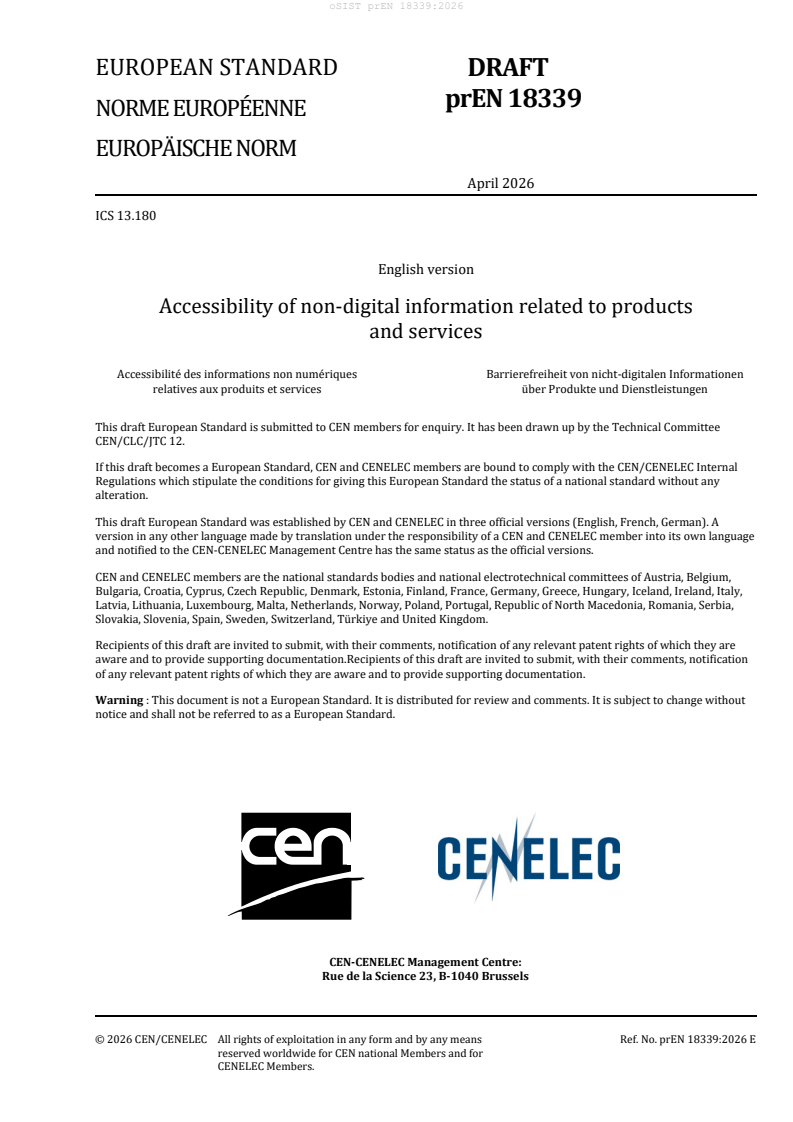
EUROPEAN STANDARD DRAFT
NORME EUROPÉENNE
EUROPÄISCHE NORM
April 2026
ICS 13.180
English version
Accessibility of non-digital information related to products
and services
Accessibilité des informations non numériques Barrierefreiheit von nicht-digitalen Informationen
relatives aux produits et services über Produkte und Dienstleistungen
This draft European Standard is submitted to CEN members for enquiry. It has been drawn up by the Technical Committee
CEN/CLC/JTC 12.
If this draft becomes a European Standard, CEN and CENELEC members are bound to comply with the CEN/CENELEC Internal
Regulations which stipulate the conditions for giving this European Standard the status of a national standard without any
alteration.
This draft European Standard was established by CEN and CENELEC in three official versions (English, French, German). A
version in any other language made by translation under the responsibility of a CEN and CENELEC member into its own language
and notified to the CEN-CENELEC Management Centre has the same status as the official versions.
CEN and CENELEC members are the national standards bodies and national electrotechnical committees of Austria, Belgium,
Bulgaria, Croatia, Cyprus, Czech Republic, Denmark, Estonia, Finland, France, Germany, Greece, Hungary, Iceland, Ireland, Italy,
Latvia, Lithuania, Luxembourg, Malta, Netherlands, Norway, Poland, Portugal, Republic of North Macedonia, Romania, Serbia,
Slovakia, Slovenia, Spain, Sweden, Switzerland, Türkiye and United Kingdom.
Recipients of this draft are invited to submit, with their comments, notification of any relevant patent rights of which they are
aware and to provide supporting documentation.Recipients of this draft are invited to submit, with their comments, notification
of any relevant patent rights of which they are aware and to provide supporting documentation.
Warning : This document is not a European Standard. It is distributed for review and comments. It is subject to change without
notice and shall not be referred to as a European Standard.
CEN-CENELEC Management Centre:
Rue de la Science 23, B-1040 Brussels
© 2026 CEN/CENELEC All rights of exploitation in any form and by any means
Ref. No. prEN 18339:2026 E
reserved worldwide for CEN national Members and for
CENELEC Members.
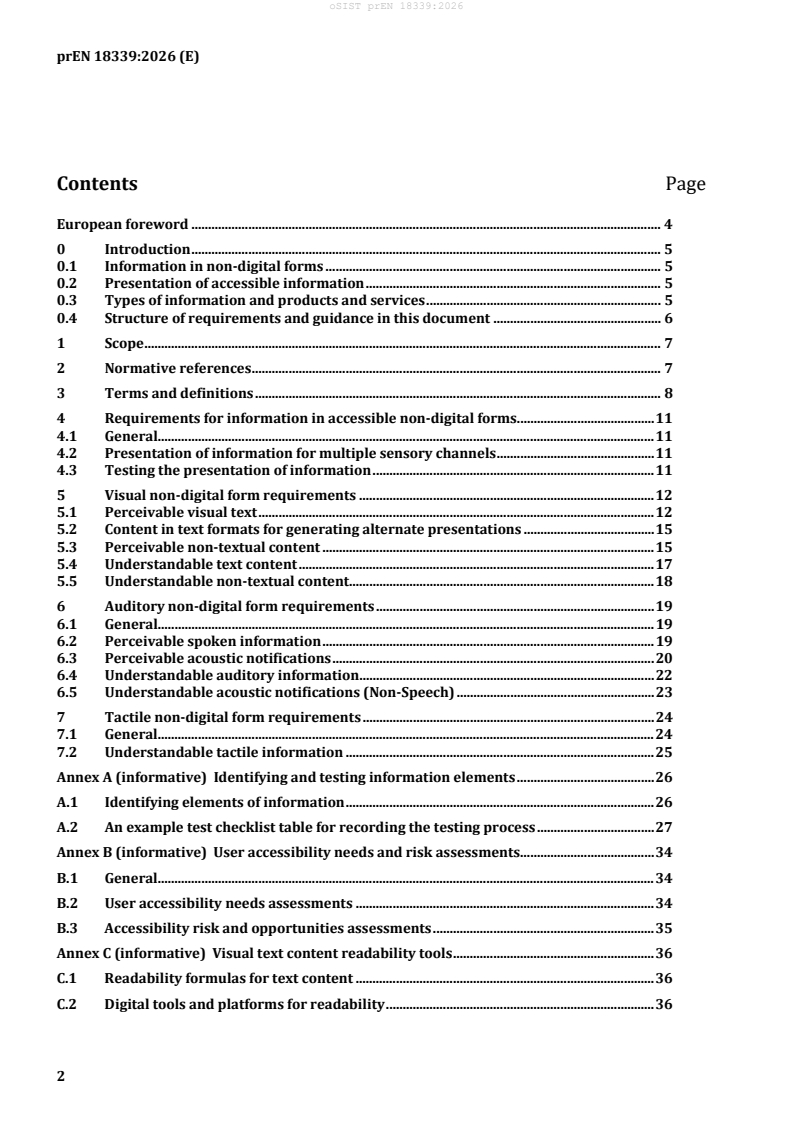
Contents Page
European foreword . 4
0 Introduction . 5
0.1 Information in non-digital forms . 5
0.2 Presentation of accessible information . 5
0.3 Types of information and products and services . 5
0.4 Structure of requirements and guidance in this document . 6
1 Scope . 7
2 Normative references . 7
3 Terms and definitions . 8
4 Requirements for information in accessible non-digital forms . 11
4.1 General. 11
4.2 Presentation of information for multiple sensory channels . 11
4.3 Testing the presentation of information . 11
5 Visual non-digital form requirements . 12
5.1 Perceivable visual text . 12
5.2 Content in text formats for generating alternate presentations . 15
5.3 Perceivable non-textual content . 15
5.4 Understandable text content . 17
5.5 Understandable non-textual content. 18
6 Auditory non-digital form requirements . 19
6.1 General. 19
6.2 Perceivable spoken information . 19
6.3 Perceivable acoustic notifications . 20
6.4 Understandable auditory information . 22
6.5 Understandable acoustic notifications (Non-Speech) . 23
7 Tactile non-digital form requirements . 24
7.1 General. 24
7.2 Understandable tactile information . 25
Annex A (informative) Identifying and testing information elements . 26
A.1 Identifying elements of information . 26
A.2 An example test checklist table for recording the testing process . 27
Annex B (informative) User accessibility needs and risk assessments . 34
B.1 General. 34
B.2 User accessibility needs assessments . 34
B.3 Accessibility risk and opportunities assessments . 35
Annex C (informative) Visual text content readability tools . 36
C.1 Readability formulas for text content . 36
C.2 Digital tools and platforms for readability . 36
Annex D (informative) Acoustic notifications and Speech transmission index (STI) . 38
D.1 Acoustic notifications . 38
D.2 Speech Transmission Index Guidance . 45
D.3 Speech Interference Level (SIL) Guidance . 45
Annex E (informative) Tactile dimensions and design guidance . 47
E.1 Dimensions of tactile markings . 47
E.2 Tactile content design considerations . 47
Annex F (informative) Information in non-digital and digital forms . 49
F.1 Non-digital forms descriptions . 49
F.2 Visual forms . 49
F.3 Auditory forms . 49
F.4 Tactile forms. 49
F.5 Combined non-digital tactile and visual for a digital auditory form . 50
Annex G (informative) Increasing accessibility with font size . 51
Annex H (Informative) Font and text layout descriptions . 52
H.1 Introduction . 52
H.2 Examples of different font styles . 53
Annex I (informative) Font size evaluator tool . 54
I.1 Introduction . 54
I.2 Steps to print and use the table tool in I.1 . 55
Annex J (informative) Measuring Light Reflectance Values (LRV) . 56
J.1 Measuring light reflectance . 56
J.2 Recommended steps for use . 56
Annex K (informative) Line spacing and Paragraph spacing for text at reading distance
(40cm) . 57
K.1 General . 57
K.2 Printing the measurement tool . 58
K.3 Using the tool. 58
Annex L (informative) Sizes and line spacing for other fonts . 59
Annex M (informative) Size, Line & Paragraph Values at Different Distances . 61
M.1 Minimum allowable size (if space is necessarily constrained) . 61
M.2 Required size . 61
Annex ZA (informative) Relationship between this European Standard and the requirements
of Directive (EU) 2019/882 of the European Parliament and of the Council of 17 April
2019 on the accessibility requirements for products and services aimed to be covered
................................................................................................................................................................... 63
Bibliography . 66
European foreword
This document (prEN 18339:2026) has been prepared by Technical Committee CEN/CLC JTC 12 “Design
for ALL”, the secretariat of which is held by SIS.
This document is currently submitted to the CEN Enquiry.
This document has been prepared under a standardization request addressed to CEN by the European
Commission. The Standing Committee of the EFTA States subsequently approves these requests for its
Member States.
For the relationship with EU Legislation, see informative Annex ZA, which is an integral part of this
standard.
The European Accessibility Act (EAA), Directive (EU) 2019/882 continues the EU’s and the member
states’ commitment to accessibility. Six harmonized standards have been requested from the European
standardization organisations, CEN, CENELEC and ETSI. Together these standards cover the accessibility
requirements of the EAA, in different aspects. The documents are interrelated and interdependent.
This document provides requirements for the accessibility of information presented in non-digital forms
on and about the products and services defined in the EAA.
The five other standards are:
— Design for All approach Managing accessibility of products and services, EN 17161.
— Accessibility of the built environment, EN 17210.
— Accessibility requirements for ICT products and services, EN 301549.
— Accessibility of support services for products and services, EN 18340
— Accessibility and interoperability of emergency communications and (for) the answering of
emergency communications by the public safety answering points (PSAPs) (including to the single
European Emergency number 112). ETSI TS 103 919
0 Introduction
0.1 Information in non-digital forms
This document provides requirements, recommendations and guidance for how information on and
about products and services is to be presented in accessible visual, auditory and tactile non-digital forms.
Information presented in non-digital forms is information communicated in one direction, and which
cannot be changed or adapted by the user.
Examples of information presented in non-digital forms includes but is not limited to; visual labels, signs,
posters and documents; auditory speech and acoustic signals, and tactile lettering, symbols and shapes.
NOTE 1 In this document the section related to spoken information presented in one direction, is for live speech,
recorded speech, and speech transmitted as public announcements. Requirements for two-way voice
communication for conversations can be found in EN 18340, “Accessibility of support services for products and
services”.
NOTE 2 Information presented in non-digital forms is the result of a process that, in many cases, involves digital
means, such as editing and printing an instruction manual or creating a synthesized spoken message for an
announcement.
0.2 Presentation of accessible information
Information presented for use by more than one sensory channel is usable by a wider range of users.
Presenting information in visual, auditory and tactile forms can allow users to engage with it through the
human sensory channels of seeing, hearing, and touch.
Information can be presented or made available in non-digital or digital forms.
Information presented in non-digital forms can indicate the availability of information provided in a
digital form.
EXAMPLE A set of instructions can include a QR code that links the user to a website that hosts a digital copy
of the same instructions.
Combinations of non-digital and digital forms can be used to present information for more than one
sensory channel.
0.3 Types of information and products and services
The requirements and recommendations in this document are applicable to the presentation of the types
of information listed in Clause 1, Scope.
This document could be used by organisations for a wide variety of purposes, including the presentation
of information and other products and services.
This document focuses on information presented in non-digital forms on and about products and
packaging related to:
a) consumer general purpose computer hardware systems;
b) self-service terminals (e.g. ticketing, banking machines, etc); and,
c) consumer terminal equipment (e.g. TVs, radios, hearing aids, etc).
This document focuses on information presented in non-digital forms related to:
d) electronic communications services;
e) providing access to audiovisual media services;
f) E-commerce services;
g) air, bus, rail and waterborne transport services; and,
h) consumer banking services.
0.4 Structure of requirements and guidance in this document
Table 1 below shows the high-level structure of the document and how requirements are grouped for
presentation of information in visual, auditory and tactile forms. The forms for presentation are further
grouped for perceivable and understandable and also for text and non-text content.
Table 1 — The structure of the normative requirements and informative guidance in this
document.
Multiple Sensory Channels in Clause 4.2 and Annex B
Testing the presentation of information in Clause 4.3 and Annex A
Examples of information in non-digital and digital forms in Annex F
Visual Auditory Tactile
Clause 5 Clause 6 Clause 7
Perceivable text 5.1 Perceivable Spoken 6.2 Perceivable text 7.1.1
Perceivable non-text 5.3 Perceivable Signals 6.3 Perceivable non-text 7.1.2
Understandable text 5.4 Understandable Spoken 6.4 Understandable text 7.2.1
Understandable non-text 5.5 Understandable Signals 6.5 Understandable non-text
7.2.1
Annexes C and G - M Annex D Annex E
Annex ZA Relationship of this document to requirements of the EAA
1 Scope
This document provides requirements for the presentation of information on and about products and
services in visual, auditory and tactile non-digital forms for the sensory channels of seeing, hearing and
touch.
The requirements in this document are applicable to:
• Information about the functioning of a service.
• Information about the accessibility of the products used in the provision of the service.
• Information on a product’s functioning.
• Information on a product’s accessibility features, elements, functions, and characteristics.
• Information on the use of the product (on the product itself).
• Instructions for use of a product (not on the product but provided through other means).
• Instructions of products (such as for installation, maintenance, storage and disposal of a product).
• Information provided on a package of a product.
• Information provided in a package of a product.
• Information about some types of transport services.
• Information about consumer banking services.
This document is intended for use by organisations that produce products and or provide services.
NOTE 1 This document can be used by organisations for a wide variety of purposes for the presentation of
information.
This document does not apply to information permanently installed in and for the use of the built
environment (for instance, signage, alarms and controls), which is covered by EN 17210.
NOTE 2 Where this document is referring to information on and about products and services used in the built
environment, it pertains to those that can occur in it but are not a part of it.
This document does not apply to the presentation of information through a digital means by ICT products
and services, (for instance displayed on a screen), which is covered by EN 301549.
NOTE 3 Where this document is referring to understandable content presented in non-digital forms, some of the
associated requirements can be applicable to content presented in a digital form.
2 Normative references
The following documents are referred to in the text in such a way that some or all of their content
constitutes requirements of this document. For dated references, only the edition cited applies. For
undated references, the latest edition of the referenced document (including any amendments) applies.
EN IEC 60268-16:2020, Sound system equipment - Part 16: Objective rating of speech intelligibility by
speech transmission index
prEN 18156:2025, Tactile lettering - Requirements on the presentation and application of Braille and raised
characters
3 Terms and definitions
For the purposes of this document, the following terms and definitions apply.
ISO and IEC maintain terminology databases for use in standardization at the following addresses:
— ISO Online browsing platform: available at https://www.iso.org/obp/
— IEC Electropedia: available at https://www.electropedia.org/
3.1
accessibility
extent to which products, systems, services, environments and facilities can be used by people from a
population with the widest range of user needs, characteristics and capabilities to achieve identified goals
in identified contexts of use
Note 1 to entry: Context of use includes direct use or use supported by assistive technologies.
[SOURCE: EN ISO 9241-112:2025, 3.11]
3.2
information
data that are processed, organized and correlated to produce meaning
[SOURCE: ISO 22320:2011, 3.9]
3.3
non-digital form
visual, auditory or tactile information communicated in one direction, which cannot be changed or
adapted by the user
Note 1 to entry: Users as receivers of information presented in non-digital forms perceive the information by
seeing, hearing or touching the content but are not able to adjust or make any changes to the presentation.
EXAMPLE Information in non-digital forms can include but are not limited to; visual labels, signs, posters and
documents; auditory speech and acoustic signals, and tactile lettering, symbols and shapes.
3.4
perceive
recognise the existence of something
[SOURCE: ISO/IEC 29138-1:2018, 3.15]
3.5
acoustic notification
discrete, non-speech sound used to convey information or to cue subsequent speech announcements,
produced or reproduced by a product or system and presented to the user as an audible signal
Note 1 to entry: It applies to notifications signals communicated in one direction, which cannot be changed or
adapted by the user.
3.6
easy-to-understand language
any language variety which enhances comprehensibility
Note 1 to entry: Easy-to-understand language includes plain language, easy language and any intermediate variety.
These varieties share many recommendations, but the extent of comprehensibility is different as they address
different user needs.
[SOURCE: ISO/IEC 23859:2023, 3.1.1]
3.7
user
person who interacts with a system, product or service
Note 1 to entry: The person who uses a service provided by a system, such as a customer in a shop or passenger on
a train, can be considered a user.
[SOURCE: ISO 27500:2016, 2.12]
3.8
context of use
combination of users, goals and tasks, resources, and environment.
Note 1 to entry: The “environment" in a context of use includes the technical, physical, social, cultural and
organizational environments.
Note 2 to entry: context of use can also be known as conditions of use.
[SOURCE: ISO 9241-11:2018, 3.5, modified, Note 2 to entry added]
3.9
visual contrast
visual difference between one surface or component and a background or adjoining surface
Note 1 to entry: Visual contrast can be obtained by a combination of luminance contrast and colour contrast. Many
people with impaired vision can rely only on luminance contrast, in this document accessibility is evaluated in terms
of luminance contrast.
[SOURCE: ISO 21542:2021, 3.37 modified, “perception” changed to “difference”, and “two adjacent
elements of a building” changed to “one surface or component and a background or adjoining surface”
and in Note 1 to entry, changed “since” to “many”]
3.10
light reflectance value
LRV
proportion of visible light reflected by a surface at all wavelengths and directions when illuminated by a
light source
Note 1 to entry: LRV is also known as the luminance reflectance factor.
Note 2 to entry: LRV is expressed on a scale of 0 to 100, with a value of 0 points for pure black and a value of
100 points for pure white.
[SOURCE: EN ISO 23599:2019, 3.14]
3.11
tactile lettering
information provided both in Braille or raised characters
[SOURCE: prEN 18156:2025, 3.7]
3.12
frequency partials
individual frequency components within a sound, comprising the fundamental frequency and any
additional harmonic or inharmonic components that contribute to the sound’s timbre
Note 1 to entry: Frequency determines the perceived pitch of a sound. Lower frequencies (e.g., 150 – 300 Hz) are
perceived as lower-pitched sounds, while higher frequencies (e.g., 1 000 – 4 000 Hz) are perceived as higher-pitched
sounds. Frequency also influences other perceptual attributes such as localisation and masking resistance.
Note 2 to entry: Harmonic and inharmonic partials together shape the timbre or texture of an acoustic notification
and influence recognisability, distinctiveness, and perceptual clarity.
3.13
fundamental frequency
lowest frequency component of a sound and the primary determinant of its perceived pitch
Note to entry: The fundamental frequency forms the reference point for harmonic partials and may not always be
the strongest (highest-energy) component in the spectrum, especially in complex or inharmonic signals.
3.14
overtones
frequency partials above the fundamental frequency, including both harmonic and inharmonic
components
Note 1 to entry: Overtones may be integer multiples of the fundamental frequency. For example, for a fundamental
frequency of 150 Hz, harmonic overtones may occur at 300 Hz, 450 Hz, 600 Hz, etc. Harmonic overtones are typically
perceived as smooth or musically consonant, contributing to a stable and ‘pleasant’ timbre.
Note 2 to entry: Overtones may be non-integer multiples of the fundamental frequency (inharmonic overtones). For
a 150 Hz fundamental, inharmonic partials may occur at frequencies such as 235 Hz or 512 Hz. Inharmonic
overtones produce a rougher or more attention-grabbing timbre, which may be desirable for increasing
noticeability in certain acoustic notifications.
3.15
x-height
height of lowercase letters, ignoring ascenders or descenders, such as x or z
[SOURCE: ISO Guide 41:2018, 3.22, modified, such as x or Z added, note to entry removed]
3.16
point
pt
smallest unit in typography and printing, used to measure font size, line thickness, and other layout
dimensions
4 Requirements for information in accessible non-digital forms
4.1 General
Accessible information on and about products and services and their accessibility features can help to
maximise their foreseeable use by the widest range of users including persons with disabilities.
The requirements for the presentation of information in non-digital forms may be relevant depending on
the type of information, its content and context in which it is used.
EXAMPLE Some requirements applicable for the presentation of written instructions on how to use a product
may also be applicable or relevant for the presentation of written instructions on how to open the package in which
the product is contained.
4.2 Presentation of information for multiple sensory channels
4.2.1 Combinations of non-digital forms
Information made exclusively available in non-digital forms shall be made available for more than one
sensory channel by:
a) Making non-digital visual information available in an auditory or tactile non-digital form.
b) Making non-digital auditory information available in a visual or tactile non-digital form.
c) Making non-digital tactile information available in a visual or auditory non-digital form.
4.2.2 Combinations of non-digital and digital
Information presented in a non-digital form can be made available via more than one sensory channel by
also presenting the information in a digital form.
In such cases, the access to the accessible digital form shall be indicated by information available for more
than one sensory channel.
EXAMPLE The use of an accessible QR codes can provide a link to information in accessible digital formats.
For examples of information presented in non-digital forms and information presented in digital form,
see Annex F.
4.3 Testing the presentation of information
4.3.1 Testing the accessibility of information
Information presented in non-digital forms shall be evaluated in accordance with the requirements in
this document.
4.3.2 Testing information accessibility
Key activities for testing information in non-digital forms:
— determine who are the intended users of the information;
— determine what information needs to be perceived;
— determine how the information needs to be understood, e.g. what the user needs to do or not do;
— determine which non-digital forms to present;
— confirm that the information is available for more than one sensory channel;
— identify the different elements in the information, such as. headings, instructions, signals;
— create a testing checklist comprising of each identified element and the applicable requirements from
clauses 5 to 7;
— based on the checklist test each element against the applicable requirements;
— document if and how the information complies with the requirements; and,
— confirm that all the necessary information is presented in each of the forms.
For guidance on creating a testing checklist, see Annex A.
5 Visual non-digital form requirements
5.1 Perceivable visual text
5.1.1 General
The requirements for presenting visual written text content shall be taken into account together, where
feasible, for maximising the foreseeable perception of the information within the available visual space.
For guidance on the application of visual text requirements in clause 5, see Annexes G to M.
For requirements regarding text placed on images see 5.3.1.
5.1.2 Font size
5.1.2.1 General
Font sizes are determined differently between hand-held viewing distances (40 cm) and where
information needs to be perceivable at greater distances. The two methods are based on the requirements
described in the following sections.
NOTE Increasing font size reduces the available space for line spacing and paragraph spacing.
For guidance about the impact of font size on information content accessibility, see Annex G.
For guidance about size measurements for font and text layout, see Annex H.
For guidance on testing font size, see Annex I.
5.1.2.2 Hand-held viewing distance font size
For hand-held viewing distances (40 cm), the text shall have:
a) An x-height of 2,6 mm or greater (equivalent to Arial 14 pt font of normal weight);
Where this cannot be achieved due to the available space, the x-height in millimetres should be reduced
in proportion to the available space until the minimum is reached according to the following formula:
b) Minimum x-height of 1,3 mm (equivalent to Arial 7 pt font of normal weight).
Larger font sizes can be used to provide emphasis for example with headings or warnings. However, this
should be used sparingly to make the best use of the available visual space.
For guidance about the impact of font size on information content accessibility, see Annex G.
For guidance about size measurements for font and text layout, see Annex H.
NOTE A font point size is not an absolute measure. For example, 14 pt Arial has a different x-height to 14 pt
Times New Roman. See Annex L for how different fonts vary on point size to achieve the same x-height.
For guidance on application of requirements for font size, see Annex I.
5.1.2.3 Font sizes for viewing distances greater than the hand-held distance
For distances greater than the hand-held viewing distance (40 cm) the x-height shall be increased
according to the following formula:
a) x-height in mm = viewing distance in metres multiplied by 6,5;
Alternatively, to calculate the equivalent size as the point size of an Arial font of normal weight, this can
be calculated as follows:
b) Arial font size (in pt) = viewing distance in metres multiplied by 35;
Where this cannot be achieved due to the available space, the x-height in millimetres should be reduced
in proportion to the available space until the minimum is reached according to the following formula:
c) The minimum x-height in mm = viewing distance in metres multiplied by 3,25; and,
Alternatively, to calculate the equivalent size as the point size of an Arial font of normal weight, this can
be calculated as follows:
d) Arial font size (in pt) = viewing distance in metres multiplied by 17,5.
Larger font sizes can be used to provide emphasis for example with headings or warnings. However, this
should be used sparingly to make the best use of the available visual space.
For guidance about size measurements for font and text layout, see Annex M.
NOTE A font point size is not an absolute measure. For example, 14 pt Arial has a different x-height to 14 pt
Times New Roman. See Annex L for how different fonts vary with point size to achieve the same x-height.
5.1.3 Visual contrast
The absolute difference in light reflectance values (LRV) between foreground and background shall be at
least 70 points, according to the formula:
Absolute difference in LRV = absolute (LRV foreground – LRV background).
For handheld distances, for text sizes greater than or equal to an x-height of 2,6 mm (equivalent to
14 point Arial), the absolute difference in LRV may be reduced, down to 60 points.
For text intended to be viewed at greater distances, the absolute difference in LRV may be reduced to 60
points when the ‘x-height in mm’ is greater than or equal to the value calculated according to the formula
in 5.1.1.2 a.
For guidance on application of requirements for visual contrast, see Annex J.
5.1.4 Text placed on other content
5.1.4.1 Text shall not be set on top of images, other non-textual information or text, in a manner that
reduces the perceptibility of the information or reduces visual contrast. or creates visual clutter that
makes the content hard to find or understand in accordance with the relevant clauses in 5.4.2.10 and
5.5.1.
5.1.5.2 The background behind and around the content shall be of a uniform colour and visual
contrast and have a border of a minimum of 10mm.
Where content on an image is purely for decorative purposes, such as branding, it may be placed on a
non-uniform background.
Where content on image is required for essential, functional reasons, and there is no feasible alternative,
such as security verification checks, then it may be placed on a non-uniform background
5.1.5 Line spacing
5.1.5.1 Baseline-to-baseline spacing shall be at least 2,5 times the x-height.
For guidance about size measurements for font and text layout, see Annex H.
For guidance on the application of line spacing requirements for hand-held distance (40cm), see Annex
K.
For guidance on the application of line spacing requirements for different font sizes, see Annex L.
5.1.5.2 Baseline-to-baseline spacing between paragraphs shall be at least 3,75 times the x-height.
For guidance on application of paragraph spacing requirements for hand-held distance (40cm), see
Annex K.
For guidance on application of paragraph spacing requirements for different viewing distances, see
Annex M
5.1.6 Font style
The use of stylised fonts shall not reduce legibility.
Normal weight Arial text should be used as a reference font for determining legibility, according to 5.1.1.
NOTE Fonts with letter strokes that are regularly spaced such as Times are harder to read than those that are less
regular such as Open Sans. This can be seen by comparing the word ‘minimum’ in each font. See Figure 1, Examples
of different fonts.
minimum (Times New Roman)
minimum (Open Sans)
Underlined text and italics shall not be used.
NOTE People recognise the shape of familiar words, rather than reading each individual letter. Setting a word
in CAPITAL LETTERS, italics or underlining distorts the shape of the word, which makes it more difficult to read.
5.1.7 Font weight
For paragraphs of text (body text), the font weight shall be between regular-weight Open Sans and semi-
bold Open Sans.
The font weight should be neither too thin (e.g. ultra-light fonts, where the strokes are thinner than
regular -weight Open Sans) nor too heavy (e.g. extra bold or heavy fonts, where the strokes are wider
than extra-bold Open Sans).
5.1.8 Colour
5.1.8.1 Colour shall not be used as the only visual means of conveying information.
5.1.8.2 Colour used to convey information shall not reduce visual contrast in accordance with 5.1.2.
5.1.8.3 Colours used to convey information shall be distinguishable by users with different types of
colour blindness, such as protanomaly, deuteranomaly and tritanomaly.
NOTE For guidance on selecting colours that are perceivable by users with colour blindness, see Color
Universal Design at https://jfly.uni-koeln.de/color/ and the section entitled: ‘Set of colors that is unambiguous both
to colorblinds and non-colorblinds’.
It is also possible in some graphic design software to simulate different types of colour-blindness.
The requirements in 5.1.8.1 to 5.1.8.3 do not apply to colour used solely for decorative purposes.
5.1.9 Glare and opacity
5.1.9.1 The content shall be made available on a medium (such as paper, cardboard or plastic) where
its glossiness does not produce glare that affects legibility.
Areas that do not have content, may have surfaces with a higher level of gloss provided they do not
interfere with adjacent information.
5.1.9.2 Where content is adjacent to higher gloss areas, there shall be a border or space of at least 1
cm between the content and non-content areas that ensures the higher glare area does not interfere with
the content area.
5.1.9.3 The content shall be presented on a medium with an opacity equivalent 100 GSM paper for
double side printed content, and 80 GSM for single side printed content.
NOTE Paper that is matt (i.e. not glossy) and/or does not have optical brightening agents will reduce the level
of glare. This aids perception and helps readers who are photosensitive and who are susceptible to visual stress.
5.2 Content in text formats for generating alternate presentations
5.2.1 Perceivable text
Text content shall be presented in text formats perceivable by users in accordance with 5.1
NOTE Where text formats can be adaptable by technologies it also involves the user of the technology being
able to recognise that it can be adapted into an alternate presentation.
5.2.2 Adaptable text
Text content shall be presented in text formats, such as fonts, layouts and languages readily adaptable by
technologies for generating alternate presentations for alternate sensory channels.
For text to be readily adaptable for generating alternate presentations can include, but is not limited to:
a) Text content that can be recognised by technologies for generating alternate presentations.
b) Text content that can be adapted by technologies to be accessible alternate presentations.
NOTE Readily adaptable text formats for generating alternate presentations can mean that it will work with
systems such as optical character recognition (OCR) systems for text-to-speech functions.
5.3 Perceivable non-textual content
5.3.1 Visual non-textual content
Visual non-textual content that specifically conveys information or function shall be accompanied by an
accessible equivalent presentation of that information as text content.
Examples of non-textual visual content include, but are not limited to, scannable codes, pictures, diagrams
and symbols
NOTE A machine readable QR code or other scannable code can provide a supplemental, alternate presentation
of content through a digital means.
5.3.2 Non-textual line thickness and spacing
Line thickness and spacing shall be determined differently between hand-held viewing distances (40 cm)
and where information needs to be perceivable at greater distances. The two methods are described in
the following sections.
This requirement excludes QR Codes that are produced according to applicable standards.
5.3.2.1 For handheld viewing distances, the line width (stroke) and gap width (stroke) shall be 1,4
points or greater.
5.3.2.2 Where this cannot be achieved due to the available space, the line width (stroke) and gap
width (stroke) shall be a minimum of 0,7 points.
5.3.2.3 For information at distances greater than the hand-held viewing distance (40 cm), the line
width (stroke) and gap width (stroke) shall be increased according to the following formula:
Line width (stroke) and gap width (stroke) in points = viewing distance in metres multiplied by 3,5
5.3.2.4 Where this cannot be achieved due to the available space, the line width (stroke) and gap
width (stroke) shall be according to the following formula:
minimum line width (stroke) and gap width (stroke) in points = viewing distance in metres multiplied by
1,75
5.3.3 Non-textual lines visual contrast
The absolute difference in light reflectance values (LRV) between foreground and background shall be at
least 70 points, according to the formula:
Absolute difference in LRV = absolute (LRV foreground – LRV background).
For handheld distances, for line and gap widths greater than or equal to 1,4 points, the absolute difference
in LRV may be reduced, down to 60 points.
For non-textual visual content intended to be viewed at greater distances, the absolute difference in LRV
may be reduced to 60 points when the ‘line and gap widths’ are greater than or equal to the ‘viewing
distance in metres’ multiplied by 3,5.
For guidance on application of requirements for visual contrast, see Annex J.
5.3.4 Non-textual content placed on top of other content
5.3.4.1 Non-textual visual content shall not be set on top of images, other non-textual information or
text, in a manner that reduces the perceptibility of the information or reduces visual contrast. or creates
visual clutte
...