

SIST-TS CEN/TS 18244:2026
(Main)Testing of paper and board - Determination of the transfer of mineral oil hydrocarbons from food contact materials manufactured with portions of recycled pulp
General Information
- Abstract
This document specifies a test method for estimating the transfer of mineral oil saturated hydrocarbons (MOSH) and mineral oil aromatic hydrocarbons (MOAH) from food contact materials containing recycled pulp.
This test method is applicable for examining the extent of migration from paper and board equipped with a barrier or other technical solutions to reduce the amount of migration.
This test method is also applicable to paper and board made from virgin fibres.
- Status
- Published
- Public Enquiry End Date
- 24-Dec-2025
- Publication Date
- 03-May-2026
- Technical Committee
- VPK - Pulp, paper, board and products
- Current Stage
- 6060 - National Implementation/Publication (Adopted Project)
- Start Date
- 17-Apr-2026
- Due Date
- 22-Jun-2026
- Completion Date
- 04-May-2026
Buy Documents


Overview
SIST-TS CEN/TS 18244:2026 is a technical specification developed by the European Committee for Standardization (CEN) that provides a standardized method for testing paper and board materials for the transfer, or migration, of mineral oil hydrocarbons (MOH) - specifically, mineral oil saturated hydrocarbons (MOSH) and mineral oil aromatic hydrocarbons (MOAH). This standard is particularly relevant for food contact materials made from recycled pulp, as well as materials made from virgin fibres. The method outlined is designed to estimate the extent of migration from paper and board products, including those designed with barrier technologies or other functional measures to reduce the migration of these substances.
Key Topics
- Mineral Oil Hydrocarbons (MOH): Focuses on the detection and quantification of MOSH and MOAH, which are contaminants of concern in food packaging due to their potential migration into foodstuffs.
- Food Contact Materials: Applies to paper and board intended for use as food packaging, whether manufactured from recycled fibers or virgin material.
- Standardized Migration Test: Utilizes poly(2,6-diphenyl-p-phenylene oxide) (MPPO; e.g., Tenax®) as a simulant to assess transfer under controlled conditions (time and temperature).
- Functional Barriers: Evaluates the performance of technical solutions-such as coatings or other functional barriers-designed to prevent or reduce migration.
- Analytical Approach: Involves the use of gas chromatography with flame ionization detection (GC-FID) or high-performance liquid chromatography-gas chromatography (HPLC-GC-FID) for quantification.
Applications
Implementing SIST-TS CEN/TS 18244:2026 is essential for:
- Packaging Manufacturers: Enables the assessment of recycled and virgin fiber cardboard or paper intended for food contact, ensuring compliance with food safety requirements.
- Food Industry: Supports risk analysis and safer packaging system design by quantifying potential migration of harmful hydrocarbons from packaging into food.
- Testing Laboratories: Offers a harmonized and repeatable method for determining the migration of MOSH and MOAH, facilitating regulatory compliance and product quality assurance.
- Regulatory Authorities: Provides standardized data for monitoring, market surveillance, and enforcing food safety legislation regarding packaging materials.
- Product Development: Assists in developing packaging solutions that minimize mineral oil migration, thereby improving food safety and addressing consumer concerns.
Related Standards
Several related standards and references are valuable when implementing or working alongside SIST-TS CEN/TS 18244:2026, including:
- EN 1186-1: Materials and articles in contact with foodstuffs – Plastics. Guide to the selection of conditions and test methods for overall migration.
- EN 14338: Paper and board intended to come into contact with foodstuffs – Conditions for determination of migration from paper and board using MPPO as a simulant.
- BfR and FAO/WHO Guidance: Documents concerning the occurrence, assessment, and toxicology of mineral oil hydrocarbons in food and packaging.
- ISO/IEC Terminology: Standardized vocabulary for technical terms relating to hydrocarbons and food contact materials.
Practical Value
- Ensures Food Safety: By providing a reliable test for mineral oil transfer, the standard helps manufacturers validate material suitability for food packaging applications.
- Supports Regulatory Compliance: Aligns with European food contact material requirements, reducing the risk of market recalls or regulatory noncompliance.
- Facilitates Innovation: Enables the effective evaluation of new barrier technologies designed to restrict mineral oil migration into foodstuffs.
With rigorous, harmonized testing methods outlined in SIST-TS CEN/TS 18244:2026, stakeholders throughout the packaging supply chain can better safeguard food products, comply with regulations, and advance environmentally responsible, safe food packaging solutions.
Keywords: mineral oil hydrocarbons, MOSH, MOAH, food contact materials, recycled pulp, paper and board testing, migration test, packaging safety, SIST-TS CEN/TS 18244:2026, barrier technology, food packaging compliance.
Relations
- Effective Date
- 08-Jul-2026
Buy Documents
Get Certified
Connect with accredited certification bodies for this standard

BSI Group
BSI (British Standards Institution) is the business standards company that helps organizations make excellence a habit.

Bureau Veritas
Bureau Veritas is a world leader in laboratory testing, inspection and certification services.

DNV
DNV is an independent assurance and risk management provider.
Sponsored listings
Frequently Asked Questions
SIST-TS CEN/TS 18244:2026 is a technical specification published by the Slovenian Institute for Standardization (SIST). Its full title is "Testing of paper and board - Determination of the transfer of mineral oil hydrocarbons from food contact materials manufactured with portions of recycled pulp". This standard covers: This document specifies a test method for estimating the transfer of mineral oil saturated hydrocarbons (MOSH) and mineral oil aromatic hydrocarbons (MOAH) from food contact materials containing recycled pulp. This test method is applicable for examining the extent of migration from paper and board equipped with a barrier or other technical solutions to reduce the amount of migration. This test method is also applicable to paper and board made from virgin fibres.
This document specifies a test method for estimating the transfer of mineral oil saturated hydrocarbons (MOSH) and mineral oil aromatic hydrocarbons (MOAH) from food contact materials containing recycled pulp. This test method is applicable for examining the extent of migration from paper and board equipped with a barrier or other technical solutions to reduce the amount of migration. This test method is also applicable to paper and board made from virgin fibres.
SIST-TS CEN/TS 18244:2026 is classified under the following ICS (International Classification for Standards) categories: 67.250 - Materials and articles in contact with foodstuffs; 85.060 - Paper and board. The ICS classification helps identify the subject area and facilitates finding related standards.
SIST-TS CEN/TS 18244:2026 has the following relationships with other standards: It is inter standard links to SIST EN 1186-1:2002. Understanding these relationships helps ensure you are using the most current and applicable version of the standard.
SIST-TS CEN/TS 18244:2026 is available in PDF format for immediate download after purchase. The document can be added to your cart and obtained through the secure checkout process. Digital delivery ensures instant access to the complete standard document.
Standards Content (Sample)
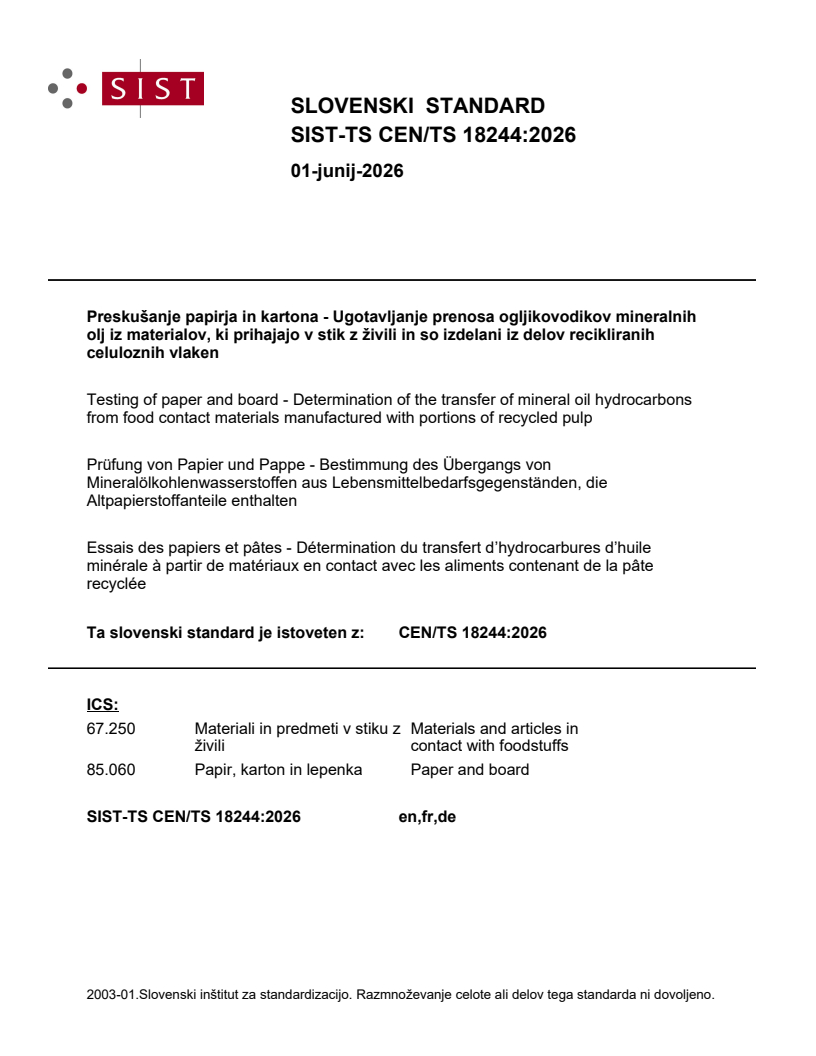
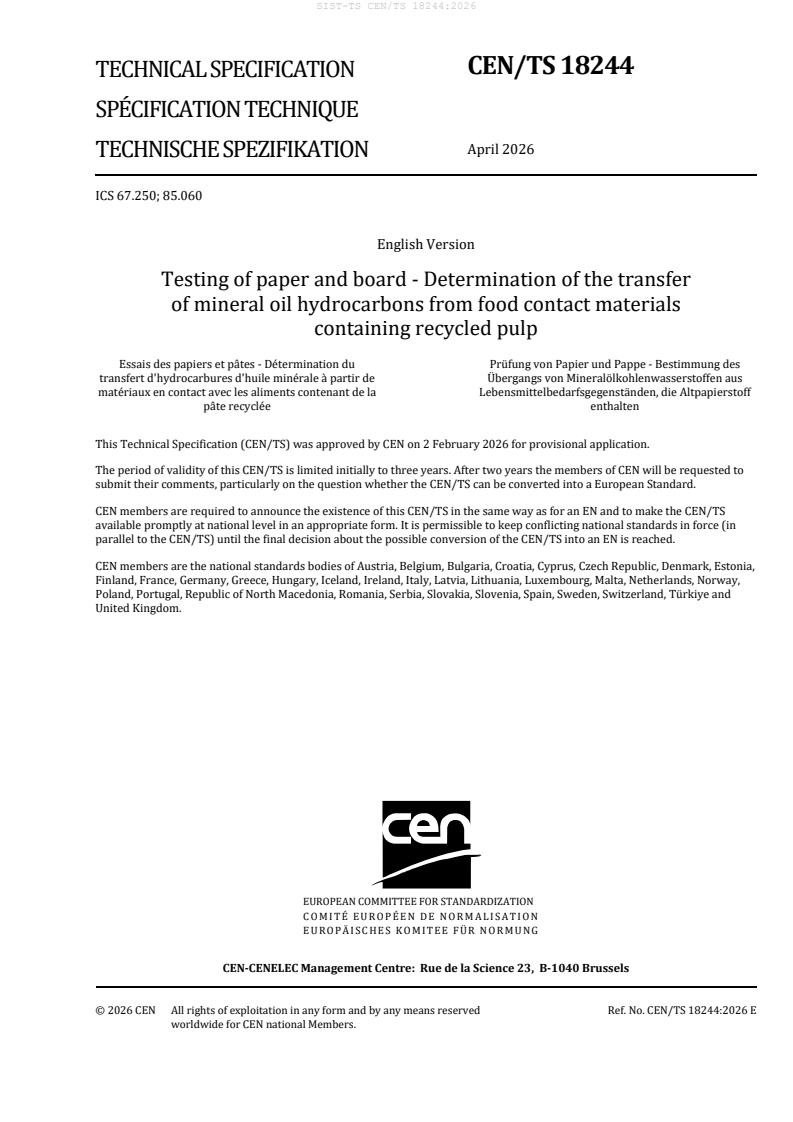
SLOVENSKI STANDARD
01-junij-2026
Preskušanje papirja in kartona - Ugotavljanje prenosa ogljikovodikov mineralnih
olj iz materialov, ki prihajajo v stik z živili in so izdelani iz delov recikliranih
celuloznih vlaken
Testing of paper and board - Determination of the transfer of mineral oil hydrocarbons
from food contact materials manufactured with portions of recycled pulp
Prüfung von Papier und Pappe - Bestimmung des Übergangs von
Mineralölkohlenwasserstoffen aus Lebensmittelbedarfsgegenständen, die
Altpapierstoffanteile enthalten
Essais des papiers et pâtes - Détermination du transfert d’hydrocarbures d’huile
minérale à partir de matériaux en contact avec les aliments contenant de la pâte
recyclée
Ta slovenski standard je istoveten z: CEN/TS 18244:2026
ICS:
67.250 Materiali in predmeti v stiku z Materials and articles in
živili contact with foodstuffs
85.060 Papir, karton in lepenka Paper and board
2003-01.Slovenski inštitut za standardizacijo. Razmnoževanje celote ali delov tega standarda ni dovoljeno.
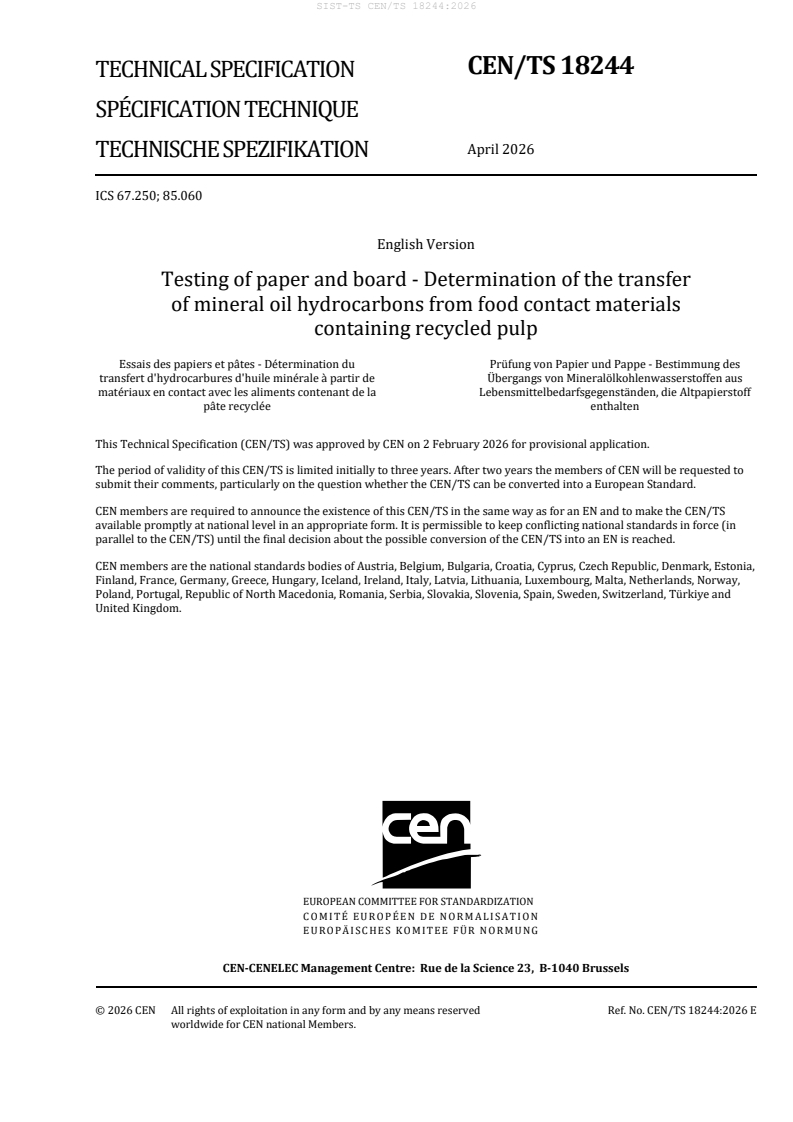
CEN/TS 18244
TECHNICAL SPECIFICATION
SPÉCIFICATION TECHNIQUE
April 2026
TECHNISCHE SPEZIFIKATION
ICS 67.250; 85.060
English Version
Testing of paper and board - Determination of the transfer
of mineral oil hydrocarbons from food contact materials
containing recycled pulp
Essais des papiers et pâtes - Détermination du Prüfung von Papier und Pappe - Bestimmung des
transfert d'hydrocarbures d'huile minérale à partir de Übergangs von Mineralölkohlenwasserstoffen aus
matériaux en contact avec les aliments contenant de la Lebensmittelbedarfsgegenständen, die Altpapierstoff
pâte recyclée enthalten
This Technical Specification (CEN/TS) was approved by CEN on 2 February 2026 for provisional application.
The period of validity of this CEN/TS is limited initially to three years. After two years the members of CEN will be requested to
submit their comments, particularly on the question whether the CEN/TS can be converted into a European Standard.
CEN members are required to announce the existence of this CEN/TS in the same way as for an EN and to make the CEN/TS
available promptly at national level in an appropriate form. It is permissible to keep conflicting national standards in force (in
parallel to the CEN/TS) until the final decision about the possible conversion of the CEN/TS into an EN is reached.
CEN members are the national standards bodies of Austria, Belgium, Bulgaria, Croatia, Cyprus, Czech Republic, Denmark, Estonia,
Finland, France, Germany, Greece, Hungary, Iceland, Ireland, Italy, Latvia, Lithuania, Luxembourg, Malta, Netherlands, Norway,
Poland, Portugal, Republic of North Macedonia, Romania, Serbia, Slovakia, Slovenia, Spain, Sweden, Switzerland, Türkiye and
United Kingdom.
EUROPEAN COMMITTEE FOR STANDARDIZATION
COMITÉ EUROPÉEN DE NORMALISATION
EUROPÄISCHES KOMITEE FÜR NORMUNG
CEN-CENELEC Management Centre: Rue de la Science 23, B-1040 Brussels
© 2026 CEN All rights of exploitation in any form and by any means reserved Ref. No. CEN/TS 18244:2026 E
worldwide for CEN national Members.
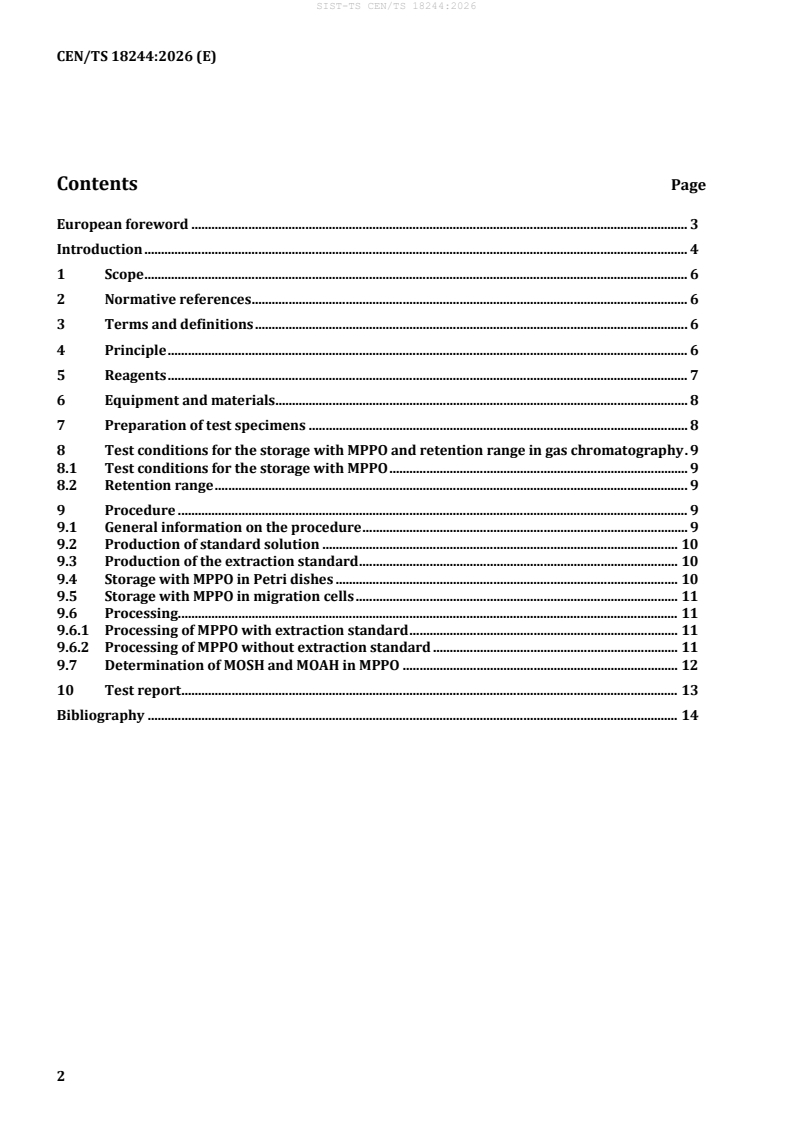
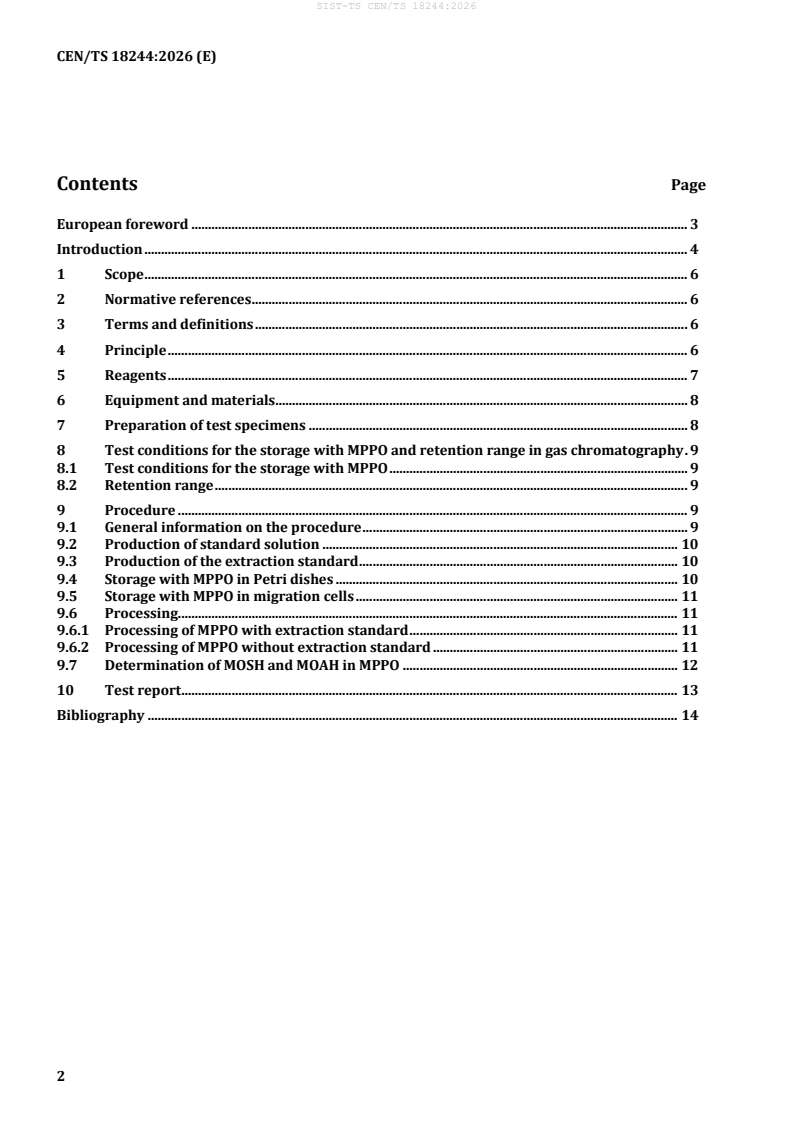
Contents Page
European foreword . 3
Introduction . 4
1 Scope . 6
2 Normative references . 6
3 Terms and definitions . 6
4 Principle . 6
5 Reagents . 7
6 Equipment and materials. 8
7 Preparation of test specimens . 8
8 Test conditions for the storage with MPPO and retention range in gas chromatography . 9
8.1 Test conditions for the storage with MPPO . 9
8.2 Retention range . 9
9 Procedure . 9
9.1 General information on the procedure . 9
9.2 Production of standard solution . 10
9.3 Production of the extraction standard . 10
9.4 Storage with MPPO in Petri dishes . 10
9.5 Storage with MPPO in migration cells . 11
9.6 Processing. 11
9.6.1 Processing of MPPO with extraction standard . 11
9.6.2 Processing of MPPO without extraction standard . 11
9.7 Determination of MOSH and MOAH in MPPO . 12
10 Test report . 13
Bibliography . 14
European foreword
This document (CEN/TS 18244:2026) has been prepared by Technical Committee CEN/TC 172 “Pulp,
paper and board”, the secretariat of which is held by DIN.
Attention is drawn to the possibility that some of the elements of this document may be the subject of
patent rights. CEN shall not be held responsible for identifying any or all such patent rights.
Any feedback and questions on this document should be directed to the users’ national standards body.
A complete listing of these bodies can be found on the CEN website.
According to the CEN/CENELEC Internal Regulations, the national standards organisations of the
following countries are bound to announce this Technical Specification: Austria, Belgium, Bulgaria,
Croatia, Cyprus, Czech Republic, Denmark, Estonia, Finland, France, Germany, Greece, Hungary, Iceland,
Ireland, Italy, Latvia, Lithuania, Luxembourg, Malta, Netherlands, Norway, Poland, Portugal, Republic of
North Macedonia, Romania, Serbia, Slovakia, Slovenia, Spain, Sweden, Switzerland, Türkiye and the
United Kingdom.
Introduction
The Joint FAO/WHO Expert Committee on Food Additives (JECFA) has been concerned with questions
involving the occurrence, application and toxicology of mineral oil hydrocarbons in food [1], [2] since the
st
first decade of the 21 century. Thus, among other things, it became clear that the occurrence of
hydrocarbons in food is not only attributable to targeted use of additives containing mineral oil, but is
also based on naturally occurring ingredients. Impurities from manufacturing, processing, packaging and
transport processes were also known.
Mineral oil hydrocarbons came into focus in connection with food packaging after it was determined in
2009 that they occur in packaging made from recycled paper board or paper and can migrate into food.
Printing ink containing mineral oil, used particularly in newspaper printing, was identified as the main
source of the mineral oil hydrocarbons in recycled paper board and paper [3]. These printing inks contain
highly refined mineral oil products as solvents. A distinction was made between mineral oil saturated
hydrocarbons (MOSH) and mineral oil aromatic hydrocarbons (MOAH).
Within the scope of a decision-making guidance project of the German Federal Ministry of Food,
Agriculture and Consumer Protection the contaminant load of packaging containing recycled fibres as
well as the potential migration of mineral oil hydrocarbons in particular were proven [4]. Mineral oil
hydrocarbons were ascertained in a large number of dry, non-fatty foodstuffs from the retail trade;
although there was no causal examination of their sources of input in this study design.
As a result of the "mineral oil discussion" over several years within the entire food chain, including the
packaging and raw material industries, private and public testing facilities, authorities and non-
governmental organizations, additional knowledge is available today with regard to foreseeable sources
of contamination, avoidable and unavoidable ubiquitous contamination, as well as the analytic
challenges.
Since that time the food chain has developed different strategies and technologies with which sources of
entry can be identified and controlled. Thus, the measurable concentration of mineral oil hydrocarbons
was able to be substantially reduced in the case of a very large number of foods. The declining number of
complaints from the official food inspection authorities and regular publication of product testing provide
ample proof.
Manufacturers and converters offer various marketable solutions for protecting food from the migration
of mineral oil hydrocarbons from sustainable, fibre-based packaging and/or for protection against
ubiquitous mineral oil hydrocarbons:
1) use of select qualities of paper and board for recycling with reduced mineral oil hydrocarbons for
manufacturing recycled paper and board;
2) use of paper and board from virgin fibre for manufacturing food contact materials;
3) use of paper and board from virgin or recycled fibre with a functional barrier (coating and/or
addition of adsorbents to the fibre pulp).
Which approach ensures the best possible protection of a given food against the transfer of mineral oil
hydrocarbons from fibre-based food contact materials or contamination from the environment can in
each case only be determined by the market participants in the individual case of application.
It has been shown that numerous factors of influence, among other things like the kind of food (fatty, dry,
etc.), its storage life, its processing, transport and storage conditions as well as the use by the consumer,
are to be considered when it comes to configuration of a suitable packaging system.
The migration potential of mineral oil hydrocarbons is of crucial importance for evaluation of the
functional barrier quality of fibre-based packaging materials and packaging components. As a rule, the
functionality of a barrier is evaluated through measurement of the migration of substances (in this case
mineral oil hydrocarbons) over a defined period of time (e.g. shelf life of the foodstuffs).
Thus, it follows, that for these barrier solutions it is necessary to examine the migration of mineral oil
hydrocarbons with the help of a standardised measuring method.
With this document a standardised measuring method is made available for evaluating the functional
barrier quality. In the individual case of application, it allows for conclusions about estimates of the
migration of mineral oil hydrocarbons from fibre-based paper and board equipped with a barrier.
The measuring method is applicable to paper and board (sheets and reels) and with restrictions
(applicable) to the finished, three-dimensional food contact material (e.g. folding boxes).
The manufacturers of fibre-based paper and board with barrier function know the individual processing
conditions for their materials and recommend them to their customers. These specifications enable the
converter to perform an individual case risk evaluation of migration from the finished food contact
material for the unprocessed material on the basis of the determined values.
This document only describes a standardized measuring method for the determination of migration
values. It does not define any quality requirements for paper and board with barrier function or fibre-
based food contact materials manufactured from them.
1 Scope
This document specifies a test method for estimating the transfer of mineral oil saturated hydrocarbons
(MOSH) and mineral oil aromatic hydrocarbons (MOAH) from food contact materials containing recycled
pulp.
This test method is applicable for examining the extent of migration from paper and board equipped with
a barrier or other technical solutions to reduce the amount of migration.
This test method is also applicable to paper and board made from virgin fibres.
2 Normative references
The following documents are referred to in the text in such a way that some or all of their content
constitutes requirements of this document. For dated references, only the edition cited applies. For
undated references, the latest edition of the referenced document (including any amendments) applies.
EN 1186-1, Materials and articles in contact with foodstuffs — Plastics — Part 1: Guide to the selection of
conditions and test methods for overall migration
3 Terms and definitions
For the purposes of this document, the following terms and definitions apply.
ISO and IEC maintain terminology databases for use in standardization at the following addresses:
— ISO Online browsing platform: available at https://www.iso.org/obp/
— IEC Electropedia: available at https://www.electropedia.org/
3.1
mineral oil saturated hydrocarbon
MOSH
saturated hydrocarbon from mineral oil which consist of aliphatic hydrocarbons (paraffins) as well as
alkylated and non-alkylated cyclic hydrocarbons (naphthenes)
3.2
mineral oil aromatic hydrocarbon
MOAH
highly alkylated aromatic hydrocarbon from mineral oil with one or more aromatic rings
4 Principle
The side of the test specimen intended for contact with food shall be covered with MPPO
[poly(2,6-diphenyl-p-phenylene oxide), e.g. available under the trade name Tenax® ] and stored under
the required time and temperature test conditions. Storage shall take place in a thermostatically
controlled oven. After storage the MPPO shall be extracted with n-hexane.
Tenax® is the trade name of the product supplied by Varian BV, Herculesweg 8, NL-4338 PL Middelburg. This
information is given for the convenience of users of this CEN/TS and does not constitute an endorsement by CEN
of this product. Equivalent products may be used if they can be shown to lead to the same results.
5 Reagents
Reagents shown in Table 1 shall be used. All chemicals shall be of analytically pure quality unless
otherwise indicated.
Table 1 — List of reagents
a
Reagents CAS Registry Number®
b
a n-hexane 110-54-3
b toluene 108-88-3
c
c MPPO poly(2,6-diphenyl-p-phenylene oxide) —
d
d n-dodecane 112-40-3
d
e n-pentacosane 629-99-2
d
f hexylbenzene 1077-16-3
g n-undecane 1120-21-4
h n-pentylbenzene 538-68-1
i n-tridecane 629-50-5
j 1-methylnaphthalene 90-12-0
k cyclohexylcyclohexane 92-51-3
l 2-methylnaphthalene 91-57-6
m 1,3,5-tri-tert-butylbenzene 1460-02-2
n perylene 198-55-0
o 5-α cholestane 481-21-0
e
p n-alkane standard mixture C to C —
10 40
NOTE 1 MPPO is a polymer with a high molecular weight (containing (500 000 to 1 000 000) Da). It is a very
stable and porous material with high temperature resistance (Tmax = 350 °C), a large surface and a low
specific mass (0,23 g/cm ).
NOTE 2 Gas chromatograms of extracts of commercially available MPPO have shown that impurities can be
present at a significant measure. A method for cleaning can be found in EN 14338.
a
CAS Registry Number® (CAS RN®) is a trademark American Chemical Society (ACS). This information is
given for the convenience of users of this document and does not constitute an endorsement by CEN of the
product named. Equivalent products may be used if they can be shown to lead to the same results.
b
For chromatography.
c
(60 to 80) mesh.
d
For processing of MPPO with extraction standard (see 9.6.1).
e
Solution of same concentration in a non-polar solvent, ρ = 1 μg/ml for determination of the retention
ranges according to 8.2.
...
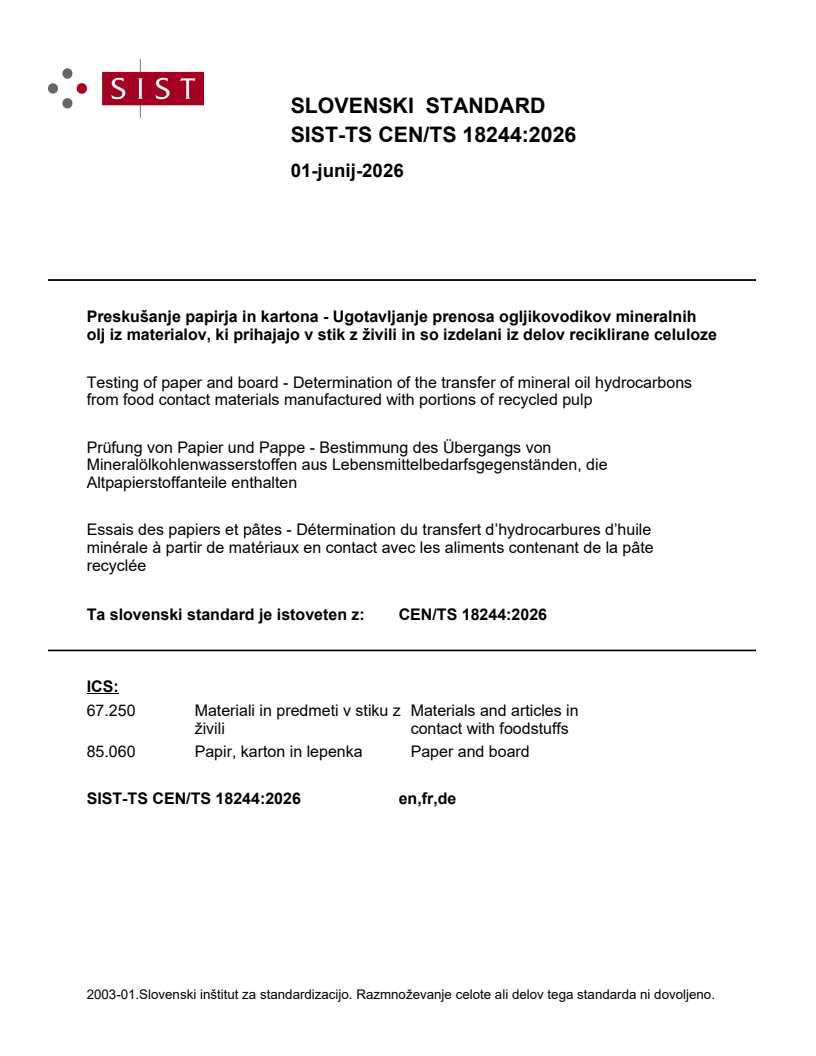
SLOVENSKI STANDARD
01-junij-2026
Preskušanje papirja in kartona - Ugotavljanje prenosa ogljikovodikov mineralnih
olj iz materialov, ki prihajajo v stik z živili in so izdelani iz delov reciklirane celuloze
Testing of paper and board - Determination of the transfer of mineral oil hydrocarbons
from food contact materials manufactured with portions of recycled pulp
Prüfung von Papier und Pappe - Bestimmung des Übergangs von
Mineralölkohlenwasserstoffen aus Lebensmittelbedarfsgegenständen, die
Altpapierstoffanteile enthalten
Essais des papiers et pâtes - Détermination du transfert d’hydrocarbures d’huile
minérale à partir de matériaux en contact avec les aliments contenant de la pâte
recyclée
Ta slovenski standard je istoveten z: CEN/TS 18244:2026
ICS:
67.250 Materiali in predmeti v stiku z Materials and articles in
živili contact with foodstuffs
85.060 Papir, karton in lepenka Paper and board
2003-01.Slovenski inštitut za standardizacijo. Razmnoževanje celote ali delov tega standarda ni dovoljeno.
CEN/TS 18244
TECHNICAL SPECIFICATION
SPÉCIFICATION TECHNIQUE
April 2026
TECHNISCHE SPEZIFIKATION
ICS 67.250; 85.060
English Version
Testing of paper and board - Determination of the transfer
of mineral oil hydrocarbons from food contact materials
containing recycled pulp
Essais des papiers et pâtes - Détermination du Prüfung von Papier und Pappe - Bestimmung des
transfert d'hydrocarbures d'huile minérale à partir de Übergangs von Mineralölkohlenwasserstoffen aus
matériaux en contact avec les aliments contenant de la Lebensmittelbedarfsgegenständen, die Altpapierstoff
pâte recyclée enthalten
This Technical Specification (CEN/TS) was approved by CEN on 2 February 2026 for provisional application.
The period of validity of this CEN/TS is limited initially to three years. After two years the members of CEN will be requested to
submit their comments, particularly on the question whether the CEN/TS can be converted into a European Standard.
CEN members are required to announce the existence of this CEN/TS in the same way as for an EN and to make the CEN/TS
available promptly at national level in an appropriate form. It is permissible to keep conflicting national standards in force (in
parallel to the CEN/TS) until the final decision about the possible conversion of the CEN/TS into an EN is reached.
CEN members are the national standards bodies of Austria, Belgium, Bulgaria, Croatia, Cyprus, Czech Republic, Denmark, Estonia,
Finland, France, Germany, Greece, Hungary, Iceland, Ireland, Italy, Latvia, Lithuania, Luxembourg, Malta, Netherlands, Norway,
Poland, Portugal, Republic of North Macedonia, Romania, Serbia, Slovakia, Slovenia, Spain, Sweden, Switzerland, Türkiye and
United Kingdom.
EUROPEAN COMMITTEE FOR STANDARDIZATION
COMITÉ EUROPÉEN DE NORMALISATION
EUROPÄISCHES KOMITEE FÜR NORMUNG
CEN-CENELEC Management Centre: Rue de la Science 23, B-1040 Brussels
© 2026 CEN All rights of exploitation in any form and by any means reserved Ref. No. CEN/TS 18244:2026 E
worldwide for CEN national Members.
Contents Page
European foreword . 3
Introduction . 4
1 Scope . 6
2 Normative references . 6
3 Terms and definitions . 6
4 Principle . 6
5 Reagents . 7
6 Equipment and materials. 8
7 Preparation of test specimens . 8
8 Test conditions for the storage with MPPO and retention range in gas chromatography . 9
8.1 Test conditions for the storage with MPPO . 9
8.2 Retention range . 9
9 Procedure . 9
9.1 General information on the procedure . 9
9.2 Production of standard solution . 10
9.3 Production of the extraction standard . 10
9.4 Storage with MPPO in Petri dishes . 10
9.5 Storage with MPPO in migration cells . 11
9.6 Processing. 11
9.6.1 Processing of MPPO with extraction standard . 11
9.6.2 Processing of MPPO without extraction standard . 11
9.7 Determination of MOSH and MOAH in MPPO . 12
10 Test report . 13
Bibliography . 14
European foreword
This document (CEN/TS 18244:2026) has been prepared by Technical Committee CEN/TC 172 “Pulp,
paper and board”, the secretariat of which is held by DIN.
Attention is drawn to the possibility that some of the elements of this document may be the subject of
patent rights. CEN shall not be held responsible for identifying any or all such patent rights.
Any feedback and questions on this document should be directed to the users’ national standards body.
A complete listing of these bodies can be found on the CEN website.
According to the CEN/CENELEC Internal Regulations, the national standards organisations of the
following countries are bound to announce this Technical Specification: Austria, Belgium, Bulgaria,
Croatia, Cyprus, Czech Republic, Denmark, Estonia, Finland, France, Germany, Greece, Hungary, Iceland,
Ireland, Italy, Latvia, Lithuania, Luxembourg, Malta, Netherlands, Norway, Poland, Portugal, Republic of
North Macedonia, Romania, Serbia, Slovakia, Slovenia, Spain, Sweden, Switzerland, Türkiye and the
United Kingdom.
Introduction
The Joint FAO/WHO Expert Committee on Food Additives (JECFA) has been concerned with questions
involving the occurrence, application and toxicology of mineral oil hydrocarbons in food [1], [2] since the
st
first decade of the 21 century. Thus, among other things, it became clear that the occurrence of
hydrocarbons in food is not only attributable to targeted use of additives containing mineral oil, but is
also based on naturally occurring ingredients. Impurities from manufacturing, processing, packaging and
transport processes were also known.
Mineral oil hydrocarbons came into focus in connection with food packaging after it was determined in
2009 that they occur in packaging made from recycled paper board or paper and can migrate into food.
Printing ink containing mineral oil, used particularly in newspaper printing, was identified as the main
source of the mineral oil hydrocarbons in recycled paper board and paper [3]. These printing inks contain
highly refined mineral oil products as solvents. A distinction was made between mineral oil saturated
hydrocarbons (MOSH) and mineral oil aromatic hydrocarbons (MOAH).
Within the scope of a decision-making guidance project of the German Federal Ministry of Food,
Agriculture and Consumer Protection the contaminant load of packaging containing recycled fibres as
well as the potential migration of mineral oil hydrocarbons in particular were proven [4]. Mineral oil
hydrocarbons were ascertained in a large number of dry, non-fatty foodstuffs from the retail trade;
although there was no causal examination of their sources of input in this study design.
As a result of the "mineral oil discussion" over several years within the entire food chain, including the
packaging and raw material industries, private and public testing facilities, authorities and non-
governmental organizations, additional knowledge is available today with regard to foreseeable sources
of contamination, avoidable and unavoidable ubiquitous contamination, as well as the analytic
challenges.
Since that time the food chain has developed different strategies and technologies with which sources of
entry can be identified and controlled. Thus, the measurable concentration of mineral oil hydrocarbons
was able to be substantially reduced in the case of a very large number of foods. The declining number of
complaints from the official food inspection authorities and regular publication of product testing provide
ample proof.
Manufacturers and converters offer various marketable solutions for protecting food from the migration
of mineral oil hydrocarbons from sustainable, fibre-based packaging and/or for protection against
ubiquitous mineral oil hydrocarbons:
1) use of select qualities of paper and board for recycling with reduced mineral oil hydrocarbons for
manufacturing recycled paper and board;
2) use of paper and board from virgin fibre for manufacturing food contact materials;
3) use of paper and board from virgin or recycled fibre with a functional barrier (coating and/or
addition of adsorbents to the fibre pulp).
Which approach ensures the best possible protection of a given food against the transfer of mineral oil
hydrocarbons from fibre-based food contact materials or contamination from the environment can in
each case only be determined by the market participants in the individual case of application.
It has been shown that numerous factors of influence, among other things like the kind of food (fatty, dry,
etc.), its storage life, its processing, transport and storage conditions as well as the use by the consumer,
are to be considered when it comes to configuration of a suitable packaging system.
The migration potential of mineral oil hydrocarbons is of crucial importance for evaluation of the
functional barrier quality of fibre-based packaging materials and packaging components. As a rule, the
functionality of a barrier is evaluated through measurement of the migration of substances (in this case
mineral oil hydrocarbons) over a defined period of time (e.g. shelf life of the foodstuffs).
Thus, it follows, that for these barrier solutions it is necessary to examine the migration of mineral oil
hydrocarbons with the help of a standardised measuring method.
With this document a standardised measuring method is made available for evaluating the functional
barrier quality. In the individual case of application, it allows for conclusions about estimates of the
migration of mineral oil hydrocarbons from fibre-based paper and board equipped with a barrier.
The measuring method is applicable to paper and board (sheets and reels) and with restrictions
(applicable) to the finished, three-dimensional food contact material (e.g. folding boxes).
The manufacturers of fibre-based paper and board with barrier function know the individual processing
conditions for their materials and recommend them to their customers. These specifications enable the
converter to perform an individual case risk evaluation of migration from the finished food contact
material for the unprocessed material on the basis of the determined values.
This document only describes a standardized measuring method for the determination of migration
values. It does not define any quality requirements for paper and board with barrier function or fibre-
based food contact materials manufactured from them.
1 Scope
This document specifies a test method for estimating the transfer of mineral oil saturated hydrocarbons
(MOSH) and mineral oil aromatic hydrocarbons (MOAH) from food contact materials containing recycled
pulp.
This test method is applicable for examining the extent of migration from paper and board equipped with
a barrier or other technical solutions to reduce the amount of migration.
This test method is also applicable to paper and board made from virgin fibres.
2 Normative references
The following documents are referred to in the text in such a way that some or all of their content
constitutes requirements of this document. For dated references, only the edition cited applies. For
undated references, the latest edition of the referenced document (including any amendments) applies.
EN 1186-1, Materials and articles in contact with foodstuffs — Plastics — Part 1: Guide to the selection of
conditions and test methods for overall migration
3 Terms and definitions
For the purposes of this document, the following terms and definitions apply.
ISO and IEC maintain terminology databases for use in standardization at the following addresses:
— ISO Online browsing platform: available at https://www.iso.org/obp/
— IEC Electropedia: available at https://www.electropedia.org/
3.1
mineral oil saturated hydrocarbon
MOSH
saturated hydrocarbon from mineral oil which consist of aliphatic hydrocarbons (paraffins) as well as
alkylated and non-alkylated cyclic hydrocarbons (naphthenes)
3.2
mineral oil aromatic hydrocarbon
MOAH
highly alkylated aromatic hydrocarbon from mineral oil with one or more aromatic rings
4 Principle
The side of the test specimen intended for contact with food shall be covered with MPPO
[poly(2,6-diphenyl-p-phenylene oxide), e.g. available under the trade name Tenax® ] and stored under
the required time and temperature test conditions. Storage shall take place in a thermostatically
controlled oven. After storage the MPPO shall be extracted with n-hexane.
Tenax® is the trade name of the product supplied by Varian BV, Herculesweg 8, NL-4338 PL Middelburg. This
information is given for the convenience of users of this CEN/TS and does not constitute an endorsement by CEN
of this product. Equivalent products may be used if they can be shown to lead to the same results.
5 Reagents
Reagents shown in Table 1 shall be used. All chemicals shall be of analytically pure quality unless
otherwise indicated.
Table 1 — List of reagents
a
Reagents CAS Registry Number®
b
a n-hexane 110-54-3
b toluene 108-88-3
c
c MPPO poly(2,6-diphenyl-p-phenylene oxide) —
d
d n-dodecane 112-40-3
d
e n-pentacosane 629-99-2
d
f hexylbenzene 1077-16-3
g n-undecane 1120-21-4
h n-pentylbenzene 538-68-1
i n-tridecane 629-50-5
j 1-methylnaphthalene 90-12-0
k cyclohexylcyclohexane 92-51-3
l 2-methylnaphthalene 91-57-6
m 1,3,5-tri-tert-butylbenzene 1460-02-2
n perylene 198-55-0
o 5-α cholestane 481-21-0
e
p n-alkane standard mixture C to C —
10 40
NOTE 1 MPPO is a polymer with a high molecular weight (containing (500 000 to 1 000 000) Da). It is a very
stable and porous material with high temperature resistance (Tmax = 350 °C), a large surface and a low
specific mass (0,23 g/cm ).
NOTE 2 Gas chromatograms of extracts of commercially available MPPO have shown that impurities can be
present at a significant measure. A method for cleaning can be found in EN 14338.
a
CAS Registry Number® (CAS RN®) is a trademark American Chemical Society (ACS). This information is
given for the convenience of users of this document and does not constitute an endorsement by CEN of the
product named. Equivalent products may be used if they can be shown to lead to the same results.
b
For chromatography.
c
(60 to 80) mesh.
d
For processing of MPPO with extraction standard (see 9.6.1).
e
Solution of same concentration in a non-polar solvent, ρ = 1 μg/ml for determination of the retention
ranges according to 8.2.
...