

SIST EN 9300-100:2026
(Main)Aerospace series - LOTAR LOng-Term Archiving and Retrieval of digital technical product documentation such as 3D, CAD and PDM data - Part 100: Common concepts for long-term archiving and retrieval of 3D mechanical CAD information
General Information
- Abstract
This document specifies common fundamental concepts for long term archiving and retrieval of mechanical CAD information for elementary parts and assemblies. It details the “fundamentals and concepts” of EN 9300-003:2012 in the specific context of long-term archiving of CAD mechanical models.
Mechanical CAD information is divided into assembly structure and geometrical information, both including explicit and implicit geometrical representation, geometric dimensioning and tolerancing with form features.
The EN 9300-1XX series is organized as a sequence of parts, each building on the previous ones in a consistent way, each adding a level of complexity in the CAD data model. This includes the detailing of relationships between the essential information for the different types of CAD information covered by the EN 9300-1XX series.
As technology matures, additional parts will be released in order to support new requirements within the aerospace community.
1.2 In Scope
This document specifies:
- the fundamentals and concepts for long-term archiving and retrieval of 3D mechanical CAD information;
- the document structure of the EN 9300-1XX series, and the links between all these parts;
- the qualification methods for long-term preservation of archived mechanical CAD information; more specially, principles for the CAD validation properties and for verification of the quality of the CAD archived file;
- specifications for the preservation planning of archived CAD information;
- specific functions for administration and monitoring of CAD archived mechanical models;
- the definition of archive information packages for CAD data.
1.3 Out of scope
The following are out of scope for this part:
- long-term archiving of CAD 2D drawings;
- other CAD specialization disciplines, such as electrical harnesses, composite.
- Status
- Published
- Public Enquiry End Date
- 05-May-2024
- Publication Date
- 03-May-2026
- Technical Committee
- I13 - Imaginarni 13
- Current Stage
- 6060 - National Implementation/Publication (Adopted Project)
- Start Date
- 17-Apr-2026
- Due Date
- 22-Jun-2026
- Completion Date
- 04-May-2026

Overview
SIST EN 9300-100:2026 is part of the Aerospace series developed by CEN to establish standardized requirements for LOTAR (LOng-Term Archiving and Retrieval) of digital technical product documentation-specifically 3D mechanical CAD information. The standard sets out common concepts and fundamental principles for the preservation, administration, and retrieval of mechanical CAD data, with special focus on elementary parts and assemblies in the aerospace industry.
By defining the critical structures and processes for long-term digital archiving, SIST EN 9300-100:2026 enables organizations to ensure their digital product documentation remains usable, accessible, and verifiable for decades, supporting regulatory compliance, product liability, certification, and business continuity.
Key Topics
Common Fundamentals for Long-Term CAD Archiving
- Fundamentals and Concepts: Outlines the principles and key methodologies for the effective preservation and retrieval of 3D mechanical CAD data, building on the foundations provided in EN 9300-003.
- Information Structure: Describes the division of mechanical CAD data into assembly structures and geometrical information, including both explicit and implicit representations, as well as geometric dimensioning and tolerancing.
- Qualification Methods: Specifies principles for validating and verifying the quality and completeness of archived CAD files, including risk management approaches tailored by organizations.
- Archive Information Packages (AIP): Provides specifications for packaging CAD data for archiving, including content, preservation description, reference, context, provenance, fixity, packaging, and descriptive information.
Series Framework and Organization
- EN 9300-1XX Series Structure: Describes how the series is built as a sequence of interrelated parts, each adding complexity and addressing specific aspects of the CAD data model and archiving process.
- Linkages: Explains interdependencies and relationships among EN 9300-1XX parts to ensure consistency and support for evolving technology and requirements.
Administration and Monitoring
- Details the administrative functions and monitoring mechanisms required to support long-term CAD data stewardship.
- Addresses the evolution and adaptability of archiving processes, technology updates, and continuous improvement in practices.
Applications
SIST EN 9300-100:2026 provides practical value in several key areas:
- Aerospace Manufacturing: Ensures that 3D mechanical CAD files remain accessible and authentic over extended product lifecycles, often exceeding 50 years.
- Certification and Product Liability: Supports compliance by ensuring design data can be validated and retrieved reliably for audits, legal defense, and regulatory submissions.
- Business Continuity and Risk Management: Enables organizations to implement robust risk management strategies for critical product information, covering data verification, validation, and migration.
- Interoperability and Vendor Neutrality: Promotes open data formats and standards-based practices, facilitating future retrieval regardless of proprietary CAD tools.
- Support for Modern CAD Methods: As new CAD modeling techniques and technologies emerge, the standard ensures backward compatibility and structured evolution.
Related Standards
Organizations implementing SIST EN 9300-100:2026 should be aware of its dependencies and connections to other standards:
- EN 9300-003: General fundamentals and concepts for LOTAR.
- EN 9300-110: Explicit geometry information for 3D CAD.
- EN 9300-115: Explicit CAD assembly structure.
- EN 9300-120/121/125: Covering product manufacturing information and advanced semantic structures in CAD data.
- ISO 10303 (STEP): International standard defining CAD information models and data exchange protocols.
- ISO 1101, ISO 16792: Additional references for geometric dimensioning and tolerancing relevant to CAD archiving.
By following the practices outlined in SIST EN 9300-100:2026, aerospace industry stakeholders-and those in related sectors-can establish effective, future-proof strategies for the long-term management and accessibility of vital 3D mechanical CAD documentation.
Relations
- Effective Date
- 02-Sep-2026
- Effective Date
- 02-Sep-2026
- Effective Date
- 05-Aug-2026
- Effective Date
- 08-Apr-2026
- Effective Date
- 08-Apr-2026
- Effective Date
- 08-Apr-2026
- Effective Date
- 08-Apr-2026
- Effective Date
- 08-Apr-2026
- Effective Date
- 08-Apr-2026
- Effective Date
- 08-Apr-2026
- Effective Date
- 08-Apr-2026
- Effective Date
- 08-Apr-2026
- Effective Date
- 08-Apr-2026
- Effective Date
- 17-May-2023
Get Certified
Connect with accredited certification bodies for this standard

BSI Group
BSI (British Standards Institution) is the business standards company that helps organizations make excellence a habit.

Bureau Veritas
Bureau Veritas is a world leader in laboratory testing, inspection and certification services.

DNV
DNV is an independent assurance and risk management provider.
Sponsored listings
Frequently Asked Questions
SIST EN 9300-100:2026 is a standard published by the Slovenian Institute for Standardization (SIST). Its full title is "Aerospace series - LOTAR LOng-Term Archiving and Retrieval of digital technical product documentation such as 3D, CAD and PDM data - Part 100: Common concepts for long-term archiving and retrieval of 3D mechanical CAD information". This standard covers: This document specifies common fundamental concepts for long term archiving and retrieval of mechanical CAD information for elementary parts and assemblies. It details the “fundamentals and concepts” of EN 9300-003:2012 in the specific context of long-term archiving of CAD mechanical models. Mechanical CAD information is divided into assembly structure and geometrical information, both including explicit and implicit geometrical representation, geometric dimensioning and tolerancing with form features. The EN 9300-1XX series is organized as a sequence of parts, each building on the previous ones in a consistent way, each adding a level of complexity in the CAD data model. This includes the detailing of relationships between the essential information for the different types of CAD information covered by the EN 9300-1XX series. As technology matures, additional parts will be released in order to support new requirements within the aerospace community. 1.2 In Scope This document specifies: - the fundamentals and concepts for long-term archiving and retrieval of 3D mechanical CAD information; - the document structure of the EN 9300-1XX series, and the links between all these parts; - the qualification methods for long-term preservation of archived mechanical CAD information; more specially, principles for the CAD validation properties and for verification of the quality of the CAD archived file; - specifications for the preservation planning of archived CAD information; - specific functions for administration and monitoring of CAD archived mechanical models; - the definition of archive information packages for CAD data. 1.3 Out of scope The following are out of scope for this part: - long-term archiving of CAD 2D drawings; - other CAD specialization disciplines, such as electrical harnesses, composite.
This document specifies common fundamental concepts for long term archiving and retrieval of mechanical CAD information for elementary parts and assemblies. It details the “fundamentals and concepts” of EN 9300-003:2012 in the specific context of long-term archiving of CAD mechanical models. Mechanical CAD information is divided into assembly structure and geometrical information, both including explicit and implicit geometrical representation, geometric dimensioning and tolerancing with form features. The EN 9300-1XX series is organized as a sequence of parts, each building on the previous ones in a consistent way, each adding a level of complexity in the CAD data model. This includes the detailing of relationships between the essential information for the different types of CAD information covered by the EN 9300-1XX series. As technology matures, additional parts will be released in order to support new requirements within the aerospace community. 1.2 In Scope This document specifies: - the fundamentals and concepts for long-term archiving and retrieval of 3D mechanical CAD information; - the document structure of the EN 9300-1XX series, and the links between all these parts; - the qualification methods for long-term preservation of archived mechanical CAD information; more specially, principles for the CAD validation properties and for verification of the quality of the CAD archived file; - specifications for the preservation planning of archived CAD information; - specific functions for administration and monitoring of CAD archived mechanical models; - the definition of archive information packages for CAD data. 1.3 Out of scope The following are out of scope for this part: - long-term archiving of CAD 2D drawings; - other CAD specialization disciplines, such as electrical harnesses, composite.
SIST EN 9300-100:2026 is classified under the following ICS (International Classification for Standards) categories: 01.100 - Technical drawings; 01.110 - Technical product documentation; 35.240.10 - Computer-aided design (CAD); 35.240.30 - IT applications in information, documentation and publishing; 35.240.60 - IT applications in transport; 49.020 - Aircraft and space vehicles in general. The ICS classification helps identify the subject area and facilitates finding related standards.
SIST EN 9300-100:2026 has the following relationships with other standards: It is inter standard links to SIST EN 9300-010:2026, SIST EN 9300-003:2026, SIST EN 9300-210:2026, SIST EN 9300-005:2017, SIST EN 9300-002:2018, SIST EN 9300-115:2018, SIST EN 9300-200:2018, SIST EN 9300-120:2024, SIST EN 9300-007:2025, SIST EN 9300-125:2024, SIST EN 9300-007:2017, SIST EN 9300-121:2024, SIST EN 9300-110:2018, SIST EN 9300-100:2018. Understanding these relationships helps ensure you are using the most current and applicable version of the standard.
SIST EN 9300-100:2026 is available in PDF format for immediate download after purchase. The document can be added to your cart and obtained through the secure checkout process. Digital delivery ensures instant access to the complete standard document.
Standards Content (Sample)
SLOVENSKI STANDARD
01-junij-2026
Aeronavtika - LOTAR dolgotrajno arhiviranje in iskanje digitalne tehnične
dokumentacije o izdelkih, kot so podatki o 3D, CAD in PDM - 100. del: Splošni
pojmi za dolgoročno arhiviranje in pridobivanje 3D mehanskih CAD informacij
Aerospace series - LOTAR LOng-Term Archiving and Retrieval of digital technical
product documentation such as 3D, CAD and PDM data - Part 100: Common concepts
for long-term archiving and retrieval of 3D mechanical CAD information
Luft- und Raumfahrt - LOTAR Langzeitarchivierung und Bereitstellung digitaler
technischer Produktdokumentationen beispielsweise 3D CAD und PDM Daten - Teil 100:
Allgemeine Konzepte für die Langzeitarchivierung und Wiederverwendung von 3D CAD
Mechanik-Informationen
Série aérospatiale - LOTAR Archivage long terme et récupération des données
techniques produits numériques telles que CAD 3D et PDM - Partie 100 : Concepts
communs pour l’archivage long terme et la récupération des données CAO mécaniques
3D
Ta slovenski standard je istoveten z: EN 9300-100:2026
ICS:
01.110 Tehnična dokumentacija za Technical product
izdelke documentation
35.240.30 Uporabniške rešitve IT v IT applications in information,
informatiki, dokumentiranju in documentation and
založništvu publishing
49.020 Letala in vesoljska vozila na Aircraft and space vehicles in
splošno general
2003-01.Slovenski inštitut za standardizacijo. Razmnoževanje celote ali delov tega standarda ni dovoljeno.
EN 9300-100
EUROPEAN STANDARD
NORME EUROPÉENNE
April 2026
EUROPÄISCHE NORM
ICS 01.110; 35.240.30; 35.240.60; 49.020 Supersedes EN 9300-100:2018
English Version
Aerospace series - LOTAR LOng-Term Archiving and
Retrieval of digital technical product documentation such
as 3D, CAD and PDM data - Part 100: Common concepts for
long-term archiving and retrieval of 3D mechanical CAD
information
Série aérospatiale - LOTAR Archivage long terme et Luft- und Raumfahrt - LOTAR Langzeitarchivierung
récupération des données techniques produits und Bereitstellung digitaler technischer
numériques telles que CAD 3D et PDM - Partie 100 : Produktdokumentationen beispielsweise 3D CAD und
Concepts communs pour l'archivage long terme et la PDM Daten - Teil 100: Allgemeine Konzepte für die
récupération des données CAO mécaniques 3D Langzeitarchivierung und Wiederverwendung von 3D
CAD Mechanik-Informationen
This European Standard was approved by CEN on 16 February 2026.
CEN members are bound to comply with the CEN/CENELEC Internal Regulations which stipulate the conditions for giving this
European Standard the status of a national standard without any alteration. Up-to-date lists and bibliographical references
concerning such national standards may be obtained on application to the CEN-CENELEC Management Centre or to any CEN
member.
This European Standard exists in three official versions (English, French, German). A version in any other language made by
translation under the responsibility of a CEN member into its own language and notified to the CEN-CENELEC Management
Centre has the same status as the official versions.
CEN members are the national standards bodies of Austria, Belgium, Bulgaria, Croatia, Cyprus, Czech Republic, Denmark, Estonia,
Finland, France, Germany, Greece, Hungary, Iceland, Ireland, Italy, Latvia, Lithuania, Luxembourg, Malta, Netherlands, Norway,
Poland, Portugal, Republic of North Macedonia, Romania, Serbia, Slovakia, Slovenia, Spain, Sweden, Switzerland, Türkiye and
United Kingdom.
EUROPEAN COMMITTEE FOR STANDARDIZATION
COMITÉ EUROPÉEN DE NORMALISATION
EUROPÄISCHES KOMITEE FÜR NORMUNG
CEN-CENELEC Management Centre: Rue de la Science 23, B-1040 Brussels
© 2026 CEN All rights of exploitation in any form and by any means reserved Ref. No. EN 9300-100:2026 E
worldwide for CEN national Members.
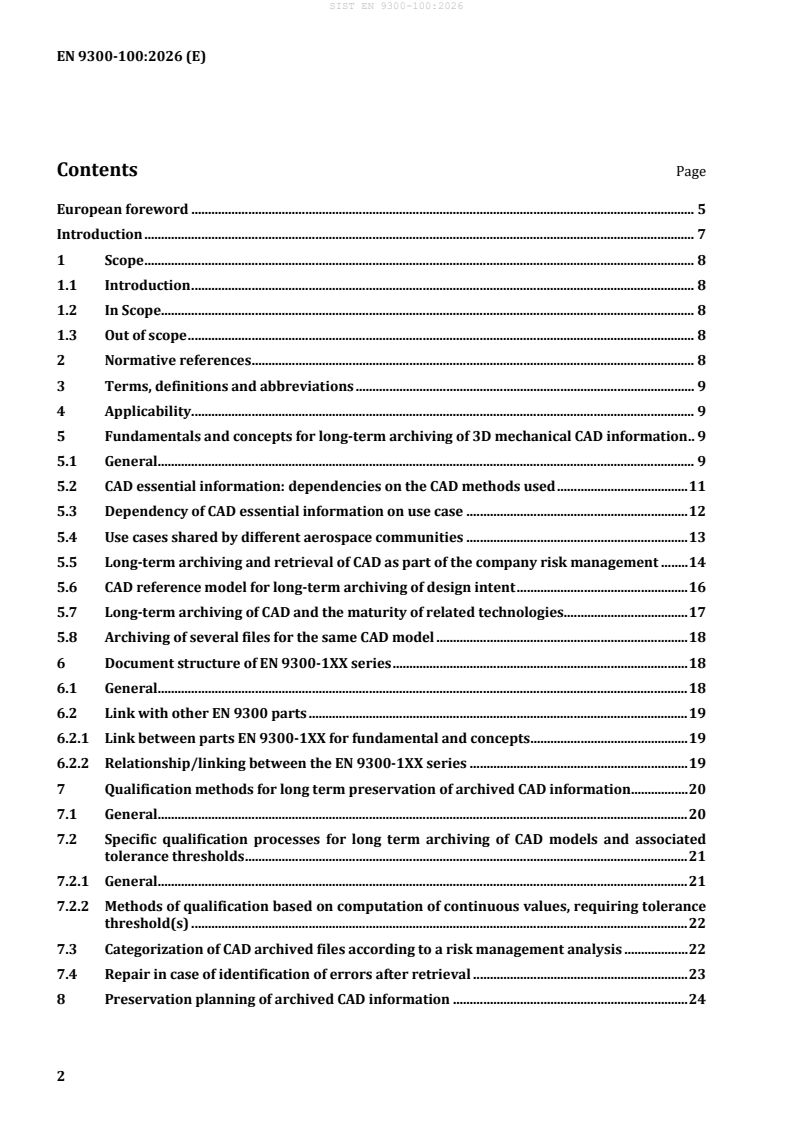
Contents Page
European foreword . 5
Introduction . 7
1 Scope . 8
1.1 Introduction . 8
1.2 In Scope. 8
1.3 Out of scope . 8
2 Normative references . 8
3 Terms, definitions and abbreviations . 9
4 Applicability . 9
5 Fundamentals and concepts for long-term archiving of 3D mechanical CAD information . 9
5.1 General. 9
5.2 CAD essential information: dependencies on the CAD methods used . 11
5.3 Dependency of CAD essential information on use case . 12
5.4 Use cases shared by different aerospace communities . 13
5.5 Long-term archiving and retrieval of CAD as part of the company risk management . 14
5.6 CAD reference model for long-term archiving of design intent . 16
5.7 Long-term archiving of CAD and the maturity of related technologies. 17
5.8 Archiving of several files for the same CAD model . 18
6 Document structure of EN 9300-1XX series . 18
6.1 General. 18
6.2 Link with other EN 9300 parts . 19
6.2.1 Link between parts EN 9300-1XX for fundamental and concepts . 19
6.2.2 Relationship/linking between the EN 9300-1XX series . 19
7 Qualification methods for long term preservation of archived CAD information . 20
7.1 General. 20
7.2 Specific qualification processes for long term archiving of CAD models and associated
tolerance thresholds . 21
7.2.1 General. 21
7.2.2 Methods of qualification based on computation of continuous values, requiring tolerance
threshold(s) . 22
7.3 Categorization of CAD archived files according to a risk management analysis . 22
7.4 Repair in case of identification of errors after retrieval . 23
8 Preservation planning of archived CAD information . 24
8.1 General . 24
8.2 Evolution of CAD systems and other related applications (3D viewers) . 25
8.3 Creation of new validation properties and verification rules . 25
8.4 Evolution of standards and the related relevant recommended practices . 25
8.5 Evolution of business requirements . 26
8.6 Review of the preservation planning policy . 26
9 Administration and monitoring . 26
10 Definition of archive information packages for CAD data . 27
10.1 General . 27
10.2 Content information . 28
10.3 Preservation Description Information (PDI) . 28
10.3.1 General . 28
10.3.2 Reference information . 29
10.3.3 Context information . 29
10.3.4 Provenance information . 30
10.3.5 Fixity information. 30
10.3.6 Application of PDI data for LTA of 3D CAD . 31
10.4 Packaging information . 32
10.5 Descriptive information . 32
Annex A (informative) The progression of content within CAD systems . 34
Annex B (informative) Template for the table of contents of a part of the EN 9300-1XX series . 35
Annex C (informative) Considerations for long-term preservation of CAD 3D information . 36
C.1 General . 36
C.2 Precision of CAD mechanical systems and CAD generation . 36
C.3 Tolerance of design versus tolerance of the CAD geometric modeller . 37
C.4 Tolerances to control the long-term preservation of essential information of CAD 3D
models . 38
C.5 Different levels of information of CAD 3D shape representation . 39
C.6 Quality of CAD geometry . 40
C.7 CAD models used as the reference after the release of the design . 42
C.8 Use of native CAD models in conjunction with STEP CAD archived models during the
aerospace product life cycle . 43
C.9 Long-term archiving formats for 3D CAD information . 43
Annex D (informative) Definition of a representative sample of test cases . 45
D.1 General . 45
D.2 Units tests cases . 46
D.3 Operational tests cases . 47
Annex E (informative) Examples of performance indicators used to manage longevity of CAD
archived information. 48
Annex F (informative) Maturity of the main components for long-term archiving of CAD
mechanical information . 51
Annex G (informative) Acronyms . 52
Bibliography . 53
European foreword
This document (EN 9300-100:2026) has been prepared by ASD-STAN.
After enquiries and votes carried out in accordance with the rules of this Association, this document has
received the approval of the National Associations and the Official Services of the member countries of
ASD-STAN, prior to its presentation to CEN.
This European Standard shall be given the status of a national standard, either by publication of an
identical text or by endorsement, at the latest by October 2026, and conflicting national standards shall
be withdrawn at the latest by October 2026.
Attention is drawn to the possibility that some of the elements of this document may be the subject of
patent rights. CEN shall not be held responsible for identifying any or all such patent rights.
This document supersedes EN 9300-100:2018.
This document includes the following significant technical changes with respect to EN 9300-100:2018:
EN 9300-100 (P1), 07/2018 — Document updated for new generations of CAD methods and tools. The
contents in scope of other EN 9300 parts have been removed:
— “Annex B (informative) Overview of the main types of CAD 3D mechanical information”
— “Annex C (informative) Overview of CAD mechanical assembly structure information”.
The annexes of EN 9300-100 provide an understanding of the principles of long-term archiving of CAD
information. EN 9300-100 makes no claim that the listed principles are complete, and the Annexes
should not be understood as a training lecture.
Annex A sums up the evolution of CAD systems.
Annex B proposes a template for the table of contents for a part of the EN 9300-1XX series.
Annex C sums up the main issues to take into consideration for long term archiving of CAD 3D
information.
Annex D provides general information for the definition of a representative sample of test cases to be
used in a test plan.
Annex E describes examples of performance indicators used to manage the longevity of CAD archived
information.
Annex F gives an overview of maturity of the main components for long term archiving of CAD
mechanical information.
Any feedback and questions on this document should be directed to the users’ national standards body.
A complete listing of these bodies can be found on the CEN website.
According to the CEN-CENELEC Internal Regulations, the national standards organizations of the
following countries are bound to implement this European Standard: Austria, Belgium, Bulgaria,
Croatia, Cyprus, Czech Republic, Denmark, Estonia, Finland, France, Germany, Greece, Hungary, Iceland,
Ireland, Italy, Latvia, Lithuania, Luxembourg, Malta, Netherlands, Norway, Poland, Portugal, Republic of
North Macedonia, Romania, Serbia, Slovakia, Slovenia, Spain, Sweden, Switzerland, Türkiye and the
United Kingdom.
Introduction
This document was prepared jointly by AIA, ASD-STAN, PDES, Inc. and the prostep ivip Association.
The prostep ivip Association is an international non-profit association in Europe. For establishing
leadership in IT-based engineering it offers a moderated platform to its nearly 200 members from
leading industries, system vendors and research institutions. Its product and process data
standardization activities at European and worldwide levels are well known and accepted. The prostep
ivip Association sees this document and the related parts as a milestone of product data technology.
PDES Inc is an international non-profit association in USA. The mission of PDES, Inc. is to accelerate the
development and implementation of ISO 10303, enabling enterprise integration and PLM
interoperability for member companies. PDES, Inc. gathers members from leading manufacturers,
national government agencies, PLM vendors and research organizations. PDES, Inc. supports this
document as an industry resource to sustain the interoperability of digital product information,
ensuring and maintaining authentic longevity throughout their product lifecycle.
Readers of this document should note that all standards undergo periodic revisions and that any
reference made herein to any other standard implies its latest edition, unless otherwise stated.
The documents will be published under two different standards organizations using different prefixes.
ASD-STAN will publish the document under the number EN 9300–XXX. AIA will publish the document
under the number NAS 9300–xxx. The content in the EN 9300 and NAS 9300 documents will be the
same. The differences will be noted in the reference documentation. For example, EN 9300 Geometric
Dimensioning and Tolerancing will be referenced in ISO 1101 and ISO 16792, and for NAS 9300 the
same information will be referenced in ASME Y 14.5M and ASME Y 14.41. The document formatting,
etc., will follow that of the respective editorial rules of ASD-STAN and AIA.
1 Scope
1.1 Introduction
This document specifies common fundamental concepts for long term archiving and retrieval of
mechanical CAD information for elementary parts and assemblies. It details the “fundamentals and
concepts” of EN 9300-003:2012 in the specific context of long-term archiving of CAD mechanical
models.
Mechanical CAD information is divided into assembly structure and geometrical information, both
including explicit and implicit geometrical representation, geometric dimensioning and tolerancing
with form features.
The EN 9300-1XX series is organized as a sequence of parts, each building on the previous ones in a
consistent way, each adding a level of complexity in the CAD data model. This includes the detailing of
relationships between the essential information for the different types of CAD information covered by
the EN 9300-1XX series.
As technology matures, additional parts will be released in order to support new requirements within
the aerospace community.
1.2 In Scope
This document specifies:
— the fundamentals and concepts for long-term archiving and retrieval of 3D mechanical CAD
information;
— the document structure of the EN 9300-1XX series, and the links between all these parts;
— the qualification methods for long-term preservation of archived mechanical CAD information;
more specially, principles for the CAD validation properties and for verification of the quality of the
CAD archived file;
— the specifications for the preservation planning of archived CAD information;
— the specific functions for administration and monitoring of CAD archived mechanical models;
— the definition of archive information packages for CAD data.
1.3 Out of scope
The following are out of scope for this part:
— long-term archiving of CAD 2D drawings;
— other CAD specialization disciplines, such as electrical harnesses, composite.
2 Normative references
The following documents are referred to in the text in such a way that some or all of their content
constitutes requirements of this document. For dated references, only the edition cited applies. For
undated references, the latest edition of the referenced document (including any amendments) applies.
EN 9300 (all parts), Aerospace series — LOTAR — LOng-Term Archiving and Retrieval of digital technical
product documentation such as 3D, CAD and PDM data
ISO 14721, Space Data System Practices — Reference model for an open archival information system
(OAIS)
3 Terms, definitions and abbreviations
For the purposes of this document, the terms, definitions and abbreviations given in EN 9300-007
apply.
ISO and IEC maintain terminology databases for use in standardization at the following addresses:
— ISO Online browsing platform: available at https://www.iso.org/obp/
— IEC Electropedia: available at https://www.electropedia.org/
4 Applicability
Refer to applicability of EN 9300-001:2024, Clause 4.
5 Fundamentals and concepts for long-term archiving of 3D mechanical CAD
information
5.1 General
The EN 9300-1XX series is based on the principles that, over the last several decades, there have been
major changes between the generations of CAD applications, resulting in change of the underlying
representation of the CAD information, and there is a risk of further representational changes. Figure 1
illustrates this.
Figure 1 — Illustration of the major generations of CAD systems
NOTE Figure 1 illustrates:
— the first generation of CAD design method allowed the engineer to digitally create a 2D drawing
(without a 3D model). The essential information as well as the regulatory authority of the design
intent is represented by the 2D drawing;
— the second generation of CAD design method is based primarily on the use of 3D models with
the output being both 2D representation (drawings) and a 3D CAD data set to drive CAM/CAI.
The regulatory authority of the design intent is represented by the 2D drawing;
— the second generation and half of CAD design method is based on the 3D as principal authoring
and the 2D is the published document. The 2D is the document for regulatory authority;
— the third generation of CAD design method is based on the use of parametric and relational
design. The 3D model is fully annotated. The essential information as well as the regulatory
authority of the design intent are represented by the 3D model;
— the fourth generation of CAD design method is also based on the use of 3D annotated model but
only the semantic PMI are explicitly modelled. The basic dimension has to be queried in the
model. The essential information as well as the regulatory authority of the design intent is
represented by the 3D model;
— the fifth generation of CAD design method is represented by the totally semantic integration.
The primary intent is the machine readability. The human-displayed information are totally on
demand.
For more details, see:
— Annex A (informative) – The progressions of content within CAD Systems;
— Annex C (informative) – Considerations for long-term preservation of CAD 3D information;
— EN 9300-110;
— EN 9300-115.
Some algorithms within CAD applications used in the aerospace industry are proprietary and are not
available to the public. These algorithms represent a competitive advantage to the CAD companies.
This results in the fact that aerospace manufacturers cannot guarantee the access to all essential design
intents in their native format, over the life of the product.
The EN 9300-100 describes the methods for preserving CAD mechanical essential information over
time, recognizing that the mathematical representation may change between creation of the CAD
information to its retrieval and hence, after importation, the archived file has to be qualified as
acceptable to a level of precision requested by the business function.
5.2 CAD essential information: dependencies on the CAD methods used
Manufacturers may use different CAD methods for the definition of 3D components. The definition of a
part may be based on:
— 2D drawing only, dimensioned and tolerance;
— 2D drawing with dimensions and tolerances authored in the 2D, derived from a CAD 3D exact
model;
— 2D drawing derived from a CAD 3D exact model with dimensions and tolerances authored in the 3D;
— 3D with GD&T, fully dimensioned and tolerance;
— 3D with GD&T, partially dimensioned and tolerance;
— 3D with GD&T, dimension and tolerance not displayed by default but on demand.
Table 1 sums up the type of CAD information to archive, showing the type of CAD method used.
Table 1 — Type of CAD essential information to archive, depending on the CAD methods used
Generation Generation Generation Generation Generation Generation
Use cases
1 2 2.5 3 4 5
Certification Archive 2D Archive 2D Archive 2D Archive 3D Archive 3D Archive 3D
annotated annotated annotated
and 3D
model model model
Product Archive 2D Archive 2D Archive 2D Archive 3D Archive 3D Archive 3D
liability and 3D annotated annotated annotated
model model model
Support in Archive 2D Archive 2D Archive 2D Archive 3D Archive 3D Archive 3D
operation and 3D and 3D annotated annotated annotated
model model model
Reuse Archive 2D Archive 2D Archive 2D Archive 3D Archive 3D Archive 3D
and 3D and 3D annotated annotated annotated
model model model
If a company uses method 1 for mechanical design, this company may decide to archive the 3D CAD
model to ease the reuse, but it is not mandatory and depends on its internal policy. The requirements
for the design method are defined in Table 2.
Table 2 — Requirement of category “Design method”
No. Requirement
DM1 If a company uses the method 2 type of data, the 2D drawing shall be archived for
certification and product liability.
Optionally, 3D file can extend the archive package for the support and reuse.
DM2 If a company uses the method 2.5 type of data, the 2D drawing shall be archived for
certification and product liability.
DM3 If a company uses the method 2.5 and 3D data are required by your company certification
policy, the 3D data shall be archived in addition to the 2D drawing.
DM4 If a company uses method 3, 4 or 5 Long Term Archiving and Retrieval of 3D CAD with GD&T
models is required.
5.3 Dependency of CAD essential information on use case
Following the regular enhancements of CAD applications, designers create new types of CAD
information (see Annex A).
This document for long-term archiving and retrieval of CAD information cannot be defined and
implemented in the abstract, but it shall be related to specific business requirements (see
EN 9300-002:2018, Clause 6 “Key requirements”) detailed by use cases (see EN 9300-003:2012,
Figure 8: “Distinction of business requirements, business cases and use cases”).
These use cases describe precisely the functions to be supported by the preserved information after
retrieval. Consequently, they identify the essential information for archive specific to the use case, and
the related mechanisms to validate the full process of preservation. This is illustrated by Figure 2 below.
Figure 2 — Links between use cases, essential information and EN 9300-1XX parts
In this example, the part 1XX describes specifications for long-term archiving of a set of essential
o
information n 1, allowing to support retrieval for use cases 1 and 2. Then, the part 1YY describes
o
specifications for long-term archiving of a set of essential information n 2, including the set of essential
o
information n 1, then supporting additional use cases 3 and 4. The figure also points out that both the
functions to be supported after retrieval and the associated levels of quality depend of the policy of risk
management of the aerospace manufacturer (see 5.5).
5.4 Use cases shared by different aerospace communities
Aerospace manufacturers share some common requirements, such as certification and product liability;
these result in common use cases for retrieval. However, there are also strong differences in products
and processes between aerospace manufacturers, depending on:
— the type of product (satellites, large civil airframe manufacturer, engines, etc.);
— the type of customers (civil, defence);
— the related processes of support.
As a result, the aerospace community does not share a single set of use case. Some use cases are
common only to a particular community of aerospace manufacturers, which may share the same legal
constraints or business needs. Use cases specific to a company are not described; these may be related
to a particular process, or part of a competitive advantage. Figure 3 illustrates the families of use case.
Figure 3 — Different levels of commonality of business requirements and use cases
The EN 9300-1XX documents describe requirements and use cases for long term archiving and retrieval
of CAD mechanical information which are:
— common to all the community of aerospace manufacturers;
— common to a particular but broad community of aerospace manufacturers, with a scope clearly
mentioned, and with the agreement of the aerospace community.
Some requirements are not shared by all the aerospace manufacturers.
Where a use case is shared by a particular community of aerospace manufacturers, EN 9300 (all parts)
may be extended to include this case.
In the case of use cases particular to e.g. a manufacturer, the fundamental concepts of EN 9300 (all
parts) shall be applied relevant to its needs, and the related process chain and essential information
shall be documented.
The section “Business specifications” of each specific part details the business requirements and the
associated use cases.
5.5 Long-term archiving and retrieval of CAD as part of the company risk management
The use of 3D mechanical CAD information results to different risks for long term archiving compared
to those encountered in the past for 2D drawings, such as information access and usability of the digital
data content.
EN 9300 (all parts) defines rules and principles that can be applied by the manufacturers. It defines,
where possible, a mandatory set of verification rules for the CAD model, based on an open international
format, and it defines also validation properties to be created during the ingestion and to be checked
during the retrieval process (see EN 9300-005:2017).
For CAD information, these verification and validation rules are in most cases based on thresholds, the
values of which are not fixed in the document, since the results are subject to numerical errors in the
algorithms of the CAD applications. EN 9300-100 identifies the point where it may be adapted by each
manufacturer, according to its own specific processes and products. It can be the responsibility of the
manufacturer to document and apply the principles, with the appropriate thresholds, according to an
analysis based on risk management, as illustrated in Figure 4 and Table 3.
Figure 4 — Long-term archiving of CAD and risk management
Table 3 — Requirement of category “Risk management”
No. Requirement
RM1 The company shall describe precisely the list of rules it has selected for verification and
validation levels (level 0, level 1 or level 2), with the associated tolerance thresholds
RM2 If the verification or validation levels are not level 0 then, the company shall archive the CAD
standardized open neutral format file with the associated validation report and verification
report.
The aerospace manufacturer should define a risk management policy to ensure the long-term archiving
and retrieval of CAD information. To reduce the risk, the company should select or establish an
appropriate qualification method.
For more details, see Clause 7: “Qualification methods for long term preservation of archived CAD
information”.
5.6 CAD reference model for long-term archiving of design intent
Once the CAD model has been released, there are three main strategies to preserve the essential
information of the design through the product life cycle:
— Solution 1 is illustrated in Figure 5: to migrate the design intent of the released native CAD format
from system X to the native format of the next generation of CAD system Y, with a process
demonstrating that the essential information of the migrated model is equivalent to that of the
original native essential information.
Figure 5 — Migration strategy
NOTE This solution is out of the scope of EN 9300 (all parts), and is not put forward for aerospace products,
where data life is expected to exceed 50 years.
— Solution 2 is illustrated in Figure 6: to convert the released original native CAD model to an archived
open format, then convert it upon retrieval to the target CAD native format and ensure that the
target native essential information is equivalent to the original released essential information based
on the validation properties in the archived open format.
Figure 6 — Migration strategy 2
— Solution 3 is illustrated in Figure 7: to convert the released original native CAD model to an archived
open format; and in parallel, to migrate the released native CAD format to the native format of the
next generation of CAD system. The essential information of the archived open format is compared
to the essential information of the migrated native CAD model.
Figure 7 — Migration strategy 3
There is a need to identify what is the CAD reference information over the time and corresponding to
the use cases of the organization.
The qualification of a CAD model as the reference is related to its precise purpose within a well-defined
context, e.g. Table 4 relative to the specific processes and methods of each company.
Table 4 — Requirement of category “CAD reference model”
No. Requirement
CRM1 According to its specific processes and use cases, the company shall decide if an archived
standardized open neutral format CAD model can be directly used as a reference, OR if
the reference is the CAD native format model (as initially released, or migrated, or
converted from the STEP archive).
For example, a CAD 3D reference model with neutral formatting may be used to confirm that the
manufactured part conforms to the design geometry by comparing digital scan of the physical to the
digital nominal, but the same neutral format file may not be allowable to initiate an NC machine
programming, for such a case the native file format may be mandated as the input data source.
The identification of the use cases where the neutral archived CAD model is the reference allows the
company to list the essential information required for the archive. Refer to the relevant appendices of
the specific parts EN 9300-1XX.
5.7 Long-term archiving of CAD and the maturity of related technologies
The availability of COTS applications able to support open standards for the long-term archiving of CAD
- as stipulated in EN 9300-003:2012 - requires the availability of:
— ISO or equivalent open standard defining the CAD information model (e.g. ISO 10303-203:2011,
ISO 10303-214:2010 or ISO 10303-242);
— associated recommended practices, such as that developed and maintained by STEP associations
like the CAX Implementor Forum;
— applications for long-term archiving of CAD essential information (for example, STEP interfaces for
CAD systems, STEP file checker, STEP viewer). These applications are developed and maintained by
CAD IT vendors or companies specialized in CAD interoperability solutions;
— qualification of these applications for long-term archiving.
The breakdown of the EN 9300-1XX series takes into account both the priorities of aerospace
manufacturers business needs and the maturity of the related components. EN 9300 (all parts) cannot
make use of specifications which are immature or do not reflect the consensus of the aerospace
community.
See Annex F (informative) “Maturity of the main components for long-term archiving of CAD
mechanical information”.
5.8 Archiving of several files for the same CAD model
The same native CAD model may contain different types of essential information, corresponding to
different use cases. In addition, technologies to archive the different types of essential information are
being developed progressively, and some of them are not yet available. As a result, the organization may
decide to convert the same native CAD model into several neutral archive files, corresponding to
different use cases, and different types of essential information to be preserved.
NOTE The part 100 allows the CAD parametric and the explicit information to be archived in the same file if
all the appropriate information is preserved.
6 Document structure of EN 9300-1XX series
6.1 General
The parts EN 9300-1XX have been structured based on the main types of CAD essential information
required for each archive use case, taking into account the technologies available.
As described in EN 9300-001:2024 the structure of parts for the EN 9300-1XX series is shown in
Table 5.
Table 5 — Document structure of EN 9300-1XX series
9300–100 Common concepts for long-term archiving and retrieval of 3D mechanical CAD
information
9300–110 CAD mechanical 3D Explicit geometry information
9300–115 Explicit CAD assembly structure
9300–120 CAD 3D explicit geometry with graphic product and manufacturing information
9300–121 Semantic representation of CAD 3D Explicit Geometry with graphic Product and
Manufacturing Information
9300–125 Explicit CAD assembly structure with graphic Product and Manufacturing Information
(PMI)
For clarity and consistency, the document structure of each specific part EN 9300-1XX will follow the
same scheme, as described in Annex B “Template for the table of contents of a part the EN 9300-1XX
series”.
6.2 Link with other EN 9300 parts
6.2.1 Link between parts EN 9300-1XX for fundamental and concepts
To share common concepts across several EN 9300 parts in a consistent way and without duplication,
the generic concepts for long term archiving and retrieval of all types of 3D design aerospace
information are described in EN 9300-003:2012. Part EN 9300-100 describes all concepts common to
the EN 9300-1XX series. Each part 110, 115, 120, etc. will detail the concepts specific to its scope.
6.2.2 Relationship/linking between the EN 9300-1XX series
In general, it is possible to add different kinds of information into one Archival Information Package
(AIP). This includes, for example, native formatted files as well as archived formatted files. As a further
breakdown, when different kinds of information are present in one archived formatted file it is
necessary to comment on the relationships linking the parts and their constraints. This means that one
neutral format file can contain relevant information from different data domain specific parts. Figure 8
shows an example.
Figure 8 — Relationship/linking between the EN 9300-1XX series
The part EN 9300-120 reuses the principles of long-term archiving of the 3D explicit geometry as
descripted in part EN 9300-110.
The part EN 9300-125 reuses the principles of long-term archiving of the CAD assembly structure as
described in part EN 9300-115 and the principles of long-term archiving of the 3D explicit geometry as
described in part EN 9300-120.
Table 6 — LOTAR part relation with CAD generations
Scope Generation 2 Generation Generation 3 Generation 4 Generation 5
2.5
110 Explicit CAD YES YES YES YES YES
Geometry
115 Explicit CAD — YES YES YES YES
Assembly
Structure
120 Explicit CAD — YES YES YES —
Geometry with
Graphic PMI
121 Explicit CAD — — YES YES YES
Geometry with
Semantic PMI
125 Explicit CAD — YES YES YES —
Assembly
Structure with
Graphic PMI
a
Explicit CAD — — YES YES YES
Assembly
Structure with
Semantic PMI
a
Explicit CAD — — — YES YES
Geometry and
Machining Form
Features
a
132 Structural Joints — — YES YES YES
for Assembly and
Installation
a
Planned future LOTAR documents.
The archived STEP file contains different kinds of information. In the example in Figure 8 verification
and validation properties for 3D shape information, auxiliary geometrical/layer information and PMI
information were archived. Although the AIP contains all kinds of information, the description of
requirements/definitions for these kinds of information belongs not to one EN 9300 part but to
different parts as defined in Table 6.
7 Qualification methods for long term preservation of archived CAD information
7.1 General
While this document makes use of the neutral format STEP for examples, any open format can be used
as long as it complies with the companies needs and standards etc.
As stated in Clause 5, long-term archiving and retrieval of CAD mechanical information is based on the
precise identification of the essential information, according to a specific context described by a set of
use cases. Historically, each new generation of CAD application has had an associated change of
mathematical representation of the CAD information. Since further change cannot be ruled out, the CAD
information may have to be transformed to a new representation during the im
...