

oSIST prEN IEC 60876-1:2026
(Main)Fibre optic interconnecting devices and passive components - Fibre optic spatial switches - Part 1: Generic specification
General Information
- Abstract
- Status
- Not Published
- Public Enquiry End Date
- 31-May-2026
- Technical Committee
- MOC - Mobile Communications
- Current Stage
- 4020 - Public enquire (PE) (Adopted Project)
- Start Date
- 17-Mar-2026
- Due Date
- 04-Aug-2026
- Completion Date
- 27-May-2026


Overview
oSIST prEN IEC 60876-1:2026 is the generic specification for fibre optic interconnecting devices and passive components, focusing specifically on fibre optic spatial switches. Developed by the International Electrotechnical Commission (IEC) and parallel-voted via CENELEC (CLC), this standard outlines the classification, terminology, requirements, and defining parameters for spatial switches used in fibre optic systems. As data transmission demands escalate across industries, ensuring interoperability, performance, and reliability of fibre optic switches is critical for modern telecommunication and data network infrastructures.
Key Topics
This standard covers the following important aspects:
Scope and Definitions:
- Addresses only passive fibre optic switches with multiple states and optical ports (fibres or fibre optic connectors).
- Supports standardized terminology harmonized with related IEC and ISO documents.
Types of Fibre Optic Spatial Switches:
- Explains different actuation mechanisms, such as mechanical, magneto-optic effect, thermo-optic effect, MEMS (micro-electromechanical systems), and mechanical beam-steering.
Performance Parameters:
- Essential parameters include insertion loss, return loss, crosstalk, switching time, rise/fall time, latency, and bounce time.
- Matrix and transfer matrix concepts define how power is routed between different ports in a switch.
Switch Classifications:
- Technical criteria for classification:
- Technology type (mechanical, MEMS, MO, TO, etc.)
- Latching vs. non-latching mechanisms
- Topology (single-pole single-throw, single-pole N-throw, N×N matrices, etc.)
- Port configuration (1×N, N×1, or M×N)
- Wavelength band (O, C, L, or combinations)
- Interface style and connector options
- Technical criteria for classification:
Documentation and Drawings:
- Specifies requirements for graphical symbols, dimensional systems (using ISO standards), and consistent projection methods in documentation.
- Details packaging, marking, labeling, and test reporting requirements.
Applications
Fibre optic spatial switches standardized by oSIST prEN IEC 60876-1:2026 are vital in:
- Telecommunications: Automated and manual switching in optical cross-connects for routing signals in high-speed fiber networks.
- Data Centers: Rapid and reliable optical switching for server and storage interconnects, ensuring network flexibility and redundancy.
- Test and Measurement: Optical switching enables automated routing of signals in testing environments, increasing efficiency and accuracy.
- Research and Development: Standardized switches facilitate experimental setups and modular network designs, ensuring compatibility.
The use of standardized spatial switches supports reliable signal routing, low latency, minimal crosstalk, and optimized performance in optical communication networks.
Related Standards
Several other standards are referenced and complement oSIST prEN IEC 60876-1:2026, including:
- IEC 61300 series: Basic test and measurement procedures for fibre optic interconnecting devices and passive components.
- IEC 61753 series: Performance standards for fibre optic interconnecting devices and passive components.
- IEC 62005 series: Reliability standards for fibre optic devices.
- IEC TS 62627-09: Additional terminology and transfer matrix definitions.
- ISO 129-1, ISO 286-1, ISO 1101: Standards for technical drawings, tolerancing, and geometric specifications.
- IEC 60027, IEC 60617: Letter and graphical symbols for diagrams.
By using oSIST prEN IEC 60876-1:2026 alongside these related standards, stakeholders ensure fibre optic spatial switches are interoperable, reliable, and meet the stringent requirements of today’s optical networks. This standard supports manufacturers, system designers, operators, and test engineers in delivering robust fibre optic solutions compliant with international best practices.
Relations
- Effective Date
- 10-Dec-2024
Get Certified
Connect with accredited certification bodies for this standard

ANCE
Mexican certification and testing association.

Intertek Slovenia
Intertek testing, inspection, and certification services in Slovenia.

LNE (Laboratoire National de Métrologie et d'Essais)
French national laboratory for metrology and testing.
Sponsored listings
Frequently Asked Questions
oSIST prEN IEC 60876-1:2026 is a draft published by the Slovenian Institute for Standardization (SIST). Its full title is "Fibre optic interconnecting devices and passive components - Fibre optic spatial switches - Part 1: Generic specification". This standard covers: Fibre optic interconnecting devices and passive components - Fibre optic spatial switches - Part 1: Generic specification
Fibre optic interconnecting devices and passive components - Fibre optic spatial switches - Part 1: Generic specification
oSIST prEN IEC 60876-1:2026 is classified under the following ICS (International Classification for Standards) categories: 31.220.20 - Switches; 33.180.20 - Fibre optic interconnecting devices. The ICS classification helps identify the subject area and facilitates finding related standards.
oSIST prEN IEC 60876-1:2026 has the following relationships with other standards: It is inter standard links to SIST EN 60876-1:2015. Understanding these relationships helps ensure you are using the most current and applicable version of the standard.
oSIST prEN IEC 60876-1:2026 is available in PDF format for immediate download after purchase. The document can be added to your cart and obtained through the secure checkout process. Digital delivery ensures instant access to the complete standard document.
Standards Content (Sample)
SLOVENSKI STANDARD
01-maj-2026
Optični spojni elementi in pasivne komponente - Optična prostorska stikala - 1.
del: Splošna specifikacija
Fibre optic interconnecting devices and passive components - Fibre optic spatial
switches - Part 1: Generic specification
Lichtwellenleiter - Verbindungselemente und passive Bauteile - Räumliche Umschalter
für Lichtwellenleiter - Teil 1: Fachgrundspezifikation
Dispositifs d'interconnexion et composants passifs à fibres optiques - Commutateurs
spatiaux à fibres optiques - Partie 1: Spécification générique
Ta slovenski standard je istoveten z: prEN IEC 60876-1:2026
ICS:
31.220.20 Stikala Switches
33.180.20 Povezovalne naprave za Fibre optic interconnecting
optična vlakna devices
2003-01.Slovenski inštitut za standardizacijo. Razmnoževanje celote ali delov tega standarda ni dovoljeno.
86B/5193/CDV
COMMITTEE DRAFT FOR VOTE (CDV)
PROJECT NUMBER:
IEC 60876-1 ED6
DATE OF CIRCULATION: CLOSING DATE FOR VOTING:
2026-03-13 2026-06-05
SUPERSEDES DOCUMENTS:
86B/5058/CD, 86B/5096A/CC
IEC SC 86B : FIBRE OPTIC INTERCONNECTING DEVICES AND PASSIVE COMPONENTS
SECRETARIAT: SECRETARY:
Japan Mr Ryo Koyama
OF INTEREST TO THE FOLLOWING COMMITTEES: HORIZONTAL FUNCTION(S):
ASPECTS CONCERNED:
SUBMITTED FOR CENELEC PARALLEL VOTING NOT SUBMITTED FOR CENELEC PARALLEL VOTING
Attention IEC-CENELEC parallel voting
The attention of IEC National Committees, members of
CENELEC, is drawn to the fact that this Committee Draft
for Vote (CDV) is submitted for parallel voting.
The CENELEC members are invited to vote through the
CENELEC online voting system.
This document is still under study and subject to change. It should not be used for reference purposes.
Recipients of this document are invited to submit, with their comments, notification of any relevant patent rights of
which they are aware and to provide supporting documentation.
Recipients of this document are invited to submit, with their comments, notification of any relevant “In Some Countries”
clauses to be included should this proposal proceed. Recipients are reminded that the CDV stage is the final stage for
submitting ISC clauses. (SEE AC/22/2007 OR NEW GUIDANCE DOC).
TITLE:
Fibre optic interconnecting devices and passive components - Fibre optic spatial switches - Part 1:
Generic specification
PROPOSED STABILITY DATE: 2033
NOTE FROM TC/SC OFFICERS:
this electronic file, to make a copy and to print out the content for the sole purpose of preparing National Committee
positions. You may not copy or "mirror" the file or printed version of the document, or any part of it, for any other
purpose without permission in writing from IEC.
IEC CDV 60876-1 © IEC 2026
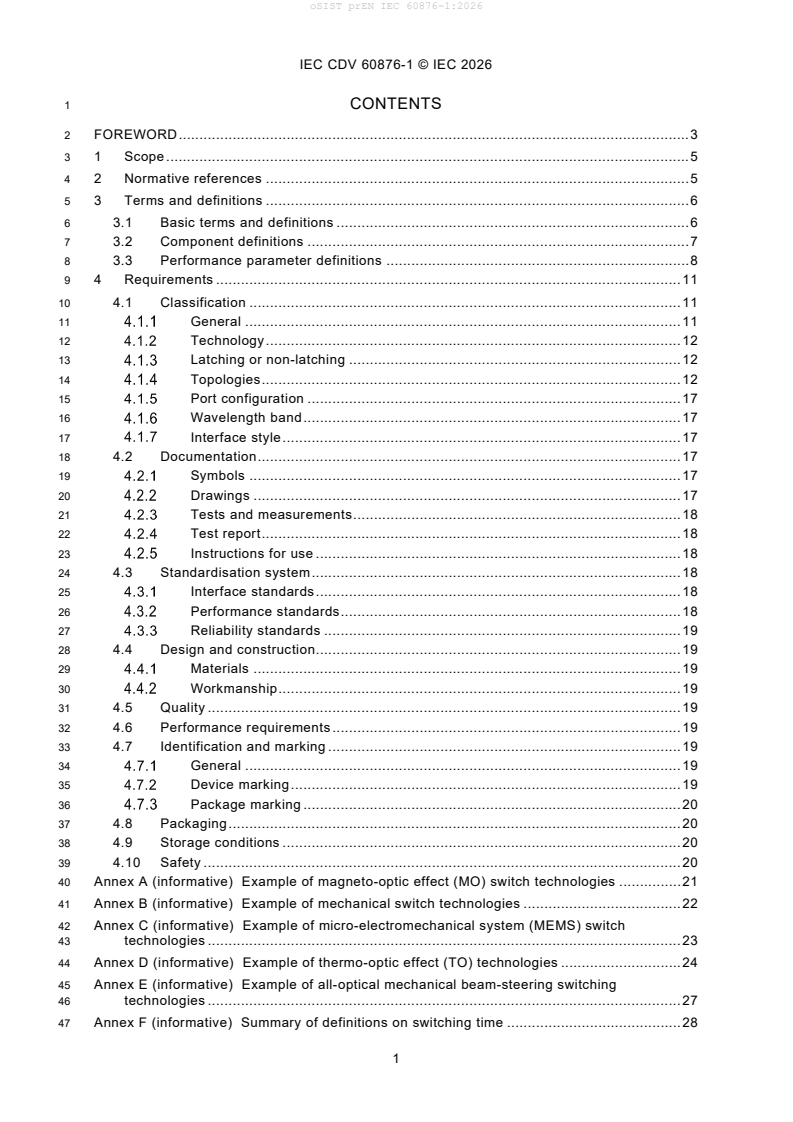
1 CONTENTS
2 FOREWORD . 3
3 1 Scope . 5
4 2 Normative references . 5
5 3 Terms and definitions . 6
6 3.1 Basic terms and definitions . 6
7 3.2 Component definitions . 7
8 3.3 Performance parameter definitions . 8
9 4 Requirements . 11
10 4.1 Classification . 11
11 General . 11
12 Technology . 12
13 Latching or non-latching . 12
14 Topologies . 12
15 Port configuration . 17
16 Wavelength band . 17
17 Interface style . 17
18 4.2 Documentation . 17
19 Symbols . 17
20 Drawings . 17
21 Tests and measurements . 18
22 Test report . 18
23 Instructions for use . 18
24 4.3 Standardisation system . 18
25 Interface standards . 18
26 Performance standards . 18
27 Reliability standards . 19
28 4.4 Design and construction . 19
29 Materials . 19
30 Workmanship . 19
31 4.5 Quality . 19
32 4.6 Performance requirements . 19
33 4.7 Identification and marking . 19
34 General . 19
35 Device marking . 19
36 Package marking . 20
37 4.8 Packaging . 20
38 4.9 Storage conditions . 20
39 4.10 Safety . 20
40 Annex A (informative) Example of magneto-optic effect (MO) switch technologies . 21
41 Annex B (informative) Example of mechanical switch technologies . 22
42 Annex C (informative) Example of micro-electromechanical system (MEMS) switch
43 technologies . 23
44 Annex D (informative) Example of thermo-optic effect (TO) technologies . 24
45 Annex E (informative) Example of all-optical mechanical beam-steering switching
46 technologies . 27
47 Annex F (informative) Summary of definitions on switching time . 28
IEC CDV 60876-1 © IEC 2026
48 Annex G (informative) Example of interface style . 29
49 Bibliography . 30
50 Figure 1 – Representation of latency time, rise time, fall time, bounce time and
51 switching time . 12
52 Figure 2 – Single-pole, single-throw switch . 14
53 Figure 3 – Transfer matrix for one input port and one output port . 14
54 Figure 4 – Single-pole, throw switch . 14
55 Figure 5 – Transfer matrix for one input port and N output ports . 14
56 Figure 6 – N-port matrix switch . 15
57 Figure 7 – Transfer matrix for N-ports switch . 15
58 Figure 8 – Four-port switch without crossover . 16
59 Figure 9 – Four-port switch with crossover . 16
60 Figure 10 – Configuration A, a device containing integral fibre optic pigtails without
61 connectors . 17
62 Figure 11 – Configuration B, a device containing integral fibre optic pigtails, with a
63 connector on each pigtail . 17
64 Figure 12 – Configuration C, a device containing a fibre optic connector as an integral
65 part of the device housing . 17
66 Figure 13 – Standards . 23
67 Figure A.1 – Example of 1×2 MO switch . 27
68 Figure B.1 – Example of mechanical switch (mirror driving type) . 28
69 Figure B.2 – Example of mechanical switch (fibre driving type) . 28
70 Figure C.1 – Example of MEMS switch . 29
71 Figure D.1 – Example of TO switch . 30
72 Figure D.2 – Output power of TO switch . 31
73 Figure D.3 – Example of switching response of TO switch . 31
74 Figure D.4 – 1 × N and N × N examples of TO switch . 32
76 Table 1 – Example of a typical switch classification . 13
77 Table 2 – Transfer matrix of a four-port switch without crossover . 15
78 Table 3 – Transfer matrix of a four-port switch with crossover . 16
79 Table 4 – IEC specification structure . 19
80 Table 5 – Standards interlink matrix . 24
81 Table E.1 – Summary of definitions of latency time . 33
82 Table E.2 – Summary of the definitions of rise time . 33
83 Table E.3 – Summary of the definitions of fall time . 33
IEC CDV 60876-1 © IEC 2026
86 INTERNATIONAL ELECTROTECHNICAL COMMISSION
87 ____________
89 FIBRE OPTIC INTERCONNECTING DEVICES
90 AND PASSIVE COMPONENTS –
91 FIBRE OPTIC SPATIAL SWITCHES –
93 Part 1: Generic specification
95 FOREWORD
96 1) The International Electrotechnical Commission (IEC) is a worldwide organization for standardization comprising
97 all national electrotechnical committees (IEC National Committees). The object of IEC is to promote international
98 co-operation on all questions concerning standardization in the electrical and electronic fields. To this end and
99 in addition to other activities, IEC publishes International Standards, Technical Specifications, Technical Reports,
100 Publicly Available Specifications (PAS) and Guides (hereafter referred to as “IEC Publication(s)”). Their
101 preparation is entrusted to technical committees; any IEC National Committee interested in the subject dealt with
102 may participate in this preparatory work. International, governmental and non-governmental organizations liaising
103 with the IEC also participate in this preparation. IEC collaborates closely with the International Organization for
104 Standardization (ISO) in accordance with conditions determined by agreement between the two organizations.
105 2) The formal decisions or agreements of IEC on technical matters express, as nearly as possible, an international
106 consensus of opinion on the relevant subjects since each technical committee has representation from all
107 interested IEC National Committees.
108 3) IEC Publications have the form of recommendations for international use and are accepted by IEC National
109 Committees in that sense. While all reasonable efforts are made to ensure that the technical content of IEC
110 Publications is accurate, IEC cannot be held responsible for the way in which they are used or for any
111 misinterpretation by any end user.
112 4) In order to promote international uniformity, IEC National Committees undertake to apply IEC Publications
113 transparently to the maximum extent possible in their national and regional publications. Any divergence between
114 any IEC Publication and the corresponding national or regional publication shall be clearly indicated in the latter.
115 5) IEC itself does not provide any attestation of conformity. Independent certification bodies provide conformity
116 assessment services and, in some areas, access to IEC marks of conformity. IEC is not responsible for any
117 services carried out by independent certification bodies.
118 6) All users should ensure that they have the latest edition of this publication.
119 7) No liability shall attach to IEC or its directors, employees, servants or agents including individual experts and
120 members of its technical committees and IEC National Committees for any personal injury, property damage or
121 other damage of any nature whatsoever, whether direct or indirect, or for costs (including legal fees) and
122 expenses arising out of the publication, use of, or reliance upon, this IEC Publication or any other IEC Publications.
123 8) Attention is drawn to the Normative references cited in this publication. Use of the referenced publications is
124 indispensable for the correct application of this publication.
125 9) Attention is drawn to the possibility that some of the elements of this IEC Publication may be the subject of patent
126 rights. IEC shall not be held responsible for identifying any or all such patent rights.
127 International Standard IEC 60876-1 has been prepared by subcommittee SC86B: Fibre optic
128 interconnecting devices and passive components, of IEC technical committee 86: Fibre optics.
129 This sixth edition cancels and replaces the fifth edition published in 2014. This document
130 constitutes a technical revision.
131 This edition includes the following significant technical changes with respect to the previous
132 edition:
133 a) Harmonized terms and definitions with IEC TS 62627-09;
134 b) Changed the content of clause 4, requirements, using references to other existing standards
135 (for example IEC 61753 series) whenever possible;
136 c) Addition of an Annex E with an example of mechanical beam-steering switching
137 technologies;
138 d) Addition of an informative Annex G including examples of interface styles.
IEC CDV 60876-1 © IEC 2026
139 The text of this standard is based on the following documents:
FDIS Report on voting
86B/xxxx/FDIS 86B/xxxx/RVD
141 Full information on the voting for the approval of this standard can be found in the report on
142 voting indicated in the above table.
143 This publication has been drafted in accordance with the ISO/IEC Directives, Part 2.
144 A list of all the parts in the IEC 60876 series, published under the general title Fibre optic
145 interconnecting devices and passive components – Fibre optic spatial switches can be found
146 on the IEC website.
147 The committee has decided that the contents of this publication will remain unchanged until the
148 stability date indicated on the IEC web site under "http://webstore.iec.ch" in the data related to
149 the specific publication. At this date, the publication will be
150 • reconfirmed,
151 • withdrawn,
152 • replaced by a revised edition, or
153 • amended.
IMPORTANT – The 'colour inside' logo on the cover page of this publication indicates
that it contains colours which are considered to be useful for the correct understanding
of its contents. Users should therefore print this document using a colour printer.
IEC CDV 60876-1 © IEC 2026
157 FIBRE OPTIC INTERCONNECTING DEVICES
158 AND PASSIVE COMPONENTS –
159 FIBRE OPTIC SPATIAL SWITCHES –
160 Part 1: Generic specification
162 1 Scope
163 This part of IEC 60876 applies to fibre optic switches possessing all of the following general
164 features:
165 – they are passive in that they contain no optoelectronic or other transducing elements;
166 – they have one or more ports for the transmission of optical power and two or more states in
167 which power may be routed or blocked between these ports;
168 – the ports are optical fibres or fibre optic connectors.
169 2 Normative references
170 The following documents, in whole or in part, are normatively referenced in this document and
171 are indispensable for its application. For dated references, only the edition cited applies. For
172 undated references, the latest edition of the referenced document (including any amendments)
173 applies.
174 IEC 60027 (all parts), Letter symbols to be used in electrical technology
175 IEC 60050-731, International Electrotechnical Vocabulary – Chapter 731: Optical fibre
176 communication
177 IEC 60617 (all parts), Graphical symbols for diagrams (available at )
178 IEC 60695-11-5, Fire hazard testing – Part 11-5: Test flames – Needle-flame test method –
179 Apparatus, confirmatory test arrangement and guidance
180 IEC 60825-1, Safety of laser products – Part 1: Equipment classification and requirements
181 IEC 61300 (all parts), Fibre optic interconnecting devices and passive components – Basic test
182 and measurement procedures
183 IEC 61753 (all parts), Fibre optic interconnecting devices and passive components -
184 Performance standard
185 IEC TR 61930, Fibre optic graphical symbology
186 IEC 62005 (all parts), Reliability of fibre optic interconnecting devices and passive components
187 IEC 62047-1, Semiconductor devices – Micro-electromechanical devices – Part 1: Terms and
188 definitions
189 ISO 129-1, Technical drawings – Indication of dimensions and tolerances – Part 1: General
190 principles
191 ISO 286-1, Geometrical product specifications (GPS) – ISO code system for tolerances on
192 linear sizes – Part 1: Basis of tolerances, deviations and fits
IEC CDV 60876-1 © IEC 2026
193 ISO 1101, Geometrical product specifications (GPS) – Geometrical tolerancing – Tolerances of
194 form, orientation, location and run-out
195 ISO 8601, Data elements and interchange formats – Information interchange – Representation
196 of dates and times
197 3 Terms and definitions
198 For the purposes of this document, the terms and definitions given in IEC 60050-731 and IEC
199 TS 62627-09 and the following apply.
200 ISO and IEC maintain terminology databases for use in standardization at the following
201 addresses:
202 • IEC Electropedia: available at https://www.electropedia.org/
203 • ISO Online browsing platform: available at https://www.iso.org/obp.
204 3.1 Basic terms and definitions
206 switch state
207 particular optical configuration of a switch, whereby optical power is transmitted or blocked
208 between specific ports in a predetermined manner
210 actuation mechanism
211 physical means (mechanical, electrical, acoustic, thermo-optics, etc.) by which a switch is
212 designed to change between states
214 actuation energy
215 input energy required to place a switch in a specific state
217 blocking
218 inability to establish a connection from a free input port to a free output port due to the existence
219 of some other established connection
220 Note 1 to entry: Blocking and various degrees of non-blocking operation functionalities are of various types:
221 “Strict-sense non-blocking” refers to a switch matrix in which it is always possible to establish a connection between
222 any free input port and any free output port, irrespective of previously established connections.
223 “Wide-sense non-blocking” refers to a matrix in which it is always possible to establish a desired connection provided
224 that some systematic procedure is followed in setting up connections. Some multistage switching architectures fall
225 into this category.
226 “Rearrangeably non-blocking” refers to a switch matrix in which any free input port can be connected to any free
227 output port provided that other established connections are unconnected and then reconnected as part of making the
228 new connection.
230 normally on
231 condition where a port pair is in a conducting state when there is no actuation energy applied
232 for a non-latching switch
IEC CDV 60876-1 © IEC 2026
234 normally off
235 condition where a port pair is in an isolated state when there is no actuation energy applied for
236 a non-latching switch
237 3.2 Component definitions
239 optical switch
240 passive component processing one or more ports which selectively transmits, redirects or
241 blocks optical power in an optical fibre transmission line
243 latching switch
244 switch that maintains its last state and specified performance level when the actuation energy
245 which initiated the change is removed
247 non-latching switch
248 switch that reverts to a home state or undefined state when the actuation energy which initiated
249 a change is removed
251 magneto-optic effect switch
252 MO switch
253 optical switch which uses the magneto-optic effect (phenomenon of polarization state change
254 in transmitted light and reflected light due to a magnetic field)
255 Note 1 to entry: Annex A shows an example of magneto-optic effect swich technologies.
257 mechanical switch
258 optical switch which realises the switching function by driving of the movable part
259 Note 1 to entry: Annex B shows an example of mechanical swich technologies.
261 micro-electromechanical system switch
262 MEMS switch
263 optical switch using MEMS technology
264 Note 1 to entry: the Term of MEMS is defined in IEC 62047-1.
265 Note 2 to entry: Annex C shows example of micro-mechanical system swich technologies.
267 thermo-optic effect switch
268 TO switch
269 optical switch which uses the thermo-optic effect (phenomenon of refractive index change
270 caused by temperature variation)
271 Note 1 to entry: Annex D shows an example of thermo-optic effect swich technologies.
272 3.2.8
273 mechanical beam steering optical switch
274 optical switch which uses the mechanical beam steering technology using arrayed collimated
275 beams
276 Note 1 to entry: Annex E shows an example of mechanical beam steering technologies.
IEC CDV 60876-1 © IEC 2026
277 3.3 Performance parameter definitions
279 operating wavelength
280 λ
281 nominal wavelength at which a passive component is designed to operate with the specified
282 performance
284 insertion loss
285 maximum value of logarithmic transmission coefficient, a (where i ≠ j) within the passband of
ij
286 a passive optical device (component) in case of a conducting port pair
287 Note 1 to entry: It is the reduction in optical power between an input and output port of a passive component
288 expressed in decibels and is defined as follows:
289 a = –10 log (P /P )
ij 10 j i
290 where
291 P is the optical power launched into the input port, and
i
292 P is the optical power received from the output port.
j
293 Note 2 to entry: The insertion loss values depend on the state of the switch.
294 [SOURCE: IEC TS 62627-09, Ed.1, 3.4.8]
296 return loss
297 element of logarithmic transmission coefficient, a (where i = j) of the logarithmic transfer matrix
ij
298 Note 1 to entry: It is the fraction of input power that is returned from a port of a passive component and is defined
299 as follows:
300 RL = –10 log (P /P )
i 10 refl i
301 where
302 P is the optical power launched into a port, and
i
303 P is the optical power received back from the same port.
refl
304 Note 2 to entry: The return loss values depend on the state of the switch.
305 [SOURCE: IRC TS 62627-09, Ed.1, 3.4.9.]
307 crosstalk
308 ratio of the output power of the isolated input port to the output power of the conducting input
309 port for an output port
311 latency time
312 3.3.5.1
313 latency time
314 t
l
315 elapsed time for the output power of a
316 specified output port to reach 10 % of its steady-state value from the time the actuation energy
317 is applied, when switching from an isolated state to conducting state, normally-off for a non-
318 latching switch, or a latching switch
319 Note 1 to entry: See Figure 1.
IEC CDV 60876-1 © IEC 2026
320 3.3.5.2
321 latency time
322 t ’
l
323
324 elapsed time for the output power of a specified output port to reach 90 % of its steady-state
325 value from the time the actuation energy is removed. when switching from a conducting state
326 to isolated state, normally-off for a non-latching switch
327 Note 1 to entry: See Figure 1.
328 3.3.5.3
329 latency time
330 t ’
l
331 elapsed time when the
332 output power of a specified output port reaches 90 % of its steady-state value from the time the
333 actuation energy is applied, when switching from a conducting state to isolated state, for a
334 latching switch
335 Note 1 to entry: See Figure 1.
336 Note 2 to entry: See Annex F.
338 rise time
339 elapsed time when the output power of the specified output port rises from 10 % of the steady-
340 state value to 90 % of the steady-state value
342 fall time
343 elapsed time when the output power of the specified output port falls from 90 % of the steady-
344 state value to 10 % of the steady-state value
346 bounce time
347 3.3.8.1
348 bounce time
349 t
b
350 elapsed time when the output power of a
351 specified output port maintains betw
...