

SIST EN 16485:2026
(Main)Round and sawn timber - Environmental Product Declarations - Product category rules for wood and wood-based products for use in construction
General Information
- Abstract
This document provides general product category rules (PCR) for Type III environmental declarations for wood and wood-based products, including wood-based panels, for use in construction and related construction and in-service processes.
This document complements the core rules for the product category of construction products as defined in EN 15804 and is intended to be used in conjunction with EN 15804.
This document does not cover the assessment of social and economic performances at product level.
The core PCR:
— define the parameters to be declared and the way in which they are collated and reported;
— describe which stages of a product’s life cycle are considered in the EPD and which processes are to be included in the life cycle stages;
— define rules for the development of scenarios;
— include the rules for calculating the life cycle inventory and the life cycle impact assessment underlying the EPD, including the specification of the data quality to be applied;
— include the rules for reporting predetermined, environmental and health information, that is not covered by LCA for a product, construction process and construction service where necessary;
— define the conditions under which construction products can be compared based on the information provided by EPD.
For the EPD of construction services, the same rules and requirements apply as for the EPD of construction products.
Additionally, to the common parts of EN 15804, this document for wood and wood-based products:
— defines the system boundaries;
— defines the rules for modelling and assessment of material-specific characteristics such as carbon content and net calorific value of wood;
— defines allocation procedures for multi-output processes along the wood chain;
— defines allocation procedures for reuse, recycling and energy recovery;
— includes the rules for calculating the life cycle inventory and the life cycle impact assessment underlying the EPD, including the assessment of carbon and net calorific value of wood;
— provides guidance/specific rules for the determination of the reference service life (RSL).
- Status
- Published
- Public Enquiry End Date
- 12-Sep-2023
- Publication Date
- 03-May-2026
- Technical Committee
- LLZ - Les, lesni izdelki in zaščita lesa
- Current Stage
- 6060 - National Implementation/Publication (Adopted Project)
- Start Date
- 17-Apr-2026
- Due Date
- 22-Jun-2026
- Completion Date
- 04-May-2026

Overview
SIST EN 16485:2026 is a European standard developed by CEN that specifies product category rules (PCR) for preparing Type III Environmental Product Declarations (EPD) for round and sawn timber, as well as for a wide range of wood-based products used in construction. As an essential complement to EN 15804, this standard ensures that environmental data for wood and wood-based construction products is collected, analyzed, and communicated in a harmonized way, thereby supporting transparent sustainability assessments within the construction sector.
The standard covers all stages of a product’s life cycle, from raw material acquisition through production, use, and end-of-life phases. It also provides specific rules for dealing with the unique characteristics of wood, such as biogenic carbon storage and energy content, delivering greater accuracy and comparability for EPDs in the wood product category.
Key Topics
- Product Category Rules (PCR): Defines which parameters must be reported in EPDs, how they are collated, and the data quality required.
- Life Cycle Assessment (LCA) Alignment: Establishes rules for life cycle inventory and impact assessment, ensuring compliance with EN 15804 and EN ISO 14044.
- Material-Specific Guidance: Sets boundaries and modeling approaches specific to wood, including treatment of carbon content and net calorific value.
- Co-Product and Recycling Allocation: Clarifies allocation methods for multi-output processes, recycling, energy recovery, and material re-use in the wood value chain.
- Reference Service Life (RSL): Provides explicit guidance for determining RSL for wood and wood-based products in construction applications.
- System Boundaries: Specifies the inclusion of different life cycle stages (cradle-to-gate, cradle-to-grave) and defines how biogenic carbon flows are accounted.
- Environmental Impact Communication: Outlines how to communicate additional environmental or health information not covered by LCA, supporting full disclosure.
- Comparability: Sets the conditions under which environmental impacts of construction products can be fairly compared using EPDs.
- Terminology and Data Consistency: Standardizes key terms and reporting structures relevant to timber and wood-based construction products.
Applications
SIST EN 16485:2026 is a crucial reference for:
- EPD Program Operators: Offers a clear methodology to produce, verify, and publish EPDs for wood products in construction.
- Manufacturers of Wood and Wood-Based Products: Helps collect and report environmental performance data, enabling market differentiation through transparency.
- Sustainability Consultants and LCA Practitioners: Provides detailed product category rules to ensure that LCAs and EPDs for timber and wood-based construction products are consistent, accurate, and comparable.
- Architects, Designers, and Specifiers: Facilitates the evaluation and selection of environmentally responsible wood products for sustainable building projects.
- Green Building Certification Schemes: Supports compliance with eco-labeling, procurement standards, and building certification systems that require verified, standardized environmental data.
Related Standards
For a holistic approach to sustainability and environmental declarations in the construction sector, SIST EN 16485:2026 should be used in conjunction with:
- EN 15804: Core rules for the product category of construction products.
- EN 15643: Framework for the assessment of the sustainability of construction works.
- EN ISO 14044: Requirements and guidelines for life cycle assessment.
- EN 15978: Method for assessing the environmental performance of buildings.
- CEN/TR 15941: Methodology for selection and use of generic data in EPDs.
- EN 15942: Communication format for business-to-business EPDs.
By following SIST EN 16485:2026, stakeholders ensure that environmental claims and sustainability assessments for wood and wood-based building products are robust, credible, and aligned with European best practices, supporting environmental transparency and sustainable construction across the industry.
Relations
- Effective Date
- 13-May-2026
- Effective Date
- 13-May-2026
- Effective Date
- 13-May-2026
- Effective Date
- 13-May-2026
- Effective Date
- 15-Apr-2026
- Effective Date
- 15-Apr-2026
- Effective Date
- 15-Apr-2026
- Effective Date
- 19-Jan-2023
Get Certified
Connect with accredited certification bodies for this standard

BSI Group
BSI (British Standards Institution) is the business standards company that helps organizations make excellence a habit.

Bureau Veritas
Bureau Veritas is a world leader in laboratory testing, inspection and certification services.

DNV
DNV is an independent assurance and risk management provider.
Sponsored listings
Frequently Asked Questions
SIST EN 16485:2026 is a standard published by the Slovenian Institute for Standardization (SIST). Its full title is "Round and sawn timber - Environmental Product Declarations - Product category rules for wood and wood-based products for use in construction". This standard covers: This document provides general product category rules (PCR) for Type III environmental declarations for wood and wood-based products, including wood-based panels, for use in construction and related construction and in-service processes. This document complements the core rules for the product category of construction products as defined in EN 15804 and is intended to be used in conjunction with EN 15804. This document does not cover the assessment of social and economic performances at product level. The core PCR: — define the parameters to be declared and the way in which they are collated and reported; — describe which stages of a product’s life cycle are considered in the EPD and which processes are to be included in the life cycle stages; — define rules for the development of scenarios; — include the rules for calculating the life cycle inventory and the life cycle impact assessment underlying the EPD, including the specification of the data quality to be applied; — include the rules for reporting predetermined, environmental and health information, that is not covered by LCA for a product, construction process and construction service where necessary; — define the conditions under which construction products can be compared based on the information provided by EPD. For the EPD of construction services, the same rules and requirements apply as for the EPD of construction products. Additionally, to the common parts of EN 15804, this document for wood and wood-based products: — defines the system boundaries; — defines the rules for modelling and assessment of material-specific characteristics such as carbon content and net calorific value of wood; — defines allocation procedures for multi-output processes along the wood chain; — defines allocation procedures for reuse, recycling and energy recovery; — includes the rules for calculating the life cycle inventory and the life cycle impact assessment underlying the EPD, including the assessment of carbon and net calorific value of wood; — provides guidance/specific rules for the determination of the reference service life (RSL).
This document provides general product category rules (PCR) for Type III environmental declarations for wood and wood-based products, including wood-based panels, for use in construction and related construction and in-service processes. This document complements the core rules for the product category of construction products as defined in EN 15804 and is intended to be used in conjunction with EN 15804. This document does not cover the assessment of social and economic performances at product level. The core PCR: — define the parameters to be declared and the way in which they are collated and reported; — describe which stages of a product’s life cycle are considered in the EPD and which processes are to be included in the life cycle stages; — define rules for the development of scenarios; — include the rules for calculating the life cycle inventory and the life cycle impact assessment underlying the EPD, including the specification of the data quality to be applied; — include the rules for reporting predetermined, environmental and health information, that is not covered by LCA for a product, construction process and construction service where necessary; — define the conditions under which construction products can be compared based on the information provided by EPD. For the EPD of construction services, the same rules and requirements apply as for the EPD of construction products. Additionally, to the common parts of EN 15804, this document for wood and wood-based products: — defines the system boundaries; — defines the rules for modelling and assessment of material-specific characteristics such as carbon content and net calorific value of wood; — defines allocation procedures for multi-output processes along the wood chain; — defines allocation procedures for reuse, recycling and energy recovery; — includes the rules for calculating the life cycle inventory and the life cycle impact assessment underlying the EPD, including the assessment of carbon and net calorific value of wood; — provides guidance/specific rules for the determination of the reference service life (RSL).
SIST EN 16485:2026 is classified under the following ICS (International Classification for Standards) categories: 13.020.99 - Other standards related to environmental protection; 79.040 - Wood, sawlogs and sawn timber; 91.010.99 - Other aspects; 91.080.20 - Timber structures. The ICS classification helps identify the subject area and facilitates finding related standards.
SIST EN 16485:2026 has the following relationships with other standards: It is inter standard links to SIST EN ISO 14044:2006/A2:2020, SIST ISO 14067:2023, SIST EN 15804:2012+A2:2019, SIST EN ISO 14044:2006, SIST EN 14081-1:2016+A1:2019, SIST EN 14081-1:2016, SIST EN 16810:2017, SIST EN 16485:2014. Understanding these relationships helps ensure you are using the most current and applicable version of the standard.
SIST EN 16485:2026 is associated with the following European legislation: EU Directives/Regulations: 305/2011. When a standard is cited in the Official Journal of the European Union, products manufactured in conformity with it benefit from a presumption of conformity with the essential requirements of the corresponding EU directive or regulation.
SIST EN 16485:2026 is available in PDF format for immediate download after purchase. The document can be added to your cart and obtained through the secure checkout process. Digital delivery ensures instant access to the complete standard document.
Standards Content (Sample)
SLOVENSKI STANDARD
01-junij-2026
Okrogli in žagani les - Okoljske deklaracije za proizvode - Pravila za kategorije
proizvodov za les in lesne kompozite za uporabo v gradbeništvu
Round and sawn timber - Environmental Product Declarations - Product category rules
for wood and wood-based products for use in construction
Rund- und Schnittholz - Umweltproduktdeklarationen - Produktkategorieregeln für Holz
und Holzwerkstoffe im Bauwesen
Bois ronds et sciages - Déclarations environnementales de produits - Règles de
définition des catégories de produits en bois et à base de bois pour l'utilisation en
construction
Ta slovenski standard je istoveten z: EN 16485:2026
ICS:
13.020.99 Drugi standardi v zvezi z Other standards related to
varstvom okolja environmental protection
79.040 Les, hlodovina in žagan les Wood, sawlogs and sawn
timber
91.080.20 Lesene konstrukcije Timber structures
2003-01.Slovenski inštitut za standardizacijo. Razmnoževanje celote ali delov tega standarda ni dovoljeno.
EN 16485
EUROPEAN STANDARD
NORME EUROPÉENNE
April 2026
EUROPÄISCHE NORM
ICS 91.010.99; 91.080.20 Supersedes EN 16485:2014
English Version
Round and sawn timber - Environmental product
declarations - Product category rules for wood and wood-
based products for use in construction
Bois ronds et sciages - Déclarations environnementales Rund- und Schnittholz - Umweltproduktdeklarationen
de produits - Règles de définition des catégories de - Produktkategorieregeln für Holz und Holzwerkstoffe
produits en bois et à base de bois pour l'utilisation en im Bauwesen
construction
This European Standard was approved by CEN on 23 February 2026.
CEN members are bound to comply with the CEN/CENELEC Internal Regulations which stipulate the conditions for giving this
European Standard the status of a national standard without any alteration. Up-to-date lists and bibliographical references
concerning such national standards may be obtained on application to the CEN-CENELEC Management Centre or to any CEN
member.
This European Standard exists in three official versions (English, French, German). A version in any other language made by
translation under the responsibility of a CEN member into its own language and notified to the CEN-CENELEC Management
Centre has the same status as the official versions.
CEN members are the national standards bodies of Austria, Belgium, Bulgaria, Croatia, Cyprus, Czech Republic, Denmark, Estonia,
Finland, France, Germany, Greece, Hungary, Iceland, Ireland, Italy, Latvia, Lithuania, Luxembourg, Malta, Netherlands, Norway,
Poland, Portugal, Republic of North Macedonia, Romania, Serbia, Slovakia, Slovenia, Spain, Sweden, Switzerland, Türkiye and
United Kingdom.
EUROPEAN COMMITTEE FOR STANDARDIZATION
COMITÉ EUROPÉEN DE NORMALISATION
EUROPÄISCHES KOMITEE FÜR NORMUNG
CEN-CENELEC Management Centre: Rue de la Science 23, B-1040 Brussels
© 2026 CEN All rights of exploitation in any form and by any means reserved Ref. No. EN 16485:2026 E
worldwide for CEN national Members.
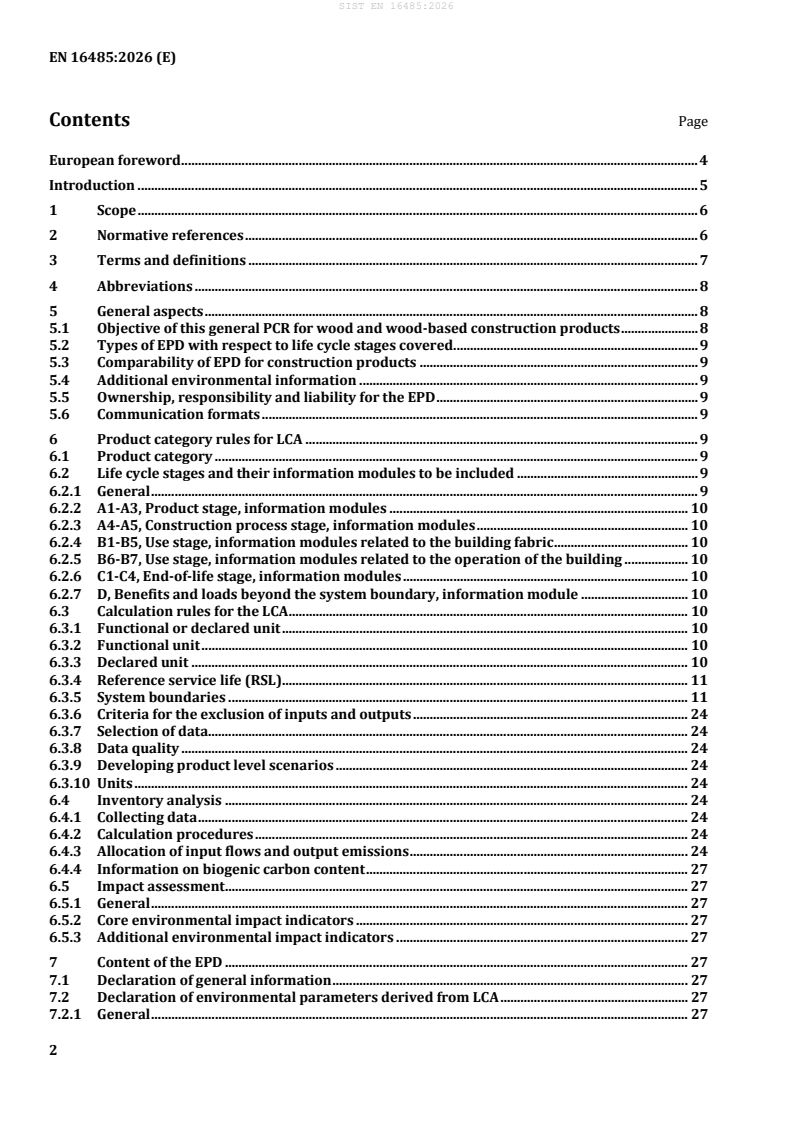
Contents Page
European foreword . 4
Introduction . 5
1 Scope . 6
2 Normative references . 6
3 Terms and definitions . 7
4 Abbreviations . 8
5 General aspects . 8
5.1 Objective of this general PCR for wood and wood-based construction products . 8
5.2 Types of EPD with respect to life cycle stages covered . 9
5.3 Comparability of EPD for construction products . 9
5.4 Additional environmental information . 9
5.5 Ownership, responsibility and liability for the EPD . 9
5.6 Communication formats . 9
6 Product category rules for LCA . 9
6.1 Product category . 9
6.2 Life cycle stages and their information modules to be included . 9
6.2.1 General . 9
6.2.2 A1-A3, Product stage, information modules . 10
6.2.3 A4-A5, Construction process stage, information modules . 10
6.2.4 B1-B5, Use stage, information modules related to the building fabric . 10
6.2.5 B6-B7, Use stage, information modules related to the operation of the building . 10
6.2.6 C1-C4, End-of-life stage, information modules . 10
6.2.7 D, Benefits and loads beyond the system boundary, information module . 10
6.3 Calculation rules for the LCA . 10
6.3.1 Functional or declared unit . 10
6.3.2 Functional unit . 10
6.3.3 Declared unit . 10
6.3.4 Reference service life (RSL). 11
6.3.5 System boundaries . 11
6.3.6 Criteria for the exclusion of inputs and outputs . 24
6.3.7 Selection of data . 24
6.3.8 Data quality . 24
6.3.9 Developing product level scenarios . 24
6.3.10 Units . 24
6.4 Inventory analysis . 24
6.4.1 Collecting data . 24
6.4.2 Calculation procedures . 24
6.4.3 Allocation of input flows and output emissions . 24
6.4.4 Information on biogenic carbon content . 27
6.5 Impact assessment . 27
6.5.1 General . 27
6.5.2 Core environmental impact indicators . 27
6.5.3 Additional environmental impact indicators . 27
7 Content of the EPD . 27
7.1 Declaration of general information . 27
7.2 Declaration of environmental parameters derived from LCA . 27
7.2.1 General . 27
7.2.2 Rules for declaring LCA information per module . 27
7.2.3 Indicators describing environmental impacts based on life cycle impact assessment (LCIA)
................................................................................................................................................................................ 28
7.2.4 Indicators describing resource use and environmental information based on life cycle
inventory (LCI) . 28
7.3 Scenarios and additional technical information. 28
7.3.1 General . 28
7.3.2 Construction process stage . 29
7.3.3 B1-B7 use stage . 29
7.3.4 End-of-life. 29
7.4 Additional information on release of dangerous substances to indoor air, soil and water
during the use stage . 29
7.4.1 Indoor air . 29
7.4.2 Soil and water . 29
7.5 Aggregation of information modules . 29
7.6 Additional environmental information . 29
7.6.1 Additional information on carbon offset, carbon storage and delayed emissions . 29
7.6.2 Additional information on sustainable forest management and wood traceability . 30
8 Project report . 30
8.1 General . 30
8.2 LCA-related elements of the project report . 30
8.3 Documentation on additional information . 30
8.4 Data availability for verification . 30
9 Verification and validity of an EPD . 30
Annex A (normative) Requirements and guidance on the reference service life . 31
Annex B (informative) Waste . 32
Annex C (normative) Impact categories and related indicators, methodologies and
characterization factors (CF) . 33
Annex D (informative) End of life formulae. 34
Annex E (informative) Schemes to be applied for data quality assessment of generic and specific
data . 35
Annex F (informative) Example calculations of delayed emissions resulting from temporary
biogenic carbon storage in wood products . 36
Annex G (informative) Allocation formulas example . 38
Bibliography . 43
European foreword
This document (EN 16485:2026) has been prepared by Technical Committee CEN/TC 175 “Round and
sawn timber”, the secretariat of which is held by AFNOR.
This European Standard shall be given the status of a national standard, either by publication of an identical
text or by endorsement, at the latest by October 2026, and conflicting national standards shall be
withdrawn at the latest by October 2026.
Attention is drawn to the possibility that some of the elements of this document may be the subject of
patent rights. CEN shall not be held responsible for identifying any or all such patent rights.
This document supersedes EN 16485:2014.
— new figures and examples for the systems boundaries in the calculation rules for the LCA (6.3.5);
— proposal for co-product allocation (6.4.3.2);
— addition of new chapter Additional environmental information (7.6);
— addition of five informative annexes and two normative annexes.
Any feedback and questions on this document should be directed to the users’ national standards body. A
complete listing of these bodies can be found on the CEN website.
According to the CEN-CENELEC Internal Regulations, the national standards organisations of the following
countries are bound to implement this European Standard: Austria, Belgium, Bulgaria, Croatia, Cyprus,
Czech Republic, Denmark, Estonia, Finland, France, Germany, Greece, Hungary, Iceland, Ireland, Italy,
Latvia, Lithuania, Luxembourg, Malta, Netherlands, Norway, Poland, Portugal, Republic of North
Macedonia, Romania, Serbia, Slovakia, Slovenia, Spain, Sweden, Switzerland, Türkiye and the United
Kingdom.
Introduction
EN 15804 provides core product category rules for all construction products and services. It provides a
structure to ensure that all environmental product declarations (EPD) of construction products,
construction services and construction processes are derived, verified and presented in a harmonized way.
This document provides rules for environmental product declarations (EPD) specifically for wood and
wood-based products. It complements the core product category rules for all construction products and
services as established in EN 15804.
An EPD communicates verifiable, accurate, non-misleading environmental information for products and
their applications, thereby supporting scientifically based, fair choices and stimulating the potential for
market-driven continuous environmental improvement.
The standardization process has taken place in accordance with EN ISO 14025. All common issues are
covered horizontally for all product types in order to minimize vertical (branch specific) deviations. All
common issues are covered horizontally for all wood and wood-based products in order to minimize intra-
sectoral deviations.
EPD information is expressed in information modules as defined in EN 15804, which allow easy
organization and expression of data packages throughout the life cycle of wood and wood-based products.
The approach requires that the underlying data are consistent, reproducible and comparable.
In line with EN 15804, the EPD is expressed in a form that allows aggregation (addition) to provide
complete information for buildings and other construction works. This document does not deal with
aggregation at the building level, nor does it describe the rules for applying EPD in a building assessment.
This document provides the means for developing a Type III environmental declaration of wood and wood-
based construction products in the context of the suite of standards that are intended to assess the
sustainability of construction works.
This suite of standards includes:
— EN 15643, Sustainability of construction works - Framework for assessment of buildings and civil
engineering works “
— EN 15978, Sustainability of construction works — Assessment of environmental performance of buildings
— Calculation method
— EN 15804:2012+A2:2019, Sustainability of construction works — Environmental product declarations
— Core rules for the product category of construction products
— EN 15941:2024, Sustainability of construction works — Environmental product declarations —
Methodology for selection and use of generic data
— EN 15942, Sustainability of construction works — Environmental product declarations —
Communication format business to business
1 Scope
This document provides general product category rules (PCR) for Type III environmental declarations for
wood and wood-based products, including wood-based panels, for use in construction and related
construction and in-service processes.
This document complements the core rules for the product category of construction products as defined
in EN 15804 and is intended to be used in conjunction with EN 15804.
This document does not cover the assessment of social and economic performances at product level.
The core PCR:
— define the parameters to be declared and the way in which they are collated and reported;
— describe which stages of a product’s life cycle are considered in the EPD and which processes are to be
included in the life cycle stages;
— define rules for the development of scenarios;
— include the rules for calculating the life cycle inventory and the life cycle impact assessment underlying
the EPD, including the specification of the data quality to be applied;
— include the rules for reporting predetermined, environmental and health information, that is not
covered by LCA for a product, construction process and construction service where necessary;
— define the conditions under which construction products can be compared based on the information
provided by EPD.
For the EPD of construction services, the same rules and requirements apply as for the EPD of construction
products.
Additionally, to the common parts of EN 15804, this document for wood and wood-based products:
— defines the system boundaries;
— defines the rules for modelling and assessment of material-specific characteristics such as carbon
content and net calorific value of wood;
— defines allocation procedures for multi-output processes along the wood chain;
— defines allocation procedures for reuse, recycling and energy recovery;
— includes the rules for calculating the life cycle inventory and the life cycle impact assessment
underlying the EPD, including the assessment of carbon and net calorific value of wood;
— provides guidance/specific rules for the determination of the reference service life (RSL).
2 Normative references
The following documents are referred to in the text in such a way that some or all of their content
constitutes requirements of this document. For dated references, only the edition cited applies. For
undated references, the latest edition of the referenced document (including any amendments) applies.
EN ISO 14044:2006 , Environmental management — Life cycle assessment — Requirements and guidelines
(ISO 14044:2006)
EN 15804:2012+A2:2019, Sustainability of construction works — Environmental product declarations —
Core rules for the product category of construction products
ISO 14067:2018, Greenhouse gases — Carbon footprint of products — Requirements and guidelines for
quantification
3 Terms and definitions
For the purposes of this document, the terms and definitions given in EN 15804:2012+A2:2019 and the
following apply.
ISO and IEC maintain terminology databases for use in standardization at the following addresses:
— ISO Online browsing platform: available at https://www.iso.org/obp
— IEC Electropedia: available at https://www.electropedia.org
3.1
co-product
any of two or more marketable materials, products, or fuels from the same unit process, but which is not
the object of the assessment
Note 1 to entry: Co-product, by-product and product have the same status and are used for identification of several
distinguished flows of products from the same unit process. From co-product, by-product and product, waste is the
only output to be distinguished as a non-product.
[SOURCE: EN 15804:2012+A2:2019, 3.8]
3.2
biogenic carbon
carbon derived from/contained in biomass
3.3
biomass
material of biological origin excluding material embedded in geological formations and material
transformed to fossilised material
3.4
biogenic carbon balance
balance of biogenic carbon of a defined carbon pool, made up of net uptake/carbon inflow and release of
carbon/carbon outflow
Note 1 to entry: In the case of wood products, the biogenic carbon being transferred from forest biomass onto the
product system and released during natural decay or incineration.
As impacted by EN ISO 14044:2006/A2:2020.
3.5
direct land use change
change in human use or management of land at the location of the production, use or disposal of raw
materials, intermediate products and final products or wastes in the product system being assessed
[SOURCE: ISO 14050:2020, 3.8.19]
3.6
carbon pool
reservoir, a component or components of the climate system where a greenhouse gas or a precursor of a
greenhouse gas is stored, examples of carbon pools are forest biomass, wood products, soils and the
atmosphere, the units are mass
Note 1 to entry: The forest carbon reservoir is subdivided into the five pools: above-ground biomass, below-ground
biomass, litter, dead wood and soil organic carbon.
[SOURCE: IPCC 2006, Table 1.1]
3.7
fossil carbon
carbon which is contained in fossilised material
Note 1 to entry: Examples of fossilised material are coal, oil and natural gas.
3.8
recovered wood
all kind of wood material which, at the end of its life cycle in wooden products, is made available for re-use,
recycling or energy recovery
4 Abbreviations
EPD environmental product declaration
PCR product category rules
LCA life cycle assessment
LCI life cycle inventory analysis
LCIA life cycle impact assessment
RSL reference service life
GWP global warming potential
GHG greenhouse gas
CHP combined heat and power
5 General aspects
5.1 Objective of this general PCR for wood and wood-based construction products
An EPD according to this document provides quantified environmental information for wood and wood-
based construction product or related service on a harmonized and scientific basis. It also provides
information on health related emissions to indoor air, soil and water during the use stage of the building.
The purpose of an EPD in the construction sector is to provide the basis for assessing buildings and other
construction works and identifying those which cause less stress to the environment.
Thus, the objective of this general PCR for wood and wood-based products is to ensure:
— the provision of verifiable and consistent data for an EPD, based on LCA;
— the provision of verifiable and consistent product related technical data or scenarios for the
assessment of the environmental performance of buildings;
— the provision of verifiable and consistent product related technical data or scenarios potentially related
to the health of users for the assessment of the performance of buildings;
— that comparisons between construction products are carried out in the context of their application in
the building, as explained in EN 15804:2012+A2:2019 Clause 5.3;
— the communication of the environmental information of construction products from business to
business;
— the basis, subject to additional requirements, for the communication of the environmental information
of construction products to consumers.
Declarations based on this document are not comparative assertions.
NOTE See definition 3.4 of EN 15804:2012+A2:2019 and EN ISO 14044:2006 , 5.1 for more information
concerning LCA used for comparative assertion.
5.2 Types of EPD with respect to life cycle stages covered
EN 15804:2012+A2:2019 shall apply.
5.3 Comparability of EPD for construction products
EN 15804:2012+A2:2019 shall apply.
5.4 Additional environmental information
EN 15804:2012+A2:2019 shall apply.
5.5 Ownership, responsibility and liability for the EPD
EN 15804:2012+A2:2019 shall apply.
5.6 Communication formats
EN 15804:2012+A2:2019 shall apply.
6 Product category rules for LCA
6.1 Product category
The product category referred to in this document includes all wood and wood-based construction
products as well as related construction services for buildings and other construction works.
6.2 Life cycle stages and their information modules to be included
6.2.1 General
EN 15804:2012+A2:2019 shall apply.
6.2.2 A1-A3, Product stage, information modules
EN 15804:2012+A2:2019 shall apply.
6.2.3 A4-A5, Construction process stage, information modules
EN 15804:2012+A2:2019 shall apply.
6.2.4 B1-B5, Use stage, information modules related to the building fabric
EN 15804:2012+A2:2019 shall apply.
6.2.5 B6-B7, Use stage, information modules related to the operation of the building
EN 15804:2012+A2:2019 shall apply.
6.2.6 C1-C4, End-of-life stage, information modules
EN 15804:2012+A2:2019 shall apply.
6.2.7 D, Benefits and loads beyond the system boundary, information module
EN 15804:2012+A2:2019 shall apply.
6.3 Calculation rules for the LCA
6.3.1 Functional or declared unit
EN 15804:2012+A2:2019 shall apply.
6.3.2 Functional unit
6.3.2.1 General
EN 15804:2012+A2:2019 shall apply with the following addition:
— When communicating the functional unit of an EPD, the apparent density and moisture content of wood
and wood-based products shall be provided as complementary information.
— Values for apparent density and moisture content can be taken from product or application standards
and should reflect the respective values underlying the LCA calculations.
6.3.2.2 Performance in a functional unit
EN 15804:2012+A2:2019 shall apply.
6.3.3 Declared unit
EN 15804:2012+A2:2019 should apply with the following addition:
The declared unit is used instead of the functional unit when the precise function of the product or
scenarios at the building level is not stated or is unknown. The declared unit provides a reference by means
of which the material flows of the information module of a construction product are normalized (in a
mathematical sense) to produce data, expressed on a common basis. It provides the reference for
combining material flows attributed to the construction product and for combining environmental impacts
for the selected stages of the construction product’s incomplete life cycle (see 6.5). The declared unit shall
relate to the typical applications of products.
The declared unit in the EPD shall be one of the unit types listed below. A different unit may be declared
for reasons that shall be explained and in such cases information shall be provided on how to convert this
unit to one or more of the required unit types:
— an item, an assemblage of items, e.g. roof truss;
3 3
— volume (m ), e.g. 1 m of sawn timber;
— mass (kg), e.g. wood chips, recovered wood;
— length (m), e.g. 1 m of wood moulding;
2 2 2 2
— area (m ), e.g. 1 m of wall elements; 1 m of wood flooring; 1 m of wood-based panel.
If the declared unit is not expressed in mass, then a conversion factor, e.g. to 1 kg of material shall be
provided.
For the development of, for example, transport and disposal scenarios, conversion factors to mass per
declared unit shall be provided.
For the development of, e.g. transport and disposal scenarios, the apparent density and moisture content
shall be part of the declared unit provided.
NOTE 1 Reasons for declaring units other than those listed include the need to use units normally used for design,
planning, procurement and sale.
NOTE 2 CEN Technical Committees for product standards are expected to harmonize the declared unit to be used
for their product families.
6.3.4 Reference service life (RSL)
6.3.4.1 General
EN 15804:2012+A2:2019 shall apply.
6.3.4.2 Scenarios for RSL and functional unit
EN 15804:2012+A2:2019 shall apply.
6.3.5 System boundaries
6.3.5.1 General
6.3.5.1.1 General
EN 15804:2012+A2:2019 shall apply with the additions related to the treatment of wood (a) as part of the
biogenic carbon cycle and the associated inherent property of biogenic carbon content and (b) its inherent
property of having a calorific value (6.3.5.1.2 to 6.3.5.1.5).
6.3.5.1.2 Treatment of wood inherent properties such as biogenic carbon content and net calorific
value
In line with requirements as set out in EN 15804:2012+A2:2019, specific inherent properties of materials
shall always be reflected in physical mass flows. For wood, this concerns the two relevant properties
“biogenic carbon content” and “net calorific value”. However, due to its nature as a renewable raw material
as well as due the different aspects which are intended to be addressed with the application of the relevant
indicators of the environmental assessment, these properties are handled differently, not least to comply
with the applicable provisions of EN 15804.
On the one hand, wood or wood-based products can be used not only as raw material e.g. in construction
works, but also as an energy source along the entire value and process chain up to the end of their life cycle
due to their inherent calorific value. This energy-relevant aspect is reflected both in the resource indicators
“Use of renewable primary energy excluding renewable primary energy resources used as raw materials”
(in MJ) and “Use of renewable primary energy resources used as raw materials” (in MJ). Additionally, wood
can also be reused and is therefore available as a secondary raw material for renewed material and/or
subsequent energy use as recovered wood (cascade use). EN 15804 provides the two indicators “use as
secondary material” (in kg) and “Use of renewable secondary fuels” (in MJ) for this aspect. Since the specific
treatment of the material’s inherent property “net calorific value” in relation to most of these indicators
describe resource use which becomes relevant especially at the end of life phase of woody construction
products, especially the relevant section 6.3.5.5 provides further specific guidance.
The only exception to this concerns the handling of the property “net calorific value” of waste wood, which
is included in the separate EN 15804 resource indicator “Use of renewable secondary fuels” which – in
terms of consistency with the treatment the property “biogenic carbon content” – is also dealt with in
section 6.3.5.1.4.
On the other hand, the renewable resource wood is part of the natural carbon cycle of forests and consists
of around 50 % of its dry mass of carbon as an inherent property. This connection is reflected in the core
environmental impact indicators “Global warming potential biogenic” (GWP-biogenic) and “Global
warming potential land use and land use change” (GWP-luluc).
Particular attention shall be paid to the distinction between the biogenic emission balances of forests,
which are determined exclusively at landscape level by means of methods provided e.g. by IPCC, and the
associated aspects related to product systems that can be described using LCA.
Whereas natural growth and decay processes shall not be attributed to the production function of forests
and therefore shall not be considered in the LCA, the system boundary with nature is set to include those
carbon fluxes related to technical processes that provide the material and energy inputs into the system
and the following manufacturing (module A1 to A3). Also carbon fluxes which are associated with wood
waste arising from those processes, related to the construction processes (module A5) as well as the end-
of-life modules C3 and C4 shall be considered. This also applies to any benefits and loads beyond the system
boundary (module D).
Further attention shall be paid to the question of the sustainability of the forest resource use and the
question, how the origin of the wood as feedstock for construction products impacts the biogenic carbon
balance of forests. There are numerous international legal requirements and agreements on this aspect in
particular, which shall also be consistently taken into account in this document.
Resulting from the fundamental principle of sustainable forest management to preserve the production
function of forest, the total carbon pools of forests on land remaining forest land shall be considered stable
under sustainable forest management. This is due to the fact that temporal decreases of the forest carbon
pools resulting from harvesting on one site are compensated by increases of these pools on the other sites,
forming together the forests on remaining forest land under sustainable forest management.
NOTE 1 The definition of sustainable forest management does not require a minimum of area, since sustainability
requirements are management rules, and are therefore independent of area.
Effects on the forest carbon pools below-ground biomass (roots), litter (related to the extraction of slash)
or dead wood shall not be attributed to the material use of wood and are therefore not considered in this
document.
NOTE 2 In accordance with European policies, forests are understood as a natural system with multiple functions,
the production function of timber being one of them. The existence of forests as natural systems is protected by
European and national legislation.
NOTE 3 Harvesting operations lead to temporal decreases in forest carbon pools in the respective stand. Impacts
on forest carbon pools resulting from the sustainable or unsustainable management of forests requires the
consideration of carbon pool changes on landscape level (for example national or community level), i.e. the level
based on which management decisions are made.
In order to reflect the biogenic nature of wood, its renewability and its potentially balanced carbon balance,
the system boundary between nature and the product system under study is defined as follows:
— Wood entering the product system from nature accounts for the net calorific value and the biogenic
carbon content as material inherent properties.
— All technical processes related to forestry operations intended to produce timber, (e.g. stand
establishment, tending, thinning(s), harvesting, establishment and maintenance of forest roads) are
considered within the system boundary and are subject to co-product allocations as outlined in 6.4.3.2.
— Potential implications due to the unknown origin of wood or unsustainably produced timber are
considered.
— Human induced impacts on carbon pools resulting from deforestation activities associated with the
use of wood originating thereof are included.
NOTE 4 In line with UNFCCC Decision 18/CMA.1 on Modalities, procedures and guidelines for the transparency
framework for action and support referred to in Article 13 of the Paris Agreement, and in line with the respective
methodological Guidelines for National Greenhouse Gas Inventories provided by IPCC (i.e. 2006 IPCC Guidelines and
2019 Refinement) and/or in line with Regulation (EU) 2018/841, all major European producing countries of timber
annually report CO2 emissions and removals associated with the change of the defined forest carbon pools under the
UNFCCC.
NOTE 5 According to Regulation (EU) 2018/841 its amendment Regulation (EU) 2023/839, wood from
originating from deforested lands is excluded from estimating the national contribution of harvested wood products
to biogenic CO2 emissions and removals (Annex I, B f).
However, in the event of land-use change from forest land to other types of land use (e.g. cropland or
settlements incl. infrastructure), which is defined as “deforestation”, sustainable forest management can
no longer be assumed. While the impact of land use (i.e. other than forestry) and land-use change on GHG
emissions associated with the declared/functional unit is accounted in the indicator “Global warming
potential land use and land use change” (GWP-luluc), the removal of biogenic carbon from the forests’
above ground biomass carbon pool in form of timber/wood that comes along with the deforestation
activity and which might be transferred to the declared/functional unit shall be considered in the indicator
“biogenic global warming potential” (GWP-biogenic). In order to systematically quantify the material’s
inherent property of wood with respect to its biogenic carbon content and the sustainable origin of the
wood feedstock of products in the relevant indicators GWP-biogenic, the following cases shall thus be
distinguished:
— wood from managed forests on remaining forest land (6.3.5.1.3);
NOTE 6 Managed forests on remaining forest land include managed forest, short-term forests, degraded forests,
and forests with short-term or long-term rotations as set out in EN 15804:2012+A2:2019, C.2.4, NOTE 1.
— wood from forests subject to deforestation activities (6.3.5.1.4);
— recovered wood (6.3.5.1.5) (all kind of wood material which, at the end of its life cycle in wooden
products, made available for re-use, recycling or energy recovery.
6.3.5.1.3 Use of wood in the product system originating from managed forests on remaining forest
land
In order to assess whether the wood being used in the defined product system originates from sustainably
managed forests, two alternative verification options can be chosen:
— by checking the share of the land use category of the respective country and/or countries of origin of
the wood raw material used in the construction product. The country and/or countries of origin and
the correlating verification of deforestation-free feedstock usage shall be determined in the course of
the data collection as set out in 6.4.1.
— by chain of custody certification of available forest certification schemes demonstrating compliance.
NOTE 1 Additional information in i.e. deforestation-free supply in line with Regulation (EU) 2023/1115) and/or
managed forests on remaining forest land (i.e. land that is categorized as forest in line with Regulation (EU) 2018/841
and Regulation (EU) 2023/839) and/or IPCC (2019 Refinement to the 2006 IPCC Guidelines for National Greenhouse
Gas Inventories, Chapter 4: Forest Land).
NOTE 2 Additional information on custody certification of available forest certification schemes is included in
Regulation (EU) 2023/1115.
In the absence of appropriate evidence or relevant information for the application of the guidance for
implementing one of those verification options, the specifications for biogenic carbon fluxes in cases where
the wood is sourced from forests subject to deforestation activities (Section 6.3.5.1.4) shall be applied for
the characterization of the material’s inherent property biogenic carbon content.
When applying the first verification option for wood originating from sustainably managed forests and/or
managed forests on remaining forest land, the first step is to determine the respective country and/or
countries of origin for the wood feedstock in the course of the LCI data collection as set out in 6.4.1.
In a second step, the share of remaining forest land in the total forest area including forests subject to
deforestation activities is to be checked by means of information provided by the feedstock supplying
country and/or countries e.g. in its annual National Inventory Document (NID). If the total mass proportion
of wood contained in the assessed product is 95 % or more declared as raw material originating from
managed forests on remaining forest land the factors to be applied for the characterization of biogenic
carbon fluxes when calculating the impact category GWP-biogenic shall be characterized as detailed in
Figure 1.
At the same time, in line with EN 15804:2012+A2:2019, Section C.2.5, the impact category GWP-luluc may
be provided as not declared (ND), if the contribution of GWP-
...