

SIST EN 18064-6:2025
(Main)Plastics - Quality recommendations and basis for specifications for application of plastic recyclates in products - Part 6 : Polystyrene (PS)
General Information
- Abstract
This document provides characteristics and typical values for polystyrene (PS) recyclates intended for groups of defined applications (the product families).
The characteristics and typical values for the different product families are derived from the performance requirements of the products belonging to that family, including requirements for product manufacturing processes where applicable.
This document applies to plastic recyclates intended to be used for the manufacturing of (intermediate) products.
This document is intended to be used in conjunction with part 1 of this standard series, which describes the designation system for plastic recyclates. The designation system allows comparison between recycled and virgin material at the level of the polymer’s defined designatory properties.
NOTE 1 Examples of designations of plastic recyclates are given in Annex A.
NOTE 2 The selection of relevant properties for a product family is based on EN ISO 10350 1, extended with specific properties related to plastic recyclates.
- Status
- Published
- Public Enquiry End Date
- 14-May-2024
- Publication Date
- 24-Aug-2025
- Technical Committee
- IPMA - Polimer materials and products
- Current Stage
- 6060 - National Implementation/Publication (Adopted Project)
- Start Date
- 08-Aug-2025
- Due Date
- 13-Oct-2025
- Completion Date
- 25-Aug-2025

Overview
SIST EN 18064-6:2025 is part of a comprehensive standard developed by CEN that provides quality recommendations and serves as a basis for specifications for the application of recycled polystyrene (PS) in plastic products. The standard supports manufacturers, converters, and recyclers by defining characteristic properties and providing typical values for various product families of PS recyclates, covering general-purpose polystyrene (GPPS), impact-resistant PS (HIPS), expanded (EPS), and extruded (XPS) polystyrene. This guideline is crucial for aligning product quality, sustainability goals, and circular economy objectives in the plastics industry.
The document is intended for the manufacturing of both final and intermediate products and should be used alongside EN 18064-1, which details the designation system for plastic recyclates. This cross-reference enables effective comparison between recycled and virgin PS materials at the level of key designatory properties.
Key Topics
- Polystyrene Recyclate Characteristics: Lays out characteristics and typical property ranges for various PS product families, directly based on product performance and manufacturing needs.
- Designation System: Establishes a coding pattern to communicate recyclate specifications, covering polymer type, fillers, processing methods, typical property values, and origin (e.g., post-consumer or post-industrial).
- Data Quality Levels (DQL): Encourages transparency and comparability by enabling data quality classification, as described in EN 18065.
- Product Family-Specific Guidance: Provides property recommendations for applications such as thin/thick-walled injection molding, thin/thick-walled extrusion, and block/shape molding for expanded PS.
- Typical Properties Covered: Includes density, melt mass-flow rate (MFR), Vicat softening temperature, recycled content percentage, mechanical and thermal properties, and origin/source of material.
- Material Traceability: Facilitates communication between suppliers and buyers regarding quality, processing suitability, and recycled content.
Applications
SIST EN 18064-6:2025 is vital in supporting the use of recycled PS in diverse applications, enabling more sustainable manufacturing practices:
- Material and Product Selection: Assists producers and converters in choosing appropriate PS recyclates based on application-specific requirements (e.g., packaging, electronics, construction, insulation).
- Specification Development: Serves as a foundation for developing precise, product-specific recyclate specifications in cooperation between recyclers and converters.
- Sustainable Manufacturing: Encourages the adoption of recycled content, helping companies meet regulatory requirements and sustainability targets within the context of the circular economy.
- Quality Alignment: Promotes consistent quality across supply chains, reducing variability and fostering market trust in recycled materials.
- Regulatory Compliance: Supports alignment with European regulations for plastics recycling and, where relevant, food contact applications (subject to additional legislation).
Related Standards
SIST EN 18064-6:2025 operates within a robust ecosystem of European and international standards, enhancing the reliability and interoperability of recycled plastics:
- EN 18064-1: General aspects and the designation system for plastic recyclates.
- EN 15342: Characterization methods for recycled PS.
- EN 15343: Traceability and conformity assessment for recycled plastics and determination of recycled content.
- EN 18065: Classification of recycled plastics based on data quality for trading.
- EN ISO 10350-1: Test procedures and data presentation for basic properties of plastics.
- EN ISO 24022-1: Designatory properties for PS materials.
- Other Material-Specific Parts: EN 18064 series also includes standards for PE, PP, PET, PVC, and ABS.
Adopting SIST EN 18064-6:2025 ensures that manufacturers and recyclers can systematically select and communicate the quality of recycled polystyrene, drive reliability in product development, and contribute to the broader goals of plastic recycling and sustainability in the industry.
Relations
- Refers
SIST EN 15342:2025 - Plastics - Recycled plastics - Characterization of polystyrene (PS) recyclates - Effective Date
- 28-Jan-2026
- Effective Date
- 28-Jan-2026
- Effective Date
- 28-Jan-2026
- Effective Date
- 28-Jan-2026
- Effective Date
- 28-Jan-2026
- Effective Date
- 28-Jan-2026
- Effective Date
- 28-Jan-2026
Get Certified
Connect with accredited certification bodies for this standard

DIN CERTCO
DIN Group product certification.
CIS Institut d.o.o.
Personal Protective Equipment (PPE) certification body. Notified Body NB-2890 for EU Regulation 2016/425 PPE.

Kiwa BDA Testing
Building and construction product certification.
Sponsored listings
Frequently Asked Questions
SIST EN 18064-6:2025 is a standard published by the Slovenian Institute for Standardization (SIST). Its full title is "Plastics - Quality recommendations and basis for specifications for application of plastic recyclates in products - Part 6 : Polystyrene (PS)". This standard covers: This document provides characteristics and typical values for polystyrene (PS) recyclates intended for groups of defined applications (the product families). The characteristics and typical values for the different product families are derived from the performance requirements of the products belonging to that family, including requirements for product manufacturing processes where applicable. This document applies to plastic recyclates intended to be used for the manufacturing of (intermediate) products. This document is intended to be used in conjunction with part 1 of this standard series, which describes the designation system for plastic recyclates. The designation system allows comparison between recycled and virgin material at the level of the polymer’s defined designatory properties. NOTE 1 Examples of designations of plastic recyclates are given in Annex A. NOTE 2 The selection of relevant properties for a product family is based on EN ISO 10350 1, extended with specific properties related to plastic recyclates.
This document provides characteristics and typical values for polystyrene (PS) recyclates intended for groups of defined applications (the product families). The characteristics and typical values for the different product families are derived from the performance requirements of the products belonging to that family, including requirements for product manufacturing processes where applicable. This document applies to plastic recyclates intended to be used for the manufacturing of (intermediate) products. This document is intended to be used in conjunction with part 1 of this standard series, which describes the designation system for plastic recyclates. The designation system allows comparison between recycled and virgin material at the level of the polymer’s defined designatory properties. NOTE 1 Examples of designations of plastic recyclates are given in Annex A. NOTE 2 The selection of relevant properties for a product family is based on EN ISO 10350 1, extended with specific properties related to plastic recyclates.
SIST EN 18064-6:2025 is classified under the following ICS (International Classification for Standards) categories: 13.030.50 - Recycling; 83.080.01 - Plastics in general; 83.080.20 - Thermoplastic materials; 83.140.01 - Rubber and plastics products in general. The ICS classification helps identify the subject area and facilitates finding related standards.
SIST EN 18064-6:2025 has the following relationships with other standards: It is inter standard links to SIST EN 15342:2025, SIST EN 18065:2025, SIST-TP CEN/TR 15353:2007, SIST EN ISO 1043-1:2012, SIST EN ISO 472:2014, SIST EN 17615:2022, SIST EN 18064-1:2025. Understanding these relationships helps ensure you are using the most current and applicable version of the standard.
SIST EN 18064-6:2025 is associated with the following European legislation: Standardization Mandates: M/584. When a standard is cited in the Official Journal of the European Union, products manufactured in conformity with it benefit from a presumption of conformity with the essential requirements of the corresponding EU directive or regulation.
SIST EN 18064-6:2025 is available in PDF format for immediate download after purchase. The document can be added to your cart and obtained through the secure checkout process. Digital delivery ensures instant access to the complete standard document.
Standards Content (Sample)
SLOVENSKI STANDARD
01-oktober-2025
Polimerni materiali - Priporočila za kakovost in podlaga za specifikacije za
uporabo polimernih reciklatov v izdelkih - 6. del: Polistiren (PS)
Plastics - Quality recommendations and basis for specifications for application of plastic
recyclates in products - Part 6 : Polystyrene (PS)
Kunststoffe - Qualitätsempfehlungen und Grundlagen für Spezifikationen für die
Verwendung von Kunststoffrezyklaten in Produkten - Teil 6: Polystyrol (PS)
Plastiques - Recommandations qualité et base de spécification pour l’application des
recyclats de plastiques dans les produits - Partie 6 : Polystyrène (PS)
Ta slovenski standard je istoveten z: EN 18064-6:2025
ICS:
13.030.50 Recikliranje Recycling
83.080.01 Polimerni materiali na Plastics in general
splošno
2003-01.Slovenski inštitut za standardizacijo. Razmnoževanje celote ali delov tega standarda ni dovoljeno.
EN 18064-6
EUROPEAN STANDARD
NORME EUROPÉENNE
July 2025
EUROPÄISCHE NORM
ICS 13.030.50; 83.080.20
English Version
Plastics - Quality recommendations and basis for
specifications for application of plastic recyclates in
products - Part 6: Polystyrene (PS)
Plastiques - Recommandations qualité et base de Kunststoffe - Qualitätsempfehlungen und Grundlagen
spécification pour l'application des recyclats de für Spezifikationen für die Verwendung von
plastiques dans les produits - Partie 6 : Polystyrène Kunststoffrezyklaten in Produkten - Teil 6: Polystyrol
(PS) (PS)
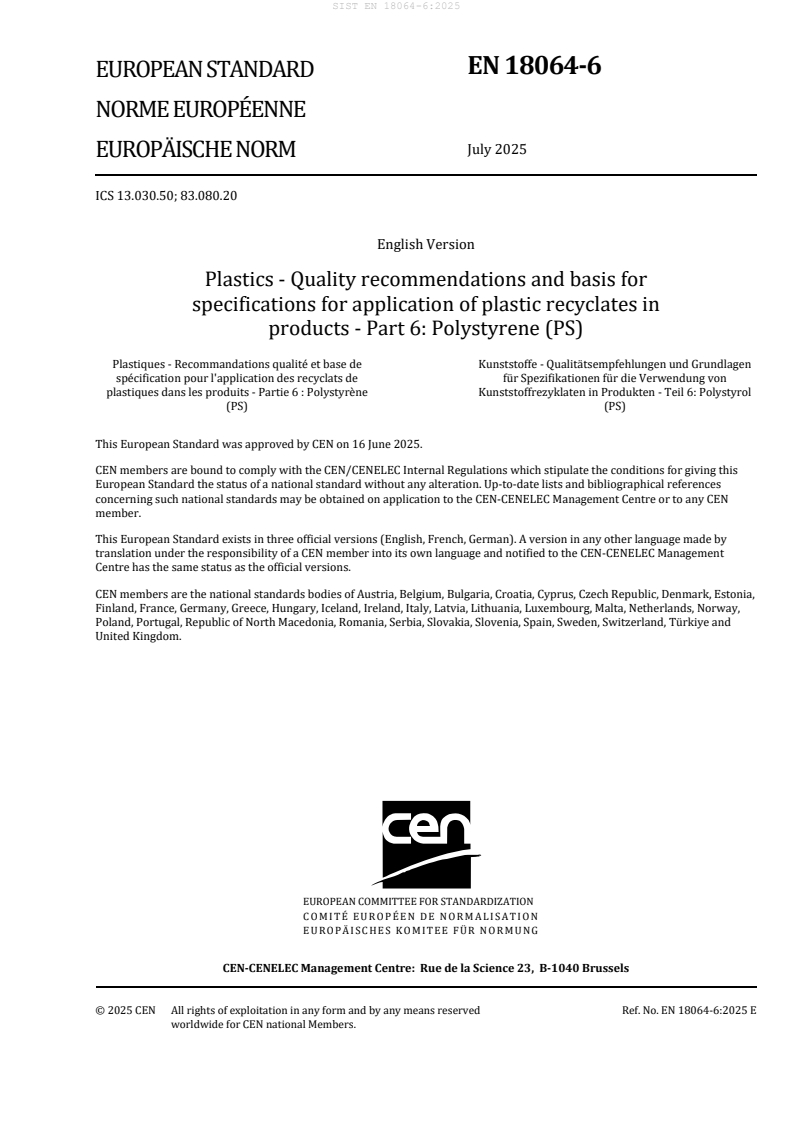
This European Standard was approved by CEN on 16 June 2025.
CEN members are bound to comply with the CEN/CENELEC Internal Regulations which stipulate the conditions for giving this
European Standard the status of a national standard without any alteration. Up-to-date lists and bibliographical references
concerning such national standards may be obtained on application to the CEN-CENELEC Management Centre or to any CEN
member.
This European Standard exists in three official versions (English, French, German). A version in any other language made by
translation under the responsibility of a CEN member into its own language and notified to the CEN-CENELEC Management
Centre has the same status as the official versions.
CEN members are the national standards bodies of Austria, Belgium, Bulgaria, Croatia, Cyprus, Czech Republic, Denmark, Estonia,
Finland, France, Germany, Greece, Hungary, Iceland, Ireland, Italy, Latvia, Lithuania, Luxembourg, Malta, Netherlands, Norway,
Poland, Portugal, Republic of North Macedonia, Romania, Serbia, Slovakia, Slovenia, Spain, Sweden, Switzerland, Türkiye and
United Kingdom.
EUROPEAN COMMITTEE FOR STANDARDIZATION
COMITÉ EUROPÉEN DE NORMALISATION
EUROPÄISCHES KOMITEE FÜR NORMUNG
CEN-CENELEC Management Centre: Rue de la Science 23, B-1040 Brussels
© 2025 CEN All rights of exploitation in any form and by any means reserved Ref. No. EN 18064-6:2025 E
worldwide for CEN national Members.
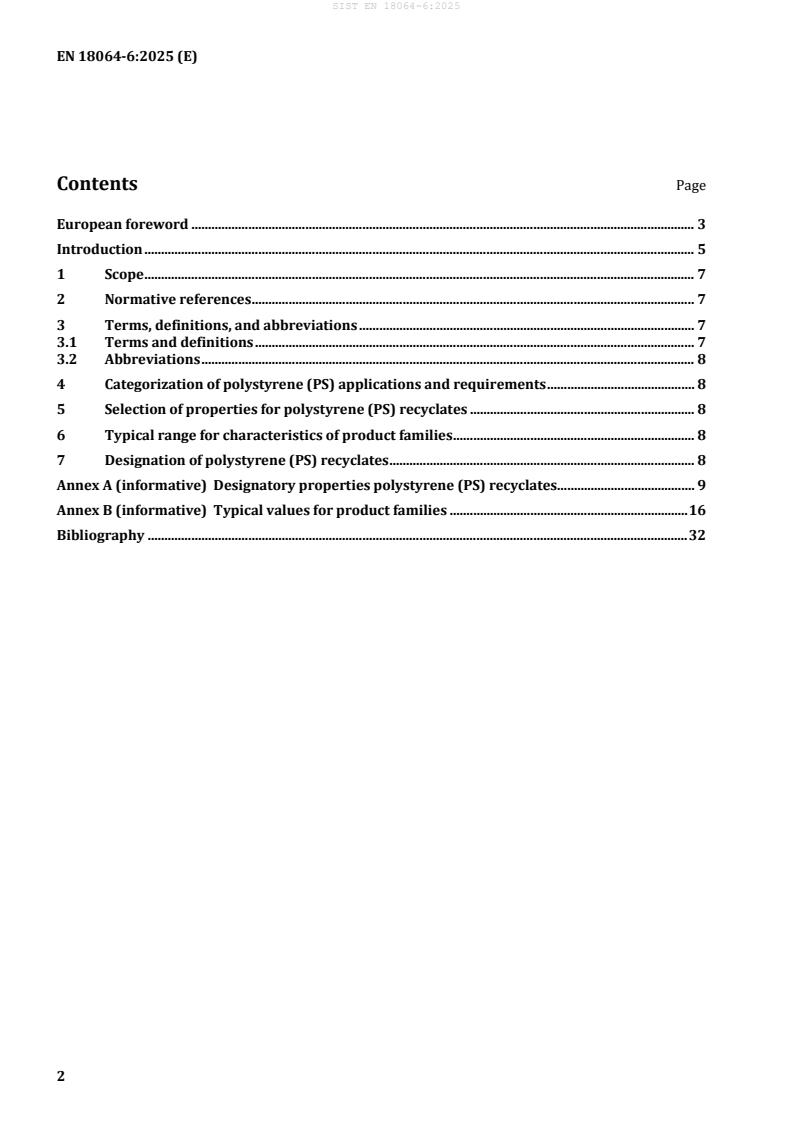
Contents Page
European foreword . 3
Introduction . 5
1 Scope . 7
2 Normative references . 7
3 Terms, definitions, and abbreviations . 7
3.1 Terms and definitions . 7
3.2 Abbreviations . 8
4 Categorization of polystyrene (PS) applications and requirements . 8
5 Selection of properties for polystyrene (PS) recyclates . 8
6 Typical range for characteristics of product families . 8
7 Designation of polystyrene (PS) recyclates . 8
Annex A (informative) Designatory properties polystyrene (PS) recyclates . 9
Annex B (informative) Typical values for product families . 16
Bibliography . 32
European foreword
This document (EN 18064-6:2025) has been prepared by Technical Committee CEN/TC 249 “Plastics”,
the secretariat of which is held by SIS.
This European Standard shall be given the status of a national standard, either by publication of an
identical text or by endorsement, at the latest by January 2026, and conflicting national standards shall
be withdrawn at the latest by January 2026.
Attention is drawn to the possibility that some of the elements of this document may be the subject of
patent rights. CEN shall not be held responsible for identifying any or all such patent rights.
This document is part of CEN publications on plastics recycling, listed as follows:
— EN 15342, Plastics — Recycled plastics — Characterization of polystyrene (PS) recyclates
— EN 15343, Plastics — Recycled Plastics — Plastics recycling traceability and assessment of conformity
and recycled content
— EN 15344, Plastics — Recycled plastics — Characterization of Polyethylene (PE) recyclates
— EN 15345, Plastics — Recycled plastics — Characterization of Polypropylene (PP) recyclates
— EN 15346, Plastics — Recycled plastics — Characterization of poly(vinyl chloride) (PVC) recyclates
— EN 15347 (all parts), Plastics — Sorted plastics wastes
— EN 15348, Plastics — Recycled plastics — Characterization of poly(ethylene terephthalate) (PET)
recyclates
— EN 18064 (all parts), Plastics —Quality recommendations and basis for specifications for application
of plastic recyclates in products
— EN 18065, Plastics —Recycled plastics — Classification of recycled plastics based on Data Quality
Levels for use and (digital) trading
— EN 18067, Plastics — Recycled plastics — Characterization of Acrylonitrile-Butadiene-Styrene (ABS)
recyclates
— CEN/TR 15353, Plastics — Recycled plastics — Guidelines for the development of standards for recycled
plastics
— CEN/TR 18160, Plastics recycling — Classification of plastic recyclates as postconsumer recyclates
(PCR) and postindustrial recyclates (PIR)
This document is part of the EN 18064-series, currently consisting of all parts as listed below. This series
of standards consists of a general part 1, and material specific parts.
EN 18064, Plastics — Quality recommendations and basis for specifications for application of plastic
recyclates in products, is currently composed with the following parts:
— Part 1: General aspects
— Part 2: Polyethylene (PE)
— Part 3: Polypropylene (PP)
— Part 4: Poly(ethylene terephthalate) (PET)
— Part 5: Poly(vinyl chloride) (PVC)
— Part 6: Polystyrene (PS)
— Part 7: Acrylonitrile-butadiene-styrene (ABS)
NOTE Part 6 for PS also includes EPS and XPS.
This document has been prepared under a standardization request addressed to CEN and CENELEC by
the European Commission. The Standing Committee of the EFTA States subsequently approves these
requests for its Member States.
This part is supported by other standards on test methods to which references are made throughout this
document.
Any feedback and questions on this document should be directed to the users’ national standards body.
A complete listing of these bodies can be found on the CEN website.
According to the CEN-CENELEC Internal Regulations, the national standards organisations of the
following countries are bound to implement this European Standard: Austria, Belgium, Bulgaria, Croatia,
Cyprus, Czech Republic, Denmark, Estonia, Finland, France, Germany, Greece, Hungary, Iceland, Ireland,
Italy, Latvia, Lithuania, Luxembourg, Malta, Netherlands, Norway, Poland, Portugal, Republic of North
Macedonia, Romania, Serbia, Slovakia, Slovenia, Spain, Sweden, Switzerland, Türkiye and the United
Kingdom.
Introduction
This standards series is answering to the European Standardization Request M/584 .
European standardization deliverable(s) on quality assessment of plastic recyclates for use in products
are expected for: recycled polyethylene (rPE), recycled polypropylene (rPP), recycled polyethylene
terephthalate (rPET), recycled polyvinyl chloride (rPVC), recycled polystyrene (rPS) (including recycled
expanded polystyrene (rEPS) and recycled extruded polystyrene (rXPS)), recycled acrylonitrile-
butadiene-styrene (rABS).
How to use this standards series?
The characteristics are generic and cover the properties the converter needs at the entry of the converting
operation. The intention is that this standard series supports the establishment of first contact with
possible suppliers that could deliver this recyclate with or without compounding. The designation system
is intended to make a callout for the desired recyclate. After first contact, the specifications will be agreed
between recycler and converter. This is not part of this standards series.
This series is not intended for use as a specification system, and hence cannot be used as a means to
guaranty a certain recyclate quality to a buyer of plastic recyclates. Characteristics are specified in
Annex B of the polymer specific parts of this series, which provides typical values or a range as applicable.
The EN 18064 series can be used by:
— producers of specific products for material selection of recyclates to be used in their products;
— recyclers to produce recyclates that are suitable for certain product families/production
technologies.
The EN 18064 series covers:
Part 1: description of purpose of this series of standards and designation system
Parts 2-7: Polymer specific parts, with two informative annexes as follows:
In the Annexes A designatory properties are given;
In the Annexes B, product families are specified in combination with the (most) relevant converting
technologies. In these Annexes B, typical values are provided for the characteristics.
The purpose of the demand driven approach is to give customers guidance to choose the recyclates that
will be adequate to use in the product of choice that is going to be manufactured.
M/584 COMMISSION IMPLEMENTING DECISION of 1.8.2022 on a standardisation request to the European
Committee for Standardisation and the European Committee for Electrotechnical Standardisation as regards
plastics recycling and recycled plastics in support of the European Strategy for Plastics in a Circular Economy
EN 18064 series may be used in conjunction with:
— EN 18065, Recycled plastics — Classification by data quality levels for use and (digital) trading.
These standards (EN 18064, Part 1 through Part 7) are aligned with ISO/TC 61 material standards:
— EN ISO 10350-1 identifies specific test procedures for the acquisition and presentation of comparable
data for certain basic properties of plastics;
— EN ISO polymer specific standards for the preparation of test specimens and determination of
properties (see normative references of the polymer specific parts EN 18064, Part 2 through 7).
The EN ISO material standards for polymers provides the designation system (see Part 1 of the EN ISO
material standards-moulding and extrusion materials). For recycling, appropriate additional test
methods should be taken up from the relevant EN or ISO material standard.
NOTE 1 The relevant EN standards could be e.g. EN 15342, EN 15344, EN 15345, EN 15346, EN 15348 and
EN 18067.
NOTE 2 The basis of the designation system is described in the ISO/IEC Directives Part 2 (2021), C.3“Designation
system.” This designation system was designed for virgin polymers. The designation system described in this
document is applicable for recyclates is based on that system.
NOTE 3 EC regulations and Directives can also apply.
NOTE 4 Regarding packaging in food contact, see also European legislation e.g. EC 2023/2006 (GMP),
1935/2004, 10/2011 and 2022/1616 as amended.
1 Scope
This document provides characteristics and typical values for polystyrene (PS) recyclates intended for
groups of defined applications (the product families).
The characteristics and typical values for the different product families are derived from the performance
requirements of the products belonging to that family, including requirements for product manufacturing
processes where applicable.
This document applies to plastic recyclates intended to be used for the manufacturing of (intermediate)
products.
This document is intended to be used in conjunction with part 1 of this standard series, which describes
the designation system for plastic recyclates. The designation system allows comparison between
recycled and virgin material at the level of the polymer’s defined designatory properties.
NOTE 1 Examples of designations of plastic recyclates are given in Annex A.
NOTE 2 The selection of relevant properties for a product family is based on EN ISO 10350-1, extended with
specific properties related to plastic recyclates.
2 Normative references
The following documents are referred to in the text in such a way that some or all of their content
constitutes requirements of this document. For dated references, only the edition cited applies. For
undated references, the latest edition of the referenced document (including any amendments) applies.
CEN/TR 15353, Plastics — Recycled plastics — Guidelines for the development of standards for recycled
plastics
EN 15342:2025, Plastics — Recycled plastics — Characterization of polystyrene (PS) recyclates
EN 17615, Plastics — Environmental Aspects — Vocabulary
EN 18064-1, Plastics — Quality recommendations and basis for specifications for application of plastic
recyclates in products — Part 1: General aspects
EN 18065, Plastics — Recycled plastics — Classification of recycled plastics based on Data Quality Levels
for use and (digital) trading
EN ISO 472, Plastics — Vocabulary (ISO 472)
EN ISO 1043-1, Plastics — Symbols and abbreviated terms — Part 1: Basic polymers and their special
characteristics (ISO 1043-1)
3 Terms, definitions, and abbreviations
3.1 Terms and definitions
For the purposes of this document, the terms and definitions given in EN ISO 472, EN 17615 and
CEN/TR 15353 and the following apply.
ISO and IEC maintain terminology databases for use in standardization at the following addresses:
— ISO Online browsing platform: available at https://www.iso.org/obp
— IEC Electropedia: available at https://www.electropedia.org/
3.1.1
typical value
indicative value intended for first contact, e. g. between converter and recycler
Note 1 to entry: Final values to be agreed e.g. between converter and recycler.
3.2 Abbreviations
For the purposes of this document, abbreviated terms related to recyclates given in EN ISO 1043-1,
EN 18064-1 and EN 15342 apply.
4 Categorization of polystyrene (PS) applications and requirements
The product families in combination with the relevant converting technologies are given in the dedicated
annexes. In here description is given of the intended use(s) of these product families (for example impact
resistant application), and for which products these can be used (containers, sheet materials, …).
5 Selection of properties for polystyrene (PS) recyclates
The mandatory characteristics are given in EN 15342.
Characteristics per product family in combination with the relevant production technologies are given in
Annex B.
NOTE Next to mandatory characteristics from EN 15342, this can also include the optional characteristics
given in EN 15342, EN ISO 20028-2 and EN ISO 10350-1.
6 Typical range for characteristics of product families
The typical characteristics are specified in Annex B, which provide typical values (min./max. values or a
range as applicable) for the product family specific characteristics in combination with the relevant
production technologies. This information is intended to be used for material selection by buyers of
recyclate.
NOTE This part is not intended for use as a specification system, and hence cannot be used as a means to
guarantee a certain recyclate quality to a buyer of plastic recyclate.
7 Designation of polystyrene (PS) recyclates
The principle for this designation system is given in EN 18064-1, the ISO/IEC Directives, Part 2, 2021,
and Annex A.
This designation provides a code describing how to declare characteristics and related typical values for
recyclate materials, intended to be used for a defined category group (product family), enabling effective
communication between supplier and purchaser of recyclate materials, based on the intended use
(product family in combination with the relevant production technologies).
Annex A provides designatory properties of polystyrene recyclates given in EN ISO 24022-1.
Under A.2.7 examples of designation of a polystyrene thermoplastic material are given.
Annex A
(informative)
Designatory properties polystyrene (PS) recyclates
A.1 Generic and additional designatory properties
The types of polystyrene plastics are differentiated from each other by a classification system based on
appropriate levels of the designatory properties (see EN ISO 24022-1) and the following additional
designatory properties related to polystyrene:
a) Vicat softening temperature;
b) Melt mass-flow rate (MFR);
and information about chemical structure, method of processing, important properties, additives,
colour, fillers and reinforcing materials. See EN 18064-1 block 1 – 5, based on EN ISO 24022-1.
A.2 Designation of polystyrene (PS) recyclates
A.2.1 General
The designation system for thermoplastics is based on the following standardized pattern, as shown in
Table A.1.
Table A.1 — Standard pattern for thermoplastic material designation
Designation
Identity Block
Description
Individual-item Block
International
Block
Standard
Data Data Data
Block Data Block 1 Data Block 3
Block 2 Block 4 Block 5
Optional Mandatory Mandatory Optional Optional Mandatory only Optional Optional
for polymer for agreed position 1 of agreed
type DQL upon Table 2. Positions upon
between from 2 to 8 agreed between
the upon between the the
interested interested parties interested
parties parties
The designation consists of an optional description block, reading e.g. “Thermoplastics”, and an identity
block comprising the considerable International Standard number and an individual-item block. For
unambiguous designation, the individual-item block is subdivided into five data blocks comprising the
information.
For further information on this designation system please refer to EN 18064-1, EN ISO 24022-1 and
ISO/IEC Directives, Part 2, 2021, Annex C.
A.2.2 Data block 1
Data block 1 contains the polymer information and optionally the data quality level (DQL) indication of
the respective material.
In this data block, after the hyphen, polystyrene plastics are identified by the symbol “PS”, in accordance
with EN ISO 1043-1 and EN ISO 24022-1 as below.
Table A.2 — Code letters used for additional information in data block 1
Code letter Definition
G Polystyrene homopolymer (General Purpose), usually called GPPS.
Includes recyclates coming from expanded polystyrene (EPS) and extruded polystyrene
(XPS) foams after pelletizing
H Polystyrene impact polymer consisting of two (or more) phases of which one of
polystyrene G and rubber phases composed of polybutadiene or styrene-butadiene
rubber, added in situ (grafting), or physically blended with the propylene plastic matrix
M Mixtures of polystyrene G and H
E Expandable polystyrene consisting of GPPS impregnated with a blowing agent
F Expanded polystyrene based on EPS raw material
X Extruded polystyrene based on GPPS (General Purpose PS) raw material
For recyclate the letter “r” is added in front of the abbreviated term for the type of polymer, e.g. “rPS”.
NOTE Additionally to the abbreviation “rPS”, “PS-R” or “R-PS” or “PS (REC)” are used as well.
Furthermore, the data quality level (DQL) could be added to data block 1 after another hyphen. To reach
a certain data quality level, several characteristics shall be added to a technical data sheet of the material.
These characteristics are listed in EN 18065.
In terms of the designation system a higher number of the data quality level indicates a need for more
information from the supplier.
A.2.3 Data block 2
In this data block, information about the type of filler and/or reinforcing material is represented by a
single code-letter in position 1 and its physical form by a second code-letter in position 2, the code-letters
being as specified in Table A.3 (in accordance with EN ISO 1043-2). For the filler material, it is
represented by a two-code-letter in position 1.
Subsequently (without a space), the mass content may be given by a two-figure-number in positions 3
and 4. The first figure-number is presented by 0 and the second figure-number is the figure of the mass
content if the mass content of filler and/or reinforcing material is less than 10 %.
Mixtures of filler materials or forms may be indicated by combining the relevant codes using the sign “+”
within parentheses followed by the total filler content outside the parenthesis. For example, a mixture of
25 % glass fibres (GF) and 10 % mineral powder (MD) would be indicated by (GF+MD)35 or
(GF25+MD10).
Table A.3 — Code-letters used for fillers and reinforcing materials in data block 2
Code-letter Material (Position 1) Form (Position 2)
B Boron Beads, Spheres, Balls
a
C Carbon
D Fines, Powder
F Fiber
G Glass Ground
H Whiskers
K Calcium carbonate
L Cellulose
a
M Mineral
b
ME Metal
a
S Synthetic organic Flakes
T Talcum
X Not specified Not specified
a
Z Others Others
a
These materials may be identified after the mass content, e.g. by chemical symbol(s) or additional codes to
be agreed upon.
b
The type of metal shall be identified by means of the relevant chemical symbol(s) after the mass content. For
example, steel whiskers may be designated “MEH05Fe”.
For the purpose of packaging or insulation applications, data block 2 could not be relevant and will
remain empty.
A.2.4 Data block 3
In this data block, information about the intended application and/or method of processing is given by a
code-letter in position 1, followed by additional code-letters about additives, supplementary information,
and other characteristics in positions 2 to 8. The code-letters of EN ISO 24022-1 used are specified in
Table A.4.
If no specific information is given on the method of processing, the letter X shall be used as the first code-
letter.
Table A.4 — Code-letters used for the processing method and characteristics in data block 3
Code-letter Processing method Additives, supplementary information,
and other characteristics
A Processing stabilized
C Coloured
D Powder
E Extrusion Expandable
F Extrusion of films Special burning characteristics
G General use
L Light-and/or weather-stabilized
M Injection moulding
N Natural (no colour added)
R Mould release agent
S Lubricated
X No indication
Z Antistatic
A.2.5 Data block 4
A.2.5.1 General
In this data block, information about the range of Vicat softening temperature is represented by a three-
figure code-number (see A.2.5.2) and the melt mass-flow rate by a two-figure code-number (see A.2.6).
The code-numbers are separated from each other by hyphens.
If a property in Block 4 is not specified the symbol '#' will be used instead.
EXAMPLE (Thermoplastics) EN ISO 24022-1 rPS-2, (GF25+MD10), MLN, #-12, where the symbol '#' indicates
unspecified Vicat softening temperature.
If a property value falls on or near a range limit, the manufacturer shall state which range will designate
the material. If subsequent individual test values lie on, or on either side of, the limit because of
manufacturing tolerances, the designation is not affected.
For recyclates broader ranges can be applicable than for virgin materials. Therefor for recyclates multiple
ranges can be declared in the designation:
EXAMPLE
— Designation virgin: (Thermoplastics) EN ISO 24022-1 PS, (GF25+MD10), MLN, 085-12
— Designation recyclate: (Thermoplastics) EN ISO 24022-1 rPS-2, (GF25+MD10), MLN, 085-12/24 (broader MFR
range)
NOTE Not all combinations of the values of the designatory properties might be possible for currently available
materials.
A.2.5.2 Vicat softening temperature
The Vicat softening temperature shall be determined in accordance with EN ISO 24022-2.
The possible values of the Vicat softening temperature are divided into five ranges, each represented by
a three-figure code-number as specified in Table A.5.
NOTE The Vicat softening temperature is not applicable for EPS.
Table A.5 — Code-numbers used for Vicat softening temperature in data block 4
Code-number Range of Vicat softening
temperature
°C
075 ≤ 80
085 > 80 but ≤ 90
095 > 90 but ≤ 100
105 > 100 but ≤ 110
115 > 110
A.2.6 Melt mass-flow rate
The melt mass-flow rate (MFR) shall be determined in accordance with EN ISO 24022-2.
The possible values of melt mass-flow rate are divided into five rang
...