

EN 13859-1:2010
(Main)Flexible sheets for waterproofing - Definitions and characteristics of underlays - Part 1: Underlays for discontinuous roofing
General Information
- Abstract
This European standard specifies the characteristics of flexible sheets for underlays which are to be used under roof covering of discontinuous roofs. It specifies the requirements and test methods and provides for the evaluation of conformity of the products with the requirements of this document.
- Status
- Withdrawn
- Publication Date
- 22-Jun-2010
- Withdrawal Date
- 29-Apr-2014
- Technical Committee
- CEN/TC 254 - Flexible sheets for water proofing
- Drafting Committee
- CEN/TC 254/WG 9 - Underlays for discontinuous roof coverings
- Current Stage
- 9960 - Withdrawal effective - Withdrawal
- Start Date
- 30-Apr-2014
- Completion Date
- 30-Apr-2014
89/106/EEC - Construction productsOJ Ref: C, C 344 OJ Date: 17-Dec-2010

Relations
- Effective Date
- 28-Jun-2010
- Effective Date
- 07-May-2014
- Effective Date
- 04-Feb-2026
- Effective Date
- 28-Jan-2026
- Effective Date
- 28-Jan-2026
- Effective Date
- 28-Jan-2026
- Effective Date
- 28-Jan-2026
- Effective Date
- 28-Jan-2026
- Effective Date
- 28-Jan-2026
- Effective Date
- 28-Jan-2026
- Effective Date
- 28-Jan-2026
- Effective Date
- 28-Jan-2026
- Effective Date
- 28-Jan-2026
- Effective Date
- 28-Jan-2026
- Effective Date
- 28-Jan-2026
Get Certified
Connect with accredited certification bodies for this standard

DIBt (Deutsches Institut für Bautechnik)
German Institute for Building Technology.
DIN CERTCO
DIN Group product certification.

Aboma Certification B.V.
Specialized in construction, metal, and transport sectors.
Sponsored listings
Frequently Asked Questions
EN 13859-1:2010 is a standard published by the European Committee for Standardization (CEN). Its full title is "Flexible sheets for waterproofing - Definitions and characteristics of underlays - Part 1: Underlays for discontinuous roofing". This standard covers: This European standard specifies the characteristics of flexible sheets for underlays which are to be used under roof covering of discontinuous roofs. It specifies the requirements and test methods and provides for the evaluation of conformity of the products with the requirements of this document.
This European standard specifies the characteristics of flexible sheets for underlays which are to be used under roof covering of discontinuous roofs. It specifies the requirements and test methods and provides for the evaluation of conformity of the products with the requirements of this document.
EN 13859-1:2010 is classified under the following ICS (International Classification for Standards) categories: 91.100.50 - Binders. Sealing materials. The ICS classification helps identify the subject area and facilitates finding related standards.
EN 13859-1:2010 has the following relationships with other standards: It is inter standard links to EN 13859-1:2005+A1:2008, EN 13859-1:2014, EN ISO 11925-2:2026, EN 13416:2001, EN ISO 12572:2016, EN 1931:2000, EN 1107-1:1999, EN 1928:2000, EN 13111:2010, EN 1109:2013, EN 1849-2:2019, EN 1848-1:2025, EN 1849-1:1999, EN 1107-2:2001, EN 1297:2004. Understanding these relationships helps ensure you are using the most current and applicable version of the standard.
EN 13859-1:2010 is associated with the following European legislation: EU Directives/Regulations: 305/2011, 89/106/EEC; Standardization Mandates: M/102. When a standard is cited in the Official Journal of the European Union, products manufactured in conformity with it benefit from a presumption of conformity with the essential requirements of the corresponding EU directive or regulation.
EN 13859-1:2010 is available in PDF format for immediate download after purchase. The document can be added to your cart and obtained through the secure checkout process. Digital delivery ensures instant access to the complete standard document.
Standards Content (Sample)
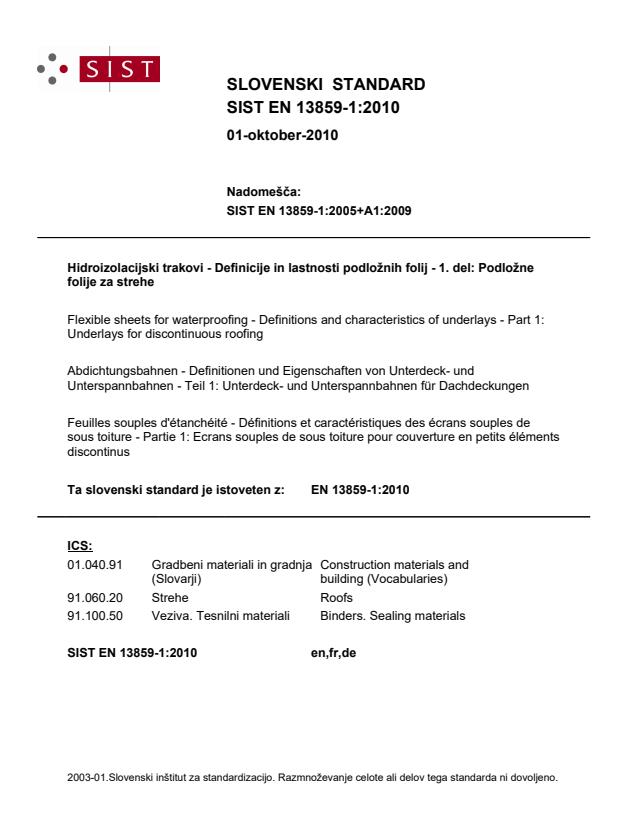
2003-01.Slovenski inštitut za standardizacijo. Razmnoževanje celote ali delov tega standarda ni dovoljeno.Hidroizolacijski trakovi - Definicije in lastnosti podložnih folij - 1. del: Podložne folije za streheAbdichtungsbahnen - Definitionen und Eigenschaften von Unterdeck- und Unterspannbahnen - Teil 1: Unterdeck- und Unterspannbahnen für DachdeckungenFeuilles souples d'étanchéité - Définitions et caractéristiques des écrans souples de sous toiture - Partie 1: Ecrans souples de sous toiture pour couverture en petits éléments discontinusFlexible sheets for waterproofing - Definitions and characteristics of underlays - Part 1: Underlays for discontinuous roofing91.100.50Veziva. Tesnilni materialiBinders. Sealing materials91.060.20StreheRoofs01.040.91Gradbeni materiali in gradnja (Slovarji)Construction materials and building (Vocabularies)ICS:Ta slovenski standard je istoveten z:EN 13859-1:2010SIST EN 13859-1:2010en,fr,de01-oktober-2010SIST EN 13859-1:2010SLOVENSKI
STANDARDSIST EN 13859-1:2005+A1:20091DGRPHãþD
EUROPEAN STANDARD NORME EUROPÉENNE EUROPÄISCHE NORM
EN 13859-1
June 2010 ICS 91.100.50 Supersedes EN 13859-1:2005+A1:2008English Version
Flexible sheets for waterproofing -Definitions and characteristics of underlays - Part 1: Underlays for discontinuous roofing
Feuilles souples d'étanchéité - Définitions et caractéristiques des écrans souples de sous toiture -Partie 1: Ecrans souples de sous toiture pour couverture en petits éléments discontinus
Abdichtungsbahnen - Definitionen und Eigenschaften von Unterdeck- und Unterspannbahnen - Teil 1: Unterdeck-und Unterspannbahnen für Dachdeckungen This European Standard was approved by CEN on 6 May 2010.
CEN members are bound to comply with the CEN/CENELEC Internal Regulations which stipulate the conditions for giving this European Standard the status of a national standard without any alteration. Up-to-date lists and bibliographical references concerning such national standards may be obtained on application to the CEN Management Centre or to any CEN member.
This European Standard exists in three official versions (English, French, German). A version in any other language made by translation under the responsibility of a CEN member into its own language and notified to the CEN Management Centre has the same status as the official versions.
CEN members are the national standards bodies of Austria, Belgium, Bulgaria, Croatia, Cyprus, Czech Republic, Denmark, Estonia, Finland, France, Germany, Greece, Hungary, Iceland, Ireland, Italy, Latvia, Lithuania, Luxembourg, Malta, Netherlands, Norway, Poland, Portugal, Romania, Slovakia, Slovenia, Spain, Sweden, Switzerland and United Kingdom.
EUROPEAN COMMITTEE FOR STANDARDIZATION
COMITÉ EUROPÉEN DE NORMALISATION EUROPÄISCHES KOMITEE FÜR NORMUNG
Management Centre:
Avenue Marnix 17,
B-1000 Brussels © 2010 CEN All rights of exploitation in any form and by any means reserved worldwide for CEN national Members. Ref. No. EN 13859-1:2010: ESIST EN 13859-1:2010
Determination of tensile properties . 13A.1General . 13SIST EN 13859-1:2010
Determination of resistance to tearing . 16B.1General . 16B.2Apparatus . 16B.3Sampling. 16B.4Preparation of test specimens . 16B.5Procedure . 16B.6Expression and evaluation of results . 17B.7Test report . 17Annex C (normative)
Artificial ageing by exposure to UV and heat . 18C.1General . 18C.2Principle. 18C.3Apparatus . 18C.3.1Apparatus for exposure to UV-A irradiation and elevated temperature . 18C.3.2Apparatus for exposure to heat . 18C.4Preparation of test specimens . 18C.4.1Dimensions of test specimens . 18C.4.2Number of specimens . 18C.4.3Conditioning of test specimens . 19C.5Procedure . 19C.5.1Exposure to UV irradiation and elevated temperature . 19C.5.2Exposure to heat . 19C.5.3Testing of resistance to water penetration and tensile properties after artificial ageing . 19C.6Expression of results . 19C.7Test report . 19Annex D (normative)
Initial type test and frequencies of testing for factory production control . 21Annex E (informative)
Example of a product data sheet . 22E.1General information . 22Annex F (normative)
Determination of the watertightness of seams . 24F.1General . 24F.2Definitions . 24F.2.1Watertightness of seams . 24F.3Procedure . 24F.4Apparatus . 24F.4.1General . 24F.4.2Sealing gaskets . 24F.5Preparation of the test specimens . 24F.6Procedure . 25F.7Evaluation. 25F.8Test report . 25Annex ZA (informative)
Clauses of this European Standard addressing provision of the Construction Products Directive (CPD) . 26ZA.1Scope and relevant characteristics . 26ZA.2Procedures for attestation of conformity of underlays for discontinuous roofing . 27ZA.2.1Systems of attestation of conformity . 27ZA.2.2EC Declaration of conformity . 30ZA.3CE marking and labelling. 31Bibliography . 34
EN 1928:2000, Flexible sheets for waterproofing — Bitumen, plastic and rubber sheets for roof waterproofing — Determination of watertightness EN 1931, Flexible sheets for waterproofing — Bitumen, plastic and rubber sheets for roof waterproofing — Determination of water vapour transmission properties EN 12310-1:1999, Flexible sheets for waterproofing — Part 1: Bitumen sheets for waterproofing — Determination of resistance to tearing (nail shank) EN 12311-1, Flexible sheets for waterproofing — Part 1: Bitumen sheets for roof waterproofing — Determination of tensile properties EN 13111, Flexible sheets for waterproofing — Underlays for discontinuous roofing and walls — Determination of resistance to water penetration EN 13416:2001, Flexible sheets for waterproofing — Bitumen, plastic and rubber sheets for roof waterproofing — Rules for sampling SIST EN 13859-1:2010
MLV value stated by the manufacturer to be met during testing, that can be a minimum or a maximum value according to statements made under product characteristics of this document 3.4 manufacturer's declared value MDV value declared by the manufacturer accompanied by a declared tolerance 3.5 sampling procedure used to select or constitute a sample 3.6 sample sheet from which a test piece is taken 3.7 test piece part of the sample from which test specimens are taken 3.8 test specimen piece of precise dimensions taken from the test piece SIST EN 13859-1:2010
4.3 Application related characteristics 4.3.1 Reaction to fire Where required, the reaction to fire shall be determined in accordance with 5.2.2. 4.3.2 Resistance to water penetration 4.3.2.1 Class W1 The product shall be classified as resistant to water penetration Class W1 if it passes the resistance to water penetration test in accordance with 5.2.3. If the product fails the test of resistance to water penetration indicated in 5.2.3, it shall be tested in accordance with 4.3.2.2. 4.3.2.2 Class W2 A product failing to pass the test indicated in 5.2.3 shall be tested in accordance with 5.2.4. If the measured mean volume of water passing through the specimens tested is less than 100 ml, the product shall be classified as resistant to water penetration Class W2. SIST EN 13859-1:2010
The characteristics of the product, determined in accordance with the test methods specified in this document, shall be listed in a technical data sheet. The technical data sheet shall give the following information: a) product trade name and manufacturer's name; b) origin/source of manufacture or traceable code; c) method of application; d) results of tests; e) certification mark, if any; f) consumer information, e.g. restrictions concerning use and storage and safety precautions during installation and disposal; g) description of the product (e.g. components, type and number of carriers, type of coating, mass or thickness, type of surfacing). An example of a product data sheet is given in Annex E. 8 Marking, labelling and packaging The following information shall be indicated on each roll and/or in the accompanying technical or commercial documentation: a) production date or identification number; b) product trade name; c) length and width; d) thickness or mass; e) labelling according to national regulations related to dangerous substances and/or health and safety. SIST EN 13859-1:2010
Determination of tensile properties A.1 General The tensile properties of foldable products shall be tested in accordance with EN 12311-1 with the following modifications. A.2 Apparatus Tensile testing machine in accordance with EN 12311-1. A.3 Sampling Test samples shall be taken in accordance with EN 13416. A.4 Preparation of test specimens For the purpose of a complete tensile test, two sets of test specimens are to be prepared: one set of five for the longitudinal direction and one set of five for the transverse direction. Test specimens shall be cut from a test piece not closer than 100 mm to the edge of the sheet, with the aid of a template, or die cutter, to provide rectangular test specimens measuring (100,0 ± 0,5) mm wide by a length of at least 200 mm + (2 × gripping length), the longer direction being the test direction. Any non-permanent surface layer or provisional protection sheet shall be removed. Test specimens shall be conditioned for at least 20 h at a temperature of (23 ± 2) °C and relative air humidity in the range 30 % to 70 % before testing. A.5 Procedure The 100 mm wide test specimen shall be folded and joined in the middle as shown in Figure A.1 and tightly clamped in the tensile test machine taking care that the axes of the specimen and grips are correctly aligned. The clear distance between grips shall be (200 ± 1) mm. The test specimen shall be arranged concentrically. A pre-load of maximum 5 N shall be applied before the start of the test to take out any slack in the test specimen. The folded edges shall meet in the middle of the sheet without overlapping. The tolerance of the deviation from the middle shall not exceed ± 1 mm. SIST EN 13859-1:2010
Key l gripping length Figure A.1 — Folding of a test specimen A.6 Expression and evaluation of results Determine from the force and distance recorder, or from the data registered, the maximum force and the corresponding elongation calculated from the separation of the tensile testing machine grips (or extensiometer) and expressed as a percentage of the original gauge length. Disregard any test result where the test specimen breaks within 10 mm from the grips or when it slips by more than the permitted limit within the grips of the tensile test machine, and retest with a replacement test specimen. The measured values of tensile force xmi, of the test specimens with a width of 100 mm, which are folded twice, shall be transformed to the measured values of the property xi as indicated in Equation (A.1): xi = xmi × 0,5 (A.1) where: xm1, xm2 . xmn are the measured values of the test specimens; SIST EN 13859-1:2010
Determination of resistance to tearing B.1 General The resistance to tearing of foldable products shall be tested in accordance with EN 12310-1 with the following modifications. B.2 Apparatus Tensile testing machine in accordance with EN 12310-1. The width of the grips shall not be less than 50 mm. B.3 Sampling Test samples shall be taken in accordance with EN 13416. B.4 Preparation of test specimens For a complete tear test, two sets of test specimens are to be prepared: one set of five for the longitudinal direction and one set of five for the transverse direction. Size of the test specimens: (200,0 ± 1,0) mm wide by at least 200 mm long. B.5 Procedure The 200 mm wide test specimen shall be folded as shown in Figure B.1 and is inserted between the arms of a close fitting stirrup, and a (2,5 ± 0,1) mm diameter sharpened nail shank is pushed through locating holes in the stirrup arms such that the shank pierces one layer of the specimen along the centre line at a distance of (50 ± 5) mm from the free end inside the stirrup. A diagrammatic representation of the test apparatus is indicated in EN 12310-1:1999, Figure 1. In this figure the sample thickness (e) is the thickness of the folded sample. SIST EN 13859-1:2010
Key 1 upper grips 2 nail position Figure B.1 — Folding and inserting of a test specimen B.6 Expression and evaluation of results The resistance to tearing of the specimen is the maximum tensile force recorded during the test. The maximum force shall be taken from the continuously recorded force. List the individual values for each set of five test specimens, and calculate the mean value and the document deviation, noting the test direction. B.7 Test report The test report shall include at least the following information: a) all details necessary to identify the product tested; b) reference to this document and any deviation from it; c) information of sampling in accordance with B.3; d) details of preparation of the test specimens in accordance with B.4; e) test results in accordance with B.6, indicating the test direction; f) date of the test(s). SIST EN 13859-1:2010
Artificial ageing by exposure to UV and heat C.1 General The artificial ageing shall be tested in accordance with EN 1297 and EN 1296 with the following modifications. C.2 Principle The test method consists of exposing test specimens to continuous UV irradiation at elevated temperature without wetting with water followed by long term exposure to heat. Resistance to water penetration and tensile strength and elongation shall be determined after artificial ageing. C.3 Apparatus C.3.1 Apparatus for exposure to UV-A irradiation and elevated temperature An apparatus indicated in EN 1297 not using water spraying shall be used. C.3.2 Apparatus for exposure to heat A ventilated oven in accordance with EN 1296 shall be used. The oven shall be equipped with frames capable of holding the test specimens in a vertical position without stressing them during the testing. The air flow shall be steady, laminar and the air speed should not exceed 0,05 m/s. Higher air speeds may have a negative effect on the performance of the product. If higher air speeds are applied, it shall be recorded in the test report. C.4 Preparation of test specimens C.4.1 Dimensions of test specimens Test specimens shall have the size specified in 5.2.3, 5.2.4 and 5.2.6. C.4.2 Number of specimens For the determination of tensile properties, two sets of five test specimens for the longitudinal direction and two sets of five test specimens for the transverse direction shall be prepared. One set of the test specimens for the longitudinal and one set for the transverse direction shall be exposed to artificial ageing. The tensile properties of the other two sets of test specimens shall be tested in unexposed condition. For the determination of resistance to water penetration, the test spe
...