

CEN/TR 15232-2:2016
(Main)Energy performance of buildings - Part 2: Accompanying TR prEN 15232-1:2015 - Modules M10-4,5,6,7,8,9,10
General Information
- Abstract
This Technical Report refers to prEN 15232-1, Energy performance of buildings - Part 1: Impact of Building Automation, Controls and Building Management - Modules M10-4,5,6,7,8,9,10.
It contains information to support the correct understanding, use and national adaption of standard prEN 15232-1:2015.
This technical report does not contain any normative provision.
- Status
- Withdrawn
- Publication Date
- 27-Sep-2016
- Withdrawal Date
- 29-Sep-2026
- Technical Committee
- CEN/TC 247 - Controls for mechanical building services
- Current Stage
- 9960 - Withdrawal effective - Withdrawal
- Start Date
- 09-Mar-2022
- Completion Date
- 30-Sep-2026



Relations
- Effective Date
- 08-Jun-2022
- Effective Date
- 28-Jan-2026
- Effective Date
- 28-Jan-2026
- Effective Date
- 28-Jan-2026
- Effective Date
- 28-Jan-2026
- Effective Date
- 28-Jan-2026
- Effective Date
- 28-Jan-2026
- Effective Date
- 28-Jan-2026
- Effective Date
- 28-Jan-2026
- Effective Date
- 28-Jan-2026
- Effective Date
- 28-Jan-2026
- Effective Date
- 28-Jan-2026
- Effective Date
- 28-Jan-2026
- Effective Date
- 28-Jan-2026
- Effective Date
- 28-Jan-2026
Get Certified
Connect with accredited certification bodies for this standard

BSI Group
BSI (British Standards Institution) is the business standards company that helps organizations make excellence a habit.

DIBt (Deutsches Institut für Bautechnik)
German Institute for Building Technology.
DIN CERTCO
DIN Group product certification.
Sponsored listings
Frequently Asked Questions
CEN/TR 15232-2:2016 is a technical report published by the European Committee for Standardization (CEN). Its full title is "Energy performance of buildings - Part 2: Accompanying TR prEN 15232-1:2015 - Modules M10-4,5,6,7,8,9,10". This standard covers: This Technical Report refers to prEN 15232-1, Energy performance of buildings - Part 1: Impact of Building Automation, Controls and Building Management - Modules M10-4,5,6,7,8,9,10. It contains information to support the correct understanding, use and national adaption of standard prEN 15232-1:2015. This technical report does not contain any normative provision.
This Technical Report refers to prEN 15232-1, Energy performance of buildings - Part 1: Impact of Building Automation, Controls and Building Management - Modules M10-4,5,6,7,8,9,10. It contains information to support the correct understanding, use and national adaption of standard prEN 15232-1:2015. This technical report does not contain any normative provision.
CEN/TR 15232-2:2016 is classified under the following ICS (International Classification for Standards) categories: 35.240.99 - IT applications in other fields; 91.120.10 - Thermal insulation of buildings; 97.120 - Automatic controls for household use. The ICS classification helps identify the subject area and facilitates finding related standards.
CEN/TR 15232-2:2016 has the following relationships with other standards: It is inter standard links to CEN ISO/TR 52120-2:2022, EN 15232-1:2017, EN 15316-4-2:2017, EN 15316-4-3:2017, EN 12098-5:2017, EN 15378-1:2017, EN 16798-5-1:2017, EN 16798-5-2:2017, EN ISO 52000-1:2017, EN 12098-3:2017, EN ISO 13790:2008, EN 15603:2008, EN 16798-7:2017, EN 15241:2007, CEN ISO/TR 52003-2:2017. Understanding these relationships helps ensure you are using the most current and applicable version of the standard.
CEN/TR 15232-2:2016 is associated with the following European legislation: EU Directives/Regulations: 2010/31/EU; Standardization Mandates: M/480. When a standard is cited in the Official Journal of the European Union, products manufactured in conformity with it benefit from a presumption of conformity with the essential requirements of the corresponding EU directive or regulation.
CEN/TR 15232-2:2016 is available in PDF format for immediate download after purchase. The document can be added to your cart and obtained through the secure checkout process. Digital delivery ensures instant access to the complete standard document.
Standards Content (Sample)
SLOVENSKI STANDARD
01-maj-2018
Energijske lastnosti stavb - 2. del: Razlaga in utemeljitev prEN 15232-1:2015 -
Moduli M10-4, 5, 6, 7, 8, 9, 10
Energy performance of buildings - Part 2: Accompanying TR prEN 15232-1:2015 -
Modules M10-4,5,6,7,8,9,10
Performance énergétique des bâtiments - Partie 2 : Rapport technique accompagnant le
prEN 15232-1:2015 - Modules M10-4,5,6,7,8,9,10
Ta slovenski standard je istoveten z: CEN/TR 15232-2:2016
ICS:
91.120.10 Toplotna izolacija stavb Thermal insulation of
buildings
97.120 Avtomatske krmilne naprave Automatic controls for
za dom household use
2003-01.Slovenski inštitut za standardizacijo. Razmnoževanje celote ali delov tega standarda ni dovoljeno.
CEN/TR 15232-2
TECHNICAL REPORT
RAPPORT TECHNIQUE
September 2016
TECHNISCHER BERICHT
ICS 35.240.99; 91.120.10; 97.120
English Version
Energy performance of buildings - Part 2: Accompanying
TR prEN 15232-1:2015 - Modules M10-4,5,6,7,8,9,10
This Technical Report was approved by CEN on 11 April 2016. It has been drawn up by the Technical Committee CEN/TC 247.
CEN members are the national standards bodies of Austria, Belgium, Bulgaria, Croatia, Cyprus, Czech Republic, Denmark, Estonia,
Finland, Former Yugoslav Republic of Macedonia, France, Germany, Greece, Hungary, Iceland, Ireland, Italy, Latvia, Lithuania,
Luxembourg, Malta, Netherlands, Norway, Poland, Portugal, Romania, Slovakia, Slovenia, Spain, Sweden, Switzerland, Turkey and
United Kingdom.
EUROPEAN COMMITTEE FOR STANDARDIZATION
COMITÉ EUROPÉEN DE NORMALISATION
EUROPÄISCHES KOMITEE FÜR NORMUNG
CEN-CENELEC Management Centre: Avenue Marnix 17, B-1000 Brussels
© 2016 CEN All rights of exploitation in any form and by any means reserved Ref. No. CEN/TR 15232-2:2016 E
worldwide for CEN national Members.
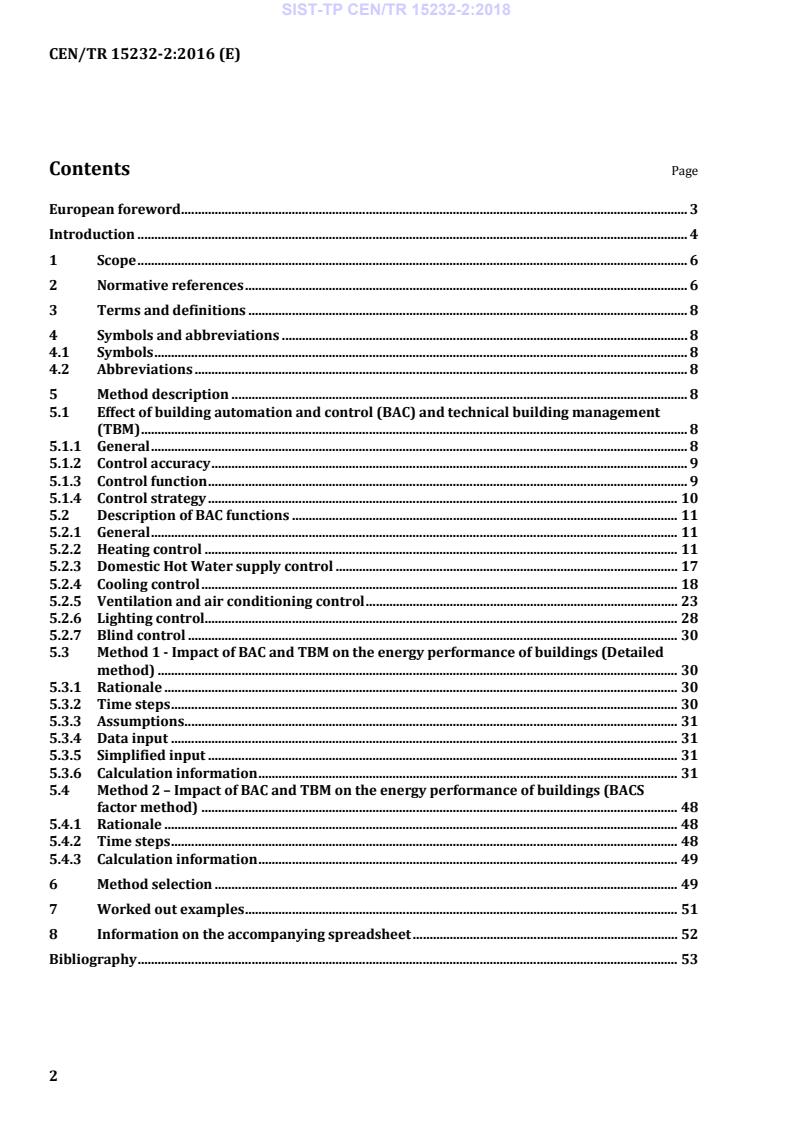
Contents Page
European foreword . 3
Introduction . 4
1 Scope . 6
2 Normative references . 6
3 Terms and definitions . 8
4 Symbols and abbreviations . 8
4.1 Symbols . 8
4.2 Abbreviations . 8
5 Method description . 8
5.1 Effect of building automation and control (BAC) and technical building management
(TBM) . 8
5.1.1 General . 8
5.1.2 Control accuracy . 9
5.1.3 Control function . 9
5.1.4 Control strategy . 10
5.2 Description of BAC functions . 11
5.2.1 General . 11
5.2.2 Heating control . 11
5.2.3 Domestic Hot Water supply control . 17
5.2.4 Cooling control . 18
5.2.5 Ventilation and air conditioning control . 23
5.2.6 Lighting control. 28
5.2.7 Blind control . 30
5.3 Method 1 - Impact of BAC and TBM on the energy performance of buildings (Detailed
method) . 30
5.3.1 Rationale . 30
5.3.2 Time steps . 30
5.3.3 Assumptions . 31
5.3.4 Data input . 31
5.3.5 Simplified input . 31
5.3.6 Calculation information . 31
5.4 Method 2 – Impact of BAC and TBM on the energy performance of buildings (BACS
factor method) . 48
5.4.1 Rationale . 48
5.4.2 Time steps . 48
5.4.3 Calculation information . 49
6 Method selection . 49
7 Worked out examples . 51
8 Information on the accompanying spreadsheet . 52
Bibliography . 53
European foreword
This document (CEN/TR 15232-2:2016) has been prepared by Technical Committee CEN/TC 247
“Building Automation, Controls and Building Management”, the secretariat of which is held by SNV.
Attention is drawn to the possibility that some of the elements of this document may be the subject of
patent rights. CEN shall not be held responsible for identifying any or all such patent rights.
This document has been prepared under a mandate given to CEN by the European Commission and the
European Free Trade Association.
This document is currently divided into the following parts:
— Energy performance of buildings — Part 1: Impact of Building Automation, Controls and Building
Management - Modules M10-4,5,6,7,8,9,10 [currently at Enquiry stage];
— Energy performance of buildings — Part 2: Accompanying prCEN/TR 15232-1:2015 Modules M10-
4,5,6,7,8,9,10 [the present Technical Report; currently at Voting stage].
Introduction
The CENSE project, the discussions between CEN and the Concerted action highlighted the high page
count of the entire package due to a lot of “textbook” information. This resulted in flooding and
confusing the normative text.
A huge amount of informative contents shall indeed be recorded and available for users to properly
understand, apply and nationally adapt the EPB standards
The detailed technical rules in CEN/TS 16629, "Detailed Technical Rules" ask for a clear separation
between normative and informative contents:
— to avoid flooding and confusing the actual normative part with informative content;
— to reduce the page count of the actual standard;
— to facilitate understanding of the package.
Therefore each EPB standard shall be accompanied by an informative technical report, like this one,
where all informative contents is collected.
Table 1 — Position of this standard within the EPB set of standards
Over-arching Building Technical Building System
(as such)
sub1 M1 M2 M3 M4 M5 M6 M7 M8 M9 M10 M11
1 General General General
Common
terms and
Building
2 definitions; Needs
Energy Needs
symbols, units
and subscripts
(Free) Indoor
Maximum
Conditions
3 Application Load and
without
Power
Systems
Ways to Ways to Ways to
Express Express Express
4 x
Energy Energy Energy
Performance Performance Performance
Building
Heat Transfer
Functions and Emission and
5 by x
Building control
Transmission
Boundaries
Building
Heat Transfer
Occupancy Distribution
6 by Infiltration x
and Operating and control
and Ventilation
Conditions
Submodule
Descriptions
Descriptions
Descriptions
Heating
Cooling
Ventilation
Humidification
Dehumidification
Domestic Hot waters
Lighting
Building automation
and control
PV, wind, .
Over-arching Building Technical Building System
(as such)
sub1 M1 M2 M3 M4 M5 M6 M7 M8 M9 M10 M11
Aggregation of
Energy
Internal Heat Storage and
7 Services and x
Gains control
Energy
Carriers
Building Solar Heat Generation
8 x
Partitioning Gains and control
Load
Calculated Building
dispatching
9 Energy Dynamics x
and operating
Performance (thermal mass)
conditions
Measured Measured Measured
10 Energy Energy Energy x
Performance Performance Performance
11 Inspection Inspection Inspection
Ways to
Express
12 BMS
Indoor
Comfort
External
13 Environment
Conditions
Economic
Calculation
Submodule
Descriptions
Descriptions
Descriptions
Heating
Cooling
Ventilation
Humidification
Dehumidification
Domestic Hot waters
Lighting
Building automation
and control
PV, wind, .
1 Scope
This Technical Report refers to prEN 15232-1, Energy performance of buildings — Part 1: Impact of
Building Automation, Controls and Building Management - Modules M10-4,5,6,7,8,9,10.
It contains information to support the correct understanding, use and national adaption of standard
prEN 15232-1:2015.
This technical report does not contain any normative provision.
2 Normative references
The following documents, in whole or in part, are normatively referenced in this document and are
indispensable for its application. For dated references, only the edition cited applies. For undated
references, the latest edition of the referenced document (including any amendments) applies.
prEN 12098-1:2015, Controls for heating systems — Part 1: Control equipment for hot water heating
systems - Modules M3-5,6,7,8
prEN 12098-3:2015, Controls for heating systems — Part 3: Control equipment for electrical heating
systems - Modules M3-5,6,7,8
prEN 12098-5:2015, Controls for heating systems — Part 3: Control equipment for electrical heating
systems — Modules M3-5,6,7,8
EN 13779, Ventilation for non-residential buildings - Performance requirements for ventilation and room-
conditioning systems
EN 15217, Energy performance of buildings - Methods for expressing energy performance and for energy
certification of buildings
prEN 15232-1:2015, Energy performance of buildings — Part 1: Impact of Building Automation, Controls
and Building Management — Modules M10-4,5,6,7,8,9,10
EN 15241:2007, Ventilation for buildings - Calculation methods for energy losses due to ventilation and
infiltration in commercial buildings
EN 15242:2007, Ventilation for buildings - Calculation methods for the determination of air flow rates in
buildings including infiltration
EN 15243:2007, Ventilation for buildings - Calculation of room temperatures and of load and energy for
buildings with room conditioning systems
EN 15316-1:2007, Heating systems in buildings - Method for calculation of system energy requirements
and system efficiencies - Part 1: General
EN 15316-2-1:2007, Heating systems in buildings - Method for calculation of system energy requirements
and system efficiencies - Part 2-1: Space heating emission systems
EN 15316-2-3:2007, Heating systems in buildings - Method for calculation of system energy requirements
and system efficiencies - Part 2-3: Space heating distribution systems
EN 15316-3-2, Heating systems in buildings - Method for calculation of system energy requirements and
system efficiencies - Part 3-2: Domestic hot water systems, distribution
EN 15316-3-3, Heating systems in buildings - Method for calculation of system energy requirements and
system efficiencies - Part 3-3: Domestic hot water systems, generation
EN 15316-4-1:2008, Heating systems in buildings - Method for calculation of system energy requirements
and system efficiencies - Part 4-1: Space heating generation systems, combustion systems (boilers)
EN 15316-4-2, Heating systems in buildings - Method for calculation of system energy requirements and
system efficiencies - Part 4-2: Space heating generation systems, heat pump systems
EN 15316-4-4, Heating systems in buildings - Method for calculation of system energy requirements and
system efficiencies - Part 4-4: Heat generation systems, building-integrated cogeneration systems
EN 15316-4-5, Heating systems in buildings - Method for calculation of system energy requirements and
system efficiencies - Part 4-5: Space heating generation systems, the performance and quality of district
heating and large volume systems
EN 15316-4-6, Heating systems in buildings - Method for calculation of system energy requirements and
system efficiencies - Part 4-6: Heat generation systems, photovoltaic systems
EN 15316-4-7, Heating systems in buildings - Method for calculation of system energy requirements and
system efficiencies - Part 4-7: Space heating generation systems, biomass combustion systems
EN 15378, Heating systems in buildings - Inspection of boilers and heating systems
EN 15239, Ventilation for buildings - Energy performance of buildings - Guidelines for inspection of
ventilation systems
EN 15240, Ventilation for buildings - Energy performance of buildings - Guidelines for inspection of air-
conditioning systems
prEN 15500-1:2015, Control for heating, ventilating and air-conditioning applications — Part 1:
Electronic individual zone control equipment — Modules M3-5,M4-5,M5-5
EN 15603:2008, Energy performance of buildings - Overall energy use and definition of energy ratings
prEN 16798–5-1, Energy performance of buildings — Modules M5-6, M5-8, M6-5, M6-8, M7-5, M7-8 —
Ventilation for buildings — Calculation methods for energy requirements of ventilation and air
conditioning systems — Part 5-1: Distribution and generation (revision of EN 15241) — Method 1
prEN 16798–5-2:2015, Energy performance of buildings — Modules M5-6, M5-8 — Ventilation for
buildings — Calculation methods for energy requirements of ventilation systems — Part 5-2: Distribution
and generation (revision of EN 15241) — method 2
prEN 16798-7:2014, Energy performance of buildings — Part 7: Ventilation for buildings — Modules M5-
1, M5-5, M5-6, M5-8 — Calculation methods for the determination of air flow rates in buildings including
infiltration
prEN 16947-1:2015, Building Management System — Module M10-12
FprCEN/TR 16947-2:2015, Accompanying TR for New Work Item — Building Management System
EN ISO 7345:1995, Thermal insulation - Physical quantities and definitions (ISO 7345:1987)
EN ISO 13790:2008, Energy performance of buildings - Calculation of energy use for space heating and
cooling (ISO 13790:2008)
EN ISO 16484-3:2005, Building automation and control systems (BACS) - Part 3: Functions (ISO 16484-
3:2005)
prEN ISO 52000-1:2015, Energy performance of buildings — Overarching EPB assessment — Part 1:
General framework and procedures (ISO/DIS 52000-1:2015)
3 Terms and definitions
For the purposes of this document, the terms and definitions given in EN ISO 7345:1995,
prEN ISO 52000-1:2015 and prEN 15232-1:2015 (the accompanied EPB standard) apply.
4 Symbols and abbreviations
4.1 Symbols
For the purposes of this Technical Report, the symbols given in prEN ISO 52000-1:2015, in
EN 15232-1:2015 (the accompanied EPB standard) apply.
4.2 Abbreviations
For the purposes of this Technical Report, the abbreviations in prEN 15232-1:2015 (the accompanied
EPB standard) apply.
5 Method description
5.1 Effect of building automation and control (BAC) and technical building
management (TBM)
5.1.1 General
The key-role of Building Automation and Control and TBM is to ensure the balance between the desired
human comfort - which shall be maximal, and energy used to obtain this goal - which shall be minimal!
The scope of BAC and TBM covers in accordance with their role from one side all Technical Building
Systems (where the effect of the BAC is used in the calculation procedures) and from another side the
global optimization Energy Performance of a Building.
We could identify several categories of controls:
— Technical Building Systems specific controls; these controllers are dedicated to the physical chain
of transformation of the energy, from Generation, to Storage, Distribution and Emission. We find
them in the matrix starting with the Modules M3-5 to M9-5 and finishing with M3-8 till M9-8. We
could consider that it exist one controller by module, but some time one controller do the control
among several modules. More often, these controllers are communicating between them via a
standardized open bus, such as BACnet, KNX or LON
— BAC used for all or several Technical Building Systems who do multidiscipline (heating, cooling,
ventilation, DHW, lighting…) optimization and complex control functions. For example, one of them
is INTERLOCK, a control function who avoids heating and cooling in same time.
— If all Technical Building System are used in the building, we have (depending of the size of the
building) a Technical Building Management System. Specific global functions are implemented here,
necessary to reach the key-role mentioned above. Usually, in this case, an interrelation with the
Building as such (Module M2) will occur, mainly to take in consideration the building needs; for
example due to outside temperature, taken into account the inertia of the building when the control
will reach the set point in a room.
In a control system dedicated to a building, who is BAC and TBM we can distinguish three main
characteristics as described in 5.1.2, 5.1.3 and 5.1.4.
5.1.2 Control accuracy
Control accuracy is the degree of correspondence between the ultimately controlled variable and the
ideal value in a feedback control system. The controlled variable could be any physical variable such as
a temperature, humidity, pressure, etc. The ideal value is in fact the SET POINT established by the user
(occupant) when he determines his level of comfort. It is clear that the entire control loop is concerned
with all the elements constituent, such as sensors, valves and actuators. The equipment itself is another
important element and usually specific equipment asks for a specific controller. For the energy carrier
hot water, an important issue is the balancing of the hydraulic circuits. For that purposes, balancing
hydraulic valves are need it.
The temperature control accuracy (CA) for a zone temperature is a key number that allows calculating
the additional energy need for heating or cooling caused by the inaccuracy of zone temperature control.
The temperature Control Accuracy (CA) can be calculated from Control Variation (CV) and Control Set
point Deviation (CSD) as described in the main text of prEN 15500:2015. The compliance with CA is also
defined in the standard. This is an important input for EN 15316-2 and for prEN 16798-7, where the
effect of the control for heating, cooling and ventilation is taken into account.
The same standard (prEN 15500-1:2015) describes also the 4 operations modes who deal with the
levels of temperatures: Comfort, Precomfort, Economy and Frost/Building Protection. These 4
predefined operation modes are parameters that could be set by the users (occupant) – the
temperature allocate to each operation mode. These operations modes are important for the control
strategy used for intermittence, which will be described below.
5.1.3 Control function
The control function is the ability of a controller (or set of communicative controllers) to perform a
determined task(s). Usually the functions implemented in the controllers are parametrable or free
programmable. The functions could be performed by a single controller or by a set of communicative
controllers. A controller could perform several functions.
The CONTROL FUNCTIONS present in a BAC or TBM, are present in prEN 15232-1:2015 Table 4. These
functions in Table 4 are organized in the matrix given by Modular Structure of EPB standards. Table 4
starts with Heating Emission, Distribution, Storage and Generation (M3-5, M3-6, M3-7, M3-8) follow by
Domestic Hot Water, Cooling, Ventilation and Lighting (M9-5, M9-6, M9-7, M9-8). Each function is
described in detail, in accordance with the type (level) of the function: from the lower type (NO
AUTOMATIC CONTROL Type = 0) to most advanced types. For each function, an IDENTIFIER who is the
software language for BAC and TBM is also defined, as the destination of the module where the control
function gives his effect. An example of Table 4 is given bellow, as abstract from prEN 15232-1:2015
Table 4.
For practical reasons, four different BAC efficiency classes (A, B, C, D) of functions are defined both for
non-residential and residential buildings. This is the fastest way to specify a BAC or a TBM.
— Class D corresponds to non-energy efficient BAC. Building with such systems shall be retrofitted.
New buildings shall not be built with such systems.
— Class C corresponds to standard BAC.
— Class B corresponds to advanced BAC and some specific TBM functions.
— Class A corresponds to high-energy performance BAC and TBM.
One is in class D: If the minimum functions to be in class C are not implemented.
To be in class C: Minimum functions defined in Table B.1 shall be implemented.
To be in class B: Building automation function plus some specific functions defined in Table 4 shall be
implemented in addition to class C. Room controllers shall be able to communicate with a building
automation system.
To be in class A: Technical building management function plus some specific functions defined in
Table 4 shall be implemented in addition to class B. Room controllers shall be able for demand
controlled HVAC (e.g. adaptive set point based on sensing of occupancy, air quality, etc.) including
additional integrated functions for multi-discipline interrelationships between HVAC and various
building services (e.g. electricity, lighting, solar shading, etc.)
In addition, the hydraulic system should be properly balanced.
The functions assignment to the BACS efficiency classes are listed in prEN 15232-1:2015, Table 5.
BAC functions with the purpose to control or monitor a plant or part of a plant which is not installed in
the building do not have to be considered when determining the class even if they are shaded for that
class. For example, to be in class B for a building with no cooling system no Individual room control
with communication is required for emission control of cooling systems.
If a specific function is required to be in a specific BAC efficiency class, it is not required that it is strictly
required everywhere in the building: if the designer can give good reasons that the application of a
function does not bring a benefit in a specific case it can be ignored. For example, if the designer can
show that the heating load of a set of rooms is only dependant on the outdoor temperature and can be
compensated with one central controller, no individual room control by thermostatic valves or
electronic controllers is required to be in class C.
A reference list of BACS functions to reach is defined in prEN 15232-1:2015, Table 6. That table defines
the minimum requirements of BACS functions according to BACS efficiency class C of Table 5.
Unless differently specified this list shall be used for the following:
— to specify the minimum functions to be implemented for a project;
— to define the BACS function to take into account for the calculation of energy consumption of a
building when the BACS functions are not defined in detail.
— to calculate the energy use for the reference case in step 1 of the BACS efficiency factor method.
5.1.4 Control strategy
The control function is the methods employed to achieve a given level of control to reach a goal. Optimal
control strategies deliver a desired level of control at a minimum cost (minimum energy demand). A
CONTROL STRATEGY could consist by a CONTROL FUNCTION or a group of CONTROL FUNCTIONS. An
example of a CONTROL STRATEGY consist by a CONTROL FUNCTION is OPTIMUM START, OPTIMUM
STOP, Night SET BACK described in the standards prEN 12098-1:2015 and prEN 12098-3:2015. The
Timer function is described in prEN 12098-5:2015.
An example of a CONTROL STRATEGY who is realized by a group of CONTROL FUNCTIONS is the
CONTROL STRATEGY used by INTERMITENCE. This function uses several CONTROL FUNCTIONS,
OPERATION MODES, OPTIMUM START-STOP and TIMER in same time. All elements together are called
either Building Profile or User Pattern. Usually, to implement such Building profile, a TBM is a
prerequisite.
The most important CONTROL STRATEGY described and implemented in prEN 15232-1:2015 is
DEMAND ORIENTED CONTROL. Usually these strategies implement the sense of the energy flow (from
GENERATION to EMISSION) with flow of calculation (from building needs to delivered energy). Usually
for this complex CONTROL STRATEGY, a TBM is necessary with a distributed specific control for each
Technical Building System who communicates in system architecture via a communication
standardized bus such as BACnet, KNX or LON.
More clear, this Demand Oriented Control works as follows: When the comfort is reach in the Emission
area, the controller from the Emission sent the message to the controller in charge of Distribution to
stop to distribute energy, who sent the message to the controller in charge of Storage either to store the
energy and if the Storage cannot store more energy sent the message to the controller in charge with
the Generation to stop to generate more energy.
Another important Control Strategy is the control strategy for multi generators either from same type
(e.g. several boilers) or different types (e.g. a boiler and heat pomp) including also the Renewable
Energy Sources. The strategy could be based as follow:
— Priorities only based on running time
— Fixed sequencing based on loads only: e.g. depending on the generators characteristics, e.g. hot
water boiler vs. heat pump
— Priorities based on generator efficiency and characteristics: The generator operational control is
set individually to available generators so that they operate with an overall high degree of
efficiency (e.g. solar, geothermic heat, cogeneration plant, fossil fuels)
— Load prediction based sequencing: The sequence is based on e.g. efficiency and available power of a
device and the predicted required power
The standards enabling to calculate the effect of BACS and TBM functions on energy consumption use
different approaches to calculate this impact. The approaches are described in prEN 15232-1:2015,
6.4.2.
5.2 Description of BAC functions
5.2.1 General
The numbers in italics refer to the numbers in prEN 15232-1:2015, Table 4.
5.2.2 Heating control
1.1 Heating – Emission control
1.1.0 No automatic control
Description: No automatic control of the room temperature.
1.1.1 Central automatic control
Description: Central automatic control of temperature in rooms by means of heating, is acting either on
the distribution or on the generation. Heating control is performed without consideration of local
demand of different rooms, possibly by using one room as reference. This can be achieved for example
by an outside temperature controller conforming to prEN 12098-1:2015 or prEN 12098-3:2015.
Target: To improve EP by minimizing emitted heat by emitters (e.g. radiators) or by air in the building
using central control of temperature and/or flow. This control may be based on outside temperature
and/or a reference sensor inside the building and assumes similar demands in different parts/rooms of
the building.
1.1.2 Individual room control
Description: Individual room control by thermostatic valves or electronic controllers. The individual
room control of heating temperature in rooms is performed either by thermostatic valves or local (non-
communicating) electronic control units. The individual control should/may be combined with
scheduler programs providing different operating modes.
Target: To improve EP by minimizing emitted heat by emitters (e.g. radiators) or by air in the building
using local control of temperature and/or flow in the rooms, thereby adapting to local demand, i.e.
different loads in different rooms.
1.1.3 Individual room control with communication
Description: Individual room control with communication between controllers and to BACS. Individual
control of temperature in rooms by means of heating, with communication between controllers and to
BACS, allows exchange of setpoints, demand and other status information.
Target: To improve EP by minimizing emitted heat by emitters (e.g. radiators) or by air in the building
using local control of temperature and/or flow in the rooms, thereby adapting to local demand, i.e.
different loads in different rooms. Furthermore to obtain energy demand for further use to control
distribution and generators, keeping run time at minimum and setpoints optimal.
1.1.4 Individual room control with communication and presence control
Description: Individual room control with communication between controllers and to BACS, and
presence control performed by occupancy. Individual control of temperature in rooms by means of
heating, with communication between controllers and to BACS, allows exchange of setpoints, demand
and other status information.
Target: To improve EP by minimizing emitted heat by emitters (e.g. radiators) or by air in the building
using local control of temperature and/or flow in the rooms, thereby adapting to local demand, i.e.
different loads in different rooms. Furthermore to obtain energy demand for further use to control
distribution and generators, keeping run time at minimum and setpoints optimal.
1.2 Heating – Emission control for TABS
1.2.0 No automatic control
Description: There’s no automatic control of the room temperature implemented.
Target: Manual controls of a loop apply.
1.2.1 Central automatic control
Description: The central automatic control for a TABS zone (which comprises all rooms which get the
same supply water temperature) typically is a supply water temperature control loop whose setpoint is
dependent on the filtered outside temperature, e.g. the average of the previous 24 h.
Target: The supply water temperature shall be set according to the filtered outside air temperature
(filtered -weather compensated supply water temperature).
1.2.2 Advanced central automatic control
Description: This is an automatic control of the TABS zone that fulfils the following conditions
— If the TABS is used only for heating: The central automatic control is designed and tuned to achieve
an optimal self-regulating of the room temperature within the required comfort range (specified by
the room temperature heating setpoint). “Optimal” means that the room temperatures of all rooms
of the TABS zone remain during operation periods in the comfort range, to meet comfort
requirements, but also is as low as possible to reduce the energy demand for heating.
— If the TABS is used for heating and cooling: The central automatic control is designed and tuned to
achieve an optimal self-regulating of the room temperature within the required comfort range
(specified by room temperature heating and cooling setpoints). “Optimal” means that the room
temperatures of all rooms of the TABS zone remain during operation periods in the comfort range,
to meet comfort requirements, but also uses as far as possible the full range to reduce the energy
demand for heating and cooling.
— If the TABS are used for heating and cooling: the automatic switching between heating and cooling
is not done only dependent on the outside temperature, but also taking at least indirectly the heat
gains (internal and solar) into account.
One solution to achieve these requirements can be found in [2] and [3].
Target: Achieve temperatures within the desired bandwidth for all rooms in the heating/cooling group.
1.2.3 Advanced central automatic control with intermittent operation and/or room temperature
feedback control
Description: Advanced central automatic control with room temperature feedback control:
— Advanced central automatic control with intermittent operation. This is an advanced central
automatic control according to 2) with the following supplement: The pump is switched off
regularly to save electrical energy, either with a fast frequency - typically 6 h on/off cycle time - or
with a slow frequency, corresponding to 24 h on/off cycle time. If the TABS are used for cooling,
intermittent operation with 24 h on/off cycle time can also be used to reject the heat to the outside
air if the outside air is cold. One solution to achieve this requirement can be found in [2] and [4].
— Advanced central automatic control with room temperature feedback control. This is an advanced
central automatic control according to 2) with the following supplement: The supply water
temperature setpoint is corrected by the output of a room temperature feedback controller, to
adapt the setpoint to non-predictable day-to-day variation of the heat gain. Since TABS react slowly,
only day-to-day room temperature correction is applied, an instant correction cannot be achieved
with TABS. The room temperature that is fed back is the temperature of a reference room or
another temperature representative for the zone. One solution to achieve this requirement can be
found in [2].
— Advanced central automatic control with intermittent operation and room temperature feedback
control.
Target: The goal is to compensate room/zone behaviour into the supply water temperature control in
order to optimize emissions taking into account heat gain and radiation.
1.3 Heating – Control of distribution network hot water (supply or return)
1.3.0 No automatic control
Description: The distribution network temperature of the hot water is not controlled.
1.3.1 Outside temperature compensated control
Description: Control of the temperature of the hot water distribution based on outside temperature
compensation.
Target: To improve EP by lowering the mean temperature of the flow, thereby minimizing heat losses.
1.3.2 Demand based control
Description: Control of the temperature of the hot water distribution is based on indoor temperature
measurements.
Prerequisite: Communicating system to room control units.
Target: To improve EP by lowering the mean temperature of the flow as well as decreasing the flow
rate, thereby minimizing heat losses. In addition use energy demand information to keep run time at
minimum and setpoints optimal.
1.4 Heating – Control of distribution pumps in networks
1.4.0 No automatic control
Description: Distribution pumps are not controlled (only protection functions).
1.4.1 On / off control
Description: On / off control. Pumps are switched on and off automatically but once switched the run no
control at maximum speed.
Target: To improve EP by avoiding auxiliary energy consumption of pumps while no energy need to be
circulated.
1.4.2 Multi-Stage control
Description: Speed of pumps is controlled by a multi-step control.
Target: To improve EP by reducing auxiliary energy consumption by adapting (in fixed steps) the speed
of the pump depending on the system conditions.
1.4.3 Variable speed pump control
Description: Speed of pumps is controlled depending on different states of the system. This may be
done with constant or variable Δp and with demand evaluation to reduce the auxiliary energy demand
of the pumps.
Target: To improve EP by reducing auxiliary energy consumption of pumps by optimizing their speed
according to the current system conditions.
1.4.4 Variable speed pump control
Description: Speed of pumps is controlled depending on different states of the system. This may be
done with variable Δp following an external demand signal, e.g. hydraulic requirements, ΔT, energy
optimization, demand evaluation to reduce the auxiliary energy demand of the pumps.
Target: To improve EP by reducing auxiliary energy consumption of pumps by optimizing their speed
for the current system conditions.
1.5 Heating – Intermittent control of emission and/or distribution
1.5.0 No automatic control
Description: No intermittent control (always full energy consumption).
1.5.1 Automatic control with fixed time program
Description: Automatic control is realized to reach intermittent operation of the emission and/or
distribution components.
Target: To improve EP by lowering the temperature setpoints during certain conditions (e.g. night).
This leads to improved EP due to shortened operation time of the generation/distribution, lower losses
of the room(s) due to lower temperature differences to the outside.
1.5.2 Automatic control with Optimum Start/Stop
Description: Automatic control is realized to reach optimized Start/Stop of intermittent operation of the
emission and/or distribution components.
Target: To improve EP through optimized start/stop to maximize time for economy mode by
considering energy capacity of the building in control.
1.5.3 Automatic control with demand evaluation
Description: Automatic control is realized to reach intermittent operation of emission and/or
distribution based on demand (occupancy).
Target: To improve EP through maximizing “pre-comfort” and/or “economy” time periods by detecting
or using information about real demand (e.g. occupancy).
1.6 Heating – Generator control for combustion and district heating
1.6.0 Constant Temperature Control
Description: Generator temperature is controlled to hold a predefined constant temperature within a
defined control deviation.
Target: To improve EP by minimizing the generator operation temperatures and avoiding max boiler
temperature (with highest losses), e.g. compared to thermostatic on/off control.
1.6.1 Variable temperature depending on outdoor temperature
Description: Generator temperature setpoint is variable depending on outdoor temperature.
Target: To improve EP by minimizing the generator operation temperatures using outdoor temperature
information.
1.6.2 Variable temperature depending on the load
Description: Generator temperature setpoint is variable depending on the load of the system.
Target: To improve EP by minimizing the generator operation temperatures using information about
current demand of the system.
1.7 Heating – Generator control for heat pumps
1.7.0 Constant Temperature Control
Description: Heat generation is not optimized to environmental conditions and control is always
towards the maximum allowed temperature.
Inputs: Max allowed temperature setpoint.
1.7.1 Variable temperature depending on outdoor temperature
Description: The control temperature is calculated with the goal to operate the heat pump with
minimized operating temperature setpoints depending on outdoor temperature.
Target: To improve EP by avoiding unnecessary electrical pumping energy by minimizing the generator
operation temperatures using outdoor temperature information.
1.7.2 Variable temperature depending on the load or demand
Description: Heat pump temperature setpoint is variable depending on demand based on the load of the
system.
Target: To improve EP by optimizing efficiency of the heat pump at given environmental conditions
based on current demand of the system.
1.8 Heating – Generator control for outdoor unit
The goal consists generally in maximizing the heat generator efficiency
1.8.0 On/Off-control of heat generator
1.8.1 Multi-stage control of heat generator
Description: Output of heat generator is controlled depending on the load or demand (e.g. on/off of
several compressors)
1.8.2 Variable control of heat generator
Description: Output of he
...