

EN ISO 3325:2026
(Main)Sintered metal materials, excluding hardmetals - Determination of transverse rupture strength (ISO 3325:2026)
General Information
- Abstract
This document specifies a method for the determination of the transverse rupture strength of sintered metal materials, excluding hardmetals. The method is particularly suitable for comparing the sintered strength of a batch of metal powder with that of a reference powder or with a reference strength.
The method is applicable to sintered metal materials, excluding hardmetals, whether they have been subjected to heat treatment after sintering or not, and also to materials that have been sized or coined after sintering.
It is especially suitable for materials having a uniform hardness throughout their section and negligible ductility, i.e. a ductility corresponding to a permanent deformation of less than about 0,5 mm measured between the two supports during the transverse rupture strength determination.
NOTE The permanent deformation can be measured with sufficient precision from the two fragments of the broken or cracked bar by indexing the lower surface. Alternatively, the deflection of a straight line drawn horizontally on the side of the test piece can be measured using an optical instrument such as a measuring microscope or optical comparator.
- Status
- Published
- Publication Date
- 27-Jan-2026
- Technical Committee
- CEN/SS M11 - Powder metallurgy
- Drafting Committee
- CEN/SS M11 - Powder metallurgy
- Current Stage
- 6060 - Definitive text made available (DAV) - Publishing
- Start Date
- 28-Jan-2026
- Completion Date
- 28-Jan-2026

Overview
EN ISO 3325:2026 establishes a standardized method for determining the transverse rupture strength of sintered metal materials, excluding hardmetals. Published by CEN and identical to ISO 3325:2026, this international standard offers a consistent approach for testing mechanical properties of sintered metals, which is crucial in quality control and materials development. The method is suitable for materials with negligible ductility and ensures that the results are reliable for both treated and untreated, as well as sized or coined, sintered metal materials.
Key Topics
Scope and Purpose
- Applies to sintered metal materials except for hardmetals.
- Suitable for materials with uniform hardness and negligible ductility (permanent deformation under 0.5 mm during testing).
- Facilitates direct comparison of sintered strength between batches or against reference materials.
Testing Method
- Involves breaking a bar-shaped test piece supported on two cylinders by applying a load at the midpoint.
- Provides clear instructions on specimen dimensioning and placement for repeatable results.
- Specifies the requirements for test equipment and procedures, enhancing accuracy and repeatability.
Measurement and Reporting
- Outlines precise measurement of specimen dimensions at the midpoint.
- Sets standards for load application rate, specimen positioning, and data recording.
- Requires reporting of calculations and test conditions, enabling traceability and comparability.
Applications
EN ISO 3325:2026 is widely used in industries relying on powder metallurgy and sintered components, including automotive, aerospace, tooling, and consumer goods. Practical uses include:
Quality Control
- Assures consistent strength in sintered products by enabling batch-to-batch comparisons.
- Detects deviations from reference materials, helping to maintain product reliability.
Material Development
- Assesses the effects of process variables (e.g., heat treatment, sizing, coining) on transverse rupture strength.
- Aids in the selection and optimization of metal powders for new component designs.
Supplier Assessment
- Enables evaluation of different powder suppliers based on standard test results, supporting procurement decisions.
Research and Certification
- Provides a solid basis for academic or industrial research on the mechanical properties of sintered metals.
- Ensures compliance with international standards, simplifying certification processes.
Related Standards
- ISO 2740 - Sintered metal materials, excluding hardmetals - Determination of hardness and porosity
- ISO 3953 - Powder metallurgy - Determination of mass of a cubic centimetre of free-flowing metal powders
- EN 10002-1 - Metallic materials - Tensile testing - Part 1: Method of test at ambient temperature
Integrating EN ISO 3325:2026 into your testing protocols ensures conformance to internationally recognized best practices for evaluating the transverse rupture strength of sintered metal materials. This standard is an essential reference for manufacturers, material scientists, and quality assurance professionals in the powder metallurgy sector.
For further guidance, always consult the latest official publication from ISO or your national standards body.
Relations
- Effective Date
- 19-Jan-2023
- Effective Date
- 19-Jan-2023
- Consolidated By
ISO 3325:2026 - Sintered metal materials, excluding hardmetals — Determination of transverse rupture strength - Effective Date
- 12-Feb-2026
Get Certified
Connect with accredited certification bodies for this standard

Element Materials Technology
Materials testing and product certification.

Inštitut za kovinske materiale in tehnologije
Institute of Metals and Technology. Materials testing, metallurgical analysis, NDT.
Sponsored listings
Frequently Asked Questions
EN ISO 3325:2026 is a standard published by the European Committee for Standardization (CEN). Its full title is "Sintered metal materials, excluding hardmetals - Determination of transverse rupture strength (ISO 3325:2026)". This standard covers: This document specifies a method for the determination of the transverse rupture strength of sintered metal materials, excluding hardmetals. The method is particularly suitable for comparing the sintered strength of a batch of metal powder with that of a reference powder or with a reference strength. The method is applicable to sintered metal materials, excluding hardmetals, whether they have been subjected to heat treatment after sintering or not, and also to materials that have been sized or coined after sintering. It is especially suitable for materials having a uniform hardness throughout their section and negligible ductility, i.e. a ductility corresponding to a permanent deformation of less than about 0,5 mm measured between the two supports during the transverse rupture strength determination. NOTE The permanent deformation can be measured with sufficient precision from the two fragments of the broken or cracked bar by indexing the lower surface. Alternatively, the deflection of a straight line drawn horizontally on the side of the test piece can be measured using an optical instrument such as a measuring microscope or optical comparator.
This document specifies a method for the determination of the transverse rupture strength of sintered metal materials, excluding hardmetals. The method is particularly suitable for comparing the sintered strength of a batch of metal powder with that of a reference powder or with a reference strength. The method is applicable to sintered metal materials, excluding hardmetals, whether they have been subjected to heat treatment after sintering or not, and also to materials that have been sized or coined after sintering. It is especially suitable for materials having a uniform hardness throughout their section and negligible ductility, i.e. a ductility corresponding to a permanent deformation of less than about 0,5 mm measured between the two supports during the transverse rupture strength determination. NOTE The permanent deformation can be measured with sufficient precision from the two fragments of the broken or cracked bar by indexing the lower surface. Alternatively, the deflection of a straight line drawn horizontally on the side of the test piece can be measured using an optical instrument such as a measuring microscope or optical comparator.
EN ISO 3325:2026 is classified under the following ICS (International Classification for Standards) categories: 77.040.10 - Mechanical testing of metals; 77.160 - Powder metallurgy. The ICS classification helps identify the subject area and facilitates finding related standards.
EN ISO 3325:2026 has the following relationships with other standards: It is inter standard links to EN ISO 3325:1999, EN ISO 3325:1999/A1:2002, ISO 3325:2026. Understanding these relationships helps ensure you are using the most current and applicable version of the standard.
EN ISO 3325:2026 is available in PDF format for immediate download after purchase. The document can be added to your cart and obtained through the secure checkout process. Digital delivery ensures instant access to the complete standard document.
Standards Content (Sample)
SLOVENSKI STANDARD
01-april-2026
Nadomešča:
SIST EN ISO 3325:2000
SIST EN ISO 3325:2000/A1:2004
Sintrani kovinski materiali, razen trdih kovin - Določanje prečne lomne trdnosti
(ISO 3325:2026)
Sintered metal materials, excluding hardmetals - Determination of transverse rupture
strength (ISO 3325:2026)
Sintermetalle, ausgenommen Hartmetalle - Ermittlung der Biegebruchfestigkeit (ISO
3325:2026)
Matériaux métalliques frittés à l'exclusion des métaux-durs - Détermination de la
résistance à la rupture transversale (ISO 3325:2026)
Ta slovenski standard je istoveten z: EN ISO 3325:2026
ICS:
77.040.10 Mehansko preskušanje kovin Mechanical testing of metals
77.160 Metalurgija prahov Powder metallurgy
2003-01.Slovenski inštitut za standardizacijo. Razmnoževanje celote ali delov tega standarda ni dovoljeno.
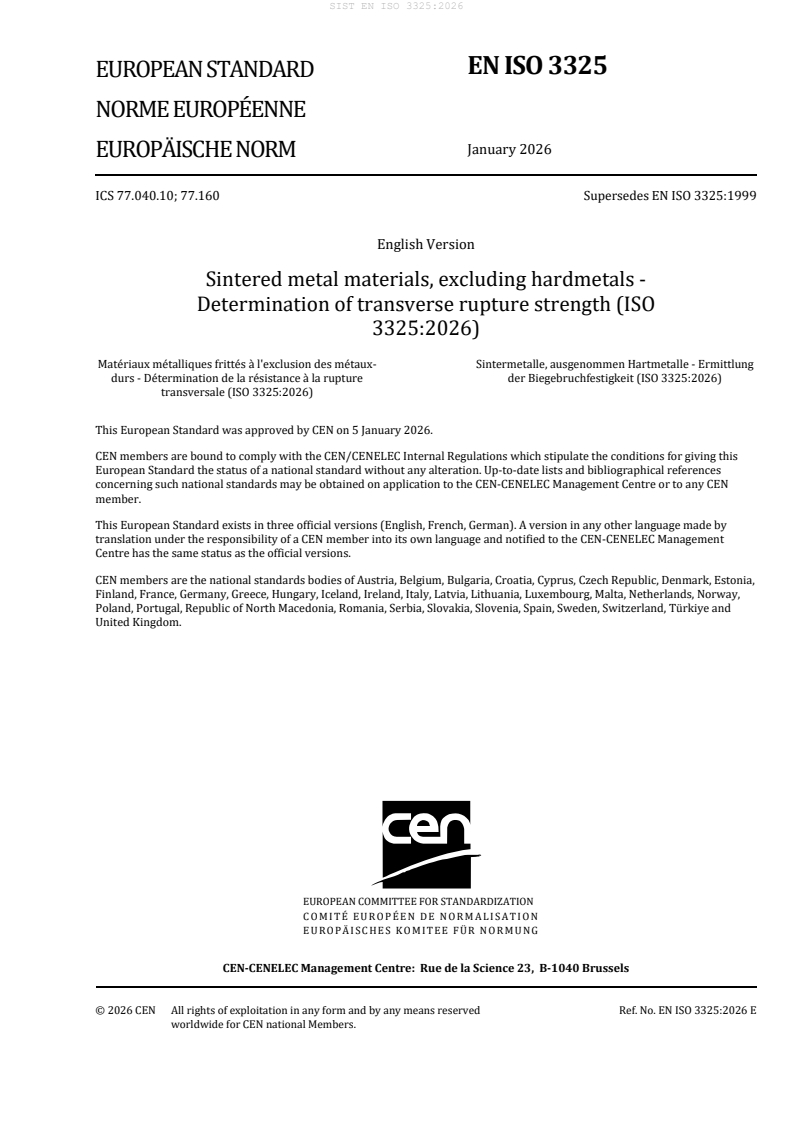
EN ISO 3325
EUROPEAN STANDARD
NORME EUROPÉENNE
January 2026
EUROPÄISCHE NORM
ICS 77.040.10; 77.160 Supersedes EN ISO 3325:1999
English Version
Sintered metal materials, excluding hardmetals -
Determination of transverse rupture strength (ISO
3325:2026)
Matériaux métalliques frittés à l'exclusion des métaux- Sintermetalle, ausgenommen Hartmetalle - Ermittlung
durs - Détermination de la résistance à la rupture der Biegebruchfestigkeit (ISO 3325:2026)
transversale (ISO 3325:2026)
This European Standard was approved by CEN on 5 January 2026.
CEN members are bound to comply with the CEN/CENELEC Internal Regulations which stipulate the conditions for giving this
European Standard the status of a national standard without any alteration. Up-to-date lists and bibliographical references
concerning such national standards may be obtained on application to the CEN-CENELEC Management Centre or to any CEN
member.
This European Standard exists in three official versions (English, French, German). A version in any other language made by
translation under the responsibility of a CEN member into its own language and notified to the CEN-CENELEC Management
Centre has the same status as the official versions.
CEN members are the national standards bodies of Austria, Belgium, Bulgaria, Croatia, Cyprus, Czech Republic, Denmark, Estonia,
Finland, France, Germany, Greece, Hungary, Iceland, Ireland, Italy, Latvia, Lithuania, Luxembourg, Malta, Netherlands, Norway,
Poland, Portugal, Republic of North Macedonia, Romania, Serbia, Slovakia, Slovenia, Spain, Sweden, Switzerland, Türkiye and
United Kingdom.
EUROPEAN COMMITTEE FOR STANDARDIZATION
COMITÉ EUROPÉEN DE NORMALISATION
EUROPÄISCHES KOMITEE FÜR NORMUNG
CEN-CENELEC Management Centre: Rue de la Science 23, B-1040 Brussels
© 2026 CEN All rights of exploitation in any form and by any means reserved Ref. No. EN ISO 3325:2026 E
worldwide for CEN national Members.
Contents Page
European foreword . 3
European foreword
This document (EN ISO 3325:2026) has been prepared by Technical Committee ISO/TC 119 "Powder
metallurgy" in collaboration with CCMC.
This European Standard shall be given the status of a national standard, either by publication of an
identical text or by endorsement, at the latest by July 2026, and conflicting national standards shall be
withdrawn at the latest by July 2026.
Attention is drawn to the possibility that some of the elements of this document may be the subject of
patent rights. CEN shall not be held responsible for identifying any or all such patent rights.
This document supersedes EN ISO 3325:1999.
Any feedback and questions on this document should be directed to the users’ national standards
body/national committee. A complete listing of these bodies can be found on the CEN website.
According to the CEN-CENELEC Internal Regulations, the national standards organizations of the
following countries are bound to implement this European Standard: Austria, Belgium, Bulgaria,
Croatia, Cyprus, Czech Republic, Denmark, Estonia, Finland, France, Germany, Greece, Hungary, Iceland,
Ireland, Italy, Latvia, Lithuania, Luxembourg, Malta, Netherlands, Norway, Poland, Portugal, Republic of
North Macedonia, Romania, Serbia, Slovakia, Slovenia, Spain, Sweden, Switzerland, Türkiye and the
United Kingdom.
Endorsement notice
The text of ISO 3325:2026 has been approved by CEN as EN ISO 3325:2026 without any modification.
International
Standard
ISO 3325
Third edition
Sintered metal materials, excluding
2026-01
hardmetals — Determination of
transverse rupture strength
Matériaux métalliques frittés à l’exclusion des métaux-durs —
Détermination de la résistance à la rupture transversale
Reference number
ISO 3325:2026(en) © ISO 2026
ISO 3325:2026(en)
© ISO 2026
All rights reserved. Unless otherwise specified, or required in the context of its implementation, no part of this publication may
be reproduced or utilized otherwise in any form or by any means, electronic or mechanical, including photocopying, or posting on
the internet or an intranet, without prior written permission. Permission can be requested from either ISO at the address below
or ISO’s member body in the country of the requester.
ISO copyright office
CP 401 • Ch. de Blandonnet 8
CH-1214 Vernier, Geneva
Phone: +41 22 749 01 11
Email: copyright@iso.org
Website: www.iso.org
Published in Switzerland
ii
ISO 3325:2026(en)
Contents Page
Foreword .iv
1 Scope . 1
2 Normative references . 1
3 Terms and definitions . 1
4 Principle . 1
5 Apparatus . 1
6 Test piece . 2
7 Procedure . 3
8 Expression of results . 3
9 Precision . 3
10 Test report . 4
iii
ISO 3325:2026(en)
Foreword
ISO (the International Organization for Standardization) is a worldwide federation of national standards
bodies (ISO member bodies). The work of preparing International Standards is normally carried out through
ISO technical committees. Each member body interested in a subject for which a technical committee
has been established has the right to be represented on that committee. International organizations,
governmental and non-governmental, in liaison with ISO, also take part in the work. ISO collaborates closely
with the International Electrotechnical Commission (IEC) on all matters of electrotechnical standardization.
The procedures used to develop this document and those intended for its further maintenance are described
in the ISO/IEC Directives, Part 1. In particular, the different approval criteria needed for the different types
of ISO document should be noted. This document was draf
...