

SIST EN 16755:2017
(Main)Durability of reaction to fire performance - Classes of fire-retardant treated wood products in interior and exterior end use applications
General Information
- Abstract
This European Standard describes the characteristics for fire-retardant treated wood products.
NOTE 1 It is based on maintaining performance undiminished throughout the desired service life in the anticipated conditions of use.
The European Standard prescribes the classification requirements for the durability of the reaction to fire performance of fire-retardant treated wood products to be used in interior and exterior end use conditions.
This European Standard applies to wood which has been treated during a production process with fire retardant products applied either by a penetration process or by a superficial process, such as with a film forming or intumescent fire retardant coating. It covers fire-retardant treated products that are coated with an ordinary paint.
Mechanical properties and biological durability of fire-retardant treated wood products are not covered by this European Standard.
NOTE 2 This standard can be used for other manufactured wood products.
This standard covers wood products. It doesn’t cover wood-based panels.
NOTE 3 Wood based panels for construction are described in EN 13986.
- Status
- Published
- Public Enquiry End Date
- 02-Mar-2016
- Publication Date
- 21-Nov-2017
- Technical Committee
- LLZ - Les, lesni izdelki in zaščita lesa
- Current Stage
- 6060 - National Implementation/Publication (Adopted Project)
- Start Date
- 20-Oct-2017
- Due Date
- 25-Dec-2017
- Completion Date
- 22-Nov-2017
Buy Documents



Overview
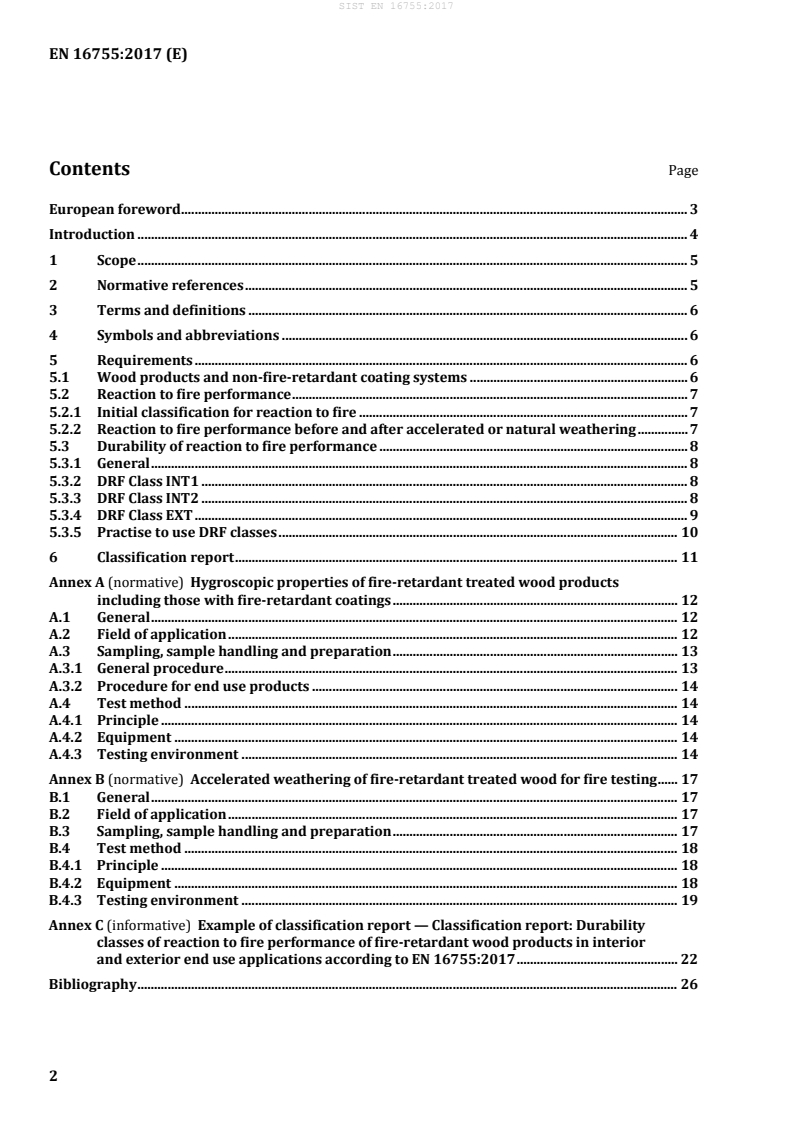
EN 16755:2017 - Durability of reaction to fire performance sets out how to classify the durability of the reaction-to-fire performance of fire‑retardant treated wood products for interior and exterior end uses. The standard covers wood treated by penetration or superficial processes (including film‑forming or intumescent coatings) and products coated with ordinary paint. It is focused on maintaining fire performance over the anticipated service life under expected use conditions. Mechanical properties and biological durability are explicitly not covered. Note: wood‑based panels are excluded (see EN 13986).
Key topics and requirements
- Scope of application
- Applies to treated solid wood and other manufactured wood products (not wood‑based panels).
- Covers both impregnated and surface‑treated (coated) fire‑retardant systems.
- Durability classes (DRF)
- DRF INT1, INT2 and EXT classify treated wood according to expected moisture/ exposure conditions (dry, humid, exterior).
- Initial and maintained reaction‑to‑fire performance
- Initial classification via recognized reaction‑to‑fire standards (preferred: EN 13823 / EN 13501‑1 for construction; IMO FTP for maritime).
- Verification of maintained performance after accelerated or natural weathering.
- Weathering and hygroscopic testing
- Annex A: hygroscopic properties testing (humidity influence).
- Annex B: accelerated weathering procedures for fire testing; natural weathering per EN 927‑3 or artificial per EN 927‑6 are allowed.
- Minimum specimen width for accelerated weathering: 100 mm.
- Fire testing options after weathering
- Preferred: EN 13823 (SBI) for classification.
- Alternative: small‑scale cone calorimeter ISO 5660‑1 (heat flux 50 kW/m2 for ≥1 200 s) - requires at least three replicates and careful specimen preparation.
- Manufacturer declarations and maintenance
- Fire‑retardant retention declared in kg/m3 (or kg/m2 for surface products) conditioned per EN 13238.
- Manufacturers must declare maintenance regime: type, interval, time until first maintenance/recoating, and coating system.
Practical applications and users
- Who uses EN 16755:2017
- Wood product manufacturers and treaters, façade and cladding producers, paint/coating formulators, test laboratories, fire safety engineers, architects, building certifiers and regulators.
- Why it matters
- Provides a framework to demonstrate that treated wood retains fire performance in service conditions - essential for specifying exterior claddings, interior timber elements, and compliance with fire safety regulations.
- Supports product classification, labelling, performance claims, and procurement specifications.
Related standards
- EN 13823, EN 13501‑1 (reaction‑to‑fire classification)
- ISO 5660‑1 (cone calorimeter)
- EN 927‑3 / EN 927‑6 (natural and artificial weathering for coatings)
- EN 13238 (conditioning procedures)
- EN 13986 (wood‑based panels - excluded from EN 16755)
Keywords: EN 16755:2017, fire‑retardant treated wood, durability of reaction to fire, DRF classes, weathering, hygroscopic properties, EN 13823, ISO 5660‑1.
Relations
- Effective Date
- 10-Jan-2018
- Effective Date
- 05-Aug-2026
- Effective Date
- 09-Feb-2026
- Effective Date
- 28-Jan-2026
- Effective Date
- 28-Jan-2026
- Effective Date
- 28-Jan-2026
- Effective Date
- 28-Jan-2026
- Effective Date
- 28-Jan-2026
- Effective Date
- 01-Oct-2018
- Effective Date
- 19-Jan-2023
Buy Documents
Get Certified
Connect with accredited certification bodies for this standard

ECOCERT
Organic and sustainability certification.

CIS Institut d.o.o.
Personal Protective Equipment (PPE) certification body. Notified Body NB-2890 for EU Regulation 2016/425 PPE.

Eurofins Food Testing Global
Global leader in food, environment, and pharmaceutical product testing.
Sponsored listings
Frequently Asked Questions
SIST EN 16755:2017 is a standard published by the Slovenian Institute for Standardization (SIST). Its full title is "Durability of reaction to fire performance - Classes of fire-retardant treated wood products in interior and exterior end use applications". This standard covers: This European Standard describes the characteristics for fire-retardant treated wood products. NOTE 1 It is based on maintaining performance undiminished throughout the desired service life in the anticipated conditions of use. The European Standard prescribes the classification requirements for the durability of the reaction to fire performance of fire-retardant treated wood products to be used in interior and exterior end use conditions. This European Standard applies to wood which has been treated during a production process with fire retardant products applied either by a penetration process or by a superficial process, such as with a film forming or intumescent fire retardant coating. It covers fire-retardant treated products that are coated with an ordinary paint. Mechanical properties and biological durability of fire-retardant treated wood products are not covered by this European Standard. NOTE 2 This standard can be used for other manufactured wood products. This standard covers wood products. It doesn’t cover wood-based panels. NOTE 3 Wood based panels for construction are described in EN 13986.
This European Standard describes the characteristics for fire-retardant treated wood products. NOTE 1 It is based on maintaining performance undiminished throughout the desired service life in the anticipated conditions of use. The European Standard prescribes the classification requirements for the durability of the reaction to fire performance of fire-retardant treated wood products to be used in interior and exterior end use conditions. This European Standard applies to wood which has been treated during a production process with fire retardant products applied either by a penetration process or by a superficial process, such as with a film forming or intumescent fire retardant coating. It covers fire-retardant treated products that are coated with an ordinary paint. Mechanical properties and biological durability of fire-retardant treated wood products are not covered by this European Standard. NOTE 2 This standard can be used for other manufactured wood products. This standard covers wood products. It doesn’t cover wood-based panels. NOTE 3 Wood based panels for construction are described in EN 13986.
SIST EN 16755:2017 is classified under the following ICS (International Classification for Standards) categories: 13.220.40 - Ignitability and burning behaviour of materials and products; 71.100.50 - Wood-protecting chemicals; 79.040 - Wood, sawlogs and sawn timber. The ICS classification helps identify the subject area and facilitates finding related standards.
SIST EN 16755:2017 has the following relationships with other standards: It is inter standard links to SIST CEN/TS 15912:2012, SIST EN 13238:2026, SIST ISO 5660-1:2018, SIST EN 13238:2010, SIST EN 13823:2020+A1:2022, SIST EN 927-3:2019, SIST EN 927-6:2019, SIST EN 13501-1:2019, SIST EN 16755:2017/AC:2018, kSIST FprEN 16755:2026. Understanding these relationships helps ensure you are using the most current and applicable version of the standard.
SIST EN 16755:2017 is available in PDF format for immediate download after purchase. The document can be added to your cart and obtained through the secure checkout process. Digital delivery ensures instant access to the complete standard document.
Standards Content (Sample)
2003-01.Slovenski inštitut za standardizacijo. Razmnoževanje celote ali delov tega standarda ni dovoljeno.WHPDauerhaftigkeit des Verhaltens bei Brandeinwirkung - Klassen der mit Feuerschutzmitteln behandelten Holzprodukte für Anwendungen im Innen- und AußenbereichDurabilité des performances de réaction au feu - Classement des produits à base de bois ignifugés pour utilisation finale en intérieur et en extérieurDurability of reaction to fire performance - Classes of fire-retardant treated wood products in interior and exterior end use applications79.040Les, hlodovina in žagan lesWood, sawlogs and sawn timber71.100.50Wood-protecting chemicals13.220.40Sposobnost vžiga in obnašanje materialov in proizvodov pri gorenjuIgnitability and burning behaviour of materials and productsICS:Ta slovenski standard je istoveten z:EN 16755:2017SIST EN 16755:2017en,fr,de01-december-2017SIST EN 16755:2017SLOVENSKI
STANDARD
EUROPEAN STANDARD NORME EUROPÉENNE EUROPÄISCHE NORM
EN 16755
October
t r s y ICS
s uä t t rä v râ
s uä t t rä w râ
y sä s r rä w r English Version
Durability of reaction to fire performance æ Classes of fireæretardant treated wood products in interior and exterior end use applications Durabilitß des performances de rßaction au feu æ Classement des produits à base de bois ignifugßs pour utilisation finale en intßrieur et en extßrieur
Dauerhaftigkeit des Verhaltens bei Brandeinwirkung æ Klassen der mit Feuerschutzmitteln behandelten Holzprodukte für Anwendungen im Innenæ und Außenbereich This European Standard was approved by CEN on
t July
t r s yä
egulations which stipulate the conditions for giving this European Standard the status of a national standard without any alterationä Upætoædate lists and bibliographical references concerning such national standards may be obtained on application to the CENæCENELEC Management Centre or to any CEN memberä
translation under the responsibility of a CEN member into its own language and notified to the CENæCENELEC Management Centre has the same status as the official versionsä
CEN members are the national standards bodies of Austriaá Belgiumá Bulgariaá Croatiaá Cyprusá Czech Republicá Denmarká Estoniaá Finlandá Former Yugoslav Republic of Macedoniaá Franceá Germanyá Greeceá Hungaryá Icelandá Irelandá Italyá Latviaá Lithuaniaá Luxembourgá Maltaá Netherlandsá Norwayá Polandá Portugalá Romaniaá Serbiaá Slovakiaá Sloveniaá Spainá Swedená Switzerlandá Turkey and United Kingdomä
EUROPEAN COMMITTEE FOR STANDARDIZATION COMITÉ EUROPÉEN DE NORMALISATION EUROPÄISCHES KOMITEE FÜR NORMUNG
CEN-CENELEC Management Centre:
Avenue Marnix 17,
B-1000 Brussels
t r s y CEN All rights of exploitation in any form and by any means reserved worldwide for CEN national Membersä Refä Noä EN
s x y w wã t r s y ESIST EN 16755:2017
Hygroscopic properties of fire-retardant treated wood products including those with fire-retardant coatings . 12 A.1 General . 12 A.2 Field of application . 12 A.3 Sampling, sample handling and preparation . 13 A.3.1 General procedure . 13 A.3.2 Procedure for end use products . 14 A.4 Test method . 14 A.4.1 Principle . 14 A.4.2 Equipment . 14 A.4.3 Testing environment . 14 Annex B (normative)
Accelerated weathering of fire-retardant treated wood for fire testing . 17 B.1 General . 17 B.2 Field of application . 17 B.3 Sampling, sample handling and preparation . 17 B.4 Test method . 18 B.4.1 Principle . 18 B.4.2 Equipment . 18 B.4.3 Testing environment . 19 Annex C (informative)
Example of classification report — Classification report: Durability classes of reaction to fire performance of fire-retardant wood products in interior and exterior end use applications according to EN 16755:2017 . 22 Bibliography . 26
3.1.1 dry condition DRF INT1 moisture content in the materials corresponding to a temperature of 20 °C and the relative humidity of the surrounding air exceeding 65 % only for a few weeks per year Note 1 to entry: In Eurocode EN 1995–1–1 as Service class 1. 3.1.2 humid condition DRF INT2 moisture content in the material corresponding to a temperature of 20 °C and a relative humidity of the surrounding air exceeding 85 % only for a few weeks per year Note 1 to entry: In EN 1995–1–1 defined as Service class 2. 3.2 ordinary paint non-fire retardant paint 4 Symbols and abbreviations The symbols for DRF Classes INT1, INT2 and EXT are the following ones:
Figure 1 — Proposed symbols for classes 5 Requirements 5.1 Wood products and non-fire-retardant coating systems The treatment manufacturing process and application rate declared by the producer shall be declared by the manufacturer of the final product. Actual fire-retardant retention shall be expressed in kg/m3 of the final wood product, or in kg/m2 for surface treated products. Values shall be given for products conditioned at (50 ± 5)% relative humidity at (23 ± 2) °C (as for fire testing) according to EN 13238. For products in DRF Classes INT and EXT procedures for maintenance shall be provided by the manufacturers regarding: — type of maintenance; — interval of maintenance; SIST EN 16755:2017
Intended use Reaction to fire class, initial Hygroscopic propertiesb Reaction to fire performance after weather exposure INT1 Interior dry applications Relevant fire class
- INT2 Interior humid applications Relevant fire class - Moisture content < 28 % - No exudation of liquid - Minimum visible salt with no increase at surface - EXTf Exterior applications Relevant fire class - Moisture content < 28 % - No exudation of liquid - Minimum visible salt with no increase at surface Maintained reaction to fire claimed performancec, d, e after - Accelerated weathering or - Natural weathering Application of specified maintenance may be included. a To be fulfilled using product produced in the same way using the same manufacturing process and having a similar retention level as for the reaction to fire performance. b For INT2 at (90 ± 5) % RH and (27 ± 2) °C according to Annex A. Classes INT2 and EXT are only applicable for product application rates less than or equal to the highest level tested. Wood products treated to higher application rates will be assumed to be Class INT1. c
For EN 13823 according to 5.2.2.2.2, the relevant classification criteria according to EN 13501–1 shall be used. At least the same classification level as initially shall be reached. d Criteria for small scale fire testing according to 5.2.2.2.3 after weather exposure:
- Class B products (according to EN 13501–1): Heat Release Rate, HRR30s ave
150 kW/m2 during 600 s after ignition and Total Heat Release THR600s increase < 20 % compared to fire testing before the weather exposure.
- Class C products (according to EN 13501–1): HRR 30s ave
220 kW/m2 during 600 s after ignition and THR600s increase < 20 % compared to fire testing before the weather exposure. e For DRF Class EXT, the Durability of Reaction to Fire performance classification is only valid for the type of coating system (with an ordinary paint) to be verified. f Verification of DRF Class EXT obtained without a coating system (with an ordinary paint) is valid also for the same product coated, provided that the coating does not reduce the reaction to fire performance according to 5.2.1. NOTE 2 Heat Release Rate, HRR30s ave is calculated as the sum of the HRR peak value and three values before and after the peak (totally seven values) divided by seven. 5.3.5 Practise to use DRF classes Practices to use the DRF classification system: — DRF INT1 and INT2 classifications apply for the lifetime of the wood product provided the product is only used in the intended service class. — DRF Class EXT is complex with a number of factors to be considered. The manufacturers should be consulted regarding service life. SIST EN 16755:2017
Figure 2 — Proposed labels to be used for DRF classes INT1, INT2 and EXT with year of initial testing according to this standard 6 Classification report Classification report according to this document shall be issued by accredited institutes and approval bodies. The classification report shall include the following items: — name and address of the accredited institute or approval body; — name and address of the organization or person stating the classification; — name and address of the manufacturer or supplier of the tested product; — identification of the wood product including type of fire-retardant treatment, retention level and coating details; — a general description of the product including density and thickness; — initial reaction to fire class obtained according to e.g. EN 13501-1 or IMO Code FTP, incl. details on mounting and fixing; — identification and number of the test reports referred to; — accelerated weathering method used for DRF Class EXT; — information if any maintenance shall be performed during use; — hygroscopicity and weathering tests, including test method employed; — performance according to the criteria for the actual DRF class; — reference to this Standard and the fire classification standard used. The format for a classification report is given in Annex C. SIST EN 16755:2017
Hygroscopic properties of fire-retardant treated wood products including those with fire-retardant coatings A.1 General This test method prescribes the procedure for determining the equilibrium moisture content after exposure to standard high relative humidity conditions of (90 ± 5) % at (27 ± 2)°C, depending on DRF class. The method is based on NT Build 504 [16], with changes in A.3 and an additional humid climate included for testing. It is a modified and extended version of ASTM D3201-94 (with the same title) [10]. The extension aims at more repeatable and reproducible results by requiring conditioning to equilibrium moisture content (instead of a specified time, one week, without specifying the sample size or air velocities in the climate chamber in the ASTM version). In this European Standard, some further modifications are included, mainly testing for two interior cases, dry and humid. A.2 Field of application — The method is applicable for assessing the hygroscopic properties of fire-retardant treated wood products (with the fire-retardant incorporated during the manufacturing of the wood product). It is also applicable for wood products with fire-retardant coatings, including film-forming, non-film-forming and intumescent coatings. The hygroscopic properties of wood and wood products treated with fire-retardant chemicals may be greater than for untreated products. This is particularly true at the higher relative humidity conditions. This higher hygroscopicity may cause staining, decay, poor paint adhesion, migration and exuding of chemicals and moisture at the high humidities. Corrosion of metal fasteners may also occur. The results obtained with this Standard are important in determining if the fire-retardant treated wood or wood product has undesirable hygroscopic properties, i.e. reaches an equilibrium moisture content that exceeds that for untreated wood and the maximum prescribed level for the applicable DRF Class. — Two test options are included, one general option and one specific option for end use products. — The general test option (A.3.1) for impregnation treatments and fire-retardant coatings is carried out using Scots pine (Pinus sylvestris) sapwood, in an uncoated manner (without ordinary paint) since this will give c
...
SLOVENSKI STANDARD
01-december-2017
Nadomešča:
SIST CEN/TS 15912:2012
Odpornost odziva na ogenj - Razredi lesnih proizvodov, obdelanih z zaščitnimi
sredstvi proti ognju, za uporabo v notranjih prostorih in na prostem
Durability of reaction to fire performance - Classes of fire-retardant treated wood
products in interior and exterior end use applications
Dauerhaftigkeit des Verhaltens bei Brandeinwirkung - Klassen der mit
Feuerschutzmitteln behandelten Holzprodukte für Anwendungen im Innen- und
Außenbereich
Durabilité des performances de réaction au feu - Classement des produits à base de
bois ignifugés pour utilisation finale en intérieur et en extérieur
Ta slovenski standard je istoveten z: EN 16755:2017
ICS:
13.220.40 Sposobnost vžiga in Ignitability and burning
obnašanje materialov in behaviour of materials and
proizvodov pri gorenju products
71.100.50 Kemikalije za zaščito lesa Wood-protecting chemicals
79.040 Les, hlodovina in žagan les Wood, sawlogs and sawn
timber
2003-01.Slovenski inštitut za standardizacijo. Razmnoževanje celote ali delov tega standarda ni dovoljeno.
EN 16755
EUROPEAN STANDARD
NORME EUROPÉENNE
October 2017
EUROPÄISCHE NORM
ICS 13.220.40; 13.220.50; 71.100.50
English Version
Durability of reaction to fire performance - Classes of fire-
retardant treated wood products in interior and exterior
end use applications
Durabilité des performances de réaction au feu - Dauerhaftigkeit des Verhaltens bei Brandeinwirkung -
Classement des produits à base de bois ignifugés pour Klassen der mit Feuerschutzmitteln behandelten
utilisation finale en intérieur et en extérieur Holzprodukte für Anwendungen im Innen- und
Außenbereich
This European Standard was approved by CEN on 2 July 2017.
CEN members are bound to comply with the CEN/CENELEC Internal Regulations which stipulate the conditions for giving this
European Standard the status of a national standard without any alteration. Up-to-date lists and bibliographical references
concerning such national standards may be obtained on application to the CEN-CENELEC Management Centre or to any CEN
member.
This European Standard exists in three official versions (English, French, German). A version in any other language made by
translation under the responsibility of a CEN member into its own language and notified to the CEN-CENELEC Management
Centre has the same status as the official versions.
CEN members are the national standards bodies of Austria, Belgium, Bulgaria, Croatia, Cyprus, Czech Republic, Denmark, Estonia,
Finland, Former Yugoslav Republic of Macedonia, France, Germany, Greece, Hungary, Iceland, Ireland, Italy, Latvia, Lithuania,
Luxembourg, Malta, Netherlands, Norway, Poland, Portugal, Romania, Serbia, Slovakia, Slovenia, Spain, Sweden, Switzerland,
Turkey and United Kingdom.
EUROPEAN COMMITTEE FOR STANDARDIZATION
COMITÉ EUROPÉEN DE NORMALISATION
EUROPÄISCHES KOMITEE FÜR NORMUNG
CEN-CENELEC Management Centre: Avenue Marnix 17, B-1000 Brussels
© 2017 CEN All rights of exploitation in any form and by any means reserved Ref. No. EN 16755:2017 E
worldwide for CEN national Members.
Contents Page
European foreword . 3
Introduction . 4
1 Scope . 5
2 Normative references . 5
3 Terms and definitions . 6
4 Symbols and abbreviations . 6
5 Requirements . 6
5.1 Wood products and non-fire-retardant coating systems . 6
5.2 Reaction to fire performance . 7
5.2.1 Initial classification for reaction to fire . 7
5.2.2 Reaction to fire performance before and after accelerated or natural weathering . 7
5.3 Durability of reaction to fire performance . 8
5.3.1 General . 8
5.3.2 DRF Class INT1 . 8
5.3.3 DRF Class INT2 . 8
5.3.4 DRF Class EXT . 9
5.3.5 Practise to use DRF classes . 10
6 Classification report . 11
Annex A (normative) Hygroscopic properties of fire-retardant treated wood products
including those with fire-retardant coatings . 12
A.1 General . 12
A.2 Field of application . 12
A.3 Sampling, sample handling and preparation . 13
A.3.1 General procedure . 13
A.3.2 Procedure for end use products . 14
A.4 Test method . 14
A.4.1 Principle . 14
A.4.2 Equipment . 14
A.4.3 Testing environment . 14
Annex B (normative) Accelerated weathering of fire-retardant treated wood for fire testing . 17
B.1 General . 17
B.2 Field of application . 17
B.3 Sampling, sample handling and preparation . 17
B.4 Test method . 18
B.4.1 Principle . 18
B.4.2 Equipment . 18
B.4.3 Testing environment . 19
Annex C (informative) Example of classification report — Classification report: Durability
classes of reaction to fire performance of fire-retardant wood products in interior
and exterior end use applications according to EN 16755:2017 . 22
Bibliography . 26
European foreword
This document (EN 16755:2017) has been prepared by Technical Committee CEN/TC 175 “Round and
sawn timber”, the secretariat of which is held by AFNOR.
This European Standard shall be given the status of a national standard, either by publication of an
identical text or by endorsement, at the latest by April 2018, and conflicting national standards shall be
withdrawn at the latest by April 2018.
Attention is drawn to the possibility that some of the elements of this document may be the subject of
patent rights. CEN shall not be held responsible for identifying any or all such patent rights.
According to the CEN-CENELEC Internal Regulations, the national standards organizations of the
following countries are bound to implement this European Standard: Austria, Belgium, Bulgaria,
Croatia, Cyprus, Czech Republic, Denmark, Estonia, Finland, Former Yugoslav Republic of Macedonia,
France, Germany, Greece, Hungary, Iceland, Ireland, Italy, Latvia, Lithuania, Luxembourg, Malta,
Netherlands, Norway, Poland, Portugal, Romania, Serbia, Slovakia, Slovenia, Spain, Sweden, Switzerland,
Turkey and the United Kingdom.
Introduction
Fire-retardant treatments may considerably improve the reaction to fire properties of wood products
and these may result in wood products having the highest fire performance characteristics achievable
with any combustible product. However, the reaction to fire performance may be reduced by exposure
to wet and/or humid conditions [11] and the ability of the treated products to continue to perform even
when exposed to these conditions needs to be demonstrated.
Two aspects of the reaction to fire durability of fire-retardant wood products need to be considered.
One is the risk for high moisture content and migration of the fire-retardant chemicals within the wood
product and salt crystallization on the product surface that may fall off and reduce the improved fire
properties. These hygroscopic properties of the treated wood product can be evaluated by exposure to
high relative humidity.
The other aspect is the risk for decreased fire performance due to loss of the fire-retardant chemicals by
leaching in exterior applications, e.g. facade claddings. Maintained fire performance after weathering
needs to be verified.
This standard is based on the Technical Specification CEN/TS 15912, on a Nordtest standard [20] and
on experience from North America [10, 9].
1 Scope
This European Standard describes the characteristics for fire-retardant treated wood products.
NOTE 1 It is based on maintaining performance undiminished throughout the desired service life in the
anticipated conditions of use.
The European Standard prescribes the classification requirements for the durability of the reaction to
fire performance of fire-retardant treated wood products to be used in interior and exterior end use
conditions.
This European Standard applies to wood which has been treated during a production process with fire
retardant products applied either by a penetration process or by a superficial process, such as with a
film forming or intumescent fire retardant coating. It covers fire-retardant treated products that are
coated with an ordinary paint.
Mechanical properties and biological durability of fire-retardant treated wood products are not covered
by this European Standard.
NOTE 2 This standard can be used for other manufactured wood products.
This standard covers wood products. It doesn’t cover wood-based panels.
NOTE 3 Wood based panels for construction are described in EN 13986.
2 Normative references
The following documents, in whole or in part, are normatively referenced in this document and are
indispensable for its application. For dated references, only the edition cited applies. For undated
references, the latest edition of the referenced document (including any amendments) applies.
EN 927-3, Paints and varnishes — Coating materials and coating systems for exterior wood — Part 3:
Natural weathering test
EN 927-6, Paints and varnishes — Coating materials and coating systems for exterior wood — Part 6:
Exposure of wood coatings to artificial weathering using fluorescent UV lamps and water
EN 13238, Reaction to fire tests for building products — Conditioning procedures and general rules for
selection of substrates
EN 13501-1, Fire classification of construction products and building elements — Part 1: Classification
using data from reaction to fire tests
EN 13823, Reaction to fire tests for building products — Building products excluding floorings exposed to
the thermal attack by a single burning item
ISO 5660-1, Reaction-to-fire tests — Heat release, smoke production and mass loss rate — Part 1: Heat
release rate (cone calorimeter method) and smoke production rate (dynamic measurement)
3 Terms and definitions
For the purposes of this document, the following terms and definitions apply.
3.1
service classes
3.1.1
dry condition
DRF INT1
moisture content in the materials corresponding to a temperature of 20 °C and the relative humidity of
the surrounding air exceeding 65 % only for a few weeks per year
Note 1 to entry: In Eurocode EN 1995–1–1 as Service class 1.
3.1.2
humid condition
DRF INT2
moisture content in the material corresponding to a temperature of 20 °C and a relative humidity of the
surrounding air exceeding 85 % only for a few weeks per year
Note 1 to entry: In EN 1995–1–1 defined as Service class 2.
3.2
ordinary paint
non-fire retardant paint
4 Symbols and abbreviations
The symbols for DRF Classes INT1, INT2 and EXT are the following ones:
Figure 1 — Proposed symbols for classes
5 Requirements
5.1 Wood products and non-fire-retardant coating systems
The treatment manufacturing process and application rate declared by the producer shall be declared
by the manufacturer of the final product. Actual fire-retardant retention shall be expressed in kg/m of
the final wood product, or in kg/m for surface treated products. Values shall be given for products
conditioned at (50 ± 5)% relative humidity at (23 ± 2) °C (as for fire testing) according to EN 13238.
For products in DRF Classes INT and EXT procedures for maintenance shall be provided by the
manufacturers regarding:
— type of maintenance;
— interval of maintenance;
— time until to the first maintenance/recoating (if relevant);
— coating system to be used initially and at maintenance (if relevant).
Verification of DRF Class EXT obtained without a coating system (with an ordinary paint) is valid also
for the same product coated, provided that the coating does not reduce the reaction to fire performance.
The maintained fire performance of a coated product (with an ordinary paint) may be verified by fire
testing according to EN 13823 or ISO 5660-1.
Verification of DRF Class EXT is valid for thicker wood products than verified, but not for thinner.
5.2 Reaction to fire performance
5.2.1 Initial classification for reaction to fire
Classification testing for reaction to fire performance shall be performed. The products shall fulfil a
specified fire performance according to a recognized reaction to fire standard. The recognized
standards are for construction products EN 13501-1 and for maritime application the IMO Code FTP
[12].
5.2.2 Reaction to fire performance before and after accelerated or natural weathering
5.2.2.1 General
Reaction to fire performance before and after weather exposure shall be performed according to 5.2.2.2.
The weather exposure shall be performed according to an accelerated procedure, see Annex B, or
according to EN 927-6 or natural weathering according to EN 927-3. If there is a contestation, the
reference test method is EN 927-3 with fire testing according to EN 13823 before and after weathering.
For the accelerated weathering, it is essential that the exposed samples are large enough to be fire
tested. Thus, minimum width is 100 mm (minimum according to ISO 5660-1).
For the accelerated weathering, it is also essential that the exposed samples are large enough to fulfil
the cutting requirements in 5.2.2.2.3 and Annex B.
For the natural weathering, it is essential that the exposed samples are large enough to be fire tested
either by European standards or by small scale testing, see 5.2.2.2.2 and 5.2.2.2.3.
It is recommended that the natural weathering according to EN 927-3 is extended for at least one year
as specified in EN 927-3, since experience shows that the fire performance may degrade during up to
10 years [21, 20].
For the natural weathering, exposure at 45° slope is recommended.
Natural weathering at relevant conditions for the specific end use is most desirable, but such data are
usually not available. It is recommended that a set of the products going through an accelerated
weathering procedure is also exposed to natural weathering, in order to gain experience on the
relationship between accelerated and natural weathering.
Additional variations of the product, e.g. additional coating systems (with ordinary paints), could
preferably be evaluated at the same time. Examples of weathering studies are given in [21, 20].
5.2.2.2 Testing for reaction to fire performance
5.2.2.2.1 General
The reaction to fire performance after weathering shall be tested according to one of the following two
procedures:
5.2.2.2.2 Fire performance testing according to European standards
The preferred test method is the same as for the initial classification according to 5.2.1, i.e. EN 13823. At
least one replicate may be used for the fire testing after weathering. The same mounting conditions
shall be used for the fire testing before and after weathering.
5.2.2.2.3 Fire performance according to small scale testing
Alternatively, fire testing may be performed in small scale according to the cone calorimeter
ISO 5660-1. This alternative is justified by correlation studies with methods for classification test
methods of many product, e.g. [21, 22, 23]. Some data on limited correlation are also available [19].
At least three replicates at a heat flux 50 kW/m for at least 1 200 s shall be tested. Conditioning for
ISO 5660-1 tests shall be carried out according to EN 13238.
If this alternative is chosen, testing of the product before weathering is also needed for comparison of
the fire performance before and after weathering.
The preparation of small test specimens of fire-retardant treated wood products is very important for
the test results obtained, since the amount of fire-retardant chemicals may vary between small samples.
This is especially important for impregnated solid wood products. Such specimens shall therefore be
cut in order to represent the fire properties of the full wood plank. A suitable procedure as specified in
[13] is recommended:
— Specimens should be cut approximately 0,1 m from the end of the plank;
— Specimens should not have knots in the centre area – sound knots covered by the edge frame in the
ISO 5660 series may be used.
5.3 Durability of reaction to fire performance
5.3.1 General
Three classes for the Durability of Reaction to Fire performance are defined:
— DRF Class INT1 for permanent use in interior dry applications, service class 1 (e.g. wall and ceiling
products);
— DRF Class INT2 for permanent use in interior humid applications, service class 2 (e.g. wall and
ceiling products);
— DRF Class EXT for permanent use in exterior applications, service class 3 (e.g. facade claddings,
exterior conditions).
The following items shall be reported for each DRF class, see Table 1.
5.3.2 DRF Class INT1
— Reaction to fire class, initial, according to 5.2.1.
5.3.3 DRF Class INT2
— Reaction to fire class, initial, according to 5.2.1.
— Hygroscopic properties at (90 ± 5) % RH and (27 ± 2) °C according to Annex A. The test shall be
carried out with samples uncoated (with an ordinary paint). The equilibrium moisture content shall
be < 28 %.
5.3.4 DRF Class EXT
a) Reaction to fire class, initial, according to 5.2.1:
1) initial fire class;
2) maintained fire performance after weathering according to 5.2.2.1 and Table 1.
b) Hygroscopic properties at (90 ± 5) % RH and (27 ± 2) °C according to Annex A. The test shall be
carried out with samples uncoated (with an ordinary paint). The equilibrium moisture content shall
be < 28 %.
Products in DRF Class EXT meet the criteria DRF Class INT1 and INT2, but not vice versa.
NOTE 1 Background information on criteria for reaction to fire performance is available in [21, 22, 23].
Table 1 — Requirements for DRF Classes of fire-retardant wood products in interior and
exterior end use applications
Additional performance requirements at different end
DRF class Existing fire
requirements a
use of fire-retardant wood products
Intended Reaction to fire b Reaction to fire performance
Hygroscopic properties
use class, initial after weather exposure
INT1 Interior dry Relevant fire -
applications class
INT2 Interior Relevant fire - Moisture content < 28 % -
humid class
- No exudation of liquid
applications
- Minimum visible salt with
no increase at surface
f Exterior Relevant fire - Moisture content < 28 % Maintained reaction to fire
EXT
applications class c, d, e
- No exudation of liquid claimed performance
after
- Minimum visible salt with
no increase at surface - Accelerated weathering or
- Natural weathering
Application of specified
maintenance may be included.
a
To be fulfilled using product produced in the same way using the same manufacturing process and having a
similar retention level as for the reaction to fire performance.
b
For INT2 at (90 ± 5) % RH and (27 ± 2) °C according to Annex A. Classes INT2 and EXT are only applicable for
product application rates less than or equal to the highest level tested. Wood products treated to higher application
rates will be assumed to be Class INT1.
c
For EN 13823 according to 5.2.2.2.2, the relevant classification criteria according to EN 13501–1 shall be used.
At least the same classification level as initially shall be reached.
d
Criteria for small scale fire testing according to 5.2.2.2.3 after weather exposure:
- Class B products (according to EN 13501–1): Heat Release Rate, HRR ≤ 150 kW/m during 600 s after
30s ave
ignition and Total Heat Release THR600s increase < 20 % compared to fire testing before the weather exposure.
- Class C products (according to EN 13501–1): HRR 30s ave ≤ 220 kW/m during 600 s after ignition and THR600s
increase < 20 % compared to fire testing before the weather exposure.
e
For DRF Class EXT, the Durability of Reaction to Fire performance classification is only valid for the type of
coating system (with an ordinary paint) to be verified.
f
Verification of DRF Class EXT obtained without a coating system (with an ordinary paint) is valid also for the
same product coated, provided that the coating does not reduce the reaction to fire performance according to 5.2.1.
NOTE 2 Heat Release Rate, HRR is calculated as the sum of the HRR peak value and three values before
30s ave
and after the peak (totally seven values) divided by seven.
5.3.5 Practise to use DRF classes
Practices to use the DRF classification system:
— DRF INT1 and INT2 classifications apply for the lifetime of the wood product provided the product
is only used in the intended service class.
— DRF Class EXT is complex with a number of factors to be considered. The manufacturers should be
consulted regarding service life.
— Manufacturers of fire-retardant wood products with DRF classification shall use a third party
production control system according to Assessment and verification of constancy of performance
System 1.
— Systems in the relevant product standards for CE-marking may preferably be used, since they
include high Assessment and verification of constancy of performance levels for fire-retardant
treated wood products.
— Documentation shall include instructions on maintenance frequency and methods according to 5.1.
— Products approved with a DRF class INT1, INT2 or EXT, should be individually marked with DRF
Class symbols (see below) unless for aesthetic reasons this is not practical. Producer’s name, name
of fire-retardant product or trade name on the package label should also be displayed.
Year of initial testing according to this standard in the symbol, or beside, may be used, see Figure 2.
Figure 2 — Proposed labels to be used for DRF classes INT1, INT2 and EXT with year of initial
testing according to this standard
6 Classification report
Classification report according to this document shall be issued by accredited institutes and approval
bodies. The classification report shall include the following items:
— name and address of the accredited institute or approval body;
— name and address of the organization or person stating the classification;
— name and address of the manufacturer or supplier of the tested product;
— identification of the wood product including type of fire-retardant treatment, retention level and
coating details;
— a general description of the product including density and thickness;
— initial reaction to fire class obtained according to e.g. EN 13501-1 or IMO Code FTP, incl. details on
mounting and fixing;
— identification and number of the test reports referred to;
— accelerated weathering method used for DRF Class EXT;
— information if any maintenance shall be performed during use;
— hygroscopicity and weathering tests, including test method employed;
— performance according to the criteria for the actual DRF class;
— reference to this Standard and the fire classification standard used.
The format for a classification report is given in Annex C.
Annex A
(normative)
Hygroscopic properties of fire-retardant treated wood products including
those with fire-retardant coatings
A.1 General
This test method prescribes the procedure for determining the equilibrium moisture content after
exposure to standard high relative humidity conditions of (90 ± 5) % at (27 ± 2)°C, depending on DRF
class. The method is based on NT Build 504 [16], with changes in A.3 and an additional humid climate
included for testing. It is a modified and extended version of ASTM D3201-94 (with the same title) [10].
The extension aims at more repeatable and reproducible results by requiring conditioning to
equilibrium moisture content (instead of a specified time, one week, without specifying the sample size
or air velocities in the climate chamber in the ASTM version).
In this European Standard, some further modifications are included, mainly testing for two interior
cases, dry and humid.
A.2 Field of application
— The method is applicable for assessing the hygroscopic properties of fire-retardant treated wood
products (with the fire-retardant incorporated during the manufacturing of the wood product). It is
also applicable for wood products with fire-retardant coatings, including film-forming, non-film-
forming and intumescent coatings. The hygroscopic properties of wood and wood products treated
with fire-retardant chemicals may be greater than for untreated products. This is particularly true
at the higher relative humidity conditions. This higher hygroscopicity may cause staining, decay,
poor paint adhesion, migration and exuding of chemicals and moisture at the high humidities.
Corrosion of metal fasteners may also occur. The results obtained with this Standard are important
in determining if the fire-retardant treated wood or wood product has undesirable hygroscopic
properties, i.e. reaches an equilibrium moisture content that exceeds that for untreated wood and
the maximum prescribed level for the applicable DRF Class.
— Two test options are included, one general option and one specific option for end use products.
— The general test option (A.3.1) for impregnation treatments and fire-retardant coatings is carried
out using Scots pine (Pinus sylvestris) sapwood, in an uncoated manner (without
...