

SIST EN 301 489-51 V2.1.1:2019
(Main)ElectroMagnetic Compatibility (EMC) standard for radio equipment and services - Part 51: Specific conditions for Automotive, Ground based Vehicles and Surveillance Radar Devices using 24,05 GHz to 24,25 GHz, 24,05 GHz to 24,5 GHz, 76 GHz to 77 GHz and 77 GHz to 81 GHz - Harmonised Standard covering the essential requirements of article 3.1b of Directive 2014/53/EU
General Information
- Abstract
The present document, together with ETSI EN 301 489-1 [1], covers the assessment of automotive, ground based
vehicles and surveillance radar devices using 24,05 GHz to 24,25 GHz, 24,05 GHz to 24,5 GHz, 76 GHz to 77 GHz and
77 GHz to 81 GHz in respect of ElectroMagnetic Compatibility (EMC).
Technical specifications related to the antenna port and emissions from the enclosure port of radar equipment are not
included in the present document. Such technical specifications are found in the relevant product standards for the
effective use of the radio spectrum.
The present document specifies the applicable test conditions, performance assessment and performance criteria for
automotive and surveillance radar devices and associated ancillary equipment.
Automotive and surveillance radar equipments are low power millimetre wave devices that are able to detect and
characterize targets in their environment.
The following use cases are included (but are not limited to):
• automotive Advanced Driver Assistance Systems (ADAS) applications, such as Adaptive Cruise Control
(ACC), Blind Spot Detection (BSD), parking aid, backup aid, autonomous braking and pre-crash systems
(PCS);
• surveillance radars for other kind of ground based vehicles, such as trains, trams, aircrafts while taxiing;
• fixed infrastructure radars for traffic monitoring;
• railway/road crossings obstacle detection radars;
• helicopter obstacle detection radars.
Examples of automotive and surveillance radar devices are given in the related harmonised standards.
In case of differences (for instance concerning special conditions, definitions, abbreviations) between the present
document and ETSI EN 301 489-1 [1], the provisions of the present document take precedence.
The environmental classification and the emission and immunity requirements used in the present document are as
stated in ETSI EN 301 489-1 [1], except for any special conditions included in the present document.
- Status
- Published
- Public Enquiry End Date
- 31-May-2017
- Publication Date
- 14-Apr-2019
- Technical Committee
- MOC - Mobile Communications
- Current Stage
- 6060 - National Implementation/Publication (Adopted Project)
- Start Date
- 15-Apr-2019
- Due Date
- 20-Jun-2019
- Completion Date
- 15-Apr-2019
Buy Documents

ETSI EN 301 489-51 V2.1.0 (2017-03) - ElectroMagnetic Compatibility (EMC) standard for radio equipment and services; Part 51: Specific conditions for Automotive, Ground based Vehicles and Surveillance Radar Devices using 24,05 GHz to 24,25 GHz, 24,05 GHz to 24,5 GHz, 76 GHz to 77 GHz and 77 GHz to 81 GHz; Harmonised Standard covering the essential requirements of article 3.1b of Directive 2014/53/EU

ETSI EN 301 489-51 V2.1.1 (2019-04) - ElectroMagnetic Compatibility (EMC) standard for radio equipment and services; Part 51: Specific conditions for Automotive, Ground based Vehicles and Surveillance Radar Devices using 24,05 GHz to 24,25 GHz, 24,05 GHz to 24,5 GHz, 76 GHz to 77 GHz and 77 GHz to 81 GHz; Harmonised Standard covering the essential requirements of article 3.1(b) of Directive 2014/53/EU

Overview
SIST EN 301 489-51 V2.1.1:2019 is a harmonised European standard developed by SIST and ETSI. It addresses ElectroMagnetic Compatibility (EMC) specifically for automotive, ground-based vehicles, and surveillance radar devices operating in the frequency ranges 24,05–24,25 GHz, 24,05–24,5 GHz, 76–77 GHz, and 77–81 GHz. This standard covers essential EMC requirements of Article 3.1(b) of Directive 2014/53/EU, ensuring that radar devices and related equipment do not cause or suffer from electromagnetic interference in their operational environment.
This document is intended for manufacturers, engineers, technical professionals, and regulatory authorities involved in designing, testing, and assessing radar systems and their ancillary equipment for use in automotive and infrastructure applications.
Key Topics
- EMC Requirements: Specifies procedures for evaluating EMC performance, ensuring devices meet emission and immunity standards to mitigate interference with other electronic systems.
- Frequency Bands: Focuses on automotive and surveillance radars operating in millimetre wave bands (24 GHz and 76–81 GHz) commonly used for advanced vehicular assistance and monitoring applications.
- Performance Assessment: Details criteria and test conditions for verifying correct functionality during and after exposure to electromagnetic phenomena, including both continuous and transient disturbances.
- Application Scope: Includes automotive ADAS (Advanced Driver Assistance Systems), surveillance radars for various ground vehicles, traffic monitoring radars, railway or road crossing obstacle detection, and helicopter obstacle detection.
- Presumption of Conformity: Compliance with this standard confers a presumption of conformity with Directive 2014/53/EU, facilitating market access across the European Union.
Applications
SIST EN 301 489-51 is practically relevant in several sectors:
Automotive Industry
- Supports EMC testing for radar systems in ADAS functions such as Adaptive Cruise Control (ACC), Blind Spot Detection (BSD), parking aids, backup aids, autonomous emergency braking, and pre-crash safety systems.
- Ensures radar sensors do not interfere with onboard electronics or external radio-frequency sources, boosting safety and system reliability.
Public Transport and Infrastructure
- Applies to ground-based vehicles like trains, trams, and aircrafts while taxiing, promoting safe integration of radar solutions in complex electromagnetic environments.
- Used for fixed infrastructure radars for road and railway traffic monitoring, enabling accurate and dependable obstacle detection at crossings and intersections.
Aviation and Emergency Services
- Guides EMC requirements for helicopter obstacle detection radars, enhancing operational safety during take-offs, landings, and in critical airspace areas.
Manufacturing and Compliance Testing
- Provides a benchmark for equipment manufacturers and testing laboratories, outlining necessary EMC test conditions and acceptance criteria to support CE marking and regulatory approval.
Related Standards
For comprehensive compliance and integration, consider these related standards:
- ETSI EN 301 489-1: Common technical requirements for EMC of radio equipment and services; provides baseline emission and immunity criteria applicable to all equipment.
- Directive 2014/53/EU (Radio Equipment Directive): Legislative framework for the free movement and market conformity of radio equipment within the EU.
- Product-specific radar standards: Contain additional technical details, especially for antenna port and enclosure emissions, not covered in EN 301 489-51.
- ETSI EN 301 489 Series: Addresses EMC for a wide range of radio equipment operating at different frequencies and environments, ensuring ongoing compatibility and safe operation.
Adhering to SIST EN 301 489-51 is essential for manufacturers and integrators seeking to deploy radar technology in vehicles and infrastructure while achieving compliance with EU regulatory requirements. This EMC standard underpins the safety, reliability, and legal marketability of next-generation automotive and surveillance radar devices in the European market.
Buy Documents
ETSI EN 301 489-51 V2.1.0 (2017-03) - ElectroMagnetic Compatibility (EMC) standard for radio equipment and services; Part 51: Specific conditions for Automotive, Ground based Vehicles and Surveillance Radar Devices using 24,05 GHz to 24,25 GHz, 24,05 GHz to 24,5 GHz, 76 GHz to 77 GHz and 77 GHz to 81 GHz; Harmonised Standard covering the essential requirements of article 3.1b of Directive 2014/53/EU
ETSI EN 301 489-51 V2.1.1 (2019-04) - ElectroMagnetic Compatibility (EMC) standard for radio equipment and services; Part 51: Specific conditions for Automotive, Ground based Vehicles and Surveillance Radar Devices using 24,05 GHz to 24,25 GHz, 24,05 GHz to 24,5 GHz, 76 GHz to 77 GHz and 77 GHz to 81 GHz; Harmonised Standard covering the essential requirements of article 3.1(b) of Directive 2014/53/EU
Get Certified
Connect with accredited certification bodies for this standard

TÜV Rheinland
TÜV Rheinland is a leading international provider of technical services.

TÜV SÜD
TÜV SÜD is a trusted partner of choice for safety, security and sustainability solutions.

DEKRA Certification Inc.
DEKRA US certification services.
Sponsored listings
Frequently Asked Questions
SIST EN 301 489-51 V2.1.1:2019 is a standard published by the Slovenian Institute for Standardization (SIST). Its full title is "ElectroMagnetic Compatibility (EMC) standard for radio equipment and services - Part 51: Specific conditions for Automotive, Ground based Vehicles and Surveillance Radar Devices using 24,05 GHz to 24,25 GHz, 24,05 GHz to 24,5 GHz, 76 GHz to 77 GHz and 77 GHz to 81 GHz - Harmonised Standard covering the essential requirements of article 3.1b of Directive 2014/53/EU". This standard covers: The present document, together with ETSI EN 301 489-1 [1], covers the assessment of automotive, ground based vehicles and surveillance radar devices using 24,05 GHz to 24,25 GHz, 24,05 GHz to 24,5 GHz, 76 GHz to 77 GHz and 77 GHz to 81 GHz in respect of ElectroMagnetic Compatibility (EMC). Technical specifications related to the antenna port and emissions from the enclosure port of radar equipment are not included in the present document. Such technical specifications are found in the relevant product standards for the effective use of the radio spectrum. The present document specifies the applicable test conditions, performance assessment and performance criteria for automotive and surveillance radar devices and associated ancillary equipment. Automotive and surveillance radar equipments are low power millimetre wave devices that are able to detect and characterize targets in their environment. The following use cases are included (but are not limited to): • automotive Advanced Driver Assistance Systems (ADAS) applications, such as Adaptive Cruise Control (ACC), Blind Spot Detection (BSD), parking aid, backup aid, autonomous braking and pre-crash systems (PCS); • surveillance radars for other kind of ground based vehicles, such as trains, trams, aircrafts while taxiing; • fixed infrastructure radars for traffic monitoring; • railway/road crossings obstacle detection radars; • helicopter obstacle detection radars. Examples of automotive and surveillance radar devices are given in the related harmonised standards. In case of differences (for instance concerning special conditions, definitions, abbreviations) between the present document and ETSI EN 301 489-1 [1], the provisions of the present document take precedence. The environmental classification and the emission and immunity requirements used in the present document are as stated in ETSI EN 301 489-1 [1], except for any special conditions included in the present document.
The present document, together with ETSI EN 301 489-1 [1], covers the assessment of automotive, ground based vehicles and surveillance radar devices using 24,05 GHz to 24,25 GHz, 24,05 GHz to 24,5 GHz, 76 GHz to 77 GHz and 77 GHz to 81 GHz in respect of ElectroMagnetic Compatibility (EMC). Technical specifications related to the antenna port and emissions from the enclosure port of radar equipment are not included in the present document. Such technical specifications are found in the relevant product standards for the effective use of the radio spectrum. The present document specifies the applicable test conditions, performance assessment and performance criteria for automotive and surveillance radar devices and associated ancillary equipment. Automotive and surveillance radar equipments are low power millimetre wave devices that are able to detect and characterize targets in their environment. The following use cases are included (but are not limited to): • automotive Advanced Driver Assistance Systems (ADAS) applications, such as Adaptive Cruise Control (ACC), Blind Spot Detection (BSD), parking aid, backup aid, autonomous braking and pre-crash systems (PCS); • surveillance radars for other kind of ground based vehicles, such as trains, trams, aircrafts while taxiing; • fixed infrastructure radars for traffic monitoring; • railway/road crossings obstacle detection radars; • helicopter obstacle detection radars. Examples of automotive and surveillance radar devices are given in the related harmonised standards. In case of differences (for instance concerning special conditions, definitions, abbreviations) between the present document and ETSI EN 301 489-1 [1], the provisions of the present document take precedence. The environmental classification and the emission and immunity requirements used in the present document are as stated in ETSI EN 301 489-1 [1], except for any special conditions included in the present document.
SIST EN 301 489-51 V2.1.1:2019 is classified under the following ICS (International Classification for Standards) categories: 33.060.01 - Radiocommunications in general; 33.100.01 - Electromagnetic compatibility in general; 43.040.15 - Car informatics. On board computer systems. The ICS classification helps identify the subject area and facilitates finding related standards.
SIST EN 301 489-51 V2.1.1:2019 is available in PDF format for immediate download after purchase. The document can be added to your cart and obtained through the secure checkout process. Digital delivery ensures instant access to the complete standard document.
Standards Content (Sample)
Draft ETSI EN 301 489-51 V2.1.0 (2017-03)
HARMONISED EUROPEAN STANDARD
ElectroMagnetic Compatibility (EMC) standard
for radio equipment and services;
Part 51: Specific conditions for Automotive, Ground based
Vehicles and Surveillance Radar Devices using
24,05 GHz to 24,25 GHz, 24,05 GHz to 24,5 GHz,
76 GHz to 77 GHz and 77 GHz to 81 GHz;
Harmonised Standard covering the essential requirements
of article 3.1b of Directive 2014/53/EU
2 Draft ETSI EN 301 489-51 V2.1.0 (2017-03)
Reference
DEN/ERM-EMC-382
Keywords
EMC, harmonised standard, measurement, radar
ETSI
650 Route des Lucioles
F-06921 Sophia Antipolis Cedex - FRANCE
Tel.: +33 4 92 94 42 00 Fax: +33 4 93 65 47 16
Siret N° 348 623 562 00017 - NAF 742 C
Association à but non lucratif enregistrée à la
Sous-Préfecture de Grasse (06) N° 7803/88
Important notice
The present document can be downloaded from:
http://www.etsi.org/standards-search
The present document may be made available in electronic versions and/or in print. The content of any electronic and/or
print versions of the present document shall not be modified without the prior written authorization of ETSI. In case of any
existing or perceived difference in contents between such versions and/or in print, the only prevailing document is the
print of the Portable Document Format (PDF) version kept on a specific network drive within ETSI Secretariat.
Users of the present document should be aware that the document may be subject to revision or change of status.
Information on the current status of this and other ETSI documents is available at
https://portal.etsi.org/TB/ETSIDeliverableStatus.aspx
If you find errors in the present document, please send your comment to one of the following services:
https://portal.etsi.org/People/CommiteeSupportStaff.aspx
Copyright Notification
No part may be reproduced or utilized in any form or by any means, electronic or mechanical, including photocopying
and microfilm except as authorized by written permission of ETSI.
The content of the PDF version shall not be modified without the written authorization of ETSI.
The copyright and the foregoing restriction extend to reproduction in all media.
© European Telecommunications Standards Institute 2017.
All rights reserved.
TM TM TM
DECT , PLUGTESTS , UMTS and the ETSI logo are Trade Marks of ETSI registered for the benefit of its Members.
TM
3GPP and LTE™ are Trade Marks of ETSI registered for the benefit of its Members and
of the 3GPP Organizational Partners.
GSM® and the GSM logo are Trade Marks registered and owned by the GSM Association.
ETSI
3 Draft ETSI EN 301 489-51 V2.1.0 (2017-03)
Contents
Intellectual Property Rights . 4
Foreword . 4
Modal verbs terminology . 4
1 Scope . 5
2 References . 5
2.1 Normative references . 5
2.2 Informative references . 6
3 Definitions and abbreviations . 6
3.1 Definitions . 6
3.2 Abbreviations . 6
4 Test conditions . 6
4.1 General . 6
4.2 Arrangements for test signals . 6
4.2.1 General . 6
4.2.2 Arrangements for test signals at the input of transmitters . 6
4.2.3 Arrangements for test signals at the output of transmitters . 7
4.2.4 Arrangements for test signals at the input of receivers . 7
4.2.5 Arrangements for test signals at the output of receivers . 7
4.2.6 Arrangements for testing transmitter and receiver together (as a system) . 7
4.3 Exclusion bands . 7
4.4 Narrow band responses of receivers . 7
4.5 Normal test modulation . 7
5 Performance assessment . 7
5.1 General . 7
6 Performance criteria . 7
6.0 Introduction . 7
6.1 Performance criteria . 8
7 Applicability overview . 8
7.1 Emission . 8
7.2 Immunity . 8
Annex A (informative): Relationship between the present document and the essential
requirements of Directive 2014/53/EU . 9
Annex B (informative): Change history . 11
History . 12
ETSI
4 Draft ETSI EN 301 489-51 V2.1.0 (2017-03)
Intellectual Property Rights
IPRs essential or potentially essential to the present document may have been declared to ETSI. The information
pertaining to these essential IPRs, if any, is publicly available for ETSI members and non-members, and can be found
in ETSI SR 000 314: "Intellectual Property Rights (IPRs); Essential, or potentially Essential, IPRs notified to ETSI in
respect of ETSI standards", which is available from the ETSI Secretariat. Latest updates are available on the ETSI Web
server (https://ipr.etsi.org).
Pursuant to the ETSI IPR Policy, no investigation, including IPR searches, has been carried out by ETSI. No guarantee
can be given as to the existence of other IPRs not referenced in ETSI SR 000 314 (or the updates on the ETSI Web
server) which are, or may be, or may become, essential to the present document.
Foreword
This draft Harmonised European Standard (EN) has been produced by ETSI Technical Committee Electromagnetic
compatibility and Radio spectrum Matters (ERM), and is now submitted for the combined Public Enquiry and Vote
phase of the ETSI standards EN Approval Procedure.
The present document has been prepared under the Commission's standardisation request C(2015) 5376 final [i.2] to
provide one voluntary means of conforming to the essential requirements of Directive 2014/53/EU on the harmonisation
of the laws of the Member States relating to the making available on the market of radio equipment and repealing
Directive 1999/5/EC [i.1].
Once the present document is cited in the Official Journal of the European Union under that Directive, compliance with
the normative clauses of the present document given in table A.1 confers, within the limits of the scope of the present
document, a presumption of conformity with the corresponding essential requirements of that Directive, and associated
EFTA regulations.
The present document is part 51 of a multi-part deliverable. Full details of the entire series can be found in part 1 [1].
Proposed national transposition dates
Date of latest announcement of this EN (doa): 3 months after ETSI publication
Date of latest publication of new National Standard
or endorsement of this EN (dop/e): 6 months after doa
Date of withdrawal of any conflicting National Standard (dow): 18 months after doa
Modal verbs terminology
In the present document "shall", "shall not", "should", "should not", "may", "need not", "will", "will not", "can" and
"cannot" are to be interpreted as described in clause 3.2 of the ETSI Drafting Rules (Verbal forms for the expression of
provisions).
"must" and "must not" are NOT allowed in ETSI deliverables except when used in direct citation.
ETSI
5 Draft ETSI EN 301 489-51 V2.1.0 (2017-03)
1 Scope
The present document, together with ETSI EN 301 489-1 [1], covers the assessment of automotive, ground based
vehicles and surveillance radar devices using 24,05 GHz to 24,25 GHz, 24,05 GHz to 24,5 GHz, 76 GHz to 77 GHz and
77 GHz to 81 GHz in respect of ElectroMagnetic Compatibility (EMC).
Technical specifications related to the antenna port and emissions from the enclosure port of radar equipment are not
included in the present document. Such technical specifications are found in the relevant product standards for the
effective use of the radio spectrum.
The present document specifies the applicable test conditions, performance assessment and performance criteria for
automotive and surveillance radar devices and associated ancillary equipment.
Automotive and surveillance radar equipments are low power millimetre wave devices that are able to detect and
characterize targets in their environment.
The following use cases are included (but are not limited to):
• automotive Advanced Driver Assistance Systems (ADAS) applications, such as Adaptive Cruise Control
(ACC), Blind Spot Detection (BSD), parking aid, backup aid, autonomous braking and pre-crash systems
(PCS);
• surveillance radars for other kind of g
...
HARMONISED EUROPEAN STANDARD
ElectroMagnetic Compatibility (EMC)
standard for radio equipment and services;
Part 51: Specific conditions for Automotive, Ground based
Vehicles and Surveillance Radar Devices using
24,05 GHz to 24,25 GHz, 24,05 GHz to 24,5 GHz,
76 GHz to 77 GHz and 77 GHz to 81 GHz;
Harmonised Standard covering the essential requirements
of article 3.1(b) of Directive 2014/53/EU
2 ETSI EN 301 489-51 V2.1.1 (2019-04)
Reference
REN/ERM-EMC-382
Keywords
EMC, harmonised standard, measurement, radar
ETSI
650 Route des Lucioles
F-06921 Sophia Antipolis Cedex - FRANCE
Tel.: +33 4 92 94 42 00 Fax: +33 4 93 65 47 16
Siret N° 348 623 562 00017 - NAF 742 C
Association à but non lucratif enregistrée à la
Sous-Préfecture de Grasse (06) N° 7803/88
Important notice
The present document can be downloaded from:
http://www.etsi.org/standards-search
The present document may be made available in electronic versions and/or in print. The content of any electronic and/or
print versions of the present document shall not be modified without the prior written authorization of ETSI. In case of any
existing or perceived difference in contents between such versions and/or in print, the prevailing version of an ETSI
deliverable is the one made publicly available in PDF format at www.etsi.org/deliver.
Users of the present document should be aware that the document may be subject to revision or change of status.
Information on the current status of this and other ETSI documents is available at
https://portal.etsi.org/TB/ETSIDeliverableStatus.aspx
If you find errors in the present document, please send your comment to one of the following services:
https://portal.etsi.org/People/CommiteeSupportStaff.aspx
Copyright Notification
No part may be reproduced or utilized in any form or by any means, electronic or mechanical, including photocopying
and microfilm except as authorized by written permission of ETSI.
The content of the PDF version shall not be modified without the written authorization of ETSI.
The copyright and the foregoing restriction extend to reproduction in all media.
© ETSI 2019.
All rights reserved.
TM TM TM
DECT , PLUGTESTS , UMTS and the ETSI logo are trademarks of ETSI registered for the benefit of its Members.
TM TM
3GPP and LTE are trademarks of ETSI registered for the benefit of its Members and
of the 3GPP Organizational Partners.
oneM2M™ logo is a trademark of ETSI registered for the benefit of its Members and
of the oneM2M Partners. ®
GSM and the GSM logo are trademarks registered and owned by the GSM Association.
ETSI
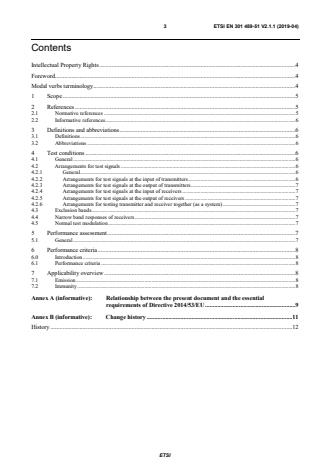
3 ETSI EN 301 489-51 V2.1.1 (2019-04)
Contents
Intellectual Property Rights . 4
Foreword . 4
Modal verbs terminology . 4
1 Scope . 5
2 References . 5
2.1 Normative references . 5
2.2 Informative references . 6
3 Definitions and abbreviations . 6
3.1 Definitions . 6
3.2 Abbreviations . 6
4 Test conditions . 6
4.1 General . 6
4.2 Arrangements for test signals . 6
4.2.1 General . 6
4.2.2 Arrangements for test signals at the input of transmitters . 6
4.2.3 Arrangements for test signals at the output of transmitters . 7
4.2.4 Arrangements for test signals at the input of receivers . 7
4.2.5 Arrangements for test signals at the output of receivers . 7
4.2.6 Arrangements for testing transmitter and receiver together (as a system) . 7
4.3 Exclusion bands . 7
4.4 Narrow band responses of receivers . 7
4.5 Normal test modulation . 7
5 Performance assessment . 7
5.1 General . 7
6 Performance criteria . 8
6.0 Introduction . 8
6.1 Performance criteria . 8
7 Applicability overview . 8
7.1 Emission . 8
7.2 Immunity . 8
Annex A (informative): Relationship between the present document and the essential
requirements of Directive 2014/53/EU . 9
Annex B (informative): Change history . 11
History . 12
ETSI
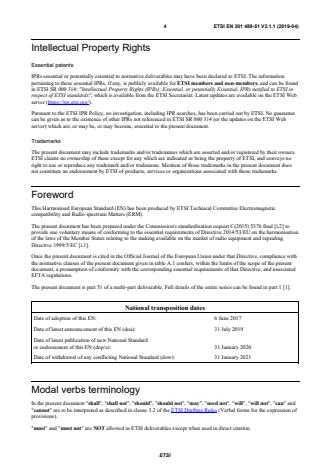
4 ETSI EN 301 489-51 V2.1.1 (2019-04)
Intellectual Property Rights
Essential patents
IPRs essential or potentially essential to normative deliverables may have been declared to ETSI. The information
pertaining to these essential IPRs, if any, is publicly available for ETSI members and non-members, and can be found
in ETSI SR 000 314: "Intellectual Property Rights (IPRs); Essential, or potentially Essential, IPRs notified to ETSI in
respect of ETSI standards", which is available from the ETSI Secretariat. Latest updates are available on the ETSI Web
server (https://ipr.etsi.org/).
Pursuant to the ETSI IPR Policy, no investigation, including IPR searches, has been carried out by ETSI. No guarantee
can be given as to the existence of other IPRs not referenced in ETSI SR 000 314 (or the updates on the ETSI Web
server) which are, or may be, or may become, essential to the present document.
Trademarks
The present document may include trademarks and/or tradenames which are asserted and/or registered by their owners.
ETSI claims no ownership of these except for any which are indicated as being the property of ETSI, and conveys no
right to use or reproduce any trademark and/or tradename. Mention of those trademarks in the present document does
not constitute an endorsement by ETSI of products, services or organizations associated with those trademarks.
Foreword
This Harmonised European Standard (EN) has been produced by ETSI Technical Committee Electromagnetic
compatibility and Radio spectrum Matters (ERM).
The present document has been prepared under the Commission's standardisation request C(2015) 5376 final [i.2] to
provide one voluntary means of conforming to the essential requirements of Directive 2014/53/EU on the harmonisation
of the laws of the Member States relating to the making available on the market of radio equipment and repealing
Directive 1999/5/EC [i.1].
Once the present document is cited in the Official Journal of the European Union under that Directive, compliance with
the normative clauses of the present document given in table A.1 confers, within the limits of the scope of the present
document, a presumption of conformity with the corresponding essential requirements of that Directive, and associated
EFTA regulations.
The present document is part 51 of a multi-part deliverable. Full details of the entire series can be found in part 1 [1].
National transposition dates
Date of adoption of this EN: 6 June 2017
Date of latest announcement of this EN (doa): 31 July 2019
Date of latest publication of new National Standard
or endorsement of this EN (dop/e): 31 January 2020
Date of withdrawal of any conflicting National Standard (dow): 31 January 2021
Modal verbs terminology
In the present document "shall", "shall not", "should", "should not", "may", "need not", "will", "will not", "can" and
"cannot" are to be interpreted as described in clause 3.2 of the ETSI Drafting Rules (Verbal forms for the expression of
provisions).
"must" and "must not" are NOT allowed in ETSI deliverables except when used in direct citation.
ETSI
5 ETSI EN 301 489-51 V2.1.1 (2019-04)
1 Scope
The present document, together with ETSI EN 301 489-1 [1], covers the assessment of automotive, ground based
vehicles and surveillance radar devices using 24,05 GHz to 24,25 GHz, 24,05 GHz to 24,5 GHz, 76 GHz to 77 GHz and
77 GHz to 81 GHz in respect of ElectroMagnetic Compatibility (EMC).
Technical specifications related to the antenna port and emissions from the enclosure port of radar equipment are not
included in the present document. Such technical specifications are found in the relevant product standards for the
effective use of the radio spectrum.
The present document specifies the applicable test conditions, performance assessment and performance criteria for
automotive and surveillance radar devices and associated ancillary equipment.
Automotive and surveillance radar equipments are low power millimetre wave devices that are able to detect and
characterize targets in their environment.
The following use cases are included (but are not limited to):
• automotive Advanced Driver
...
2003-01.Slovenski inštitut za standardizacijo. Razmnoževanje celote ali delov tega standarda ni dovoljeno.ElectroMagnetic Compatibility (EMC) standard for radio equipment and services - Part 51: Specific conditions for Automotive, Ground based Vehicles and Surveillance Radar Devices using 24,05 GHz to 24,25 GHz, 24,05 GHz to 24,5 GHz, 76 GHz to 77 GHz and 77 GHz to 81 GHz - Harmonised Standard covering the essential requirements of article 3.1b of Directive 2014/53/EU43.040.15Car informatics. On board computer systems33.100.01Elektromagnetna združljivost na splošnoElectromagnetic compatibility in general33.060.01Radijske komunikacije na splošnoRadiocommunications in generalICS:Ta slovenski standard je istoveten z:ETSI EN 301 489-51 V2.1.1 (2019-04)SIST EN 301 489-51 V2.1.1:2019en01-junij-2019SIST EN 301 489-51 V2.1.1:2019SLOVENSKI
STANDARD
HARMONISED EUROPEAN STANDARD SIST EN 301 489-51 V2.1.1:2019
ETSI ETSI EN 301 489-51 V2.1.1 (2019-04)2
Reference REN/ERM-EMC-382 Keywords EMC, harmonised standard, measurement, radar ETSI 650 Route des Lucioles F-06921 Sophia Antipolis Cedex - FRANCE
Tel.: +33 4 92 94 42 00
Fax: +33 4 93 65 47 16
Siret N° 348 623 562 00017 - NAF 742 C Association à but non lucratif enregistrée à la Sous-Préfecture de Grasse (06) N° 7803/88
Important notice The present document can be downloaded from: http://www.etsi.org/standards-search The present document may be made available in electronic versions and/or in print. The content of any electronic and/or print versions of the present document shall not be modified without the prior written authorization of ETSI. In case of any existing or perceived difference in contents between such versions and/or in print, the prevailing version of an ETSI deliverable is the one made publicly available in PDF format at www.etsi.org/deliver. Users of the present document should be aware that the document may be subject to revision or change of status. Information on the current status of this and other ETSI documents is available at https://portal.etsi.org/TB/ETSIDeliverableStatus.aspx If you find errors in the present document, please send your comment to one of the following services: https://portal.etsi.org/People/CommiteeSupportStaff.aspx Copyright Notification No part may be reproduced or utilized in any form or by any means, electronic or mechanical, including photocopying and microfilm except as authorized by written permission of ETSI. The content of the PDF version shall not be modified without the written authorization of ETSI. The copyright and the foregoing restriction extend to reproduction in all media.
© ETSI 2019. All rights reserved.
DECTTM, PLUGTESTSTM, UMTSTM and the ETSI logo are trademarks of ETSI registered for the benefit of its Members. 3GPPTM and LTETM are trademarks of ETSI registered for the benefit of its Members and of the 3GPP Organizational Partners. oneM2M™ logo is a trademark of ETSI registered for the benefit of its Members and of the oneM2M Partners. GSM® and the GSM logo are trademarks registered and owned by the GSM Association. SIST EN 301 489-51 V2.1.1:2019
ETSI ETSI EN 301 489-51 V2.1.1 (2019-04)3 Contents Intellectual Property Rights . 4 Foreword . 4 Modal verbs terminology . 4 1 Scope . 5 2 References . 5 2.1 Normative references . 5 2.2 Informative references . 6 3 Definitions and abbreviations . 6 3.1 Definitions . 6 3.2 Abbreviations . 6 4 Test conditions . 6 4.1 General . 6 4.2 Arrangements for test signals . 6 4.2.1 General . 6 4.2.2 Arrangements for test signals at the input of transmitters . 6 4.2.3 Arrangements for test signals at the output of transmitters . 7 4.2.4 Arrangements for test signals at the input of receivers . 7 4.2.5 Arrangements for test signals at the output of receivers . 7 4.2.6 Arrangements for testing transmitter and receiver together (as a system) . 7 4.3 Exclusion bands . 7 4.4 Narrow band responses of receivers . 7 4.5 Normal test modulation . 7 5 Performance assessment . 7 5.1 General . 7 6 Performance criteria . 8 6.0 Introduction . 8 6.1 Performance criteria . 8 7 Applicability overview . 8 7.1 Emission . 8 7.2 Immunity . 8 Annex A (informative): Relationship between the present document and the essential requirements of Directive 2014/53/EU . 9 Annex B (informative): Change history . 11 History . 12
ETSI ETSI EN 301 489-51 V2.1.1 (2019-04)4 Intellectual Property Rights Essential patents IPRs essential or potentially essential to normative deliverables may have been declared to ETSI. The information pertaining to these essential IPRs, if any, is publicly available for ETSI members and non-members, and can be found in ETSI SR 000 314: "Intellectual Property Rights (IPRs); Essential, or potentially Essential, IPRs notified to ETSI in respect of ETSI standards", which is available from the ETSI Secretariat. Latest updates are available on the ETSI Web server (https://ipr.etsi.org/). Pursuant to the ETSI IPR Policy, no investigation, including IPR searches, has been carried out by ETSI. No guarantee can be given as to the existence of other IPRs not referenced in ETSI SR 000 314 (or the updates on the ETSI Web server) which are, or may be, or may become, essential to the present document. Trademarks The present document may include trademarks and/or tradenames which are asserted and/or registered by their owners. ETSI claims no ownership of these except for any which are indicated as being the property of ETSI, and conveys no right to use or reproduce any trademark and/or tradename. Mention of those trademarks in the present document does not constitute an endorsement by ETSI of products, services or organizations associated with those trademarks. Foreword This Harmonised European Standard (EN) has been produced by ETSI Technical Committee Electromagnetic compatibility and Radio spectrum Matters (ERM). The present document has been prepared under the Commission's standardisation request C(2015) 5376 final [i.2] to provide one voluntary means of conforming to the essential requirements of Directive 2014/53/EU on the harmonisation of the laws of the Member States relating to the making available on the market of radio equipment and repealing Directive 1999/5/EC [i.1]. Once the present document is cited in the Official Journal of the European Union under that Directive, compliance with the normative clauses of the present document given in table A.1 confers, within the limits of the scope of the present document, a presumption of conformity with the corresponding essential requirements of that Directive, and associated EFTA regulations. The present document is part 51 of a multi-part deliverable. Full details of the entire series can be found in part 1 [1].
National transposition dates Date of adoption of this EN: 6 June 2017 Date of latest announcement of this EN (doa): 31 July 2019 Date of latest publication of new National Standard or endorsement of this EN (dop/e):
31 January 2020 Date of withdrawal of any conflicting National Standard (dow): 31 January 2021
Modal verbs terminology In the present document "shall", "shall not", "should", "should not", "may", "need not", "will", "will not", "can" and "cannot" are to be interpreted as described in clause 3.2 of the ETSI Drafting Rules (Verbal forms for the expression of provisions). "must" and "must not" are NOT allowed in ETSI deliverables except when used in direct citation. SIST EN 301 489-51 V2.1.1:2019
ETSI ETSI EN 301 489-51 V2.1.1 (2019-04)5 1 Scope The present document, together with ETSI EN 301 489-1 [1], covers the assessment of automotive, ground based vehicles and surveillance radar devices using 24,05 GHz to 24,25 GHz, 24,05 GHz to 24,5 GHz, 76 GHz to 77 GHz and 77 GHz to 81 GHz in respect of ElectroMagnetic Compatibility (EMC). Technical specifications related to the antenna port and emissions from the enclosure port of radar equipment are not included in the present document. Such technical specifications are
...