

oSIST prEN 18348:2026
(Main)Plastics - Intrinsic biodegradability - Criteria and test methods
General Information
- Abstract
The work item aims to differentiate between biodegradable and non-biodegradable plastic materials. Non-biodegradable plastics are defined as those plastics which do not biodegrade, even in conditions which are conducive to the process. In contrast, the biodegradation of biodegradable plastics occurs when they come into contact with active microorganisms, under conditions that are conducive to biodegradation. This process is analogous to the biodegradation of natural polymers. The plastic materials that are categorised as being intrinsically biodegradable can be utilised in the design of products with a high risk of dispersion. The test scheme is not intended to be applicable to any specific application. Instead, the objective is to develop a framework methodology that can be utilised across diverse industrial sectors for the identification of biodegradable plastics, with the subsequent application of these plastics in the manufacture of various products and for different purposes. The work item does not intend to characterise and evaluate the environmental impact of products containing plastics identified as biodegradable. The test scheme should address the definition of intrinsic biodegradability of plastic materials, without determining the hazard potential of the products, which necessitates a distinct assessment that extends beyond the scope of this particular work item. The rate of biodegradation of a plastic object is not the focus of this particular work item, as it is contingent on environmental conditions. The test scheme to be developed will not be sufficient to carry out an analysis of the ecological risk associated with the dispersal of products, as this requires an assessment of the intrinsic hazard, of the environmental fate, in addition to the assessment of biodegradability.
- Status
- Not Published
- Public Enquiry End Date
- 30-Jul-2026
- Technical Committee
- IPMA - Polimer materials and products
- Current Stage
- 4020 - Public enquire (PE) (Adopted Project)
- Start Date
- 27-May-2026
- Due Date
- 14-Oct-2026
- Completion Date
- 03-Aug-2026

Overview
oSIST prEN 18348:2026 is a draft European standard developed by the Slovenian Institute for Standardization (SIST) and coordinated by CEN/TC 249 “Plastics.” This standard specifies criteria and test methods to assess intrinsic biodegradability of plastic materials. The main objective is to provide a consistent framework to distinguish between biodegradable and non-biodegradable plastics under aerobic conditions typical of natural habitats. The standard is intended for application across multiple industries and is particularly relevant for designers and manufacturers developing products that carry a high risk of environmental dispersion, such as agricultural films, fishing gear, or items likely to enter the natural environment.
Importantly, oSIST prEN 18348:2026 does not evaluate the environmental risk or the rate of biodegradation of products but strictly focuses on identifying the intrinsic biodegradability of materials under controlled laboratory conditions.
Key Topics
- Intrinsic Biodegradability: Defines and tests the potential of plastic materials to biodegrade when exposed to active microorganisms in aerobic environments, comparable to the biodegradation behavior of natural polymers.
- Distinguishing Biodegradable vs. Non-biodegradable Plastics: Sets clear, laboratory-based criteria for what constitutes a biodegradable plastic versus persistent materials.
- Test Methods: Mandates recognized aerobic biodegradation test methods (e.g., EN ISO 17556, EN ISO 18830, EN ISO 19679, EN ISO 23977) performed in controlled conditions with reference materials like microcrystalline cellulose and polyethylene.
- Threshold Criteria: Requires minimum mineralization levels (e.g., ≥90% carbon mineralization relative to reference material) by the end of the test period, ensuring test rigor and reliability.
- Constituent Biodegradability: Outlines a procedure for assessing the biodegradability of individual components present in a plastic, especially those between 1% and 15% concentration by total organic carbon.
- Reporting Requirements: Specifies documentation and reporting standards to ensure traceability and test validity.
- Exclusions: Does not assess hazard, rate of degradation, or environmental risk, and is not designed to address applications mandated by specific regulations.
Applications
- Product Design for High Dispersion Risk: Enables manufacturers and product designers to select plastics that are proven to be intrinsically biodegradable for applications where environmental release is probable, such as:
- Agricultural mulch films
- Aquaculture and fishing equipment
- Single-use consumer goods
- Items intended for open-air or aquatic environments
- Cross-sectoral Utility: As a framework methodology, the standard supports diverse industries in evaluating raw material options for sustainable design, independent of specific end-use requirements.
- Material Selection and Claims: Provides robust, comparative data for declaring the biodegradability of plastic materials, supporting environmental claims and eco-labeling efforts.
- Preliminary Environmental Responsibility: While not a risk assessment tool, it aids in preemptively reducing potential environmental accumulation of persistent plastics by encouraging the substitution with biodegradable alternatives.
Related Standards
For comprehensive evaluation and conformity, the following related standards are referenced or play a supporting role:
- EN ISO 17556: Plastics - Determination of ultimate aerobic biodegradability in soil.
- EN ISO 18830, EN ISO 19679, EN ISO 22404, EN ISO 23977: Determination of aerobic biodegradation in various aquatic environments.
- EN ISO 5430: Ecotoxicity of biodegradable plastic materials in the marine environment.
- ISO 23517: Soil biodegradable plastics for agriculture and horticulture.
- OECD Guidelines 301 and 310: Ready biodegradability test methods for individual constituents.
- ISO 10210: Sample preparation methods for biodegradation testing.
By integrating oSIST prEN 18348:2026 processes within product development and raw material validation, stakeholders advance the goal of sustainable plastics-minimizing environmental persistence and supporting the transition to circular material use.
Keywords: biodegradable plastics, intrinsic biodegradability, plastics standards, biodegradation test methods, aerobic conditions, plastic material selection, sustainable design, oSIST prEN 18348, SIST, environmental responsibility, eco-friendly plastics.
Get Certified
Connect with accredited certification bodies for this standard

DIN CERTCO
DIN Group product certification.

Smithers Quality Assessments
US management systems and product certification.
Sponsored listings
Frequently Asked Questions
oSIST prEN 18348:2026 is a draft published by the Slovenian Institute for Standardization (SIST). Its full title is "Plastics - Intrinsic biodegradability - Criteria and test methods". This standard covers: The work item aims to differentiate between biodegradable and non-biodegradable plastic materials. Non-biodegradable plastics are defined as those plastics which do not biodegrade, even in conditions which are conducive to the process. In contrast, the biodegradation of biodegradable plastics occurs when they come into contact with active microorganisms, under conditions that are conducive to biodegradation. This process is analogous to the biodegradation of natural polymers. The plastic materials that are categorised as being intrinsically biodegradable can be utilised in the design of products with a high risk of dispersion. The test scheme is not intended to be applicable to any specific application. Instead, the objective is to develop a framework methodology that can be utilised across diverse industrial sectors for the identification of biodegradable plastics, with the subsequent application of these plastics in the manufacture of various products and for different purposes. The work item does not intend to characterise and evaluate the environmental impact of products containing plastics identified as biodegradable. The test scheme should address the definition of intrinsic biodegradability of plastic materials, without determining the hazard potential of the products, which necessitates a distinct assessment that extends beyond the scope of this particular work item. The rate of biodegradation of a plastic object is not the focus of this particular work item, as it is contingent on environmental conditions. The test scheme to be developed will not be sufficient to carry out an analysis of the ecological risk associated with the dispersal of products, as this requires an assessment of the intrinsic hazard, of the environmental fate, in addition to the assessment of biodegradability.
The work item aims to differentiate between biodegradable and non-biodegradable plastic materials. Non-biodegradable plastics are defined as those plastics which do not biodegrade, even in conditions which are conducive to the process. In contrast, the biodegradation of biodegradable plastics occurs when they come into contact with active microorganisms, under conditions that are conducive to biodegradation. This process is analogous to the biodegradation of natural polymers. The plastic materials that are categorised as being intrinsically biodegradable can be utilised in the design of products with a high risk of dispersion. The test scheme is not intended to be applicable to any specific application. Instead, the objective is to develop a framework methodology that can be utilised across diverse industrial sectors for the identification of biodegradable plastics, with the subsequent application of these plastics in the manufacture of various products and for different purposes. The work item does not intend to characterise and evaluate the environmental impact of products containing plastics identified as biodegradable. The test scheme should address the definition of intrinsic biodegradability of plastic materials, without determining the hazard potential of the products, which necessitates a distinct assessment that extends beyond the scope of this particular work item. The rate of biodegradation of a plastic object is not the focus of this particular work item, as it is contingent on environmental conditions. The test scheme to be developed will not be sufficient to carry out an analysis of the ecological risk associated with the dispersal of products, as this requires an assessment of the intrinsic hazard, of the environmental fate, in addition to the assessment of biodegradability.
oSIST prEN 18348:2026 is classified under the following ICS (International Classification for Standards) categories: 83.080.01 - Plastics in general. The ICS classification helps identify the subject area and facilitates finding related standards.
oSIST prEN 18348:2026 is available in PDF format for immediate download after purchase. The document can be added to your cart and obtained through the secure checkout process. Digital delivery ensures instant access to the complete standard document.
Standards Content (Sample)
SLOVENSKI STANDARD
01-julij-2026
Polimerni materiali - Lastna biorazgradljivost - Merila in preskusne metode
Plastics - Intrinsic biodegradability - Criteria and test methods
Kunststoffe - Intrinsische biologische Abbaubarkeit - Kriterien und Prüfverfahren
Plastiques - Biodégradabilité intrinsèque - Critères et méthodes d'essai
Ta slovenski standard je istoveten z: prEN 18348
ICS:
83.080.01 Polimerni materiali na Plastics in general
splošno
2003-01.Slovenski inštitut za standardizacijo. Razmnoževanje celote ali delov tega standarda ni dovoljeno.
DRAFT
EUROPEAN STANDARD
NORME EUROPÉENNE
EUROPÄISCHE NORM
May 2026
ICS 83.080.01
English Version
Plastics - Intrinsic biodegradability - Criteria and test
methods
Plastiques - Biodégradabilité intrinsèque - Critères et Kunststoffe - Intrinsische biologische Abbaubarkeit -
méthodes d'essai Kriterien und Prüfverfahren
This draft European Standard is submitted to CEN members for enquiry. It has been drawn up by the Technical Committee
CEN/TC 249.
If this draft becomes a European Standard, CEN members are bound to comply with the CEN/CENELEC Internal Regulations
which stipulate the conditions for giving this European Standard the status of a national standard without any alteration.
This draft European Standard was established by CEN in three official versions (English, French, German). A version in any other
language made by translation under the responsibility of a CEN member into its own language and notified to the CEN-CENELEC
Management Centre has the same status as the official versions.
CEN members are the national standards bodies of Austria, Belgium, Bulgaria, Croatia, Cyprus, Czech Republic, Denmark, Estonia,
Finland, France, Germany, Greece, Hungary, Iceland, Ireland, Italy, Latvia, Lithuania, Luxembourg, Malta, Netherlands, Norway,
Poland, Portugal, Republic of North Macedonia, Romania, Serbia, Slovakia, Slovenia, Spain, Sweden, Switzerland, Türkiye and
United Kingdom.
Recipients of this draft are invited to submit, with their comments, notification of any relevant patent rights of which they are
aware and to provide supporting documentation.
Warning : This document is not a European Standard. It is distributed for review and comments. It is subject to change without
notice and shall not be referred to as a European Standard.
EUROPEAN COMMITTEE FOR STANDARDIZATION
COMITÉ EUROPÉEN DE NORMALISATION
EUROPÄISCHES KOMITEE FÜR NORMUNG
CEN-CENELEC Management Centre: Rue de la Science 23, B-1040 Brussels
© 2026 CEN All rights of exploitation in any form and by any means reserved Ref. No. prEN 18348:2026 E
worldwide for CEN national Members.
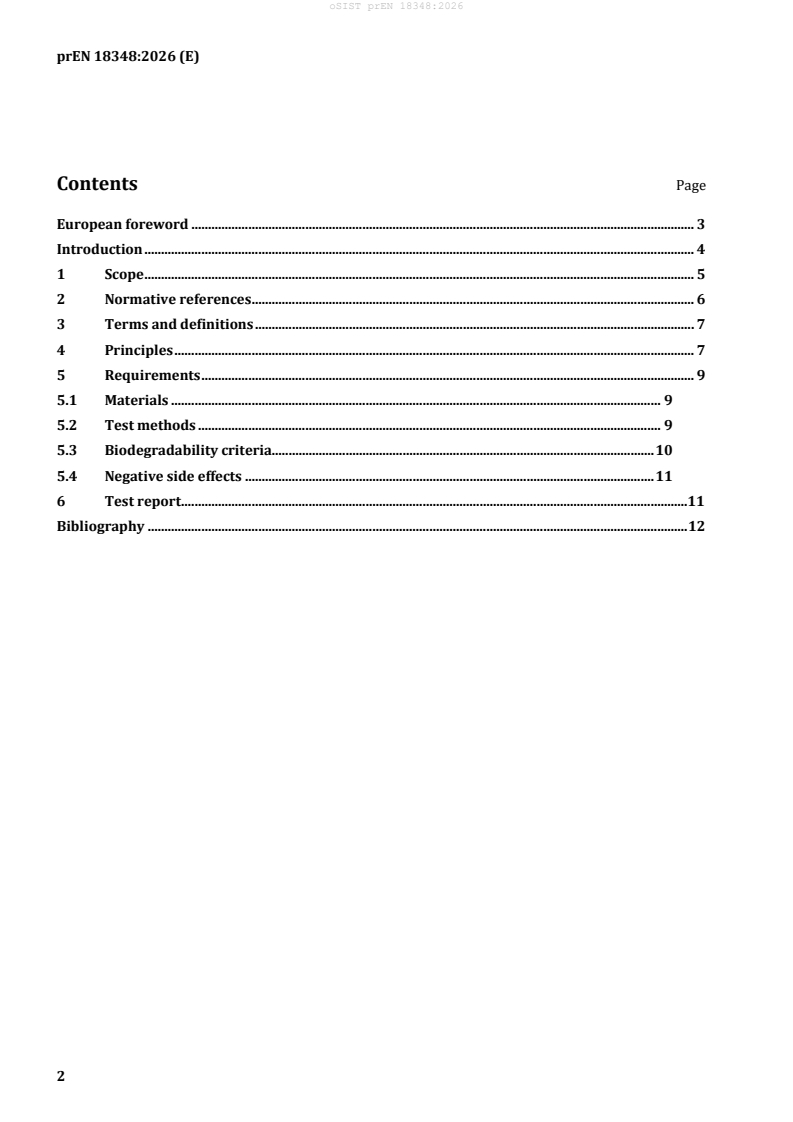
Contents Page
European foreword . 3
Introduction . 4
1 Scope . 5
2 Normative references . 6
3 Terms and definitions . 7
4 Principles . 7
5 Requirements . 9
5.1 Materials . 9
5.2 Test methods . 9
5.3 Biodegradability criteria. 10
5.4 Negative side effects . 11
6 Test report .11
Bibliography .12
European foreword
This document (prEN 18348:2026) has been prepared by Technical Committee CEN/TC 249 “Plastics”,
the secretariat of which is held by SIS.
This document is currently submitted to the CEN Enquiry.
This document has been prepared under a standardization request addressed to CEN by the European
Commission. The Standing Committee of the EFTA States subsequently approves these requests for its
Member States.
Introduction
Human activities take place within the so-called technosphere, i.e. the system of structures and artefacts
that humans have built over time. With the aim of preserving the natural environment, products are
manufactured, consumed, recycled and disposed of within the technosphere, avoiding as far as possible
their uncontrolled release into the biosphere, understood as the natural environment populated by living
beings. This applies to all products, including biodegradable products, which are also used within the
technosphere and recovered through separate collection and organic recycling in waste treatment
facilities, where they undergo controlled biological processes (such as composting).
Therefore, littering (i.e. the improper disposal of waste in public places or in the natural environment,
resulting in pollution and adverse effects on the environment) is not an action that can be justified or
considered acceptable, as it is never without negative consequences, large or small.
However, there are products that are used in applications that are inherently at risk of uncontrolled
release from the technosphere. For example, tools used in fishing, aquaculture, and mussel farming are
subject to breakage and dispersal because they are immersed in seawater and exposed to the aggressive
action of the sea (storm surges, erosion, etc.). Normally these products are intended to be recovered and
brought ashore for recycling or disposal, but occasionally they break and are dispersed.
Then there are other products that are deliberately released into the biosphere because of the way they
are used. Fireworks, for example, are fired into the air and, when they burst, they break into pieces that
fall to the ground below with little chance of being recovered.
The designer involved in the development of these applications with a high risk of uncontrolled release
is interested in knowing the biodegradability of different materials in order to reduce the ecological risk
of man-made products entering the environment. It is therefore necessary to develop a framework
methodology for the definition of principles, test methods and criteria for the biodegradability of
applications with a risk of dispersion, which can be applied across the sectors concerned without
unnecessary multiplication of approaches.
The methodologies and criteria described in this document may not be appropriate if the release into the
environment occurs in areas where constant anaerobic conditions are expected, such as deep ocean
sediments.
1 Scope
This document defines test methods and criteria for distinguishing intrinsically biodegradable plastic
materials from those that are persistent. Biodegradability is inferred from biodegradation tests
conducted under aerobic conditions, i.e. under the conditions typically found in most natural habitats.
Plastics that undergo ultimate biodegradation under aerobic conditions in a manner similar to natural
polymer materials are defined as biodegradable plastics. This document describes a method for
distinguishing between non-biodegradable plastics, which do not biodegrade even when environmental
conditions are favourable for biodegradation (including aerobic conditions), and biodegradable plastics,
i.e. those that biodegrade upon contact with active microorganisms when environmental conditions are
favourable for biodegradation.
The aim is to demonstrate ultimate aerobic biodegradability of plastic materials, i.e. the intrinsic potential
for conversion to carbon dioxide, water and biomass by aerobic microorganisms in an oxygen-rich
environment, which is representative of most natural environments.
The potential for biodegradation should be verified using alternative tests and criteria, if a deposition in
a permanent anaerobic environment (e.g. deep subsurface environments, wetlands and swamps, anoxic
zones in oceans and lakes) is expected.
NOTE Currently, there are no methodologies or criteria available to verify accumulation due to the lack of
biodegradation of plastics in such anaerobic habitats.
The plastic materials identified as intrinsically biodegradable following this document can be used in the
design of products with a high risk of dispersion whenever the use of biodegradable components is
searched by the designer. Intrinsically non-biodegradable components are not susceptible to
biodegradation and therefore cannot be removed from the environment by the action of micro-
organisms. This factor tends to increase the residence time of products in the environment. In addition,
their eventual degradation, mainly due to abiotic factors, results in persistent fragments (microplastics).
The test scheme described in this document is not specific to any particular application. Rather, it is a
framework methodology that can be used in different industries to identify biodegradable plastics that
can be used to make different types of products and for different applications. For the characterisation
and environmental assessment of products placed on the market containing plastics identified as
biodegradable according to this document, reference is made to the specific product standards, where
available. This document only deals with the definition of intrinsic biodegradability of plastic materials,
without defining the hazard of the products, which requires a specific assessment that is beyond the
scope of this document. The rate of biodegradation of a plastic object as a function of environmental
conditions cannot be determined from this document. Therefore, this document is not sufficient to carry
out an analysis of the ecological risk associated with the dispersal of products, as this requires an
assessment of the intrinsic hazard, of the environmental fate, in addition to the assessment of
biodegradability.
The methodology described in this document does not apply to applications covered by mandatory
regulations.
2 Normative references
The following documents are referred to in the text in such a way that some or all of their content
constitutes requirements of this document. For dated references, only the edition cited applies. For
undated references, the latest edition of the referenced document (including any amendments) applies.
EN ISO 5430, Plastics — Ecotoxicity testing scheme for soluble decomposition intermediates from
biodegradable plastic materials and products used in the marine environment — Test methods and
requirements
EN ISO 17556, Plastics — Determination of the ultimate aerobic biodegradability of plastic materials in soil
by measuring the oxygen demand in a respirometer or the amount of carbon dioxide evolved
EN ISO 18830, Plastics — Determination of aerobic biodegradation of non-floating plastic materials in a
seawater/sandy sediment interface — Method by measuring the oxygen demand in closed respirometer
EN ISO 19679, Plastics — Determination of aerobic biodegradation of non-floating plastic materials in a
seawater/sediment interface — Method by analysis of evolved carbon dioxide
EN ISO 22404, Plastics — Determination of the aerobic biodegradation of non-floating materials exposed
to marine sediment — Method by analysis of evolved carbon dioxide
ISO 23517, Plastics — Soil biodegradable materials for mulch films for use in agriculture and horticulture
— Requirements and test methods regarding biodegradation, ecotoxicity and control of constituents
EN ISO 23977-1, Plastics — Determination of the aerobic biodegradation of plastic materials exposed to
seawater — Part 1: Method by analysis of evolved carbon dioxide
EN ISO 23977-2, Plastics — Determination of the aerobic biodegradation of plastic materials exposed to
seawater — Part 2: Method by measuring the oxygen demand in closed respirometer
3 Terms and definitions
For the purposes of this document, the following terms and definitions apply.
ISO and IEC maintain terminology databases for use in standardization at the following addresses:
— ISO Online browsing platform: available at https://www.iso.org/obp/
— IEC Electropedia: available at https://www.electropedia.org/
3.1
intrinsic biodegradability
potential of a polymer or plastic material to be biodegraded established under controlled laboratory
conditions
3.2
ultimate biodegradation
breakdown of an organic chemical compound by microorganisms in the presence of oxygen to carbon
dioxide, water, and mineral salts of any other elements present (mineralization) and new biomass or in
the absence of oxygen to carbon dioxide, methane, mineral salts, and new biomass
3.3
constituent
every pure chemical material or substance of which a polymer or plastic material is composed
4 Principles
Human activities occur within the technosphere, a system of human-made structures and artifacts. To
protect the natural environment (biosphere), products are manufactured, used, recycled, and disposed
of within the technosphere. However, some products, like fishing gear and fireworks, are prone to
uncontrolled release into the biosphere due to their usage conditions. Designers of such products aim to
understand the environmental impact of materials to minimize ecological risks.
As is well known, risk assessment involves knowledge of the hazard and the potential harm caused by
the stressor. The term hazard is used to describe a stre
...