

SIST EN ISO 1183-2:2026
(Main)Plastics - Methods for determining the density of non-cellular plastics - Part 2: Density gradient column method (ISO 1183-2:2026)
General Information
- Abstract
This document specifies a gradient column method for the determination of the density of non-cellular moulded or extruded plastics or pellets in void-free form.
- Status
- Published
- Public Enquiry End Date
- 09-Jun-2025
- Publication Date
- 06-May-2026
- Technical Committee
- IPMA - Polimer materials and products
- Current Stage
- 6060 - National Implementation/Publication (Adopted Project)
- Start Date
- 17-Apr-2026
- Due Date
- 22-Jun-2026
- Completion Date
- 07-May-2026

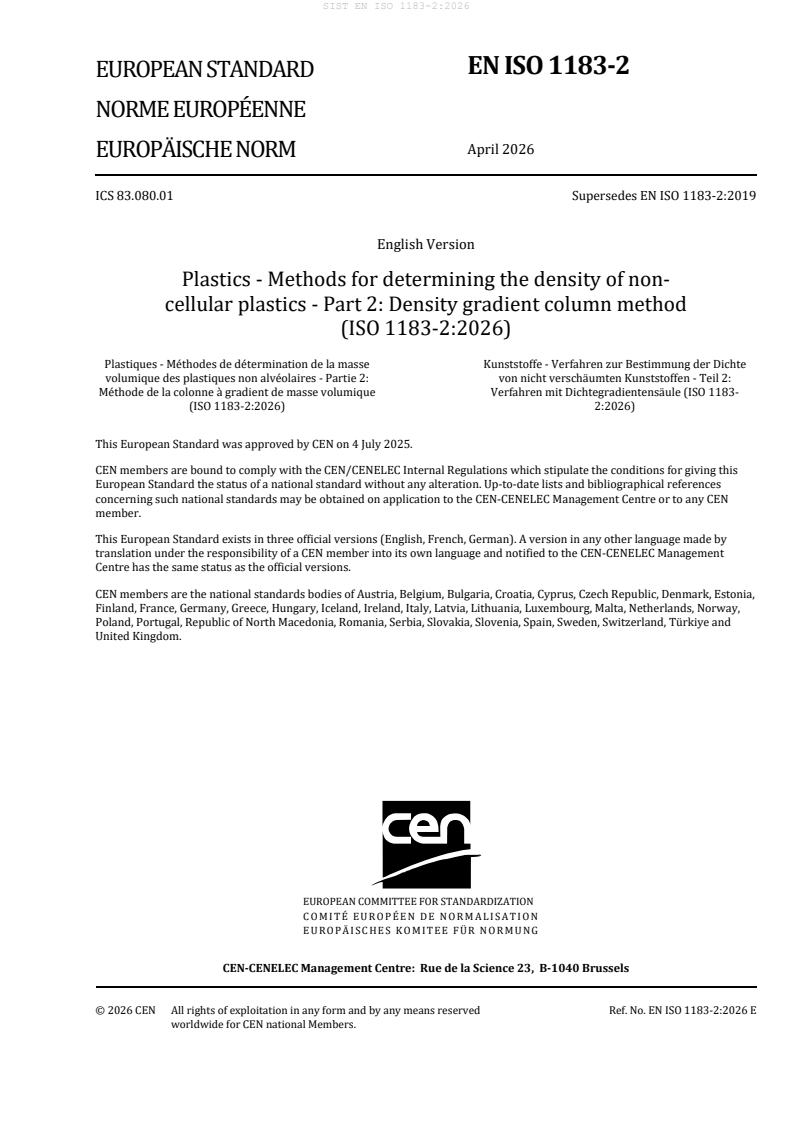
Overview
SIST EN ISO 1183-2:2026 defines a standard test method for determining the density of non-cellular plastics, specifically using the density gradient column technique. Developed by CEN and mirroring ISO 1183-2:2026, this standard applies to void-free forms of moulded or extruded plastics and plastic pellets. Accurately measuring plastic density is essential for quality control, consistency, and comparison of materials in production and research settings.
The density gradient column method involves placing a plastic specimen in a vertical column containing a mixture of two liquids with a continuously increasing density from the top to the bottom. The position where the specimen stabilizes indicates its density.
Key Topics
- Scope of Application: Focused on void-free, non-cellular plastics, including pellets, moulded, and extruded forms.
- Density Gradient Column Method:
- Utilizes a vertically oriented column filled with a density-gradient liquid mixture.
- Specimens are immersed, and the equilibrium height reflects their density.
- Specimen Preparation:
- Ensures specimen is clean, void of cavities, and appropriately shaped to minimize measurement errors.
- Attention to preventing air bubble entrapment, which can affect accuracy.
- Calibration and Measurement:
- Involves preparation of calibrated glass floats and careful temperature control.
- Density is calculated either graphically, by plotting float density against height, or mathematically through interpolation.
- Corrections for buoyancy are applied as necessary.
- Conditioning: Specimens are conditioned according to relevant material standards, generally eliminating the need for constant temperature pre-conditioning, as the test inherently standardizes sample temperature.
Applications
The SIST EN ISO 1183-2:2026 standard is applied across multiple industries where plastics quality is critical:
- Quality Control in Manufacturing: Ensures consistency in plastic products by monitoring density, which reflects changes in material structure or composition.
- Materials Comparison: Enables manufacturers, laboratories, and researchers to compare plastic materials under standardized conditions.
- Product Development: Used during the development of plastics to balance properties such as mechanical strength and weight.
- Incoming Materials Verification: Validates material supplied against specified density ranges, preventing process issues.
- Research and Testing: Supports studies on the physical structure and behavior of plastic materials under various conditions.
Routine usage of this method contributes to higher product reliability, minimized waste, and improved compliance with regulatory or customer requirements.
Related Standards
- ISO 1183-1: Plastics – Methods for determining the density of non-cellular plastics – Part 1: Provides alternative methods such as immersion, liquid pycnometer, and titration.
- ISO 291: Plastics – Standard atmospheres for conditioning and testing, referenced for specimen conditioning.
- ISO 80000-4: Quantities and units – Mechanics, referenced for terminology regarding density.
These related standards offer complementary techniques and definitions, broadening the scope of density measurement practices in the plastics industry.
By adhering to SIST EN ISO 1183-2:2026, stakeholders in plastics manufacturing, quality assurance, and research ensure the use of a reliable, repeatable, and internationally recognized method for determining plastic density. This assists in maintaining high-quality standards, process optimization, and regulatory compliance.
Keywords: plastic density, density determination, density gradient column, non-cellular plastics, plastics testing standard, EN ISO 1183-2, quality control, material testing, CEN standards
Relations
- Effective Date
- 25-Aug-2026
- Effective Date
- 08-Apr-2026
- Referred By
SIST EN 26:2015 - Gas-fired instantaneous water heaters for the production of domestic hot water - Effective Date
- 08-Apr-2026
- Effective Date
- 08-Apr-2026
- Effective Date
- 08-Apr-2026
- Effective Date
- 08-Apr-2026
- Effective Date
- 08-Apr-2026
- Effective Date
- 08-Apr-2026
- Effective Date
- 08-Apr-2026
- Effective Date
- 08-Apr-2026
- Effective Date
- 08-Apr-2026
- Effective Date
- 08-Apr-2026
- Effective Date
- 08-Apr-2026
- Effective Date
- 08-Apr-2026
- Effective Date
- 08-Apr-2026
Get Certified
Connect with accredited certification bodies for this standard

DIN CERTCO
DIN Group product certification.

Smithers Quality Assessments
US management systems and product certification.
Sponsored listings
Frequently Asked Questions
SIST EN ISO 1183-2:2026 is a standard published by the Slovenian Institute for Standardization (SIST). Its full title is "Plastics - Methods for determining the density of non-cellular plastics - Part 2: Density gradient column method (ISO 1183-2:2026)". This standard covers: This document specifies a gradient column method for the determination of the density of non-cellular moulded or extruded plastics or pellets in void-free form.
This document specifies a gradient column method for the determination of the density of non-cellular moulded or extruded plastics or pellets in void-free form.
SIST EN ISO 1183-2:2026 is classified under the following ICS (International Classification for Standards) categories: 83.080.01 - Plastics in general. The ICS classification helps identify the subject area and facilitates finding related standards.
SIST EN ISO 1183-2:2026 has the following relationships with other standards: It is inter standard links to SIST EN 50465:2015, SIST EN 1852-1:2018, SIST EN 26:2015, SIST EN 50290-2-29:2016, SIST EN 1555-1:2021, SIST EN 1555-1:2010, SIST EN 10245-5:2012, SIST EN 1337-2:2004, SIST EN 15860:2010, SIST EN 15330-4:2023, SIST EN 13476-2:2025, SIST EN 12566-3:2005+A1:2009, SIST EN 10310:2004, SIST EN 12245:2022, SIST EN 1451-1:2018. Understanding these relationships helps ensure you are using the most current and applicable version of the standard.
SIST EN ISO 1183-2:2026 is available in PDF format for immediate download after purchase. The document can be added to your cart and obtained through the secure checkout process. Digital delivery ensures instant access to the complete standard document.
Standards Content (Sample)
SLOVENSKI STANDARD
01-junij-2026
Polimerni materiali - Metode za določanje gostote nepenjenih polimernih
materialov - 2. del: Kolonska metoda na osnovi gradienta gostote (ISO 1183-
2:2026)
Plastics - Methods for determining the density of non-cellular plastics - Part 2: Density
gradient column method (ISO 1183-2:2026)
Kunststoffe - Verfahren zur Bestimmung der Dichte von nicht verschäumten Kunststoffen
- Teil 2: Verfahren mit Dichtegradientensäule (ISO 1183-2:2026)
Plastiques - Méthodes de détermination de la masse volumique des plastiques non
alvéolaires - Partie 2: Méthode de la colonne à gradient de masse volumique (ISO 1183-
2:2026)
Ta slovenski standard je istoveten z: EN ISO 1183-2:2026
ICS:
83.080.01 Polimerni materiali na Plastics in general
splošno
2003-01.Slovenski inštitut za standardizacijo. Razmnoževanje celote ali delov tega standarda ni dovoljeno.
EN ISO 1183-2
EUROPEAN STANDARD
NORME EUROPÉENNE
April 2026
EUROPÄISCHE NORM
ICS 83.080.01 Supersedes EN ISO 1183-2:2019
English Version
Plastics - Methods for determining the density of non-
cellular plastics - Part 2: Density gradient column method
(ISO 1183-2:2026)
Plastiques - Méthodes de détermination de la masse Kunststoffe - Verfahren zur Bestimmung der Dichte
volumique des plastiques non alvéolaires - Partie 2: von nicht verschäumten Kunststoffen - Teil 2:
Méthode de la colonne à gradient de masse volumique Verfahren mit Dichtegradientensäule (ISO 1183-
(ISO 1183-2:2026) 2:2026)
This European Standard was approved by CEN on 4 July 2025.
CEN members are bound to comply with the CEN/CENELEC Internal Regulations which stipulate the conditions for giving this
European Standard the status of a national standard without any alteration. Up-to-date lists and bibliographical references
concerning such national standards may be obtained on application to the CEN-CENELEC Management Centre or to any CEN
member.
This European Standard exists in three official versions (English, French, German). A version in any other language made by
translation under the responsibility of a CEN member into its own language and notified to the CEN-CENELEC Management
Centre has the same status as the official versions.
CEN members are the national standards bodies of Austria, Belgium, Bulgaria, Croatia, Cyprus, Czech Republic, Denmark, Estonia,
Finland, France, Germany, Greece, Hungary, Iceland, Ireland, Italy, Latvia, Lithuania, Luxembourg, Malta, Netherlands, Norway,
Poland, Portugal, Republic of North Macedonia, Romania, Serbia, Slovakia, Slovenia, Spain, Sweden, Switzerland, Türkiye and
United Kingdom.
EUROPEAN COMMITTEE FOR STANDARDIZATION
COMITÉ EUROPÉEN DE NORMALISATION
EUROPÄISCHES KOMITEE FÜR NORMUNG
CEN-CENELEC Management Centre: Rue de la Science 23, B-1040 Brussels
© 2026 CEN All rights of exploitation in any form and by any means reserved Ref. No. EN ISO 1183-2:2026 E
worldwide for CEN national Members.
Contents Page
European foreword . 3
European foreword
This document (EN ISO 1183-2:2026) has been prepared by Technical Committee ISO/TC 61 "Plastics"
in collaboration with Technical Committee CEN/TC 249 “Plastics” the secretariat of which is held by SIS.
This European Standard shall be given the status of a national standard, either by publication of an
identical text or by endorsement, at the latest by October 2026, and conflicting national standards shall
be withdrawn at the latest by October 2026.
Attention is drawn to the possibility that some of the elements of this document may be the subject of
patent rights. CEN shall not be held responsible for identifying any or all such patent rights.
This document supersedes EN ISO 1183-2:2019.
Any feedback and questions on this document should be directed to the users’ national standards
body/national committee. A complete listing of these bodies can be found on the CEN website.
According to the CEN-CENELEC Internal Regulations, the national standards organizations of the
following countries are bound to implement this European Standard: Austria, Belgium, Bulgaria,
Croatia, Cyprus, Czech Republic, Denmark, Estonia, Finland, France, Germany, Greece, Hungary, Iceland,
Ireland, Italy, Latvia, Lithuania, Luxembourg, Malta, Netherlands, Norway, Poland, Portugal, Republic of
North Macedonia, Romania, Serbia, Slovakia, Slovenia, Spain, Sweden, Switzerland, Türkiye and the
United Kingdom.
Endorsement notice
The text of ISO 1183-2:2026 has been approved by CEN as EN ISO 1183-2:2026 without any
modification.
International
Standard
ISO 1183-2
Third edition
Plastics — Methods for determining
2026-03
the density of non-cellular
plastics —
Part 2:
Density gradient column method
Plastiques — Méthodes de détermination de la masse volumique
des plastiques non alvéolaires —
Partie 2: Méthode de la colonne à gradient de masse volumique
Reference number
ISO 1183-2:2026(en) © ISO 2026
ISO 1183-2:2026(en)
© ISO 2026
All rights reserved. Unless otherwise specified, or required in the context of its implementation, no part of this publication may
be reproduced or utilized otherwise in any form or by any means, electronic or mechanical, including photocopying, or posting on
the internet or an intranet, without prior written permission. Permission can be requested from either ISO at the address below
or ISO’s member body in the country of the requester.
ISO copyright office
CP 401 • Ch. de Blandonnet 8
CH-1214 Vernier, Geneva
Phone: +41 22 749 01 11
Email: copyright@iso.org
Website: www.iso.org
Published in Switzerland
ii
ISO 1183-2:2026(en)
Contents Page
Foreword .iv
Introduction .v
1 Scope . 1
2 Normative references . 1
3 Terms, definitions and symbols . 1
3.1 Terms and definitions .1
3.2 Symbols .2
4 Conditioning . 2
5 Method . 2
5.1 Apparatus .2
5.2 Immersion liquids .2
5.3 Specimens .3
5.4 Procedure .3
5.4.1 Preparation and calibration of glass floats .3
5.4.2 Preparation of density gradient column .3
5.4.3 Measurement of density .3
5.4.4 Calculations . .4
6 Test report . 4
Annex A (informative) Liquid systems suitable for density determinations . 6
Annex B (informative) Preparation of density gradient column . 7
Bibliography .11
iii
ISO 1183-2:2026(en)
Foreword
ISO (the International Organization for Standardization) is a worldwide federation of national standards
bodies (ISO member bodies). The work of preparing International Standards is normally carried out through
ISO technical committees. Each member body interested in a subject for which a technical committee
has been established has the right to be represented on that committee. International organizations,
governmental and non-governmental, in liaison with ISO, also take part in the work. ISO collaborates closely
with the International Electrotechnical Commission (IEC) on all matters of electrotechnical standardization.
The procedures used to develop this document and those intended for its further maintenance are described
in the ISO/IEC Directives, Part 1. In particular, the different approval criteria needed for the different types
of ISO document should be noted. This document was drafted in accordance with the editorial rules of the
ISO/IEC Directives, Part 2 (see www.iso.org/directives).
ISO draws attention to the possibility that the implementation of this document may involve the use of (a)
patent(s). ISO takes no position concerning the evidence, validity or applicability of any claimed patent
rights in respect thereof. As of the date of publication of this document, ISO had not received notice of (a)
patent(s) which may be required to implement this document. However, implementers are cautioned that
this may not represent the latest information, which may be obtained from the patent database available at
www.iso.org/patents. ISO shall not be held responsible for identifying any or all such patent rights.
Any trade name used in this document is information given for the convenience of users and does not
constitute an endorsement.
For an explanation of the voluntary nature of standards, the meaning of ISO specific terms and expressions
related to conformity assessment, as well as information about ISO's adherence to the World Trade
Organization (WTO) principles in the Technical Barriers to Trade (TBT), see www.iso.org/iso/foreword.html.
This document was prepared by Technical Committee ISO/TC 61, Plastics, Subcommittee SC 5, Physical-
chemical properties, in collaboration with the European Committee for Standardization (CEN) Technical
Committee CEN/TC 249, Plastics, in accordance with the Agreement on technical cooperation between ISO
and CEN (Vienna Agreement).
This third edition cancels and replaces the second edition (ISO 1183-2:2019), which has been technically
revised.
The main changes are as follows:
— reference to this document, any deviations and any unusual features observed have been added to the
test report.
A list of all parts in the ISO 1183 series can be found on the ISO website.
Any feedback or questions on this document should be directed to the user’s national standards body. A
complete listing of these bodies can be found at www.iso.org/members.html.
iv
ISO 1183-2:2026(en)
Introduction
Density is frequently used to follow variations in physical structure or composition of plastic materials.
Density can also be useful in assessing the uniformity of samples or specimens. The density of plastic
materials can depend upon the choice of specimen preparation method. When this is the case, precise details
of the specimen preparation method are intended to be included in the appropriate material specification.
v
International Standard ISO 1183-2:2026(en)
Plastics — Methods for determining the density of non-
cellular plastics —
Part 2:
Density gradient column method
WARNING — The use of this document can involve hazardous materials, operations or equipment.
This document does not purport to address all of the safety problems, if any, associated with its
use. It is the responsibility of the user of this document to establish appropriate health and safety
practices.
1 Scope
This document specifies a gradient column method for the determination of the density of non-cellular
moulded or extruded plastics or pellets in void-free form.
2 Normative references
The following documents are referred to in the text in such a way that some or all of their content constitutes
requirements of this document. For dated references, only the edition cited applies. For undated references,
the latest edition of the referenced document (including any amendments) applies.
ISO 291, Plastics — Standard atmospheres for conditioning and testing
ISO 1183-1, Plastics — Methods for determining the density of non-cellular plastics — Part 1: Immersion method,
liquid pycnometer method and titration method
3 Terms, definitions and symbols
3.1 Terms and definitions
For the purposes of this document, the following terms and definitio
...