

ISO/IEC 23000-22:2019
(Main)Information technology — Multimedia application format (MPEG-A) — Part 22: Multi-image application format (MIAF)
General Information
- Abstract
This document specifies the Multi-Image Application Format (MIAF), which contains coded images, groups and sequences of images along with their metadata and the information about their relations to each other, all embedded in the High Efficiency Image File (HEIF) format. This document builds on the HEIF specification and defines the following: — a set of additional constraints on ISO/IEC 23008-12 (HEIF) specification, to simplify its file format options; — specific alpha plane formats; — a set of specific profiles and levels for the supported coding formats; — a set of specific metadata formats; — a set of brands, including application brands indicating conformance with specific profiles; — a set of rules for extending MIAF format to support additional coding formats, profiles, levels and metadata. This document also defines the normative behaviour for a MIAF reader and MIAF renderer. The MIAF specification is intentionally written to be extensible, and to allow for forward compatibility. The format is also permissive of the presence of other data, such as coding formats, metadata, and derived images.
- Status
- Withdrawn
- Publication Date
- 20-Jun-2019
- Current Stage
- 9599 - Withdrawal of International Standard
- Start Date
- 11-Feb-2025
- Completion Date
- 29-Aug-2026
Buy Documents

ISO/IEC 23000-22:2019 - Information technology — Multimedia application format (MPEG-A) — Part 22: Multi-image application format (MIAF)/21/2019

ISO/IEC 23000-22:2019 - Information technology -- Multimedia application format (MPEG-A)
Overview
ISO/IEC 23000-22:2019 specifies the Multi‑Image Application Format (MIAF), a constrained, interoperable profile of the High Efficiency Image File (HEIF) container (ISO/IEC 23008‑12). MIAF packages coded images, image groups and sequences, alpha planes and associated metadata together in HEIF files and defines the normative behaviour of a MIAF reader and MIAF renderer. The specification is intentionally extensible to allow forward compatibility while simplifying HEIF options for reliable cross‑platform interoperability.
Key topics and technical requirements
- HEIF constraints: MIAF imposes additional constraints on the HEIF file format to reduce optionality and ensure consistent parsing and rendering.
- Alpha plane formats: Defines specific supported alpha (transparency) plane encodings for compositing and overlays.
- Profiles and levels: Specifies supported coding formats through a set of profiles and levels to guarantee decoder capability interoperability.
- Metadata formats: Requires particular metadata (including content light level and mastering display colour volume properties) and metadata formats for consistent image presentation and HDR workflows.
- Brands and file signalling: Introduces application brands (e.g., progressive, animation, burst capture, fragmented alpha video, common media fragmented) and conventions for file extensions and application signalling.
- Reader and renderer behaviour: Normative rules for how MIAF readers parse files and how renderers present master, derived, thumbnail and auxiliary images.
- Extensibility rules: Rules for extending MIAF to add new coding formats, profiles, levels or metadata while preserving forward compatibility.
- Permissive coexistence: Allows other data (additional coding formats, metadata, derived images) to be present while maintaining clearly defined interoperability points.
Applications and who uses it
- Device manufacturers (camera and smartphone OEMs) for reliable storage of multi‑image content (bursts, HDR captures, layered images).
- Imaging and photo‑editing software vendors to ensure consistent import/export and rendering of HEIF‑based collections.
- Cloud storage and media delivery services to standardize processing, thumbnails, and metadata handling.
- Playback and compositing engines (browsers, OS image libraries, video players) that must render multi‑image assets, animations and alpha overlays.
- Content workflows requiring HDR metadata, derived images, and grouped image sequences (e.g., burst-to-HDR workflows, animated images).
Related standards
- ISO/IEC 23008‑12 - HEIF (base format MIAF constrains)
- ISO/IEC 14496‑12 - ISO base media file format
- Rec. ITU‑T H.265 / ISO/IEC 23008‑2 - HEVC video coding
- Rec. ITU‑T H.264 / ISO/IEC 14496‑10 - AVC video coding
- ISO 16684‑1 - XMP metadata
- ISO/IEC 23000‑19 - CMAF (related media application format)
Keywords: MIAF, HEIF, ISO/IEC 23000‑22:2019, multi‑image application format, MIAF reader, MIAF renderer, profiles and levels, alpha plane, metadata, interoperability.
Relations
- Effective Date
- 24-Sep-2022
- Effective Date
- 06-Jun-2022
- Effective Date
- 08-Jan-2022
- Effective Date
- 18-Dec-2021
- Effective Date
- 12-Aug-2023
Buy Documents
ISO/IEC 23000-22:2019 - Information technology — Multimedia application format (MPEG-A) — Part 22: Multi-image application format (MIAF)/21/2019
ISO/IEC 23000-22:2019 - Information technology -- Multimedia application format (MPEG-A)
Get Certified
Connect with accredited certification bodies for this standard

BSI Group
BSI (British Standards Institution) is the business standards company that helps organizations make excellence a habit.

NYCE
Mexican standards and certification body.
Sponsored listings
Frequently Asked Questions
ISO/IEC 23000-22:2019 is a standard published by the International Organization for Standardization (ISO). Its full title is "Information technology — Multimedia application format (MPEG-A) — Part 22: Multi-image application format (MIAF)". This standard covers: This document specifies the Multi-Image Application Format (MIAF), which contains coded images, groups and sequences of images along with their metadata and the information about their relations to each other, all embedded in the High Efficiency Image File (HEIF) format. This document builds on the HEIF specification and defines the following: — a set of additional constraints on ISO/IEC 23008-12 (HEIF) specification, to simplify its file format options; — specific alpha plane formats; — a set of specific profiles and levels for the supported coding formats; — a set of specific metadata formats; — a set of brands, including application brands indicating conformance with specific profiles; — a set of rules for extending MIAF format to support additional coding formats, profiles, levels and metadata. This document also defines the normative behaviour for a MIAF reader and MIAF renderer. The MIAF specification is intentionally written to be extensible, and to allow for forward compatibility. The format is also permissive of the presence of other data, such as coding formats, metadata, and derived images.
This document specifies the Multi-Image Application Format (MIAF), which contains coded images, groups and sequences of images along with their metadata and the information about their relations to each other, all embedded in the High Efficiency Image File (HEIF) format. This document builds on the HEIF specification and defines the following: — a set of additional constraints on ISO/IEC 23008-12 (HEIF) specification, to simplify its file format options; — specific alpha plane formats; — a set of specific profiles and levels for the supported coding formats; — a set of specific metadata formats; — a set of brands, including application brands indicating conformance with specific profiles; — a set of rules for extending MIAF format to support additional coding formats, profiles, levels and metadata. This document also defines the normative behaviour for a MIAF reader and MIAF renderer. The MIAF specification is intentionally written to be extensible, and to allow for forward compatibility. The format is also permissive of the presence of other data, such as coding formats, metadata, and derived images.
ISO/IEC 23000-22:2019 is classified under the following ICS (International Classification for Standards) categories: 35.040.40 - Coding of audio, video, multimedia and hypermedia information. The ICS classification helps identify the subject area and facilitates finding related standards.
ISO/IEC 23000-22:2019 has the following relationships with other standards: It is inter standard links to ISO 18562-3:2024, ISO 18562-2:2024, ISO/IEC 23000-22:2019/Amd 1:2021, ISO/IEC 23000-22:2019/Amd 2:2021, ISO/IEC 23000-22:2025. Understanding these relationships helps ensure you are using the most current and applicable version of the standard.
ISO/IEC 23000-22:2019 is available in PDF format for immediate download after purchase. The document can be added to your cart and obtained through the secure checkout process. Digital delivery ensures instant access to the complete standard document.
Standards Content (Sample)
INTERNATIONAL ISO/IEC
STANDARD 23000-22
First edition
2019-06
Information technology — Multimedia
application format (MPEG-A) —
Part 22:
Multi-image application format (MIAF)
Technologies de l'information — Format pour application multimédia
(MPEG-A) —
Partie 22: Format pour application à images multiples (MIAF)
Reference number
©
ISO/IEC 2019
© ISO/IEC 2019
All rights reserved. Unless otherwise specified, or required in the context of its implementation, no part of this publication may
be reproduced or utilized otherwise in any form or by any means, electronic or mechanical, including photocopying, or posting
on the internet or an intranet, without prior written permission. Permission can be requested from either ISO at the address
below or ISO’s member body in the country of the requester.
ISO copyright office
CP 401 • Ch. de Blandonnet 8
CH-1214 Vernier, Geneva
Phone: +41 22 749 01 11
Fax: +41 22 749 09 47
Email: copyright@iso.org
Website: www.iso.org
Published in Switzerland
ii © ISO/IEC 2019 – All rights reserved
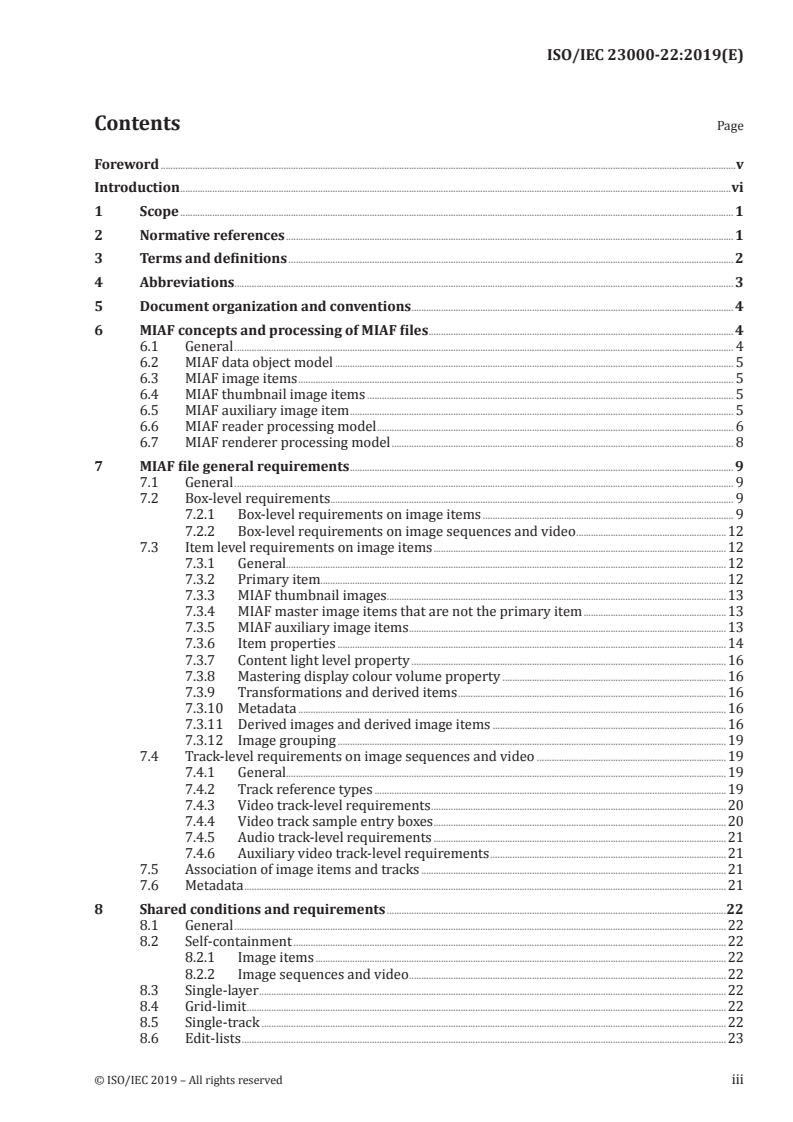
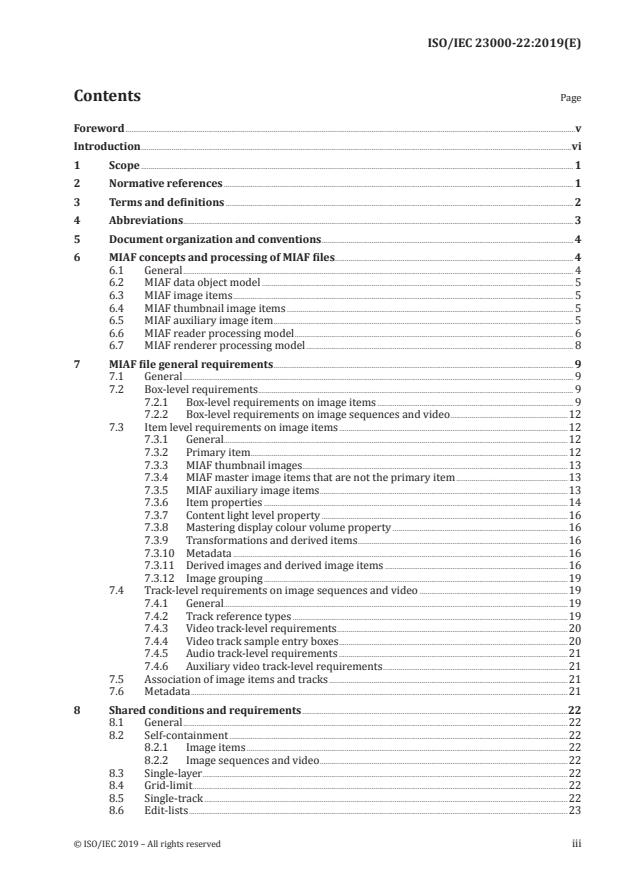
Contents Page
Foreword .v
Introduction .vi
1 Scope . 1
2 Normative references . 1
3 Terms and definitions . 2
4 Abbreviations. 3
5 Document organization and conventions . 4
6 MIAF concepts and processing of MIAF files . 4
6.1 General . 4
6.2 MIAF data object model . 5
6.3 MIAF image items . 5
6.4 MIAF thumbnail image items . 5
6.5 MIAF auxiliary image item . 5
6.6 MIAF reader processing model . 6
6.7 MIAF renderer processing model . 8
7 MIAF file general requirements . 9
7.1 General . 9
7.2 Box-level requirements . 9
7.2.1 Box-level requirements on image items . 9
7.2.2 Box-level requirements on image sequences and video .12
7.3 Item level requirements on image items .12
7.3.1 General.12
7.3.2 Primary item.12
7.3.3 MIAF thumbnail images .13
7.3.4 MIAF master image items that are not the primary item .13
7.3.5 MIAF auxiliary image items .13
7.3.6 Item properties .14
7.3.7 Content light level property .16
7.3.8 Mastering display colour volume property .16
7.3.9 Transformations and derived items .16
7.3.10 Metadata .16
7.3.11 Derived images and derived image items .16
7.3.12 Image grouping .19
7.4 Track-level requirements on image sequences and video .19
7.4.1 General.19
7.4.2 Track reference types .19
7.4.3 Video track-level requirements .20
7.4.4 Video track sample entry boxes .20
7.4.5 Audio track-level requirements .21
7.4.6 Auxiliary video track-level requirements .21
7.5 Association of image items and tracks .21
7.6 Metadata .21
8 Shared conditions and requirements .22
8.1 General .22
8.2 Self-containment .22
8.2.1 Image items .22
8.2.2 Image sequences and video .22
8.3 Single-layer .22
8.4 Grid-limit .22
8.5 Single-track .22
8.6 Edit-lists .23
© ISO/IEC 2019 – All rights reserved iii
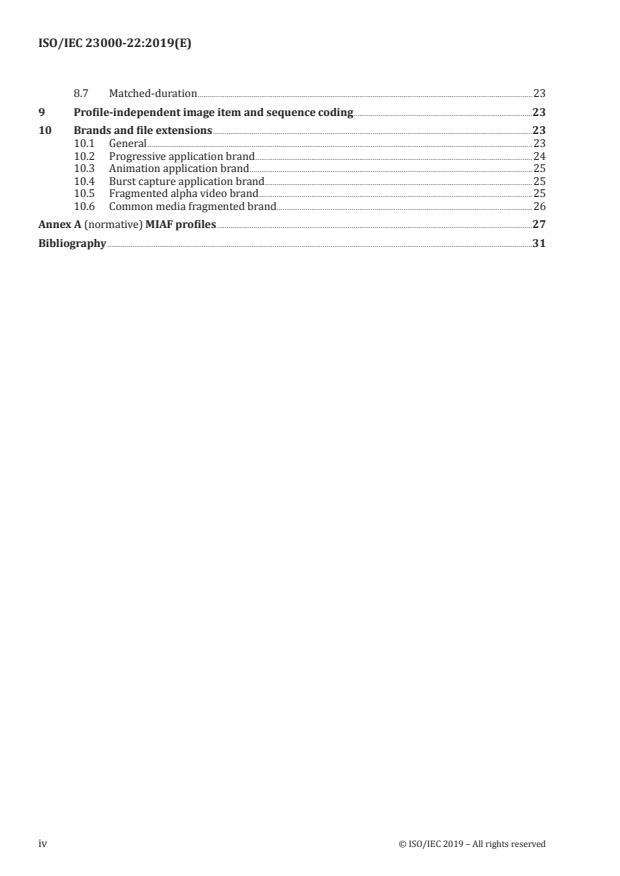
8.7 Matched-duration .23
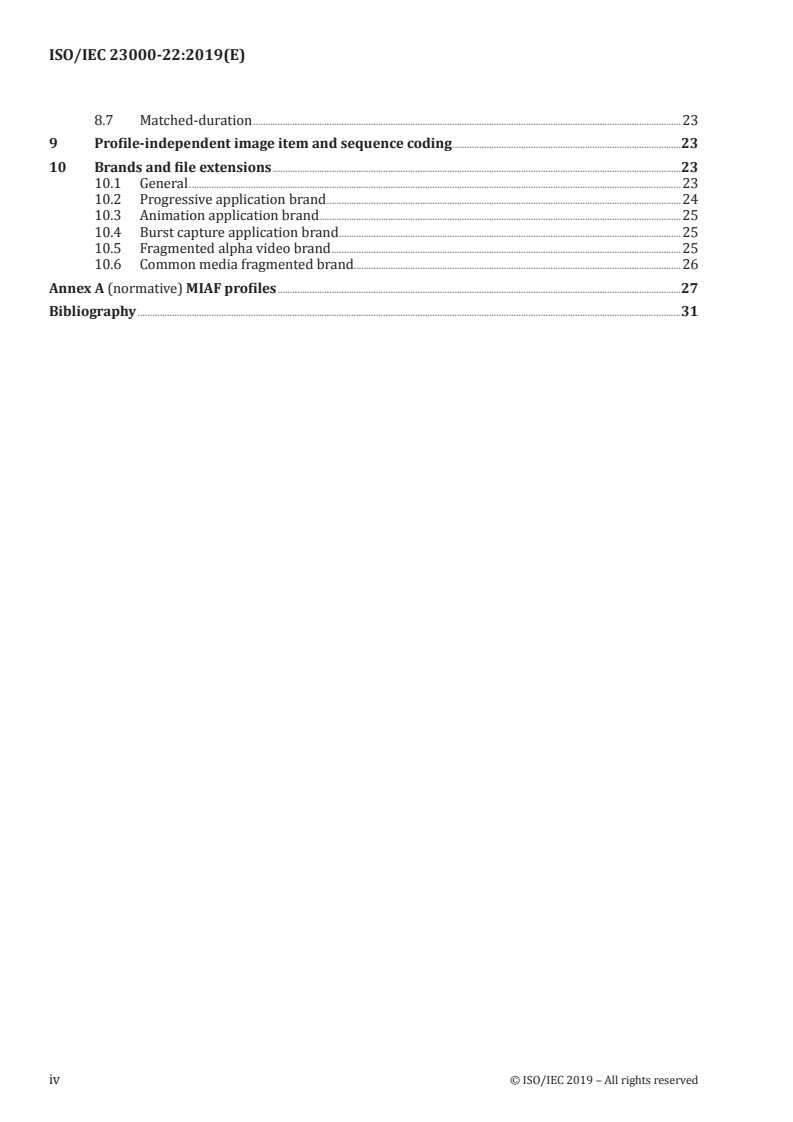
9 Profile-independent image item and sequence coding .23
10 Brands and file extensions .23
10.1 General .23
10.2 Progressive application brand .24
10.3 Animation application brand .25
10.4 Burst capture application brand .25
10.5 Fragmented alpha video brand .25
10.6 Common media fragmented brand.26
Annex A (normative) MIAF profiles .27
Bibliography .31
iv © ISO/IEC 2019 – All rights reserved
Foreword
ISO (the International Organization for Standardization) and IEC (the International Electrotechnical
Commission) form the specialized system for worldwide standardization. National bodies that
are members of ISO or IEC participate in the development of International Standards through
technical committees established by the respective organization to deal with particular fields of
technical activity. ISO and IEC technical committees collaborate in fields of mutual interest. Other
international organizations, governmental and non-governmental, in liaison with ISO and IEC, also
take part in the work.
The procedures used to develop this document and those intended for its further maintenance are
described in the ISO/IEC Directives, Part 1. In particular, the different approval criteria needed for
the different types of document should be noted. This document was drafted in accordance with the
editorial rules of the ISO/IEC Directives, Part 2 (see www .iso .org/directives).
Attention is drawn to the possibility that some of the elements of this document may be the subject
of patent rights. ISO and IEC shall not be held responsible for identifying any or all such patent
rights. Details of any patent rights identified during the development of the document will be in the
Introduction and/or on the ISO list of patent declarations received (see www .iso .org/patents) or the IEC
list of patent declarations received (see http: //patents .iec .ch).
Any trade name used in this document is information given for the convenience of users and does not
constitute an endorsement.
For an explanation of the voluntary nature of standards, the meaning of ISO specific terms and
expressions related to conformity assessment, as well as information about ISO's adherence to the
World Trade Organization (WTO) principles in the Technical Barriers to Trade (TBT) see www .iso
.org/iso/foreword .html.
This document was prepared by Joint Technical Committee ISO/IEC JTC 1, Information technology,
Subcommittee SC 29, Coding of audio, picture, multimedia and hypermedia information.
A list of all parts in the ISO/IEC 23000 series can be found on the ISO website.
Any feedback or questions on this document should be directed to the user’s national standards body. A
complete listing of these bodies can be found at www .iso .org/members .html.
© ISO/IEC 2019 – All rights reserved v
Introduction
This document specifies a multimedia application format, the Multi-Image Application Format (MIAF),
that enables precise interoperability points for creation, reading, parsing and decoding of images
embedded in the High Efficiency Image File (HEIF) format. The MIAF specification fully conforms to the
HEIF format and only defines additional constraints to ensure higher interoperability.
The HEIF specification (ISO/IEC 23008-12) defines a file format for the inclusion of one or more images,
possibly with one or more sequences of images, with associated metadata and their relationship to each
other. While the HEIF specification defines the file format and general requirements for the included
coding formats, it does not define specific interoperability points by which capturing devices, editing
applications, storage systems, cloud and delivery networks, and playback devices and applications can
interoperate with each other.
This document, by defining specific constraints on the HEIF format, limiting the supported encoding
types to a set of specific profiles and levels, requiring specific metadata formats, and defining a set of
brands for signalling such constraints, defines precise interoperability points which enable the industry
to deploy particular uses of the HEIF specification to improve interoperability.
This document defines the normative requirements for MIAF files as well as for MIAF readers and
renderers.
vi © ISO/IEC 2019 – All rights reserved
INTERNATIONAL STANDARD ISO/IEC 23000-22:2019(E)
Information technology — Multimedia application format
(MPEG-A) —
Part 22:
Multi-image application format (MIAF)
1 Scope
This document specifies the Multi-Image Application Format (MIAF), which contains coded images,
groups and sequences of images along with their metadata and the information about their relations to
each other, all embedded in the High Efficiency Image File (HEIF) format.
This document builds on the HEIF specification and defines the following:
— a set of additional constraints on ISO/IEC 23008-12 (HEIF) specification, to simplify its file format
options;
— specific alpha plane formats;
— a set of specific profiles and levels for the supported coding formats;
— a set of specific metadata formats;
— a set of brands, including application brands indicating conformance with specific profiles;
— a set of rules for extending MIAF format to support additional coding formats, profiles, levels and
metadata.
This document also defines the normative behaviour for a MIAF reader and MIAF renderer.
The MIAF specification is intentionally written to be extensible, and to allow for forward compatibility.
The format is also permissive of the presence of other data, such as coding formats, metadata, and
derived images.
2 Normative references
The following documents are referred to in the text in such a way that some or all of their content
constitutes requirements of this document. For dated references, only the edition cited applies. For
undated references, the latest edition of the referenced document (including any amendments) applies.
ISO/IEC 14496-3, Information technology — Coding of audio-visual objects — Part 3: Audio
Rec. ITU-T H.264 | ISO/IEC 14496-10, Information technology — Coding of audio-visual objects —
Advanced video coding
ISO/IEC 14496-12, Information technology — Coding of audio-visual objects — Part 12: ISO base media
file format
ISO/IEC 14496-15, Information technology — Coding of audio-visual objects — Part 15: Carriage of
network abstraction layer (NAL) unit structured video in the ISO base media file format
Rec. ITU-T T.802 | ISO/IEC 15444-3, Information technology — JPEG 2000 image coding system — Part 3:
Motion JPEG 2000
© ISO/IEC 2019 – All rights reserved 1
ISO 16684-1, Graphic technology — Extensible metadata platform (XMP)— Part 1: Data model,
serialization and core properties
ISO/IEC 23000-19, Information technology — Multimedia application format (MPEG-A) — Part 19:
Common media application format (CMAF) for segmented media
ISO/IEC 23001-14, Information technology — MPEG systems technologies — Part 14: Partial file format
Rec. ITU-T H.265 | ISO/IEC 23008-2, Information technology — High efficiency coding and media delivery
in heterogeneous environments — High efficiency video coding
ISO/IEC 23008-12, Information technology — High efficiency coding and media delivery in heterogeneous
environments — Part 12: Image File Format
JEITA CP-3451, Exchangeable image file format for digital still cameras
3 Terms and definitions
For the purposes of this document, the terms and definitions given in Rec. ITU-T H.264 | ISO
ISO/IEC 14496-10, Rec. ITU-T H.264 | ISO ISO/IEC 23008-2, ISO/IEC 14496-12, ISO/IEC 23008-12 and
the following apply.
ISO and IEC maintain terminological databases for use in standardization at the following addresses:
— ISO Online browsing platform: available at https: //www .iso .org/obp
— IEC Electropedia: available at http: //www .electropedia .org/
3.1
alpha plane
image specifying the transparency information of the master image
Note 1 to entry: When the resolution of an alpha plane differs from that of the master image, MIAF renderers
are expected to rescale the alpha plane to the resolution of the master image, but the rescaling operation is not
specified exactly and thus the exact behaviour of different MIAF renderer implementations can differ.
3.2
depth map
image that contains information relating to the distance of the surfaces of scene objects from a
viewpoint
3.3
MIAF application brand
brand indicating that a MIAF file (3.5) conforms to a specific MIAF profile (3.8) and that MIAF readers
(3.9) and MIAF renderers (3.12) that only implement the features required by that MIAF profile can
process the MIAF file
3.4
MIAF auxiliary image item
image item that provides auxiliary visual information but is not normally independently rendered
Note 1 to entry: The requirements are in subclause 7.3.5.
3.5
MIAF file
file containing one or more image and/or image sequence and/or video tracks
Note 1 to entry: A MIAF file is constrained to conform to clause 7.
3.6
MIAF master image item
image item that may be rendered
2 © ISO/IEC 2019 – All rights reserved
3.7
MIAF image item
MIAF master image item (3.6), MIAF auxiliary image item (3.4) or MIAF thumbnail image item (3.10)
3.8
MIAF profile
set of restrictions on a MIAF file (3.5)
Note 1 to entry: These are typically restrictions on the media coding format/profile/level, content protection
scheme, or on quantitative measures. MIAF profiles enable interoperability between MIAF files and MIAF
readers.
Note 2 to entry: A MIAF file may conform to multiple MIAF profiles. A MIAF reader or MIAF renderer may be
capable of processing one or more MIAF profiles.
3.9
MIAF reader
entity that reads and parses MIAF files (3.5), identifies the type of image coding and metadata, and
decodes the coded streams for the coding types/profiles/levels that it supports
3.10
MIAF thumbnail image item
image item that is referenced using the thumbnail reference type
Note 1 to entry: The requirements for a MIAF thumbnail image item are specified in subclause 7.3.3.
3.11
MIAF player
entity including a MIAF reader (3.9) and a MIAF renderer (3.12)
3.12
MIAF renderer
entity that renders the output of MIAF reader (3.9) into a visual context (3.15), taking into account
associated metadata (e.g. colour information) and auxiliary image data (e.g. alpha planes)
3.13
primary image
image identified as the primary item (3.14) in the file-level MetaBox
3.14
primary item
item as identified by the PrimaryItemBox in the file-level MetaBox
3.15
visual context
visual rendering surface such as a screen buffer, which may already contain visual material, and onto
which an image can be rendered
4 Abbreviations
AVC Advanced Video Coding (as specified by Rec. ITU-T H.264 | ISO/IEC 14496-10)
HEIF High Efficiency Image File format (as specified by ISO/IEC 23008-12)
HEVC High Efficiency Video Coding (as specified by Rec. ITU-T H.265 | ISO/IEC 23008-2)
MIAF Multi Image Application Format (as specified by this document)
© ISO/IEC 2019 – All rights reserved 3
5 Document organization and conventions
Clause 6 specifies general concepts and processing of MIAF files.
Clause 7 specifies general requirements that apply to all profiles. These requirements are split in
two ways:
— requirements at the file format structure level, and requirements at the 'abstraction layer' that the
file format structures create; and
— requirements for both still images, image sequences and video.
Clause 8 specifies constraints which are shared by one or more profiles.
Clause 9 specifies the coding format(s) that are required to be supported in any player, independent of
any profile.
Clause 10 specifies the brands that indicate conformance to the normative requirements of this
document, common to all profiles (as documented in the clauses preceding the annexes), and the
applicable file extensions.
Annex A specifies the profiles, each of which imposes a set of specific restrictions which shall be
followed for enabling interoperability between MIAF files and MIAF readers.
This document derives variables that are named by a mixture of lower case and upper case letters
and without any underscore characters. Variables starting with an upper case letter are derived for
the current syntax structure and all depending syntax structures. Variables starting with an upper
case letter may be used in the specification for dependent syntax structures without mentioning the
originating syntax structure of the variable. Variables starting with a lower case letter are only used
within the clause in which they are derived.
6 MIAF concepts and processing of MIAF files
6.1 General
This clause describes the overall encoding, packaging, parsing and decoding architecture as well as the
data structure (concepts of image, image sequence, video, metadata, etc.).
This document places requirements on
— the format of files;
— the action of a process that reads and parses a file, and produces output images (a "reader");
— the action of a process that renders the output images (a "renderer").
Figure 1 illustrates a possible processing model to handle MIAF files. A MIAF reader gets a MIAF file
as input. In addition, the caller process or application provides inputs on how the file is intended to
be processed. The MIAF reader produces output images that are provided to the MIAF renderer for
displaying. The rendering takes place on a visual context, such as a screen buffer, and is controlled by
the caller process or application.
Figure 1 — Processing of a MIAF file
4 © ISO/IEC 2019 – All rights reserved
6.2 MIAF data object model
The data object model consists of the boxes at the file format layer, and the two abstraction layers that
those boxes create:
— image items, with their properties, and relationships (expressed by item references);
— image sequences and/or video, with the sample entry setup information, and their relationships
(expressed by track references).
These two abstraction layer models can be linked by references and entity groups.
Image items are suitable when neither timing nor coding dependency is required. If either timing is
required or the coding scheme takes advantage of inter-picture prediction, an image sequence track
or a video track is used. A key difference between image sequence tracks and video tracks is that, in
image sequence tracks, the timing is advisory. Consequently, it is suggested that MIAF files contain
image sequence tracks when timing is not meaningful or essential for playback — for example, images
captured with exposure or focal bracketing.
6.3 MIAF image items
A MIAF image item is an item that conforms
a) to the box-level requirements for items in subclause 7.2.1;
b) to the requirements for items in subclause 7.3;
c) to the requirements of a defined MIAF codec profile;
d) and for which a MIAF brand appears in the FileTypeBox.
6.4 MIAF thumbnail image items
A MIAF thumbnail image item is an item that
a) is referenced as a thumbnail image from a MIAF master image item;
b) conforms to the box-level requirements for items in subclause 7.2;
c) conforms also to the requirements for items in subclause 7.3;
d) conforms either to a profile that a MIAF reader conforming to the profile of the associated master
image item is required to support, or to the requirements of a format defined in clause 9;
e) is unprotected;
f) has its image data stored in the same file as the MIAF master image item for which it is a thumbnail.
6.5 MIAF auxiliary image item
A MIAF auxiliary image item is an item that
a) conforms to the box-level requirements for items in subclause 7.2;
b) conforms also to the requirements for items in subclause 7.3;
c) conforms to the requirements for auxiliary items in subclause 7.3.5;
d) conforms either to the requirements of the same MIAF codec profile as the MIAF master image
item for which it is an auxiliary image, or to the requirements of a format defined in clause 9.
A MIAF auxiliary image may have alternates.
© ISO/IEC 2019 – All rights reserved 5
6.6 MIAF reader processing model
A MIAF reader is an entity capable of:
a) concluding which image item(s) or track(s) of a MIAF-conforming file are to be output based on
given input parameters;
b) decoding image items(s) or track(s) to be output;
c) generating the output pictures from the decoded pictures (e.g. by applying transformative image
properties); and
d) outputting the output pictures and file metadata associated with the output pictures.
Inputs to a MIAF reader are:
— a file with a FileTypeBox containing at least one brand specified in this document;
— optionally one of the following:
— item_ID of the item to be output (psItemId),
— track_ID of the track to be output (psTrackId),
— a selection between a static image (psImagePreferredFlag equal to 1) or track
(psImagePreferredFlag equal to 0) to be output,
NOTE 1 When neither psItemId nor psTrackId is provided as input, a default image item or track is
selected as specified in this clause.
— optionally constraints, such as the maximum width and height of an image item or track;
— optionally one or more of the following roles of the image or track to be output:
— master (default),
— thumbnail,
— auxiliary, which may be further classified by the type.
NOTE 2 More than one role can be provided as input for example to instruct a MIAF reader to return
both an image item and its alpha plane (when present).
Outputs of a MIAF reader are:
— the output image(s) of the track(s) or item(s) that was (were) requested as input or selected by the
MIAF reader as specified below, not including any non-output samples as defined in ISO/IEC 14496-12;
— in the case that any tracks are present, the composition times for each output sample, with any
associated edit list;
— the metadata associated with the output image(s), including the content of the
ColourInformationProperty or ColourInformationBox.
NOTE 3 When a MIAF reader is requested to provide auxiliary images as output, the output image(s) of
the MIAF reader include output images of auxiliary image item(s) or decoded samples of auxiliary track(s)
of any type, when no input of auxiliary picture type is given to the MIAF reader, or of the type matching that
given as input to the MIAF reader.
6 © ISO/IEC 2019 – All rights reserved
A track_ID or item_ID value seedId is derived using the following ordered steps:
— If neither psItemId nor psTrackId is provided as input, the following applies:
— If there is an alternate group including the primary item of the file, the following applies:
— If psImagePreferredFlag is provided as input and is equal to 0, the tracks in the alternate
group are examined in the order they are listed in the alternate group and seedId is set
equal to the track_ID value of the first track that the MIAF reader is able to decode and that
fulfils the constraints provided as input, if any.
— Otherwise, if psImagePreferredFlag is provided as input and is equal to 1, the items in the
alternate group are examined in the order they are listed in the alternate group and seedId
is set equal to the item_ID value of the first item that the MIAF reader is able to decode and
that fulfils the constraints provided as input, if any.
— Otherwise (psImagePreferredFlag is not provided as input), the tracks and items in the
alternate group are examined in the order they are listed in the alternate group and seedId
is set equal to the track_ID or item_ID value of the first track or item that the MIAF reader
is able to decode and that fulfils the constraints provided as input, if any.
NOTE 4 The selection of an entity from an alternate group can be implemented in a MIAF reader
as follows. At least the initial part of the file is retrieved for inspection — enough to cover the
FileTypeBox, and MetaBox and possibly the MovieBox (if any). The MetaBox is then inspected to find
the identification of the primary item, and any of its alternatives indicated by an alternate group. If
there are alternatives, the MIAF reader selects the first such entity listed in the alternate group that the
MIAF reader can support — with regards to compatible coding format, existence of protection, and so
on, and that fulfils the constraints provided as input, if any.
— Otherwise, the following applies:
— If psImagePreferredFlag is not provided as input, or is equal to 1, seedId is set equal to the
item_ID value of the primary item.
— Otherwise, seedId is set equal to the track_ID value of any track conforming to this
document and fulfils the constraints provided as input, if any.
— Otherwise, if psItemId is provided as input, seedId is set equal to psItemId.
— Otherwise, seedId is set equal to psTrackId.
A list of track_ID or item_ID values to be decoded, selectedIds, is derived as follows:
— If seedId represents a track_ID and one or more roles are provided as input, selectedIds is a list of
track_ID values such that both of the following are true for each list element selectedIds[listIdx]:
— selectedIdsx[listIdx] is equal to seedId or the track_ID value of any auxiliary and thumbnail
tracks associated with the track having track_ID equal to seedId;
— the track with the track_ID value equal to selectedIds[listIdx] has a role that is given as input.
— Otherwise, if seedId represents an item_ID and one or more roles are provided as input,
selectedIds is a list of item_ID values such that both of the following are true for each list element
selectedIds[listIdx]:
— selectedIds[listIdx] is equal to seedId or the item_ID value of any auxiliary and thumbnail items
associated with the item having item_ID equal to seedId;
— the item with the item_ID value equal to selectedIds[listIdx] has a role that is given as input.
— Otherwise, selectedIds is a list that has one and only one list element that is set equal to seedId.
© ISO/IEC 2019 – All rights reserved 7
NOTE 5 selectedIds can contain multiple items, such as a master image item and its thumbnail image item,
when more than one role is given as an input to a MIAF reader.
A MIAF reader shall conclude an error when any of the following occurs:
— selectedIds contains no track_ID or item_ID values;
— one or more roles are provided as input and selectedIds contains a track_ID or item_ID value of a
track or item that has a role other than those provided as input.
NOTE 6 A MIAF reader retrieves enough of the data-portion of the file (identified by offsets and sizes in the
data already retrieved) to enable the decoding and reconstruction of the output image(s) or image sequence(s) or
video(s), represented by the image items or tracks identified by selectedIds.
A MIAF reader decodes each track or item identified by the values in selectedIds and provides as output
the output images of the decoded image items or the decoded samples, including the application of
transformations.
1. Derive output image(s) from the image item(s) to be output, if any, as specified in ISO/IEC 23008-12.
2. Decode image sequence or video track(s) to be output, if any, and apply matrix of TrackHeaderBox
and CleanApertureBox to the decoded pictures to generate pictures to be output.
For each output image, the MIAF reader returns metadata, such as the colour information property or
equivalent metadata. For each track identified by the values in selectedIds, the MIAF reader returns the
composition times of the output images and the edit list, if any, applying to the track.
NOTE 7 Decoding of an image item can involve image derivation, or the application of transformative
properties applied in sequence.
6.7 MIAF renderer processing model
Inputs to a MIAF renderer are:
— the output image(s) of the item(s) or the sample(s) of the track(s) that were provided as output by
the MIAF reader;
— in the case that any tracks are present, the composition times of the output samples, with their
associated edit lists;
— the metadata associated with the output image(s), including the content of the
ColourInformationProperty or ColourInformationBox;
— a visual context, such as a bitmap representing a displaying window prior to rendering the output
image(s).
NOTE 1 When the output image(s) provided as output by the MIAF reader include(s) auxiliary image(s), this
(these) auxiliary image(s) is (are) also provided as input to the MIAF renderer.
Outputs of a MIAF renderer are:
— A new visual context subsequent to rendering the output image(s) into the provided visual context.
Profiles or application brands may specify the operation of the MIAF renderer. When profiles or
application brands do not specify the operation of the MIAF renderer and no other information of the
MIAF renderer operation is available, the MIAF renderer should operate as follows.
If an output image given as input to the MIAF renderer resulted from an image item, the following
processing steps are applied once to produce the updated visual context. Otherwise, if output image(s)
given as input to the MIAF renderer resulted from a video track, the following processing steps are
applied multiple times using the timing provided by the edit list, if any, or composition times, otherwise.
NOTE 2 Colour properties and other descriptive properties are expected to be used to enable display matching.
8 © ISO/IEC 2019 – All rights reserved
NOTE 3 No default rendering for an image sequence track is specified. A proper rendering of an image
sequence track depends on the use case or capturing scenario for the image sequence track.
If both a master image and an associated alpha plane are provided as inputs to the processing model,
the following applies:
— When the width or the height of the alpha plane differs from the width or the height of the master
image, respectively, the alpha plane is resized to have the same width and height as those of the
master image.
— If the master image is not pre-multiplied, the visual context is updated by performing the following
operation for each co-located pixel of the master image and the visual context:
v = m × α + v × (1 − α)
u i
— Otherwise (the master image is pre-multiplied), the visual context is updated by performing the
following operation for each co-located pixel of the master image and the visual context:
v = m + v × (1 − α)
u i
where
v is a pixel value in the updated visual context;
u
m is a pixel value in the master image;
α is an alpha plane value, scaled into the range of 0 (fully transparent) to 1 (fully opaque),
inclusive;
v is a pixel value in the visual context given as input to the process.
i
Otherwise (no alpha plane with a master image is provided as input to the processing model), the
master image is opaquely overlaid on the visual context.
7 MIAF file general requirements
7.1 General
A MIAF file shall conform to the requirements specified by ISO/IEC 23008-12 (which in turn references
requirements in ISO/IEC 14496-12).
A MIAF reader shall process all normative parts of a MIAF file.
NOTE A MIAF file can contain data additional to that defined by this document. A MIAF reader is expected to
ignore and/or skip the data it does not understand, and continue processing the received file.
7.2 Box-level requirements
7.2.1 Box-level requirements on image items
7.2.1.1 General
A summary of the boxes in MIAF that support image items is in Table 1. Indentation is used to represent
which boxes are enclosed in others. The names are the formal syntax names of the boxes. The clause
numbers indicate subclauses of this document that provide requirements and restrictions on those boxes.
© ISO/IEC 2019 – All rights reserved 9
Table 1 — Box overview and nesting for image items
Box overview and nesting for image items
file type and com-
FileTypeBox
7.2.1.2
patibility
BoxFileIndexBox
7.2.1.3 file index
MetaBox
7.2.1.4 metadata
handler, declares
HandlerBox
7.2.1.5 the metadata (han-
dler) type
data information
DataInformationBox
7.2.1.6
box, container
data reference box,
DataReferenceBox 7.2.1.6 declares source(s)
of metadata items
ItemLocationBox 7.2.1.7 item location
ItemProtectionBox
7.2.1.8 item protection
ItemInfoBox
7.2.1.9 item information
primary item refer-
PrimaryItemBox 7.2.1.10
ence
ItemPropertiesBox
7.2.1.11 item properties
ItemReferenceBox 7.2.1.12 item reference
ItemDataBox 7.2.1.13 item data
GroupsListBox
7.3.12 entity grouping
EntityToGroupBox
7.3.12
media data con-
MediaDataBox 7.2.1.13
tainer
Boxes documented in ISO/IEC 23008-12, ISO/IEC 14496-12 or ISO/IEC 23001-14 are shown in Table 1.
Other boxes may be present in the file but they shall not affect the processing of any images that are
required or conditionally required by this document.
Any MIAF file has the following constraints:
— The file shall conform to the constraints of the 'mif1' brand specified in ISO/IEC 23008-12;
— When the file contains an image sequence track, the file shall conform to the constraints of the
'msf1' brand specified in ISO/IEC 23008-12.
— When the file contains a video track, the file shall conform to the constraints of any brand specified
in ISO/IEC 14496-12.
— The file-level MetaBox shall always be present (see 7.2.1.4).
— The HandlerBox shall be the first contained box within the MetaBox.
— Both 16-bit and 32-bit item_IDs may be present.
7.2.1.2 FileTypeBox
The FileTypeBox shall contain, in the compatible_brands list, the following (in any order):
— 'mif1' (specified in ISO/IEC 23008-12).
— brand(s) identifying conformance to this document (specified in Clause 10).
10 © ISO/IEC 2019 – All rights reserved
The FileTypeBox should also contain brands that identify the MIAF profile(s), to which the file conforms
(specified in Annex A or externally), and possibly other brands to which the file conforms.
Files shall also carry a compatible brand to identify the MIAF profile to which the file conforms, as
defined in Annex A or external specifications.
7.2.1.3 Box file index
A BoxFileIndexBox that shall conform to the specification in ISO/IEC 23001-14 may be present after the
FileTypeBox to provide an index of the file. Any editing operation on the file which changes box sizing
or placement shall update this index or remove it.
NOTE Alternatively or additionally, BoxFileIndexBox can be delivered out-of-band e.g. by using the optional
fileindex MIME media parameter specified in ISO/IEC 23001-14.
7.2.1.4 MetaBox
The MetaBox shall be present at the file-level.
NOTE This also means that a file that is primarily a sequence will still have at least a primary image item in
the MetaBox (e.g. for printing).
The XMLBox and BinaryXMLBox shall not be used in a MetaBox.
7.2.1.5 HandlerBox
The file-level MetaBox shall be identified as carrying images by carrying in the associated HandlerBox
the value required by ISO/IEC 23008-12 (which is 'pict').
7.2.1.6 DataInformationBox and DataReferenceBox
Profiles may limit the use of data references for image items.
7.2.1.7 ItemLocationBox
MIAF image items are constrained as follows:
— construction_method shall be equal to 0 for MIAF image items that are coded image items.
— construction_method shall be equal to 0 or 1 for MIAF image items that are derived image items.
7.2.1.8 ItemProtectionBox
MIAF image items shall not reference any item protection, i.e. the image data shall be unprotected.
These boxes may be present but shall only be used to define the protection of other data
...
INTERNATIONAL ISO/IEC
STANDARD 23000-22
First edition
2019-06
Information technology — Multimedia
application format (MPEG-A) —
Part 22:
Multi-image application format (MIAF)
Technologies de l'information — Format pour application multimédia
(MPEG-A) —
Partie 22: Format pour application à images multiples (MIAF)
Reference number
©
ISO/IEC 2019
© ISO/IEC 2019
All rights reserved. Unless otherwise specified, or required in the context of its implementation, no part of this publication may
be reproduced or utilized otherwise in any form or by any means, electronic or mechanical, including photocopying, or posting
on the internet or an intranet, without prior written permission. Permission can be requested from either ISO at the address
below or ISO’s member body in the country of the requester.
ISO copyright office
CP 401 • Ch. de Blandonnet 8
CH-1214 Vernier, Geneva
Phone: +41 22 749 01 11
Fax: +41 22 749 09 47
Email: copyright@iso.org
Website: www.iso.org
Published in Switzerland
ii © ISO/IEC 2019 – All rights reserved
Contents Page
Foreword .v
Introduction .vi
1 Scope . 1
2 Normative references . 1
3 Terms and definitions . 2
4 Abbreviations. 3
5 Document organization and conventions . 4
6 MIAF concepts and processing of MIAF files . 4
6.1 General . 4
6.2 MIAF data object model . 5
6.3 MIAF image items . 5
6.4 MIAF thumbnail image items . 5
6.5 MIAF auxiliary image item . 5
6.6 MIAF reader processing model . 6
6.7 MIAF renderer processing model . 8
7 MIAF file general requirements . 9
7.1 General . 9
7.2 Box-level requirements . 9
7.2.1 Box-level requirements on image items . 9
7.2.2 Box-level requirements on image sequences and video .12
7.3 Item level requirements on image items .12
7.3.1 General.12
7.3.2 Primary item.12
7.3.3 MIAF thumbnail images .13
7.3.4 MIAF master image items that are not the primary item .13
7.3.5 MIAF auxiliary image items .13
7.3.6 Item properties .14
7.3.7 Content light level property .16
7.3.8 Mastering display colour volume property .16
7.3.9 Transformations and derived items .16
7.3.10 Metadata .16
7.3.11 Derived images and derived image items .16
7.3.12 Image grouping .19
7.4 Track-level requirements on image sequences and video .19
7.4.1 General.19
7.4.2 Track reference types .19
7.4.3 Video track-level requirements .20
7.4.4 Video track sample entry boxes .20
7.4.5 Audio track-level requirements .21
7.4.6 Auxiliary video track-level requirements .21
7.5 Association of image items and tracks .21
7.6 Metadata .21
8 Shared conditions and requirements .22
8.1 General .22
8.2 Self-containment .22
8.2.1 Image items .22
8.2.2 Image sequences and video .22
8.3 Single-layer .22
8.4 Grid-limit .22
8.5 Single-track .22
8.6 Edit-lists .23
© ISO/IEC 2019 – All rights reserved iii
8.7 Matched-duration .23
9 Profile-independent image item and sequence coding .23
10 Brands and file extensions .23
10.1 General .23
10.2 Progressive application brand .24
10.3 Animation application brand .25
10.4 Burst capture application brand .25
10.5 Fragmented alpha video brand .25
10.6 Common media fragmented brand.26
Annex A (normative) MIAF profiles .27
Bibliography .31
iv © ISO/IEC 2019 – All rights reserved
Foreword
ISO (the International Organization for Standardization) and IEC (the International Electrotechnical
Commission) form the specialized system for worldwide standardization. National bodies that
are members of ISO or IEC participate in the development of International Standards through
technical committees established by the respective organization to deal with particular fields of
technical activity. ISO and IEC technical committees collaborate in fields of mutual interest. Other
international organizations, governmental and non-governmental, in liaison with ISO and IEC, also
take part in the work.
The procedures used to develop this document and those intended for its further maintenance are
described in the ISO/IEC Directives, Part 1. In particular, the different approval criteria needed for
the different types of document should be noted. This document was drafted in accordance with the
editorial rules of the ISO/IEC Directives, Part 2 (see www .iso .org/directives).
Attention is drawn to the possibility that some of the elements of this document may be the subject
of patent rights. ISO and IEC shall not be held responsible for identifying any or all such patent
rights. Details of any patent rights identified during the development of the document will be in the
Introduction and/or on the ISO list of patent declarations received (see www .iso .org/patents) or the IEC
list of patent declarations received (see http: //patents .iec .ch).
Any trade name used in this document is information given for the convenience of users and does not
constitute an endorsement.
For an explanation of the voluntary nature of standards, the meaning of ISO specific terms and
expressions related to conformity assessment, as well as information about ISO's adherence to the
World Trade Organization (WTO) principles in the Technical Barriers to Trade (TBT) see www .iso
.org/iso/foreword .html.
This document was prepared by Joint Technical Committee ISO/IEC JTC 1, Information technology,
Subcommittee SC 29, Coding of audio, picture, multimedia and hypermedia information.
A list of all parts in the ISO/IEC 23000 series can be found on the ISO website.
Any feedback or questions on this document should be directed to the user’s national standards body. A
complete listing of these bodies can be found at www .iso .org/members .html.
© ISO/IEC 2019 – All rights reserved v
Introduction
This document specifies a multimedia application format, the Multi-Image Application Format (MIAF),
that enables precise interoperability points for creation, reading, parsing and decoding of images
embedded in the High Efficiency Image File (HEIF) format. The MIAF specification fully conforms to the
HEIF format and only defines additional constraints to ensure higher interoperability.
The HEIF specification (ISO/IEC 23008-12) defines a file format for the inclusion of one or more images,
possibly with one or more sequences of images, with associated metadata and their relationship to each
other. While the HEIF specification defines the file format and general requirements for the included
coding formats, it does not define specific interoperability points by which capturing devices, editing
applications, storage systems, cloud and delivery networks, and playback devices and applications can
interoperate with each other.
This document, by defining specific constraints on the HEIF format, limiting the supported encoding
types to a set of specific profiles and levels, requiring specific metadata formats, and defining a set of
brands for signalling such constraints, defines precise interoperability points which enable the industry
to deploy particular uses of the HEIF specification to improve interoperability.
This document defines the normative requirements for MIAF files as well as for MIAF readers and
renderers.
vi © ISO/IEC 2019 – All rights reserved
INTERNATIONAL STANDARD ISO/IEC 23000-22:2019(E)
Information technology — Multimedia application format
(MPEG-A) —
Part 22:
Multi-image application format (MIAF)
1 Scope
This document specifies the Multi-Image Application Format (MIAF), which contains coded images,
groups and sequences of images along with their metadata and the information about their relations to
each other, all embedded in the High Efficiency Image File (HEIF) format.
This document builds on the HEIF specification and defines the following:
— a set of additional constraints on ISO/IEC 23008-12 (HEIF) specification, to simplify its file format
options;
— specific alpha plane formats;
— a set of specific profiles and levels for the supported coding formats;
— a set of specific metadata formats;
— a set of brands, including application brands indicating conformance with specific profiles;
— a set of rules for extending MIAF format to support additional coding formats, profiles, levels and
metadata.
This document also defines the normative behaviour for a MIAF reader and MIAF renderer.
The MIAF specification is intentionally written to be extensible, and to allow for forward compatibility.
The format is also permissive of the presence of other data, such as coding formats, metadata, and
derived images.
2 Normative references
The following documents are referred to in the text in such a way that some or all of their content
constitutes requirements of this document. For dated references, only the edition cited applies. For
undated references, the latest edition of the referenced document (including any amendments) applies.
ISO/IEC 14496-3, Information technology — Coding of audio-visual objects — Part 3: Audio
Rec. ITU-T H.264 | ISO/IEC 14496-10, Information technology — Coding of audio-visual objects —
Advanced video coding
ISO/IEC 14496-12, Information technology — Coding of audio-visual objects — Part 12: ISO base media
file format
ISO/IEC 14496-15, Information technology — Coding of audio-visual objects — Part 15: Carriage of
network abstraction layer (NAL) unit structured video in the ISO base media file format
Rec. ITU-T T.802 | ISO/IEC 15444-3, Information technology — JPEG 2000 image coding system — Part 3:
Motion JPEG 2000
© ISO/IEC 2019 – All rights reserved 1
ISO 16684-1, Graphic technology — Extensible metadata platform (XMP)— Part 1: Data model,
serialization and core properties
ISO/IEC 23000-19, Information technology — Multimedia application format (MPEG-A) — Part 19:
Common media application format (CMAF) for segmented media
ISO/IEC 23001-14, Information technology — MPEG systems technologies — Part 14: Partial file format
Rec. ITU-T H.265 | ISO/IEC 23008-2, Information technology — High efficiency coding and media delivery
in heterogeneous environments — High efficiency video coding
ISO/IEC 23008-12, Information technology — High efficiency coding and media delivery in heterogeneous
environments — Part 12: Image File Format
JEITA CP-3451, Exchangeable image file format for digital still cameras
3 Terms and definitions
For the purposes of this document, the terms and definitions given in Rec. ITU-T H.264 | ISO
ISO/IEC 14496-10, Rec. ITU-T H.264 | ISO ISO/IEC 23008-2, ISO/IEC 14496-12, ISO/IEC 23008-12 and
the following apply.
ISO and IEC maintain terminological databases for use in standardization at the following addresses:
— ISO Online browsing platform: available at https: //www .iso .org/obp
— IEC Electropedia: available at http: //www .electropedia .org/
3.1
alpha plane
image specifying the transparency information of the master image
Note 1 to entry: When the resolution of an alpha plane differs from that of the master image, MIAF renderers
are expected to rescale the alpha plane to the resolution of the master image, but the rescaling operation is not
specified exactly and thus the exact behaviour of different MIAF renderer implementations can differ.
3.2
depth map
image that contains information relating to the distance of the surfaces of scene objects from a
viewpoint
3.3
MIAF application brand
brand indicating that a MIAF file (3.5) conforms to a specific MIAF profile (3.8) and that MIAF readers
(3.9) and MIAF renderers (3.12) that only implement the features required by that MIAF profile can
process the MIAF file
3.4
MIAF auxiliary image item
image item that provides auxiliary visual information but is not normally independently rendered
Note 1 to entry: The requirements are in subclause 7.3.5.
3.5
MIAF file
file containing one or more image and/or image sequence and/or video tracks
Note 1 to entry: A MIAF file is constrained to conform to clause 7.
3.6
MIAF master image item
image item that may be rendered
2 © ISO/IEC 2019 – All rights reserved
3.7
MIAF image item
MIAF master image item (3.6), MIAF auxiliary image item (3.4) or MIAF thumbnail image item (3.10)
3.8
MIAF profile
set of restrictions on a MIAF file (3.5)
Note 1 to entry: These are typically restrictions on the media coding format/profile/level, content protection
scheme, or on quantitative measures. MIAF profiles enable interoperability between MIAF files and MIAF
readers.
Note 2 to entry: A MIAF file may conform to multiple MIAF profiles. A MIAF reader or MIAF renderer may be
capable of processing one or more MIAF profiles.
3.9
MIAF reader
entity that reads and parses MIAF files (3.5), identifies the type of image coding and metadata, and
decodes the coded streams for the coding types/profiles/levels that it supports
3.10
MIAF thumbnail image item
image item that is referenced using the thumbnail reference type
Note 1 to entry: The requirements for a MIAF thumbnail image item are specified in subclause 7.3.3.
3.11
MIAF player
entity including a MIAF reader (3.9) and a MIAF renderer (3.12)
3.12
MIAF renderer
entity that renders the output of MIAF reader (3.9) into a visual context (3.15), taking into account
associated metadata (e.g. colour information) and auxiliary image data (e.g. alpha planes)
3.13
primary image
image identified as the primary item (3.14) in the file-level MetaBox
3.14
primary item
item as identified by the PrimaryItemBox in the file-level MetaBox
3.15
visual context
visual rendering surface such as a screen buffer, which may already contain visual material, and onto
which an image can be rendered
4 Abbreviations
AVC Advanced Video Coding (as specified by Rec. ITU-T H.264 | ISO/IEC 14496-10)
HEIF High Efficiency Image File format (as specified by ISO/IEC 23008-12)
HEVC High Efficiency Video Coding (as specified by Rec. ITU-T H.265 | ISO/IEC 23008-2)
MIAF Multi Image Application Format (as specified by this document)
© ISO/IEC 2019 – All rights reserved 3
5 Document organization and conventions
Clause 6 specifies general concepts and processing of MIAF files.
Clause 7 specifies general requirements that apply to all profiles. These requirements are split in
two ways:
— requirements at the file format structure level, and requirements at the 'abstraction layer' that the
file format structures create; and
— requirements for both still images, image sequences and video.
Clause 8 specifies constraints which are shared by one or more profiles.
Clause 9 specifies the coding format(s) that are required to be supported in any player, independent of
any profile.
Clause 10 specifies the brands that indicate conformance to the normative requirements of this
document, common to all profiles (as documented in the clauses preceding the annexes), and the
applicable file extensions.
Annex A specifies the profiles, each of which imposes a set of specific restrictions which shall be
followed for enabling interoperability between MIAF files and MIAF readers.
This document derives variables that are named by a mixture of lower case and upper case letters
and without any underscore characters. Variables starting with an upper case letter are derived for
the current syntax structure and all depending syntax structures. Variables starting with an upper
case letter may be used in the specification for dependent syntax structures without mentioning the
originating syntax structure of the variable. Variables starting with a lower case letter are only used
within the clause in which they are derived.
6 MIAF concepts and processing of MIAF files
6.1 General
This clause describes the overall encoding, packaging, parsing and decoding architecture as well as the
data structure (concepts of image, image sequence, video, metadata, etc.).
This document places requirements on
— the format of files;
— the action of a process that reads and parses a file, and produces output images (a "reader");
— the action of a process that renders the output images (a "renderer").
Figure 1 illustrates a possible processing model to handle MIAF files. A MIAF reader gets a MIAF file
as input. In addition, the caller process or application provides inputs on how the file is intended to
be processed. The MIAF reader produces output images that are provided to the MIAF renderer for
displaying. The rendering takes place on a visual context, such as a screen buffer, and is controlled by
the caller process or application.
Figure 1 — Processing of a MIAF file
4 © ISO/IEC 2019 – All rights reserved
6.2 MIAF data object model
The data object model consists of the boxes at the file format layer, and the two abstraction layers that
those boxes create:
— image items, with their properties, and relationships (expressed by item references);
— image sequences and/or video, with the sample entry setup information, and their relationships
(expressed by track references).
These two abstraction layer models can be linked by references and entity groups.
Image items are suitable when neither timing nor coding dependency is required. If either timing is
required or the coding scheme takes advantage of inter-picture prediction, an image sequence track
or a video track is used. A key difference between image sequence tracks and video tracks is that, in
image sequence tracks, the timing is advisory. Consequently, it is suggested that MIAF files contain
image sequence tracks when timing is not meaningful or essential for playback — for example, images
captured with exposure or focal bracketing.
6.3 MIAF image items
A MIAF image item is an item that conforms
a) to the box-level requirements for items in subclause 7.2.1;
b) to the requirements for items in subclause 7.3;
c) to the requirements of a defined MIAF codec profile;
d) and for which a MIAF brand appears in the FileTypeBox.
6.4 MIAF thumbnail image items
A MIAF thumbnail image item is an item that
a) is referenced as a thumbnail image from a MIAF master image item;
b) conforms to the box-level requirements for items in subclause 7.2;
c) conforms also to the requirements for items in subclause 7.3;
d) conforms either to a profile that a MIAF reader conforming to the profile of the associated master
image item is required to support, or to the requirements of a format defined in clause 9;
e) is unprotected;
f) has its image data stored in the same file as the MIAF master image item for which it is a thumbnail.
6.5 MIAF auxiliary image item
A MIAF auxiliary image item is an item that
a) conforms to the box-level requirements for items in subclause 7.2;
b) conforms also to the requirements for items in subclause 7.3;
c) conforms to the requirements for auxiliary items in subclause 7.3.5;
d) conforms either to the requirements of the same MIAF codec profile as the MIAF master image
item for which it is an auxiliary image, or to the requirements of a format defined in clause 9.
A MIAF auxiliary image may have alternates.
© ISO/IEC 2019 – All rights reserved 5
6.6 MIAF reader processing model
A MIAF reader is an entity capable of:
a) concluding which image item(s) or track(s) of a MIAF-conforming file are to be output based on
given input parameters;
b) decoding image items(s) or track(s) to be output;
c) generating the output pictures from the decoded pictures (e.g. by applying transformative image
properties); and
d) outputting the output pictures and file metadata associated with the output pictures.
Inputs to a MIAF reader are:
— a file with a FileTypeBox containing at least one brand specified in this document;
— optionally one of the following:
— item_ID of the item to be output (psItemId),
— track_ID of the track to be output (psTrackId),
— a selection between a static image (psImagePreferredFlag equal to 1) or track
(psImagePreferredFlag equal to 0) to be output,
NOTE 1 When neither psItemId nor psTrackId is provided as input, a default image item or track is
selected as specified in this clause.
— optionally constraints, such as the maximum width and height of an image item or track;
— optionally one or more of the following roles of the image or track to be output:
— master (default),
— thumbnail,
— auxiliary, which may be further classified by the type.
NOTE 2 More than one role can be provided as input for example to instruct a MIAF reader to return
both an image item and its alpha plane (when present).
Outputs of a MIAF reader are:
— the output image(s) of the track(s) or item(s) that was (were) requested as input or selected by the
MIAF reader as specified below, not including any non-output samples as defined in ISO/IEC 14496-12;
— in the case that any tracks are present, the composition times for each output sample, with any
associated edit list;
— the metadata associated with the output image(s), including the content of the
ColourInformationProperty or ColourInformationBox.
NOTE 3 When a MIAF reader is requested to provide auxiliary images as output, the output image(s) of
the MIAF reader include output images of auxiliary image item(s) or decoded samples of auxiliary track(s)
of any type, when no input of auxiliary picture type is given to the MIAF reader, or of the type matching that
given as input to the MIAF reader.
6 © ISO/IEC 2019 – All rights reserved
A track_ID or item_ID value seedId is derived using the following ordered steps:
— If neither psItemId nor psTrackId is provided as input, the following applies:
— If there is an alternate group including the primary item of the file, the following applies:
— If psImagePreferredFlag is provided as input and is equal to 0, the tracks in the alternate
group are examined in the order they are listed in the alternate group and seedId is set
equal to the track_ID value of the first track that the MIAF reader is able to decode and that
fulfils the constraints provided as input, if any.
— Otherwise, if psImagePreferredFlag is provided as input and is equal to 1, the items in the
alternate group are examined in the order they are listed in the alternate group and seedId
is set equal to the item_ID value of the first item that the MIAF reader is able to decode and
that fulfils the constraints provided as input, if any.
— Otherwise (psImagePreferredFlag is not provided as input), the tracks and items in the
alternate group are examined in the order they are listed in the alternate group and seedId
is set equal to the track_ID or item_ID value of the first track or item that the MIAF reader
is able to decode and that fulfils the constraints provided as input, if any.
NOTE 4 The selection of an entity from an alternate group can be implemented in a MIAF reader
as follows. At least the initial part of the file is retrieved for inspection — enough to cover the
FileTypeBox, and MetaBox and possibly the MovieBox (if any). The MetaBox is then inspected to find
the identification of the primary item, and any of its alternatives indicated by an alternate group. If
there are alternatives, the MIAF reader selects the first such entity listed in the alternate group that the
MIAF reader can support — with regards to compatible coding format, existence of protection, and so
on, and that fulfils the constraints provided as input, if any.
— Otherwise, the following applies:
— If psImagePreferredFlag is not provided as input, or is equal to 1, seedId is set equal to the
item_ID value of the primary item.
— Otherwise, seedId is set equal to the track_ID value of any track conforming to this
document and fulfils the constraints provided as input, if any.
— Otherwise, if psItemId is provided as input, seedId is set equal to psItemId.
— Otherwise, seedId is set equal to psTrackId.
A list of track_ID or item_ID values to be decoded, selectedIds, is derived as follows:
— If seedId represents a track_ID and one or more roles are provided as input, selectedIds is a list of
track_ID values such that both of the following are true for each list element selectedIds[listIdx]:
— selectedIdsx[listIdx] is equal to seedId or the track_ID value of any auxiliary and thumbnail
tracks associated with the track having track_ID equal to seedId;
— the track with the track_ID value equal to selectedIds[listIdx] has a role that is given as input.
— Otherwise, if seedId represents an item_ID and one or more roles are provided as input,
selectedIds is a list of item_ID values such that both of the following are true for each list element
selectedIds[listIdx]:
— selectedIds[listIdx] is equal to seedId or the item_ID value of any auxiliary and thumbnail items
associated with the item having item_ID equal to seedId;
— the item with the item_ID value equal to selectedIds[listIdx] has a role that is given as input.
— Otherwise, selectedIds is a list that has one and only one list element that is set equal to seedId.
© ISO/IEC 2019 – All rights reserved 7
NOTE 5 selectedIds can contain multiple items, such as a master image item and its thumbnail image item,
when more than one role is given as an input to a MIAF reader.
A MIAF reader shall conclude an error when any of the following occurs:
— selectedIds contains no track_ID or item_ID values;
— one or more roles are provided as input and selectedIds contains a track_ID or item_ID value of a
track or item that has a role other than those provided as input.
NOTE 6 A MIAF reader retrieves enough of the data-portion of the file (identified by offsets and sizes in the
data already retrieved) to enable the decoding and reconstruction of the output image(s) or image sequence(s) or
video(s), represented by the image items or tracks identified by selectedIds.
A MIAF reader decodes each track or item identified by the values in selectedIds and provides as output
the output images of the decoded image items or the decoded samples, including the application of
transformations.
1. Derive output image(s) from the image item(s) to be output, if any, as specified in ISO/IEC 23008-12.
2. Decode image sequence or video track(s) to be output, if any, and apply matrix of TrackHeaderBox
and CleanApertureBox to the decoded pictures to generate pictures to be output.
For each output image, the MIAF reader returns metadata, such as the colour information property or
equivalent metadata. For each track identified by the values in selectedIds, the MIAF reader returns the
composition times of the output images and the edit list, if any, applying to the track.
NOTE 7 Decoding of an image item can involve image derivation, or the application of transformative
properties applied in sequence.
6.7 MIAF renderer processing model
Inputs to a MIAF renderer are:
— the output image(s) of the item(s) or the sample(s) of the track(s) that were provided as output by
the MIAF reader;
— in the case that any tracks are present, the composition times of the output samples, with their
associated edit lists;
— the metadata associated with the output image(s), including the content of the
ColourInformationProperty or ColourInformationBox;
— a visual context, such as a bitmap representing a displaying window prior to rendering the output
image(s).
NOTE 1 When the output image(s) provided as output by the MIAF reader include(s) auxiliary image(s), this
(these) auxiliary image(s) is (are) also provided as input to the MIAF renderer.
Outputs of a MIAF renderer are:
— A new visual context subsequent to rendering the output image(s) into the provided visual context.
Profiles or application brands may specify the operation of the MIAF renderer. When profiles or
application brands do not specify the operation of the MIAF renderer and no other information of the
MIAF renderer operation is available, the MIAF renderer should operate as follows.
If an output image given as input to the MIAF renderer resulted from an image item, the following
processing steps are applied once to produce the updated visual context. Otherwise, if output image(s)
given as input to the MIAF renderer resulted from a video track, the following processing steps are
applied multiple times using the timing provided by the edit list, if any, or composition times, otherwise.
NOTE 2 Colour properties and other descriptive properties are expected to be used to enable display matching.
8 © ISO/IEC 2019 – All rights reserved
NOTE 3 No default rendering for an image sequence track is specified. A proper rendering of an image
sequence track depends on the use case or capturing scenario for the image sequence track.
If both a master image and an associated alpha plane are provided as inputs to the processing model,
the following applies:
— When the width or the height of the alpha plane differs from the width or the height of the master
image, respectively, the alpha plane is resized to have the same width and height as those of the
master image.
— If the master image is not pre-multiplied, the visual context is updated by performing the following
operation for each co-located pixel of the master image and the visual context:
v = m × α + v × (1 − α)
u i
— Otherwise (the master image is pre-multiplied), the visual context is updated by performing the
following operation for each co-located pixel of the master image and the visual context:
v = m + v × (1 − α)
u i
where
v is a pixel value in the updated visual context;
u
m is a pixel value in the master image;
α is an alpha plane value, scaled into the range of 0 (fully transparent) to 1 (fully opaque),
inclusive;
v is a pixel value in the visual context given as input to the process.
i
Otherwise (no alpha plane with a master image is provided as input to the processing model), the
master image is opaquely overlaid on the visual context.
7 MIAF file general requirements
7.1 General
A MIAF file shall conform to the requirements specified by ISO/IEC 23008-12 (which in turn references
requirements in ISO/IEC 14496-12).
A MIAF reader shall process all normative parts of a MIAF file.
NOTE A MIAF file can contain data additional to that defined by this document. A MIAF reader is expected to
ignore and/or skip the data it does not understand, and continue processing the received file.
7.2 Box-level requirements
7.2.1 Box-level requirements on image items
7.2.1.1 General
A summary of the boxes in MIAF that support image items is in Table 1. Indentation is used to represent
which boxes are enclosed in others. The names are the formal syntax names of the boxes. The clause
numbers indicate subclauses of this document that provide requirements and restrictions on those boxes.
© ISO/IEC 2019 – All rights reserved 9
Table 1 — Box overview and nesting for image items
Box overview and nesting for image items
file type and com-
FileTypeBox
7.2.1.2
patibility
BoxFileIndexBox
7.2.1.3 file index
MetaBox
7.2.1.4 metadata
handler, declares
HandlerBox
7.2.1.5 the metadata (han-
dler) type
data information
DataInformationBox
7.2.1.6
box, container
data reference box,
DataReferenceBox 7.2.1.6 declares source(s)
of metadata items
ItemLocationBox 7.2.1.7 item location
ItemProtectionBox
7.2.1.8 item protection
ItemInfoBox
7.2.1.9 item information
primary item refer-
PrimaryItemBox 7.2.1.10
ence
ItemPropertiesBox
7.2.1.11 item properties
ItemReferenceBox 7.2.1.12 item reference
ItemDataBox 7.2.1.13 item data
GroupsListBox
7.3.12 entity grouping
EntityToGroupBox
7.3.12
media data con-
MediaDataBox 7.2.1.13
tainer
Boxes documented in ISO/IEC 23008-12, ISO/IEC 14496-12 or ISO/IEC 23001-14 are shown in Table 1.
Other boxes may be present in the file but they shall not affect the processing of any images that are
required or conditionally required by this document.
Any MIAF file has the following constraints:
— The file shall conform to the constraints of the 'mif1' brand specified in ISO/IEC 23008-12;
— When the file contains an image sequence track, the file shall conform to the constraints of the
'msf1' brand specified in ISO/IEC 23008-12.
— When the file contains a video track, the file shall conform to the constraints of any brand specified
in ISO/IEC 14496-12.
— The file-level MetaBox shall always be present (see 7.2.1.4).
— The HandlerBox shall be the first contained box within the MetaBox.
— Both 16-bit and 32-bit item_IDs may be present.
7.2.1.2 FileTypeBox
The FileTypeBox shall contain, in the compatible_brands list, the following (in any order):
— 'mif1' (specified in ISO/IEC 23008-12).
— brand(s) identifying conformance to this document (specified in Clause 10).
10 © ISO/IEC 2019 – All rights reserved
The FileTypeBox should also contain brands that identify the MIAF profile(s), to which the file conforms
(specified in Annex A or externally), and possibly other brands to which the file conforms.
Files shall also carry a compatible brand to identify the MIAF profile to which the file conforms, as
defined in Annex A or external specifications.
7.2.1.3 Box file index
A BoxFileIndexBox that shall conform to the specification in ISO/IEC 23001-14 may be present after the
FileTypeBox to provide an index of the file. Any editing operation on the file which changes box sizing
or placement shall update this index or remove it.
NOTE Alternatively or additionally, BoxFileIndexBox can be delivered out-of-band e.g. by using the optional
fileindex MIME media parameter specified in ISO/IEC 23001-14.
7.2.1.4 MetaBox
The MetaBox shall be present at the file-level.
NOTE This also means that a file that is primarily a sequence will still have at least a primary image item in
the MetaBox (e.g. for printing).
The XMLBox and BinaryXMLBox shall not be used in a MetaBox.
7.2.1.5 HandlerBox
The file-level MetaBox shall be identified as carrying images by carrying in the associated HandlerBox
the value required by ISO/IEC 23008-12 (which is 'pict').
7.2.1.6 DataInformationBox and DataReferenceBox
Profiles may limit the use of data references for image items.
7.2.1.7 ItemLocationBox
MIAF image items are constrained as follows:
— construction_method shall be equal to 0 for MIAF image items that are coded image items.
— construction_method shall be equal to 0 or 1 for MIAF image items that are derived image items.
7.2.1.8 ItemProtectionBox
MIAF image items shall not reference any item protection, i.e. the image data shall be unprotected.
These boxes may be present but shall only be used to define the protection of other data
...