

ISO/IEC 23090-4:2025
(Main)Information technology — Coded representation of immersive media — Part 4: MPEG-I immersive audio
General Information
- Abstract
This document specifies technology that supports the real-time interactive rendering of an immersive virtual or augmented reality audio presentation while permitting the user to have 6DoF movement in the audio scene. It defines metadata to support this rendering and a bitstream syntax that enables efficient storage and streaming of immersive audio content.
- Status
- Published
- Publication Date
- 02-Nov-2025
- Technical Committee
- ISO/IEC JTC 1/SC 29 - Coding of audio, picture, multimedia and hypermedia information
- Drafting Committee
- ISO/IEC JTC 1/SC 29/WG 6 - MPEG Audio coding
- Current Stage
- 6060 - International Standard published
- Start Date
- 03-Nov-2025
- Due Date
- 10-Nov-2025
- Completion Date
- 03-Nov-2025

Overview
ISO/IEC 23090-4:2025 - MPEG‑I immersive audio - specifies technologies for real‑time, interactive rendering of immersive audio in virtual and augmented reality environments while allowing 6DoF (six degrees of freedom) movement. The standard defines metadata models and a bitstream syntax for efficient storage and streaming of immersive audio content, plus a renderer framework to realize spatial audio effects in real time.
Key Topics and Requirements
- Real‑time interactive rendering: Support for dynamic user movement and viewpoint changes within an audio scene (6DoF).
- Metadata and bitstream: Defined metadata elements and a transport syntax (including MHAS) to enable streaming and storage with efficient parsing and rendering.
- Renderer architecture: A modular renderer with defined payload types and data structures (e.g., directivity, diffraction, voxel, early reflections, reverberation, granular, RasterMap, portal, dispersion).
- Renderer stages and workflows: Comprehensive stages for effects activation, acoustic environment assignment, granular synthesis, reverberation, portals, occlusion/diffraction and early reflections, plus metadata culling and consolidation.
- Spatialization: Built‑in binaural spatializer and adaptive loudspeaker rendering methods for headphone and multichannel playback.
- Utilities and safeguards: Limiter specification, equalization, and interfaces for audio utilization reporting to manage loudness and resource use.
- Profiles and encoder guidance: Informative annexes describe encoder modules, scene configuration, metadata creation and recommended default presets for acoustic environments.
Applications
- VR/AR platforms and game engines that need realistic, interactive spatial audio with user movement.
- Streaming services and content creators delivering immersive audio experiences over networks (efficient bitstream and metadata).
- Audio middleware, SDKs and renderer implementations for headphones, headphones+head‑tracking, and adaptive loudspeaker arrays.
- Encoders and authoring tools producing immersive audio scenes with metadata for real‑time playback.
- Research and development in spatial audio, acoustic simulation and real‑time audio rendering.
Who Would Use This Standard
- Audio engine developers, VR/AR system architects, and game studios
- Codec and streaming implementers, broadcast engineers
- Headphone and loudspeaker manufacturers working on spatial rendering
- Standards bodies and interoperability testing labs
Related Standards
- Part of the ISO/IEC 23090 (MPEG‑I) series - complements other MPEG‑I parts that address coded representation of immersive media. Implementers should consider interoperability with other MPEG‑I components and transport/profile specifications.
Keywords: ISO/IEC 23090-4:2025, MPEG‑I immersive audio, immersive audio, 6DoF, spatial audio, metadata, bitstream, MHAS, renderer, binaural, adaptive loudspeaker, VR audio.
Get Certified
Connect with accredited certification bodies for this standard

BSI Group
BSI (British Standards Institution) is the business standards company that helps organizations make excellence a habit.

NYCE
Mexican standards and certification body.
Sponsored listings
Frequently Asked Questions
ISO/IEC 23090-4:2025 is a standard published by the International Organization for Standardization (ISO). Its full title is "Information technology — Coded representation of immersive media — Part 4: MPEG-I immersive audio". This standard covers: This document specifies technology that supports the real-time interactive rendering of an immersive virtual or augmented reality audio presentation while permitting the user to have 6DoF movement in the audio scene. It defines metadata to support this rendering and a bitstream syntax that enables efficient storage and streaming of immersive audio content.
This document specifies technology that supports the real-time interactive rendering of an immersive virtual or augmented reality audio presentation while permitting the user to have 6DoF movement in the audio scene. It defines metadata to support this rendering and a bitstream syntax that enables efficient storage and streaming of immersive audio content.
ISO/IEC 23090-4:2025 is classified under the following ICS (International Classification for Standards) categories: 35.040.40 - Coding of audio, video, multimedia and hypermedia information. The ICS classification helps identify the subject area and facilitates finding related standards.
ISO/IEC 23090-4:2025 is available in PDF format for immediate download after purchase. The document can be added to your cart and obtained through the secure checkout process. Digital delivery ensures instant access to the complete standard document.
Standards Content (Sample)
International
Standard
ISO/IEC 23090-4
First edition
Information technology — Coded
2025-11
representation of immersive media —
Part 4:
MPEG-I immersive audio
Technologies de l'information — Représentation codée de média
immersifs —
Partie 4: Audio immersif MPEG-I
Reference number
© ISO/IEC 2025
All rights reserved. Unless otherwise specified, or required in the context of its implementation, no part of this publication may
be reproduced or utilized otherwise in any form or by any means, electronic or mechanical, including photocopying, or posting on
the internet or an intranet, without prior written permission. Permission can be requested from either ISO at the address below
or ISO’s member body in the country of the requester.
ISO copyright office
CP 401 • Ch. de Blandonnet 8
CH-1214 Vernier, Geneva
Phone: +41 22 749 01 11
Email: copyright@iso.org
Website: www.iso.org
Published in Switzerland
© ISO/IEC 2025 – All rights reserved
ii
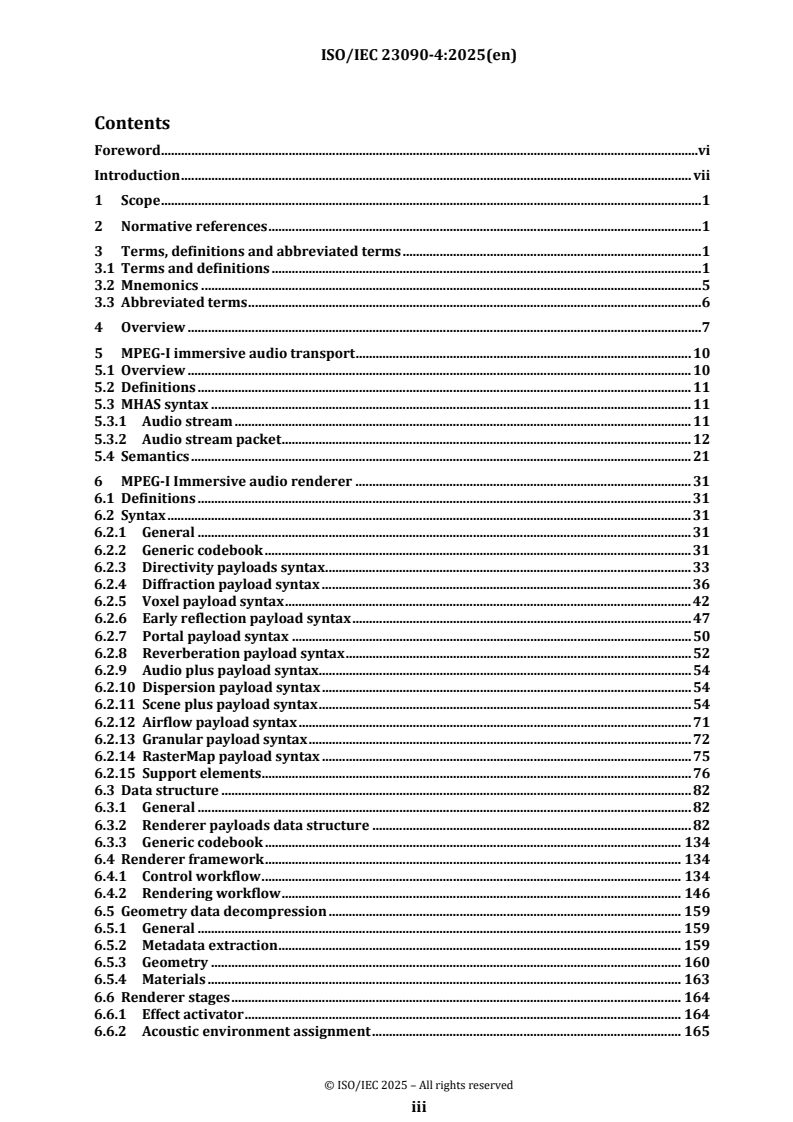
Contents
Foreword .vi
Introduction . vii
1 Scope . 1
2 Normative references . 1
3 Terms, definitions and abbreviated terms . 1
3.1 Terms and definitions . 1
3.2 Mnemonics . 5
3.3 Abbreviated terms . 6
4 Overview . 7
5 MPEG-I immersive audio transport . 10
5.1 Overview . 10
5.2 Definitions . 11
5.3 MHAS syntax . 11
5.3.1 Audio stream . 11
5.3.2 Audio stream packet . 12
5.4 Semantics . 21
6 MPEG-I Immersive audio renderer . 31
6.1 Definitions . 31
6.2 Syntax . 31
6.2.1 General . 31
6.2.2 Generic codebook . 31
6.2.3 Directivity payloads syntax . 33
6.2.4 Diffraction payload syntax . 36
6.2.5 Voxel payload syntax . 42
6.2.6 Early reflection payload syntax . 47
6.2.7 Portal payload syntax . 50
6.2.8 Reverberation payload syntax . 52
6.2.9 Audio plus payload syntax. 54
6.2.10 Dispersion payload syntax . 54
6.2.11 Scene plus payload syntax . 54
6.2.12 Airflow payload syntax . 71
6.2.13 Granular payload syntax . 72
6.2.14 RasterMap payload syntax . 75
6.2.15 Support elements . 76
6.3 Data structure . 82
6.3.1 General . 82
6.3.2 Renderer payloads data structure . 82
6.3.3 Generic codebook . 134
6.4 Renderer framework . 134
6.4.1 Control workflow . 134
6.4.2 Rendering workflow . 146
6.5 Geometry data decompression . 159
6.5.1 General . 159
6.5.2 Metadata extraction . 159
6.5.3 Geometry . 160
6.5.4 Materials . 163
6.6 Renderer stages . 164
6.6.1 Effect activator . 164
6.6.2 Acoustic environment assignment . 165
© ISO/IEC 2025 – All rights reserved
iii
6.6.3 Granular synthesis . 167
6.6.4 Reverberation . 181
6.6.5 Portals . 242
6.6.6 Early reflections . 256
6.6.7 Airflow simulation . 270
6.6.8 DiscoverSESS . 277
6.6.9 Occlusion . 279
6.6.10 Diffraction . 284
6.6.11 Voxel-based occlusion and diffraction . 301
6.6.12 Multi-Path voxel-based diffraction with RasterMaps . 326
6.6.13 Voxel-based early reflections . 332
6.6.14 Metadata culling . 340
6.6.15 Heterogeneous extent . 345
6.6.16 Directivity . 374
6.6.17 Distance . 380
6.6.18 Directional focus . 390
6.6.19 Consolidation of render items . 391
6.6.20 Equalizer (EQ) . 398
6.6.21 Low-complexity early reflections (LC-ERs) . 399
6.6.22 Fade . 408
6.6.23 Single point higher order ambisonics (SP-HOA) . 411
6.6.24 Homogeneous extent . 416
6.6.25 Panner . 421
6.6.26 Multi-point higher order ambisonics (MP-HOA) . 428
6.6.27 Low-complexity MP-HOA . 468
6.7 Spatializer . 475
6.7.1 Binaural spatializer . 475
6.7.2 Adaptive loudspeaker rendering . 494
6.8 Limiter . 528
6.8.1 General . 528
6.8.2 Data elements and variables . 528
6.8.3 Description . 528
6.9 Interface for audio utilization information . 530
6.9.1 General . 530
6.9.2 Syntax and semantics of an interface for renderer audio utilization . 530
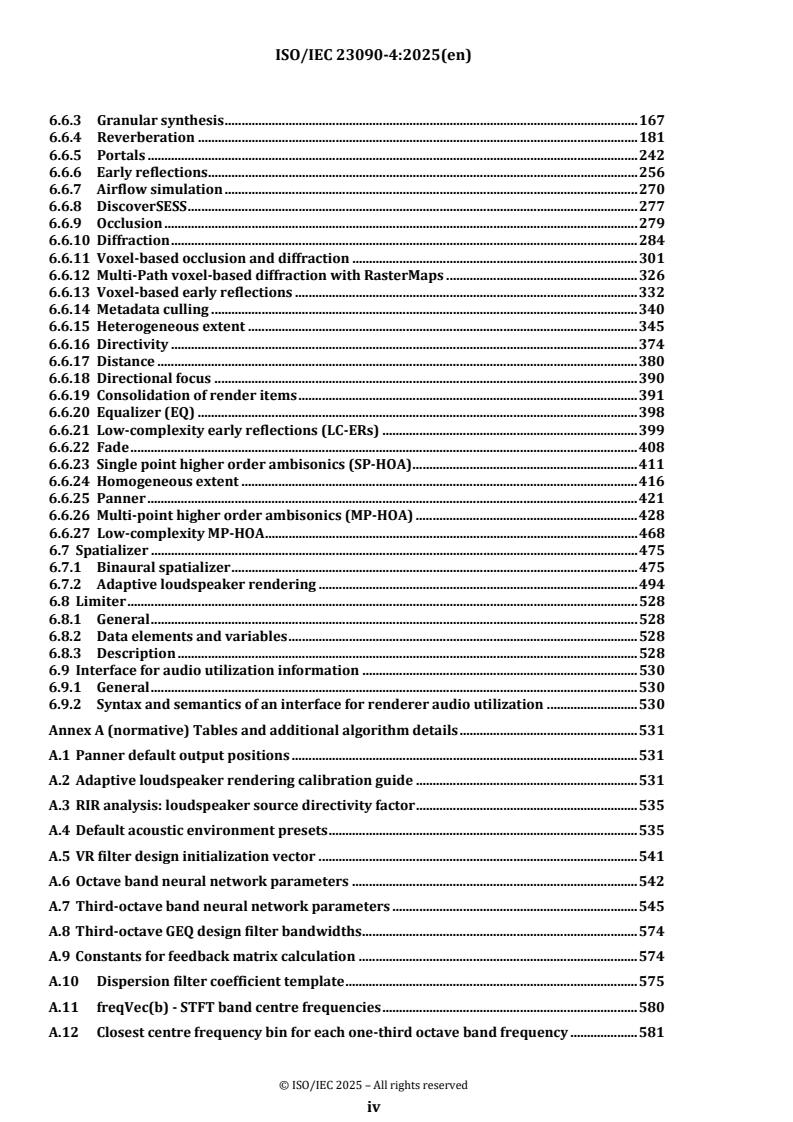
Annex A (normative) Tables and additional algorithm details . 531
A.1 Panner default output positions . 531
A.2 Adaptive loudspeaker rendering calibration guide . 531
A.3 RIR analysis: loudspeaker source directivity factor . 535
A.4 Default acoustic environment presets . 535
A.5 VR filter design initialization vector . 541
A.6 Octave band neural network parameters . 542
A.7 Third-octave band neural network parameters . 545
A.8 Third-octave GEQ design filter bandwidths . 574
A.9 Constants for feedback matrix calculation . 574
A.10 Dispersion filter coefficient template . 575
A.11 freqVec(b) - STFT band centre frequencies . 580
A.12 Closest centre frequency bin for each one-third octave band frequency . 581
© ISO/IEC 2025 – All rights reserved
iv
A.13 EQbin . 581
A.14 Fast convolution . 582
A.14.1 Uniformly partitioned overlap-save convolution . 582
A.14.2 Fast stereo convolution . 583
A.15 Support element lookup tables . 583
A.16 Airflow default frequency profiles . 593
A.17 Reverberation extent mesh definitions . 605
A.18 Headphone equalization preset responses . 607
A.19 Listener voice default directivity pattern . 607
A.20 Portal LoS data decoder tables . 608
A.21 Reverberator output directions . 609
A.22 Variable delay line anti-aliasing IIR lowpass filters . 612
Annex B (informative) Encoder, interfaces and feature guidance . 613
B.1 Encoder overview . 613
B.2 Encoder modules . 614
B.2.1 Scene configuration parameters . 614
B.2.2 Audio plus metadata creation . 614
B.2.3 Reverberation parametrization . 614
B.2.4 Default acoustic environment (Default AE) . 614
B.2.5 Low complexity early reflection parametrization . 615
B.2.6 Portal creation in implicit portal mode . 617
B.2.6.1 Creation of the geometry of the portal . 617
B.2.6.2 Identification of the connection state between two portals . 617
B.2.6.3 Creation of the portal struct containing all its metadata to be encoded . 618
B.2.7 Line-of-sight data creation in explicit portal mode . 619
B.2.8 Source/geometry staticity analysis . 619
B.2.9 Diffraction edges and paths analysis . 620
B.2.10 Early reflection surfaces and sequences analysis . 620
B.2.11 Module data collection . 620
B.2.12 Module data serialization . 620
B.3 Listener space description format (LSI) . 620
B.4 Encoder input format (EIF) . 620
B.5 Accessibility user interface . 620
B.6 Guidance on own voice usage – influence of system delay . 621
Bibliography . 624
© ISO/IEC 2025 – All rights reserved
v
Foreword
ISO (the International Organization for Standardization) and IEC (the International Electrotechnical
Commission) form the specialized system for worldwide standardization. National bodies that are
members of ISO or IEC participate in the development of International Standards through technical
committees established by the respective organization to deal with particular fields of technical activity.
ISO and IEC technical committees collaborate in fields of mutual interest. Other international
organizations, governmental and non-governmental, in liaison with ISO and IEC, also take part in the
work.
The procedures used to develop this document and those intended for its further maintenance are
described in the ISO/IEC Directives, Part 1. In particular, the different approval criteria needed for the
different types of document should be noted. This document was drafted in accordance with the editorial
rules of the ISO/IEC Directives, Part 2 (see www.iso.org/directives or
www.iec.ch/members_experts/refdocs).
ISO and IEC draw attention to the possibility that the implementation of this document may involve the
use of (a) patent(s). ISO and IEC take no position concerning the evidence, validity or applicability of any
claimed patent rights in respect thereof. As of the date of publication of this document, ISO and IEC had
not received notice of (a) patent(s) which may be required to implement this document. However,
implementers are cautioned that this may not represent the latest information, which may be obtained
from the patent database available at www.iso.org/patents and https://patents.iec.ch. ISO and IEC shall
not be held responsible for identifying any or all such patent rights.
Any trade name used in this document is information given for the convenience of users and does not
constitute an endorsement.
For an explanation of the voluntary nature of standards, the meaning of ISO specific terms and
expressions related to conformity assessment, as well as information about ISO's adherence to the World
Trade Organization (WTO) principles in the Technical Barriers to Trade (TBT) see
www.iso.org/iso/foreword.html. In the IEC, see www.iec.ch/understanding-standards.
This document was prepared by Joint Technical Committee ISO/IEC JTC 1, Information technology,
Subcommittee SC 29, Coding of audio, picture, multimedia and hypermedia information.
A list of all parts in the ISO/IEC 23090 series can be found on the ISO and IEC websites.
Any feedback or questions on this document should be directed to the user’s national standards body. A
complete listing of these bodies can be found at www.iso.org/members.html and www.iec.ch/national-
committees.
© ISO/IEC 2025 – All rights reserved
vi
Introduction
0.1 General
MPEG-I Immersive audio reproduction with six degrees of freedom (6DoF) movement of the listener in
an audio scene enables the experience of virtual acoustics in a Virtual Reality (VR) or Augmented Reality
(AR) simulation. Audio effects and phenomena known from real-world acoustics like, for example,
localization, distance attenuation, reflections, reverberation, occlusion, diffraction and the Doppler effect
are modelled by a renderer that is controlled through metadata transmitted in a bitstream with additional
input of interactive listener position data.
Along with other parts of MPEG-I (i.e. ISO/IEC 23090-12, “Immersive Video”, ISO/IEC 23090-5, “Visual
Volumetric Video-based Coding (V3C) and Video-based Point Cloud Compression” and ISO/IEC 23090-2,
“Systems Support”), the ISO/IEC 23090 series of standards supports a complete audio-visual VR or AR
presentation in which the user can navigate and interact with the simulated environment using 6DoF,
that being spatial navigation (x, y, z) and user head orientation (yaw, pitch, roll).
While VR presentations impart the feeling that the user is actually present in the virtual world, AR enables
the enrichment of the real world by virtual elements that are perceived seamlessly as being part of the
real world. The user can interact with the virtual scene or virtual elements and, in response, cause sounds
that are perceived as realistic and matching the users’ experience in the real world.
This document provides means for rendering a real-time interactive audio presentation while permitting
the user to have 6DoF movement. It defines metadata to support this rendering and a bitstream syntax
that enables efficient storage and streaming of the MPEG-I Immersive Audio content.
0.2 Typesetting of variables
For improved text readability, algorithmic variables are distinguished from descriptive text by their
dedicated typesetting. Throughout the text, variables that are input directly from the bitstream are
typeset in boldface letters. In the bitstream syntax the use of a boldface variable represents reading bits
from the bitstream and converting to an appropriate type (based on the indicated mnemonics and
number of bits), and assigning the resulting value to the boldfaced variable. Variables that are derived by
computation are typeset in pseudo-code font or italics.
© ISO/IEC 2025 – All rights reserved
vii
International Standard ISO/IEC 23090-4:2025(en)
Information technology — Coded representation of
immersive media —
Part 4:
MPEG-I immersive audio
1 Scope
This document specifies technology that supports the real-time interactive rendering of an immersive
virtual or augmented reality audio presentation while permitting the user to have 6DoF movement in the
audio scene. It defines metadata to support this rendering and a bitstream syntax that enables efficient
storage and streaming of immersive audio content.
2 Normative references
The following documents are referred to in the text in such a way that some or all of their content
constitutes requirements of this document. For dated references, only the edition cited applies. For
undated references, the latest edition of the referenced document (including any amendments) applies.
ISO 266, Acoustics — Preferred frequencies
ISO/IEC 23008-3, High efficiency coding and media delivery in heterogeneous environments — Part 3: 3D
audio
3 Terms, definitions and abbreviated terms
3.1 Terms and definitions
For the purposes of this document, the following terms and definitions apply.
ISO and IEC maintain terminology databases for use in standardization at the following addresses:
— ISO Online browsing platform: available at https://www.iso.org/obp
— IEC Electropedia: available at https://www.electropedia.org/
3.1.1
audio processing step
execution of DSP audio processing for one block of PCM audio at audio block rate
3.1.2
auralization
PCM waveform synthesis of immersive audio effects
3.1.3
audio element
audio objects, channels or HOA signals with associated MPEG-I 6DoF metadata and MPEG-H 3D Audio
metadata if appropriate
© ISO/IEC 2025 – All rights reserved
3.1.4
audio scene
all audio elements, acoustic elements and Acoustic environments needed to render the sound in the scene
3.1.5
control workflow
all components of the renderer that are not part of the rendering workflow
Note 1 to entry: For example, the scene controller and all related components belong to the control workflow.
3.1.6
cover
frequency dependant quasi-uniform grid on the surface of a unit sphere whereupon each point has an
associated scalar value in dB
3.1.7
conditional update
scene update initiated by the renderer when a certain condition is TRUE
3.1.8
Doppler effect
pitch change of sound perceived when distance between sound source and listener changes
3.19
dynamic update
update triggered by external entity that includes the values of the attributes to be updated
3.1.10
effective spatial extent
part of an extent that is acoustically relevant given a specific listening position relative to the extent
3.1.11
exterior representation
representation based on a source-centric format used for rendering when the listener is outside the
extent of the audio element
3.1.12
frame length
length of a PCM audio block in samples (B) to be processed in one audio processing step
3.1.13
HOA group
recording or synthesis of an audio scene with one or more HOA sources
3.1.14
interior representation
representation based on a listener-centric format used for rendering when the listener is inside the extent
of the audio element
3.1.15
listener centric format
audio format for representing an audio element that is rendered to reproduce a sound field around the
listener
Note 1 to entry: HOA or channel-based formats like, e.g., 5.1 channels or 7.4.1 channels.
3.1.16
limiter
processing block that prevents clipping of the multi-channel output signal of the spatializer
© ISO/IEC 2025 – All rights reserved
3.1.17
location
3D location of an object in space in Cartesian coordinates
3.1.18
metadata
all input and state parameters that are used to calculate the acoustic events of a virtual environment
3.1.19
MPEG-H 3DA decoder
MPEG-H 3D Audio Low Complexity (LC) Profile decoder
Note 1 to entry: The decoder receives as input an MPEG-H 3D Audio LC Profile MHAS stream and provides as output
decoded PCM audio together with all metadata available in the MHAS packets whereas decoded PCM audio contains
channels, objects and reconstructed HOA as described in ISO/IEC 23008-3:2018, Subclause 17.10.
3.1.20
orientation
3DoF rotation of an object in Tait-Bryan angles (yaw, pitch, roll)
3.1.21
portal
model of spatial transfer regions where there is an acoustic link that can transfer acoustic energy from
one AE into another AE
3.1.22
position
6DoF location and orientation
3.1.23
primary ray
rays used by the system to explore the scene geometry, the results of casting primary rays stored and
addressed individually by unique ray IDs
3.1.24
primary RI
RI that is directly derived from an audio element in the scene
3.1.25
renderer
entire software specified in this document
3.1.26
renderer pipeline
collection of stages, which sequentially perform audio and metadata processing
3.1.27
rendering workflow
control of renderer pipeline and spatializer
3.2.28
render item
RI
any audio element in the renderer pipeline
3.2.29
RI type
type associated to RI, denoting its relevance for pipeline stages
© ISO/IEC 2025 – All rights reserved
3.2.30
sample frequency
fs
number of discrete audio PCM samples per second
3.2.31
scene
aggregate of all entities that represent all acoustically relevant data of a virtual environment modeled in
the renderer through metadata
3.2.32
scene controller
renderer processing block that holds and updates the scene state
3.2.33
scene object
entity in the scene
Note 1 to entry: For example, geometry, audio element or listener.
3.2.34
scene state
reflection of the current state of all 6DoF metadata of the scene
3.2.35
secondary ray
auxiliary ray used to refine the results based on casting a primary ray
Note 1 to entry: The results of casting secondary rays are aggregated and stored under the respective primary ray
IDs.
3.2.36
secondary RI
RI representing additional aspects of its primary RI
Note 1 to entry: Secondary RIs are e.g. mirror sources for modelling early reflections, sources at diffracting edges
for modelling diffraction, extended sources corresponding to ray bundles having the same occlusion material lists.
3.2.37
source-centric format
audio format for representing an audio element that is rendered such that all direct sound from the audio
element appears to radiate from a bounded region in space that does not include the listener
3.2.38
spatializer
processing block situated directly after the renderer pipeline to produce a multi-channel output signal
for a specific playback method (e.g. headphones or loudspeakers)
3.2.39
spatially-heterogeneous audio element
audio element which has an extent and a source signal with more than one channel
3.2.40
stage
processing block in the renderer pipeline that addresses a dedicated rendering aspect
3.2.41
teleport
instant change of listener position triggered by user interaction within VR environment
© ISO/IEC 2025 – All rights reserved
3.2.42
timed update
scene update executed by the renderer once at a fixed predefined time
3.2.43
triggered update
scene update triggered from an external entity and executed by the renderer immediately after receiving
the trigger
3.2.44
update step
calculation of updated scene control data at a control rate
3.2.45
user
listener whose position in the scene is input to the renderer
3.2.46
voxel
geometry element defining a volume on a regular three-dimensional grid
3.2.47
voxel sub-scene
scene containing scene geometry representation based on voxels and including one or more independent
voxel sub-scenes
3.2.48
voxel sub-scene update
scene update executed by the renderer and applied to a particular available voxel sub-scene including
the currently rendered one
3.2 Mnemonics
The following mnemonics are defined to describe the different data types used in the coded bitstream
payload.
3.2.1
bslbf
bit string, left bit first, where “left” is the order in which bit strings are written in ISO/IEC 14496 (all
parts)
Note 1 to entry: Bit strings are written as a string of 1s and 0s within single quote marks, for example '1000 0001'.
Blanks within a bit string are for ease of reading and have no significance.
3.2.2
uimsbf
unsigned integer, most significant bit first
3.2.3
vlclbf
variable length code, left bit first, where “left” refers to the order in which the variable length codes are
written
3.2.4
tcimsbf
two’s complement integer, most significant (sign) bit first
3.2.5
cstring
UTF-8 string
© ISO/IEC 2025 – All rights reserved
3.2.6
float
IEEE 754 floating single point precision number
3.3 Abbreviated terms
6DoF 6-degrees-of-freedom
AE Acoustic environment
AR augmented reality
CoRI consolidation of render items
CV configuration variable
DOA direction-of-arrival
DSR diffuse-to-source energy ratio
EIF encoder input format
EP extent processor
EQ equalizer
ER early reflections
ES extended source
ESD equivalent spatial domain
FDN feedback delay network
HRIR head-related impulse responses
HRTF head related transfer function
IACC interaural cross correlation
IALD interaural level differences
IAPD interaural phase differences
ID identifier of an entity in the scene
IIR infinite impulse response
LC-ER low complexity early reflections
LCS listener coordinate system
LoS line-of-sight
LSI listener space information
MP-HOA multi point higher order ambisonics
PCM Pulse Code Modulation
RDR reverberant-to-direct ratio
RT60 reverberation time for reverberation energy to drop 60 dB
RI render item
RIR room impulse response
SESS spatially extended sound sources
SN3D data exchange format for ambisonics (schmidt semi-normalisation)
SO scene object
SOFA spatially oriented format for acoustics
© ISO/IEC 2025 – All rights reserved
SOS second-order-section
SP-HOA single point higher order ambisonics
SRIR spatial room impulse response
VBAP vector-base-amplitude-panning
VDL variable delay line
VR virtual reality
4 Overview
The renderer operates with a global sampling frequency of fs ∈ [32kHz, 44.1kHz, 48kHz]. Input PCM
audio data with other sampling frequencies must be resampled to the global sample frequency before
processing. The granular synthesis databases with audio grains have to be authored at the global
sampling frequency, fs, before their usage at the renderer. A block diagram of the MPEG-I architecture
overview is shown in Figure 2. The overview illustrates how the renderer is connected to external units
like MPEG-H 3DA coded Audio Element bitstreams, the metadata MPEG-I bitstream and other interfaces.
The MPEG-H 3DA coded Audio Elements are decoded by the MPEG-H 3DA Decoder. The MPEG-H 3DA
Decoder shall be configured to decode the MPEG-H 3DA coded audio content but skip the rendering of
the decoded audio elements in accordance with ISO/IEC 23008-3:2022, Subclause 17.10, where
Subclause 17.10 provides interface for objects, Subclause 17.10.4 provides interface for channels and
Subclause 17.10.5 provides interface for HOA. These decoded PCM samples are provided as input to the
MPEG-I immersive audio renderer. These clauses describe the PCM output, included processing to be
applied to the PCM outputs while skipping the peak limiter, and interface for accompanying MPEG-H 3DA
pass through metadata (e.g., loudness). All Audio Elements (channels, objects and HOA) that are to be
input into the renderer have a counterpart in the MPEG-I Immersive audio standard, namely so-called
source types (see Figure 1): Objects are represented as object sources, equipped with many VR/AR
specific properties. Channels are channel sources that are played back in the virtual world through a
virtual loudspeaker setup. Finally, HOA sources can be rendered into the virtual world in two different
ways: rendering one or more HOA sources individually, where the rendering has three degrees of
freedom (user orientation only) for listening positions within a possible associated spatial extent of the
HOA source and six degrees of freedom for listening positions outside of the spatial extent, or rendering
one or more HOA sources as a group, with six degrees of freedom. For all three paradigms, encoded
waveforms can preferably be carried over from MPEG-H 3D audio to MPEG-I Immersive audio directly
without the need for any re-encoding and associated loss in quality.
Figure 1 — Correspondences in MPEG-H audio and MPEG-I immersive audio
The decoded audio is subsequently rendered together with the MPEG-I bitstream, which is described in
Clause 5. The MPEG-I bitstream carries an encoded representation of the Audio Scene description and
other metadata used by the renderer. In addition, the renderer has access to listening space information,
© ISO/IEC 2025 – All rights reserved
scene updates during playback, user interactions and user position and orientation information.
Following the MPEG-I architecture overview, a more detailed description of the renderer and the
renderer pipeline is presented.
Figure 2 —MPEG-I architecture overview
The renderer allows real-time auralization of complex 6DoF audio scenes where the user may directly
interact with entities in the scene. To achieve this, the software architecture is divided into several
workflows and components. A block diagram with all renderer components is shown in Figure 3. The
renderer supports the rendering of VR as well as AR scenes. In case of VR and AR scenes, the rendering
metadata and the Audio Scene information is obtained from the bitstream. In case of AR scenes, the
listener space information is obtained via the LSI (see Annex B, Subclause B.3) during playback. The
components in the diagram are briefly described in the following. A complete description of the rendering
framework and processing is given in Subclause 6.4.
© ISO/IEC 2025 – All rights reserved
Figure 3 — MPEG-I immersive audio renderer components overview
The control workflow is the entry point of the renderer and responsible for the interfaces with external
systems and components.
Its main functionality is embedded in the scene controller component, which coordinates the state of all
entities in the 6DoF scene and implements the interactive interfaces of the renderer. The scene controller
supports external updates of modifiable properties of scene objects, as well as receiving the LSI (see B.3)
to complete the information in the bitstream. The scene controller also keeps track of time- or location-
dependent properties of scene objects (e.g. interpolated locations or listener proximity conditions).
The scene state always reflects the current state of all scene objects, including audio elements,
transforms/anchors and geometry. Other components of the renderer can subscribe to changes in the
scene state. Before rendering starts, all objects in the entire scene are created and their metadata is
updated to the state that reflects the desired scene configuration at start of playback.
The stream manager provides a unified interface for renderer components to access audio streams
associated with an audio element in the scene state as well as basic audio playback variables like the
audio sample frequency fs and audio frame length B. Audio streams are input to the renderer as PCM float
samples. The source of an audio stream may for example be decoded MPEG-H audio streams or locally
captured audio.
The clock provides an interface for renderer components to get the current scene time in seconds. The
clock input may for example be a synchronization signal from other subsystems or the internal wall clock
of the renderer. The clock input to the scene controller is not related to audio synchronization.
The rendering workflow is producing PCM float audio output signals. It is separated from the control
workflow and only the scene state (for communicating any changes in the 6DoF scene) and the stream
manager (for providing input audio streams) are accessible from the rendering workflow for
communication between both workflows.
© ISO/IEC 2025 – All rights reserved
The renderer pipeline auralizes the input audio streams provided by the stream manager based on the
current scene state. The rendering is organized in a sequential pipeline, such that individual renderer
stages implement independent perceptual effects and make use of the processing of preceding and
subsequent stages.
The spatializer is situated after the renderer pipeline and auralizes the output of the renderer stages to a
single output audio stream suitable for the desired playback method (e.g. binaural or adaptive
loudspeaker rendering).
The limiter provides clipping protection for the auralized multi-channel output signal.
Figure 4 illustrates the renderer pipeline where each box represents a separate renderer stage. The
renderer stages are instantiated during renderer initialization. renderer stages are computed in the
sequence presented in the figure.
Figure 4 — Renderer pipeline
5 MPEG-I immersive audio transport
5.1 Overview
MPEG-I immersive audio introduces three additional MHASPacketType values and associated
MHASPacketPayload for the existing MPEG-H 3DA MHAS stream to transport the MPEG-I immersive
audio bitstream necessary for 6DoF rendering of the decoded MPEG-H audio content (channels, objects,
© ISO/IEC 2025 – All rights reserved
HOA signals). The MHASPacketLabel of these packets is used to connect MPEG-H 3DA Audio content to
its associated 6DoF scene data. MHAS Packets of the MHASPacketType PACTYP_MPEGI_CFG,
PACTYP_MPEGI_UPD and PACTYP_MPEGI_PLD embed MPEG-I 6DoF scene data, mpegiSceneConfig,
mpeg
...