

ISO/IEC 23000-22:2025/Amd 1:2025
(Amendment)Information technology — Multimedia application format (MPEG-A) — Part 22: Multi-image application format (MIAF) — Amendment 1: Implementation based technologies for MIAF
General Information
- Abstract
- Status
- Published
- Publication Date
- 19-Oct-2025
- Technical Committee
- ISO/IEC JTC 1/SC 29 - Coding of audio, picture, multimedia and hypermedia information
- Drafting Committee
- ISO/IEC JTC 1/SC 29/WG 3 - MPEG Systems
- Current Stage
- 6060 - International Standard published
- Start Date
- 20-Oct-2025
- Due Date
- 21-Jul-2026
- Completion Date
- 20-Oct-2025
Buy Documents
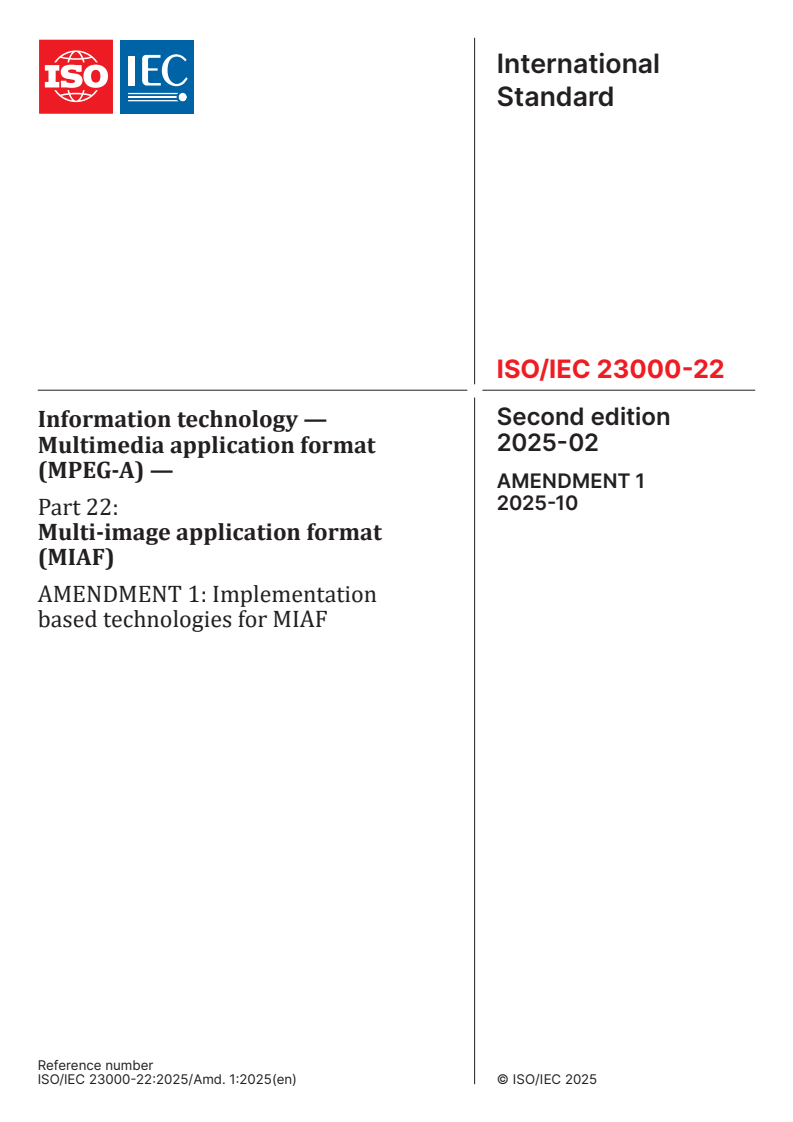

ISO/IEC 23000-22:2025/Amd 1:2025 - Information technology — Multimedia application format (MPEG-A) — Part 22: Multi-image application format (MIAF) — Amendment 1: Implementation based technologies for MIAF Released:10/20/2025
Overview
ISO/IEC 23000-22:2025/Amd 1:2025 is an International Standard Amendment under the ISO/IEC 23000 series, focusing on multimedia application formats (MPEG-A). Specifically, Part 22 addresses the Multi-image Application Format (MIAF), and this amendment introduces implementation-based technologies for MIAF. With advances in digital imaging, the demand for efficient management and presentation of multi-image files has grown. This standard supports improved interoperability and consistency across platforms dealing with multi-image content.
Key Topics
- MIAF Structure and Interoperability: Defines how multiple images and their derived items (such as tone-mapped images) should be organized within a single file for broad compatibility.
- Tone-Map Derived Images: Details the incorporation of tone-mapped images, including requirements for image transformations like rotation and mirroring to ensure uniformity.
- HDR-Signaling: Clarifies approaches for signaling High Dynamic Range (HDR) information in multi-image files.
- Implementation Practices: Provides real-world implementation insights, documenting decisions by software developers for sorting, looping, and grouping images.
Applications
The practical impact of ISO/IEC 23000-22:2025/Amd 1:2025 spans several domains:
- Photography and Consumer Electronics: Enables devices such as cameras and smartphones to package and deliver multi-image content, including HDR and tone-mapped variants, in a standardized format.
- Web Browsers and Digital Platforms: Ensures that browsers displaying HEIF (High-Efficiency Image File Format), a derivative technology, handle multi-image sequences consistently. Key scenarios include slideshow playback, looping behavior, and proper sequence rendering.
- Digital Asset Management: Simplifies workflows in cloud and enterprise systems dealing with large-scale image repositories, making retrieval and presentation predictable and efficient.
- Media Archives and Sharing: Facilitates consistent storage, retrieval, and sharing of complex image collections across software and services.
Practical Insights
Implementation Decisions and Common Behaviors:
Annex C and related sections outline collaborative outcomes from multiple software implementations:
- Looping in Image Sequences:
- Without explicit looping instructions, sequences play indefinitely.
- When EditListBox and RepeatEdits are specified, playback follows the defined repeat parameters.
- Image Sort Order:
- By default, images are surfaced in the order they appear in the file’s metadata structure, typically sorted by increasing item identification numbers.
- Grouping with 'altr':
- Image groups, represented by 'altr', are surfaced as singular entries based on the lowest item ID within the group, maintaining consistent display order across implementations.
These best practices facilitate enhanced device interoperability and user experience, reducing inconsistencies that can arise from proprietary methods.
Related Standards
- ISO/IEC 23000 Series: A comprehensive suite for multimedia application formats (MPEG-A).
- ISO/IEC 14496-12: Core standard for ISO base media file format (used by HEIF and MIAF), referenced for sequencing and playback.
- HEIF (High-Efficiency Image File Format): Closely related to MIAF, it benefits from the clarifications and added implementation guidelines introduced in this amendment.
- Other MPEG Standards: Incorporate various audio, video, and multimedia file formats for enhanced digital content delivery.
Conclusion
ISO/IEC 23000-22:2025/Amd 1:2025 provides vital updates and practical guidance for industry stakeholders developing or integrating MIAF-compatible solutions. By standardizing how multi-image applications are implemented-covering tone-mapping, HDR, sorting, and grouping-this amendment ensures seamless multimedia experiences across platforms and devices, adding efficiency and reliability to digital image handling. For organizations and developers working with advanced image formats or looking to maximize interoperability, compliance with this standard delivers significant value.
For further information or to obtain the full standard, visit ISO's official website.
Relations
- Effective Date
- 24-Aug-2024
Buy Documents
ISO/IEC 23000-22:2025/Amd 1:2025 - Information technology — Multimedia application format (MPEG-A) — Part 22: Multi-image application format (MIAF) — Amendment 1: Implementation based technologies for MIAF Released:10/20/2025
Get Certified
Connect with accredited certification bodies for this standard

BSI Group
BSI (British Standards Institution) is the business standards company that helps organizations make excellence a habit.

NYCE
Mexican standards and certification body.
Sponsored listings
Frequently Asked Questions
ISO/IEC 23000-22:2025/Amd 1:2025 is a standard published by the International Organization for Standardization (ISO). Its full title is "Information technology — Multimedia application format (MPEG-A) — Part 22: Multi-image application format (MIAF) — Amendment 1: Implementation based technologies for MIAF". This standard covers: Information technology — Multimedia application format (MPEG-A) — Part 22: Multi-image application format (MIAF) — Amendment 1: Implementation based technologies for MIAF
Information technology — Multimedia application format (MPEG-A) — Part 22: Multi-image application format (MIAF) — Amendment 1: Implementation based technologies for MIAF
ISO/IEC 23000-22:2025/Amd 1:2025 is classified under the following ICS (International Classification for Standards) categories: 35.040.40 - Coding of audio, video, multimedia and hypermedia information. The ICS classification helps identify the subject area and facilitates finding related standards.
ISO/IEC 23000-22:2025/Amd 1:2025 has the following relationships with other standards: It is inter standard links to ISO/IEC 23000-22:2025. Understanding these relationships helps ensure you are using the most current and applicable version of the standard.
ISO/IEC 23000-22:2025/Amd 1:2025 is available in PDF format for immediate download after purchase. The document can be added to your cart and obtained through the secure checkout process. Digital delivery ensures instant access to the complete standard document.
Standards Content (Sample)
International
Standard
ISO/IEC 23000-22
Second edition
Information technology —
2025-02
Multimedia application format
(MPEG-A) —
AMENDMENT 1
2025-10
Part 22:
Multi-image application format
(MIAF)
AMENDMENT 1: Implementation
based technologies for MIAF
Reference number
ISO/IEC 23000-22:2025/Amd. 1:2025(en) © ISO/IEC 2025
ISO/IEC 23000-22:2025/Amd. 1:2025(en)
© ISO/IEC 2025
All rights reserved. Unless otherwise specified, or required in the context of its implementation, no part of this publication may
be reproduced or utilized otherwise in any form or by any means, electronic or mechanical, including photocopying, or posting on
the internet or an intranet, without prior written permission. Permission can be requested from either ISO at the address below
or ISO’s member body in the country of the requester.
ISO copyright office
CP 401 • Ch. de Blandonnet 8
CH-1214 Vernier, Geneva
Phone: +41 22 749 01 11
Email: copyright@iso.org
Website: www.iso.org
Published in Switzerland
© ISO/IEC 2025 – All rights reserved
ii
ISO/IEC 23000-22:2025/Amd. 1:2025(en)
Foreword
ISO (the International Organization for Standardization) and IEC (the International Electrotechnical
Commission) form the specialized system for worldwide standardization. National bodies that are
members of ISO or IEC participate in the development of International Standards through technical
committees established by the respective organization to deal with particular fields of technical activity.
ISO and IEC technical committees collaborate in fields of mutual interest. Other international organizations,
governmental and non-governmental, in liaison with ISO and IEC, also take part in the work.
The procedures used to develop this document and those intended for its further maintenance are described
in the ISO/IEC Directives, Part 1. In particular, the different approval criteria needed for the different types
of document should be noted. This document was drafted in accordance with the editorial rules of the ISO/
IEC Directives, Part 2 (see www.iso.org/directives or www.iec.ch/members_experts/refdocs).
ISO and IEC draw attention to the possibility that the implementation of this document may involve the
use of (a) patent(s). ISO and IEC take no position concerning the evidence, validity or applicability of any
claimed patent rights in respect thereof. As of the date of publication of this document, ISO and IEC had not
received notice of (a) patent(s) which may be required to implement this document. However, implementers
are cautioned that this may not represent the latest information, which may be obtained from the patent
database available at www.iso.org/patents and https://patents.iec.ch. ISO and IEC shall not be held
responsible for identifying any or all such patent rights.
Any trade name used in this document is information given for the convenience of users and does not
constitute an endorsement.
For an explanation of the voluntary nature of standards, the meaning of ISO specific terms and expressions
related to conformity assessment, as well as information about ISO's adherence to the World Trade
Organization (WTO) principles in the Technical Barriers to Trade (TBT) see www.iso.org/iso/foreword.html.
In the IEC, see www.iec.ch/understanding-standards.
This document was prepared by Joint Technical Committee ISO/IEC JTC 1, Information technology,
Subcommittee SC 29, Coding of audio, picture, multimedia and hypermedia information.
A list of all parts in the ISO/IEC 23000 series can be found on the ISO and IEC websites.
Any feedback or questions on this document should be directed to the user’s national standards
body. A complete listing of these bodies can be found at www.iso.org/members.html and
www.iec.ch/national-committees.
© ISO/IEC 2025 – All rights reserved
iii
--------------------
...