

EN 14870-2:2004
(Main)Petroleum and natural gas industries - Induction bends, fittings and flanges for pipeline transportation systems - Part 2: Fittings (ISO 15590-2:2003 modified)
General Information
- Abstract
This part of prEN 14870 specifies the technical delivery conditions for unalloyed or low alloy steel seamless and welded pipeline fittings for use in pipeline transportation systems for the petroleum and natural gas industries as defined in ISO 13623.
This part of prEN 14870 is applicable to welding-end fittings such as elbows, caps, tees, single or multiple extruded headers, reducers, and transition sections made from seamless and welded pipe of unalloyed or low-alloy steels.
This part of prEN 14870 specifies three classes of fitting corresponding to increasing quality requirements in accordance with the technical delivery conditions of ISO 3183 for pipe as indicated in Table 1.
Table 1 - Fitting class and corresponding pipe standard
Fitting class Corresponding pipe standard
Class A ISO 3183-1
Class B ISO 3183-2
Class C ISO 3183-3
This part of prEN 14870 is not applicable to the selection of the fitting class.
This part of prEN 14870 is not applicable to the materials for, or the attachment of, factory-welded extensions.
On-land supply systems used by the gas supply industry are excluded from the scope of this standard.
- Status
- Published
- Publication Date
- 14-Dec-2004
- Withdrawal Date
- 29-Jun-2005
- Current Stage
- 6060 - Definitive text made available (DAV) - Publishing
- Start Date
- 15-Dec-2004
- Completion Date
- 15-Dec-2004

Overview
EN 14870-2:2004 is a European standard developed by CEN for the petroleum and natural gas industries, specifically addressing fittings for pipeline transportation systems. This standard, aligning with ISO 15590-2:2003 (modified), specifies technical delivery conditions for unalloyed or low-alloy seamless and welded steel pipeline fittings. These fittings are intended for use in pipelines as defined in ISO 13623 and EN 14161, covering essential components such as elbows, caps, tees, extruded headers, reducers, and transition sections.
The document details requirements for fittings manufactured from seamless and welded pipes, providing clear guidelines for material qualification, testing, and marking. It distinguishes three fitting classes corresponding to increasing quality levels, referencing the technical delivery conditions found in ISO 3183.
Key Topics
Scope and Applicability:
- Covers steel pipeline fittings for petroleum and natural gas pipeline systems
- Applies to welding-end fittings, including elbows, tees, caps, extruded headers, reducers, and transition pieces
- Excludes fittings for on-land gas supply systems and factory-welded extensions
Fitting Classes:
- Class A: Corresponds to ISO 3183-1
- Class B: Corresponds to ISO 3183-2
- Class C: Corresponds to ISO 3183-3
- Selection of fitting class is beyond the scope of the standard
Technical Requirements:
- Manufacturing covers forming, welding, and heat treatment procedures
- Designation system includes type, size, yield strength, and fitting class
- Pressure rating requirements ensure capability at least equal to matching pipe
- Marking and inspection regulations to ensure traceability and compliance
Testing and Inspection:
- Includes chemical composition analysis, mechanical testing, non-destructive testing (NDT), and dimensional checks
- Testing frequencies and methods are determined for each fitting class
- Documentation such as inspection reports and marking requirements are specified
Applications
EN 14870-2:2004 is pivotal in guaranteeing the performance and reliability of steel pipeline fittings used in critical oil and gas infrastructure. Practical applications include:
Pipeline Construction and Maintenance:
Ensures that components like elbows and tees meet industry requirements for strength, heat treatment, and weldability, reducing the risk of pipeline failure.Material Procurement:
Helps manufacturers, project managers, and procurement specialists specify reliable fittings based on well-defined classes, enhancing supply chain consistency.Quality Assurance and Compliance:
Assists inspection bodies and engineers in verifying that fittings conform to international standards, supporting project approvals and audits.Safety and Environmental Protection:
By defining rigorous testing, EN 14870-2:2004 supports the safe transportation of petroleum and natural gas, minimizing the potential for leaks or hazardous incidents.
Related Standards
- EN 14161 – Petroleum and natural gas industries - Pipeline transportation systems
- ISO 13623 – Petroleum and natural gas industries - Pipeline transportation systems
- ISO 3183 – Steel pipe for pipeline transportation systems
- ISO 15590-1 – Induction bends for pipelines
- EN ISO 15614-1 – Specification and qualification of welding procedures for metallic materials
- EN ISO 15156-2 – Materials for use in H₂S-containing environments in oil and gas production
- ASME B16.9 – Factory-made wrought buttwelding fittings
Key Benefits
- Harmonizes specifications for pipeline fittings across the European and global oil and gas industry
- Boosts operational integrity, safety, and reliability through clearly defined technical requirements
- Facilitates procurement, manufacturing, and inspection processes by aligning with respected international pipeline standards
By adopting EN 14870-2:2004, industry stakeholders support standardized quality and safer, more efficient pipeline systems in the petroleum and natural gas sector.
Relations
- Effective Date
- 25-Aug-2026
- Effective Date
- 25-Aug-2026
- Effective Date
- 25-Aug-2026
- Effective Date
- 25-Aug-2026
- Effective Date
- 25-Aug-2026
- Effective Date
- 25-Aug-2026
- Effective Date
- 25-Aug-2026
- Refers
ISO 12095:1994 - Seamless and welded steel tubes for pressure purposes — Liquid penetrant testing - Effective Date
- 25-Aug-2026
- Effective Date
- 25-Aug-2026
- Effective Date
- 25-Aug-2026
- Effective Date
- 25-Aug-2026
- Effective Date
- 25-Aug-2026
- Effective Date
- 25-Aug-2026
- Effective Date
- 09-Feb-2026
- Effective Date
- 09-Feb-2026
Get Certified
Connect with accredited certification bodies for this standard

Element Materials Technology
Materials testing and product certification.

ABS Group Brazil
ABS Group certification services in Brazil.

ABS Quality Evaluations Inc.
American Bureau of Shipping quality certification.
Sponsored listings
Frequently Asked Questions
EN 14870-2:2004 is a standard published by the European Committee for Standardization (CEN). Its full title is "Petroleum and natural gas industries - Induction bends, fittings and flanges for pipeline transportation systems - Part 2: Fittings (ISO 15590-2:2003 modified)". This standard covers: This part of prEN 14870 specifies the technical delivery conditions for unalloyed or low alloy steel seamless and welded pipeline fittings for use in pipeline transportation systems for the petroleum and natural gas industries as defined in ISO 13623. This part of prEN 14870 is applicable to welding-end fittings such as elbows, caps, tees, single or multiple extruded headers, reducers, and transition sections made from seamless and welded pipe of unalloyed or low-alloy steels. This part of prEN 14870 specifies three classes of fitting corresponding to increasing quality requirements in accordance with the technical delivery conditions of ISO 3183 for pipe as indicated in Table 1. Table 1 - Fitting class and corresponding pipe standard Fitting class Corresponding pipe standard Class A ISO 3183-1 Class B ISO 3183-2 Class C ISO 3183-3 This part of prEN 14870 is not applicable to the selection of the fitting class. This part of prEN 14870 is not applicable to the materials for, or the attachment of, factory-welded extensions. On-land supply systems used by the gas supply industry are excluded from the scope of this standard.
This part of prEN 14870 specifies the technical delivery conditions for unalloyed or low alloy steel seamless and welded pipeline fittings for use in pipeline transportation systems for the petroleum and natural gas industries as defined in ISO 13623. This part of prEN 14870 is applicable to welding-end fittings such as elbows, caps, tees, single or multiple extruded headers, reducers, and transition sections made from seamless and welded pipe of unalloyed or low-alloy steels. This part of prEN 14870 specifies three classes of fitting corresponding to increasing quality requirements in accordance with the technical delivery conditions of ISO 3183 for pipe as indicated in Table 1. Table 1 - Fitting class and corresponding pipe standard Fitting class Corresponding pipe standard Class A ISO 3183-1 Class B ISO 3183-2 Class C ISO 3183-3 This part of prEN 14870 is not applicable to the selection of the fitting class. This part of prEN 14870 is not applicable to the materials for, or the attachment of, factory-welded extensions. On-land supply systems used by the gas supply industry are excluded from the scope of this standard.
EN 14870-2:2004 is classified under the following ICS (International Classification for Standards) categories: 23.040.40 - Metal fittings; 75.200 - Petroleum products and natural gas handling equipment. The ICS classification helps identify the subject area and facilitates finding related standards.
EN 14870-2:2004 has the following relationships with other standards: It is inter standard links to ISO 783:1999, ISO/TR 7705:1991, ISO 3183-3:1999, ISO 3834-2:1994, ISO 148-3:1998, ISO 4885:1996, ISO 3183-2:1996, ISO 12095:1994, ISO 12096:1996, ISO 3183-1:1996, ISO 9712:1999, ISO 148-2:1998, ISO 13664:1997, ISO 6892:1998, ISO 11496:1993. Understanding these relationships helps ensure you are using the most current and applicable version of the standard.
EN 14870-2:2004 is available in PDF format for immediate download after purchase. The document can be added to your cart and obtained through the secure checkout process. Digital delivery ensures instant access to the complete standard document.
Standards Content (Sample)
2003-01.Slovenski inštitut za standardizacijo. Razmnoževanje celote ali delov tega standarda ni dovoljeno.Industrija za predelavo nafte in zemeljskega plina - Z indukcijo upognjena cevna kolena, fitingi in prirobnice za transportne cevovodne sisteme - 2. del: Fitingi (ISO 15590-2:2003, spremenjen)Erdöl- und Erdgasindustrie - Induktivbiegungen, Formstücke und Flansche für Transportleitungssysteme -Teil 2: Fittings (ISO 15590-2:2003 modifiziert)Industries du pétrole et du gaz naturel - Coudes d'induction, raccords et brides pour systemes de transport par conduites - Partie 2 : Raccords (ISO 15590-2:2003 modifiée)Petroleum and natural gas industries - Induction bends, fittings and flanges for pipeline transportation systems - Part 2: Fittings (ISO 15590-2:2003 modified)83.140.30Cevi, fitingi in ventili iz polimernih materialovPlastics pipes, fittings and valves75.200Petroleum products and natural gas handling equipmentICS:Ta slovenski standard je istoveten z:EN 14870-2:2004SIST EN 14870-2:2005en01-april-2005SIST EN 14870-2:2005SLOVENSKI
STANDARD
EUROPEAN STANDARDNORME EUROPÉENNEEUROPÄISCHE NORMEN 14870-2December 2004ICS 23.040.40; 75.200English versionPetroleum and natural gas industries - Induction bends, fittingsand flanges for pipeline transportation systems - Part 2: Fittings(ISO 15590-2:2003 modified)Industries du pétrole et du gaz naturel - Coudes d'induction,raccords et brides pour systèmes de transport parconduites - Partie 2 : Raccords (ISO 15590-2:2003modifiée)Erdöl- und Erdgasindustrie - Im Induktionsverfahrenhergestellte Rohrbögen, Fittings und Flansche fürRohrleitungstransportsysteme -Teil 2: Fittings (ISO 15590-2:2003 modifiziert)This European Standard was approved by CEN on 30 September 2004.CEN members are bound to comply with the CEN/CENELEC Internal Regulations which stipulate the conditions for giving this EuropeanStandard the status of a national standard without any alteration. Up-to-date lists and bibliographical references concerning such nationalstandards may be obtained on application to the Central Secretariat or to any CEN member.This European Standard exists in three official versions (English, French, German). A version in any other language made by translationunder the responsibility of a CEN member into its own language and notified to the Central Secretariat has the same status as the officialversions.CEN members are the national standards bodies of Austria, Belgium, Cyprus, Czech Republic, Denmark, Estonia, Finland, France,Germany, Greece, Hungary, Iceland, Ireland, Italy, Latvia, Lithuania, Luxembourg, Malta, Netherlands, Norway, Poland, Portugal, Slovakia,Slovenia, Spain, Sweden, Switzerland and United Kingdom.EUROPEAN COMMITTEE FOR STANDARDIZATIONCOMITÉ EUROPÉEN DE NORMALISATIONEUROPÄISCHES KOMITEE FÜR NORMUNGManagement Centre: rue de Stassart, 36
B-1050 Brussels© 2004 CENAll rights of exploitation in any form and by any means reservedworldwide for CEN national Members.Ref. No. EN 14870-2:2004: ESIST EN 14870-2:2005
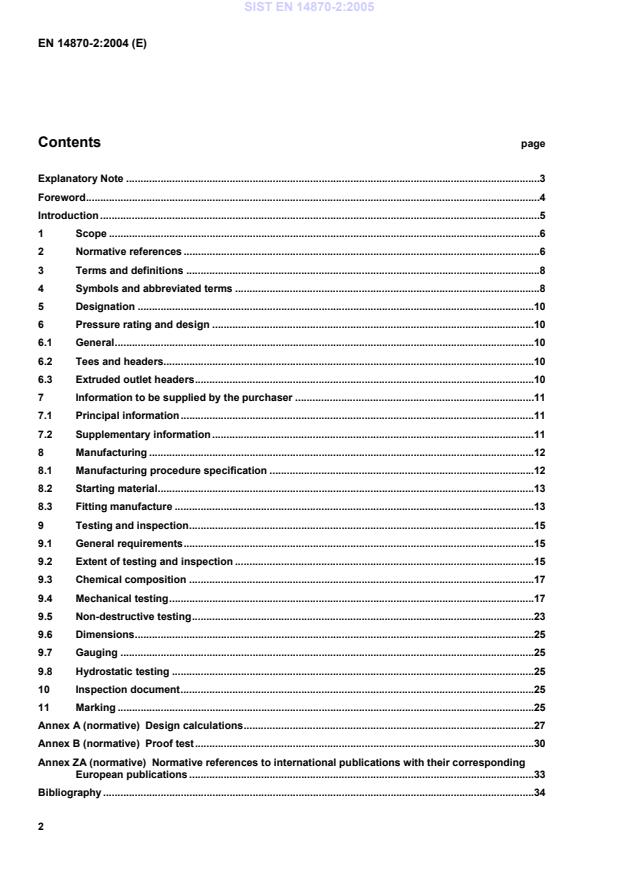
Design calculations.27 Annex B (normative)
Proof test.30 Annex ZA (normative)
Normative references to international publications with their corresponding European publications.33 Bibliography.34 SIST EN 14870-2:2005
EN 14870 consists of the following parts, under the general title Petroleum and natural gas industries — Induction bends, fittings and flanges for pipeline transportation systems: Part 1: Induction bends (ISO 15590-1:2001 modified) Part 2: Fittings (ISO 15590-2:2003 modified) The following part is under preparation: Part 3: Flanges
According to the CEN/CENELEC Internal Regulations, the national standards organizations of the following countries are bound to implement this European Standard: Austria, Belgium, Cyprus, Czech Republic, Denmark, Estonia, Finland, France, Germany, Greece, Hungary, Iceland, Ireland, Italy, Latvia, Lithuania, Luxembourg, Malta, Netherlands, Norway, Poland, Portugal, Slovakia, Slovenia, Spain, Sweden, Switzerland and United Kingdom. SIST EN 14870-2:2005
EN ISO 15156-2:2003, Petroleum, petrochemical and natural gas industries - Materials for use in H2S-containing environments in oil and gas production - Part 2: Cracking-resistant carbon and low alloy steels, and the use of cast irons (ISO 15156-2:2003). EN ISO 15614-1, Specification and qualification of welding procedures for metallic materials - Welding procedure test - Part 1: Arc and gas welding of steels and arc welding of nickel and nickel alloys (ISO 15614-1:2004). ISO 148, Steel — Charpy impact test (V-notch). ISO 148-2, Metallic materials — Charpy pendum impact text — Part 2:Verification of test machines. SIST EN 14870-2:2005
1) American Society of Mechanical Engineers, 345 East 47th Street, NY 10017-2392, USA. 2) American Society for Testing and Materials, 100 Bar Harbor Drive, West Conshohocken, PA 19428-2959, USA. 3) Manufacturers Standardization Society of the Valve & Fittings Industry, 127 Park Street, N.E., Vienna, Virginia 22180, USA. SIST EN 14870-2:2005
E factor used to calculate ti (see A.1) SIST EN 14870-2:2005
a) Internal offset
b) External offset SIST EN 14870-2:2005
c) Combination Key If the SMYSs of the sections to be joined are not equal, the minimum thickness, tD, shall be not less than t times the ratio of the SMYS of the pipe and fitting, but shall not exceed 1,5t. a There is no restriction on the minimum angle if the materials joined have equal SMYS. Figure 1 — Bevel designs for unequal wall thicknesses 9 Testing and inspection 9.1 General requirements Testing and inspection shall be carried out on fittings after final heat treatment. If the pipeline installation techniques will require post-weld heat treatment (PWHT) of the fitting, additional testing may be requested to demonstrate that the mechanical properties of the fitting are also achieved after PWHT. Details of the PWHT thermal cycle to be used during pipeline installation shall be specified. The test requirements and acceptance criteria shall be by agreement. Where the procedure requirements of 8.3.3 are not met, test pieces shall be taken from each heat treatment batch. 9.2 Extent of testing and inspection The testing and inspection to be performed during qualification and production shall be as summarized in Table 2 for each fitting class. Production testing shall be performed at the minimum frequency specified in Table 3. Test pieces for mechanical testing shall be taken from one or more of the following: exten
...