

EN 15528:2008+A1:2012
(Main + Amendment)Railway applications - Line categories for managing the interface between load limits of vehicles and infrastructure
General Information
- Abstract
This European Standard describes methods of classification of existing and new railway lines and the categorisation of vehicles. The standard specifies the technical requirements for ensuring the compatibility of the interface between vehicle and infrastructure. The standard is suitable for use on freight, passenger and mixed traffic lines and contains requirements relevant to:
- classification of the vertical load carrying capacity of railway infrastructure;
- design of railway vehicles;
- determination of payload limits of freight wagons.
A summary of the classification of infrastructure and categorisation of vehicles is given in Annex B.
The assessment of the vertical load carrying capacity of civil engineering structures, track, sub-grade and earthworks by the use of the load models defined in Annex A permits the classification of infrastructure into line categories.
This European Standard identifies on which lines vehicles are compatible to the infrastructure under normal operation conditions without further checks regarding vertical load effects.
The methodology described in this European Standard is not valid for high speed rail traffic. Tilting traffic and the working of rail mounted plant and cranes etc. are also outside the scope of this European Standard. This European Standard does not cover the system used in Great Britain, where all lines and vehicles are to be classified in accordance with the RA (Route Availability) System. A guide to the equivalent categories in accordance with this European Standard is given in Annex C.
This European Standard does not cover requirements relating to the maximum total mass or maximum length of a train.
The requirements of this European Standard do not replace regulations relating to e.g. dynamic wheel/rail contact force limits, vehicle ride considerations, vehicle structural design limitations, etc.
- Status
- Withdrawn
- Publication Date
- 30-Oct-2012
- Withdrawal Date
- 29-Sep-2026
- Technical Committee
- CEN/TC 256 - Railway applications
- Drafting Committee
- CEN/TC 256/WG 10 - Vehicle/Track Interaction
- Current Stage
- 9960 - Withdrawal effective - Withdrawal
- Start Date
- 28-Oct-2015
- Completion Date
- 30-Sep-2026
- Directive
- 2008/57/EC - DIRECTIVE 2008/57/EC OF THE EUROPEAN PARLIAMENT AND OF THE COUNCIL of 17 June 2008 on the interoperability of the rail system within the Community (Recast)OJ Ref: C, C 345 OJ Date: 26-Nov-2013

Relations
- Effective Date
- 01-Aug-2012
- Effective Date
- 11-Nov-2015
- Effective Date
- 28-Jan-2026
- Effective Date
- 28-Jan-2026
Get Certified
Connect with accredited certification bodies for this standard

IRIS Certification (UNIFE)
International Railway Industry Standard certification.

TÜV SÜD Rail GmbH
TÜV SÜD railway certification services.

Bureau Veritas Railway Certification
Railway and transportation certification.
Sponsored listings
Frequently Asked Questions
EN 15528:2008+A1:2012 is a standard published by the European Committee for Standardization (CEN). Its full title is "Railway applications - Line categories for managing the interface between load limits of vehicles and infrastructure". This standard covers: This European Standard describes methods of classification of existing and new railway lines and the categorisation of vehicles. The standard specifies the technical requirements for ensuring the compatibility of the interface between vehicle and infrastructure. The standard is suitable for use on freight, passenger and mixed traffic lines and contains requirements relevant to: - classification of the vertical load carrying capacity of railway infrastructure; - design of railway vehicles; - determination of payload limits of freight wagons. A summary of the classification of infrastructure and categorisation of vehicles is given in Annex B. The assessment of the vertical load carrying capacity of civil engineering structures, track, sub-grade and earthworks by the use of the load models defined in Annex A permits the classification of infrastructure into line categories. This European Standard identifies on which lines vehicles are compatible to the infrastructure under normal operation conditions without further checks regarding vertical load effects. The methodology described in this European Standard is not valid for high speed rail traffic. Tilting traffic and the working of rail mounted plant and cranes etc. are also outside the scope of this European Standard. This European Standard does not cover the system used in Great Britain, where all lines and vehicles are to be classified in accordance with the RA (Route Availability) System. A guide to the equivalent categories in accordance with this European Standard is given in Annex C. This European Standard does not cover requirements relating to the maximum total mass or maximum length of a train. The requirements of this European Standard do not replace regulations relating to e.g. dynamic wheel/rail contact force limits, vehicle ride considerations, vehicle structural design limitations, etc.
This European Standard describes methods of classification of existing and new railway lines and the categorisation of vehicles. The standard specifies the technical requirements for ensuring the compatibility of the interface between vehicle and infrastructure. The standard is suitable for use on freight, passenger and mixed traffic lines and contains requirements relevant to: - classification of the vertical load carrying capacity of railway infrastructure; - design of railway vehicles; - determination of payload limits of freight wagons. A summary of the classification of infrastructure and categorisation of vehicles is given in Annex B. The assessment of the vertical load carrying capacity of civil engineering structures, track, sub-grade and earthworks by the use of the load models defined in Annex A permits the classification of infrastructure into line categories. This European Standard identifies on which lines vehicles are compatible to the infrastructure under normal operation conditions without further checks regarding vertical load effects. The methodology described in this European Standard is not valid for high speed rail traffic. Tilting traffic and the working of rail mounted plant and cranes etc. are also outside the scope of this European Standard. This European Standard does not cover the system used in Great Britain, where all lines and vehicles are to be classified in accordance with the RA (Route Availability) System. A guide to the equivalent categories in accordance with this European Standard is given in Annex C. This European Standard does not cover requirements relating to the maximum total mass or maximum length of a train. The requirements of this European Standard do not replace regulations relating to e.g. dynamic wheel/rail contact force limits, vehicle ride considerations, vehicle structural design limitations, etc.
EN 15528:2008+A1:2012 is classified under the following ICS (International Classification for Standards) categories: 03.220.30 - Transport by rail; 45.060.20 - Trailing stock. The ICS classification helps identify the subject area and facilitates finding related standards.
EN 15528:2008+A1:2012 has the following relationships with other standards: It is inter standard links to EN 15528:2008, EN 15528:2015, EN 1991-2:2003, EN 15663:2017+A2:2024. Understanding these relationships helps ensure you are using the most current and applicable version of the standard.
EN 15528:2008+A1:2012 is associated with the following European legislation: EU Directives/Regulations: 2008/57/EC; Standardization Mandates: M/483, M/486. When a standard is cited in the Official Journal of the European Union, products manufactured in conformity with it benefit from a presumption of conformity with the essential requirements of the corresponding EU directive or regulation.
EN 15528:2008+A1:2012 is available in PDF format for immediate download after purchase. The document can be added to your cart and obtained through the secure checkout process. Digital delivery ensures instant access to the complete standard document.
Standards Content (Sample)
2003-01.Slovenski inštitut za standardizacijo. Razmnoževanje celote ali delov tega standarda ni dovoljeno.Železniške naprave - Kategorizacija prog za upravljanje vmesnika med dopustnimi obremenitvami vozil in infrastrukturoBahnanwendungen - Streckenklassen zur Bewerkstelligung der Schnittstelle zwischen Lastgrenzen der Fahrzeuge und InfrastrukturApplications ferroviaires - Catégories de ligne pour la gestion des interfaces entre limites de charges des véhicules et de l'infrastructureRailway applications - Line categories for managing the interface between load limits of vehicles and infrastructure45.060.20Železniški vagoniTrailing stock03.220.30Železniški transportTransport by railICS:Ta slovenski standard je istoveten z:EN 15528:2008+A1:2012SIST EN 15528:2008+A1:2014en,fr,de01-april-2014SIST EN 15528:2008+A1:2014SLOVENSKI
STANDARDSIST EN 15528:20081DGRPHãþD
EUROPEAN STANDARD NORME EUROPÉENNE EUROPÄISCHE NORM
EN 15528:2008+A1
October 2012 ICS 03.220.30; 45.060.20 Supersedes EN 15528:2008English Version
Railway applications - Line categories for managing the interface between load limits of vehicles and infrastructure
Applications ferroviaires - Catégories de ligne pour la gestion des interfaces entre limites de charges des véhicules et de l'infrastructure
Bahnanwendungen - Streckenklassen zur Bewerkstelligung der Schnittstelle zwischen Lastgrenzen der Fahrzeuge und Infrastruktur This European Standard was approved by CEN on 7 February 2008 and includes Amendment 1 approved by CEN on 20 August 2012.
CEN members are bound to comply with the CEN/CENELEC Internal Regulations which stipulate the conditions for giving this European Standard the status of a national standard without any alteration. Up-to-date lists and bibliographical references concerning such national standards may be obtained on application to the CEN-CENELEC Management Centre or to any CEN member.
This European Standard exists in three official versions (English, French, German). A version in any other language made by translation under the responsibility of a CEN member into its own language and notified to the CEN-CENELEC Management Centre has the same status as the official versions.
CEN members are the national standards bodies of Austria, Belgium, Bulgaria, Croatia, Cyprus, Czech Republic, Denmark, Estonia, Finland, Former Yugoslav Republic of Macedonia, France, Germany, Greece, Hungary, Iceland, Ireland, Italy, Latvia, Lithuania, Luxembourg, Malta, Netherlands, Norway, Poland, Portugal, Romania, Slovakia, Slovenia, Spain, Sweden, Switzerland, Turkey and United Kingdom.
EUROPEAN COMMITTEE FOR STANDARDIZATION
COMITÉ EUROPÉEN DE NORMALISATION EUROPÄISCHES KOMITEE FÜR NORMUNG
Management Centre:
Avenue Marnix 17,
B-1000 Brussels © 2012 CEN All rights of exploitation in any form and by any means reserved worldwide for CEN national Members. Ref. No. EN 15528:2008+A1:2012: ESIST EN 15528:2008+A1:2014
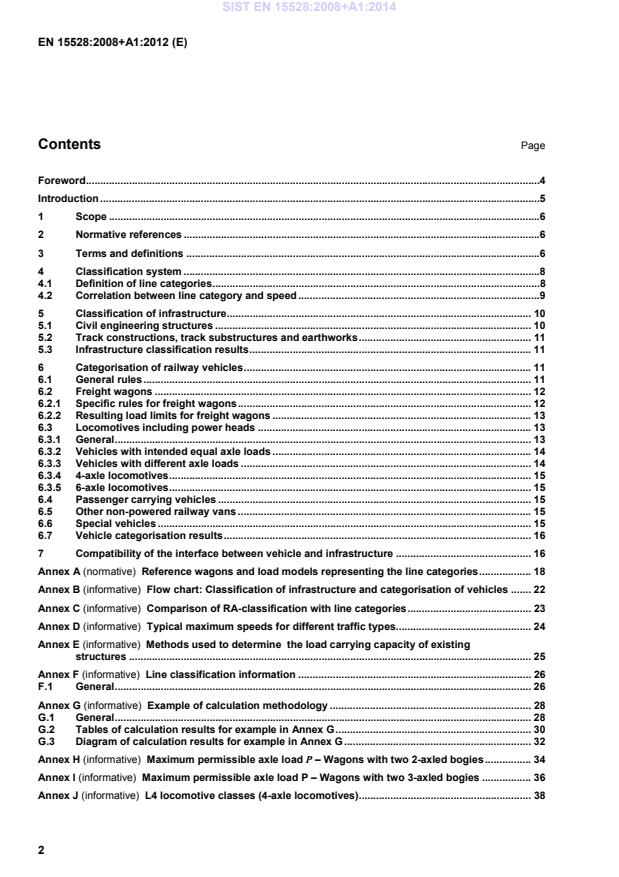
Reference wagons and load models representing the line categories . 18Annex B (informative)
Flow chart: Classification of infrastructure and categorisation of vehicles . 22Annex C (informative)
Comparison of RA-classification with line categories . 23Annex D (informative)
Typical maximum speeds for different traffic types. 24Annex E (informative)
Methods used to determine
the load carrying capacity of existing structures . 25Annex F (informative)
Line classification information . 26F.1 General . 26Annex G (informative)
Example of calculation methodology . 28G.1 General . 28G.2 Tables of calculation results for example in Annex G . 30G.3 Diagram of calculation results for example in Annex G . 32Annex H (informative)
Maximum permissible axle load P – Wagons with two 2-axled bogies . 34Annex I (informative)
Maximum permissible axle load P – Wagons with two 3-axled bogies . 36Annex J (informative)
L4 locomotive classes (4-axle locomotives) . 38SIST EN 15528:2008+A1:2014
L6 locomotive classes (6-axle locomotives) . 40Annex L (informative)
Example of correspondence between a national track classification system and line categories . 42Annex M (informative)
Weight note for locomotives . 44M.1 General . 44M.2 Example of a weight note for a series A locomotive . 45M.3 Example of a weight note for a series B locomotive . 46M.4 Example of a weight note for a series C locomotive . 47Annex ZA (informative)
!!!!Relationship between this European Standard and the Essential Requirements of EU Directive 2008/57/EC"""" . 48Bibliography . 51 SIST EN 15528:2008+A1:2014
!". !This document has been prepared under a mandate given to CEN/CENELEC/ETSI by the European Commission and the European Free Trade Association, and supports essential requirements of EU Directive 2008/57/EC. For relationship with EU Directive 2008/57/EC, see informative Annex ZA, which is an integral part of this document." According to the CEN/CENELEC Internal Regulations, the national standards organisations of the following countries are bound to implement this European Standard: Austria, Belgium, Bulgaria, Croatia, Cyprus, Czech Republic, Denmark, Estonia, Finland, Former Yugoslav Republic of Macedonia, France, Germany, Greece, Hungary, Iceland, Ireland, Italy, Latvia, Lithuania, Luxembourg, Malta, Netherlands, Norway, Poland, Portugal, Romania, Slovakia, Slovenia, Spain, Sweden, Switzerland, Turkey and the United Kingdom. SIST EN 15528:2008+A1:2014
3.6 axle load P sum of the static vertical wheel forces exerted on the track through a wheelset or a pair of independent wheels divided by acceleration of gravity 3.7 axle load Pi axle load P of the axle i 3.8 design mass mass of vehicle equipped with all the consumables and occupied by all staff which it requires in order to fulfil its function plus the exceptional payload defined according to prEN 15663 3.9 intended equal axle loads of a vehicle PieV
axle loads of a vehicle designed to be equal 3.10 mean axle load of a vehicle PmV average axle load of PieV
3.11 group of intended equal axle loads of a vehicle PieV
group of axle loads of axle i of a vehicle designed to be equal 3.12 mean axle load PmGV average axle load of PieV
3.13 mass per unit length p mass of a vehicle divided by length over buffers 3.14 length over buffers L length between coupling planes when coupled 3.15 axle spacing design values of the distances between the centres of adjacent axles SIST EN 15528:2008+A1:2014
4.2); existing operating and other restrictions relating to different types of traffic, etc. The method used to determine the load carrying capacity of structures (bridges and other structures supporting the track) shall take account of the condition of the structures and be in accordance with national requirements. NOTE 1 Examples of typical methods used to determine the load carrying capacity of structures are given in Annex E. The load models defined in Annex A are for the classification of lines and shall not be used for the design of new structures. For the design of new structures the rail traffic loading given in EN 1991-2 shall be used. The resulting output of the classification process of each structure on a line is the highest line classification related to an associated maximum speed in accordance with 4.2, subject to any additional limits in other regulations. The resulting output of the classification process for a section of the line is the minimum line classification related to an associated maximum speed taking into account each structure (see also 5.3). When determining the line classification and maximum operating speed for locomotives and other non passenger carrying power cars, account may be taken of the reduced likelihood of overloading and cargo displacement with locomotives. This may be taken into account when determining the line category for speeds of operation of locomotives higher than the line categories available for freight operation. The increased dynamic load effects from the higher speed of locomotive operation may be covered by activating additional load carrying capacity, if existing, or compensated for the use of an appropriate reduction in the partial safety factor for railway loading. NOTE 2 Additional information regarding locomotives with 4 axles and 6 axles to enable optimisation of locomotive speeds within the same line classification is given in Annex J and Annex K respectively. Any reduction in partial safety factors for railway loads is to be in accordance with national requirements. It may be necessary to specify additional operating restrictions relating to the number or position of locomotives in a train to limit associated traction forces, vertical load effects etc. To check the adequacy of the allowances for the dynamic increment of loading (in EN 1991-2:2003, Annex C) and to address the potential risk of adverse bridge dynamic effects resulting from resonance etc. between vehicles and infrastructure it is recommended that special studies should be considered for individual vehicles for proposed speeds in excess of: 100 km/h to establish an appropriate maximum speed of individual wagons with axle loads greater than 22,5 t; 120 km/h to establish an appropriate maximum speed of individual wagons with axle loads of up to 22,5 t; SIST EN 15528:2008+A1:2014
Examples of the results of line classification are given in Annex F. 6 Categorisation of railway vehicles 6.1 General rules The categorisation of a vehicle by line category or payload limit for a freight wagon defined by line category represents the static vertical load effects produced by the freight wagon or vehicle. The permissible line category or the permissible payload of vehicles shall be determined such that the maximum bending moments and shear forces on a single beam of any span length throughout the span for SIST EN 15528:2008+A1:2014
Table 1 — Maximum span increments depending on span length span range (m) maximum span increment (m) 1,0 to 10,0 0,2 10,0 to 20,0 1,0 20,0 to 60,0 2,0 60,0 to 100,0 5,0
NOTE
An example of the application of the method is given in Annex G. The vehicle mass shall be taken as the design mass under exceptional payload according to prEN 15663. When determining the maximum axle loads, measured axle loads shall be taken into account. Where any of the items specified in prEN 15663 are not included in the measured weights, adjustments shall be made. Re-evaluation of the payload-weight tables for freight wagons and a re-categorisation of other vehicles types shall be undertaken when the weight of a vehicle is increased or the distribution of axle loads changed. The measured vehicle weight for the modified vehicle shall be used to confirm the calculations. Changes in axle load of up to 100 kg from the original, whether as a result of technical alterations or a change in distribution between axles may be neglected for the purposes of vehicle categorisation. The ratio of the two wheel loads on each axle shall not exceed 10/8 = 1,25. However, the sum of both wheel loads shall not exceed the axle load relevant for line category. For locomotives additional requirements are given in 6.3. 6.2 Freight wagons 6.2.1 Specific rules for freight wagons The compatibility of freight wagons and their loads with the load capacity of lines can be determined by their geometrical and load characteristics, i.e. axle spacing, axle load and mass per unit length. The payload limit according to line category shall be determined according to 6.1. The maximum allowable payload and axle load for each type of wagon corresponding to each line category can be calculated as shown in Annex G. Alternatively, values for permissible axle loads for 4- and 6-axle wagons are given in Annex H and Annex I, which can be used to determine the maximum permitted payloads. The above payload limits are only valid if the permissible payload is evenly distributed over the length of the wagon. In the case of longitudinally displaced or unevenly distributed loading, the payload shall be reduced, so that the value of the permissible axle load is not exceeded.
As an exception 20 t axle loads may be exceeded by up to 0,5 t on Category C lines for: SIST EN 15528:2008+A1:2014
axle loads. In practice, the maximum permissible mass per wheel shall be 11,1 t. 6.2.2 Resulting load limits for freight wagons The results of the calculation of the maximum payload of a wagon for each line category determined according to 6.1 and 6.2.1 shall be recorded in a load limit table as shown in Annex G. Where lower load limits are required by specific regulations1) these lower values shall be used. Groups of wagons with the same equipment shall be identified within each major manufacturing series (e.g. wagons with air brakes, wagons with air brakes and gangway fitted with a screw brake). For each group of wagons, the average tare shall be determined and used in the calculations. Alternatively, the measured weight of an individual wagon can be used to determine the payload limit for the corresponding wagon. The tare of a wagon shall be calculated with new wheels and new brake block shoes, all removable equipment and the maximum liquid quantity (fuel, refrigerant etc.) rounded up to the nearest tenth of a tonne. The corresponding payload marked on the load limit table shall be rounded down to the nearest tenth of a tonne. 6.3 Locomotives including power heads 6.3.1 General Locomotives and power heads etc. characterised by carrying no passengers, mainly equipped with powered wheelsets, shall be categorised into line categories. The most onerous axle load distribution of each vehicle shall be determined by measurement and taken into account in the categorisation. When a vehicle is modified, its line category shall be re-evaluated. Geometrical characteristics with intended axle loads of the design mass shall be used for categorisation to determine the line category of a vehicle. The tolerances for the measured weights of vehicles shall be: individual weights of each locomotive in a series shall not exceed 3 % of the design mass, and maximum upper tolerance of the axle load is 5 % of the intended axle load, and load of the wheels measured on one side of the vehicle shall not differ by more than ± 4 % from the average of the measured wheel loads on both sides, and load difference between the right and the left wheel of each axle shall be within ± 5% from the measured axle load. The values of the intended design mass and intended axle loads shall be the same within a series of locomotives.
1) RID regulations (Annex I to Appendix B of the COTIF) of the RIV agreement (Appendix II, Loading guidelines). SIST EN 15528:2008+A1:2014
Figure 1 — Intended equal axle loads PieV of a vehicle The intended equal axle load of a vehicle PieV is the design mass divided by the number of axles. !deleted text" NOTE
For an example of a weight note used to assist with determining the axle loads used for categorising locomotives see Annex M. 6.3.3 Vehicles with different axle loads Vehicles with different axle loads consist either of: individual axles loads, or individual axles loads and a group or groups of Intended equal axles loads, or a group or groups of intended equal axles loads only. For vehicles with a group or different groups of intended equal axle loads PieV (see Figure 2) the mean axle load PmGV of each group shall be determined. The percentage of the intended equal axle load PieV related to the mean axle load PmGV of the group of axles shall be within the range of 2 %. The mean axle load of the group of intended equal axle loads of the vehicle, shown in Figure 2, is PmGV = (P1eV +P2eV)/2.
Figure 2 — Group of intended equal axle loads PieV of a vehicle When the measured axle loads exceed the permitted tolerances, the measured values are to be used in the calculation of the line category for the vehicle. SIST EN 15528:2008+A1:2014
To assist with optimising line categories for most 6-axle locomotives, locomotive classes L619, L620, L621 and L622 are defined in Annex K. !Table K.2" shows an example of L6 class locomotives used in a passenger train. 6.4 Passenger carrying vehicles Multiple unit sets, motor coaches, railcars and non-powered passenger coaches shall be categorised into line categories according to 6.1. Generally passenger coaches correspond to line category A, B1 or B2. In addition to the requirements of 6.1, multiple unit sets shall if relevant be considered as a group of fixed formation vehicles. The number of fixed formations to be taken into account shall be in accordance with the operational restrictions for the vehicles. 6.5 Other non-powered railway vans Postal vans, luggage vans, car ferrying vans and coaches for non-fare paying passengers (e.g. maintenance staff) and equipment may be considered as either a freight or passenger train. 6.6 Special vehicles In addition to the requirements of 6.1, special vehicles defined in CR TSI OPE e.g. railway cranes, maintenance machines, powered or non-powered, shall if relevant be considered as a group of fixed formation vehicles with associated match wagons, etc. SIST EN 15528:2008+A1:2014
a train of infinite number of fixed formation of vehicles (or single vehicles) as appropriate; Case 2: one single fixed formation or single vehicle as appropriate conveyed in a train of reference wagons (except reference wagons xL-a and xL-b) defined in Annex A corresponding to the line category determined from Case 1. The categorisation shall be taken as the most onerous of Case 1 and Case 2. Working conditions for these vehicles are outside the scope of this European Standard. 6.7 Vehicle categorisation results The result of the categorisation process is shown in Table 2. The vehicles are related to a payload limit, corresponding line category or locomotive class. Table 2 — Categorisation results Type of vehicles Result Freight wagons and other vehicles with relevant payload Payload limit Locomotives and power heads Line category or / and locomotive class Other powered and non-powered vehicles Line category
If vehicles or wagons and payloads cannot be categorised, being outside of the scope of the line categories defined in this standard or Clause 6, these vehicles shall be treated as individual vehicles. 7 Compatibility of the interface between vehicle and infrastructure If the category of a vehicle (or the payload limit of a wagon) is less than or equal to the classification of the line, compatibility has been demonstrated. Requirements related to speed also form part of this validation. The line categories are ranked by letter A < B < C < D < E and number 1 < 2 < 3 < 4 < 5. For example, D3, D2, C4, C3, C2 are all less than or equal to D4 (both letter and number shall be less than or equal) but also note C3 ≠ D2, D3 ≠ C4 and D4xL > D4, but D4xL ≠ E4, E5. When considering a train, the ruling case for the train shall be the vehicle with the most onerous categorisation with the maximum speed of the train limited to the most restrictive speed requirement. Freight traffic is compatible with the line if the line category corresponding to the payload of all wagons and line categories of the locomotive(s) do not exceed the line category of the line taking into account the associated maximum speed. Passenger traffic is compatible with the line if the line categories of locomotives and coaches do not exceed the line category of the line taking into account the associated maximum speed. If necessary, additional requirements (locomotive classes, single approval, etc.) shall be stated. Where compatibility using line categories can not be demonstrated, an individual line check, taking local procedures into account, shall be performed to demonstrate compatibility. SIST EN 15528:2008+A1:2014
Where a new or different vehicle or payload is proposed that will require an individual line check, early consultation with the infrastructure manager during the first stages of design of the vehicle and or the planning of operation is recommended. Possible results of individual line checks are: compatibility demonstrated; compatibility demonstrated subject to additional restrictions on operating speeds or loading, limitations on train formation, the use of barrier wagons, etc.; compatibility not demonstrated, vehicle or train operation refused.
2) Exceptional consignments are defined and listed in Clause 1 of UIC 502:2007. SIST EN 15528:2008+A1:2014
Reference wagons and load models representing the line categories Table A.1 — Reference wagons Reference wagon
Axle load
P (t) Mass per unit length
p (t/m) Geometrical characteristics A 16,0 5,0
B1 18,0 5,0 !" B2 18,0 6,4 !" C2 20,0 6,4
C3 20,0 7,2
C4 20,0 8,0
Axle load
P (t) Mass per unit length p (t/m) Geometrical characteristics D2 22,5 6,4
D3 22,5 7,2
D4 22,5 8,0
xL-a 20,0 8,0 xL-b 22.5 7,4
E4 25,0 8,0
E5 25,0 8,8
NOTE Additional reference wagons may be used to manage special traffic on specific lines (e.g. reference wagon F with axle load P equal to 27,5 t or G with axle load P equal to 30,0 t). SIST EN 15528:2008+A1:2014
B1
B2
C2
C3
C4
D2
D3
D4
The first character, a letter, characterise the limits for axle load and the second character, a number the limits for mass per unit length of the corresponding load model. The line categories are ranked by letter A < B < C < D < E and number 1 < 2 < 3 < 4 < 5. SIST EN 15528:2008+A1:2014
!E4 b" !E5 b"
a D4xL only valid for locomotives NOTE 1 D4xL may be used for other types of vehicles. b E4 and E5 only valid for freight wagons NOTE 2 D4xL > D4, but D
...