

prEN 15088
(Main)Aluminium and aluminium alloys - Structural products for construction works - Performance assessment and declaration
General Information
- Abstract
This document covers products made of aluminium and aluminium alloys intended to be used as structural elements in construction works, including its use in installations.
A product may be delivered in its final shape in coils or in one of the following forms:
— extruded rods, bars, tubes and profiles;
— cold-drawn rods and bars;
— precision profiles;
— sheets and strips including coil-coated sheets and strips;
— plates including tread plates;
— drawn tubes and wires;
— castings;
— forgings.
When delivered in coils, the characteristics are assessed on samples taken after de-coiling, straightening, cutting and bending according to the applicable factory production control procedure.
Procedures for assessment and verification of constancy of performance (AVCP) of characteristics of structural elements made of aluminium and aluminium alloys are specified in this document.
Products delivered in other forms, e.g. delivered after machining or joining operations such as bolting and welding, are excluded from the scope of this document.
- Status
- Not Published
- Publication Date
- 03-Mar-2026
- Technical Committee
- CEN/TC 132 - Aluminium and aluminium alloys
- Drafting Committee
- WG 31 - Terminology and general support
- Current Stage
- 4060 - Closure of enquiry - Enquiry
- Start Date
- 02-Jul-2026
- Due Date
- 05-May-2025
- Completion Date
- 02-Jul-2026

Overview
prEN 15088:2026 is a draft European standard developed by CEN for the assessment and declaration of performance for structural products made from aluminium and aluminium alloys used in construction works. This standard specifies requirements for products intended to serve as structural elements, including their performance assessment and factory production control (FPC). It applies to a broad range of product forms, such as extruded rods, bars, tubes, profiles, precision profiles, sheet, strip (including coil-coated), plates, tread plates, drawn tube/wire, castings, and forgings. Products delivered after machining or joining processes (e.g., welding or bolting) are excluded.
Key Topics
- Scope of Products: Includes various aluminium and aluminium alloy forms supplied for structural use in construction, either as finished coils or discrete components.
- Performance Characteristics:
- Ultimate tensile strength, 0.2% proof strength, and elongation after fracture.
- Reaction to fire (typically classified as Class A1 without further testing for uncoated aluminium).
- Reference service life under expected conditions.
- Environmental considerations, such as life cycle assessment (LCA), resource use, waste and output flows, and biogenic carbon content.
- Assessment and Verification of Constancy of Performance (AVCP):
- Lays out systematic procedures for determining and maintaining product performance.
- Utilizes appropriate testing, sampling, and evaluation methods.
- Requires comprehensive factory production control systems.
Applications
prEN 15088:2026 is highly relevant for stakeholders in the construction sector dealing with aluminium structural products, including:
- Manufacturers: Ensures that aluminium and aluminium alloy products meet standard mechanical and environmental requirements, allowing for CE marking and facilitating market access within Europe.
- Specifiers and Designers: Helps in selecting structurally compliant aluminium products for buildings, bridges, and installations, aligned with regulatory requirements.
- Contractors and Installers: Assists in compliance with legislated quality and sustainability obligations for public and private projects.
- Regulators and Quality Auditors: Provides a harmonized approach for verification and market surveillance of aluminium structural products.
- Sustainability Professionals: Supports environmental declarations and cradle-to-grave analysis of structural aluminium products used in green building projects.
Notably, the standard reinforces compliance with the EU Construction Products Regulation (CPR), including the assessment of environmental sustainability (e.g., through LCA and resource efficiency), thus supporting the European Green Deal objectives.
Related Standards
prEN 15088 references and complements several key European standards for aluminium and construction:
- EN 485 series: Aluminium and aluminium alloys - Sheet, strip and plate.
- EN 586-2: Aluminium and aluminium alloys - Forgings - Mechanical properties.
- EN 754 and EN 755 series: Cold drawn and extruded products - Mechanical properties and delivery conditions.
- EN 1301-2: Drawn wire - Mechanical properties.
- EN 1386 & EN 1396: Specifications for tread plate and coil-coated sheet/strip.
- EN 1706: Aluminium castings - Chemical and mechanical properties.
- EN 13501-1: Fire classification standard for construction products.
- EN 15804 & prEN 17662: Environmental product declarations and lifecycle assessment for construction products.
By referencing these standards, prEN 15088 ensures traceability, repeatability, and harmonization across Europe for structural aluminium products used in construction works.
Practical Value
Adoption of prEN 15088 improves consistency in product quality, structural safety, and environmental performance. By adhering to its requirements for performance assessment, documentation, and factory controls, organizations can demonstrate regulatory compliance, enhance product marketability through CE marking, and contribute to sustainable construction practices using aluminium and aluminium alloy structural products.
Relations
- Effective Date
- 20-Mar-2024
Get Certified
Connect with accredited certification bodies for this standard

Element Materials Technology
Materials testing and product certification.

Inštitut za kovinske materiale in tehnologije
Institute of Metals and Technology. Materials testing, metallurgical analysis, NDT.
Sponsored listings
Frequently Asked Questions
prEN 15088 is a draft published by the European Committee for Standardization (CEN). Its full title is "Aluminium and aluminium alloys - Structural products for construction works - Performance assessment and declaration". This standard covers: This document covers products made of aluminium and aluminium alloys intended to be used as structural elements in construction works, including its use in installations. A product may be delivered in its final shape in coils or in one of the following forms: — extruded rods, bars, tubes and profiles; — cold-drawn rods and bars; — precision profiles; — sheets and strips including coil-coated sheets and strips; — plates including tread plates; — drawn tubes and wires; — castings; — forgings. When delivered in coils, the characteristics are assessed on samples taken after de-coiling, straightening, cutting and bending according to the applicable factory production control procedure. Procedures for assessment and verification of constancy of performance (AVCP) of characteristics of structural elements made of aluminium and aluminium alloys are specified in this document. Products delivered in other forms, e.g. delivered after machining or joining operations such as bolting and welding, are excluded from the scope of this document.
This document covers products made of aluminium and aluminium alloys intended to be used as structural elements in construction works, including its use in installations. A product may be delivered in its final shape in coils or in one of the following forms: — extruded rods, bars, tubes and profiles; — cold-drawn rods and bars; — precision profiles; — sheets and strips including coil-coated sheets and strips; — plates including tread plates; — drawn tubes and wires; — castings; — forgings. When delivered in coils, the characteristics are assessed on samples taken after de-coiling, straightening, cutting and bending according to the applicable factory production control procedure. Procedures for assessment and verification of constancy of performance (AVCP) of characteristics of structural elements made of aluminium and aluminium alloys are specified in this document. Products delivered in other forms, e.g. delivered after machining or joining operations such as bolting and welding, are excluded from the scope of this document.
prEN 15088 is classified under the following ICS (International Classification for Standards) categories: 77.150.10 - Aluminium products. The ICS classification helps identify the subject area and facilitates finding related standards.
prEN 15088 has the following relationships with other standards: It is inter standard links to EN 15088:2005. Understanding these relationships helps ensure you are using the most current and applicable version of the standard.
prEN 15088 is associated with the following European legislation: EU Directives/Regulations: 305/2011; Standardization Mandates: M/120, M/616. When a standard is cited in the Official Journal of the European Union, products manufactured in conformity with it benefit from a presumption of conformity with the essential requirements of the corresponding EU directive or regulation.
prEN 15088 is available in PDF format for immediate download after purchase. The document can be added to your cart and obtained through the secure checkout process. Digital delivery ensures instant access to the complete standard document.
Standards Content (Sample)
SLOVENSKI STANDARD
01-junij-2026
Aluminij in aluminijeve zlitine - Gradbeni proizvodi za konstrukcijska dela - Ocena
in deklaracija lastnosti
Aluminium and aluminium alloys - Structural products for construction works -
Performance assessment and declaration
Aluminium und Aluminiumlegierungen - Erzeugnisse für Tragwerksanwendungen -
Technische Lieferbedingungen
Aluminium et alliages d'aluminium - Produits structurels pour les ouvrages de
construction - Évaluation et déclaration des performances
Ta slovenski standard je istoveten z: prEN 15088
ICS:
77.150.10 Aluminijski izdelki Aluminium products
2003-01.Slovenski inštitut za standardizacijo. Razmnoževanje celote ali delov tega standarda ni dovoljeno.
DRAFT
EUROPEAN STANDARD
NORME EUROPÉENNE
EUROPÄISCHE NORM
April 2026
ICS 77.150.10 Will supersede EN 15088:2005
English Version
Aluminium and aluminium alloys - Structural products for
construction works - Performance assessment and
declaration
Aluminium et alliages d'aluminium - Produits Aluminium und Aluminiumlegierungen - Erzeugnisse
structurels pour les ouvrages de construction - für Tragwerksanwendungen - Technische
Évaluation et déclaration des performances Lieferbedingungen
This draft European Standard is submitted to CEN members for enquiry. It has been drawn up by the Technical Committee
CEN/TC 132.
If this draft becomes a European Standard, CEN members are bound to comply with the CEN/CENELEC Internal Regulations
which stipulate the conditions for giving this European Standard the status of a national standard without any alteration.
This draft European Standard was established by CEN in three official versions (English, French, German). A version in any other
language made by translation under the responsibility of a CEN member into its own language and notified to the CEN-CENELEC
Management Centre has the same status as the official versions.
CEN members are the national standards bodies of Austria, Belgium, Bulgaria, Croatia, Cyprus, Czech Republic, Denmark, Estonia,
Finland, France, Germany, Greece, Hungary, Iceland, Ireland, Italy, Latvia, Lithuania, Luxembourg, Malta, Netherlands, Norway,
Poland, Portugal, Republic of North Macedonia, Romania, Serbia, Slovakia, Slovenia, Spain, Sweden, Switzerland, Türkiye and
United Kingdom.
Recipients of this draft are invited to submit, with their comments, notification of any relevant patent rights of which they are
aware and to provide supporting documentation.
Warning : This document is not a European Standard. It is distributed for review and comments. It is subject to change without
notice and shall not be referred to as a European Standard.
EUROPEAN COMMITTEE FOR STANDARDIZATION
COMITÉ EUROPÉEN DE NORMALISATION
EUROPÄISCHES KOMITEE FÜR NORMUNG
CEN-CENELEC Management Centre: Rue de la Science 23, B-1040 Brussels
© 2026 CEN All rights of exploitation in any form and by any means reserved Ref. No. prEN 15088:2026 E
worldwide for CEN national Members.
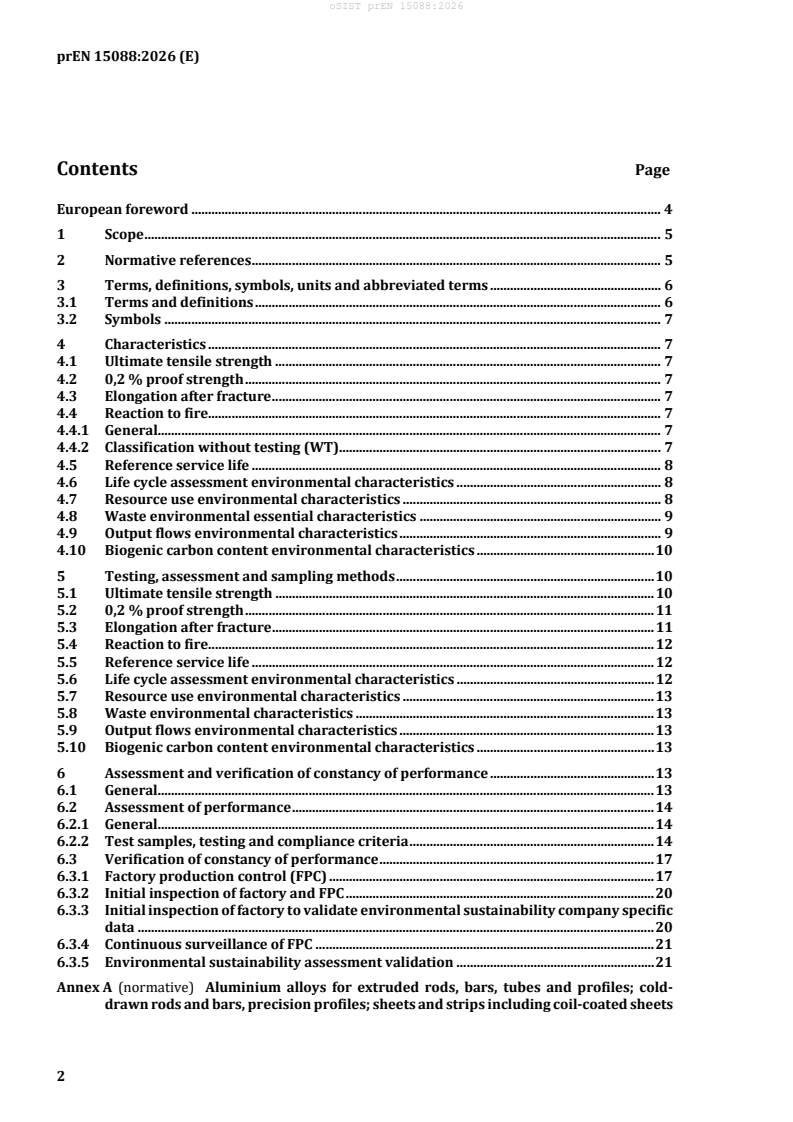
Contents Page
European foreword . 4
1 Scope . 5
2 Normative references . 5
3 Terms, definitions, symbols, units and abbreviated terms . 6
3.1 Terms and definitions . 6
3.2 Symbols . 7
4 Characteristics . 7
4.1 Ultimate tensile strength . 7
4.2 0,2 % proof strength . 7
4.3 Elongation after fracture . 7
4.4 Reaction to fire. 7
4.4.1 General. 7
4.4.2 Classification without testing (WT). 7
4.5 Reference service life . 8
4.6 Life cycle assessment environmental characteristics . 8
4.7 Resource use environmental characteristics . 8
4.8 Waste environmental essential characteristics . 9
4.9 Output flows environmental characteristics . 9
4.10 Biogenic carbon content environmental characteristics . 10
5 Testing, assessment and sampling methods . 10
5.1 Ultimate tensile strength . 10
5.2 0,2 % proof strength . 11
5.3 Elongation after fracture . 11
5.4 Reaction to fire. 12
5.5 Reference service life . 12
5.6 Life cycle assessment environmental characteristics . 12
5.7 Resource use environmental characteristics . 13
5.8 Waste environmental characteristics . 13
5.9 Output flows environmental characteristics . 13
5.10 Biogenic carbon content environmental characteristics . 13
6 Assessment and verification of constancy of performance . 13
6.1 General. 13
6.2 Assessment of performance . 14
6.2.1 General. 14
6.2.2 Test samples, testing and compliance criteria . 14
6.3 Verification of constancy of performance . 17
6.3.1 Factory production control (FPC) . 17
6.3.2 Initial inspection of factory and FPC . 20
6.3.3 Initial inspection of factory to validate environmental sustainability company specific
data . 20
6.3.4 Continuous surveillance of FPC . 21
6.3.5 Environmental sustainability assessment validation . 21
Annex A (normative) Aluminium alloys for extruded rods, bars, tubes and profiles; cold-
drawn rods and bars, precision profiles; sheets and strips including coil-coated sheets
and strips, even delivered in coils; plates including tread plates; drawn tubes and
wires; castings; and forgings products made of aluminium and aluminium alloys
intended to be used as structural elements in construction works, including its use in
installations . 22
A.1 Wrought aluminium alloys extruded rods, bars, tubes and profiles; cold-drawn rods
and bars, precision profiles; sheets and strips including coil-coated sheets and strips,
even delivered in coils; plates including tread plates; drawn tubes and wires; forgings
products made of aluminium and aluminium alloys intended to be used as structural
elements in construction works, including its use in installations . 22
A.2 Casting aluminium alloys for castings made of aluminium and aluminium alloys
intended to be used as structural elements in construction works, including its use in
installations . 23
A.3 Characteristic values of ultimate tensile strength (R ), 0,2 % proof strength (R ),
m p0,2
and elongation (A ) for sheet and strip for tempers with R ≥ 135 MPa and
50 p0,2
thickness between 0,5 mm and 6 mm . 24
Annex ZA (informative) Relationship of this European Standard with Regulation (EU)
No.305/2011 . 26
Bibliography . 32
European foreword
This document (prEN 15088:2026) has been prepared by Technical Committee CEN/TC 132 “Aluminium
and aluminium alloys”, the secretariat of which is held by AFNOR.
This document is currently submitted to the CEN Enquiry.
This document will supersede EN 15088:2005.
— adaptation to the Standardization Request for Structural Metallic Products in the framework of the
Construction Products Regulation (EU) No 305/2011;
— introduction of Reference Service Life as essential characteristic;
— introduction of environmental sustainability essential characteristics, assessments and related
Assessment and Verification of Constancy of Performance (AVCP) system 3+;
— added reference to forms of structural products made of aluminium and aluminium alloys (i.e.
extruded rods, bars, tubes and profiles; cold-drawn rods and bars; precision profiles; sheets and
strips including coil-coated sheets and strips; plates including tread plates; drawn tubes and wires;
castings and forgings);
— revision of normative references.
This document has been prepared under a standardization request addressed to CEN by the European
Commission. The Standing Committee of the EFTA States subsequently approves these requests for its
Member States.
For the relationship with EU Legislation, see informative Annex ZA, which is an integral part of this
document.
1 Scope
This document covers products made of aluminium and aluminium alloys intended to be used as
structural elements in construction works, including its use in installations.
A product can be delivered in its final shape in coils or in one of the following forms:
— extruded rods, bars, tubes and profiles;
— cold-drawn rods and bars;
— precision profiles;
— sheets and strips including coil-coated sheets and strips;
— plates including tread plates;
— drawn tubes and wires;
— castings;
— forgings.
When delivered in coils, the characteristics are assessed on samples taken after de-coiling, straightening,
cutting and bending according to the applicable factory production control procedure.
Procedures for assessment and verification of constancy of performance (AVCP) of characteristics of
structural elements made of aluminium and aluminium alloys are specified in this document.
Products delivered in other forms, e.g. delivered after machining or joining operations such as bolting
and welding, are excluded from the scope of this document.
2 Normative references
The following documents are referred to in the text in such a way that some or all of their content
constitutes requirements of this document. For dated references, only the edition cited applies. For
undated references, the latest edition of the referenced document (including any amendments) applies.
EN 485-1:2016, Aluminium and aluminium alloys — Sheet, strip and plate — Part 1: Technical conditions
for inspection and delivery
EN 485-2:2016+A1:2018, Aluminium and aluminium alloys — Sheet, strip and plate — Part 2: Mechanical
properties
EN 586-2:1994, Aluminium and aluminium alloys — Forgings — Part 2: Mechanical properties and
additional property requirements
EN 754-1:2016, Aluminium and aluminium alloys — Cold drawn rod/bar and tube — Part 1: Technical
conditions for inspection and delivery
EN 754-2:2024, Aluminium and aluminium alloys — Cold drawn rod/bar and tube — Part 2: Mechanical
properties
EN 755-1:2016, Aluminium and aluminium alloys — Extruded rod/bar, tube and profiles — Part 1:
Technical conditions for inspection and delivery
EN 755-2:2025, Aluminium and aluminium alloys — Extruded rod/bar, tube and profiles — Part 2:
Mechanical properties
EN 1301-2:2008, Aluminium and aluminium alloys — Drawn wire — Part 2: Mechanical properties
EN 1386:2007, Aluminium and aluminium alloys — Tread plate — Specifications
EN 1396:2023, Aluminium and aluminium alloys — Coil coated sheet and strip for general applications -
Specifications
EN 1706:2020+A1:2021, Aluminium and aluminium alloys — Castings — Chemical composition and
mechanical properties
EN 12258-1:2012, Aluminium and aluminium alloys — Terms and definitions — Part 1: General terms
EN 13501-1:2018, Fire classification of construction products and building elements — Part 1:
Classification using data from reaction to fire tests
EN 15804:2012+A2:2019, Sustainability of construction works — Environmental product declarations -
Core rules for the product category of construction products
prEN 17662:2025, Execution of steel structures and aluminium structures — Environmental Product
Declarations — Product category rules complementary to EN 15804 for Steel, Iron and Aluminium
structural products for use in construction works
3 Terms, definitions, symbols, units and abbreviated terms
For the purposes of this document, the following terms and definitions given in EN 12258-1:2012 and
the following apply.
ISO and IEC maintain terminology databases for use in standardization at the following addresses:
— ISO Online browsing platform: available at https://www.iso.org/obp/
— IEC Electropedia: available at https://www.electropedia.org/
3.1 Terms and definitions
3.1.1
aluminium structural element
any aluminium product which is placed on the market that could be transformed into a structural
component, to be used as load-bearing part of a work
3.1.2
aluminium product family
group of products of the same series of aluminium alloys, process (i.e.: extrusion, rolled, casting, forging)
and similar kind of temper that is produced by the same production line
EXAMPLE 1 For extrusion: EN AW 6060-T6 is in the same product family as EN AW 6082-T5.
EXAMPLE 2 For rolling: EN AW 5005-O is in the same product family as EN AW 5083-H24.
3.2 Symbols
A, A Elongation
50 mm
R Ultimate tensile strength
m
R 0,2 % proof strength
p0,2
N Number of cycles derived from test results
4 Characteristics
4.1 Ultimate tensile strength
The capacity of a product to withstand loads tending to elongate.
NOTE This characteristic is referenced as “tensile strength” (with symbol Rm) in standards like EN 755-2 or
EN 485-2.
When tested in accordance with the test method given in 5.1, results are expressed in MPa.
4.2 0,2 % proof strength
The stress at which a specific amount of plastic deformation is produced.
NOTE This characteristic is also referenced as “yield strength” (with symbol R ) in standards like EN 755-2
p0,2
or EN 485-2.
When tested in accordance with the test method given in 5.2, results are expressed in MPa.
4.3 Elongation after fracture
The amount of permanent elongation of the gauge length after fracture, expressed as a percentage of the
original gauge length.
NOTE This characteristic is referenced as “elongation A or A50 mm (minimum)” in standards like EN 755-2 or
EN 485-2.
When tested in accordance with the test method given in 5.3, results are expressed as %.
4.4 Reaction to fire
4.4.1 General
The reaction to fire indicates the degree of contribution of the material to the behaviour of the
construction product in the event of fire. When tested in accordance with the test methods given in 5.4,
relevant for the claimed class, the test results are expressed as a class according to EN 13501-1:2018.
4.4.2 Classification without testing (WT)
Whether products covered by this standard are made from one or more of the materials that have been
considered, under established conditions, as belonging to the category “No contribution to fire” because
of their low level of combustibility, the reaction to fire class A applies to these products without the need
of carrying out reaction to fire tests
4.5 Reference service life
The reference service life is the service life to be expected under a set of reference in-use conditions with
which the characteristics of the products are consistent. When assessed in accordance with the method
given in 5.5, the results are expressed as a value in years.
4.6 Life cycle assessment environmental characteristics
Characteristics in Table 1 are related to the life cycle assessment of the product. When assessed in
accordance with the method given in 5.6, the results are expressed as a value in the units included in
Table 1 for modules A1 to A3 and for each module and European harmonized scenario described in 5.6.
Table 1 — Life cycle assessment environmental characteristics
Characteristic Unit Dimensions
climate change – total kg CO2 eq. M
climate change – fossil kg CO2 eq. M
climate change – biogenic kg CO2 eq. M
climate change - land use and land use change kg CO2 eq. M
ozone depletion kg CFC 11 eq. M
Acidification mol H+ eq. N
eutrophication aquatic freshwater kg PO4 eq. M
eutrophication aquatic marine kg N eq. M
eutrophication terrestrial mol N eq. M
photochemical ozone formation kg NMVOC eq. M
depletion of abiotic resources - minerals and metals kg Sb eq. M
depletion of abiotic resources - fossil fuels MJ, net calorific ML2T-2
value
water use m3 world eq. L3
Deprived
particulate matter emissions Disease incidence -
ionising radiation, human health kBq U235 eq. S-1
ecotoxicity (freshwater) CTUe M-1
human toxicity, cancer effects CTUh M-1
human toxicity, non- cancer effects CTUh M-1
land use related impacts / soil quality Unitless -
4.7 Resource use environmental characteristics
Characteristics in Table 2 are related to the resource use over the life cycle of the product. When
assessed in accordance with the method given in 5.7, the results are expressed as a value in the units
included in Table 2 for modules A1 to A3 and for each module and European harmonized scenario
described in 5.7.
Table 2 — Resource use environmental characteristics
Characteristic Unit Dimensions
use of renewable primary energy excluding renewable MJ ML2T-2
primary energy resources used as raw materials
use of renewable primary energy resources used as raw MJ ML2T-2
materials
total use of renewable primary energy resources MJ ML2T-2
(primary energy and primary energy resources used as
raw materials)
use of non-renewable primary energy excluding non- MJ ML2T-2
renewable primary energy resources used as raw
materials
use of non-renewable primary energy resources used as MJ ML2T-2
raw materials
total use of non-renewable primary energy resources MJ ML2T-2
(primary energy and primary energy resources used as
raw materials)
use of secondary material Kg M
use of renewable secondary fuels MJ ML2T-2
use of non-renewable secondary fuels MJ ML2T-2
net use of fresh water m L3
4.8 Waste environmental essential characteristics
Characteristics in Table 3 are related to the waste produced over the life cycle of the product. When
assessed in accordance with the method given in 5.8, the results are expressed as a value in the units
included in Table 3 for modules A1 to A3 and for each module and European harmonized scenario
described in 5.8.
Table 3 — Waste environmental characteristics
Characteristic Unit Dimensions
hazardous waste disposed Kg M
non-hazardous waste disposed Kg M
radioactive waste disposed Kg M
4.9 Output flows environmental characteristics
Characteristics in Table 4 are related to the output flows over the life cycle of the product. When
assessed in accordance with the method given in 5.9, the results are expressed as a value in the units
included in Table 4 for modules A1 to A3 and for each module and European harmonized scenario
described in 5.9.
Table 4 — Output flows environmental characteristics
Characteristic Unit Dimensions
components for re-use Kg M
materials for recycling Kg M
materials for energy recovery Kg M
exported energy MJ ML2T-2
4.10 Biogenic carbon content environmental characteristics
Characteristics in Table 5 are related to the biogenic carbon content of the product. When assessed in
accordance with the method given in 5.10, the results are expressed as a value in the units included in
Table 5 for modules A1 to A3.
Table 5 — Biogenic carbon content environmental characteristics
Characteristic Unit Dimensions
biogenic carbon content in product kg C M
Biogenic carbon content in accompanying kg C M
packaging
5 Testing, assessment and sampling methods
5.1 Ultimate tensile strength
The ultimate tensile strength (R ) shall be provided in tabulated values according to documents
m
referenced in Table 6.
Table 6 — Ultimate tensile strength (UTS)
Product European Standard
Extruded rod/bar EN 755-2:2025
Extruded tube EN 755-2:2025
Extruded profile EN 755-2:2025
Precision profile EN 755-2:2025
Sheet / plate / strip EN 485-2:2016+A1:2018
Coil-coated sheet and strip EN 1396:2023
Tread plate EN 1386:2007
Cold-drawn rod / bar EN 754-2:2024
Drawn tube EN 754-2:2024
Drawn wire EN 1301-2:2008
Casting EN 1706:2020+A1:2021
Forging EN 586-2:1994
Characteristic values of ultimate tensile strength for specific aluminium alloys of thickness between
0,5 mm and 6 mm used as sheet and strip products for structural applications in tempers with 0,2 %
proof strength ≥ 135 MPa are specified at Table A.3.
5.2 0,2 % proof strength
The 0,2 % proof strength (R ) shall be provided in tabulated values according to documents referenced
p0,2
in Table 7.
Table 7 — 0,2% proof strength
Product European Standard
Extruded rod/bar EN 755-2:2025
Extruded tube EN 755-2:2025
Extruded profile EN 755-2:2025
Precision profile EN 755-2:2025
Sheet / plate / strip EN 485-2:2016+A1:2018
Coil-coated sheet and strip EN 1396:2023
Tread plate EN 1386:2007
Cold-drawn rod / bar EN 754-2:2024
Drawn tube EN 754-2:2024
Drawn wire EN 1301-2:2008
Casting EN 1706:2020+A1:2021
Forging EN 586-2:1994
Characteristic values of 0,2 % proof strength for specific aluminium alloys of thickness between 0,5 mm
and 6 mm used as sheet and strip products for structural applications in tempers with 0,2 % proof
strength ≥ 135 MPa are specified at Table A.3.
5.3 Elongation after fracture
The elongation after fracture (A, A ) shall be provided in tabulated values according to documents
50 mm
referenced in Table 8.
Table 8 — Elongation
Product European Standard
Extruded rod/bar EN 755-2:2025
Extruded tube EN 755-2:2025
Extruded profile EN 755-2:2025
Precision profile EN 755-2:2025
Sheet / plate / strip EN 485-2:2016+A1:2018
Coil-coated sheet and strip EN 1396:2023
Product European Standard
Tread plate EN 1386:2007
Cold-drawn rod / bar EN 754-2:2024
Drawn tube EN 754-2:2024
Drawn wire EN 1301-2:2008
Casting EN 1706:2020+A1:2021
Forging EN 586-2:1994
Characteristic values of elongation for specific aluminium alloys of thickness between 0,5 mm and 6 mm
used as sheet and strip products for structural applications in tempers with 0,2 % proof
strength ≥ 135 MPa are specified at Table A.3.
5.4 Reaction to fire
Reaction to fire of products made of aluminium and aluminium alloys is class A1 without testing in
accordance with Commission Decision 96/603/EC as amended by Commission Decision 2000/605/EC.
In the case of organic coated components, the product shall be tested and classified according to Table 1
of EN 13501-1:2018.
NOTE 1 Profiled sheeting products with a polyester coating having a maximum nominal thickness of 25 μm and
2 2
a gross heat of combustion (PCS) up to 1 MJ/m (included) and a mass ≤ 70 g/m are considered to satisfy the
requirements for reaction to fire performance Class A1 without further testing in accordance with the EU Decision
2010/737/EU.
NOTE 2 Profiled sheeting products with a plastisol coating having a maximum nominal thickness of 200 μm a
2 2
mass ≤ 300 g/m and a PCS up to 7 MJ/m (included) are considered to satisfy the requirements for reaction to fire
performance Class C-s3,d0 without further testing in accordance with the EU Decision 2010/737/EU.
5.5 Reference service life
For products off-the shelf, the reference service life shall be defined according to reference in- use
conditions as defined in prEN 17662:2025. The consistency with other characteristics related to the
product with an influence on it shall be considered.
For custom-made products, the reference service life shall be defined according to prEN 17662:2025
and/or this standard, considering the service life required in the project and the expected loads and
exposure scenarios. The consistency with other characteristics related to the product with an influence
on t shall be considered.
The result derived from the assessment will correspond to minimum value determined (in case of more
than one) rounded to the nearest integer.
The performance shall be expressed in dimensions T and in unit year.
5.6 Life cycle assessment environmental characteristics
Life cycle assessment environmental characteristics shall be assessed according to
EN 15804:2012+A2:2019 and prEN 17662:2025.
The results derived from the assessment will correspond to the results for each module and each
European harmonized scenario, as described in prEN 17662:2025.
The performance shall be expressed in the dimensions and units included in Table 1.
5.7 Resource use environmental characteristics
resource use environmental characteristics shall be assessed according to EN 15804:2012+A2:2019, and
prEN 17662:2025.
The results derived from the assessment will correspond to the results for each module and each
European harmonized scenario, as described in prEN 17662:2025.
The performance shall be expressed in the dimensions and units included in Table 2.
5.8 Waste environmental characteristics
waste environmental characteristics shall be assessed according to EN 15804:2012+A2:2019 and
EN 17662:2025.
The results derived from the assessment will correspond to the results for each module and each
European harmonized scenario, as described in prEN 17662:2025.
The performance shall be expressed in the dimensions and units included in Table 3.
5.9 Output flows environmental characteristics
The output flows environmental characteristics shall be assessed according to EN 15804:2012+A2:2019
and prEN 17662:2025.
The results derived from the assessment will correspond to the results for each module and each
European harmonized scenario, as described in prEN 17662:2025.
The performance shall be expressed in the dimensions and units included in Table 4.
5.10 Biogenic carbon content environmental characteristics
biogenic carbon content environmental characteristics shall be assessed according to
EN 15804:2012+A2:2019 and prEN 17662:2025.
In case the product is not made of materials containing biogenic carbon the value declared for the
characteristic biogenic carbon content in product shall be 0. The same approach shall be used for the
characteristic biogenic carbon content in accompanying packaging.
The results derived from the assessment will correspond to the results for modules A1 to A3 as described
in prEN 17662:2025.
The performance shall be expressed in the dimensions and units included in Table 5
6 Assessment and verification of constancy of performance
6.1 General
The technical details necessary for the implementation of the system of assessment and verification of
constancy of performance comprise provisions with regards to:
— the assessment of the performance of the construction product, which may be carried out on the
basis of testing (including sampling), calculation or descriptive documentation of the product; and
— the applicable factory production control.
6.2 Assessment of performance
6.2.1 General
When the intention is to declare any performance related to characteristics included in Annex ZA of this
standard this shall be carried out on the basis of testing (including sampling) or calculation or tabulated
values, in accordance with Clause 'Characteristics'.
Assessment previously performed in accordance with the provisions of this standard may be considered,
provided that this assessment was performed to the same or a more rigorous assessment method, under
the same AVCP system on the same product or products of similar design, construction and functionality,
such that the results are applicable to the product in question.
For the purposes of assessment, the products may be grouped into families, where it is considered that
the results for one or more characteristics from any one product within the family are representative for
that same characteristic for all products within that same family.
NOTE Products can be grouped into different families for different characteristics.
In addition, the determination of the product performance shall be
— carried out for all characteristics included in the standard for which it is intended to declare the
performance and for the attached documentation of the product:
— on first application of this standard, or
— at the beginning of the production of a new or product, unless a member of the same product family;
or
— at the beginning of a new or modified method of production, where the modification may affect the
stated properties;
— in case the list of characterization factors for the environmental assessment of products is revised.
— repeated for the characteristic(s) in question and for the attached documentation, whenever a
change occurs in the product design, in the raw material(s) or in the supplier of the components,
and/or in the method of production (subject to the definition of a family), which may affect
significantly the performance in relation to one or more of the characteristics or the attached
documentation;
— Where components are used whose performance in relation to their characteristics and attached
documentation has already been determined on the basis of assessment methods of other
harmonized technical specifications and those components bear CE marking in accordance with
those harmonized technical specifications, these performances and attached documentation do not
need to be re-assessed, if the intended use and the assessment methods of this standard correspond
to those used in relation to the components. The specifications of these components shall be
documented.
6.2.2 Test samples, testing and compliance criteria
The samples of the product to be tested/assessed shall be in accordance with Table 9.
Table 9 — Number of samples to be tested and assessment criteria
Characteristic Assessment
Clause No. of samples method and
criteria
a
Ultimate tensile strength 4.1 1 5.1
a
0,2% proof strength 4.2 1 5.2
a
Elongation after fracture 4.3 1 5.3
b
Reaction to fire 4.4 1 5.4
Reference service life 4.5 0 5.5
climate change – total 4.6 0 5.6
climate change – fossil 4.6 0 5.6
climate change – biogenic 4.6 0 5.6
climate change - land use and 4.6 0 5.6
land use change
ozone depletion 4.6 0 5.6
Acidification 4.6 0 5.6
eutrophication aquatic 4.6 0 5.6
freshwater
eutrophication aquatic marine 4.6 0 5.6
eutrophication terrestrial 4.6 0 5.6
photochemical ozone formation 4.6 0 5.6
depletion of abiotic resources - 4.6 0 5.6
minerals and metals
depletion of abiotic resources - 4.6 0 5.6
fossil fuels
water use 4.6 0 5.6
particulate matter emissions 4.6 0 5.6
ionising radiation, human 4.6 0 5.6
health 4.6 0 5.6
ecotoxicity (freshwater) 4.6 0 5.6
human toxicity, cancer effects 4.6 0 5.6
human toxicity, non- cancer 4.6 0 5.6
effects
land use related impacts / soil 4.6 0 5.6
quality
Characteristic Assessment
Clause No. of samples method and
criteria
use of renewable primary 4.7 0 5.7
energy excluding renewable
primary energy resources used
as raw materials
use of renewable primary 4.7 0 5.7
energy resources used as raw
materials
total use of renewable primary 4.7 0 5.7
energy resources (primary
energy and primary energy
resources used as raw
materials)
use of non-renewable primary 4.7 0 5.7
energy excluding non-
renewable primary energy
resources used as raw materials
use of non-renewable primary 4.7 0 5.7
energy resources used as raw
materials
total use of non-renewable 4.7 0 5.7
primary energy resources
(primary energy and primary
energy resources used as raw
materials)
use of secondary material 4.7 0 5.7
use of renewable secondary 4.7 0 5.7
fuels
use of non-renewable secondary 4.7 0 5.7
fuels
net use of fresh water 4.7 0 5.7
hazardous waste disposed 4.8 0 5.8
non-hazardous waste disposed 4.8 0 5.8
radioactive waste disposed 4.8 0 5.8
components for re-use 4.9 0 5.9
materials for recycling 4.9 0 5.9
materials for energy recovery 4.9 0 5.9
exported energy 4.9 0 5.9
biogenic carbon content in 4.10 0 5.10
product
Characteristic Assessment
Clause No. of samples method and
criteria
biogenic carbon content in 4.10 0 5.10
accompanying packaging
a
1 is the minimum number of samples to be tested/assessed.
For rods, bars, tubes and profiles, the number of samples shall be as specified in
EN 755-1:2016.
For cold drawn rod/bar and tubes, the number of samples shall be as specified in
EN 754-1:2016.
For sheets, strips and plates, the number of samples shall be as specified in EN 485-1:2016.
For castings, at least 1 test/assessment per lot of production shall be performed.
b
When reaction to fire Class A1 applies (see 4.4 and 5.4 of this standard), no sample of the
product shall be tested/assessed.
6.3 Verification of constancy of performance
6.3.1 Factory production control (FPC)
6.3.1.1 General
An FPC system shall be established, documented, operated, and maintained to ensure that the products
placed on the market comply with the declared performance in relation to the essential characteristics.
The FPC system shall consist of procedures, regular inspections, and tests and/or assessments and the
use of the results to control raw and other incoming materials or components, equipment, the production
process, and the product.
All the elements and provisions shall be documented in a systematic manner in the form of written
policies and procedures.
The responsibility, authority and the relationship between personnel that manages, performs, or verifies
work affecting constancy of the performance of the product, shall be defined.
The qualification and competence (e.g. on the basis of education, training, skills, or experience) of
personnel performing tasks affecting the assessment and verification of constancy of performance of the
product shall be recorded.
Documents defining the FPC system shall be drawn up and kept up to date. Documentation and
procedures should be appropriate to the product and production process. The FPC system should achieve
an appropriate level of confidence in the constancy of performance of the product. This involves:
a) the preparation of documented procedures and instructions relating to factory production control
operations, in accordance with the technical specification to which reference is made;
b) the effective implementation of these procedures and instructions;
c) the recording of these operations and their results;
d) the use of these results to correct any deviations, correct the effects of such deviations, treat any
resulting instances of non-constancy and, if necessary, revise the FPC system to rectify the cause of
non-constancy of performance.
6.3.1.2 Equipment
6.3.1.2.1 Testing
All weighing, measuring, and testing equipment shall be checked, calibrated and regularly inspected
according to documented procedures, frequencies and criteria.
6.3.1.2.2 Production
All equipment used in the production process shall be regularly inspected and maintained to ensure use,
wear or failure does not cause inconsistency in the production process. Inspections and maintenance
shall be carried out and recorded in accordance with written procedures and the records retained for the
period defined in the FPC procedures.
It shall be verified that the product maintains the declared performances also after de-coiling,
straightening, cutting and bending.
6.3.1.3 Raw materials and components
As per the FPC checks related to chemical composition, the following shall be checked:
— verification of the chemical composition of the product according to the specifications of the
manufacturer;
— verification of the consistency of the chemical composition with the relevant information provided
as regards welding of the material.
As per the FPC checks related to de-coiling, the following shall be checked:
— verification that the products maintain the declared performances after de-coiling, straightening,
cutting and bending.
As per the FPC checks related to the release of dangerous substances of the coating, the following shall
be checked:
— temporary protective measures;
— corrosion prevention coatings;
— fire performance coatings;
— coatings for other purposes.
As per the FPC checks related to the fire characteristics of the coating, the following shall be checked:
— density or weight applied / quantity per unit area;
— organic content of the coating;
— flame retardant content of the coating;
— verification of the fire performance of the coated product.
6.3.1.4 Traceability and marking
Individual products, product batches or packages shall be identifiable and traceable with regard to their
place of their production.
Written procedures ensuring that processes related to affixing traceability codes and/or markings are
inspected regularly shall be maintained.
6.3.1.5 Product assessment and evaluation
Procedures to ensure that the performance in relation to the declared characteristics are maintained shall
be established. The characteristics, and the means of control, shall be as in Table 10.
Table 10 — Factory production control
Characteristic Clause Assessment Validation Recommended Recommended
method criteria minimum minimum
number of frequency of
samples control
Ultimate 4.1 5.1 Declared For each
a
tensile value 1 production lot
strength
4.2 5.2 Declared For each
0,2 % proof
a
value production lot
strength
Declared
Elongation For each
a
4.3 5.3 1
value
after fracture production lot
Class
Reaction to For each
b
4.4 5.4 1
fire production lot
a
1 is the minimum number of samples to be tested/assessed.
For rods, bars, tubes and profiles, the number of samples shall be as specified in EN 755-1:2016.
For cold drawn rod/bar and tubes, the number of samples shall be as specified in EN 754-1:2016.
For sheets, strips and plates, the number of samples shall be as specified in EN 485-1:2016.
For castings, at least 1 test/assessment per lot of production shall be performed.
b
When reaction to fire Class A1 apply (see 4.4 and 5.4 of this document), no sample of the product shall be
tested/assessed.
Evaluation of documentation attached to the declaration of performance Procedures to ensure that the
attached documentation provided is maintained shall be established including, when applicable:
— set of drawings (including nominal dimensions and tolerances, shapes, drawings);
— description of the materials used with reference to the alloy and alloy temper/condition (e.g. number
of alloy, form of product as specified in Annex A);
— calculations when forming a basis for the declaration including structural behaviour, fatigue
resistance, earthquake resistance, explosion resistance, weldability;
— durability under exceptional atmospheric conditions or demanding use, e.g. information about
protecting measures applied to the product, including coatings;
— exposure scenarios for durability;
— de-coiling process applied before testing (information about the de-coiling, straightening, cutting,
and bending process controls).
6.3.2 Initial inspection of factory and FPC
6.3.2.1
...