

prEN 16759
(Main)Bonded Glazing for doors, windows and curtain walling - Verification of mechanical performance of bonding on aluminium and steel surfaces
General Information
- Abstract
This European Standard specifies the method to be used to verify the mechanical performance of the bonded glazing for doors, windows and curtain walling (see examples in Annex A) and its durability. The bonding covered is only that between the glass and the metal surface.
NOTE 1 Bonded glazing was formerly known as structural sealant glazing SSGS.
This European Standard covers bonded glazing incorporated into the product construction works as follows:
- either vertically; or
- up to 83° from the vertical (positive slope); or
- up to 15° from the vertical onto the building face (negative slope).
NOTE 2 A wall has a positive slope if its outer surface faces upwards.
NOTE 3 Specific additional safety provisions may apply nationally.
It gives information to the manufacturer to comply with requirements regarding design, factory production control and assembly rules.
The parts concerned in the testing are the metal surface (anodized and coated aluminium, stainless steel), the glass coated or not which shall be bonded, the bonding sealant and mechanical restraints when required.
This standard does not apply to:
- other surfaces materials;
- direct glazing;
- glass-to-glass bonding and edge seal of insulating glass units (which are covered by EN 13022 1 and EN 1279 5);
- adhesive tapes.
- Status
- Not Published
- Publication Date
- 25-Nov-2018
- Withdrawal Date
- 26-May-2019
- Technical Committee
- CEN/TC 33 - Doors, windows, shutters and building hardware
- Drafting Committee
- CEN/TC 33/WG 6 - Curtain walling
- Current Stage
- 4098 - Decision to abandon - Enquiry
- Start Date
- 20-Dec-2018
- Completion Date
- 30-Sep-2026

Overview
prEN 16759 (CEN) defines the method to verify the mechanical performance and durability of bonded glazing (formerly known as Structural Sealant Glazing Systems, SSGS) where the bond is between glass and metal surfaces. The standard applies to bonded glazing for doors, windows and curtain walling with glazing installed vertically, up to a positive slope of 83° from vertical, or up to 15° negative slope onto the building face. It gives manufacturers guidance on design, factory production control (FPC) and assembly rules for bonded glazing on aluminium (anodized and coated) and stainless steel substrates.
Key topics and requirements
- Scope and exclusions: Covers glass-to-metal bonding only. Does not apply to other framing materials, direct glazing, glass-to-glass bonding, insulating glass edge seals (EN 13022-1 / EN 1279-5), or adhesive tapes.
- Components under test: Metal adhesion surfaces (anodised/coated aluminium, stainless steel), glass (coated or uncoated), structural sealant, and mechanical restraints when required.
- Mechanical performance verification: Specifies test methods and criteria to assess bond strength, retaining devices and self-weight support, plus durability through ageing tests.
- Surface and coating controls: Requirements for recording aluminium alloy composition, anodising characteristics (thickness and sealing), and coating inspection. Accepted measurement methods referenced include ISO 2360, ISO 2128, ISO 1463, ISO 2106 for thickness and ISO 2143, ISO 3210, ISO 2931 for sealing assessment.
- Design and FPC information: Information required for manufacturer documentation to demonstrate compliance with design resistance, production checks and assembly procedures.
- Annexes: Normative annexes define principles of SSGS, setting block material, testing protocols for coated aluminium and stainless steel, and verification rules for profiles with thermal barriers.
Applications and users
prEN 16759 is intended for:
- Façade and curtain walling manufacturers
- Window and door system suppliers
- Façade engineers, structural designers and architects specifying bonded glazing
- Test laboratories and certification bodies performing bond and durability testing
- Installers and quality managers implementing factory production control and assembly rules
Practical uses include qualifying structural sealant glazing systems for building envelopes, validating material combinations (glass + metal + sealant), and ensuring long-term performance under gravity, wind and environmental ageing.
Related standards
- EN 13022-1 / EN 13022-2 (Structural sealant glazing - glass & assembly rules)
- EN 15434 (Product standard for structural sealant)
- EN 1279-1 (Insulating glass units)
- EN 13830 (Curtain walling) and EN 14351-1 (Windows & doors)
- EN 14024 (Metal profiles with thermal barrier)
- EN 15651 series (Sealants), plus ISO standards for anodising and coating measurement
Keywords: bonded glazing, structural sealant glazing, SSGS, mechanical performance, anodised aluminium, coated aluminium, stainless steel, curtain walling, windows, doors, durability testing, factory production control.
Get Certified
Connect with accredited certification bodies for this standard

DIBt (Deutsches Institut für Bautechnik)
German Institute for Building Technology.
DIN CERTCO
DIN Group product certification.

Aboma Certification B.V.
Specialized in construction, metal, and transport sectors.
Sponsored listings
Frequently Asked Questions
prEN 16759 is a draft published by the European Committee for Standardization (CEN). Its full title is "Bonded Glazing for doors, windows and curtain walling - Verification of mechanical performance of bonding on aluminium and steel surfaces". This standard covers: This European Standard specifies the method to be used to verify the mechanical performance of the bonded glazing for doors, windows and curtain walling (see examples in Annex A) and its durability. The bonding covered is only that between the glass and the metal surface. NOTE 1 Bonded glazing was formerly known as structural sealant glazing SSGS. This European Standard covers bonded glazing incorporated into the product construction works as follows: - either vertically; or - up to 83° from the vertical (positive slope); or - up to 15° from the vertical onto the building face (negative slope). NOTE 2 A wall has a positive slope if its outer surface faces upwards. NOTE 3 Specific additional safety provisions may apply nationally. It gives information to the manufacturer to comply with requirements regarding design, factory production control and assembly rules. The parts concerned in the testing are the metal surface (anodized and coated aluminium, stainless steel), the glass coated or not which shall be bonded, the bonding sealant and mechanical restraints when required. This standard does not apply to: - other surfaces materials; - direct glazing; - glass-to-glass bonding and edge seal of insulating glass units (which are covered by EN 13022 1 and EN 1279 5); - adhesive tapes.
This European Standard specifies the method to be used to verify the mechanical performance of the bonded glazing for doors, windows and curtain walling (see examples in Annex A) and its durability. The bonding covered is only that between the glass and the metal surface. NOTE 1 Bonded glazing was formerly known as structural sealant glazing SSGS. This European Standard covers bonded glazing incorporated into the product construction works as follows: - either vertically; or - up to 83° from the vertical (positive slope); or - up to 15° from the vertical onto the building face (negative slope). NOTE 2 A wall has a positive slope if its outer surface faces upwards. NOTE 3 Specific additional safety provisions may apply nationally. It gives information to the manufacturer to comply with requirements regarding design, factory production control and assembly rules. The parts concerned in the testing are the metal surface (anodized and coated aluminium, stainless steel), the glass coated or not which shall be bonded, the bonding sealant and mechanical restraints when required. This standard does not apply to: - other surfaces materials; - direct glazing; - glass-to-glass bonding and edge seal of insulating glass units (which are covered by EN 13022 1 and EN 1279 5); - adhesive tapes.
prEN 16759 is classified under the following ICS (International Classification for Standards) categories: 81.040.20 - Glass in building; 91.060.10 - Walls. Partitions. Facades; 91.060.50 - Doors and windows. The ICS classification helps identify the subject area and facilitates finding related standards.
prEN 16759 is associated with the following European legislation: EU Directives/Regulations: 305/2011. When a standard is cited in the Official Journal of the European Union, products manufactured in conformity with it benefit from a presumption of conformity with the essential requirements of the corresponding EU directive or regulation.
prEN 16759 is available in PDF format for immediate download after purchase. The document can be added to your cart and obtained through the secure checkout process. Digital delivery ensures instant access to the complete standard document.
Standards Content (Sample)
SLOVENSKI STANDARD
oSIST prEN 16759:2014
01-september-2014
Sistemi strukturne zasteklitve (SSGS)
Structural Sealant Glazing Systems (SSGS)
Geklebte Glaskonstruktionen (SSGS)
Vitrages extérieurs collés (VEC)
Ta slovenski standard je istoveten z: prEN 16759
ICS:
81.040.20 Steklo v gradbeništvu Glass in building
91.060.10 Stene. Predelne stene. Walls. Partitions. Facades
Fasade
91.060.50 Vrata in okna Doors and windows
oSIST prEN 16759:2014 en,fr,de
2003-01.Slovenski inštitut za standardizacijo. Razmnoževanje celote ali delov tega standarda ni dovoljeno.
oSIST prEN 16759:2014
oSIST prEN 16759:2014
EUROPEAN STANDARD
DRAFT
NORME EUROPÉENNE
EUROPÄISCHE NORM
June 2014
ICS 81.040.20; 91.060.10; 91.060.50
English Version
Structural Sealant Glazing Systems (SSGS)
Vitrages extérieurs collés (VEC) Geklebte Glaskonstruktionen (SSGS)
This draft European Standard is submitted to CEN members for enquiry. It has been drawn up by the Technical Committee CEN/TC 33.
If this draft becomes a European Standard, CEN members are bound to comply with the CEN/CENELEC Internal Regulations which
stipulate the conditions for giving this European Standard the status of a national standard without any alteration.
This draft European Standard was established by CEN in three official versions (English, French, German). A version in any other language
made by translation under the responsibility of a CEN member into its own language and notified to the CEN-CENELEC Management
Centre has the same status as the official versions.
CEN members are the national standards bodies of Austria, Belgium, Bulgaria, Croatia, Cyprus, Czech Republic, Denmark, Estonia,
Finland, Former Yugoslav Republic of Macedonia, France, Germany, Greece, Hungary, Iceland, Ireland, Italy, Latvia, Lithuania,
Luxembourg, Malta, Netherlands, Norway, Poland, Portugal, Romania, Slovakia, Slovenia, Spain, Sweden, Switzerland, Turkey and United
Kingdom.
Recipients of this draft are invited to submit, with their comments, notification of any relevant patent rights of which they are aware and to
provide supporting documentation.
Warning : This document is not a European Standard. It is distributed for review and comments. It is subject to change without notice and
shall not be referred to as a European Standard.
EUROPEAN COMMITTEE FOR STANDARDIZATION
COMITÉ EUROPÉEN DE NORMALISATION
EUROPÄISCHES KOMITEE FÜR NORMUNG
CEN-CENELEC Management Centre: Avenue Marnix 17, B-1000 Brussels
© 2014 CEN All rights of exploitation in any form and by any means reserved Ref. No. prEN 16759:2014 E
worldwide for CEN national Members.
oSIST prEN 16759:2014
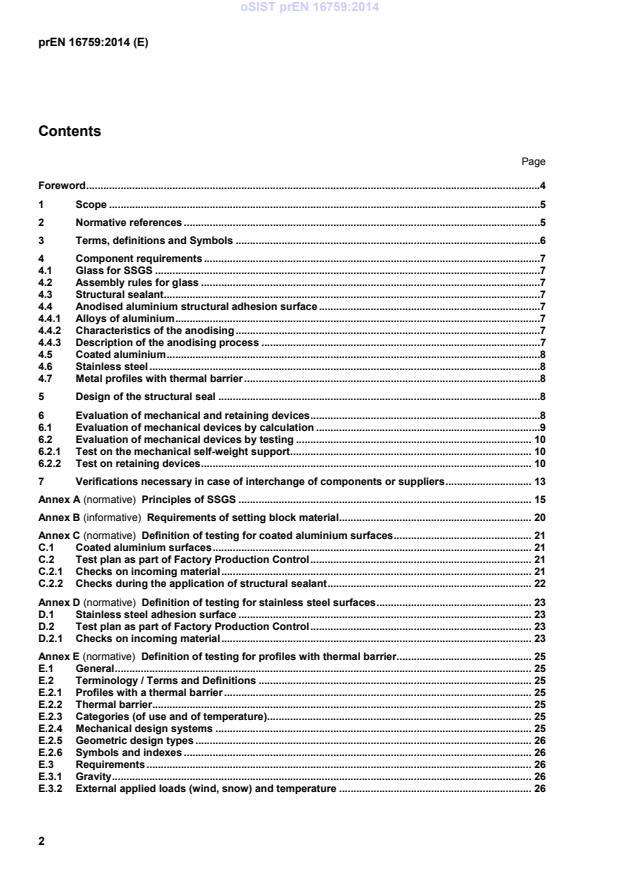
Contents
Page
Foreword .4
1 Scope .5
2 Normative references .5
3 Terms, definitions and Symbols .6
4 Component requirements .7
4.1 Glass for SSGS .7
4.2 Assembly rules for glass .7
4.3 Structural sealant.7
4.4 Anodised aluminium structural adhesion surface .7
4.4.1 Alloys of aluminium .7
4.4.2 Characteristics of the anodising .7
4.4.3 Description of the anodising process .7
4.5 Coated aluminium .8
4.6 Stainless steel .8
4.7 Metal profiles with thermal barrier .8
5 Design of the structural seal .8
6 Evaluation of mechanical and retaining devices .8
6.1 Evaluation of mechanical devices by calculation .9
6.2 Evaluation of mechanical devices by testing . 10
6.2.1 Test on the mechanical self-weight support . 10
6.2.2 Test on retaining devices . 10
7 Verifications necessary in case of interchange of components or suppliers . 13
Annex A (normative) Principles of SSGS . 15
Annex B (informative) Requirements of setting block material. 20
Annex C (normative) Definition of testing for coated aluminium surfaces . 21
C.1 Coated aluminium surfaces . 21
C.2 Test plan as part of Factory Production Control . 21
C.2.1 Checks on incoming material . 21
C.2.2 Checks during the application of structural sealant . 22
Annex D (normative) Definition of testing for stainless steel surfaces . 23
D.1 Stainless steel adhesion surface . 23
D.2 Test plan as part of Factory Production Control . 23
D.2.1 Checks on incoming material . 23
Annex E (normative) Definition of testing for profiles with thermal barrier. 25
E.1 General . 25
E.2 Terminology / Terms and Definitions . 25
E.2.1 Profiles with a thermal barrier . 25
E.2.2 Thermal barrier . 25
E.2.3 Categories (of use and of temperature). 25
E.2.4 Mechanical design systems . 25
E.2.5 Geometric design types . 26
E.2.6 Symbols and indexes . 26
E.3 Requirements . 26
E.3.1 Gravity . 26
E.3.2 External applied loads (wind, snow) and temperature . 26
oSIST prEN 16759:2014
E.3.3 Effects of water and relative humidity . 26
E.3.4 Ageing . 26
E.3.5 Durability of materials used as a thermal barrier . 27
E.3.6 Mechanical resistance . 28
E.3.7 Static proof . 28
E.4 Methods of verification . 28
E.4.1 Ageing method: Permanent shear tension and high temperature . 28
E.4.2 Requirements . 28
E.5 Static proof . 28
E.6 Extrapolation rules . 28
Bibliography . 29
oSIST prEN 16759:2014
Foreword
This document (prEN 16759:2014) has been prepared by Technical Committee CEN/TC 33 “Doors, windows,
shutters, building hardware and curtain walling”, the secretariat of which is held by AFNOR.
This document is currently submitted to the CEN Enquiry.
EN 13830 Curtain walling - EN 14351-1 Windows and
Product standard doors Product standard,
(Harmonized standard) performance characteristics -
Part 1: Windows and external
pedestrian doorsets without
resistance to fire and/or smoke
leakage characteristics
(Harmonized standard)
Glazing Systems (SSGS)
EN 13022-1 Glass in
EN 15434 Glass in building EN 1279-5 Glass in
building - Structural sealant
- Product standard for building - Insulating
glazing - Part 1: Glass
structural and/or ultraviolet glass units - Part 5:
products for structural
resistant sealant (for use Evaluation of
sealant glazing systems for
with structural sealant conformity
supported and
glazing and/or insulating
unsupported monolithic
glass units with exposed
and multiple glazing
seals)
EN 13022-2 Glass in
building - Structural sealant
glazing - Part 2: Assembly
rules
oSIST prEN 16759:2014
1 Scope
This European Standard specifies the method to be used to verify the mechanical performance of Structural
Sealant Glazing Systems.
It applies to any window/doorset or curtain walling application (see Annex A).
Structural Sealant Glazing can be incorporated into the product as follows:
either vertically; or
up to 83° from the vertical (positive slope)
up to 15° from the vertical onto the building face (negative slope).
NOTE A wall has a positive slope if its outer surface faces upwards.
It gives information to the manufacturer to comply with requirements regarding design, factory production
control and assembly rules.
The parts concerned in the testing are the metal profile (anodized and coated aluminium, stainless steel), the
glass coated or not which shall be bonded, the sealant and mechanical restraints when required.
The testing does not apply to other framing materials.
2 Normative references
The following documents, in whole or in part, are normatively referenced in this document and are
indispensable for its application. For dated references, only the edition cited applies. For undated references,
the latest edition of the referenced document (including any amendments) applies.
EN 573-3, Aluminium and aluminium alloys - Chemical composition and form of wrought products - Part 3:
Chemical composition and form of products
EN 1279-1, Glass in building - Insulating glass units - Part 1: Generalities, dimensional tolerances and rules
for the system description
EN 1990, Eurocode - Basis of structural design
EN 1991 (all parts), Eurocode 1: Actions on structures
EN 12206-1, Paints and varnishes - Coating of aluminium and aluminium alloys for architectural purposes -
Part 1: Coatings prepared from coating powder
EN 13022-1, Glass in building - Structural sealant glazing - Part 1: Glass products for structural sealant
glazing systems for supported and unsupported monolithic and multiple glazing
EN 13022-2:2006, Glass in building - Structural sealant glazing - Part 2: Assembly rules
EN 13119, Curtain walling – Terminology
EN 13830, Curtain walling – Product standard
EN 14024:2004 Metal profiles with thermal barrier - Mechanical performance - Requirements, proof and tests
for assessment
oSIST prEN 16759:2014
EN 14351-1 Windows and doors - Product standard, performance characteristics - Part 1: Windows and
external pedestrian doorsets without resistance to fire and smoke leakage characteristics
EN 15434:2006, Glass in building - Product standard for structural and/or ultraviolet resistant sealant (for use
with structural sealant glazing and/or insulating glass units with exposed seals)
EN 15651-1, Sealants for non-structural use in joints in buildings and pedestrian walkways - Part 1: Sealants
for facade elements
EN 15651-2, Sealants for non-structural use in joints in buildings and pedestrian walkways - Part 2: Sealants
for glazing
EN ISO 2813, Paints and varnishes - Determination of specular gloss of non-metallic paint films at 20
degrees, 60 degrees and 85 degrees
ISO 1463 Metallic and oxide coatings -- Measurement of coating thickness -- Microscopical method
ISO 2106 Anodizing of aluminium and its alloys - Determination of mass per unit area (surface density) of
anodic oxidation coatings - Gravimetric method
ISO 2128 Anodizing of aluminium and its alloys - Determination of thickness of anodic oxidation coatings -
Non-destructive measurement by split-beam microscope
ISO 2143 Anodizing of aluminium and its alloys - Estimation of loss of absorptive power of anodic oxidation
coatings after sealing - Dye-spot test with prior acid treatment
ISO 2360 Non-conductive coatings on non-magnetic electrically conductive basis materials - Measurement of
coating thickness - Amplitude-sensitive eddy-current method
ISO 2931 Anodizing of aluminium and its alloys - Assessment of quality of sealed anodic oxidation coatings by
measurement of admittance
ISO 3210 Anodizing of aluminium and its alloys - Assessment of quality of sealed anodic oxidation coatings by
measurement of the loss of mass after immersion in phosphoric acid/chromic acid solution
ISO 3668, Paints and varnishes -- Visual comparison of the colour of paints
3 Terms, definitions and Symbols
For the purposes of this European Standard, the terms and definitions given in EN 1279-1, EN 13022-1,
EN 13022-2, EN 13119, EN 13830, EN 15434 and the following symbols apply.
F
design resistance
des
F
characteristic force giving 75 % confidence that 95 % of the test results will be higher than
u,5
this value
F average breaking force
mean
eccentricity of 5 % with a 75 % confidence
τ
αß
s standard deviation of the series under consideration
P breaking/rupture pressure, initial state
br,n
P breaking pressure, after ageing test
br,c
safety factor
γ
oSIST prEN 16759:2014
4 Component requirements
4.1 Glass for SSGS
Glass used in SSGS shall conform to EN 13022-1.
4.2 Assembly rules for glass
The assembling of the glass elements into or onto the window, door or curtain-walling framework shall be in
accordance with EN 13022-2, clause 4.
For requirements of the setting block material see Annex B.
4.3 Structural sealant
The structural sealant shall be identified and assessed according to EN 15434.
4.4 Anodised aluminium structural adhesion surface
4.4.1 Alloys of aluminium
The chemical composition of the aluminium alloy shall be recorded.
4.4.2 Characteristics of the anodising
The aluminium structural adhesion surface on which the tests in EN 15434 are to be performed, are identified
as follows.
4.4.2.1 Measurement of the thickness
At least one of the following methods shall be used:
Eddy current test method to ISO 2360
Split-beam optical method to ISO 2128
Micro-section method to ISO 1463
Gravimetric method to ISO 2106.
4.4.2.2 Sealing tests
At least one of the following methods shall be used:
Stain test to ISO 2143
Immersion test to ISO 3210
Measurement of admittance test at 1000 Hz to ISO 2931.
4.4.3 Description of the anodising process
The following information of the anodising process shall be recorded:
4.4.3.1 Scouring
Composition of the bath
oSIST prEN 16759:2014
Time of immersion of aluminium in the bath
4.4.3.2 Anodic oxidation
Composition of the bath
Time of immersion of aluminium in the bath
Temperature of the bath
4.4.3.3 Sealing of the anodised layer
Composition of the bath or reference name
Time of immersion of aluminium in the bath
Temperature of the bath
NOTE 1 A misunderstanding can arise from the word "sealing" which is a post-treatment of the anodising. The
equivalent in French is "colmatage" and in German "Verdichtung".
Where cold sealing is proposed additional proof must be provided
NOTE 2 Details are prescribed on Qualanod ‘Sealing by hydrothermal treatment’ or ‘Cold impregnation/Cold sealing
(CI-CS) based on nickel fluoride’.
4.5 Coated aluminium
For coated aluminium the relevant information regarding testing, inspection and factory production control
shall be taken from EN 13022-2, 6.2.
For coated aluminium surfaces see Annex C.
4.6 Stainless steel
For stainless steel the relevant information regarding testing, inspection and factory production control shall be
taken from Annex D.
4.7 Metal profiles with thermal barrier
For metal profiles with thermal barrier the relevant information regarding testing, inspection and factory
production control shall be taken from EN 14024 and Annex E.
5 Design of the structural seal
The design of the glass elements into or onto the window, door or curtain-walling framework shall be in
accordance with of EN 13022-2, Annex B.
6 Evaluation of mechanical and retaining devices
Devices are used to reduce danger in the event of bond failure and they may be required by national
regulations. Functions of devices are illustrated in Figure 1.
Type I: Mechanical transfer of the self-weight of the infill to the sealant-support frame and thence to the
structure. The structural seal transfers all other actions. Devices are used to reduce danger in the event of a
bond failure.
oSIST prEN 16759:2014
Type II: Mechanical transfer of the self-weight of the infill to the sealant-support frame and thence to the
structure. The structural seal transfers all other actions and no devices are used to reduce danger in the event
of bond failure.
Type III: The structural seal transfers all actions including the self-weight of the infill to the sealant support
frame and thence to the structure. Devices are used to reduce danger in the event of a bond failure.
Type IV: The structural seal transfers all actions, including self-weight of the infill to the sealant support frame
and thence to the structure. No devices are used to reduce danger in the event of bond failure.
Key
1 retaining device to reduce danger in case of bond failure
2 mechanical self-weight support
3 structural sealant support frame
4 structural bonding
Figure 1 — Examples of the different types of SSGS
The performance of the devices shall be assessed either from the results of tests or from calculations which
shall allow for the method of attachment to the frame and also consider a variety of designs. The devices shall
not themselves cause damage to the glazing.
NOTE Some provisions may require mechanical retaining devices, e.g. for negative sloping surfaces.
6.1 Evaluation of mechanical devices by calculation
The structural adequacy of such supports is assessed using conventional calculations based upon the
strength of materials and testing will not be required.
The design principles are based on the structural Eurocode EN 1990. The actions are determined in
accordance with the structural Eurocode series EN 1991, including the National annexes.
The engineering stresses shall be calculated in accordance with the appropriate Eurocodes taking into
account the nationally determined parameters relevant to the place of use. The engineering stresses induced
oSIST prEN 16759:2014
into mechanical devices shall be no greater than those specified within the appropriate materials standard
from which mechanical devices are made.
6.2 Evaluation of mechanical devices by testing
Where the design incorporates novel features the following test can be used.
6.2.1 Test on the mechanical self-weight support
Key
1 load application
2 structural sealant support frame
3 mechanical self-weight support
Figure 2 — Test on mechanical self-weight support
The test piece comprises
...