

ASTM D7057-23
(Test Method)Standard Test Method for Analysis of Isopropylbenzene (Cumene) by Gas Chromatography (External Standard)
General Information
- Abstract
SIGNIFICANCE AND USE
5.1 This test method is suitable for setting specifications on the materials referenced in 1.2 and for use as an internal quality control tool where isopropylbenzene is produced or is used in a manufacturing process. It may also be used in development or research work involving isopropylbenzene.
5.2 This test method is useful in determining the purity of isopropylbenzene with normal impurities present. If extremely high boiling or unusual impurities are present in the isopropylbenzene, this test method would not necessarily detect them and the purity calculation would be erroneous.
5.3 Cumene hydroperoxide, if present, will yield thermal decomposition products, primarily AP and DMPC as stated in 4.1, that will elute in the chromatogram thereby giving incorrect results unless they are excluded as indicated in 4.1. It is also possible to get erroneous results for trace alpha-methylstyrene present in isopropylbenzene if the inlet has become unduly contaminated with non-volatile foreign substances.
5.4 The nonaromatic hydrocarbons commonly present from the isopropylbenzene manufacturing process, particularly a non-zeolitic one, will interfere with the determination of xylenes (if present).
SCOPE
1.1 This test method covers the determination of the purity of isopropylbenzene (cumene) by gas chromatography. Calibration of the gas chromatography system is done by the external standard calibration technique.
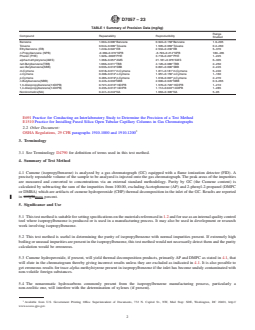
1.2 This test method has been found applicable to the measurement of impurities such as nonaromatic hydrocarbons, benzene, toluene, ethylbenzene, phenol, cymenes, t-butylbenzene, n-butylbenzene, n-propylbenzene, alpha-methylstyrene, sec-butylbenzene, and diisopropylbenzenes, which are impurities that can be found in isopropylbenzene. The latter impurities can be analyzed over a range of 1 mg/kg to 500 mg/kg by this method (see Table 1). The limit of quantitation averages 3.8 mg/kg while the limit of detection for these impurities averages 1.1 mg/kg based on the data in Table 1.
1.3 In determining the conformance of the test results using this method to applicable specifications, results shall be rounded off in accordance with the rounding-off method of Practice E29.
1.4 The values stated in SI units are to be regarded as standard. No other units of measurement are included in this standard.
1.5 This standard does not purport to address all of the safety concerns, if any, associated with its use. It is the responsibility of the user of this standard to establish appropriate safety, health, and environmental practices and determine the applicability of regulatory limitations prior to use. For specific hazard statements, see Section 9.
1.6 This international standard was developed in accordance with internationally recognized principles on standardization established in the Decision on Principles for the Development of International Standards, Guides and Recommendations issued by the World Trade Organization Technical Barriers to Trade (TBT) Committee.
- Status
- Published
- Publication Date
- 31-Mar-2023
- Technical Committee
- D16 - Aromatic, Industrial, Specialty and Related Chemicals
- Drafting Committee
- D16.07 - Styrene, Ethylbenzene and C9 and C10 Aromatic Hydrocarbons
Buy Documents
ASTM D7057-23 - Standard Test Method for Analysis of Isopropylbenzene (Cumene) by Gas Chromatography (External Standard)
REDLINE ASTM D7057-23 - Standard Test Method for Analysis of Isopropylbenzene (Cumene) by Gas Chromatography (External Standard)
Overview
ASTM D7057-23 is the standard test method for the analysis of isopropylbenzene (cumene) by gas chromatography (GC) utilizing the external standard calibration technique. Developed by ASTM International, this method provides a reliable approach for determining the purity of isopropylbenzene and the concentration of common impurities in industrial and laboratory environments. Accurate analysis of cumene purity is essential for quality control, specification compliance, and research where isopropylbenzene is produced, utilized, or studied.
Key Topics
- Principle: The test method involves injecting a precisely measured amount of isopropylbenzene sample into a gas chromatograph equipped with a flame ionization detector (FID). Concentrations of impurities and cumene content are calculated by external standard calibration.
- Scope of Impurities Measured: This method is suitable for analyzing impurities such as:
- Nonaromatic hydrocarbons
- Benzene, toluene, ethylbenzene
- Phenol, cymenes, alpha-methylstyrene
- sec-butylbenzene, tert-butylbenzene, n-butylbenzene, n-propylbenzene
- Diisopropylbenzenes (1,3- and 1,4-)
- Detection Capabilities: The method reliably quantifies impurities ranging from 1 mg/kg to 500 mg/kg, with average limits of detection and quantitation at approximately 1.1 mg/kg and 3.8 mg/kg, respectively.
- Limitations: The test method may not account for high-boiling or unusual impurities. Specific artifacts resulting from cumene hydroperoxide thermal decomposition (e.g., AP and DMPC) are excluded from purity calculations to maintain accuracy.
- Precision and Reproducibility: Precision data, summarized in the standard, ensure that results are consistent both within and between laboratories following the prescribed procedures.
Applications
The ASTM D7057-23 method is widely applied in quality assurance and specifications testing for isopropylbenzene, supporting several key areas:
- Process Quality Control: Used in manufacturing environments producing or consuming isopropylbenzene to monitor product purity and control impurity levels for regulatory compliance.
- Specification Setting: Essential for ensuring commercial cumene meets contract or industry standards for purity and allowable impurity profiles.
- Research and Development: Supports R&D efforts by providing a standardized approach for analyzing isopropylbenzene in studies focused on purification, process optimization, and impurity profiling.
- Reference for Other Hydrocarbons: The method’s approach and calibration techniques can be adapted for similar aromatic hydrocarbon analyses, promoting broader analytical utility.
Industries benefiting from ASTM D7057-23 include:
- Chemical manufacturing (aromatic hydrocarbons)
- Petrochemicals
- Analytical testing laboratories
- Research institutions
Related Standards
ASTM D7057-23 references and aligns with several other important ASTM and regulatory standards to ensure robust sampling, calibration, and reporting:
- ASTM D3437: Practice for Sampling and Handling Liquid Cyclic Products
- ASTM D4307: Practice for Preparation of Liquid Blends for Use as Analytical Standards
- ASTM D4790: Terminology of Aromatic Hydrocarbons and Related Chemicals
- ASTM D6809: Guide for Quality Control and Quality Assurance Procedures for Aromatic Hydrocarbons and Related Materials
- ASTM E29: Practice for Using Significant Digits in Test Data to Determine Conformance with Specifications
- ASTM E355: Practice for Gas Chromatography Terms and Relationships
For regulatory compliance, users are also directed to current OSHA regulations and supplier Safety Data Sheets.
Practical Value
By following ASTM D7057-23, laboratories and manufacturers can confidently determine isopropylbenzene purity, identify impurity levels, and ensure consistency across batches and between different testing sites. Adherence to this standard enhances product quality, maximizes regulatory compliance, and supports traceability in quality assurance processes.
Relations
- Effective Date
- 01-Nov-2016
- Effective Date
- 01-Oct-2015
- Effective Date
- 01-Jul-2014
- Effective Date
- 01-May-2013
- Effective Date
- 01-Nov-2011
- Effective Date
- 01-Feb-2011
- Effective Date
- 01-Jan-2011
- Effective Date
- 01-Jun-2010
- Effective Date
- 01-May-2010
- Effective Date
- 01-Oct-2008
- Effective Date
- 01-Oct-2008
- Effective Date
- 01-Jun-2008
- Effective Date
- 15-Jul-2007
- Effective Date
- 01-Jun-2007
- Effective Date
- 01-Mar-2007
Buy Documents
ASTM D7057-23 - Standard Test Method for Analysis of Isopropylbenzene (Cumene) by Gas Chromatography (External Standard)
REDLINE ASTM D7057-23 - Standard Test Method for Analysis of Isopropylbenzene (Cumene) by Gas Chromatography (External Standard)
Get Certified
Connect with accredited certification bodies for this standard

ECOCERT
Organic and sustainability certification.

Eurofins Food Testing Global
Global leader in food, environment, and pharmaceutical product testing.

Intertek Bangladesh
Intertek certification and testing services in Bangladesh.
Sponsored listings
Frequently Asked Questions
ASTM D7057-23 is a standard published by ASTM International. Its full title is "Standard Test Method for Analysis of Isopropylbenzene (Cumene) by Gas Chromatography (External Standard)". This standard covers: SIGNIFICANCE AND USE 5.1 This test method is suitable for setting specifications on the materials referenced in 1.2 and for use as an internal quality control tool where isopropylbenzene is produced or is used in a manufacturing process. It may also be used in development or research work involving isopropylbenzene. 5.2 This test method is useful in determining the purity of isopropylbenzene with normal impurities present. If extremely high boiling or unusual impurities are present in the isopropylbenzene, this test method would not necessarily detect them and the purity calculation would be erroneous. 5.3 Cumene hydroperoxide, if present, will yield thermal decomposition products, primarily AP and DMPC as stated in 4.1, that will elute in the chromatogram thereby giving incorrect results unless they are excluded as indicated in 4.1. It is also possible to get erroneous results for trace alpha-methylstyrene present in isopropylbenzene if the inlet has become unduly contaminated with non-volatile foreign substances. 5.4 The nonaromatic hydrocarbons commonly present from the isopropylbenzene manufacturing process, particularly a non-zeolitic one, will interfere with the determination of xylenes (if present). SCOPE 1.1 This test method covers the determination of the purity of isopropylbenzene (cumene) by gas chromatography. Calibration of the gas chromatography system is done by the external standard calibration technique. 1.2 This test method has been found applicable to the measurement of impurities such as nonaromatic hydrocarbons, benzene, toluene, ethylbenzene, phenol, cymenes, t-butylbenzene, n-butylbenzene, n-propylbenzene, alpha-methylstyrene, sec-butylbenzene, and diisopropylbenzenes, which are impurities that can be found in isopropylbenzene. The latter impurities can be analyzed over a range of 1 mg/kg to 500 mg/kg by this method (see Table 1). The limit of quantitation averages 3.8 mg/kg while the limit of detection for these impurities averages 1.1 mg/kg based on the data in Table 1. 1.3 In determining the conformance of the test results using this method to applicable specifications, results shall be rounded off in accordance with the rounding-off method of Practice E29. 1.4 The values stated in SI units are to be regarded as standard. No other units of measurement are included in this standard. 1.5 This standard does not purport to address all of the safety concerns, if any, associated with its use. It is the responsibility of the user of this standard to establish appropriate safety, health, and environmental practices and determine the applicability of regulatory limitations prior to use. For specific hazard statements, see Section 9. 1.6 This international standard was developed in accordance with internationally recognized principles on standardization established in the Decision on Principles for the Development of International Standards, Guides and Recommendations issued by the World Trade Organization Technical Barriers to Trade (TBT) Committee.
SIGNIFICANCE AND USE 5.1 This test method is suitable for setting specifications on the materials referenced in 1.2 and for use as an internal quality control tool where isopropylbenzene is produced or is used in a manufacturing process. It may also be used in development or research work involving isopropylbenzene. 5.2 This test method is useful in determining the purity of isopropylbenzene with normal impurities present. If extremely high boiling or unusual impurities are present in the isopropylbenzene, this test method would not necessarily detect them and the purity calculation would be erroneous. 5.3 Cumene hydroperoxide, if present, will yield thermal decomposition products, primarily AP and DMPC as stated in 4.1, that will elute in the chromatogram thereby giving incorrect results unless they are excluded as indicated in 4.1. It is also possible to get erroneous results for trace alpha-methylstyrene present in isopropylbenzene if the inlet has become unduly contaminated with non-volatile foreign substances. 5.4 The nonaromatic hydrocarbons commonly present from the isopropylbenzene manufacturing process, particularly a non-zeolitic one, will interfere with the determination of xylenes (if present). SCOPE 1.1 This test method covers the determination of the purity of isopropylbenzene (cumene) by gas chromatography. Calibration of the gas chromatography system is done by the external standard calibration technique. 1.2 This test method has been found applicable to the measurement of impurities such as nonaromatic hydrocarbons, benzene, toluene, ethylbenzene, phenol, cymenes, t-butylbenzene, n-butylbenzene, n-propylbenzene, alpha-methylstyrene, sec-butylbenzene, and diisopropylbenzenes, which are impurities that can be found in isopropylbenzene. The latter impurities can be analyzed over a range of 1 mg/kg to 500 mg/kg by this method (see Table 1). The limit of quantitation averages 3.8 mg/kg while the limit of detection for these impurities averages 1.1 mg/kg based on the data in Table 1. 1.3 In determining the conformance of the test results using this method to applicable specifications, results shall be rounded off in accordance with the rounding-off method of Practice E29. 1.4 The values stated in SI units are to be regarded as standard. No other units of measurement are included in this standard. 1.5 This standard does not purport to address all of the safety concerns, if any, associated with its use. It is the responsibility of the user of this standard to establish appropriate safety, health, and environmental practices and determine the applicability of regulatory limitations prior to use. For specific hazard statements, see Section 9. 1.6 This international standard was developed in accordance with internationally recognized principles on standardization established in the Decision on Principles for the Development of International Standards, Guides and Recommendations issued by the World Trade Organization Technical Barriers to Trade (TBT) Committee.
ASTM D7057-23 is classified under the following ICS (International Classification for Standards) categories: 71.080.15 - Aromatic hydrocarbons. The ICS classification helps identify the subject area and facilitates finding related standards.
ASTM D7057-23 has the following relationships with other standards: It is inter standard links to ASTM D6809-02(2016), ASTM D4307-99(2015), ASTM D4790-14, ASTM E691-13, ASTM E691-11, ASTM D4790-11, ASTM D3437-11, ASTM D3437-10, ASTM D4307-99(2010), ASTM E29-08, ASTM E691-08, ASTM D3437-08, ASTM D4790-07, ASTM D6809-02(2007), ASTM E355-96(2007). Understanding these relationships helps ensure you are using the most current and applicable version of the standard.
ASTM D7057-23 is available in PDF format for immediate download after purchase. The document can be added to your cart and obtained through the secure checkout process. Digital delivery ensures instant access to the complete standard document.
Standards Content (Sample)
This international standard was developed in accordance with internationally recognized principles on standardization established in the Decision on Principles for the
Development of International Standards, Guides and Recommendations issued by the World Trade Organization Technical Barriers to Trade (TBT) Committee.
Designation: D7057 − 23
Standard Test Method for
Analysis of Isopropylbenzene (Cumene) by Gas
Chromatography (External Standard)
This standard is issued under the fixed designation D7057; the number immediately following the designation indicates the year of
original adoption or, in the case of revision, the year of last revision. A number in parentheses indicates the year of last reapproval. A
superscript epsilon (´) indicates an editorial change since the last revision or reapproval.
1. Scope* mendations issued by the World Trade Organization Technical
Barriers to Trade (TBT) Committee.
1.1 This test method covers the determination of the purity
of isopropylbenzene (cumene) by gas chromatography. Cali-
2. Referenced Documents
bration of the gas chromatography system is done by the
2.1 ASTM Standards:
external standard calibration technique.
D3437 Practice for Sampling and Handling Liquid Cyclic
1.2 This test method has been found applicable to the
Products
measurement of impurities such as nonaromatic hydrocarbons,
D4307 Practice for Preparation of Liquid Blends for Use as
benzene, toluene, ethylbenzene, phenol, cymenes,
Analytical Standards
t-butylbenzene, n-butylbenzene, n-propylbenzene, alpha-
D4790 Terminology of Aromatic Hydrocarbons and Related
methylstyrene, sec-butylbenzene, and diisopropylbenzenes,
Chemicals
which are impurities that can be found in isopropylbenzene.
D6809 Guide for Quality Control and Quality Assurance
The latter impurities can be analyzed over a range of 1 mg/kg
Procedures for Aromatic Hydrocarbons and Related Ma-
to 500 mg/kg by this method (see Table 1). The limit of
terials
quantitation averages 3.8 mg/kg while the limit of detection for
E29 Practice for Using Significant Digits in Test Data to
these impurities averages 1.1 mg/kg based on the data in Table
Determine Conformance with Specifications
1.
E355 Practice for Gas Chromatography Terms and Relation-
1.3 In determining the conformance of the test results using ships
this method to applicable specifications, results shall be E691 Practice for Conducting an Interlaboratory Study to
rounded off in accordance with the rounding-off method of Determine the Precision of a Test Method
Practice E29. E1510 Practice for Installing Fused Silica Open Tubular
Capillary Columns in Gas Chromatographs
1.4 The values stated in SI units are to be regarded as
2.2 Other Document:
standard. No other units of measurement are included in this
OSHA Regulations, 29 CFR paragraphs 1910.1000 and
standard.
1910.1200
1.5 This standard does not purport to address all of the
safety concerns, if any, associated with its use. It is the
3. Terminology
responsibility of the user of this standard to establish appro-
3.1 See Terminology D4790 for definition of terms used in
priate safety, health, and environmental practices and deter-
this test method.
mine the applicability of regulatory limitations prior to use.
For specific hazard statements, see Section 9.
4. Summary of Test Method
1.6 This international standard was developed in accor-
4.1 Cumene (isopropylbenzene) is analyzed by a gas chro-
dance with internationally recognized principles on standard-
matograph (GC) equipped with a flame ionization detector
ization established in the Decision on Principles for the
(FID). A precisely repeatable volume of the sample to be
Development of International Standards, Guides and Recom-
analyzed is injected onto the gas chromatograph. The peak
1 2
This test method is under the jurisdiction of ASTM Committee D16 on For referenced ASTM standards, visit the ASTM website, www.astm.org, or
Aromatic, Industrial, Specialty and Related Chemicals and is the direct responsi- contact ASTM Customer Service at service@astm.org. For Annual Book of ASTM
bility of Subcommittee D16.07 on Styrene, Ethylbenzene and C9 and C10 Aromatic Standards volume information, refer to the standard’s Document Summary page on
Hydrocarbons. the ASTM website.
Current edition approved April 1, 2023. Published April 2023. Originally Available from U.S. Government Printing Office Superintendent of Documents,
approved in 2004. Last previous edition approved in 2018 as D7057 – 18. DOI: 732 N. Capitol St., NW, Mail Stop: SDE, Washington, DC 20401, http://
10.1520/D7057-23. www.access.gpo.gov.
*A Summary of Changes section appears at the end of this standard
Copyright © ASTM International, 100 Barr Harbor Drive, PO Box C700, West Conshohocken, PA 19428-2959. United States
D7057 − 23
TABLE 1 Summary of Precision Data (mg/kg)
Range
Compound Repeatability Reproducibility
Studied
Benzene 1.004+0.006*Benzene 0.924+0.158*Benzene 1.0–295
Toluene 0.644+0.009*Toluene 1.505+0.069*Toluene 0.2–260
Ethylbenzene (EB) 1.249+0.022*EB 2.534+0.230*EB 5–370
n-Propylbenzene (NPB) -0.369+0.015*NPB -6.793+0.214*NPB 180–465
Phenol (PHE) 1.926+.0095*PHE 3.718+0.207*PHE 1–225
alpha-methylstyrene(AMS) 1.368+0.057*AMS 21.181+0.976*AMS 6–305
tert-Butylbenzene(TBB) 1.666+0.011*TBB 4.126+0.086*TBB 2–250
sec-Butylbenzene(SBB) 0.635+0.010*SBB 0.891+0.090*SBB 2–245
m-Cymene 0.618+0.011*m-Cymene 1.811+0.181*m-Cymene 5–240
o-Cymene 0.498+0.012*o-Cymene 1.951+0.156*o-Cymene 1–160
p-Cymene 0.485+0.019*p-Cymene 1.618+0.097*p-Cymene 2–270
n-Butylbenzene(NBB) 0.445+0.030*NBB 2.600+0.045*NBB 0.3–265
1,3-diisopropylbenzene(13DIPB) 0.727+0.010*13DIPB 1.570+0.720*13DIPB 1–210
1,4-diisopropylbenzene(14DIPB) 0.435+0.013*14DIPB 1.112+0.040*14DIPB 1–285
NonAromatics(NA) 0.441+0.242*NA 1.663+0.306*NA 5–95
TABLE 2 Recommended Operating Conditions
areas of the impurities are measured and converted to concen-
Detector flame ionization
trations via an external standard methodology. Purity by GC
Injection Port capillary splitter
(the Cumene content) is calculated by subtracting the sum of
Column A:
the impurities from 100.00, excluding Acetophenone (AP) and Tubing fused silica
Stationary Phase crosslinked
2-phenyl-2-propanol (DMPC or DMBA) which are artifacts of
polydimethylsilicone (HP-1,
cumene hydroperoxide (CHP) thermal decomposition in the
DB-1 or equiv)
inlet of the GC. Results are reported in mass percent. Film Thickness, μm 1.0
Length, m 60
Diameter, mm 0.32
5. Significance and Use
Temperatures:
Injector, °C 250
5.1 This test method is suitable for setting specifications on
Detector, °C 300
the materials referenced in 1.2 and for use as an internal quality
Oven, °C 85 hold for 13 min
control tool where isopropylbenzene is produced or is used in
Ramp 1 = 6 °C ⁄min to
125 °C, hold for 2 min
a manufacturing process. It may also be used in development
Ramp 2 = 30 °C ⁄min to
or research work involving isopropylbenzene.
250 °C, hold for 7.5 min
Carrier Gas Helium
5.2 This test method is useful in determining the purity of
Flow Rate, mls/min 3
isopropylbenzene with normal impurities present. If extremely
Split Ratio 60:1
high boiling or unusual impurities are present in the Sample Size, μL 1.0
isopropylbenzene, this test method would not necessarily
detect them and the purity calculation would be erroneous.
5.3 Cumene hydroperoxide, if present, will yield thermal
column described in Table 2 has been used successfully and
decomposition products, primarily AP and DMPC as stated in
shall be used as a referee in cases of dispute. Unless the analyst
4.1, that will elute in the chromatogram thereby giving
can be sure of peak identity, for example by gas
incorrect results unless they are excluded as indicated in 4.1. It
chromatography-mass spectrometry (GC-MS), the use of the
is also possible to get erroneous results for trace alpha-
column in Table 2 is strongly recommended.
methylstyrene present in isopropylbenzene if the inlet has
become unduly contaminated with non-volatile foreign sub-
6.3 Recorder—Chromatographic data systems are preferred
stances.
but electronic integration may be used if the user can demon-
strate that the results are consistent with the precision state-
5.4 The nonaromatic hydrocarbons commonly present from
ment. Recorders are not considered adequate for meeting the
the isopropylbenzene manufacturing process, particularly a
precision requirements of this standard.
non-zeolitic one, will interfere with the determination of
xylenes (if present).
6.4 Injector—The specimen must be precisely and repeat-
edly injected into the gas chromatograph. An automatic sample
6. Apparatus
injection device is highly recommended. Manual injection can
6.1 Gas Chromatograph—Any instrument having a flame
be employed if the precision stated in Table 1, Summary of
ionization detector that can be operated at the conditions given
Precision Data, can be reliably and consistently satisfied.
in Table 2. The system should have sufficient sensitivity to
obtain a minimum peak height response for 1 mg/kg benzene 7. Reagents and Materials
of twice the height of the signal background noise.
7.1 Purity of Reagents—Reagent grade chemicals shall be
6.2 Columns—The choice of column is based on resolution used in all tests. Unless otherwise indicated, it is intended that
requirements. Any column may be used that is capable of all reagents shall conform to the specifications of the Commit-
resolving all significant impurities from isopropylbenzene. The tee on Analytical Reagents of the American Chemical Society,
D7057 − 23
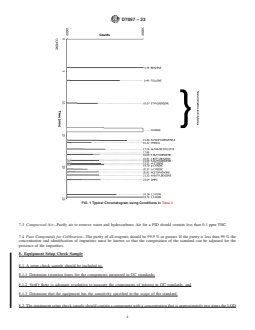
FIG. 1 Typical Chromatogram using Conditions in Table 2
where such specifications are available. Other grades may be 7.4 Pure Compounds for Calibration—The purity of all
used, provided it is first ascertained that the reagent is of reagents should be 99.9 % or greater. If the purity is less than
sufficiently high purity to permit its use without lessening the 99 % the concentration and identification of impurities must be
accuracy of the determination. known so that the composition of the standard can be adjusted
for the presence of the impurities.
7.2 Carrier Gas, Makeup, and Detector Gases—Helium,
hydrogen, nitrogen, or other carrier, makeup and detector gases
8. Equipment Setup C
...
This document is not an ASTM standard and is intended only to provide the user of an ASTM standard an indication of what changes have been made to the previous version. Because
it may not be technically possible to adequately depict all changes accurately, ASTM recommends that users consult prior editions as appropriate. In all cases only the current version
of the standard as published by ASTM is to be considered the official document.
Designation: D7057 − 18 D7057 − 23
Standard Test Method for
Analysis of Isopropylbenzene (Cumene) by Gas
Chromatography (External Standard)
This standard is issued under the fixed designation D7057; the number immediately following the designation indicates the year of
original adoption or, in the case of revision, the year of last revision. A number in parentheses indicates the year of last reapproval. A
superscript epsilon (´) indicates an editorial change since the last revision or reapproval.
1. Scope*
1.1 This test method covers the determination of the purity of isopropylbenzene (cumene) by gas chromatography. Calibration of
the gas chromatography system is done by the external standard calibration technique.
1.2 This test method has been found applicable to the measurement of impurities such as nonaromatic hydrocarbons, benzene,
toluene, ethylbenzene, phenol, cymenes, t-butylbenzene, n-butylbenzene, n-propylbenzene, alpha-methylstyrene, sec-
butylbenzene, and diisopropylbenzenes, which are impurities that can be found in isopropylbenzene. The latter impurities can be
analyzed over a range of 1 mg/kg to 500 mg/kg by this method (see Table 1). The limit of quantitation averages 3.8 mg/kg while
the limit of detection for these impurities averages 1.1 mg/kg.mg/kg based on the data in Table 1.
1.3 In determining the conformance of the test results using this method to applicable specifications, results shall be rounded off
in accordance with the rounding-off method of Practice E29.
1.4 The values stated in SI units are to be regarded as standard. No other units of measurement are included in this standard.
1.5 This standard does not purport to address all of the safety concerns, if any, associated with its use. It is the responsibility
of the user of this standard to establish appropriate safety, health, and environmental practices and determine the applicability of
regulatory limitations prior to use. For specific hazard statements, see Section 89.
1.6 This international standard was developed in accordance with internationally recognized principles on standardization
established in the Decision on Principles for the Development of International Standards, Guides and Recommendations issued
by the World Trade Organization Technical Barriers to Trade (TBT) Committee.
2. Referenced Documents
2.1 ASTM Standards:
D3437 Practice for Sampling and Handling Liquid Cyclic Products
D4307 Practice for Preparation of Liquid Blends for Use as Analytical Standards
D4790 Terminology of Aromatic Hydrocarbons and Related Chemicals
D6809 Guide for Quality Control and Quality Assurance Procedures for Aromatic Hydrocarbons and Related Materials
E29 Practice for Using Significant Digits in Test Data to Determine Conformance with Specifications
E355 Practice for Gas Chromatography Terms and Relationships
This test method is under the jurisdiction of ASTM Committee D16 on Aromatic, Industrial, Specialty and Related Chemicals and is the direct responsibility of
Subcommittee D16.07 on Styrene, Ethylbenzene and C9 and C10 Aromatic Hydrocarbons.
Current edition approved Jan. 1, 2018April 1, 2023. Published January 2018April 2023. Originally approved in 2004. Last previous edition approved in 20132018 as D7057
– 13. DOI: 10.1520/D7057-18.18. DOI: 10.1520/D7057-23.
For referenced ASTM standards, visit the ASTM website, www.astm.org, or contact ASTM Customer Service at service@astm.org. For Annual Book of ASTM Standards
volume information, refer to the standard’s Document Summary page on the ASTM website.
*A Summary of Changes section appears at the end of this standard
Copyright © ASTM International, 100 Barr Harbor Drive, PO Box C700, West Conshohocken, PA 19428-2959. United States
D7057 − 23
TABLE 1 Summary of Precision Data (mg/kg)
Range
Compound Repeatability Reproducibility
Studied
Benzene 1.004+0.006*Benzene 0.924+0.158*Benzene 1.0–295
Toluene 0.644+0.009*Toluene 1.505+0.069*Toluene 0.2–260
Ethylbenzene (EB) 1.249+0.022*EB 2.534+0.230*EB 5–370
n-Propylbenzene (NPB) -0.369+0.015*NPB -6.793+0.214*NPB 180–465
Phenol (PHE) 1.926+.0095*PHE 3.718+0.207*PHE 1–225
alpha-methylstyrene(AMS) 1.368+0.057*AMS 21.181+0.976*AMS 6–305
tert-Butylbenzene(TBB) 1.666+0.011*TBB 4.126+0.086*TBB 2–250
sec-Butylbenzene(SBB) 0.635+0.010*SBB 0.891+0.090*SBB 2–245
m-Cymene 0.618+0.011*m-Cymene 1.811+0.181*m-Cymene 5–240
o-Cymene 0.498+0.012*o-Cymene 1.951+0.156*o-Cymene 1–160
p-Cymene 0.485+0.019*p-Cymene 1.618+0.097*p-Cymene 2–270
n-Butylbenzene(NBB) 0.445+0.030*NBB 2.600+0.045*NBB 0.3–265
1,3-diisopropylbenzene(13DIPB) 0.727+0.010*13DIPB 1.570+0.720*13DIPB 1–210
1,4-diisopropylbenzene(14DIPB) 0.435+0.013*14DIPB 1.112+0.040*14DIPB 1–285
NonAromatics(NA) 0.441+0.242*NA 1.663+0.306*NA 5–95
E691 Practice for Conducting an Interlaboratory Study to Determine the Precision of a Test Method
E1510 Practice for Installing Fused Silica Open Tubular Capillary Columns in Gas Chromatographs
2.2 Other Document:
OSHA Regulations, 29 CFR paragraphs 1910.1000 and 1910.1200
3. Terminology
3.1 See Terminology D4790 for definition of terms used in this test method.
4. Summary of Test Method
4.1 Cumene (isopropylbenzene) is analyzed by a gas chromatograph (GC) equipped with a flame ionization detector (FID). A
precisely repeatable volume of the sample to be analyzed is injected onto the gas chromatograph. The peak areas of the impurities
are measured and converted to concentrations via an external standard methodology. Purity by GC (the Cumene content) is
calculated by subtracting the sum of the impurities from 100.00, excluding Acetophenone (AP) and 2-phenyl-2-propanol (DMPC
or DMBA) which are artifacts of cumene hydroperoxide (CHP) thermal decomposition in the inlet of the GC. Results are reported
in weightmass percent.
5. Significance and Use
5.1 This test method is suitable for setting specifications on the materials referenced in 1.2 and for use as an internal quality control
tool where isopropylbenzene is produced or is used in a manufacturing process. It may also be used in development or research
work involving isopropylbenzene.
5.2 This test method is useful in determining the purity of isopropylbenzene with normal impurities present. If extremely high
boiling or unusual impurities are present in the isopropylbenzene, this test method would not necessarily detect them and the purity
calculation would be erroneous.
5.3 Cumene hydroperoxide, if present, will yield thermal decomposition products, primarily AP and DMPC as stated in 4.1, that
will elute in the chromatogram thereby giving incorrect results unless they are excluded as indicated in 4.1. It is also possible to
get erroneous results for trace alpha-methylstyrene present in isopropylbenzene if the inlet has become unduly contaminated with
non-volatile foreign substances.
5.4 The nonaromatic hydrocarbons commonly present from the isopropylbenzene manufacturing process, particularly a
non-zeolitic one, will interfere with the determination of xylenes (if present).
Available from U.S. Government Printing Office Superintendent of Documents, 732 N. Capitol St., NW, Mail Stop: SDE, Washington, DC 20401, http://
www.access.gpo.gov.
D7057 − 23
6. Apparatus
6.1 Gas Chromatograph—Any instrument having a flame ionization detector that can be operated at the conditions given in Table
2. The system should have sufficient sensitivity to obtain a minimum peak height response for 1 mg/kg benzene of twice the height
of the signal background noise.
6.2 Columns—The choice of column is based on resolution requirements. Any column may be used that is capable of resolving
all significant impurities from isopropylbenzene. The column described in Table 2 has been used successfully and shall be used
as a referee in cases of dispute. Unless the analyst can be sure of peak identity, for example by gas chromatography-mass
spectrometry (GC-MS), the use of the column in Table 2 is strongly recommended.
6.3 Recorder—Chromatographic data systems are preferred but electronic integration may be used if the user can demonstrate that
the results are consistent with the precision statement. Recorders are not considered adequate for meeting the precision
requirements of this standard.
6.4 Injector—The specimen must be precisely and repeatedly injected into the gas chromatograph. An automatic sample injection
device is highly recommended. Manual injection can be employed if the precision stated in Table 1, Summary of Precision Data,
can be reliably and consistently satisfied.
7. Reagents and Materials
7.1 Purity of Reagents—Reagent grade chemicals shall be used in all tests. Unless otherwise indicated, it is intended that all
reagents shall conform to the specifications of the Committee on Analytical Reagents of the American Chemical Society, where
such specifications are available. Other grades may be used, provided it is first ascertained that the reagent is of sufficiently high
purity to permit its use without lessening the accuracy of the determination.
7.2 Carrier Gas, Makeup, and Detector Gases—Helium, hydrogen, nitrogen, or other carrier, makeup and detector gases 99.999 %
minimum purity. Oxygen in carrier gas less than 1 ppm, less than 0.5 ppm is preferred. Purify carrier, makeup, and detector gases
to remove oxygen, water, and hydrocarbons.
TABLE 2 Recommended Operating Conditions
Detector flame ionization
Injection Port capillary splitter
Column A:
Tubing fused silica
Stationary Phase crosslinked
polydimethylsilicone (HP-1,
DB-1 or equiv)
Film Thickness, μm 1.0
Length, m 60
Diameter, mm 0.32
Temperatures:
Injector, °C 250
Detector, °C 300
Oven, °C 85 hold for 13 min
Ramp 1 = 6°C/min to
125°C, hold for 2 min
Ramp 1 = 6 °C ⁄min to
125 °C, hold for 2 min
Ramp 2 = 30°C/min to
250°C, hold for 7.5 min
Ramp 2 = 30 °C ⁄min to
250 °C, hold for 7.5 min
Carrier Gas Helium
Flow Rate, mls/min 3
Split Ratio 60:1
Sample Size, μL 1.0
Reagent Chemicals, American Chemical Society Specifications,ACS Reagent Chemicals, Specifications and Procedures for Reagents and Standard-Grade Reference
Materials, American Chemical Society, Washington, DC. For suggestions on the tes
...