

ASTM D5194-24
(Test Method)Standard Test Method for Trace Chloride in Liquid Aromatic Hydrocarbons
General Information
- Abstract
SIGNIFICANCE AND USE
4.1 Organic and inorganic chlorine compounds can have a deleterious effect on equipment and reactions in processes involving aromatic hydrocarbons.
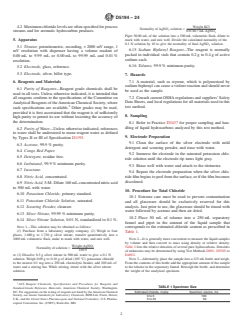
4.2 Maximum chloride levels are often specified for process streams and for aromatic hydrocarbon products.
SCOPE
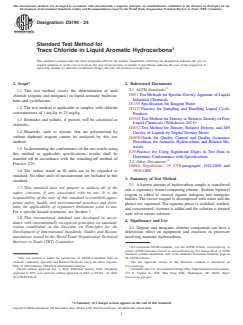
1.1 This test method covers the determination of total chloride (organic and inorganic) in liquid aromatic hydrocarbons and cyclohexane.
1.2 The test method is applicable to samples with chloride concentrations of 1 mg/kg to 25 mg/kg.
1.3 Bromides and iodides, if present, will be calculated as chlorides.
1.4 Materials, such as styrene, that are polymerized by sodium biphenyl reagent cannot be analyzed by this test method.
1.5 In determining the conformance of the test results using this method to applicable specifications, results shall be rounded off in accordance with the rounding-off method of Practice E29.
1.6 The values stated in SI units are to be regarded as standard. No other units of measurement are included in this standard.
1.7 This standard does not purport to address all of the safety concerns, if any, associated with its use. It is the responsibility of the user of this standard to establish appropriate safety, health, and environmental practices and determine the applicability of regulatory limitations prior to use. For a specific hazard statement, see Section 7.
1.8 This international standard was developed in accordance with internationally recognized principles on standardization established in the Decision on Principles for the Development of International Standards, Guides and Recommendations issued by the World Trade Organization Technical Barriers to Trade (TBT) Committee.
- Status
- Published
- Publication Date
- 31-Dec-2023
- Technical Committee
- D16 - Aromatic, Industrial, Specialty and Related Chemicals
- Drafting Committee
- D16.04 - Instrumental Analysis

Overview
ASTM D5194-24 is the internationally recognized standard titled "Standard Test Method for Trace Chloride in Liquid Aromatic Hydrocarbons," developed by ASTM International. This standard specifies a precise analytical procedure for determining trace amounts of total chloride-including both organic and inorganic forms-in liquid aromatic hydrocarbons and cyclohexane. Accurate chloride measurement is critical for the petrochemical industry, as even low levels can negatively affect chemical processes, catalysis, and equipment performance. This test method is applicable for samples with chloride concentrations ranging from 1 mg/kg to 25 mg/kg, making it suitable for quality assurance and process control.
Key Topics
- Total Chloride Determination: Provides a method to measure both organic and inorganic chloride in liquid aromatic hydrocarbons and cyclohexane.
- Sample Suitability: Applicable for samples containing chloride within the 1–25 mg/kg range.
- Interference Considerations: Bromides and iodides, if present, are calculated as chlorides. Certain materials like styrene, which polymerize under sodium biphenyl reagent, cannot be analyzed by this method.
- Safety and Compliance: Emphasizes that users must address safety, health, and environmental precautions, and comply with relevant regulatory requirements when conducting the test.
Applications
ASTM D5194-24 is widely applied in the following contexts:
- Petrochemical Production: Used by manufacturers and refiners to verify that aromatic hydrocarbons such as benzene, toluene, and xylene meet stringent chloride content specifications.
- Quality Control: Supports the ongoing quality assurance of process streams and final products by ensuring that chloride levels remain within acceptable limits, thus protecting downstream equipment and catalytic processes from chloride-induced harm.
- Specification Compliance: Helps producers and customers prove conformance with purchase specifications and regulatory requirements regarding chloride content.
- Laboratory Testing: Laboratories engaged in the analysis of industrial chemicals utilize this method for routine or investigative analyses to avoid process downtime and product contamination.
Industries benefiting from this standard include:
- Chemical manufacturing
- Petrochemical refining
- Industrial quality control laboratories
- Environmental monitoring
Related Standards
For comprehensive, accurate analyses and proper test method execution, users should be familiar with these related ASTM standards:
- ASTM D891: Test Methods for Specific Gravity of Liquid Industrial Chemicals
- ASTM D1193: Specification for Reagent Water
- ASTM D1555M: Test Method for Calculation of Volume and Weight of Industrial Aromatic Hydrocarbons and Cyclohexane
- ASTM D3437: Practice for Sampling and Handling Liquid Cyclic Products
- ASTM D4052: Test Method for Density, Relative Density, and API Gravity of Liquids by Digital Density Meter
- ASTM D6809: Guide for Quality Control and Quality Assurance Procedures for Aromatic Hydrocarbons
- ASTM E29: Practice for Using Significant Digits in Test Data to Determine Conformance with Specifications
Practical Value
Adopting ASTM D5194-24 ensures reliable detection of trace chloride contaminants in aromatic hydrocarbon streams, preventing equipment fouling, catalysis deactivation, and undesirable reactions. Consistent application supports producers in meeting international quality benchmarks and customer requirements while maintaining regulatory compliance. This standard is a critical tool in upholding the quality and integrity of aromatic hydrocarbon products globally.
Relations
- Effective Date
- 01-Jan-2024
- Effective Date
- 01-Jan-2024
- Effective Date
- 01-Jan-2024
- Referred By
ASTM D5211-19 - Standard Specification for Xylenes for <emph type="ital">p</emph>-Xylene Feedstock - Effective Date
- 01-Jan-2024
- Effective Date
- 01-Jan-2024
- Effective Date
- 01-Jan-2024
- Effective Date
- 01-Jan-2024
Get Certified
Connect with accredited certification bodies for this standard

ECOCERT
Organic and sustainability certification.

Eurofins Food Testing Global
Global leader in food, environment, and pharmaceutical product testing.

Intertek Bangladesh
Intertek certification and testing services in Bangladesh.
Sponsored listings
Frequently Asked Questions
ASTM D5194-24 is a standard published by ASTM International. Its full title is "Standard Test Method for Trace Chloride in Liquid Aromatic Hydrocarbons". This standard covers: SIGNIFICANCE AND USE 4.1 Organic and inorganic chlorine compounds can have a deleterious effect on equipment and reactions in processes involving aromatic hydrocarbons. 4.2 Maximum chloride levels are often specified for process streams and for aromatic hydrocarbon products. SCOPE 1.1 This test method covers the determination of total chloride (organic and inorganic) in liquid aromatic hydrocarbons and cyclohexane. 1.2 The test method is applicable to samples with chloride concentrations of 1 mg/kg to 25 mg/kg. 1.3 Bromides and iodides, if present, will be calculated as chlorides. 1.4 Materials, such as styrene, that are polymerized by sodium biphenyl reagent cannot be analyzed by this test method. 1.5 In determining the conformance of the test results using this method to applicable specifications, results shall be rounded off in accordance with the rounding-off method of Practice E29. 1.6 The values stated in SI units are to be regarded as standard. No other units of measurement are included in this standard. 1.7 This standard does not purport to address all of the safety concerns, if any, associated with its use. It is the responsibility of the user of this standard to establish appropriate safety, health, and environmental practices and determine the applicability of regulatory limitations prior to use. For a specific hazard statement, see Section 7. 1.8 This international standard was developed in accordance with internationally recognized principles on standardization established in the Decision on Principles for the Development of International Standards, Guides and Recommendations issued by the World Trade Organization Technical Barriers to Trade (TBT) Committee.
SIGNIFICANCE AND USE 4.1 Organic and inorganic chlorine compounds can have a deleterious effect on equipment and reactions in processes involving aromatic hydrocarbons. 4.2 Maximum chloride levels are often specified for process streams and for aromatic hydrocarbon products. SCOPE 1.1 This test method covers the determination of total chloride (organic and inorganic) in liquid aromatic hydrocarbons and cyclohexane. 1.2 The test method is applicable to samples with chloride concentrations of 1 mg/kg to 25 mg/kg. 1.3 Bromides and iodides, if present, will be calculated as chlorides. 1.4 Materials, such as styrene, that are polymerized by sodium biphenyl reagent cannot be analyzed by this test method. 1.5 In determining the conformance of the test results using this method to applicable specifications, results shall be rounded off in accordance with the rounding-off method of Practice E29. 1.6 The values stated in SI units are to be regarded as standard. No other units of measurement are included in this standard. 1.7 This standard does not purport to address all of the safety concerns, if any, associated with its use. It is the responsibility of the user of this standard to establish appropriate safety, health, and environmental practices and determine the applicability of regulatory limitations prior to use. For a specific hazard statement, see Section 7. 1.8 This international standard was developed in accordance with internationally recognized principles on standardization established in the Decision on Principles for the Development of International Standards, Guides and Recommendations issued by the World Trade Organization Technical Barriers to Trade (TBT) Committee.
ASTM D5194-24 is classified under the following ICS (International Classification for Standards) categories: 71.080.15 - Aromatic hydrocarbons. The ICS classification helps identify the subject area and facilitates finding related standards.
ASTM D5194-24 has the following relationships with other standards: It is inter standard links to ASTM D5194-18, ASTM D2359-19, ASTM D7124-19, ASTM D5211-19, ASTM D5808-23, ASTM D3193-24, ASTM D7185-19. Understanding these relationships helps ensure you are using the most current and applicable version of the standard.
ASTM D5194-24 is available in PDF format for immediate download after purchase. The document can be added to your cart and obtained through the secure checkout process. Digital delivery ensures instant access to the complete standard document.
Standards Content (Sample)
This international standard was developed in accordance with internationally recognized principles on standardization established in the Decision on Principles for the
Development of International Standards, Guides and Recommendations issued by the World Trade Organization Technical Barriers to Trade (TBT) Committee.
Designation: D5194 − 24
Standard Test Method for
Trace Chloride in Liquid Aromatic Hydrocarbons
This standard is issued under the fixed designation D5194; the number immediately following the designation indicates the year of
original adoption or, in the case of revision, the year of last revision. A number in parentheses indicates the year of last reapproval. A
superscript epsilon (´) indicates an editorial change since the last revision or reapproval.
1. Scope* 2. Referenced Documents
2.1 ASTM Standards:
1.1 This test method covers the determination of total
D891 Test Methods for Specific Gravity, Apparent, of Liquid
chloride (organic and inorganic) in liquid aromatic hydrocar-
Industrial Chemicals
bons and cyclohexane.
D1193 Specification for Reagent Water
1.2 The test method is applicable to samples with chloride
D3437 Practice for Sampling and Handling Liquid Cyclic
concentrations of 1 mg ⁄kg to 25 mg/kg.
Products
D3505 Test Method for Density or Relative Density of Pure
1.3 Bromides and iodides, if present, will be calculated as
Liquid Chemicals (Withdrawn 2023)
chlorides.
D4052 Test Method for Density, Relative Density, and API
1.4 Materials, such as styrene, that are polymerized by
Gravity of Liquids by Digital Density Meter
sodium biphenyl reagent cannot be analyzed by this test
D6809 Guide for Quality Control and Quality Assurance
method.
Procedures for Aromatic Hydrocarbons and Related Ma-
terials
1.5 In determining the conformance of the test results using
E29 Practice for Using Significant Digits in Test Data to
this method to applicable specifications, results shall be
Determine Conformance with Specifications
rounded off in accordance with the rounding-off method of
2.2 Other Documents:
Practice E29.
OSHA Regulations, 29 CFR paragraphs 1910.1000 and
1.6 The values stated in SI units are to be regarded as 1910.1200
standard. No other units of measurement are included in this
3. Summary of Test Method
standard.
3.1 A known amount of hydrocarbon sample is transferred
1.7 This standard does not purport to address all of the
into a separatory funnel containing toluene. Sodium biphenyl
safety concerns, if any, associated with its use. It is the
reagent is added to convert organic halogens into inorganic
responsibility of the user of this standard to establish appro-
halides. The excess reagent is decomposed with water and the
priate safety, health, and environmental practices and deter-
phases are separated. The aqueous phase is acidified, washed,
mine the applicability of regulatory limitations prior to use.
and concentrated. Acetone is added and the solution is titrated
For a specific hazard statement, see Section 7.
with silver nitrate solution.
1.8 This international standard was developed in accor-
4. Significance and Use
dance with internationally recognized principles on standard-
ization established in the Decision on Principles for the 4.1 Organic and inorganic chlorine compounds can have a
Development of International Standards, Guides and Recom-
deleterious effect on equipment and reactions in processes
mendations issued by the World Trade Organization Technical involving aromatic hydrocarbons.
Barriers to Trade (TBT) Committee.
For referenced ASTM standards, visit the ASTM website, www.astm.org, or
contact ASTM Customer Service at service@astm.org. For Annual Book of ASTM
Standards volume information, refer to the standard’s Document Summary page on
This test method is under the jurisdiction of ASTM Committee D16 on
the ASTM website.
Aromatic, Industrial, Specialty and Related Chemicals and is the direct responsi- The last approved version of this historical standard is referenced on
bility of Subcommittee D16.04 on Instrumental Analysis. www.astm.org.
Current edition approved Jan. 1, 2024. Published January 2024. Originally Available from U.S. Government Printing Office Superintendent of Documents,
approved in 1991. Last previous edition approved in 2018 as D5194 – 18. DOI: 732 N. Capitol St., NW, Mail Stop: SDE, Washington, DC 20401, http://
10.1520/D5194-24. www.access.gpo.gov.
*A Summary of Changes section appears at the end of this standard
Copyright © ASTM International, 100 Barr Harbor Drive, PO Box C700, West Conshohocken, PA 19428-2959. United States
D5194 − 24
4.2 Maximum chloride levels are often specified for process Weight KCl
Normality of AgNO solution 5
streams and for aromatic hydrocarbon products. 0.0746 × mL AgNO
Pipet 50.00 mL of the solution into a 500 mL volumetric flask, dilute to
mark with water, and mix well. Divide the calculated normality of the
5. Apparatus
0.1 N solution by 10 to give the normality of final AgNO solution.
5.1 Titrator, potentiometric, recording, + 2000 mV range, 1
6.15 Sodium Biphenyl Reagent—The reagent is normally
mV resolution with dispenser having a volume readout of
packed in individual vials that contain 0.2 g to 0.4 g of active
0.00 mL to 9.99 mL or 0.00 mL to 99.99 mL and 0.01 %
sodium each.
resolution.
6.16 Toluene, 99.9 % minimum purity.
5.2 Electrode, glass, reference.
5.3 Electrode, silver, billet type.
7. Hazards
7.1 A material, such as styrene, which is polymerized by
6. Reagents and Materials
sodium biphenyl can cause a violent reaction and should never
6.1 Purity of Reagents—Reagent grade chemicals shall be
be used as the sample.
used in all tests. Unless otherwise indicated, it is intended that
7.2 Consult current OSHA regulations and suppliers’ Safety
all reagents conform to the specifications of the Committee on
Data Sheets, and local regulations for all materials used in this
Analytical Reagents of the American Chemical Society, where
test method.
such specifications are available. Other grades may be used,
provided it is first ascertained that the reagent is of sufficiently
8. Sampling
high purity to permit its use without lessening the accuracy of
the determination.
8.1 Refer to Practice D3437 for proper sampling and han-
dling of liquid hydrocarbons analyzed by this test method.
6.2 Purity of Water—Unless otherwise indicated, references
to water shall be understood to mean reagent water as defined
9. Electrode Preparation
by Types II or III of Specification D1193.
9.1 Clean the surface of the silver electrode with mild
6.3 Acetone, 99.9 % purity.
detergent and scouring powder, and rinse with water.
6.4 Congo Red Paper.
9.2 Immerse the electrode in the saturated potassium chlo-
6.5 Detergent, residue free.
ride solution until the electrode tip turns light gray.
6.6 Isobutanol, 99.9 % minimum purity.
9.3 Rinse well with water and attach to the titrimeter.
6.7 Isooctane.
9.4 Repeat the electrode preparation when the silver chlo-
6.8 Nitric Acid, concentrated. ride film begins to peel from the surface, or if the film becomes
discolored.
6.9 Nitric Acid, 5-M. Dilute 160 mL concentrated nitric acid
to 500 mL with water.
10. Procedure for Total Chloride
6.10 Potassium Chloride, primary standard.
10.1 Extreme care must be used to prevent contamination
6.11 Potassium Chloride Solution, saturated.
and all glassware should be exclusively reserved for this
analysis. Just prior to use, the glassware should be rinsed with
6.12 Scouring Powder, cleanser.
water followed by acetone and then air dried.
6.13 Silver Nitrate, 99.99 % minimum purity.
10.2 Place 50 mL of toluene into a 250 mL separatory
6.14 Silver Nitrate Solution, 0.01 N, standardized to 0.1 %.
funnel and pipet in the amount of the liquid sample that
NOTE 1—This solution may be obtained as follows:
corresponds to the estimated chloride content as prescribed in
(1) Purchase from a laboratory supply company, (2) Weigh to four
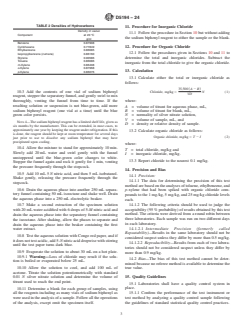
Table 1.
places, 1.680 g to 1.720 g silver nitrate, transfer quantitatively into a
1000 mL volumetric flask, make to mark with water, and mix well.
NOTE 2—It is generally more convenient to measure the liquid samples
by volume and then convert to mass using density or relative density.
Weight AgNO
Table 2 lists the relative densities of several pure hydrocarbons. Densities
Normality of solution 5
169.9
of unknowns may be determined by using Test Methods D891, D3505 or
or (3) Dissolve 8.5 g silver nitrate in 500 mL water to give a 0.1 N
D4052.
solution. Weigh 0.09 g to 0.10 g of dried (105 °C) potassium chloride NOTE 3—Alternately, place the sample into a 125 mL bottle and weigh.
to the nearest 0.1 mg into a 250 mL electrolytic beaker, add
...
This document is not an ASTM standard and is intended only to provide the user of an ASTM standard an indication of what changes have been made to the previous version. Because
it may not be technically possible to adequately depict all changes accurately, ASTM recommends that users consult prior editions as appropriate. In all cases only the current version
of the standard as published by ASTM is to be considered the official document.
Designation: D5194 − 18 D5194 − 24
Standard Test Method for
Trace Chloride in Liquid Aromatic Hydrocarbons
This standard is issued under the fixed designation D5194; the number immediately following the designation indicates the year of
original adoption or, in the case of revision, the year of last revision. A number in parentheses indicates the year of last reapproval. A
superscript epsilon (´) indicates an editorial change since the last revision or reapproval.
1. Scope*
1.1 This test method covers the determination of total chloride (organic and inorganic) in liquid aromatic hydrocarbons and
cyclohexane.
1.2 The test method is applicable to samples with chloride concentrations of 11 mg ⁄kg to 25 mg/kg.
1.3 Bromides and iodides, if present, will be calculated as chlorides.
1.4 Materials, such as styrene, that are polymerized by sodium biphenyl reagent cannot be analyzed by this test method.
1.5 In determining the conformance of the test results using this method to applicable specifications, results shall be rounded off
in accordance with the rounding-off method of Practice E29.
1.6 The values stated in SI units are to be regarded as standard. No other units of measurement are included in this standard.
1.7 This standard does not purport to address all of the safety concerns, if any, associated with its use. It is the responsibility
of the user of this standard to establish appropriate safety, health, and environmental practices and determine the applicability of
regulatory limitations prior to use. For a specific hazard statement, see Section 7.
1.8 This international standard was developed in accordance with internationally recognized principles on standardization
established in the Decision on Principles for the Development of International Standards, Guides and Recommendations issued
by the World Trade Organization Technical Barriers to Trade (TBT) Committee.
2. Referenced Documents
2.1 ASTM Standards:
D891 Test Methods for Specific Gravity, Apparent, of Liquid Industrial Chemicals
D1193 Specification for Reagent Water
D1555M Test Method for Calculation of Volume and Weight of Industrial Aromatic Hydrocarbons and Cyclohexane [Metric]
D3437 Practice for Sampling and Handling Liquid Cyclic Products
D3505 Test Method for Density or Relative Density of Pure Liquid Chemicals (Withdrawn 2023)
D4052 Test Method for Density, Relative Density, and API Gravity of Liquids by Digital Density Meter
This test method is under the jurisdiction of ASTM Committee D16 on Aromatic, Industrial, Specialty and Related Chemicals and is the direct responsibility of
Subcommittee D16.04 on Instrumental Analysis.
Current edition approved Jan. 1, 2018Jan. 1, 2024. Published January 2018January 2024. Originally approved in 1991. Last previous edition approved in 20132018 as
D5194 – 13.D5194 – 18. DOI: 10.1520/D5194-18.10.1520/D5194-24.
For referenced ASTM standards, visit the ASTM website, www.astm.org, or contact ASTM Customer Service at service@astm.org. For Annual Book of ASTM Standards
volume information, refer to the standard’s Document Summary page on the ASTM website.
The last approved version of this historical standard is referenced on www.astm.org.
*A Summary of Changes section appears at the end of this standard
Copyright © ASTM International, 100 Barr Harbor Drive, PO Box C700, West Conshohocken, PA 19428-2959. United States
D5194 − 24
D6809 Guide for Quality Control and Quality Assurance Procedures for Aromatic Hydrocarbons and Related Materials
E29 Practice for Using Significant Digits in Test Data to Determine Conformance with Specifications
2.2 Other Documents:
OSHA Regulations, 29 CFR paragraphs 1910.1000 and 1910.1200
3. Summary of Test Method
3.1 A known amount of hydrocarbon sample is transferred into a separatory funnel containing toluene. Sodium biphenyl reagent
is added to convert organic halogens into inorganic halides. The excess reagent is decomposed with water and the phases are
separated. The aqueous phase is acidified, washed, and concentrated. Acetone is added and the solution is titrated with silver nitrate
solution.
4. Significance and Use
4.1 Organic and inorganic chlorine compounds can have a deleterious effect on equipment and reactions in processes involving
aromatic hydrocarbons.
4.2 Maximum chloride levels are often specified for process streams and for aromatic hydrocarbon products.
5. Apparatus
5.1 Titrator, potentiometric, recording, + 2000 mV range, 1 mV resolution with dispenser having a volume readout of 0.000.00 mL
to 9.99 mL or 0.000.00 mL to 99.99 mL and 0.01 % resolution.
5.2 Electrode, glass, reference.
5.3 Electrode, silver, billet type.
6. Reagents and Materials
6.1 Purity of Reagents—Reagent grade chemicals shall be used in all tests. Unless otherwise indicated, it is intended that all
reagents conform to the specifications of the Committee on Analytical Reagents of the American Chemical Society, where such
specifications are available. Other grades may be used, provided it is first ascertained that the reagent is of sufficiently high purity
to permit its use without lessening the accuracy of the determination.
6.2 Purity of Water—Unless otherwise indicated, references to water shall be understood to mean reagent water as defined by
Types II or III of Specification D1193.
6.3 Acetone, 99.9 % purity.
6.4 Congo Red Paper.
6.5 Detergent, residue free.
6.6 Isobutanol, 99.9 % minimum purity.
6.7 Isooctane.
Available from U.S. Government Printing Office Superintendent of Documents, 732 N. Capitol St., NW, Mail Stop: SDE, Washington, DC 20401, http://
www.access.gpo.gov.
Reagent Chemicals, American Chemical Society Specifications,ACS Reagent Chemicals, Specifications and Procedures for Reagents and Standard-Grade Reference
Materials, American Chemical Society, Washington, DC. For suggestions on the testing of reagents not listed by the American Chemical Society, see Analar Standards for
Laboratory Chemicals, BDH Ltd., Poole, Dorset, U.K., and the United States Pharmacopeia and National Formulary, U.S. Pharmacopeial Convention, Inc. (USPC),
Rockville, MD.
D5194 − 24
6.8 Nitric Acid, concentrated.
6.9 Nitric Acid, 5-M. Dilute 160 mL concentrated nitric acid to 500 mL with water.
6.10 Potassium Chloride, primary standard.
6.11 Potassium Chloride Solution, saturated.
6.12 Scouring Powder, cleanser.
6.13 Silver Nitrate, 99.99 % minimum purity.
6.14 Silver Nitrate Solution, 0.01 N, standardized to 0.1 %.
NOTE 1—This solution may be obtained as follows:
(1) Purchase from a laboratory supply company, (2) Weigh to four places, 1.6801.680 g to 1.720 g silver nitrate, transfer quantitatively into a
1000-mL1000 mL volumetric flask, make to mark with water, and mix well.
Weight AgNO
Normality of solution 5
169.9
or (3) Dissolve 8.5 g silver nitrate in 500 mL 500 mL water to give a 0.1 N solution. Weigh 0.090.09 g to 0.10 g of dried (105°C)(105 °C) potas-
sium chloride to the nearest 0.1 mg into a 250-mL250 mL electrolytic beaker, add 100 mL of water and a stirring bar. While stirring, titrate with the
silver nitrate solution.
Weight KCl
Normality of AgNO solution 5
0.0746 ×mL AgNO
Pipet 50.00 mL of the solution into a 500-mL500 mL volumetric flask, dilute to mark with water, and mix well. Divide the calculated normality of
the 0.1 N solution by 10 to give the normality of final AgNO solution.
6.15 Sodium Biphenyl Reagent—The reagent is normally packed in individual vials that contain 0.2 to 0.4 g 0.2 g to 0.4 g of active
sodium each.
6.16 Toluene, 99.9 % minimum purity.
7. Hazards
7.1 A material, such as styrene, which is polymerized by sodium biphenyl can cause a violent reaction and should never be used
as the sample.
7.2 Consult current OSHA regulations and suppliers’ Safety Data Sheets, and local regulations for all materials used in this test
method.
8. Sampling
8.1 Refer to Practice D3437 for proper sampling and handling of liquid hydrocarbons analyzed by this test method.
9. Electrode Preparation
9.1 Clean the surface of the silver electrode with mild detergent and scouring powder, and rinse with water.
TABLE 1 Specimen Size
Estimated chloride, mg/kg Specimen volume, mL
0 to 5 100
5 to 25 50
D5194 − 24
TABLE 2 Densities of Hydrocarbons
Density in vacuo
Component at 20°C20 °C
g/cc
Benzene 0.87908
Cyclohexane 0.77849
Ethylbenzene 0.86685
Isopropylbenzene (cumene) 0.86160
Styrene 0.90586
Toluene 0.86686
m-Xylene 0.86408
o-Xylene 0.87968
p-Xylene 0
...