

ASTM D7977-23
(Test Method)Standard Test Methods for Polymer Content of AMS (α-Methylstyrene)
General Information
- Abstract
SIGNIFICANCE AND USE
4.1 This test method can be used for determining polymer concentrations in AMS monomer.
4.2 This test method will not detect dimers and trimers.
4.3 This test method can be used for plant control and for specification analysis. Information regarding plant control and specification analysis can be found in test method D6367.
SCOPE
1.1 This test method covers the determination of the polymer content of AMS (α-Methylstyrene). Dimers and trimers are not measured by these test methods.
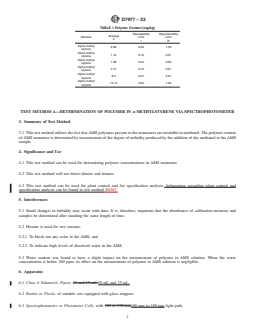
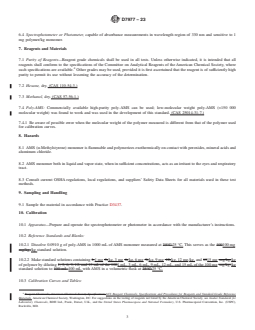
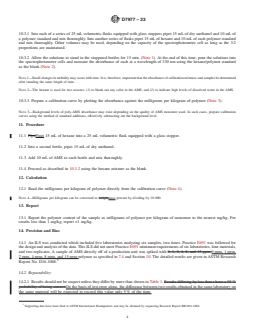
1.2 This test method has been found applicable to determining the polymer content of AMS in concentrations up to 15 mg/kg with an LOQ of 0.6 mg/kg and an LOD of 0.2 mg/kg based on the data in Table 1. Samples containing more than 15 mg/kg of polymer must be suitably diluted before measurement.
1.3 In determining the conformance of the test results using this method to applicable specifications, results shall be rounded off in accordance with the rounding-off method of Practice E29.
1.4 The values stated in SI units are to be regarded as standard. No other units of measurement are included in this standard.
1.5 This standard does not purport to address all of the safety concerns, if any, associated with its use. It is the responsibility of the user of this standard to establish appropriate safety, health, and environmental practices and determine the applicability of regulatory limitations prior to use. For specific hazard statements, see Section 8.
1.6 This international standard was developed in accordance with internationally recognized principles on standardization established in the Decision on Principles for the Development of International Standards, Guides and Recommendations issued by the World Trade Organization Technical Barriers to Trade (TBT) Committee.
- Status
- Published
- Publication Date
- 31-Mar-2023
- Technical Committee
- D16 - Aromatic, Industrial, Specialty and Related Chemicals
- Drafting Committee
- D16.07 - Styrene, Ethylbenzene and C9 and C10 Aromatic Hydrocarbons

Overview
ASTM D7977-23: Standard Test Methods for Polymer Content of AMS (α-Methylstyrene) provides definitive procedures for determining the polymer concentration in α-methylstyrene (AMS) monomer. This standard, developed by ASTM International, is essential for producers, suppliers, and laboratories handling AMS to ensure product quality and compliance with specifications. The test methods included do not measure dimer or trimer formations but focus on quantifying polymeric impurities within AMS samples.
Key features of ASTM D7977-23 include specific guidance for detection limits, reporting units in SI, and strong alignment with international standardization principles. These methods support plant process control and specification analysis, helping industry stakeholders maintain product integrity and regulatory conformity.
Key Topics
- Polymer Content Determination: Focuses on methods for measuring polymer presence in AMS monomer, applicable for concentrations up to 15 mg/kg.
- Analytical Procedures: Includes both a spectrophotometric method (based on turbidity after methanol addition) and a visual assessment method for estimation of polymer levels.
- Detection Limits: Limit of quantification (LOQ) is 0.6 mg/kg, and limit of detection (LOD) is 0.2 mg/kg, ensuring sensitivity for quality control.
- Sample Handling: Outlines best practices for sampling and handling consistent with ASTM D3437, advocating for accuracy and reliability.
- Precision and Reproducibility: Details expectations for method repeatability and reproducibility to support reliable interlaboratory comparisons.
- Quality Assurance: Emphasizes maintaining robust QA/QC systems according to ASTM D6809 and encourages interlaboratory testing for improved confidence in results.
- Safety and Environmental Considerations: Stresses the importance of compliance with current safety, health, and regulatory guidelines when handling AMS.
Applications
ASTM D7977-23 is applied across several critical areas in the chemical and petrochemical industries:
- Plant Process Control: Enables producers to monitor and control the polymer content in AMS during production, minimizing off-spec product and optimizing process efficiency.
- Specification Compliance: Laboratories can use these methods to verify conformity to customer and regulatory specifications, supporting contractual and safety requirements.
- Quality Assurance Programs: Regular testing per ASTM D7977-23 helps ensure consistent AMS quality, particularly for manufacturers supplying AMS as a feedstock for further chemical synthesis.
- Material Acceptance: Provides a standardized approach for buyers and sellers to agree on AMS polymer content, facilitating fair trade and reducing disputes.
- Research and Development: Supports laboratories involved in developing improved AMS purification processes and analytical methodologies.
Related Standards
Several ASTM standards and other referenced documents complement and support the application of ASTM D7977-23, including:
- ASTM D3437: Practice for Sampling and Handling Liquid Cyclic Products - fundamental for obtaining representative AMS samples.
- ASTM D6367: Specification for AMS (α-Methylstyrene) - defines product specifications and provides further plant control guidance.
- ASTM D6809: Guide for Quality Control and Quality Assurance Procedures for Aromatic Hydrocarbons and Related Materials.
- ASTM E29: Practice for Using Significant Digits in Test Data to Determine Conformance with Specifications.
- ASTM E691: Practice for Conducting an Interlaboratory Study to Determine the Precision of a Test Method.
- OSHA 29 CFR 1910.1000 and 1910.1200: Relevant US Occupational Safety and Health Administration standards for workplace chemical safety.
Conclusion
ASTM D7977-23 is a crucial standard for those involved in the production, analysis, or commercial exchange of α-methylstyrene. By following these test methods, organizations ensure the polymer content of AMS is accurately measured, supporting both regulatory compliance and high product quality. For industries handling AMS, adherence to this standard solidifies trust in material characterization and supports best-in-class operational practices.
Relations
- Effective Date
- 01-Nov-2016
- Effective Date
- 01-Jul-2016
- Effective Date
- 01-May-2013
- Effective Date
- 01-Dec-2012
- Effective Date
- 01-Nov-2011
- Effective Date
- 01-Jan-2011
- Effective Date
- 01-Jun-2010
- Effective Date
- 01-Oct-2008
- Effective Date
- 01-Oct-2008
- Effective Date
- 01-Jul-2008
- Effective Date
- 01-Jun-2008
- Effective Date
- 01-Jun-2007
- Effective Date
- 15-Nov-2006
- Effective Date
- 15-Sep-2006
- Effective Date
- 01-May-2006
Get Certified
Connect with accredited certification bodies for this standard

ECOCERT
Organic and sustainability certification.

Eurofins Food Testing Global
Global leader in food, environment, and pharmaceutical product testing.

Intertek Bangladesh
Intertek certification and testing services in Bangladesh.
Sponsored listings
Frequently Asked Questions
ASTM D7977-23 is a standard published by ASTM International. Its full title is "Standard Test Methods for Polymer Content of AMS (α-Methylstyrene)". This standard covers: SIGNIFICANCE AND USE 4.1 This test method can be used for determining polymer concentrations in AMS monomer. 4.2 This test method will not detect dimers and trimers. 4.3 This test method can be used for plant control and for specification analysis. Information regarding plant control and specification analysis can be found in test method D6367. SCOPE 1.1 This test method covers the determination of the polymer content of AMS (α-Methylstyrene). Dimers and trimers are not measured by these test methods. 1.2 This test method has been found applicable to determining the polymer content of AMS in concentrations up to 15 mg/kg with an LOQ of 0.6 mg/kg and an LOD of 0.2 mg/kg based on the data in Table 1. Samples containing more than 15 mg/kg of polymer must be suitably diluted before measurement. 1.3 In determining the conformance of the test results using this method to applicable specifications, results shall be rounded off in accordance with the rounding-off method of Practice E29. 1.4 The values stated in SI units are to be regarded as standard. No other units of measurement are included in this standard. 1.5 This standard does not purport to address all of the safety concerns, if any, associated with its use. It is the responsibility of the user of this standard to establish appropriate safety, health, and environmental practices and determine the applicability of regulatory limitations prior to use. For specific hazard statements, see Section 8. 1.6 This international standard was developed in accordance with internationally recognized principles on standardization established in the Decision on Principles for the Development of International Standards, Guides and Recommendations issued by the World Trade Organization Technical Barriers to Trade (TBT) Committee.
SIGNIFICANCE AND USE 4.1 This test method can be used for determining polymer concentrations in AMS monomer. 4.2 This test method will not detect dimers and trimers. 4.3 This test method can be used for plant control and for specification analysis. Information regarding plant control and specification analysis can be found in test method D6367. SCOPE 1.1 This test method covers the determination of the polymer content of AMS (α-Methylstyrene). Dimers and trimers are not measured by these test methods. 1.2 This test method has been found applicable to determining the polymer content of AMS in concentrations up to 15 mg/kg with an LOQ of 0.6 mg/kg and an LOD of 0.2 mg/kg based on the data in Table 1. Samples containing more than 15 mg/kg of polymer must be suitably diluted before measurement. 1.3 In determining the conformance of the test results using this method to applicable specifications, results shall be rounded off in accordance with the rounding-off method of Practice E29. 1.4 The values stated in SI units are to be regarded as standard. No other units of measurement are included in this standard. 1.5 This standard does not purport to address all of the safety concerns, if any, associated with its use. It is the responsibility of the user of this standard to establish appropriate safety, health, and environmental practices and determine the applicability of regulatory limitations prior to use. For specific hazard statements, see Section 8. 1.6 This international standard was developed in accordance with internationally recognized principles on standardization established in the Decision on Principles for the Development of International Standards, Guides and Recommendations issued by the World Trade Organization Technical Barriers to Trade (TBT) Committee.
ASTM D7977-23 is classified under the following ICS (International Classification for Standards) categories: 71.080.15 - Aromatic hydrocarbons. The ICS classification helps identify the subject area and facilitates finding related standards.
ASTM D7977-23 has the following relationships with other standards: It is inter standard links to ASTM D6809-02(2016), ASTM D6367-16, ASTM E691-13, ASTM D6367-12, ASTM E691-11, ASTM D3437-11, ASTM D3437-10, ASTM E691-08, ASTM E29-08, ASTM D6367-04(2008), ASTM D3437-08, ASTM D6809-02(2007), ASTM E29-06b, ASTM E29-06a, ASTM E29-06. Understanding these relationships helps ensure you are using the most current and applicable version of the standard.
ASTM D7977-23 is available in PDF format for immediate download after purchase. The document can be added to your cart and obtained through the secure checkout process. Digital delivery ensures instant access to the complete standard document.
Standards Content (Sample)
This international standard was developed in accordance with internationally recognized principles on standardization established in the Decision on Principles for the
Development of International Standards, Guides and Recommendations issued by the World Trade Organization Technical Barriers to Trade (TBT) Committee.
Designation: D7977 − 23
Standard Test Methods for
Polymer Content of AMS (α-Methylstyrene)
This standard is issued under the fixed designation D7977; the number immediately following the designation indicates the year of
original adoption or, in the case of revision, the year of last revision. A number in parentheses indicates the year of last reapproval. A
superscript epsilon (´) indicates an editorial change since the last revision or reapproval.
1. Scope* D3437 Practice for Sampling and Handling Liquid Cyclic
Products
1.1 This test method covers the determination of the poly-
D6367 Specification for AMS (α-Methylstyrene)
mer content of AMS (α-Methylstyrene). Dimers and trimers are
D6809 Guide for Quality Control and Quality Assurance
not measured by these test methods.
Procedures for Aromatic Hydrocarbons and Related Ma-
1.2 This test method has been found applicable to determin-
terials
ing the polymer content of AMS in concentrations up to
E29 Practice for Using Significant Digits in Test Data to
15 mg ⁄kg with an LOQ of 0.6 mg/kg and an LOD of 0.2 mg/kg
Determine Conformance with Specifications
based on the data in Table 1. Samples containing more than 15
E691 Practice for Conducting an Interlaboratory Study to
mg/kg of polymer must be suitably diluted before measure-
Determine the Precision of a Test Method
ment. 3
2.2 Other Document:
1.3 In determining the conformance of the test results using OSHA Regulations, 29 CFR paragraphs 1910.1000 and
this method to applicable specifications, results shall be
1910.1200
rounded off in accordance with the rounding-off method of
TEST METHOD A—DETERMINATION OF POLYMER
Practice E29.
IN α-METHYLSTYRENE VIA
1.4 The values stated in SI units are to be regarded as
SPECTROPHOTOMETER
standard. No other units of measurement are included in this
standard.
3. Summary of Test Method
1.5 This standard does not purport to address all of the
3.1 This test method utilizes the fact that AMS polymers
safety concerns, if any, associated with its use. It is the
present in the monomers are insoluble in methanol. The
responsibility of the user of this standard to establish appro-
polymer content of AMS monomer is determined by measure-
priate safety, health, and environmental practices and deter-
ment of the degree of turbidity produced by the addition of dry
mine the applicability of regulatory limitations prior to use.
methanol to the AMS sample.
For specific hazard statements, see Section 8.
1.6 This international standard was developed in accor- 4. Significance and Use
dance with internationally recognized principles on standard-
4.1 This test method can be used for determining polymer
ization established in the Decision on Principles for the
concentrations in AMS monomer.
Development of International Standards, Guides and Recom-
4.2 This test method will not detect dimers and trimers.
mendations issued by the World Trade Organization Technical
Barriers to Trade (TBT) Committee.
4.3 This test method can be used for plant control and for
specification analysis. Information regarding plant control and
2. Referenced Documents
specification analysis can be found in test method D6367.
2.1 ASTM Standards:
5. Interferences
5.1 Small changes in turbidity may occur with time. It is,
These test methods are under the jurisdiction of ASTM Committee D16 on
therefore, important that the absorbance of calibration mixtures
Aromatic, Industrial, Specialty and Related Chemicals and is the direct responsi-
and samples be determined after standing the same length of
bility of Subcommittee D16.07 on Styrene, Ethylbenzene and C9 and C10 Aromatic
Hydrocarbons. time.
Current edition approved April 1, 2023. Published April 2023. Originally
5.2 Hexane is used for two reasons:
approved in 2014. Last previous edition approved in 2019 as D7977 – 19. DOI:
10.1520/D7977-23.
For referenced ASTM standards, visit the ASTM website, www.astm.org, or
contact ASTM Customer Service at service@astm.org. For Annual Book of ASTM Available from U.S. Government Printing Office Superintendent of Documents,
Standards volume information, refer to the standard’s Document Summary page on 732 N. Capitol St., NW, Mail Stop: SDE, Washington, DC 20401, http://
the ASTM website. www.access.gpo.gov.
*A Summary of Changes section appears at the end of this standard
Copyright © ASTM International, 100 Barr Harbor Drive, PO Box C700, West Conshohocken, PA 19428-2959. United States
D7977 − 23
TABLE 1 Polymer Content (mg/kg)
8. Hazards
Repeatability Reproducibility
Average 8.1 AMS (α-Methylstyrene) monomer is flammable and
Material Limit Limit
X
polymerizes exothermically on contact with peroxides, mineral
r R
acids and aluminum chloride.
Alpha methyl
0.56 0.04 1.55
styrene
8.2 AMS monomer both in liquid and vapor state, when in
Alpha methyl
1.12 0.16 0.51
styrene sufficient concentrations, acts as an irritant to the eyes and
Alpha methyl
respiratory tract.
1.89 0.24 0.69
styrene
Alpha methyl
8.3 Consult current OSHA regulations, local regulations,
3.77 0.10 0.61
styrene
and suppliers’ Safety Data Sheets for all materials used in these
Alpha methyl
8.4 0.27 2.57
test methods.
styrene
Alpha methyl
15.14 0.62 1.65
styrene
9. Sampling and Handling
9.1 Sample the material in accordance with Practice D3437.
5.2.1 To block out any color in the AMS, and
10. Calibration
5.2.2 To indicate high levels of dissolved water in the AMS.
10.1 Apparatus—Prepare and operate the spectrophotom-
5.3 Water content was found to have a slight impact on the
eter or photometer in accordance with the manufacturer’s
measurement of polymer in AMS solution. When the water
instructions.
concentration is below 260 ppm, its effect on the measurement
10.2 Reference Standards and Blanks:
of polymer in AMS solution is negligible.
10.2.1 Dissolve 0.0910 g of poly-AMS in 1000 mL of AMS
6. Apparatus
monomer measured at 25 °C. This serves as the 100 mg ⁄kg
standard solution.
6.1 Class A Volumetric Pipets, 10 mL and 15 mL.
10.2.2 Make standard solutions containing 1 mg ⁄kg,
6.2 Bottles or Flasks, of suitable size equipped with glass
3 mg ⁄kg, 6 mg ⁄kg, 9 mg ⁄kg, 12 mg ⁄kg, and 15 mg ⁄kg of
stoppers.
polymer by diluting 1 mL, 3 mL, 6 mL, 9 mL, 12 mL, and
6.3 Spectrophotometer or Photometer Cells, with 100 mm 15 mL of the 100 mg ⁄kg standard solution to 100 mL with
to 150 mm light path.
AMS in a volumetric flask at 25 °C.
6.4 Spectrophotometer or Photometer, capable of absor- 10.3 Calibration Curves and Tables:
bance measurements in wavelength region of 330 nm and
10.3.1 Into each of a series of 25 mL volumetric flasks
sensitive to 1 mg polymer/kg monomer. equipped with glass stoppers pipet 15 mL of dry methanol and
10 mL of a polymer standard and mix thoroughly. Into another
7. Reagents and Materials
series of flasks pipet 15 mL of hexane and 10 mL of each
7.1 Purity of Reagents—Reagent grade chemicals shall be polymer standard and mix thoroughly. Other volumes may be
used, depending on the capacity of the spectrophotometer cell
used in all tests. Unless otherwise indicated, it is intended that
all reagents shall conform to the specifications of the Commit- as long as the 3:2 proportions are maintained.
10.3.2 Allow the solutions to stand in the stoppered bottles
tee on Analytical Reagents of the American Chemical Society,
where such specifications are available. Other grades may be for 15 min. (Note 1). At the end of this time, pour the solutions
used, provided it is first ascertained that the reagent is of into the spectrophotometer cells and measure the absorbance of
each at a wavelength of 330 nm using the hexane/polymer
sufficiently high purity to permit its use without lessening the
accuracy of the determination. standard as the blank (Note 2).
7.2 Hexane, dry. (CAS 110-54-3.) NOTE 1—Small changes in turbidity may occur with time. It is,
therefore, important that the absorbance of calibration mixtures and
7.3 Methanol, dry. (CAS 57-56-1.)
samples be determined after standing the same length of time.
NOTE 2—The hexane is used for two reasons: (1) to blank out any color
7.4 Poly-AMS: Commercially available high-purity poly-
in the AMS, and (2) to indicate high levels of dissolved water in the AMS.
AMS can be used; low-molecular weight poly-AMS (<150 000
10.3.3 Prepare a calibration curve by plotting the absor-
molecular weight) was found to work and was used
...
This document is not an ASTM standard and is intended only to provide the user of an ASTM standard an indication of what changes have been made to the previous version. Because
it may not be technically possible to adequately depict all changes accurately, ASTM recommends that users consult prior editions as appropriate. In all cases only the current version
of the standard as published by ASTM is to be considered the official document.
Designation: D7977 − 19 D7977 − 23
Standard Test Methods for
Polymer Content of AMS (α-Methylstyrene)
This standard is issued under the fixed designation D7977; the number immediately following the designation indicates the year of
original adoption or, in the case of revision, the year of last revision. A number in parentheses indicates the year of last reapproval. A
superscript epsilon (´) indicates an editorial change since the last revision or reapproval.
1. Scope*
1.1 This test method covers the determination of the polymer content of AMS (α-Methystyrene).(α-Methylstyrene). Dimers and
trimers are not measured by these test methods.
1.2 This test method has been found applicable to determining the polymer content of AMS in concentrations up to 1515 mg
mg/kg ⁄kg with an LOQ of 0.6 mg/kg and an LOD of 0.2 mg/kg. mg/kg based on the data in Table 1. Samples containing more
than 15 mg/kg of polymer must be suitably diluted before measurement.
1.3 In determining the conformance of the test results using this method to applicable specifications, results shall be rounded off
in accordance with the rounding-off method of Practice E29.
1.4 The values stated in SI units are to be regarded as standard. No other units of measurement are included in this standard.
1.5 This standard does not purport to address all of the safety concerns, if any, associated with its use. It is the responsibility
of the user of this standard to establish appropriate safety, health, and environmental practices and determine the applicability of
regulatory limitations prior to use. For specific hazard statements, see Section 8.
1.6 This international standard was developed in accordance with internationally recognized principles on standardization
established in the Decision on Principles for the Development of International Standards, Guides and Recommendations issued
by the World Trade Organization Technical Barriers to Trade (TBT) Committee.
2. Referenced Documents
2.1 ASTM Standards:
D3437 Practice for Sampling and Handling Liquid Cyclic Products
D6367 Specification for AMS (α-Methylstyrene)
D6809 Guide for Quality Control and Quality Assurance Procedures for Aromatic Hydrocarbons and Related Materials
E29 Practice for Using Significant Digits in Test Data to Determine Conformance with Specifications
E691 Practice for Conducting an Interlaboratory Study to Determine the Precision of a Test Method
2.2 Other Document:
OSHA Regulations, 29 CFR paragraphs 1910.1000 and 1910.1200
These test methods are under the jurisdiction of ASTM Committee D16 on Aromatic, Industrial, Specialty and Related Chemicals and is the direct responsibility of
Subcommittee D16.07 on Styrene, Ethylbenzene and C9 and C10 Aromatic Hydrocarbons.
Current edition approved June 1, 2019April 1, 2023. Published June 2019April 2023. Originally approved in 2014. Last previous edition approved in 20142019 as
D7977 – 14.D7977 – 19. DOI: 10.1520/D7977-19.10.1520/D7977-23.
For referenced ASTM standards, visit the ASTM website, www.astm.org, or contact ASTM Customer Service at service@astm.org. For Annual Book of ASTM Standards
volume information, refer to the standard’s Document Summary page on the ASTM website.
Available from U.S. Government Printing Office Superintendent of Documents, 732 N. Capitol St., NW, Mail Stop: SDE, Washington, DC 20401, http://
www.access.gpo.gov.
*A Summary of Changes section appears at the end of this standard
Copyright © ASTM International, 100 Barr Harbor Drive, PO Box C700, West Conshohocken, PA 19428-2959. United States
D7977 − 23
TABLE 1 Polymer Content (mg/kg)
Repeatability Reproducibility
Average
Material Limit Limit
X
r R
Alpha methyl
0.56 0.04 1.55
styrene
Alpha methyl
1.12 0.16 0.51
styrene
Alpha methyl
1.89 0.24 0.69
styrene
Alpha methyl
3.77 0.10 0.61
styrene
Alpha methyl
8.4 0.27 2.57
styrene
Alpha methyl
15.14 0.62 1.65
styrene
TEST METHOD A—DETERMINATION OF POLYMER IN α-METHYLSTYRENE VIA SPECTROPHOTOMETER
3. Summary of Test Method
3.1 This test method utilizes the fact that AMS polymers present in the monomers are insoluble in methanol. The polymer content
of AMS monomer is determined by measurement of the degree of turbidity produced by the addition of dry methanol to the AMS
sample.
4. Significance and Use
4.1 This test method can be used for determining polymer concentrations in AMS monomer.
4.2 This test method will not detect dimers and trimers.
4.3 This test method can be used for plant control and for specification analysis. Information regarding plant control and
specification analysis can be found in test method D6367.
5. Interferences
5.1 Small changes in turbidity may occur with time. It is, therefore, important that the absorbance of calibration mixtures and
samples be determined after standing the same length of time.
5.2 Hexane is used for two reasons:
5.2.1 To block out any color in the AMS, and
5.2.2 To indicate high levels of dissolved water in the AMS.
5.3 Water content was found to have a slight impact on the measurement of polymer in AMS solution. When the water
concentration is below 260 ppm, its effect on the measurement of polymer in AMS solution is negligible.
6. Apparatus
6.1 Class A Volumetric Pipets, 10 and 15-mL.10 mL and 15 mL.
6.2 Bottles or Flasks, of suitable size equipped with glass stoppers.
6.3 Spectrophotometer or Photometer Cells, with 100 to 150-mm100 mm to 150 mm light path.
D7977 − 23
6.4 Spectrophotometer or Photometer, capable of absorbance measurements in wavelength region of 330 nm and sensitive to 1
mg polymer/kg monomer.
7. Reagents and Materials
7.1 Purity of Reagents—Reagent grade chemicals shall be used in all tests. Unless otherwise indicated, it is intended that all
reagents shall conform to the specifications of the Committee on Analytical Reagents of the American Chemical Society, where
such specifications are available. Other grades may be used, provided it is first ascertained that the reagent is of sufficiently high
purity to permit its use without lessening the accuracy of the determination.
7.2 Hexane, dry. (CAS 110-54-3.)
7.3 Methanol, dry. (CAS 57-56-1.)
7.4 Poly-AMS: Commercially available high-purity poly-AMS can be used; low-molecular weight poly-AMS (<150 000
molecular weight) was found to work and was used in the development of this standard. (CAS 25014-31-7.)
7.4.1 Be aware of possible error when the molecular weight of the polymer measured is different from that of the polymer used
for calibration curves.
8. Hazards
8.1 AMS (α-Methylstyrene) monomer is flammable and polymerizes exothermically on contact with peroxides, mineral acids and
aluminum chloride.
8.2 AMS monomer both in liquid and vapor state, when in sufficient concentrations, acts as an irritant to the eyes and respiratory
tract.
8.3 Consult current OSHA regulations, local regulations, and suppliers’ Safety Data Sheets for all materials used in these test
methods.
9. Sampling and Handling
9.1 Sample the material in accordance with Practice D3437.
10. Calibration
10.1 Apparatus—Prepare and operate the spectrophotometer or photometer in accordance with the manufacturer’s instructions.
10.2 Reference Standards and Blanks:
10.2.1 Dissolve 0.0910 g of poly-AMS in 1000 mL of AMS monomer measured at 25°C.25 °C. This serves as the 100100 mg
mg/kg ⁄kg standard solution.
10.2.2 Make standard solutions containing 1,1 mg 3,⁄kg, 3 mg 6,⁄kg, 6 mg 9,⁄kg, 9 mg 12,⁄kg, 12 mg ⁄kg, and 1515 mg mg/kg ⁄kg
of polymer by diluting 1, 3, 6, 9, 12, and 15 mL of the 1001 mL, 3 mL, 6 mL, 9 mL, 12 mL, and 15 mL of the 100 mg mg/kg ⁄kg
standard solution to 100 mL 100 mL with AMS in a volumetric flask at 25°C.25 °C.
10.3 Calibration Curves and Tables:
Reagent Chemicals, American Chemical Society Specifications,ACS Reagent Chemicals, Specifications and Procedures for Reagents and Standard-Grade Reference
Materials, American Chemical Society, Washington, DC. For suggestions on the testing of reagents not listed by the American Chemical Society, see Analar Standards for
Laboratory Chemicals, BDH Ltd., Poole, Dorset, U.K., and the United States Pharmacopeia and National Formulary, U.S. Pharmacopeial Convention, Inc. (USPC),
Rockville, MD.
D7977 − 23
10.3.1 Into each of a series of 25 mL volumetric flasks equipped with glass stoppers pipet 15 mL of dry methanol and 10 mL of
a polymer standard and mix thoroughly. Into another series of flasks pipet 15 mL of hexane and 10 mL of each polymer standard
and mix thoroughly. Other volumes may be used, depending on the capacity of the spectrophotometer cell as long as the 3:
...