

ASTM D2232-23
(Test Method)Standard Test Method for Evaporating Residue of Naphthalene
General Information
- Abstract
SIGNIFICANCE AND USE
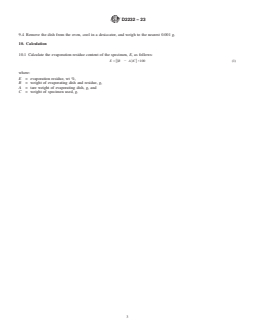
5.1 Evaporation residue is an empirical measure of nonvolatile impurities in naphthalene. This test method is suitable for setting specifications and for use as an internal quality control tool.
SCOPE
1.1 This test method covers the determination of the evaporation residue of naphthalene.
1.2 This test method has been found applicable to determining residue in the range of 0.3 and 1.5 wt %.
1.3 In determining the conformance of the test results using this method to applicable specifications, results shall be rounded off in accordance with the rounding-off method of Practice E29.
1.4 The values stated in SI units are to be regarded as standard. No other units of measurement are included in this standard.
1.5 This standard does not purport to address all of the safety concerns, if any, associated with its use. It is the responsibility of the user of this standard to establish appropriate safety, health, and environmental practices and determine the applicability of regulatory limitations prior to use. For specific hazard statements, see Section 7, 8.1, 9.2, and 9.3.
1.6 This international standard was developed in accordance with internationally recognized principles on standardization established in the Decision on Principles for the Development of International Standards, Guides and Recommendations issued by the World Trade Organization Technical Barriers to Trade (TBT) Committee.
- Status
- Published
- Publication Date
- 31-Mar-2023
- Technical Committee
- D16 - Aromatic, Industrial, Specialty and Related Chemicals
- Drafting Committee
- D16.07 - Styrene, Ethylbenzene and C9 and C10 Aromatic Hydrocarbons


Overview
ASTM D2232-23: Standard Test Method for Evaporating Residue of Naphthalene describes a precise laboratory procedure for determining the evaporation residue in naphthalene. This test method is designed for quality assessment and specification of naphthalene by quantifying nonvolatile impurities. Developed by ASTM International, it aligns with internationally recognized standardization principles and is applicable for both internal quality control and for meeting client or regulatory requirements.
Naphthalene, commonly derived from coal tar and petroleum processes, is widely used in industrial applications such as chemical synthesis and production of phthalic anhydride. High purity and low levels of residue are critical to its performance, making standardized testing essential.
Key Topics
- Purpose: Measures nonvolatile impurities remaining after evaporating a weighed sample of naphthalene.
- Applicability: Reliable for measuring residue content within the 0.3 to 1.5 wt % range.
- Method Summary:
- A fixed quantity of solid naphthalene is weighed and heated in a tared (pre-weighed) dish for 3 hours at 105°C in a forced-draft oven.
- After cooling, the remaining residue is precisely weighed.
- Quality Assurance:
- Results are rounded according to ASTM E29 guidelines.
- Laboratories must use appropriate quality control samples or statistical processes based on ASTM D6809 or other accepted practices.
- Interlaboratory comparison is encouraged for performance validation.
- Safety and Compliance:
- Users are responsible for adhering to safety, health, and environmental protocols.
- Complies with OSHA regulations and local safety requirements.
Applications
ASTM D2232-23 is widely used in:
- Industrial Quality Control: Consistently verifying the nonvolatile residue in production batches of naphthalene for compliance with industry or customer specifications.
- Specification Setting: Determining acceptable impurity levels for naphthalene used in critical applications, such as in chemical manufacturing, dyes, and synthetic resins.
- Supplier and Customer Assurance: Allowing producers, buyers, and regulatory agencies to compare and assess product quality objectively.
- Research and Development: Supporting technical studies where the purity of naphthalene may influence chemical processes or application outcomes.
Proper implementation of this standard fosters transparency, product reliability, and trade efficiency in industries reliant on naphthalene.
Related Standards
ASTM D2232-23 references and is associated with several other ASTM standards to ensure methodological integrity and traceability:
- ASTM D3438: Practice for Sampling and Handling Naphthalene and Related By-Products
- ASTM D4790: Terminology for Aromatic Hydrocarbons and Related Chemicals
- ASTM D6809: Guide for Quality Control and Assurance Procedures for Aromatic Hydrocarbons
- ASTM E29: Practice for Use of Significant Digits in Test Data
- ASTM E145: Specification for Ovens Used in Laboratory Testing
- ASTM E691: Practice for Conducting Interlaboratory Studies of Test Methods
Other relevant regulatory frameworks include OSHA standards for safe handling of toxic and hazardous substances (29 CFR 1910.1000 and 1910.1200).
Keywords: naphthalene, evaporation residue, ASTM D2232-23, nonvolatile impurities, quality control, laboratory test method, aromatic hydrocarbons, industrial standards, chemical purity, ASTM.
Relations
- Effective Date
- 01-Nov-2019
- Effective Date
- 01-Mar-2019
- Effective Date
- 01-Nov-2016
- Effective Date
- 01-Jul-2014
- Effective Date
- 01-May-2013
- Refers
ASTM E145-94(2011) - Standard Specification for Gravity-Convection and Forced-Ventilation Ovens - Effective Date
- 01-Dec-2011
- Effective Date
- 01-Nov-2011
- Effective Date
- 01-Feb-2011
- Effective Date
- 01-Jun-2010
- Effective Date
- 01-Oct-2008
- Effective Date
- 01-Oct-2008
- Effective Date
- 15-Jul-2007
- Effective Date
- 01-Jun-2007
- Effective Date
- 01-Jan-2007
- Effective Date
- 15-Nov-2006
Get Certified
Connect with accredited certification bodies for this standard

ECOCERT
Organic and sustainability certification.

Eurofins Food Testing Global
Global leader in food, environment, and pharmaceutical product testing.

Intertek Bangladesh
Intertek certification and testing services in Bangladesh.
Sponsored listings
Frequently Asked Questions
ASTM D2232-23 is a standard published by ASTM International. Its full title is "Standard Test Method for Evaporating Residue of Naphthalene". This standard covers: SIGNIFICANCE AND USE 5.1 Evaporation residue is an empirical measure of nonvolatile impurities in naphthalene. This test method is suitable for setting specifications and for use as an internal quality control tool. SCOPE 1.1 This test method covers the determination of the evaporation residue of naphthalene. 1.2 This test method has been found applicable to determining residue in the range of 0.3 and 1.5 wt %. 1.3 In determining the conformance of the test results using this method to applicable specifications, results shall be rounded off in accordance with the rounding-off method of Practice E29. 1.4 The values stated in SI units are to be regarded as standard. No other units of measurement are included in this standard. 1.5 This standard does not purport to address all of the safety concerns, if any, associated with its use. It is the responsibility of the user of this standard to establish appropriate safety, health, and environmental practices and determine the applicability of regulatory limitations prior to use. For specific hazard statements, see Section 7, 8.1, 9.2, and 9.3. 1.6 This international standard was developed in accordance with internationally recognized principles on standardization established in the Decision on Principles for the Development of International Standards, Guides and Recommendations issued by the World Trade Organization Technical Barriers to Trade (TBT) Committee.
SIGNIFICANCE AND USE 5.1 Evaporation residue is an empirical measure of nonvolatile impurities in naphthalene. This test method is suitable for setting specifications and for use as an internal quality control tool. SCOPE 1.1 This test method covers the determination of the evaporation residue of naphthalene. 1.2 This test method has been found applicable to determining residue in the range of 0.3 and 1.5 wt %. 1.3 In determining the conformance of the test results using this method to applicable specifications, results shall be rounded off in accordance with the rounding-off method of Practice E29. 1.4 The values stated in SI units are to be regarded as standard. No other units of measurement are included in this standard. 1.5 This standard does not purport to address all of the safety concerns, if any, associated with its use. It is the responsibility of the user of this standard to establish appropriate safety, health, and environmental practices and determine the applicability of regulatory limitations prior to use. For specific hazard statements, see Section 7, 8.1, 9.2, and 9.3. 1.6 This international standard was developed in accordance with internationally recognized principles on standardization established in the Decision on Principles for the Development of International Standards, Guides and Recommendations issued by the World Trade Organization Technical Barriers to Trade (TBT) Committee.
ASTM D2232-23 is classified under the following ICS (International Classification for Standards) categories: 71.080.15 - Aromatic hydrocarbons. The ICS classification helps identify the subject area and facilitates finding related standards.
ASTM D2232-23 has the following relationships with other standards: It is inter standard links to ASTM D3438-19, ASTM E145-19, ASTM D6809-02(2016), ASTM D4790-14, ASTM E691-13, ASTM E145-94(2011), ASTM E691-11, ASTM D4790-11, ASTM D3438-10, ASTM E691-08, ASTM E29-08, ASTM D4790-07, ASTM D6809-02(2007), ASTM D3438-07, ASTM E29-06b. Understanding these relationships helps ensure you are using the most current and applicable version of the standard.
ASTM D2232-23 is available in PDF format for immediate download after purchase. The document can be added to your cart and obtained through the secure checkout process. Digital delivery ensures instant access to the complete standard document.
Standards Content (Sample)
This international standard was developed in accordance with internationally recognized principles on standardization established in the Decision on Principles for the
Development of International Standards, Guides and Recommendations issued by the World Trade Organization Technical Barriers to Trade (TBT) Committee.
Designation: D2232 − 23
Standard Test Method for
Evaporating Residue of Naphthalene
This standard is issued under the fixed designation D2232; the number immediately following the designation indicates the year of
original adoption or, in the case of revision, the year of last revision. A number in parentheses indicates the year of last reapproval. A
superscript epsilon (´) indicates an editorial change since the last revision or reapproval.
1. Scope* Procedures for Aromatic Hydrocarbons and Related Ma-
terials
1.1 This test method covers the determination of the evapo-
E29 Practice for Using Significant Digits in Test Data to
ration residue of naphthalene.
Determine Conformance with Specifications
1.2 This test method has been found applicable to determin-
E145 Specification for Gravity-Convection and Forced-
ing residue in the range of 0.3 and 1.5 wt %.
Ventilation Ovens
1.3 In determining the conformance of the test results using E691 Practice for Conducting an Interlaboratory Study to
Determine the Precision of a Test Method
this method to applicable specifications, results shall be
rounded off in accordance with the rounding-off method of
2.2 Other Document:
Practice E29. OSHA Regulations, 29 CFR 1910.1000 and
1910.1200 Toxic and Hazardous Substances – Air con-
1.4 The values stated in SI units are to be regarded as
taminants; Hazard Communication
standard. No other units of measurement are included in this
standard.
3. Terminology
1.5 This standard does not purport to address all of the
3.1 See Terminology D4790 for the definition of terms used
safety concerns, if any, associated with its use. It is the
in this test method.
responsibility of the user of this standard to establish appro-
priate safety, health, and environmental practices and deter-
4. Summary of Test Method
mine the applicability of regulatory limitations prior to use.
4.1 A weighed quantity of naphthalene is heated in a tared
For specific hazard statements, see Section 7, 8.1, 9.2, and 9.3.
dish for 3 h at 105 °C in a forced-draft oven and the residue is
1.6 This international standard was developed in accor-
weighed.
dance with internationally recognized principles on standard-
ization established in the Decision on Principles for the
5. Significance and Use
Development of International Standards, Guides and Recom-
5.1 Evaporation residue is an empirical measure of nonvola-
mendations issued by the World Trade Organization Technical
tile impurities in naphthalene. This test method is suitable for
Barriers to Trade (TBT) Committee.
setting specifications and for use as an internal quality control
2. Referenced Documents tool.
2.1 ASTM Standards:
6. Apparatus
D3438 Practice for Sampling and Handling Naphthalene,
6.1 Evaporating Dishes, porcelain, shallow form or alumi-
Maleic Anhydride, and Phthalic Anhydride
num weighing dishes, low form, fluted, 60 mm diameter, 15
D4790 Terminology of Aromatic Hydrocarbons and Related
mm high, 42 mL capacity.
Chemicals
D6809 Guide for Quality Control and Quality Assurance
6.2 Drying Oven, forced-ventilation, conforming to Speci-
fication E145 Type II, Grade A or B.
This test method is under the jurisdiction of ASTM Committee D16 on
7. Hazards
Aromatic, Industrial, Specialty and Related Chemicals and is the direct responsi-
bility of Subcommittee D16.07 on Styrene, Ethylbenzene and C9 and C10 Aromatic
7.1 Consult current OSHA regulations, supplier’s Safety
Hydrocarbons.
Data Sheets and local regulations for all materials used in this
Current edition approved April 1, 2023. Published June 2023. Originally
test method.
approved in 1967. Last previous edition approved in 2018 as D2232 – 14 (2018).
DOI: 10.1520/D2232-23.
For referenced ASTM standards, visit the ASTM website, www.astm.org, or
contact ASTM Customer Service at service@astm.org. For Annual Book of ASTM Available from U.S. Government Printing Office Superintendent of Documents,
Standards volume information, refer to the standard’s Document Summary page on 732 N. Capitol St., NW, Mail Stop: SDE, Washington, DC 20401, http://
the ASTM website. www.access.gpo.gov.
*A Summary of Changes section appears at the end of this standard
Copyright © ASTM International, 100 Barr Harbor Drive, PO Box C700, West Conshohocken, PA 19428-2959. United States
D2232 − 23
TABLE 1 Evaporation Residue (wt. %)
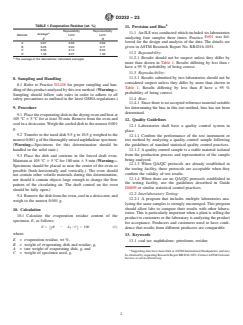
11. Precision and Bias
Repeatability Reproducibility
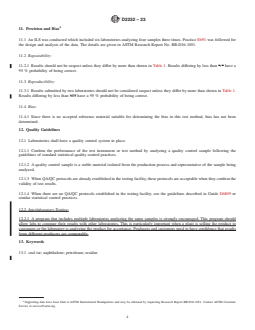
11.1 An ILS was conducted which included six laboratories
A
Average
Material Limit Limit
¯ analyzing four samples three times. Practice E691 was fol-
X r R
lowed for the design and analysis of the data. The details are
A 0.07 0.09 0.09
B 0.26 0.04 0.11 given in ASTM Research Report No. RR:D16-1051.
C 0.35 0.14 0.34
11.2 Repeatability:
D 1.48 0.27 1.36
11.2.1 Results should not be suspect unless they differ by
A
The average of the laboratories’ calculated averages.
more than shown in Table 1. Results differing by
...
This document is not an ASTM standard and is intended only to provide the user of an ASTM standard an indication of what changes have been made to the previous version. Because
it may not be technically possible to adequately depict all changes accurately, ASTM recommends that users consult prior editions as appropriate. In all cases only the current version
of the standard as published by ASTM is to be considered the official document.
Designation: D2232 − 14 (Reapproved 2018) D2232 − 23
Standard Test Method for
Evaporating Residue of Naphthalene
This standard is issued under the fixed designation D2232; the number immediately following the designation indicates the year of
original adoption or, in the case of revision, the year of last revision. A number in parentheses indicates the year of last reapproval. A
superscript epsilon (´) indicates an editorial change since the last revision or reapproval.
1. Scope Scope*
1.1 This test method covers the determination of the evaporation residue of naphthalene.
1.2 This test method has been found applicable to determining residue in the range of 0.3 and 1.5 wt %.
1.3 In determining the conformance of the test results using this method to applicable specifications, results shall be rounded off
in accordance with the rounding-off method of Practice E29.
1.4 The values stated in SI units are to be regarded as standard. No other units of measurement are included in this standard.
1.5 This standard does not purport to address all of the safety concerns, if any, associated with its use. It is the responsibility
of the user of this standard to establish appropriate safety, health, and environmental practices and determine the applicability of
regulatory limitations prior to use. For specific hazard statements, see Section 7, 8.1, 9.2, and 9.3.
1.6 This international standard was developed in accordance with internationally recognized principles on standardization
established in the Decision on Principles for the Development of International Standards, Guides and Recommendations issued
by the World Trade Organization Technical Barriers to Trade (TBT) Committee.
2. Referenced Documents
2.1 ASTM Standards:
D3438 Practice for Sampling and Handling Naphthalene, Maleic Anhydride, and Phthalic Anhydride
D4790 Terminology of Aromatic Hydrocarbons and Related Chemicals
D6809 Guide for Quality Control and Quality Assurance Procedures for Aromatic Hydrocarbons and Related Materials
E29 Practice for Using Significant Digits in Test Data to Determine Conformance with Specifications
E145 Specification for Gravity-Convection and Forced-Ventilation Ovens
E691 Practice for Conducting an Interlaboratory Study to Determine the Precision of a Test Method
2.2 Other Document:
OSHA Regulations, 29 CFR 1910.1000 and 1910.1200 paragraphs 1910.1000 and 1910.1200Toxic and Hazardous Substances
– Air contaminants; Hazard Communication
This test method is under the jurisdiction of ASTM Committee D16 on Aromatic, Industrial, Specialty and Related Chemicals and is the direct responsibility of
Subcommittee D16.07 on Styrene, Ethylbenzene and C9 and C10 Aromatic Hydrocarbons.
Current edition approved June 1, 2018April 1, 2023. Published June 2018June 2023. Originally approved in 1967. Last previous edition approved in 20142018 as
D2232 – 14.D2232 – 14 (2018). DOI: 10.1520/D2232-14R18.10.1520/D2232-23.
For referenced ASTM standards, visit the ASTM website, www.astm.org, or contact ASTM Customer Service at service@astm.org. For Annual Book of ASTM Standards
volume information, refer to the standard’s Document Summary page on the ASTM website.
Available from U.S. Government Printing Office Superintendent of Documents, 732 N. Capitol St., NW, Mail Stop: SDE, Washington, DC 20401, http://
www.access.gpo.gov.
*A Summary of Changes section appears at the end of this standard
Copyright © ASTM International, 100 Barr Harbor Drive, PO Box C700, West Conshohocken, PA 19428-2959. United States
D2232 − 23
3. Terminology
3.1 See Terminology D4790 for the definition of terms used in this test method.
4. Summary of Test Method
4.1 A weighed quantity of naphthalene is heated in a tared dish for 3 h at 105°C105 °C in a forced-draft oven and the residue is
weighed.
5. Significance and Use
5.1 Evaporation residue is an empirical measure of nonvolatile impurities in naphthalene. This test method is suitable for setting
specifications and for use as an internal quality control tool.
6. Apparatus
6.1 Evaporating Dishes, porcelain, shallow form or aluminum weighing dishes, low form, fluted, 60 mm diameter, 15 mm high,
42 mL capacity.
6.2 Drying Oven, forced-ventilation, conforming to Specification E145 Type II, Grade A or B.
7. Hazards
7.1 Consult current OSHA regulations, supplier’s Safety Data Sheets and local regulations for all materials used in this test
method.
8. Sampling and Handling
8.1 Refer to Practice D3438 for proper sampling and handling of this product analyzed by this test method. (Warning—Sampling
should follow safe rules in order to adhere to all safety precautions as outlined in the latest OSHA regulations.Caution)—Sampling
should follow safe rules in order to adhere to all safety precautions as outlined in the latest OSHA regulations.)
9. Procedure
9.1 Place the evaporating dish in the drying oven and heat at 105 6 5°C105 °C 6 5 °C for at least 30 min. Remove from the oven
and cool in a desiccator. Weigh the cooled dish to the nearest 0.001 g.
9.2 Transfer to the tared dish 9.59.5 g to 10.5 g weighed to the nearest 0.001 g of the thoroughly mixed naphthalene specimen.
(Warni
...