

ASTM D6477-23
(Terminology)Standard Terminology Relating to Tire Cord, Bead Wire, Hose Reinforcing Wire, and Fabrics
General Information
- Abstract
SCOPE
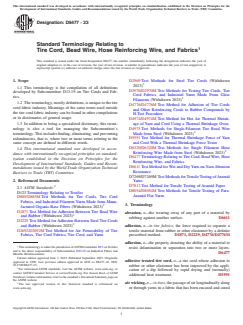
1.1 This terminology is the compilation of all definitions developed by Subcommittee D13.19 on Tire Cords and Fabrics.
1.2 The terminology, mostly definitions, is unique to the tire cord fabric industry. Meanings of the same terms used outside the tire cord fabric industry can be found in other compilations or in dictionaries of general usage.
1.3 In addition to being a specialized dictionary, this terminology is also a tool for managing the Subcommittee's terminology. This includes finding, eliminating, and preventing redundancies, that is, where two or more terms relating to the same concept are defined in different words.
1.4 This international standard was developed in accordance with internationally recognized principles on standardization established in the Decision on Principles for the Development of International Standards, Guides and Recommendations issued by the World Trade Organization Technical Barriers to Trade (TBT) Committee.
- Status
- Published
- Publication Date
- 31-May-2023
- Technical Committee
- D13 - Textiles
- Drafting Committee
- D13.19 - Industrial Fibers and Metallic Reinforcements
Buy Documents
ASTM D6477-23 - Standard Terminology Relating to Tire Cord, Bead Wire, Hose Reinforcing Wire, and Fabrics
REDLINE ASTM D6477-23 - Standard Terminology Relating to Tire Cord, Bead Wire, Hose Reinforcing Wire, and Fabrics
Overview
ASTM D6477-23: Standard Terminology Relating to Tire Cord, Bead Wire, Hose Reinforcing Wire, and Fabrics is an internationally recognized standard issued by ASTM International. This standard provides a comprehensive dictionary of terminology specific to the tire cord fabric industry, including definitions for tire cords, bead wires, hose reinforcing wires, and related fabrics. Developed under the jurisdiction of ASTM Committee D13 on Textiles, particularly Subcommittee D13.19 on Tire Cords and Fabrics, ASTM D6477-23 is essential for ensuring clear and consistent communication across the global tire reinforcement sector.
By compiling unique and precise definitions, ASTM D6477-23 supports industry professionals, manufacturers, testing laboratories, and quality assurance teams in maintaining a consistent understanding of key terms, reducing confusion and redundancy, and facilitating international trade and product standardization.
Key Topics
ASTM D6477-23 covers a wide range of terms relevant to the production, testing, and usage of tire cords and reinforcement materials, including but not limited to:
- Tire Cord: Twisted or formed structures made from one or more filaments, strands, or yarns of organic or inorganic materials used in tire construction.
- Bead Wire and Tire Bead: Steel wire components that form and reinforce the edge of the tire, ensuring a secure fit to the wheel rim.
- Hose Reinforcing Wire: Steel filaments designed to reinforce rubber or elastomer hoses for increased pressure resistance.
- Fabrics: Definitions related to woven or non-woven materials used as reinforcements in tires.
- Adhesion, Dip, and Tack: Terms describing the processes and attributes that enhance the bond between textile cords and rubber, critical for tire integrity.
- Mechanical Properties: Including breaking force, breaking strength, elongation, and work-to-break-essential metrics for evaluating material performance.
- Thermal Properties: Such as thermal shrinkage and thermal shrinkage force, relevant to processing and long-term durability.
- Process Terms: Including vulcanization, curing, and stitching, describing manufacturing and finishing operations.
- Testing Conditions: Definitions for standard atmosphere, moisture equilibrium for testing, and abrasion resistance.
Applications
The terminology set forth by ASTM D6477-23 is widely used throughout the tire manufacturing, rubber goods, and industrial textiles industries for:
- Product Development: Ensuring designers and engineers reference terms consistently when creating new tires, hoses, or reinforcement products.
- Quality Assurance and Testing: Standardizing definitions used in laboratory testing, thus enabling reliable comparisons and compliance checking.
- Procurement and Supply Chain: Facilitating clear specifications and requirements between material suppliers, manufacturers, and end users.
- Training and Documentation: Providing an authoritative resource for technical training and operational manuals.
- International Trade: Supporting harmonization of standards and reducing technical barriers, especially in compliance with WTO principles.
By adopting ASTM D6477-23, organizations ensure uniformity in communication, reduce the risk of error or misinterpretation, and uphold high quality and safety standards in reinforced rubber products.
Related Standards
ASTM D6477-23 references several key ASTM documents that further support testing and material quality in the tire cord fabric sector, including:
- ASTM D123: Terminology Relating to Textiles
- ASTM D2692/D2692M: Test Method for Air Permeability of Tire Fabrics, Cord, and Yarns
- ASTM D4776/D4776M: Test Method for Adhesion of Tire Cords to Rubber Compounds by H-Test Procedure
- ASTM D4974/D4974M: Test Method for Hot Air Thermal Shrinkage of Yarn and Cord
- ASTM D5591: Test Method for Thermal Shrinkage Force of Yarn and Cord
- ASTM D6611: Test Method for Wet and Dry Yarn-on-Yarn Abrasion Resistance
- ASTM D7269/D7269M: Test Methods for Tensile Testing of Aramid Yarns
For the latest updates or to view referenced or withdrawn ASTM standards, visit the ASTM International website.
ASTM D6477-23 is a foundational reference for accurate terminology in tire cord, bead wire, hose reinforcing wire, and industrial fabrics, promoting quality and clarity throughout the global supply chain.
Relations
- Effective Date
- 01-Jan-2024
- Effective Date
- 01-Feb-2020
- Effective Date
- 15-Jul-2017
- Effective Date
- 01-Mar-2017
- Effective Date
- 15-Sep-2015
- Effective Date
- 01-Sep-2015
- Effective Date
- 01-Apr-2015
- Effective Date
- 01-Feb-2015
- Effective Date
- 15-May-2014
- Effective Date
- 15-May-2014
- Effective Date
- 15-Jun-2013
- Effective Date
- 15-Jun-2013
- Effective Date
- 15-May-2013
- Effective Date
- 01-Jan-2013
- Effective Date
- 01-Feb-2012
Buy Documents
ASTM D6477-23 - Standard Terminology Relating to Tire Cord, Bead Wire, Hose Reinforcing Wire, and Fabrics
REDLINE ASTM D6477-23 - Standard Terminology Relating to Tire Cord, Bead Wire, Hose Reinforcing Wire, and Fabrics
Get Certified
Connect with accredited certification bodies for this standard

DIN CERTCO
DIN Group product certification.

Smithers Quality Assessments
US management systems and product certification.
Sponsored listings
Frequently Asked Questions
ASTM D6477-23 is a standard published by ASTM International. Its full title is "Standard Terminology Relating to Tire Cord, Bead Wire, Hose Reinforcing Wire, and Fabrics". This standard covers: SCOPE 1.1 This terminology is the compilation of all definitions developed by Subcommittee D13.19 on Tire Cords and Fabrics. 1.2 The terminology, mostly definitions, is unique to the tire cord fabric industry. Meanings of the same terms used outside the tire cord fabric industry can be found in other compilations or in dictionaries of general usage. 1.3 In addition to being a specialized dictionary, this terminology is also a tool for managing the Subcommittee's terminology. This includes finding, eliminating, and preventing redundancies, that is, where two or more terms relating to the same concept are defined in different words. 1.4 This international standard was developed in accordance with internationally recognized principles on standardization established in the Decision on Principles for the Development of International Standards, Guides and Recommendations issued by the World Trade Organization Technical Barriers to Trade (TBT) Committee.
SCOPE 1.1 This terminology is the compilation of all definitions developed by Subcommittee D13.19 on Tire Cords and Fabrics. 1.2 The terminology, mostly definitions, is unique to the tire cord fabric industry. Meanings of the same terms used outside the tire cord fabric industry can be found in other compilations or in dictionaries of general usage. 1.3 In addition to being a specialized dictionary, this terminology is also a tool for managing the Subcommittee's terminology. This includes finding, eliminating, and preventing redundancies, that is, where two or more terms relating to the same concept are defined in different words. 1.4 This international standard was developed in accordance with internationally recognized principles on standardization established in the Decision on Principles for the Development of International Standards, Guides and Recommendations issued by the World Trade Organization Technical Barriers to Trade (TBT) Committee.
ASTM D6477-23 is classified under the following ICS (International Classification for Standards) categories: 83.160.01 - Tyres in general. The ICS classification helps identify the subject area and facilitates finding related standards.
ASTM D6477-23 has the following relationships with other standards: It is inter standard links to ASTM D6320/D6320M-24, ASTM D7269/D7269M-20, ASTM D7269/D7269M-17, ASTM D123-17, ASTM D123-15b, ASTM D123-15a, ASTM D123-15, ASTM D2692/D2692M-15, ASTM D2692/D2692M-10(2014), ASTM D885/D885M-10a(2014), ASTM D123-13a, ASTM D123-13ae1, ASTM D123-13, ASTM D6477-13, ASTM D123-12e1. Understanding these relationships helps ensure you are using the most current and applicable version of the standard.
ASTM D6477-23 is available in PDF format for immediate download after purchase. The document can be added to your cart and obtained through the secure checkout process. Digital delivery ensures instant access to the complete standard document.
Standards Content (Sample)
This international standard was developed in accordance with internationally recognized principles on standardization established in the Decision on Principles for the
Development of International Standards, Guides and Recommendations issued by the World Trade Organization Technical Barriers to Trade (TBT) Committee.
Designation: D6477 − 23
Standard Terminology Relating to
Tire Cord, Bead Wire, Hose Reinforcing Wire, and Fabrics
This standard is issued under the fixed designation D6477; the number immediately following the designation indicates the year of
original adoption or, in the case of revision, the year of last revision. A number in parentheses indicates the year of last reapproval. A
superscript epsilon (´) indicates an editorial change since the last revision or reapproval.
1. Scope D2969 Test Methods for Steel Tire Cords (Withdrawn
2023)
1.1 This terminology is the compilation of all definitions
D2970/D2970M Test Methods for Testing Tire Cords, Tire
developed by Subcommittee D13.19 on Tire Cords and Fab-
Cord Fabrics, and Industrial Yarns Made From Glass
rics.
Filaments (Withdrawn 2023)
1.2 The terminology, mostly definitions, is unique to the tire
D4776/D4776M Test Method for Adhesion of Tire Cords
cord fabric industry. Meanings of the same terms used outside
and Other Reinforcing Cords to Rubber Compounds by
the tire cord fabric industry can be found in other compilations
H-Test Procedure
or in dictionaries of general usage.
D4974/D4974M Test Method for Hot Air Thermal Shrink-
age of Yarn and Cord Using a Thermal Shrinkage Oven
1.3 In addition to being a specialized dictionary, this termi-
nology is also a tool for managing the Subcommittee’s D4975 Test Methods for Single-Filament Tire Bead Wire
Made from Steel (Withdrawn 2023)
terminology. This includes finding, eliminating, and preventing
redundancies, that is, where two or more terms relating to the D5591 Test Method for Thermal Shrinkage Force of Yarn
and Cord With a Thermal Shrinkage Force Tester
same concept are defined in different words.
D6320/D6320M Test Methods for Single Filament Hose
1.4 This international standard was developed in accor-
Reinforcing Wire Made from Steel (Withdrawn 2023)
dance with internationally recognized principles on standard-
D6477 Terminology Relating to Tire Cord, Bead Wire, Hose
ization established in the Decision on Principles for the
Reinforcing Wire, and Fabrics
Development of International Standards, Guides and Recom-
D6611 Test Method for Wet and Dry Yarn-on-Yarn Abrasion
mendations issued by the World Trade Organization Technical
Resistance
Barriers to Trade (TBT) Committee.
D7269/D7269M Test Methods for Tensile Testing of Aramid
2. Referenced Documents Yarns
2 D7812 Test Method for Tensile Testing of Aramid Paper
2.1 ASTM Standards:
D8054/D8054M Test Methods for Tensile Testing of Para-
D123 Terminology Relating to Textiles
Aramid Flat Yarns
D885/D885M Test Methods for Tire Cords, Tire Cord
Fabrics, and Industrial Filament Yarns Made from Manu-
3. Terminology
factured Organic-Base Fibers (Withdrawn 2023)
D1871 Test Method for Adhesion Between Tire Bead Wire
abrasion, n—the wearing away of any part of a material by
and Rubber (Withdrawn 2023)
rubbing against another surface. D6611
D2229 Test Method for Adhesion Between Steel Tire Cords
and Rubber (Withdrawn 2023) adhesion, n—in tire fabrics, the force required to separate a
D2692/D2692M Test Method for Air Permeability of Tire textile material from rubber or other elastomer by a definite
Fabrics, Tire Cord Fabrics, Tire Cord, and Yarns prescribed method. D1871, D2229, D4776/D4776M
adhesion, n—the property denoting the ability of a material to
This terminology is under the jurisdiction of ASTM Committee D13 on Textiles
resist delamination or separation into two or more layers.
and is the direct responsibility of Subcommittee D13.19 on Industrial Fibers and
D6477
Metallic Reinforcements.
Current edition approved June 1, 2023. Published September 2023. Originally
adhesive treated tire cord, n—a tire cord whose adhesion to
approved in 1999. Last previous edition approved in 2022 as D6477–22. DOI:
10.1520/D6477-23.
rubber or other elastomer has been improved by the appli-
For referenced ASTM standards, visit the ASTM website, www.astm.org, or
cation of a dip followed by rapid drying and (normally)
contact ASTM Customer Service at service@astm.org. For Annual Book of ASTM
additional heat treatment. D5591
Standards volume information, refer to the standard’s Document Summary page on
the ASTM website.
air wicking, n— in tires, the passage of air longitudinally along
The last approved version of this historical standard is referenced on
www.astm.org. or through yarns in a fabric that has been encased and cured
Copyright © ASTM International, 100 Barr Harbor Drive, PO Box C700, West Conshohocken, PA 19428-2959. United States
D6477 − 23
fabric is usually made wickproof to prevent air leaking from the inflated
in rubber or other elastomer, that is, air permeability in the
tire. D2692/D2692M
plane of the fabric. D2692/D2692M
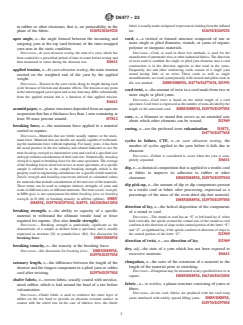
cord, n—a twisted or formed structure composed of one or
apex angle, n—the angle formed between the incoming and
more single or plied filaments, strands, or yarns of organic
outgoing yarn at the top (and bottom) of the inter-wrapped
polymer or inorganic materials.
yarn area in the static condition.
DISCUSSION—In yarn abrasion testing, the state of a yarn, which has DISCUSSION—Cord, as used in these test methods, is used for the
been soaked for a prescribed period of time in water before testing and manufacture of pneumatic tires or other industrial fabrics. The direction
of twist used to combine the single or plied yarn elements into a cord
then immersed in water during the abrasion test. D6611
construction is in the direction opposite to that used in the yarns.
applied tension, n—In yarn abrasion testing, the static tension Frequently, tire and other reinforcing cords consist of a single yarn
strand having little or no twist. These cords as well as single
exerted on the weighted end of the yarn by the applied
monofilaments, are used synonymously with twisted and plied cords in
weight.
this test method. D885/D885M, D4776/D4776M, D5591
DISCUSSION—Tension in the yarn varies along its length during each
cycle because of friction and dynamic effects. The tension at any point
cord twist, n—the amount of twist in a cord made from two or
in the interwrapped yarn region and at any time may differ substantially
more single or plied yarns.
from the applied tension but is a function of that applied tension.
DISCUSSION—Cord twist is based on the initial length of a cord
D6611
specimen. Cord twist is expressed as the number of turns divided by the
length of the untwisted cord. D885/D885M, D2970/D2970M
aramid paper, n—planar structures deposited from an aqueous
suspension that has a thickness less than 1 mm containing at
core, n—a filament or strand that serves as an extended axis
least 50 mass percent aramid. D7812
about which other elements can be wound. D2969
breaking force, n—the maximum force applied to a material
curing, n—see the preferred term vulcanization. D1871,
carried to rupture.
D4776/D4776M
DISCUSSION—Materials that are brittle usually rupture at the maxi-
mum force. Materials that are ductile are usually capable of withstand-
cycles to failure, CTF, n—in yarn abrasion testing, the
ing the maximum force without rupturing. For many years, it has been
number of cycles applied to the yarn before it fails due to
the usual practice in the tire industry and related industries to use the
abrasion.
term breaking strength to characterize yarn and cord of a specified size
DISCUSSION—Failure is considered to occur when the yarn is com-
and type without consideration of their unit size. Numerically, breaking
pletely separated. D6611
strength is equal to breaking force for the same specimen. The average
of the breaking forces observed on two or more specimens of a specific
dip, n—a chemical composition that is applied to a textile cord
sample is referred to as the sample breaking strength, which is the
or fabric to improve its adhesion to rubber or other
property used in engineering calculations for a specific textile material.
Tensile strength and breaking tenacityare derived or calculated values elastomer. D885/D885M, D2970/D2970M
for materials that include consideration of the unit size of the materials.
dip pick-up, n—the amount of dip or dip components present
These terms can be used to compare intrinsic strengths of yarns and
cords of different sizes or different materials. The term tensile strength, in a textile cord or fabric after processing, expressed as a
in MPA (psi), is not synonymous hit either breaking force or breaking
percentage of the mass of the oven-dried dip-free material.
strength, in N (lbf), or breaking tenacity, in mN/tex (gf/den). D885/
D885/D885M, D2970/D2970M
D885M, D2970/D2970M, D4975, D6320/D6320M
direction of lay, n—the helical disposition of the components
breaking strength, n—the ability or capacity of a specific
of a strand or cord.
material to withstand the ultimate tensile load or force
DISCUSSION—The strand or cord has an “S” or left hand lay if, when
required for rupture. (See also tensile strength).
held vertically, the spirals around the central axis of the strand or cord
DISCUSSION— Breaking strength is particularly significant as the conform in the direction of slope to the central portion of the letter “S”;
characteristic of a sample as distinct from a specimen, and is usually and “Z”, or righthand lay, if the spirals conform in direction of slope to
expressed as newtons (N) or pounds-force (lbf). See discussion for
the central portion of the letter “Z”. D2969
breaking force. D885/D885M
direction of twist, n—see direction of lay. D2969
breaking tenacity, n—the tenacity at the breaking force.
dry, adj—the state of a yarn which has not been exposed to
DISCUSSION—See discussion for breaking force. D885/D885M,
excessive moisture. D6611
D2970/D2970M
elongation, n—the ratio of the extension of a material to the
catenary length, n—the difference between the length of the
length of the material prior to stretching.
shortest and the longest component in a plied yarn or cables
DISCUSSION—Elongation may be measured at any specified force or at
cord after twisting. D2970/D2970M
rupture. D885/D885M, D6320/D6320M
chafer fabric, n—woven fabric, usually coated with unvulca-
fabric , n—in textiles, a planar structure consisting of yarns or
nized rubber, which is laid around the bead of a tire before
fibers.
vulcanization.
DISCUSSION—In tire cord, fabrics are produced with tire cord warp
DISCUSSION—Chafer fabric is used to reinforce the outer layer of
yarns interlaced with widely spaced filling yarns. D885/D885M,
rubber on the tire bead to provide an abrasion resistant surface in
contact with the wheel rim. In the case of tubeless tires, the chafer D2970/D2970M
D6477 − 23
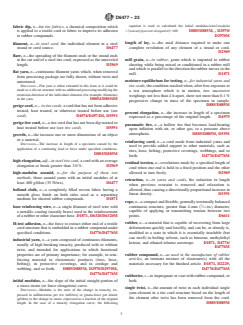
equation is used to calculated the initial modulus:initail modulus
fabric dip, n—for tire fabrics, a chemical composition which
5 tencaity/percent elongation ×100 D885/D885M, , D2970/
~ !
is applied to a textile cord or fabric to improve its adhesion
D2970M
to rubber compounds.
length of lay, n—the axial distance required to make one
filament, n—in steel cord, the individual element in a steel
complete revolution of any element of a strand or cord.
strand or cord source. D6477
D2969
flare, n—the spreading of the filament ends or the strand ends
mill grain, n—in rubber, grain which is imparted to rubber
at the cut end of a steel tire cord, expressed as the unraveled
sheeting while being mixed or conditioned in a rubber mill
length. D2969
and which is parallel to the direction the rubber moves in the
flat yarn, n—continuous filament yarns which, when removed
mill. D1871
from processing package are fully drawn, without twist and
moisture equilibrium for testing, n—for industrial yarns and
untextured.
tire cords, the condition reached when, after free exposure
...
This document is not an ASTM standard and is intended only to provide the user of an ASTM standard an indication of what changes have been made to the previous version. Because
it may not be technically possible to adequately depict all changes accurately, ASTM recommends that users consult prior editions as appropriate. In all cases only the current version
of the standard as published by ASTM is to be considered the official document.
Designation: D6477 − 22 D6477 − 23
Standard Terminology Relating to
Tire Cord, Bead Wire, Hose Reinforcing Wire, and Fabrics
This standard is issued under the fixed designation D6477; the number immediately following the designation indicates the year of
original adoption or, in the case of revision, the year of last revision. A number in parentheses indicates the year of last reapproval. A
superscript epsilon (´) indicates an editorial change since the last revision or reapproval.
1. Scope
1.1 This terminology is the compilation of all definitions developed by Subcommittee D13.19 on Tire Cords and Fabrics.
1.2 The terminology, mostly definitions, is unique to the tire cord fabric industry. Meanings of the same terms used outside the
tire cord fabric industry can be found in other compilations or in dictionaries of general usage.
1.3 In addition to being a specialized dictionary, this terminology is also a tool for managing the Subcommittee’s terminology.
This includes finding, eliminating, and preventing redundancies, that is, where two or more terms relating to the same concept are
defined in different words.
1.4 This international standard was developed in accordance with internationally recognized principles on standardization
established in the Decision on Principles for the Development of International Standards, Guides and Recommendations issued
by the World Trade Organization Technical Barriers to Trade (TBT) Committee.
2. Referenced Documents
2.1 ASTM Standards:
D123 Terminology Relating to Textiles
D885/D885M Test Methods for Tire Cords, Tire Cord Fabrics, and Industrial Filament Yarns Made from Manufactured
Organic-Base Fibers (Withdrawn 2023)
D1871 Test Method for Adhesion Between Tire Bead Wire and Rubber (Withdrawn 2023)
D2229 Test Method for Adhesion Between Steel Tire Cords and Rubber (Withdrawn 2023)
D2692/D2692M Test Method for Air Permeability of Tire Fabrics, Tire Cord Fabrics, Tire Cord, and Yarns
D2969 Test Methods for Steel Tire Cords (Withdrawn 2023)
D2970/D2970M Test Methods for Testing Tire Cords, Tire Cord Fabrics, and Industrial Yarns Made From Glass Filaments
(Withdrawn 2023)
D4776/D4776M Test Method for Adhesion of Tire Cords and Other Reinforcing Cords to Rubber Compounds by H-Test
Procedure
D4974/D4974M Test Method for Hot Air Thermal Shrinkage of Yarn and Cord Using a Thermal Shrinkage Oven
D4975 Test Methods for Single-Filament Tire Bead Wire Made from Steel (Withdrawn 2023)
D5591 Test Method for Thermal Shrinkage Force of Yarn and Cord With a Thermal Shrinkage Force Tester
D6320/D6320M Test Methods for Single Filament Hose Reinforcing Wire Made from Steel (Withdrawn 2023)
This terminology is under the jurisdiction of ASTM Committee D13 on Textiles and is the direct responsibility of Subcommittee D13.19 on Industrial Fibers and Metallic
Reinforcements.
Current edition approved June 1, 2022June 1, 2023. Published July 2022September 2023. Originally approved in 1999. Last previous edition approved in 20132022 as
ɛ1
D6477–13–22. which was withdrawn January 2022 and reinstated in June 2022. DOI: 10.1520/D6477-22.DOI: 10.1520/D6477-23.
For referenced ASTM standards, visit the ASTM website, www.astm.org, or contact ASTM Customer Service at service@astm.org. For Annual Book of ASTM Standards
volume information, refer to the standard’s Document Summary page on the ASTM website.
The last approved version of this historical standard is referenced on www.astm.org.
Copyright © ASTM International, 100 Barr Harbor Drive, PO Box C700, West Conshohocken, PA 19428-2959. United States
D6477 − 23
D6477 Terminology Relating to Tire Cord, Bead Wire, Hose Reinforcing Wire, and Fabrics
D6611 Test Method for Wet and Dry Yarn-on-Yarn Abrasion Resistance
D7269/D7269M Test Methods for Tensile Testing of Aramid Yarns
D7812 Test Method for Tensile Testing of Aramid Paper
D8054/D8054M Test Methods for Tensile Testing of Para-Aramid Flat Yarns
3. Terminology
abrasion, n—the wearing away of any part of a material by rubbing against another surface. D6611
adhesion, n—in tire fabrics, the force required to separate a textile material from rubber or other elastomer by a definite
prescribed method. D1871, D2229, D4776/D4776M
adhesion, n—the property denoting the ability of a material to resist delamination or separation into two or more layers. D6477
adhesive treated tire cord, n—a tire cord whose adhesion to rubber or other elastomer has been improved by the application
of a dip followed by rapid drying and (normally) additional heat treatment. D5591
air wicking, n— in tires, the passage of air longitudinally along or through yarns in a fabric that has been encased and cured
in rubber or other elastomer, that is, air permeability in the plane of the fabric. D2692/D2692M
apex angle, n—the angle formed between the incoming and outgoing yarn at the top (and bottom) of the inter-wrapped yarn area
in the static condition.
DISCUSSION—
In yarn abrasion testing, the state of a yarn, which has been soaked for a prescribed period of time in water before testing and then immersed in water
during the abrasion test. D6611
applied tension, n—In yarn abrasion testing, the static tension exerted on the weighted end of the yarn by the applied weight.
DISCUSSION—
Tension in the yarn varies along its length during each cycle because of friction and dynamic effects. The tension at any point in the interwrapped yarn
region and at any time may differ substantially from the applied tension but is a function of that applied tension. D6611
aramid paper, n—planar structures deposited from an aqueous suspension that has a thickness less than 1 mm containing at least
50 mass percent aramid. D7812
breaking force, n—the maximum force applied to a material carried to rupture.
DISCUSSION—
Materials that are brittle usually rupture at the maximum force. Materials that are ductile are usually capable of withstanding the maximum force
without rupturing. For many years, it has been the usual practice in the tire industry and related industries to use the term breaking strength to
characterize yarn and cord of a specified size and type without consideration of their unit size. Numerically, breaking strength is equal to breaking force
for the same specimen. The average of the breaking forces observed on two or more specimens of a specific sample is referred to as the sample breaking
strength, which is the property used in engineering calculations for a specific textile material. Tensile strength and breaking tenacityare derived or
calculated values for materials that include consideration of the unit size of the materials. These terms can be used to compare intrinsic strengths of
yarns and cords of different sizes or different materials. The term tensile strength, in MPA (psi), is not synonymous hit either breaking force or breaking
strength, in N (lbf), or breaking tenacity, in mN/tex (gf/den). D885/D885M, D2970/D2970M, D4975, D6320/D6320M
breaking strength, n—the ability or capacity of a specific material to withstand the ultimate tensile load or force required for
rupture. (See also tensile strength).
DISCUSSION—
Breaking strength is particularly significant as the characteristic of a sample as distinct from a specimen, and is usually expressed as newtons (N) or
pounds-force (lbf). See discussion for breaking force. D885/D885M
breaking tenacity, n—the tenacity at the breaking force.
DISCUSSION—
See discussion for breaking force. D885/D885M, D2970/D2970M
D6477 − 23
catenary length, n—the difference between the length of the shortest and the longest component in a plied yarn or cables cord
after twisting. D2970/D2970M
chafer fabric, n—woven fabric, usually coated with unvulcanized rubber, which is laid around the bead of a tire before
vulcanization.
DISCUSSION—
Chafer fabric is used to reinforce the outer layer of rubber on the tire bead to provide an abrasion resistant surface in contact with the wheel rim. In
the case of tubeless tires, the chafer fabric is usually made wickproof to prevent air leaking from the inflated tire. D2692/D2692M
cord, n—a twisted or formed structure composed of one or more single or plied filaments, strands, or yarns of organic polymer
or inorganic materials.
DISCUSSION—
Cord, as used in these test methods, is used for the manufacture of pneumatic tires or other industrial fabrics. The direction of twist used to combine
the single or plied yarn elements into a cord construction is in the direction opposite to that used in the yarns. Frequently, tire and other reinforcing
cords consist of a single yarn strand having little or no twist. These cords as well as single monofilaments, are used synonymously with twisted and
plied cords in this test method. D885/D885M, D4776/D4776M, D5591
cord twist, n—the amount of twist in a cord made from two or more single or plied yarns.
DISCUSSION—
Cord twist is based on the initial length of a cord specimen. Cord twist is expressed as the number of turns divided by the length of the untwisted cord.
D885/D885M, D2970/D2970M
core, n—a filament or strand that serves as an extended axis about which other elements can be wound. D2969
curing, n—see the preferred term vulcanization. D1871, D4776/D4776M
cycles to failure, CTF, n—in yarn abrasion testing, the number of cycles applied to the yarn before it fails due to abrasion.
DISCUSSION—
Failure is considered to occur when the yarn is completely separated. D6611
dip, n—a chemical composition that is applied to a textile cord or fabric to improve its adhesion to rubber or other elastomer.
D885/D885M, D2970/D2970M
dip pick-up, n—the amount of dip or dip components present in a textile cord or fabric after processing, expressed as a
percentage of the mass of the oven-dried dip-free material. D885/D885M, D2970/D2970M
direction of lay, n—the helical disposition of the components of a strand or cord.
DISCUSSION—
The strand or cord has an “S” or left hand lay if, when held vertically, the spirals around the central axis of the strand or cord conform in the direction
of slope to the central portion of the letter “S”; and “Z”, or righthand lay, if the spirals conform in direction of slope to the central portion of the letter
“Z”. D2969
direction of twist, n—see direction of lay. D2969
dry, adj—the state of a yarn which has not been exposed to excessive moisture. D6611
elongation, n—the ratio of the extension of a material to the length of the material prior to stretching.
DISCUSSION—
Elongation may be measured at any specified force or at rupture. D885/D885M, D6320/D6320M
fabric , n—in textiles, a planar structure consisting of yarns or fibers.
D6477 − 23
DISCUSSION—
In tire cord, fabrics are produced with tire cord warp yarns interlaced with widely spaced filling yarns. D885/D885M, D2970/D2970M
fabric dip, n—for tire fabrics, a chemical composition which is applied to a textile cord or fabric to improve its adhesion to
rubber compounds.
filament, n—in steel cord, the individual element in a steel strand or cord source. D6477
flare, n—the spreading of the filament ends or the strand ends at the cut end of a steel tire cord, expressed as the unraveled length.
D2969
flat yarn, n—continuous filament yarns which, when removed from processing package are fully drawn, without twist and
untextured.
DISCUSSION—
Flat yarn is either extruded in this form or it could be made as a slit cut structure with no additional processing modifying the extension direction of
the individual elements (for example, filaments) in the yarn. D8054/D8054M
greige cord, n— in tire cords, a cord that has not been adhesive treated, heat treated, or otherwise treated before use (see cord).
D4974/D4974M, D5591
greige tire cord, n—a tire cord that has not been dip treated or heat treated before use (see tire cord). D5591
growth
...