

ASTM D6270-20
(Practice)Standard Practice for Use of Scrap Tires in Civil Engineering Applications
General Information
- Abstract
SIGNIFICANCE AND USE
4.1 This practice is intended for use of scrap tires including: tire-derived aggregate (TDA) comprised of pieces of scrap tires, TDA/soil mixtures, tire sidewalls, and whole scrap tires in civil engineering applications. This includes use of TDA and TDA/soil mixtures as lightweight embankment fill; lightweight retaining wall backfill; drainage layers for roads, landfills, and other applications; thermal insulation to limit frost penetration beneath roads; insulating backfill to limit heat loss from buildings; vibration damping layers for rail lines; and replacement for soil or rock in other fill applications. Use of whole scrap tires and tire sidewalls includes construction of retaining walls, drainage culverts, road-base reinforcement, and erosion protection, as well as use as fill when whole tires have been compressed into bales. It is the responsibility of the design engineer to determine the appropriateness of using scrap tires in a particular application and to select applicable tests and specifications to facilitate construction and environmental protection. This practice is intended to encourage wider utilization of scrap tires in civil engineering applications.
4.2 Three TDA fills with thicknesses in excess of 7 m have experienced a serious heating reaction. However, more than 100 fills with a thickness less than 3 m have been constructed with no evidence of a deleterious heating reaction (1).7 Guidelines have been developed to minimize internal heating of TDA fills (2) as discussed in 6.11. The guidelines are applicable to fills less than 3 m thick. Thus, this practice should be applied only to TDA fills less than 3 m thick.
SCOPE
1.1 This practice provides guidance for testing the physical properties, design considerations, construction practices, and leachate generation potential of processed or whole scrap tires in lieu of conventional civil engineering materials, such as stone, gravel, soil, sand, lightweight aggregate, or other fill materials.
1.2 The values stated in SI units are to be regarded as standard. No other units of measurement are included in this standard.
1.3 This international standard was developed in accordance with internationally recognized principles on standardization established in the Decision on Principles for the Development of International Standards, Guides and Recommendations issued by the World Trade Organization Technical Barriers to Trade (TBT) Committee.
- Status
- Published
- Publication Date
- 31-Aug-2020
- Technical Committee
- D34 - Waste Management
- Drafting Committee
- D34.03 - Treatment, Recovery and Reuse
Overview
ASTM D6270-20: Standard Practice for Use of Scrap Tires in Civil Engineering Applications provides comprehensive guidance for the beneficial use of scrap tire materials, including tire-derived aggregate (TDA), TDA/soil mixtures, tire sidewalls, and whole scrap tires, in a variety of civil engineering projects. This practice outlines the requirements for testing physical properties, design considerations, construction practices, and environmental impacts, specifically focusing on leachate generation and material suitability when substituting scrap tires for conventional materials like stone, gravel, sand, and lightweight aggregates. The standard encourages the sustainable reuse of scrap tires, supports environmental protection, and supplies design engineers and field practitioners with the essential criteria to ensure safe, effective application.
Key Topics
- Material characterizations: ASTM D6270-20 details the physical properties and quality requirements for TDA and scrap tire materials, covering gradation, water absorption, dry density, shear strength, hydraulic and thermal conductivity.
- Design and construction practices: The standard provides best practices for construction using TDA, including guidance for fill thickness, compaction, appropriate soil covers, and geotextile integration, as well as strategies to minimize self-heating reaction risks.
- Environmental considerations: Defines standards for evaluating leachate potential using procedures such as the EPA TCLP (Method 1311), with references to studies on metal and organic compound leaching, aquatic toxicity, and groundwater impacts.
- Application limitations: This practice applies specifically to TDA fills less than 3 meters thick, with design guidelines to prevent excess heating found in thicker installations.
- Terminology and referenced tests: Clarifies terms such as TDA, rough shreds, rubber buffings, and tire chips, and references relevant ASTM and AASHTO test methods for evaluating material properties.
Applications
The practical uses for scrap tires and TDA in civil engineering are extensive, offering technical, economic, and environmental benefits:
- Lightweight embankment fill: TDA is used where reduced load on compressible or weak subgrades is critical, improving slope stability and reducing settlement in embankments and landslide remediation.
- Retaining wall backfill: TDA serves as a lightweight, low-pressure backfill for retaining walls, reducing lateral earth pressures and improving drainage.
- Drainage layers: Due to its high hydraulic conductivity, TDA is ideal for systems like road drainage, landfill leachate collection, and on-site sewage leach fields.
- Thermal insulation: TDA layers insulate roads and building foundations, limiting frost penetration and reducing heat loss, leading to improved durability and energy efficiency.
- Vibration damping: TDA is effective in damping ground-borne vibrations, such as those transmitted from railways to adjacent structures.
- Erosion control and reinforcement: Whole tires and cut sidewalls reinforce road bases, construct retaining walls, and provide robust erosion protection.
- Septic systems: Type A TDA serves as a reliable alternative to rock aggregate in leach beds, meeting wastewater treatment and material durability needs.
Related Standards
- ASTM C127: Test Method for Relative Density and Absorption of Coarse Aggregate
- ASTM C136/C136M: Sieve Analysis of Aggregates
- ASTM D698 and D1557: Laboratory Compaction Characteristics of Soil
- ASTM D2434: Permeability of Granular Soils (Constant Head)
- ASTM D7760: Measurement of Hydraulic Conductivity of Tire Materials
- AASHTO T 274: Resilient Modulus of Subgrade Soils
- AASHTO M 288: Specification for Geotextiles
- EPA Method 1311: Toxicity Characteristic Leaching Procedure (TCLP)
Conclusion
ASTM D6270-20 promotes resource sustainability and environmental safety by guiding the use of scrap tires in civil engineering applications. The standard supports engineers in material selection, design, and environmental compliance while expanding the beneficial re-use of scrap tires and TDA. Integration of these practices can result in cost savings, reduced material use, and minimized environmental impact, aligning with sustainable development goals in construction and infrastructure projects. For optimal project outcomes, the standard should be used alongside relevant ASTM and AASHTO methods, and tailored to the specific requirements of each application.
Relations
- Effective Date
- 01-Nov-2023
- Effective Date
- 01-Nov-2023
- Effective Date
- 15-Jan-2020
- Effective Date
- 15-Jan-2020
- Effective Date
- 01-Nov-2018
- Effective Date
- 01-Jan-2018
- Effective Date
- 01-Sep-2017
- Effective Date
- 01-Nov-2016
- Effective Date
- 01-Mar-2016
- Effective Date
- 01-Mar-2016
- Effective Date
- 01-Feb-2016
- Effective Date
- 15-Dec-2014
- Effective Date
- 01-Nov-2014
- Effective Date
- 01-Jun-2013
- Effective Date
- 01-Feb-2013
Get Certified
Connect with accredited certification bodies for this standard

DIN CERTCO
DIN Group product certification.

Smithers Quality Assessments
US management systems and product certification.
Sponsored listings
Frequently Asked Questions
ASTM D6270-20 is a standard published by ASTM International. Its full title is "Standard Practice for Use of Scrap Tires in Civil Engineering Applications". This standard covers: SIGNIFICANCE AND USE 4.1 This practice is intended for use of scrap tires including: tire-derived aggregate (TDA) comprised of pieces of scrap tires, TDA/soil mixtures, tire sidewalls, and whole scrap tires in civil engineering applications. This includes use of TDA and TDA/soil mixtures as lightweight embankment fill; lightweight retaining wall backfill; drainage layers for roads, landfills, and other applications; thermal insulation to limit frost penetration beneath roads; insulating backfill to limit heat loss from buildings; vibration damping layers for rail lines; and replacement for soil or rock in other fill applications. Use of whole scrap tires and tire sidewalls includes construction of retaining walls, drainage culverts, road-base reinforcement, and erosion protection, as well as use as fill when whole tires have been compressed into bales. It is the responsibility of the design engineer to determine the appropriateness of using scrap tires in a particular application and to select applicable tests and specifications to facilitate construction and environmental protection. This practice is intended to encourage wider utilization of scrap tires in civil engineering applications. 4.2 Three TDA fills with thicknesses in excess of 7 m have experienced a serious heating reaction. However, more than 100 fills with a thickness less than 3 m have been constructed with no evidence of a deleterious heating reaction (1).7 Guidelines have been developed to minimize internal heating of TDA fills (2) as discussed in 6.11. The guidelines are applicable to fills less than 3 m thick. Thus, this practice should be applied only to TDA fills less than 3 m thick. SCOPE 1.1 This practice provides guidance for testing the physical properties, design considerations, construction practices, and leachate generation potential of processed or whole scrap tires in lieu of conventional civil engineering materials, such as stone, gravel, soil, sand, lightweight aggregate, or other fill materials. 1.2 The values stated in SI units are to be regarded as standard. No other units of measurement are included in this standard. 1.3 This international standard was developed in accordance with internationally recognized principles on standardization established in the Decision on Principles for the Development of International Standards, Guides and Recommendations issued by the World Trade Organization Technical Barriers to Trade (TBT) Committee.
SIGNIFICANCE AND USE 4.1 This practice is intended for use of scrap tires including: tire-derived aggregate (TDA) comprised of pieces of scrap tires, TDA/soil mixtures, tire sidewalls, and whole scrap tires in civil engineering applications. This includes use of TDA and TDA/soil mixtures as lightweight embankment fill; lightweight retaining wall backfill; drainage layers for roads, landfills, and other applications; thermal insulation to limit frost penetration beneath roads; insulating backfill to limit heat loss from buildings; vibration damping layers for rail lines; and replacement for soil or rock in other fill applications. Use of whole scrap tires and tire sidewalls includes construction of retaining walls, drainage culverts, road-base reinforcement, and erosion protection, as well as use as fill when whole tires have been compressed into bales. It is the responsibility of the design engineer to determine the appropriateness of using scrap tires in a particular application and to select applicable tests and specifications to facilitate construction and environmental protection. This practice is intended to encourage wider utilization of scrap tires in civil engineering applications. 4.2 Three TDA fills with thicknesses in excess of 7 m have experienced a serious heating reaction. However, more than 100 fills with a thickness less than 3 m have been constructed with no evidence of a deleterious heating reaction (1).7 Guidelines have been developed to minimize internal heating of TDA fills (2) as discussed in 6.11. The guidelines are applicable to fills less than 3 m thick. Thus, this practice should be applied only to TDA fills less than 3 m thick. SCOPE 1.1 This practice provides guidance for testing the physical properties, design considerations, construction practices, and leachate generation potential of processed or whole scrap tires in lieu of conventional civil engineering materials, such as stone, gravel, soil, sand, lightweight aggregate, or other fill materials. 1.2 The values stated in SI units are to be regarded as standard. No other units of measurement are included in this standard. 1.3 This international standard was developed in accordance with internationally recognized principles on standardization established in the Decision on Principles for the Development of International Standards, Guides and Recommendations issued by the World Trade Organization Technical Barriers to Trade (TBT) Committee.
ASTM D6270-20 is classified under the following ICS (International Classification for Standards) categories: 83.160.01 - Tyres in general. The ICS classification helps identify the subject area and facilitates finding related standards.
ASTM D6270-20 has the following relationships with other standards: It is inter standard links to ASTM D3080/D3080M-23, ASTM D5681-23, ASTM D2974-20e1, ASTM D2974-20, ASTM D5681-18, ASTM D7760-18, ASTM D5681-17, ASTM D5681-16a, ASTM D4253-16e1, ASTM D4253-16, ASTM D5681-16, ASTM D4253-14, ASTM D2974-14, ASTM D2974-13, ASTM D5681-13. Understanding these relationships helps ensure you are using the most current and applicable version of the standard.
ASTM D6270-20 is available in PDF format for immediate download after purchase. The document can be added to your cart and obtained through the secure checkout process. Digital delivery ensures instant access to the complete standard document.
Standards Content (Sample)
This international standard was developed in accordance with internationally recognized principles on standardization established in the Decision on Principles for the
Development of International Standards, Guides and Recommendations issued by the World Trade Organization Technical Barriers to Trade (TBT) Committee.
Designation: D6270 − 20
Standard Practice for
Use of Scrap Tires in Civil Engineering Applications
This standard is issued under the fixed designation D6270; the number immediately following the designation indicates the year of
original adoption or, in the case of revision, the year of last revision.Anumber in parentheses indicates the year of last reapproval.A
superscript epsilon (´) indicates an editorial change since the last revision or reapproval.
1. Scope Content, Ash Content, and Organic Material of Peat and
Other Organic Soils
1.1 This practice provides guidance for testing the physical
D3080/D3080MTest Method for Direct Shear Test of Soils
properties, design considerations, construction practices, and
Under Consolidated Drained Conditions (Withdrawn
leachate generation potential of processed or whole scrap tires
2020)
in lieu of conventional civil engineering materials, such as
D4253Test Methods for Maximum Index Density and Unit
stone, gravel, soil, sand, lightweight aggregate, or other fill
Weight of Soils Using a Vibratory Table
materials.
D5681Terminology for Waste and Waste Management
1.2 The values stated in SI units are to be regarded as
D7760Test Method for Measurement of Hydraulic Conduc-
standard. No other units of measurement are included in this
tivityofMaterialsDerivedfromScrapTiresUsingaRigid
standard.
Wall Permeameter
1.3 This international standard was developed in accor- F538Terminology Relating to the Characteristics and Per-
dance with internationally recognized principles on standard-
formance of Tires
ization established in the Decision on Principles for the
2.2 American Association of State Highway and Transpor-
Development of International Standards, Guides and Recom-
tation Offıcials Standards:
mendations issued by the World Trade Organization Technical
T274Standard Method of Test for Resilient Modulus of
Barriers to Trade (TBT) Committee.
Subgrade Soils
M288Standard Specification for Geotextiles
2. Referenced Documents
2.3 U.S. Environmental Protection Agency Standard:
Method 1311Toxicity Characteristics Leaching Procedure
2.1 ASTM Standards:
C127Test Method for Relative Density (Specific Gravity)
3. Terminology
and Absorption of Coarse Aggregate
3.1 Definitions—For definitions of common terms used in
C136/C136MTest Method for Sieve Analysis of Fine and
this practice, refer to Terminologies D5681 (waste
Coarse Aggregates
management), F538 (tires), and D1566 (rubber), respectively.
D698Test Methods for Laboratory Compaction Character-
istics of Soil Using Standard Effort (12,400 ft-lbf/ft (600
3.2 Definitions of Terms Specific to This Standard:
kN-m/m ))
3.2.1 bead wire, n—a high-tensile steel wire surrounded by
D1557Test Methods for Laboratory Compaction Character-
rubber, which forms the bead of a tire that provides a firm
istics of Soil Using Modified Effort (56,000 ft-lbf/ft
contact to the rim.
(2,700 kN-m/m ))
3.2.2 casing, n—the tire structure not including the tread
D1566Terminology Relating to Rubber
portion of the tire.
D2434Test Method for Permeability of Granular Soils
3.2.3 mineral soil, n—soil containing less than5%organic
(Constant Head)
matter as determined by a loss on ignition test. (D2974)
D2974Test Methods for Determining the Water (Moisture)
The last approved version of this historical standard is referenced on
This practice is under the jurisdiction of ASTM Committee D34 on Waste www.astm.org.
ManagementandisthedirectresponsibilityofSubcommitteeD34.03onTreatment, Standard Specifications for Transportation Materials and Methods of Sampling
Recovery and Reuse. and Testing, Part II: Methods of Sampling and Testing, American Association of
Current edition approved Sept. 1, 2020. Published September 2020. Originally State Highway and Transportation Officials, Washington, DC.
approved in 1998. Last previous edition approved in 2017 as D6270–17. DOI: Standard Specifications for Transportation Materials and Methods of Sampling
10.1520/D6270-20. and Testing, Part I: Specifications, American Association of State Highway and
For referenced ASTM standards, visit the ASTM website, www.astm.org, or Transportation Officials, Washington, DC.
6 rd
contact ASTM Customer Service at service@astm.org. For Annual Book of ASTM Test Methods for Evaluating Solid Waste: Physical/Chemical Methods,3 ed.,
Standards volume information, refer to the standard’s Document Summary page on Report No. EPA530/SW-846, U.S. Environmental ProtectionAgency, Washington,
the ASTM website. DC.
Copyright © ASTM International, 100 Barr Harbor Drive, PO Box C700, West Conshohocken, PA 19428-2959. United States
D6270 − 20
3.2.4 preliminary remediation goal, n—risk-based concen- with no evidence of a deleterious heating reaction (1).
trations that the USEPAconsiders to be protective for lifetime Guidelines have been developed to minimize internal heating
exposure to humans. of TDA fills (2) as discussed in 6.11. The guidelines are
applicabletofillslessthan3mthick.Thus,thispracticeshould
3.2.5 rough shred, n—apieceofashreddedtirethatislarger
be applied only to TDA fills less than 3 m thick.
than 50 by 50 by 50 mm, but smaller than 762 by 50 by
100mm.
5. Material Characterization
3.2.6 rubber buffıngs, n—vulcanized rubber usually ob-
5.1 The specific gravity and water absorption capacity of
tained from a worn or used tire in the process of removing the
TDA should be determined in accordance with Test Method
old tread in preparation for retreading.
C127. However, the specific gravity of TDA is less than half
3.2.7 rubber fines, n—small particles of ground rubber that
the value obtained for common earthen coarse aggregate, so it
result as a by-product of producing shredded rubber.
is permissible to use a minimum weight of test sample that is
half of the specified value. The particle density or density of
3.2.8 scrap tire, n—a pneumatic rubber tire discarded be-
solids of TDA (ρ ) may be determined from the apparent
cause it no longer has value as a new tire, but can be either s
specific gravity using the following equation:
reused and processed for similar applications as new or
processed for other applications not associated with its origi-
ρ 5 S ~ρ ! (1)
s a w
nally intended use.
where:
3.2.9 steel belt, n—rubber-coated steel cords that run diago-
S = apparent specific gravity, and
a
nally under the tread of steel radial tires and extend across the
ρ = density of water.
w
tire approximately the width of the tread.
5.2 The gradation of TDA should be determined in accor-
3.2.10 tire chips, n—pieces of scrap tires that have a basic
dance with Test Method C136/C136M. However, the specific
geometrical shape and are generally between 12 and 50 mm in
gravity of TDA is less than half the values obtained for
size and have most of the wire removed.
common earthen materials, so it is permissible to use a
3.2.11 tire-derived aggregate (TDA), n—pieces of scrap
minimum weight of test sample that is half of the specified
tires that have a basic geometrical shape and are generally
value.
between12and305mminsizeandareintendedforuseincivil
5.3 The laboratory-compacted dry density (or bulk density)
engineering applications.
ofTDAandTDA/soilmixtureswithlessthan30%retainedon
3.2.12 waste tire, n—atirethatisnolongercapableofbeing
the 19.0-mm sieve can be determined in accordance with Test
used for its original purpose, but has been disposed of in such
Methods D698 or D1557. However, TDA and TDA/soil
a manner that it cannot be used for any other purpose.
mixtures used for civil engineering applications almost always
have more than 30% retained on the 19.0-mm sieve, so these
3.2.13 whole tire, n—a tire that has been removed from a
methods generally are not applicable. A larger compaction
rim but has not been processed.
mold should be used to accommodate the larger size of the
TDA. The sizes of typical compaction molds are summarized
4. Significance and Use
in Table 1.The larger mold requires that the number of layers,
4.1 Thispracticeisintendedforuseofscraptiresincluding:
or the number of blows of the rammer per layer, or both, be
tire-derived aggregate (TDA) comprised of pieces of scrap
increased to produce the desired compactive energy per unit
tires, TDA/soil mixtures, tire sidewalls, and whole scrap tires
volume. Compactive energies ranging from 60% of Test
3 3
incivilengineeringapplications.ThisincludesuseofTDAand
Methods D698 (60% × 600 kN-m/m = 360 kN-m/m)to
TDA/soilmixturesaslightweightembankmentfill;lightweight 3
100% of Test Methods D1557 (2700 kN-m/m ) have been
retaining wall backfill; drainage layers for roads, landfills, and
used. Compaction energy has only a small effect on the
other applications; thermal insulation to limit frost penetration
resulting dry density (3); thus, for most applications it is
beneath roads; insulating backfill to limit heat loss from
permissible to use a compactive energy equivalent to 60% of
buildings; vibration damping layers for rail lines; and replace-
Test Methods D698. To achieve this energy with a mold
ment for soil or rock in other fill applications. Use of whole
scrap tires and tire sidewalls includes construction of retaining
walls, drainage culverts, road-base reinforcement, and erosion
Theboldfacenumbersinparenthesesrefertothelistofreferencesattheendof
protection, as well as use as fill when whole tires have been
this standard.
compressed into bales. It is the responsibility of the design
engineer to determine the appropriateness of using scrap tires
TABLE 1 Size of Compaction Molds Used to Determine Dry
in a particular application and to select applicable tests and
Density of TDA
specifications to facilitate construction and environmental
Maximum Particle Size Mold Diameter Mold Volume
Reference
protection. This practice is intended to encourage wider utili-
(mm) (mm) (m )
zation of scrap tires in civil engineering applications.
75 254 0.0125 (3)
75 305 0.0146 (4)
A
4.2 Three TDAfills with thicknesses in excess of 7 m have
51 203 and 305 N.R. (5)
experienced a serious heating reaction. However, more than A
N.R. = not reported.
100 fills with a thickness less than 3 m have been constructed
D6270 − 20
volume of 0.0125 m would require that the sample be where:
compactedinfivelayerswith44blowsperlayerwitha44.5N
C = modified secondary compression index ≈0.0065 for
αε
rammer falling 457 mm. The water content of the sample has
100% TDA,
only a small effect on the compacted dry density (3) so it is H = thickness of the TDA layer,
permissible to perform compaction tests on air or oven-dried t = time when time-dependent compression begins (as-
sumed to be one day), and
samples.
t = time at which the magnitude of time-dependent com-
5.3.1 The dry densities for TDA loosely dumped into a
pression is required.
compaction mold and TDA compacted by vibratory methods
(similar to Test Methods D4253) are about the same (4-6).
For long-term settlement, refer to X1.11.
Thus, vibratory compaction ofTDAin the laboratory (seeTest
5.4 The compressibility ofTDAandTDA/soil mixtures can
Methods D4253) should not be used.
be measured by placing TDA in a rigid cylinder with a
5.3.2 Whenestimatinganin-placedensityforuseindesign,
diameterseveraltimesgreaterthanthelargestparticlesizeand
the compression of aTDAlayer under its own self-weight and
then measuring the vertical strain caused by an increasing
undertheweightofanyoverlyingmaterialmustbeconsidered.
vertical stress. If it is desired to calculate the coefficient of
The dry density determined as discussed in 5.3 are uncom-
lateral earth pressure at rest K , the cylinder can be instru-
pressed values. In addition, short-term time-dependent settle-
mented to measure the horizontal stress of the TDAacting on
mentofTDAshouldbeaccountedforwhenestimatingthefinal
the wall of the cylinder.
in-place density (7).
5.4.1 The high compressibility of TDAnecessitates the use
5.3.3 Valuesofthesecantconstrainedmodulus, M ,which
sec
of a relatively thick sample. In general, the ratio of the initial
vary linearly with the compacted unit weight and applied
specimen thickness to sample diameter should be greater than
vertical stress, can be estimated as (8):
one. This leads to concerns that a significant portion of the
M 51.8σv1115γ 2458 kPa (2)
sec
applied vertical stress could be transferred to the walls of the
cylinder by friction. If the stress transferred to the walls of the
where:
cylinder is not accounted for, the compressibility of the TDA
σv = vertical stress, and
will be underestimated. For all compressibility tests, the inside
γ = compacted unit weight, kN/m .
of the container should be lubricated to reduce the portion of
5.3.4 Time-dependent settlement for an average duration of
the applied load that is transmitted by side friction from the
four weeks, �H, can be calculated as (9):
t
sample to the walls of the cylinder. For testing where a high
t levelofaccuracyisdesired,theverticalstressatthetopandthe
∆H 5HC log (3)
t αε
t bottom of the sample should be measured so that the average
FIG. 1 Compressibility Apparatus for TDA Designed to Measure Lateral Stress and the Portion of the Vertical Load Transferred
by Friction from TDA to Container (11)
D6270 − 20
vertical stress in the sample can be computed.Atest apparatus D3080M or using a triaxial shear apparatus. The large size of
designed for this purpose is illustrated in Fig. 1 (10). TDAtypically used for civil engineering applications requires
that specimen sizes be several times greater than used for
5.5 The resilient modulus (M ) of subgrade soils can be
R
common soils. Because of the limited availability of large
expressed as:
triaxial shear apparatus, this method is generally restricted to
B
M 5 Aθ (4)
R
TDA 25 mm in size and smaller. The interface strength
between TDA and geomembrane can be measured in a large-
where:
scale direct shear test apparatus (12, 13).
θ = first invariant of stress (sum of the three principal
stresses),
5.8 The hydraulic conductivity (permeability) of TDA and
A = experimentally determined parameter, and
TDA/soils mixtures should be measured with a constant head
B = experimentally determined parameter.
permeameter with a diameter several times greater than the
5.5.1 Tests for the parameters A and B can be conducted
maximum particle size. TDA with a maximum size smaller
according to AASHTO T274. The maximum particle size
than19mmcanbedeterminedinaccordancewithTestMethod
typically is limited to 19 mm by the testing apparatus, which
D2434. However, TDA and TDA/soil mixtures used for civil
precludes the general applicability of this procedure to the
engineeringapplicationsalmostalwayshaveamajorityoftheir
larger size TDA typically used for civil engineering applica-
particles larger than 19 mm, so this method is generally not
tions.
applicable.Samplesshouldbetestedatavoidratiocomparable
to the value expected in the field. This may require a per-
5.6 The coefficient of lateral earth pressure at rest K and
meametercapableofapplyingaverticalstresstothesampleto
Poisson’sratioµcanbedeterminedfromtheresultsofconfined
simulatethecompressionthatwouldoccurundertheweightof
compressiontestswherethehorizontalstressesweremeasured.
A test apparatus designed for this purpose is shown in Fig. 1. overlying material. The high hydraulic conductivity of TDA
should be accounted for in design of the permeameter. This
K and µ are calculated from:
includes provisions for an adequate supply of water and
σ
h
K 5 (5)
measuring the head loss across the sample using standpipes
σ
v
mounted on the body of the permeameter. An apparatus that
K
takes these factors into account is shown in Fig. 2 (11).A
µ 5 (6)
11K
~ !
standard test method for measurement of hydraulic conductiv-
ity of TDA is provided in Test Method D7760.
where:
σ = measured horizontal stress, and
h
5.9 The thermal conductivity of TDAis significantly lower
σ = measured vertical stress.
v
than for common soils. For TDA smaller than 25 mm in size,
5.7 The shear strength of TDA may be determined in a the thermal conductivity can be measured using commercially
direct shear apparatus in accordance withTest Method D3080/ available guarded hot plate apparatus. For TDA larger than
FIG. 2 Hydraulic Conductivity Apparatus for TDA with Provisions for Application of Vertical Stress (14)
D6270 − 20
25mm, it is necessary to construct a large-scale hot plate are shredded such that the largest shred is the lesser of one
apparatus (15). The thermal conductivity of TDA also can be quartercircleinshapeor600mminlength.Inallcases,atleast
back-calculated from field measurements (15). one side wall should be severed from the tread.
6.7 TDA with a maximum size of 75 mm or 300 mm are
6. Construction Practices
generally placed in 300-mm thick lifts and compacted by a
6.1 TDA have a compacted dry density that is one third to
tracked bulldozer, sheepsfoot roller, or smooth drum vibratory
one half of the compacted dry density of typical soil. This
roller with a minimum operating weight of 90 kN. Rough
makes them an attractive lightweight fill for embankments
shreds are generally placed in 900-mm thick lifts and com-
constructed on weak, compressible soils where slope stability
pacted by a tracked bulldozer. For most applications, a mini-
or excessive settlement are a concern, as well as landslide
mum of six passes of the compaction equipment should be
repair.
used.
6.2 The thermal resistivity of TDA is approximately eight
6.8 TDA should be covered with a sufficient thickness of
times greater than for typical granular soil. For this reason,
soiltolimitdeflectionsofoverlyingpavementcausedbytraffic
TDAcan be used as a 150 to 450-mm thick insulating layer to
loading.Soilcoverthicknessesaslowas0.8mmaybesuitable
limitthedepthoffrostpenetrationbeneathroads.Thisreduces
for paved roads with light traffic. For paved roads with heavy
frostheaveinthewinterandimprovessubgradesupportduring
traffic, 1 to2mof soil cover may be required. For unpaved
the spring thaw. In addition, TDA can be used as backfill
applications, 0.3 to 0.5 m of soil cover may be suitable
around basements to limit heat lost through basement walls,
dependingonthetrafficloading.Thedesignershouldassessthe
thereby reducing heating costs.
actual thickness of soil cover needed based on the loading
6.3 The low compacted dry density, high hydraulic
conditions, TDA layer thickness, pavement thickness, and
conductivity, and low thermal conductivity make TDA very
otherconditionsasappropriateforaparticularproject.Regard-
attractive for use as retaining wall backfill. Lateral earth
less of the application, the TDA should be covered in such a
pressures for TDA backfill can be about 50% of values
way as to prevent contact between the public and the TDA,
obtained for soil backfill (7, 10, 12). TDAcan also be used as
which may have exposed steel belts.
backfill for geosynthetic-reinforced retaining walls. An at-rest
6.9 In applications where pavement will be placed over the
value of K = 0.3 has been recommended for the design of
TDA layer, highway drainage applications, and retaining wall
cantileverretainingwallswithTDAbackfillupto3mthick (8,
backfill, the TDA layer should be completely wrapped in a
16-18).
layer of geotextile to minimize infiltration of soil particles into
6.4 ThehydraulicconductivityofTDAmakesthemsuitable
the voids between the TDA. AASHTO M288 should be used
for many drainage applications including French drains, drain-
for guidance on geotextile selection.
age layers in landfill liner and cover systems, and leach fields
6.10 Whole scrap tires and tire sidewalls that have been cut
for on-site sewage disposal systems. For applications with a
from the tire casing can be used to construct retaining walls,
vertical stress less than 50 kPa, the hydraulic conductivity of
reinforcing mats beneath roads constructed on weak ground,
TDAis generally greater than 1 cm/s, which is comparable to
and erosion protection layers.
conventional uniformly graded aggregate. When TDA is used
as a component of landfill leachate collection and removal
6.11 TDA fills should be designed to minimize the possi-
systems,andotherapplicationswheretheverticalstresswould
bility of an internal heating reaction (2). Oxidation of the
be greater than 50 kPa, the hydraulic conductivity and void
exposed wire is the primary mechanism for an exothermic
ratiounderthefinaldesignverticalstressshouldbeconsidered.
reaction responsible for self-heating in TDA (24). Conditions
The hydraulic conductivity must meet applicable regulatory
favorable for oxidation of exposed steel or rubber, or both,
requirements and the void ratio must be sufficient to minimize
include:retentionofheatcausedbythehighinsulatingvalueof
clogging.
TDAin combination with a large fill thickness; large amounts
6.4.1 TDA can be used as a substitute for gravel in landfill
of exposed steel belts; and smaller TDA sizes and excessive
horizontal gas collection trenches. In this application, 152 mm
amounts of granulated rubber particles.
ofTDAisplacedonthebottomofthetrenchasabasematerial
6.11.1 TDAlayersofgreaterthan3mverticalthicknessare
for the gas collection pipe. After the pipe is in place, an
not recommended.A3-m TDAfill which is constructed based
additional 305 mm of TDA is placed over the pipe (19).
on current design guidelines should not experience an exother-
6.5 TDAcan be used as a vibration damping layer beneath
mic reaction resulting in self-heating that leads to combustion
rail lines to reduce the impact of ground-borne vibrations
(24). Design of fills that are mixtures or alternating layers of
above16Hzonresidencesandbusinessesadjoiningthetracks.
TDA and soil should be handled on a case-by-case basis.
In this application, a 300-mm thick layer of 75-mm maximum
6.11.2 Fills shall be constructed in such a way that there
size TDA wrapped in filter fabric is placed beneath the
shall be no direct contact between TDA and organic matter.
conventional ballast/subballast system (20-23).
One possible way to accomplish this is to cover the top and
6.6 Two different sizes of TDA are commonly used for the sidesofthefillwitha0.5-mthicklayerofcompactedsoil.The
applications discussed above. One has a maximum size of soilshouldbeseparatedfromtheTDAwithageotextilefabric.
75mm and the other has a maximum size of 300 mm. Rough Additionalfillmaybeplacedontopofthesoillayerasneeded
shredscanalsobeusedforsomeapplications,providedalltires tomeettheoveralldesignoftheproject.Thereisnoneedtotry
D6270 − 20
TABLE 2 TDA Gradation Requirements (27)
toexcludewaterorairmovementinanefforttoreducetherisk
of a hazardous level of self-heating (24). Type A Spec. Type B Spec.
Sieve Opening Sieve Opening
Requirements Requirements
6.11.3 Embankments constructed in accordance with the
(mm) (in.)
(% passing) (% passing)
guidelines have shown no evidence of self-heating (25).
450 18 1 1
300 12 100 % 100 %
6.12 TypeATDAisasuitablealternativesubstituteforrock
200 8 100 % 75–100 %
aggregate in on-site septic systems in regard to wastewater
100 4 100 % . . .
75 3 95–100 % 0–85 %
treatment and media durability (26).
38 1.5 0–70 % 0–25 %
4.75 0.187 (No. 4) 0–5 % 0–1 %
7. Material Specifications pan pan 0 % 0 %
7.1 The material specifications for TDA that are presented
Free steel 1 % max 1 % max
Longest shred (in.) 10 18
belowtakeintoconsiderationtheneedtolimitinternalheating
% weight of shred >12 in. long . . . 16 % max
ofTDAfillsasdiscussedin6.11,producingamaterialthatcan
Sidewall shreds (ea) 0 0
be placed and compacted with conventional construction
Shreds >2 in. wire exposed 10 % max 10 % max
Shreds >1 in. wire exposed 25 % max 25 % max
equipment, and limiting exposed steel belts to allow for
rubber-to-rubber contacts between the pieces when placed in a
fill.Moreover,TDAmeetingthespecificationscanbeproduced
with reasonably well-maintained processing equipment that
severed from the side wall. A minimum of 75% (by weight)
hasbeenproperlyselectedforthesizeproductbeingproduced.
shallpassthe200-mmsquaremeshsieve,amaximumof85%
Specifications are provided for two size ranges. The first is
(by weight) shall pass the 75-mm square mesh sieve, a
termed Type A and is suitable for many drainage, vibration
maximum of 25% (by weight) shall pass the 38-mm square
damping, and insulation applications.The second is larger and
mesh sieve, and a maximum of 1% (by weight) shall pass the
is termed Type B. It is suitable for use as lightweight
4.75-mm sieve, as summarized in Table 2.
embankment fill, wall backfill, and some landfill drainage and
gas collection applications.
8. Leachate
7.1.1 The TDA shall be made from scrap tires which shall
beshreddedintothesizesspecifiedin7.1.3forTypeATDAor 8.1 The Toxicity Characteristics Leaching Procedure
7.1.4 for Type B TDA. They shall be produced by a shearing (TCLP) (USEPA Method 1311) is one test to determine if a
process.TDAproduced by a hammer mill will not be allowed. wasteisregulatedasahazardouswasteduetoleachingoftoxic
The TDA shall be free of all contaminants including but not compounds that could pose a significant hazard to human
limited to oil, grease, gasoline, and diesel fuel that could leach health. The TCLP test represents the scenario of acid rain
intothegroundwaterorcreateafirehazard.Innocaseshallthe percolating through the waste and exiting as leachate. For all
TDAcontain the remains of tires that have been subjected to a regulated metals and organics, the results for TDA are well
fire, because the heat of a fire may liberate liquid petroleum below the TCLP regulatory limits (28-30); therefore, TDAare
products from the tire that could create a fire hazard when the not classified as a hazardous waste.
TDA are placed in a fill. The TDA shall be free from organic
8.2 In addition to TCLP tests, laboratory leaching studies
matter such as fragments of wood, wood chips, topsoil, etc.
have been performed following several test protocols. Results
7.1.2 The TDA shall have less than 1% (by weight) of
show that metals are leached most readily at low pH and that
metalfragmentsthatarenotatleastpartiallyencasedinrubber.
organics are leached most readily at high pH (30, 31). Thus, it
Metal fragments that are partially encased in rubber shall
is preferable to use TDA in environments with a near neutral
protrudenomorethan25mmfromthecutedgeoftheTDAon
pH.
75% of the pieces (by weight) and no more than 50 mm on
8.3 The potential of TDA to generate leachate has been
90% of the pieces (by weight). The gradation shall be
examined in field studies for both above- and below-
measured in accordance with Test Method C136/C136M,
groundwater table applications. The results have been com-
except that the minimum sample size shall be 6 to 12 kg for
pared to primary drinking water standards, secondary (aes-
Type ATDA and 16 to 23 kg for Type B TDA.
thetic) drinking water standards, and USEPA preliminary
7.1.3 Type A TDA shall have a maximum dimension,
remediation goals (PRG) (32). PRG are risk-based concentra-
measured in any direction, of 250 mm. In addition, Type A
tions that the USEPA considers to be protective for lifetime
TDAshallhave100%passingthe100-mmsquaremeshsieve,
exposure to humans (32). Freshwater aquatic toxicity has also
a minimum of 95% passing (by weight) the 75-mm square
been evaluated. These results were summarized in a literature
mesh sieve, a maximum of 70% passing (by weight) the
review and statistical analysis performed for the USEPA
38-mmsquaremeshsieve,andamaximumof5%passing(by
Resource Conservation Challenge (33).
weight) the 4.75-mm sieve, as summarized in Table 2.
7.1.4 Type B TDA shall have a maximum of 16% (by 8.4 In above-groundwater table applications, the TDA is
weight) with a maximum dimension, measured in any placed above the water table and is subjected to water from
direction, of 300 mm and 100% with a maximum dimension, infiltration. Seven field studies have examined this category of
measured in any direction, of 450 mm. At least one side wall applications (34-41). A statistical comparison was performed
shallberemovedfromthetreadofeachtire.Thesidewallwill (33) using procedures for censored environmental data recom-
be considered removed if the bead wire has been completely mended by Helsel (42).
D6270 − 20
8.4.1 The preponderance of evidence shows that TDAused wasunlikelytoincreaselevelsofmetalswithprimarydrinking
above the water table does not cause the primary drinking water standards above naturally occurring background levels
water standards for metals to be exceeded. Moreover, a
(33).
statistical comparison shows that TDA is unlikely to increase
8.5.2 For chemicals with secondary drinking water
levels of metals with primary drinking water standards above
standards, it is likely that TDA below the groundwater table
naturally occurring background levels (33).
would increase the concentrations of iron, manganese, and
8.4.2 For above-groundwater table applications, it is likely
zinc. For water that is collected directly from TDA fill below
that TDA would increase the concentrations of iron and
the groundwater table, it is likely that the concentrations of
manganese,whichhavesecondarydrinkingwaterstandards.At
manganeseandironwillexceedtheirsecondarydrinkingwater
the point where water emerges from aTDAfill, it is likely that
standardsandPRGfortapwater.Thesecondarydrinkingwater
the levels of iron and manganese will exceed secondary
standards and PRG for zinc were not exceeded even for water
drinking water standards, and the PRG for tap water for
in direct contact with TDA. The rate at which metals leach
manganese will also be exceeded. After an extended dry
from TDA is the highest when constantly submerged, but
period, an initial pulse of iron and manganese mass may occur
release rates decrease over time, where it significantly de-
(43).When aTDAseptic tank leach field serviced with typical
creases after eight months and becomes constant by the end of
domestic wastewater sewage was compared with a leach field
15 months at very low values; iron and manganese will likely
comprised of rock aggregate media, iron, manganese, and zinc
be released from a submergedTDAfill at low, detectable rates
concentrations from theTDAeffluent were statistically signifi-
for the lifetime of typical civil engineering applications (43).
cantly higher compared to the rock media, which is likely a
The concentration of iron, manganese, and zinc decreases to
result of oxidation of metallic components in the TDA (26).
nearbackgroundlevelsbyflowingonlyashortdistancethough
However, for two of three projects where samples were taken
soil (0.6 to 3.3 m). For other chemicals with secondary
from wells adjacent to the TDA fills, the iron and manganese
drinkingwaterstandards,astatisticalcomparisonshowedlittle
levels were about the same as background levels. The preva-
likelihood that TDA placed below the water table alters
lence of manganese in groundwater is shown by the naturally
naturally occurring background levels (33).
occurring concentrations at three projects being above the
8.5.3 Trace levels of a few volatile and semivolatile organ-
secondary drinking water standard and PRG. For other chemi-
ics were found from water taken directly from TDA-filled
cals with secondary drinking water standards, a statistical
trenches. The concentration of benzene, chloroethane, cis-1,2-
comparison shows that there is no evidence that TDA affects
dichloroethene, and aniline for water in direct contact with
naturally occurring background levels (33).
TDA are above their respective PRG for tap water. However,
8.4.3 Volatile and semivolatile organics have been moni-
chloroethane, cis-1,2-dichloroethene, and aniline concentra-
tored on two projects where TDAwas placed above the water
tionswerebelowthePRGforallsamplestakenfromwells0.6
table (35-37). Substances are generally below detection limits.
and 3.3 m downgradient. Moreover, the concentrations were
Moreover, for those substances with drinking water standards,
below the detection limits for virtually all samples, indicating
the levels were below the standards. The concentrations were
thatthesesubstanceshavelimiteddowngradientmobility (30).
also below the applicable PRG (33). A few substances were
8.5.4 The data on benzene deserves additional discussion.
occasionally found above the test method detection limit;
Theprimarydrinkingwaterstandardforbenzeneis5µg/Land
however, the highest concentrations were found in a control
its PRG is 0.35 µg/L. For six sample dates, the detection limit
section located uphill from the TDA (35), suggesting a source
reported by the laboratory was 0.5 µg/L, slightly above the
associated with active roadways. There are also laboratory
PRG. For the remaining four sample dates the detection limit
studies showing that TDA has the ability to absorb some
was 5 µg/L. Focusing on the data from samples with a
organic compounds (44).
detection limit of 0.5 µg/L, the benzene concentration was
8.4.4 Aquatic toxicity tests were performed on samples
below the detection limit in downgradient wells for all but one
taken from one above-groundwater table project. The results
well,onasingledate,whentheconcentrationwas1µg/L.This
showed that water collected directly from TDA fills had no
data shows that benzene also has limited downgradient mobil-
effect on survival, growth, and reproduction of two standard
ity (30). In a different study where TDA was submerged in
test species (fathead minnows and a small crustacean (Ceri-
water for 15 months, the highest benzene concentration of
odaphnia dubia)) (33, 36).
0.97µg⁄Lwasobservedatthebeginningoftheexperiment,but
8.4.5 In summary,TDAplaced above the water table would
dropped below detection limit of 0.3 µg/L by Week 34 (43).
beexpectedtohaveanegligibleoff-siteeffectonwaterquality
This study indicated that the specific loss rates for benzene are
(33).
highest at the beginning, and decline rapidly over the first 18
weeks (43).
8.5 TDA placed below the water table has been studied at
three different sites (45). A statistical comparison was per-
8.5.5 Aquatic toxicity tests were performed on samples
formed (33) using procedures for censored environmental data
taken on two dates. The results showed that water collected
recommended by Helsel (42).
directlyfromTDA-filledtrencheshadnoeffectonsurvivaland
8.5.1 Astatistical analysis of the data at these sites showed growth of fathead minnows. While there were some toxic
effects of TDA placed below the groundwater table on Ceri-
thatuseofTDAdidnotcauseprimarydrinkingwaterstandards
for metals to be exceeded. Moreover, the data shows thatTDA odaphnia dubia,asmallamountofdilution(uptothreefold)as
D6270 − 20
the groundwater flowed downgradient or when it entered a 9. Keywords
surface body of water would remove the toxic effects (33, 36).
9.1 construction practices; landfills; leachate; lightweight
8.5.6 Insummary,TDAplacedbelowthewatertablewould
fill; rail lines; retaining walls; roads; scrap tires; TDA; tire
beexpectedtohaveanegligibleoff-siteeffectonwaterquality
chips; tire-derived aggregate; tire shreds; vibration damping
(33).
APPENDIX
(Nonmandatory Information)
X1. TYPICAL MATERIAL PROPERTIES
X1.1 This appendix contains typical properties of TDA to envelopes for tests conducted at low stress levels (less than
aid in the selection of values for preliminary designs and to about 100 kPa) are compared in Figs. X1.3 and X1.4. The
provide a basis for comparison for test results. internal shear strength failure envelopes are nonlinear and
concave down, with a secant friction angle varying from
X1.2 Values of specific gravity and water absorption capac-
approximately 30 to 39° (13), so when fitting a linear failure
ityreportedintheliteraturearesummarizedinTableX1.1.The
envelope to the data, it is important that this be done over the
unit weight of TDA changes with placement and compaction
rangeofstressesthatwilloccurinthefield.TheTDA-concrete
conditions and the application of overburden stress, as sum-
interface failure envelope is linear, with a friction angle of
marized in Table X1.2 (8). Table X1.3 summarizes the com-
approximately 22.6° (13). Tables X1.13 and X1.14 summarize
pacted and uncompacted dry density of TDA. Compaction
the geogrid pullout (PO) test results and the TDA interface
results for mixtures of TDA and soil also are available (4-6,
shear strength test results, respectively, from McCartney et al.
46). The results from one study are summarized in Fig. X1.1.
(55). Each test was conducted to a minimum displacement of
12in. (300mm) or until both peak and large displacement
X1.3 Typical compressibility results are summarized in
shear strengths values were obtained.
Table X1.4. The compressive properties between the different
types of TDA are equivalent after initial compaction or
X1.7 The shear strength of TDA/soil mixtures has been
compression (26). Increased compressive loading results in a
measured using triaxial shear (5, 56) and direct shear (4, 57).
reduction in hydraulic conductivity.
Tables X1.15 and X1.16 summarize the results from Ahmed
(5). Edil and Bosscher (4), and Benson and Khire (57) were
X1.4 A measure of compressibility applicable to vehicle
primarily interested in the reinforcing effect of TDA when
loads is resilient modulus. Results determined by Ahmed (5)
added to a sand. Under some circumstances, the shear strength
using AASHTO T274-82 for mixtures of TDA and soil are
is increased by adding TDA.
summarizedinTableX1.5.TheparameterA,andtherefore M ,
R
decreases as the percent TDA by dry weight of the mix
X1.8 Typical hydraulic conductivities for TDA and mix-
increases. Results determined by Edil and Bosscher (4, 51) for
tures ofTDAand soil are reported in Tables X1.17 and X1.18,
mixtures of TDAand sand are summarized in Fig. X1.2. Shao
and Fig. X1.5.
et al. (53) performed resilient modulus tests on crumb rubber
X1.9 Measured thermal conductivities ranged from 0.0838
(7mm maximum size) and rubber buffings (1mm maximum
Cal/m-hr-°C for 1-mm particles tested in a thawed state with a
size). The resilient modulus values ranged from 700 to
water content less than 1% and with low compaction to 0.147
1700kPa.
Cal/m-hr-°C for 25-mm TDA tested in a frozen state with a
X1.5 Typicalvaluesofcoefficientoflateralearthpressureat
water content of 5% and high compaction (53). The thermal
rest and Poisson’s ratio, measured as part of vertical compres-
conductivity increased with increasing particle size, increased
sion tests, are presented in Table X1.6.
watercontent,andincreasedcompaction.Thethermalconduc-
tivity was higher for TDAtested under frozen conditions than
X1.6 The shear strength of TDA has been measured using
when tested under thawed conditions. A thermal conductivity
triaxial shear (5, 48, 53), simple shear (13), interface direct
of 0.2 Cal/m-hr-°C was back-calculated from a field trial
shear (13), and using direct shear (12, 13, 46, 49, 54). Tables
constructed using TDA with a maximum size of 51 mm (59).
X1.7-X1.12 summarize the Type B TDA shear test results of:
Itisreasonablethattheback-calculatedthermalconductivityis
simple shear testing of Type B TDA; internal interface direct
higher than found by Shao et al. (53) since the TDA for the
sheartestingofTypeBTDA(DS);TDAandconcreteinterface
former were larger and contained more steel bead wire and
direct shear testing of Type B TDA (DSI); TDA and sand
steel belt.
interface direct shear testing ofType BTDA(DSIS);TDAand
aggregateinterfacedirectsheartestingofTypeBTDA(DSIA); X1.10 The results of TCLP tests for regulated metals are
andTDAandclayinterfacedirectsheartestingofTypeBTDA summarized in Table X1.19. Results of field studies of the
(DSIC),respectively,fromMcCartneyetal. (13, 55).Available effectofTDAonwaterqualityaresummarizedinTablesX1.20
shear strength data give cohesionc=13to14kPa (8). Failure and X1.21, as well as Figs. X1.6 and X1.7.
D6270 − 20
X1.11 Time-dependent settlement for a Type B, 15-ft TDA begins to decrease after three years (1095 days), at approxi-
fill between one and seven years can be estimated using a mately 2 % strain, which corresponds to approximately 9.4 cm
logarithmic curve, shown in Fig. X1.8. The settlement rate of settlement for a 4.6-m TDA fill (63).
TABLE X1.1 Summary of Specific Gravity and Water Absorption Capacity
Specific Gravity
Water
TDA Type Absorption Reference
Saturate
Bulk Apparent
Capacity (%)
Surface Dry
Steel belted 1.06 1.01 1.10 4 (47)
Mixture 1.06 1.16 1.18 9.5 (48)
Mixture(Pine State) ---- ---- 1.24 2 (46)
Mixture(Palmer) ---- ---- 1.27 2 (46)
Mixture (Sawyer) ---- ---- 1.23 4.3 (46)
Mixture 1.01 1.05 1.05 4 (47)
Mixture(12.7mmto50.8mm) ---- 0.88 to 1.13 ---- ---- (5)
TABLE X1.2 Unit Weight of Large-Size TDA
Uncompacted Unit Compacted Unit
A
TDA size
Specimen Size
Weight Weight Compaction Effort Reference
(mm)
(mm)
3 3
(kN/m ) (kN/m )
#76 3.35 6.07 60 % of standard Proctor energy 254(D) × 254(H) (49)
B
50–305 N/A 4.71–6.30 Laboratory compaction Varies (50)
B B
#178 N/A 4.47 N/A 305 (L) × 305 (W) (9)
#76 3.30–4.88 5.03–6.92 Laboratory compaction Varies (13)
6.45–7.54 Field compaction (13)
C
38–125 4.90 6.31 Cyclic loading with a maximum of 54 kPa 570 (D) × 1120 (H) (13)
6.48 Cyclic loading with a maximum of 134 kPa
C
35–125 4.80 6.11 Cyclic loading with a maximum of 58 kPa
D
(OTR) 6.24 Cyclic loading with a maximum of 146 kPa
A
D, L, W, andH=diameter, length, width, and height, respectively.
B
Not available.
C
Under a vertical stress of 50 to 60 kPa.
D
Off-the-road TDA.
D6270 − 20
TABLE X1.3 Summary of Laboratory Dry Densities of TDA
Compaction Particle Size TDA Dry Density
Source of TDA Reference
A 3
Method Range (mm) Type (kg/m )
Loose 2 to 75 Mixed Palmer Shredding 341 (46, 49)
Loose 2 to 51 Mixed Pine State Recycling 482 (46, 49)
Loose 2 to 25 Glass F&B Enterprises 495 (46, 49)
Loose 2 to 51 Mixed Sawyer Environmental 409 (3, 47)
Loose 51 max Mixed ---- 466 (5, 6)
Loose 25 max Mixed ---- 489 (5, 6)
Vibration 25max Mixed ---- 496 (5, 6)
Vibration 13max Mixed ---- 473 (5, 6)
50 % Standard 51 max Mixed ---- 614 (5, 6)
50 % Standard 25 max Mixed ---- 641 (5, 6)
60 % Standard 2 to 75 Mixed Palmer Shredding 620 (46, 49)
60 % Standard 2 to 51 Mixed Pine State Recycling 643 (46, 49)
60 % Standard 2 to 25 Glass F&B Enterprises 618 (46, 49)
60 % Standard 2 to 51 Mixed Sawyer Environmental 625 (3, 47)
Standard 2 to 51 Mixed Sawyer Environmental 640 (3, 47)
Standard 51 max Mixed ---- 635 (5, 6)
Standard 38 max Mixed ---- 645 (5, 6)
Standard 25 max Mixed ---- 653 (5, 6)
Standard 13 max Mixed ---- 633 (5, 6)
B
Standard 20 to 75 ---- Rodefeld 594 (4, 51)
C
Standard 20 to 75 ---- Rodefeld 560 (4, 51)
Modified 2 to 51 Mixed Sawyer Environmental 660 (3, 47)
Modified 51 max Mixed ---- 668 (5, 6)
Modified 25 max Mixed ---- 685 (5, 6)
---- 50.8 Mixed ---- 410 to 570 (48)
A
Compaction methods:
Loose = no compaction; TDA loosely dumped into compaction mold.
Vibration = Test Methods D4253.
50 % Standard = Impact compaction with compaction energy of 296.4 kJ/m .
60 % Standard = Impact compaction with compaction energy of 355.6 kJ/m .
Standard = Impact compaction with compaction energy of 296.4 kJ/m .
Modified = Impact compaction with compaction energy of 2693 kJ/m .
B
152-mm diameter mold compacted by 4.54 kg rammer falling 305 mm.
C
305-mm diameter mold compacted by 27.4 kg rammer falling 457 mm.
FIG. X1.1 Comparison of Compacted Dry Density of Mixtures of TDA with Ottawa Sand and Crosby Till (5)
D6270 − 20
TABLE X1.4 Compressibility on Initial Loading
Particle
Vertical Strain (%) at Indicated Vertical Stress (kPa)
Initial Dry
Size TDA TDA
Density Reference
Range Type Source
(kg/m )
10 25 50 100 200
(mm)
2 to 75 Mixed Palmer Compacted 7 to 11 16 to 21 23 to 27 30 to 34 38 to 41 (47)
2 to 51 Mixed Pine State Compacted 8 to 14 15 to 20 21 to 26 27 to 32 33 to 37 (46)
2 to 25 Glass F&B Compacted 5 to 10 11 to 16 18 to 22 26 to 28 33 to 35 (46)
2 to 51 Mixed Sawyer Compacted 5 to 10 13 to 18 17 to 23 22 to 30 29 to 37 (47)
Mixed Compacted 4 to 5 8 to 11 13 to 16 18 to 23 27 (5)
75 max Mixed Pine State 510 to 670 12 to 20 18 to 28 ---- ---- ---- (10)
2 to 51 Mixed Pine State Loose 18 34 41 46 52 (46)
2 to 25 Mixed F&B Loose 8 18 28 37 45 (46)
---- Loose 9 12 to 17 17 to
...
This document is not an ASTM standard and is intended only to provide the user of an ASTM standard an indication of what changes have been made to the previous version. Because
it may not be technically possible to adequately depict all changes accurately, ASTM recommends that users consult prior editions as appropriate. In all cases only the current version
of the standard as published by ASTM is to be considered the official document.
Designation: D6270 − 17 D6270 − 20
Standard Practice for
Use of Scrap Tires in Civil Engineering Applications
This standard is issued under the fixed designation D6270; the number immediately following the designation indicates the year of
original adoption or, in the case of revision, the year of last revision. A number in parentheses indicates the year of last reapproval. A
superscript epsilon (´) indicates an editorial change since the last revision or reapproval.
1. Scope
1.1 This practice provides guidance for testing the physical properties, design considerations, construction practices, and leachate
generation potential of processed or whole scrap tires in lieu of conventional civil engineering materials, such as stone, gravel, soil,
sand, lightweight aggregate, or other fill materials.
1.2 The values stated in SI units are to be regarded as standard. No other units of measurement are included in this standard.
1.3 This international standard was developed in accordance with internationally recognized principles on standardization
established in the Decision on Principles for the Development of International Standards, Guides and Recommendations issued
by the World Trade Organization Technical Barriers to Trade (TBT) Committee.
2. Referenced Documents
2.1 ASTM Standards:
C127 Test Method for Relative Density (Specific Gravity) and Absorption of Coarse Aggregate
C136C136/C136M Test Method for Sieve Analysis of Fine and Coarse Aggregates
3 3
D698 Test Methods for Laboratory Compaction Characteristics of Soil Using Standard Effort (12,400 ft-lbf/ft (600 kN-m/m ))
D1557 Test Methods for Laboratory Compaction Characteristics of Soil Using Modified Effort (56,000 ft-lbf/ft (2,700
kN-m/m ))
D1566 Terminology Relating to Rubber
D2434 Test Method for Permeability of Granular Soils (Constant Head)
D2974 Test Methods for Determining the Water (Moisture) Content, Ash Content, and Organic Material of Peat and Other
Organic Soils
D3080D3080/D3080M Test Method for Direct Shear Test of Soils Under Consolidated Drained Conditions (Withdrawn 2020)
D4253 Test Methods for Maximum Index Density and Unit Weight of Soils Using a Vibratory Table
D5681 Terminology for Waste and Waste Management
D7760 Test Method for Measurement of Hydraulic Conductivity of Materials Derived from Scrap Tires Using a Rigid Wall
Permeameter
F538 Terminology Relating to the Characteristics and Performance of Tires
This practice is under the jurisdiction of ASTM Committee D34 on Waste Management and is the direct responsibility of Subcommittee D34.03 on Treatment, Recovery
and Reuse.
Current edition approved Dec. 15, 2017Sept. 1, 2020. Published January 2018September 2020. Originally approved in 1998. Last previous edition approved in 20122017
as D6270 – 08 (2012).D6270 – 17. DOI: 10.1520/D6270-17.10.1520/D6270-20.
For referenced ASTM standards, visit the ASTM website, www.astm.org, or contact ASTM Customer Service at service@astm.org. For Annual Book of ASTM Standards
volume information, refer to the standard’s Document Summary page on the ASTM website.
The last approved version of this historical standard is referenced on www.astm.org.
Copyright © ASTM International, 100 Barr Harbor Drive, PO Box C700, West Conshohocken, PA 19428-2959. United States
D6270 − 20
2.2 American Association of State Highway and Transportation Offıcials Standards:
T 274 Standard Method of Test for Resilient Modulus of Subgrade Soils
M 288 Standard Specification for Geotextiles
2.3 U.S. Environmental Protection Agency Standard:
Method 1311 Toxicity Characteristics Leaching Procedure
3. Terminology
3.1 Definitions—For definitions of common terms used in this practice, refer to Terminologies D5681 (waste management), F538
(tires), and D1566 (rubber), respectively.
3.2 Definitions of Terms Specific to This Standard:
3.2.1 bead wire, n—a high-tensile steel wire surrounded by rubber, which forms the bead of a tire that provides a firm contact to
the rim.
3.2.2 casing, n—the tire structure not including the tread portion of the tire.
3.2.3 mineral soil, n—soil containing less than 5 % organic matter as determined by a loss on ignition test .test. (D2974)
3.2.4 preliminary remediation goal, n—risk-based concentrations that the USEPA considers to be protective for lifetime exposure
to humans.
3.2.5 rough shred, n—a piece of a shredded tire that is larger than 50 by 50 by 50 mm, but smaller than 762 by 50 by 100 mm.
3.2.6 rubber buffıngs, n—vulcanized rubber usually obtained from a worn or used tire in the process of removing the old tread in
preparation for retreading.
3.2.7 rubber fines, n—small particles of ground rubber that result as a by-product of producing shredded rubber.
3.2.8 scrap tire, n—a pneumatic rubber tire discarded because it no longer has value as a new tire, but can be either reused and
processed for similar applications as new or processed for other applications not associated with its originally intended use.
3.2.9 steel belt, n—rubber-coated steel cords that run diagonally under the tread of steel radial tires and extend across the tire
approximately the width of the tread.
3.2.10 tire chips, n—pieces of scrap tires that have a basic geometrical shape and are generally between 12 and 50 mm in size and
have most of the wire removed.
3.2.11 tire-derived aggregate (TDA), n—pieces of scrap tires that have a basic geometrical shape and are generally between 12
and 305 mm in size and are intended for use in civil engineering applications.
3.2.12 waste tire, n—a tire that is no longer capable of being used for its original purpose, but has been disposed of in such a
manner that it cannot be used for any other purpose.
3.2.13 whole tire, n—a tire that has been removed from a rim but has not been processed.
4. Significance and Use
4.1 This practice is intended for use of scrap tires including: tire derived tire-derived aggregate (TDA) comprised of pieces of
Standard Specifications for Transportation Materials and Methods of Sampling and Testing, Part II: Methods of Sampling and Testing, American Association of State
Highway and Transportation Officials, Washington, DC.
Standard Specifications for Transportation Materials and Methods of Sampling and Testing, Part I: Specifications, American Association of State Highway and
Transportation Officials, Washington, DC.
rd
Test Methods for Evaluating Solid Waste: Physical/Chemical Methods, 3 ed., Report No. EPA 530/SW-846, U.S. Environmental Protection Agency, Washington, DC.
D6270 − 20
scrap tires, TDA/soil mixtures, tire sidewalls, and whole scrap tires in civil engineering applications. This includes use of TDA
and TDA/soil mixtures as lightweight embankment fill,fill; lightweight retaining wall backfill,backfill; drainage layers for roads,
landfills, and other applications,applications; thermal insulation to limit frost penetration beneath roads,roads; insulating backfill
to limit heat loss from buildings,buildings; vibration damping layers for rail lines,lines; and replacement for soil or rock in other
fill applications. Use of whole scrap tires and tire sidewalls includes construction of retaining walls, drainage culverts, road-base
reinforcement, and erosion protection, as well as use as fill when whole tires have been compressed into bales. It is the
responsibility of the design engineer to determine the appropriateness of using scrap tires in a particular application and to select
applicable tests and specifications to facilitate construction and environmental protection. This practice is intended to encourage
wider utilization of scrap tires in civil engineering applications.
4.2 Three TDA fills with thicknesses in excess of 7 m have experienced a serious heating reaction. However, more than 100 fills
with a thickness less than 3 m have been constructed with no evidence of a deleterious heating reaction (1). Guidelines have been
developed to minimize internal heating of TDA fills (2) as discussed in 6.11. The guidelines are applicable to fills less than 3 m
thick. Thus, this practice should be applied only to TDA fills less than 3 m thick.
5. Material Characterization
5.1 The specific gravity and water absorption capacity of TDA should be determined in accordance with Test Method C127.
However, the specific gravity of TDA is less than half the value obtained for common earthen coarse aggregate, so it is permissible
to use a minimum weight of test sample that is half of the specified value. The particle density or density of solids of TDA (ρ )
s
may be determined from the apparent specific gravity using the following equation:
ρ 5 S ρ (1)
~ !
s a w
where:
S = apparent specific gravity, and
a
ρ = density of water.
w
5.2 The gradation of TDA should be determined in accordance with Test Method C136C136/C136M. However, the specific
gravity of TDA is less than half the values obtained for common earthen materials, so it is permissible to use a minimum weight
of test sample that is half of the specified value.
5.3 The laboratory-compacted dry density (or bulk density) of TDA and TDA/soil mixtures with less than 30 % retained on the
19.0-mm sieve can be determined in accordance with Test MethodMethods D698 or D1557. However, TDA and TDA/soil mixtures
used for civil engineering applications almost always have more than 30 % retained on the 19.0-mm sieve, so these methods
generally are not applicable. A larger compaction mold should be used to accommodate the larger size of the TDA. The sizes of
typical compaction molds are summarized in Table 1. The larger mold requires that the number of layers, or the number of blows
of the rammer per layer, or both, be increased to produce the desired compactive energy per unit volume. Compactive energies
3 3
ranging from 60 % of Test MethodMethods D698 (60 % × 600 kN-m/m = 360 kN-m/m ) to 100 % of Test MethodMethods D1557
(2700 kN-m/m ) have been used. Compaction energy has only a small effect on the resulting dry density (3); thus, for most
applications it is permissible to use a compactive energy equivalent to 60 % of Test MethodMethods D698. To achieve this energy
with a mold volume of 0.0125 m would require that the sample be compacted in five layers with 44 blows per layer with a 44.5
N rammer falling 457 mm. The water content of the sample has only a small effect on the compacted dry density (3) so it is
permissible to perform compaction tests on air or oven-dried samples.
TABLE 1 Size of Compaction Molds Used to Determine Dry
Density of TDA
Maximum Particle Size Mold Diameter Mold Volume
Reference
(mm) (mm) (m )
75 254 0.0125 (3)
75 305 0.0146 (4)
A
51 203 and 305 N.R. (5)
A
N.R. = not reported.
The boldface numbers in parentheses refer to the list of references at the end of this standard.
D6270 − 20
5.3.1 The dry densities for TDA loosely dumped into a compaction mold and TDA compacted by vibratory methods (similar to
Test MethodMethods D4253) are about the same (4-6). Thus, vibratory compaction of TDA in the laboratory (see Test
MethodMethods D4253) should not be used.
5.3.2 When estimating an in-place density for use in design, the compression of a TDA layer under its own self-weight and under
the weight of any overlying material must be considered. The dry density determined as discussed in 5.3 are uncompressed values.
In addition, short-term time-dependent settlement of TDA should be accounted for when estimating the final in-place density (7).
5.3.3 Values of the secant constrained modulus, M , which vary linearly with the compacted unit weight and applied vertical
sec
stress, can be estimated as (8):
M 5 1.8σv1115γ 2 458 kPa (2)
sec
where:
σv = vertical stress, and
γ = compacted unit weight, kN/m .
5.3.4 Time-dependent settlement for an average duration of four weeks,H , can be calculated as (9):
t
t
ΔH 5 HC log (3)
t αε
t
where:
C = modified secondary compression index ≈0.0065 for 100 % TDA,
αε
H = thickness of the TDA layer,
t = time when time-dependent compression begins (assumed to be one day), and
t = time at which the magnitude of time-dependent compression is required.
For long-term settlement, refer to X1.11.
5.4 The compressibility of TDA and TDA/soil mixtures can be measured by placing TDA in a rigid cylinder with a diameter
several times greater than the largest particle size and then measuring the vertical strain caused by an increasing vertical stress.
If it is desired to calculate the coefficient of lateral earth pressure at rest K , the cylinder can be instrumented to measure the
O0
horizontal stress of the TDA acting on the wall of the cylinder.
5.4.1 The high compressibility of TDA necessitates the use of a relatively thick sample. In general, the ratio of the initial specimen
thickness to sample diameter should be greater than one. This leads to concerns that a significant portion of the applied vertical
stress could be transferred to the walls of the cylinder by friction. If the stress transferred to the walls of the cylinder is not
accounted for, the compressibility of the TDA will be underestimated. For all compressibility tests, the inside of the container
should be lubricated to reduce the portion of the applied load that is transmitted by side friction from the sample to the walls of
the cylinder. For testing where a high level of accuracy is desired, the vertical stress at the top and the bottom of the sample should
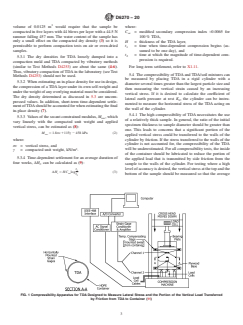
be measured so that the average vertical stress in the sample can be computed. A test apparatus designed for this purpose is
illustrated in Fig. 1 (10).
5.5 The resilient modulus (M ) of subgrade soils can be expressed as:
R
B
M 5 Aθ (4)
R
where:
θ = first invariant of stress (sum of the three principal stresses),
A = experimentally determined parameter, and
B = experimentally determined parameter.
5.5.1 Tests for the parameters A and B can be conducted according to AASHTO T 274. The maximum particle size typically is
limited to 19 mm by the testing apparatus, which precludes the general applicability of this procedure to the larger size TDA
typically used for civil engineering applications.
D6270 − 20
FIG. 1 Compressibility Apparatus for TDA Designed to MeasuredMeasure Lateral Stress and the Portion of the Vertical Load Trans-
ferred
by Friction from TDA to Container (11)
5.6 The coefficient of lateral earth pressure at rest K and Poisson’sPoisson’s ratio μ can be determined from the results of
O 0
confined compression tests where the horizontal stresses were measured. A test apparatus designed for this purpose is shown in
Fig. 1. K and μ are calculated from:
O 0
σ
h
K 5 (5)
O
σ
v
σ
h
K 5 (5)
σ
v
K
O
μ 5 (6)
11K
~ !
O
K
μ 5 (6)
~11K !
where:
σ = measured horizontal stress, and
h
σ = measured vertical stress.
v
5.7 The shear strength of TDA may be determined in a direct shear apparatus in accordance with Test Method D3080D3080/
D3080M or using a triaxial shear apparatus. The large size of TDA typically used for civil engineering applications requires that
specimen sizes be several times greater than used for common soils. Because of the limited availability of large triaxial shear
apparatus, this method is generally restricted to TDA 25 mm in size and smaller. The interface strength between TDA and
geomembrane can be measured in a large scale large-scale direct shear test apparatus (12, 13).
5.8 The hydraulic conductivity (permeability) of TDA and TDA/soils mixtures should be measured with a constant head
permeameter with a diameter several times greater than the maximum particle size. TDA with a maximum size smaller than 19
mm can be determined in accordance with Test Method D2434. However, TDA and TDA/soil mixtures used for civil engineering
applications almost always have a majority of their particles larger than 19 mm, so this method is generally not applicable. Samples
should be tested at a void ratio comparable to the value expected in the field. This may require a permeameter capable of applying
a vertical stress to the sample to simulate the compression that would occur under the weight of overlying material. The high
hydraulic conductivity of TDA should be accounted for in design of the permeameter. This includes provisions for an adequate
D6270 − 20
supply of water and measuring the head loss across the sample using standpipes mounted on the body of the permeameter. An
apparatus that takes these factors into account is shown in Fig. 2 (11). A standard test method for measurement of hydraulic
conductivity of TDA is provided in Test Method D7760.
5.9 The thermal conductivity of TDA is significantly lower than for common soils. For TDA smaller than 25 mm in size, the
thermal conductivity can be measured using commercially available guarded hot plate apparatus. For TDA larger than 25 mm, it
is necessary to construct a large-scale hot plate apparatus (15). The thermal conductivity of TDA also can be back-calculated from
field measurements (15).
6. Construction Practices
6.1 TDA have a compacted dry density that is one-third to one-half one third to one half of the compacted dry density of typical
soil. This makes them an attractive lightweight fill for embankments constructed on weak, compressible soils where slope stability
or excessive settlement are a concern, as well as landslide repair.
6.2 The thermal resistivity of TDA is approximately eight times greater than for typical granular soil. For this reason, TDA can
be used as a 150 to 450-mm thick insulating layer to limit the depth of frost penetration beneath roads. This reduces frost heave
in the winter and improves subgrade support during the spring thaw. In addition, TDA can be used as backfill around basements
to limit heat lost through basement walls, thereby reducing heating costs.
6.3 The low compacted dry density, high hydraulic conductivity, and low thermal conductivity make TDA very attractive for use
as retaining wall backfill. Lateral earth pressures for TDA backfill can be about 50 % of values obtained for soil backfill (7-127,
10, 12). TDA can also be used as backfill for geosynthetic-reinforced retaining walls. An at-rest value of K = 0.3 has been
recommended for the design of cantilever retaining walls with TDA backfill up to 3 m thick (8, 16-18).
6.4 The hydraulic conductivity of TDA makes them suitable for many drainage applications including French drains, drainage
layers in landfill liner and cover systems, and leach fields for on-site sewage disposal systems. For applications with a vertical
stress less than 50 kPa, the hydraulic conductivity of TDA is generally greater than 1 cm/s, which is comparable to conventional
uniformly graded aggregate. When TDA is used as a component of landfill leachate collection and removal systems, and other
applications where the vertical stress would be greater than 50 kPa, the hydraulic conductivity and void ratio under the final design
vertical stress should be considered. The hydraulic conductivity must meet applicable regulatory requirements and the void ratio
must be sufficient to minimize clogging.
FIG. 2 Hydraulic Conductivity Apparatus for TDA with Provisions for Application of Vertical Stress (14)
D6270 − 20
6.4.1 TDA can be used as a substitute for gravel in landfill horizontal gas collection trenches. In this application, 152 mm of TDA
is placed on the bottom of the trench as a base material for the gas collection pipe. After the pipe is in place, an additional 305
mm of TDA is placed over the pipe (19).
6.5 TDA can be used as a vibration damping layer beneath rail lines to reduce the impact of ground-bournground-borne vibrations
above 16 Hz on residences and businesses adjoining the tracks. In this application, a 300-mm thick layer of 75-mm maximum size
TDA wrapped in filter fabric is placed beneath the conventional ballast/subballast system (20-23).
6.6 Two different sizes of TDA are commonly used for the applications discussed above. One has a maximum size of 75 mm and
the other has a maximum size of 300 mm. Rough shreds can also be used for some applications, provided all tires are shredded
such that the largest shred is the lesser of one-quarter one quarter circle in shape or 600 mm in length. In all cases, at least one
side wall should be severed from the tread.
6.7 TDA with a maximum size of 75 mm or 300 mm are generally placed in 300-mm thick lifts and compacted by a tracked
bulldozer, sheepsfoot roller, or smooth drum vibratory roller with a minimum operating weight of 90 kN. Rough shreds are
generally placed in 900-mm thick lifts and compacted by a tracked bulldozer. For most applications, a minimum of six passes of
the compaction equipment should be used.
6.8 TDA should be covered with a sufficient thickness of soil to limit deflections of overlying pavement caused by traffic loading.
Soil cover thicknesses as low as 0.8 m may be suitable for paved roads with light traffic. For paved roads with heavy traffic, 1 to
2 m of soil cover may be required. For unpaved applications, 0.3 to 0.5 m of soil cover may be suitable depending on the traffic
loading. The designer should assess the actual thickness of soil cover needed based on the loading conditions, TDA layer thickness,
pavement thickness, and other conditions as appropriate for a particular project. Regardless of the application, the TDA should be
covered with soil in such a way as to prevent contact between the public and the TDA, which may have exposed steel belts.
6.9 In applications where pavement will be placed over the TDA layer, highway drainage applications, and retaining wall backfill,
the TDA layer should be completely wrapped in a layer of non-woven or woven geotextile to minimize infiltration of soil particles
into the voids between the TDA. AASHTO M 288 should be used for guidance on geotextile selection.
6.10 Whole scrap tires and tire sidewalls that have been cut from the tire casing can be used to construct retaining walls,
reinforcing mats beneath roads constructed on weak ground, and erosion protection layers.
6.11 TDA fills should be designed to minimize the possibility of an internal heating reaction (2). Possible causes Oxidation of the
reaction are oxidation of the exposed steel belts and oxidation of the rubber. Microbes may play a role in bothexposed wire is the
primary mechanism for an exothermic reaction responsible for self-heating in TDA reactions.(24). Factors thought to create
conditions Conditions favorable for oxidation of exposed steel,steel or rubber, or both, include: free access to air; free access to
water; retention of heat caused by the high insulating value of TDA in combination with a large fill thickness; large amounts of
exposed steel belts; and smaller TDA sizes and excessive amounts of granulated rubber particles; and the presence of inorganic
and organic nutrients that would enhance microbial action.particles.
6.11.1 The design guidelines given in the following sections were developed to minimize the possibility for heating of TDA fills
by minimizing factors that could create conditions favorable for this reaction. In developing these guidelines, the insulating effect
caused by increasing fill thickness and the favorable performance of projects with TDA fills less than 4-m thick have been
considered. Thus, design guidelines are less stringent for projects with thinner TDA layers. The guidelines are divided into two
classes: Class I fills with TDA layers less than 1-m thick, and Class II fills with TDA layers in the range of 1 to 3-m thick. Although
there have been no projects with less than 4 m of TDA fill that have experienced a catastrophic heating reaction, to be conservative,
TDA layers greater than 3-m thick are not recommended. The guidelines are for use in designing TDA fills. TDA layers of greater
than 3 m vertical thickness are not recommended. A 3-m TDA fill which is constructed based on current design guidelines should
not experience an exothermic reaction resulting in self-heating that leads to combustion (24). Design of fills that are mixtures or
alternating layers of TDA and mineral soil should be handled on a case-by-case basis.
6.11.2 For Class I fills, the material shall meet the material requirements for Type A TDA given in 7.1.1 and 7.1.2. No special
design features are required to minimize heating of Class I fills.
6.11.3 For Class II fills, the material shall meet the material requirements for Type B TDA given in 7.1.1 and 7.1.3.
D6270 − 20
6.11.2 Class II fills Fills shall be constructed in such a way that infiltration of water and air is minimized. Moreover, there shall
be no direct contact between TDA and soil containing organic matter, such as topsoil. organic matter. One possible way to
accomplish this is to cover the top and sides of the fill with a 0.5-m thick layer of compacted mineral soil with a minimum of 30 %
rubber fines. The mineral soil. The soil should be separated from the TDA with a geotextile. The top of the mineral soil layer should
be sloped so that water will drain away from the TDA fill. geotextile fabric. Additional fill may be placed on top of the mineral
soil layer as needed to meet the overall design of the project. If the project will be paved, it is recommended that the pavement
extend to the shoulder of the embankment or that other measures be taken to minimize infiltration at the edge of theThere is no
need to try to exclude water or air movement in an effort to reduce the risk of a hazardous level of self-heating pavement.(24).
6.11.5 For Class II fills, use of drainage features located at the bottom of the fill that could provide free access to air should be
avoided. This includes, but is not limited to, open graded drainage layers daylighting on the side of the fill. Under some conditions,
it may be possible to use a well-graded granular soil as a drainage layer. The thickness of the drainage layer at the point where
it daylights on the side of the fill should be minimized. For TDA fills placed against walls, it is recommended that the drainage
holes in the wall be covered with well-graded granular soil. The granular soil should be separated from the TDA with geotextile.
6.11.3 Embankments constructed in accordance with the guidelines have shown no evidence of self heating self-heating (2425).
6.12 Type A TDA is a suitable alternative substitute for rock aggregate in on-site septic systems in regardsregard to wastewater
treatment and media durability (2526).
7. Material Specifications
7.1 The material specifications for TDA that are presented below take into consideration the need to limit internal heating of TDA
fills as discussed in 6.11, producing a material that can be placed and compacted with conventional construction equipment, and
limiting exposed steel belts to allow for rubber-to-rubber contacts between the pieces when placed in a fill. Moreover, TDA meeting
the specifications can be produced with reasonably well-maintained processing equipment that has been properly selected for the
size product being produced. Specifications are provided for two size ranges. The first is termed Type A and is suitable for many
drainage, vibration damping, and insulation applications. The second is larger and is termed Type B. It is suitable for use as
lightweight embankment fill, wall backfill, and some landfill drainage and gas collection applications.
7.1.1 The TDA shall be made from scrap tires which shall be shredded into the sizes specified in 7.1.27.1.3 for Type A TDA or
7.1.37.1.4 for Type B TDA. They shall be produced by a shearing process. TDA produced by a hammer mill will not be allowed.
The TDA shall be free of all contaminants including but not limited to oil, grease, gasoline, and diesel fuel that could leach into
the groundwater or create a fire hazard. In no case shall the TDA contain the remains of tires that have been subjected to a fire,
because the heat of a fire may liberate liquid petroleum products from the tire that could create a fire hazard when the TDA are
placed in a fill. The TDA shall be free from organic matter such as fragments of wood, wood chips, and other fibrous organic matter.
The TDA shall have less than 1 % (by weight) of metal fragments that are not at least partially encased in rubber. Metal fragments
that are partially encased in rubber shall protrude no more than 25 mm from the cut edge of the TDA on 75 % of the pieces (by
weight) and no more than 50 mm on 90 % of the pieces (by weight). The gradation shall be measured in accordance with Test
Method topsoil, etc. C136, except that the minimum sample size shall be 6 to 12 kg for Type A TDA and 16 to 23 kg for Type
B TDA.
7.1.2 The TDA shall have less than 1 % (by weight) of metal fragments that are not at least partially encased in rubber. Metal
fragments that are partially encased in rubber shall protrude no more than 25 mm from the cut edge of the TDA on 75 % of the
pieces (by weight) and no more than 50 mm on 90 % of the pieces (by weight). The gradation shall be measured in accordance
with Test Method C136/C136M, except that the minimum sample size shall be 6 to 12 kg for Type A TDA and 16 to 23 kg for
Type B TDA.
7.1.3 Type A TDA shall have a maximum dimension, measured in any direction, of 200250 mm. In addition, Type A TDA shall
have 100 % passing the 100-mm square mesh sieve, a minimum of 95 % passing (by weight) the 75-mm square mesh sieve, a
maximum of 50 %70 % passing (by weight) the 38-mm square mesh sieve, and a maximum of 5 % passing (by weight) the
4.75-mm sieve.sieve, as summarized in Table 2.
7.1.4 Type B TDA shall have a minimummaximum of 90 %16 % (by weight) with a maximum dimension, measured in any
direction, of 300 mm and 100 % with a maximum dimension, measured in any direction, of 450 mm. At least one side wall shall
be removed from the tread of each tire. The side wall will be considered removed if the bead wire has been completely severed
from the side wall. A minimum of 75 % (by weight) shall pass the 200-mm square mesh sieve, a maximum of 50 %85 % (by
D6270 − 20
TABLE 2 TDA Gradation Requirements (27)
Type A Spec. Type B Spec.
Sieve Opening Sieve Opening
Requirements Requirements
(mm) (in.)
(% passing) (% passing)
450 18 1 1
300 12 100 % 100 %
200 8 100 % 75–100 %
100 4 100 % . . .
75 3 95–100 % 0–85 %
38 1.5 0–70 % 0–25 %
4.75 0.187 (No. 4) 0–5 % 0–1 %
pan pan 0 % 0 %
Free steel 1 % max 1 % max
Longest shred (in.) 10 18
% weight of shred >12 in. long . . . 16 % max
Sidewall shreds (ea) 0 0
Shreds >2 in. wire exposed 10 % max 10 % max
Shreds >1 in. wire exposed 25 % max 25 % max
weight) shall pass the 75-mm square mesh sieve, a maximum of 25 % (by weight) shall pass the 38-mm square mesh sieve, and
a maximum of 1 % (by weight) shall pass the 4.75-mm sieve.sieve, as summarized in Table 2.
8. Leachate
8.1 The Toxicity Characteristics Leaching Procedure (TCLP) (USEPA Method 1311) is one test to determine if a waste is regulated
as a hazardous waste due to leaching of toxic compounds that could pose a significant hazard to human health. The TCLP test
represents the scenario of acid rain percolating through the waste and exiting as leachate. For all regulated metals and organics,
the results for TDA are well below the TCLP regulatory limits (26-28-2830); therefore, TDA are not classified as a hazardous
waste.
8.2 In addition to TCLP tests, laboratory leaching studies have been performed following several test protocols. Results show that
metals are leached most readily at low pH and that organics are leached most readily at high pH (2830, 2931). Thus, it is preferable
to use TDA in environments with a near neutral pH.
8.3 The potential of TDA to generate leachate has been examined in field studies for both above- and below-groundwater table
applications. The results have been compared to primary drinking water standards, secondary (aesthetic) drinking water standards,
and USEPA preliminary remediation goals (PRG) (3032). PRG are risk-based concentrations that the USEPA considers to be
protective for lifetime exposure to humans (3032). Freshwater aquatic toxicity has also been evaluated. These results were
summarized in a literature review and statistical analysis performed for the USEPA Resource Conservation Challenge (3133).
8.4 In above-groundwater table applications, the TDA is placed above the water table and is subjected to water from infiltration.
Seven field studies have examined this category of applications (32-34-3941). A statistical comparison was performed (3133) using
procedures for censored environmental data recommended by Helsel (4042).
8.4.1 The preponderance of evidence shows that TDA used above the water table does not cause the primary drinking water
standards for metals to be exceeded. Moreover, a statistical comparison shows that TDA is unlikely to increase levels of metals
with primary drinking water standards above naturally occurring background levels (3133).
8.4.2 For above-groundwater table applications, it is likely that TDA would increase the concentrations of iron and manganese,
which have secondary drinking water standards. At the point where water emerges from a TDA fill, it is likely that the levels of
iron and manganese will exceed secondary drinking water standards, and the PRG for tap water for manganese will also be
exceeded. After an extended dry period, an initial pulse of iron and manganese mass may occur (4143). When a TDA septic tank
leach field serviced with typical domestic wastewater sewage was compared with a leach field comprised of rock aggregate media,
iron, manganese, and zinc concentrations from the TDA effluent were statistically significantly higher compared to the rock media,
which is likely a result of oxidation of metallic components in the TDA (2526). However, for two of three projects where samples
were taken from wells adjacent to the TDA fills, the iron and manganese levels were about the same as background levels. The
prevalence of manganese in groundwater is shown by the naturally occurring concentrations at three projects being above the
secondary drinking water standard and PRG. For other chemicals with secondary drinking water standards, a statistical comparison
shows that there is no evidence that TDA affects naturally occurring background levels (3133).
D6270 − 20
8.4.3 Volatile and semivolatile organics have been monitored on two projects where TDA was placed above the water table
(33-35-3537). Substances are generally below detection limits. Moreover, for those substances with drinking water standards, the
levels were below the standards. The concentrations were also below the applicable PRG (3133). A few substances were
occasionally found above the test method detection limit; however, the highest concentrations were found in a control section
located uphill from the TDA (3335), suggesting a source associated with active roadways. There are also laboratory studies
showing that TDA has the ability to absorb some organic compounds (4244).
8.4.4 Aquatic toxicity tests were performed on samples taken from one above-groundwater table project. The results showed that
water collected directly from TDA fills had no effect on survival, growth, and reproduction of two standard test species (fathead
minnows and a small crustacean (Ceriodaphnia dubia)) (3133, 3436).
8.4.5 In summary, TDA placed above the water table would be expected to have a negligible off-site effect on water quality (3133).
8.5 TDA placed below the water table has been studied at three different sites (4345). A statistical comparison was performed
(3133) using procedures for censored environmental data recommended by Helsel (4042).
8.5.1 A statistical analysis of the data at these sites showed that use of TDA did not cause primary drinking water standards for
metals to be exceeded. Moreover, the data shows that TDA was unlikely to increase levels of metals with primary drinking water
standards above naturally occurring background levels (3133).
8.5.2 For chemicals with secondary drinking water standards, it is likely that TDA below the groundwater table would increase
the concentrations of iron, manganese, and zinc. For water that is collected directly from TDA fill below the groundwater table,
it is likely that the concentrations of manganese and iron will exceed their secondary drinking water standards and PRG for tap
water. The secondary drinking water standards and PRG for zinc were not exceeded even for water in direct contact with TDA.
The rate at which metals leach from TDA is the highest when constantly submerged, but release rates decrease over time, where
it significantly decreases after eight months and becomes constant by the end of 15 months at very low values; iron and manganese
will likely be released from a submerged TDA fill at low, detectable rates for the lifetime of typical civil engineering applications
(4143). The concentration of iron, manganese, and zinc decreases to near background levels by flowing only a short distance
though soil (0.6 to 3.3 m). For other chemicals with secondary drinking water standards, a statistical comparison showed little
likelihood that TDA placed below the water table alters naturally occurring background levels (3133).
8.5.3 Trace levels of a few volatile and semivolatile organics were found from water taken directly from TDA-filled trenches. The
concentration of benzene, chloroethane, cis-1,2-dichloroethene, and aniline for water in direct contact with TDA are above their
respective PRG for tap water. However, chloroethane, cis-1,2-dichloroethene, and aniline concentrations were below the PRG for
all samples taken from wells 0.6 and 3.3 m downgradient. Moreover, the concentrations were below the detection limits for
virtually all samples, indicating that these substances have limited downgradient mobility (2830).
8.5.4 The data on benzene deserves additional discussion. The primary drinking water standard for benzene is 5 μg/L and its PRG
is 0.35 μg/L. For six sample dates, the detection limit reported by the laboratory was 0.5 μg/L, slightly above the PRG. For the
remaining four sample dates the detection limit was 5 μg/L. Focusing on the data from samples with a detection limit of 0.5 μg/L,
the benzene concentration was below the detection limit in downgradient wells for all but one well, on a single date, when the
concentration was 1 μg/L. This data shows that benzene also has limited downgradient mobility (2830). In a different study where
TDA was submerged in water for 15 months, the highest benzene concentration of 0.97 μg ⁄L was observed at the beginning of the
experiment, but dropped below detection limit of 0.3 μg/L by Week 34 (4143). This study indicated that the specific loss rates for
benzene are highest at the beginning, and decline rapidly over the first 18 weeks (4143).
8.5.5 Aquatic toxicity tests were performed on samples taken on two dates. The results showed that water collected directly from
TDA-filled trenches had no effect on survival and growth of fathead minnows. While there were some toxic effects of TDA placed
below the groundwater table on Ceriodaphnia dubia, a small amount of dilution (up to threefold) as the groundwater flowed
downgradient or when it entered a surface body of water would remove the toxic effects (3133, 3436).
8.5.6 In summary, TDA placed below the water table would be expected to have a negligible off-site effect on water quality (3133).
9. Keywords
9.1 construction practices; landfills; leachate; lightweight fill; rail lines; retaining walls; roads; scrap tires; TDA; tire chips;
tire-derived aggregate; tire shreds; vibration damping
D6270 − 20
APPENDIX
(Nonmandatory Information)
X1. TYPICAL MATERIAL PROPERTIES
X1.1 This appendix contains typical properties of TDA to aid in the selection of values for preliminary designs and to provide a
basis for comparison for test results.
X1.2 Values of specific gravity and water absorption capacity reported in the literature are summarized in Table X1.1. The unit
weight of TDA changes with placement and compaction conditions and the application of overburden stress, as summarized in
Table X1.2 (8).Table X1.3 summarizes the compacted and uncompacted dry density of TDA. Compaction results for mixtures of
TDA and soil also are available (4-6, 4446). The results from one study are summarized in Fig. X1.1.
X1.3 Typical compressibility results are summarized in Table X1.4. The compressive properties between the different types of
TDA are equivalent after initial compaction or compression (2526). Increased compressive loading results in a reduction in
hydraulic conductivity.
X1.4 A measure of compressibility applicable to vehicle loads is resilient modulus. Results determined by Ahmed (5) using
AASHTO T 274-82 for mixtures of TDA and soil are summarized in Table X1.5. The parameter A, and therefore M , decreases
R
as the percent TDA by dry weight of the mix increases. Results determined by Edil and Bosscher (4, 4951) for mixtures of TDA
and sand are summarized in Fig. X1.2. Shao et al. (5153) performed resilient modulus tests on crumb rubber (7-mm(7 mm
maximum size) and rubber buffings (1-mm(1 mm maximum size). The resilient modulus values ranged from 700 to 1700 kPa.
X1.5 Typical values of coefficient of lateral earth pressure at rest and Poisson’s ratio, measured as part of vertical compression
tests, are presented in Table X1.6.
X1.6 The shear strength of TDA has been measured using triaxial shear (5, 4648, 5153), simple shear (13), interface direct shear
(13), and using direct shear (12, 13, 4446, 4749, 5254).Tables X1.7-X1.9X1.12 summarize the Type B TDA shear test results of:
simple shear testing of Type B TDA; internal interface direct shear testing of Type B TDA (DS); TDA and concrete interface direct
shear testing of Type B TDA (DSI); TDA and sand interface direct shear testing of Type B TDA (DSIS); TDA and aggregate
interface direct shear testing of Type B TDA (DSIA); and TDA and clay interface direct shear testing of Type B TDA (DSIC),
TABLE X1.1 Summary of Specific Gravity and Water Absorption Capacity
Specific Gravity
Water
TDA Type Absorption Reference
Saturate
Bulk Apparent
Capacity (%)
Surface Dry
Steel belted 1.06 1.01 1.10 4 (45)
Steel belted 1.06 1.01 1.10 4 (47)
Mixture 1.06 1.16 1.18 9.5 (46)
Mixture 1.06 1.16 1.18 9.5 (48)
Mixture (Pine State) - - - - - - - - 1.24 2 (44)
Mixture (Pine State) - - - - - - - - 1.24 2 (46)
Mixture (Palmer) - - - - - - - - 1.27 2 (44)
Mixture (Palmer) - - - - - - - - 1.27 2 (46)
Mixture (Sawyer) - - - - - - - - 1.23 4.3 (44)
Mixture (Sawyer) - - - - - - - - 1.23 4.3 (46)
Mixture 1.01 1.05 1.05 4 (45)
Mixture 1.01 1.05 1.05 4 (47)
Mixture (12.7 mm to 50.8 mm) - - - - 0.88 to 1.13 - - - - - - - - (5)
D6270 − 20
TABLE X1.2 Unit Weight of Large-Size TDA
Uncompacted Unit Compacted Unit
A
TDA size
Specimen Size
Weight Weight Compaction Effort Reference
(mm)
(mm)
3 3
(kN/m ) (kN/m )
#76 3.35 6.07 60 % of standard Proctor energy 254(D) × 254(H) (47)
#76 3.35 6.07 60 % of standard Proctor energy 254(D) × 254(H) (49)
B
50 – 305 N/A 4.71 – 6.30 Laboratory compaction Varies (48)
B
50–305 N/A 4.71–6.30 Laboratory compaction Varies (50)
B B
#178 N/A 4.47 N/A 305 (L) × 305 (W) (9)
#76 3.30 – 4.88 5.03 – 6.92 Laboratory compaction Varies (13)
#76 3.30–4.88 5.03–6.92 Laboratory compaction Varies (13)
6.45 – 7.54 Field compaction (13)
6.45–7.54 Field compaction (13)
C
38-125 4.90 6.31 Cyclic loading with a maximum of 54 kPa 570 (D) × 1120 (H) (13)
C
38–125 4.90 6.31 Cyclic loading with a maximum of 54 kPa 570 (D) × 1120 (H) (13)
6.48 Cyclic loading with a maximum of 134 kPa
C
35 – 125 4.80 6.11 Cyclic loading with a maximum of 58 kPa
C
35–125 4.80 6.11 Cyclic loading with a maximum of 58 kPa
D
(OTR) 6.24 Cyclic loading with a maximum of 146 kPa
A
D, L, W, and H = diameter, length, width, and height, respectively.
B
Not available.
C
Under a vertical stress of 50 to 60 kPa.
D
Off-the-road TDA.
respectively, from McCartney et al. (13, 55). Available shear strength data give cohesion c = 13 to 14 kPa (8). Failure envelopes
for tests conducted at low stress
...