

ASTM D6320/D6320M-24
(Test Method)Standard Test Methods for Single Filament Hose Reinforcing Wire Made from Steel
General Information
- Abstract
SIGNIFICANCE AND USE
5.1 The procedures for the determination of properties of single-filament hose reinforcing wire made from steel are considered satisfactory for acceptance testing of commercial shipments of this product because the procedures are the best available and have been used extensively in the trade.
5.1.1 In the case of a dispute arising from differences in reported test results when using these test methods for acceptance testing of commercial shipments, the purchaser and supplier should conduct comparative tests to determine if there is a statistical bias between their laboratories. Competent statistical assistance is recommended for investigation of bias. As a minimum, two parties should take a group of test specimens which are as homogeneous as possible and which are from a lot of material of the type in question. The test specimens then should be randomly assigned in equal numbers to each laboratory for testing. The average results from the two laboratories should be compared by using an appropriate statistical test and an acceptable probability level chosen by the two parties before testing is begun. If a bias is found, either its cause must be determined and corrected or the purchaser and supplier must agree to interpret future test results with consideration to the known bias.
SCOPE
1.1 These test methods cover testing of single filament steel wires that are used to reinforce hose products. By agreement, these test methods may be applied to similar filaments used for reinforcing other rubber products.
1.2 These test methods describe test procedures only and do not establish specifications or tolerances.
1.3 These test methods cover the determinations of the mechanical properties listed below:
Property
Section
Breaking force (strength)
7 – 14
Yield strength
7 – 14
Elongation
7 – 14
Knot strength
15 – 21
Torsion resistance
22 – 29
Reverse bend
30 – 37
Wrap
38 – 44
Diameter
45 – 51
1.4 The values stated in either SI units or inch-pound units are to be regarded separately as standard. The values stated in each system may not be exact equivalents; therefore, each system shall be used independently of the other. Combining values from the two systems may result in non-conformance with the standard.
1.5 This standard does not purport to address all of the safety concerns, if any, associated with its use. It is the responsibility of the user of this standard to establish appropriate safety, health, and environmental practices and determine the applicability of regulatory limitations prior to use.
1.6 This international standard was developed in accordance with internationally recognized principles on standardization established in the Decision on Principles for the Development of International Standards, Guides and Recommendations issued by the World Trade Organization Technical Barriers to Trade (TBT) Committee.
- Status
- Published
- Publication Date
- 31-Dec-2023
- Technical Committee
- D13 - Textiles
- Drafting Committee
- D13.19 - Industrial Fibers and Metallic Reinforcements
Overview
ASTM D6320/D6320M-24 specifies standardized test methods for determining key mechanical properties of single filament steel wires used as hose reinforcement. Developed by ASTM, this international standard provides consistent procedures for the evaluation of wire used in the reinforcement of hoses and, by agreement, other rubber products. Covering aspects such as breaking force, yield strength, elongation, torsion resistance, knot strength, reverse bend, wrap, and diameter, the standard ensures reproducibility and reliability in acceptance testing for commercial shipments.
These test methods do not dictate material specifications but offer a rigorously defined approach for characterizing wire properties, thereby supporting quality control, product development, and dispute resolution in both buyer and supplier laboratories.
Key Topics
Scope and Applicability
- Applicable to single filament steel hose reinforcing wires and, if agreed, similar filaments in other rubber reinforcements.
- Describes procedures for property determination, not specification limits or tolerances.
Mechanical Properties Tested
- Breaking force (strength)
- Yield strength
- Elongation
- Knot strength
- Torsion resistance
- Reverse bend (fatigue/ductility)
- Wrap (surface integrity)
- Diameter and roundness
Test Method Structure
- Consistent approach for sampling, specimen preparation, testing apparatus, and result reporting.
- Recommendations for comparative testing and handling differences in laboratory results, including guidance for addressing statistical bias.
Reporting and Precision
- Specifies detailed reporting requirements for each property tested, including test conditions and deviations.
- Outlines precision and bias considerations for reproducibility and consistency across laboratories.
International Relevance
- Developed in line with WTO Technical Barriers to Trade (TBT) Committee principles, ensuring global alignment in testing practices.
Applications
Quality Control
- Essential for manufacturers and buyers of steel-reinforced hoses to verify wire quality before product acceptance and shipment.
Product Development
- Supports engineers and designers in selecting appropriate wire based on mechanical properties such as ductility, strength, and surface integrity to ensure hose performance and safety.
Dispute Resolution
- Provides an objective, statistically sound process for comparing test results between laboratories, helping to resolve differences during commercial transactions.
Regulatory Compliance
- Assists organizations in meeting international requirements for hose reinforcement material testing, supporting compliance with quality and safety standards.
Broader Material Testing
- While focused on steel wire in hoses, these test methods may also be adapted for similar applications in other rubber products where metallic reinforcement is used.
Related Standards
- ASTM D76 - Specification for Tensile Testing Machines for Textiles
- ASTM D123 - Terminology Relating to Textiles
- ASTM D4848 - Terminology Related to Force, Deformation, and Related Properties of Textiles
- ASTM D6477 - Terminology Relating to Tire Cord, Bead Wire, Hose Reinforcing Wire, and Fabrics
These referenced standards provide definitions and equipment requirements essential for the accurate and repeatable execution of the test methods described in ASTM D6320/D6320M-24.
Keywords: steel hose reinforcing wire, ASTM D6320, tensile testing, elongation, yield strength, knot strength, torsion resistance, reverse bend, wire diameter, quality control, hose reinforcement standards, mechanical properties testing.
Relations
- Effective Date
- 01-Jan-2024
- Effective Date
- 01-Jan-2024
Frequently Asked Questions
ASTM D6320/D6320M-24 is a standard published by ASTM International. Its full title is "Standard Test Methods for Single Filament Hose Reinforcing Wire Made from Steel". This standard covers: SIGNIFICANCE AND USE 5.1 The procedures for the determination of properties of single-filament hose reinforcing wire made from steel are considered satisfactory for acceptance testing of commercial shipments of this product because the procedures are the best available and have been used extensively in the trade. 5.1.1 In the case of a dispute arising from differences in reported test results when using these test methods for acceptance testing of commercial shipments, the purchaser and supplier should conduct comparative tests to determine if there is a statistical bias between their laboratories. Competent statistical assistance is recommended for investigation of bias. As a minimum, two parties should take a group of test specimens which are as homogeneous as possible and which are from a lot of material of the type in question. The test specimens then should be randomly assigned in equal numbers to each laboratory for testing. The average results from the two laboratories should be compared by using an appropriate statistical test and an acceptable probability level chosen by the two parties before testing is begun. If a bias is found, either its cause must be determined and corrected or the purchaser and supplier must agree to interpret future test results with consideration to the known bias. SCOPE 1.1 These test methods cover testing of single filament steel wires that are used to reinforce hose products. By agreement, these test methods may be applied to similar filaments used for reinforcing other rubber products. 1.2 These test methods describe test procedures only and do not establish specifications or tolerances. 1.3 These test methods cover the determinations of the mechanical properties listed below: Property Section Breaking force (strength) 7 – 14 Yield strength 7 – 14 Elongation 7 – 14 Knot strength 15 – 21 Torsion resistance 22 – 29 Reverse bend 30 – 37 Wrap 38 – 44 Diameter 45 – 51 1.4 The values stated in either SI units or inch-pound units are to be regarded separately as standard. The values stated in each system may not be exact equivalents; therefore, each system shall be used independently of the other. Combining values from the two systems may result in non-conformance with the standard. 1.5 This standard does not purport to address all of the safety concerns, if any, associated with its use. It is the responsibility of the user of this standard to establish appropriate safety, health, and environmental practices and determine the applicability of regulatory limitations prior to use. 1.6 This international standard was developed in accordance with internationally recognized principles on standardization established in the Decision on Principles for the Development of International Standards, Guides and Recommendations issued by the World Trade Organization Technical Barriers to Trade (TBT) Committee.
SIGNIFICANCE AND USE 5.1 The procedures for the determination of properties of single-filament hose reinforcing wire made from steel are considered satisfactory for acceptance testing of commercial shipments of this product because the procedures are the best available and have been used extensively in the trade. 5.1.1 In the case of a dispute arising from differences in reported test results when using these test methods for acceptance testing of commercial shipments, the purchaser and supplier should conduct comparative tests to determine if there is a statistical bias between their laboratories. Competent statistical assistance is recommended for investigation of bias. As a minimum, two parties should take a group of test specimens which are as homogeneous as possible and which are from a lot of material of the type in question. The test specimens then should be randomly assigned in equal numbers to each laboratory for testing. The average results from the two laboratories should be compared by using an appropriate statistical test and an acceptable probability level chosen by the two parties before testing is begun. If a bias is found, either its cause must be determined and corrected or the purchaser and supplier must agree to interpret future test results with consideration to the known bias. SCOPE 1.1 These test methods cover testing of single filament steel wires that are used to reinforce hose products. By agreement, these test methods may be applied to similar filaments used for reinforcing other rubber products. 1.2 These test methods describe test procedures only and do not establish specifications or tolerances. 1.3 These test methods cover the determinations of the mechanical properties listed below: Property Section Breaking force (strength) 7 – 14 Yield strength 7 – 14 Elongation 7 – 14 Knot strength 15 – 21 Torsion resistance 22 – 29 Reverse bend 30 – 37 Wrap 38 – 44 Diameter 45 – 51 1.4 The values stated in either SI units or inch-pound units are to be regarded separately as standard. The values stated in each system may not be exact equivalents; therefore, each system shall be used independently of the other. Combining values from the two systems may result in non-conformance with the standard. 1.5 This standard does not purport to address all of the safety concerns, if any, associated with its use. It is the responsibility of the user of this standard to establish appropriate safety, health, and environmental practices and determine the applicability of regulatory limitations prior to use. 1.6 This international standard was developed in accordance with internationally recognized principles on standardization established in the Decision on Principles for the Development of International Standards, Guides and Recommendations issued by the World Trade Organization Technical Barriers to Trade (TBT) Committee.
ASTM D6320/D6320M-24 has the following relationships with other standards: It is inter standard links to ASTM D6320/D6320M-10(2014), ASTM D6477-23. Understanding these relationships helps ensure you are using the most current and applicable version of the standard.
ASTM D6320/D6320M-24 is available in PDF format for immediate download after purchase. The document can be added to your cart and obtained through the secure checkout process. Digital delivery ensures instant access to the complete standard document.
Standards Content (Sample)
This international standard was developed in accordance with internationally recognized principles on standardization established in the Decision on Principles for the
Development of International Standards, Guides and Recommendations issued by the World Trade Organization Technical Barriers to Trade (TBT) Committee.
Designation: D6320/D6320M − 24
Standard Test Methods for
Single Filament Hose Reinforcing Wire Made from Steel
This standard is issued under the fixed designation D6320/D6320M; the number immediately following the designation indicates the
year of original adoption or, in the case of revision, the year of last revision. A number in parentheses indicates the year of last
reapproval. A superscript epsilon (´) indicates an editorial change since the last revision or reapproval.
1. Scope 2. Referenced Documents
2.1 ASTM Standards:
1.1 These test methods cover testing of single filament steel
D76 Specification for Tensile Testing Machines for Textiles
wires that are used to reinforce hose products. By agreement,
D123 Terminology Relating to Textiles
these test methods may be applied to similar filaments used for
D2969 Test Methods for Steel Tire Cords (Withdrawn
reinforcing other rubber products.
2023)
1.2 These test methods describe test procedures only and do
D4848 Terminology Related to Force, Deformation and
not establish specifications or tolerances.
Related Properties of Textiles
D6477 Terminology Relating to Tire Cord, Bead Wire, Hose
1.3 These test methods cover the determinations of the
Reinforcing Wire, and Fabrics
mechanical properties listed below:
Property Section 3. Terminology
Breaking force (strength) 7 – 14
3.1 Definitions:
Yield strength 7 – 14
Elongation 7 – 14
3.1.1 For definitions of terms relating to tire cord, bead wire,
Knot strength 15 – 21
hose wire, and tire cord fabrics, refer to Terminology D6477.
Torsion resistance 22 – 29
3.1.1.1 The following terms are relevant to this standard:
Reverse bend 30 – 37
Wrap 38 – 44
hose reinforcing wire, torsion resistance, yield strength.
Diameter 45 – 51
3.1.2 For definitions of terms related to force and deforma-
1.4 The values stated in either SI units or inch-pound units tion in textiles, refer to Terminology D4848.
are to be regarded separately as standard. The values stated in 3.1.2.1 The following terms are relevant to this standard:
breaking force and elongation.
each system may not be exact equivalents; therefore, each
system shall be used independently of the other. Combining 3.1.3 For definitions of other terms related to textiles, refer
to Terminology D123.
values from the two systems may result in non-conformance
with the standard.
4. Summary of Test Method
1.5 This standard does not purport to address all of the
4.1 A summary of the directions prescribed for determina-
safety concerns, if any, associated with its use. It is the
tion of specific properties of hose reinforcing wire is stated in
responsibility of the user of this standard to establish appro-
the appropriate sections of the specific test methods that follow.
priate safety, health, and environmental practices and deter-
mine the applicability of regulatory limitations prior to use. 5. Significance and Use
1.6 This international standard was developed in accor-
5.1 The procedures for the determination of properties of
dance with internationally recognized principles on standard-
single-filament hose reinforcing wire made from steel are
ization established in the Decision on Principles for the
considered satisfactory for acceptance testing of commercial
Development of International Standards, Guides and Recom-
shipments of this product because the procedures are the best
mendations issued by the World Trade Organization Technical available and have been used extensively in the trade.
Barriers to Trade (TBT) Committee. 5.1.1 In the case of a dispute arising from differences in
reported test results when using these test methods for accep-
tance testing of commercial shipments, the purchaser and
These test methods are under the jurisdiction of ASTM Committee D13 on
Textiles and are the direct responsibility of Subcommittee D13.19 on Industrial For referenced ASTM standards, visit the ASTM website, www.astm.org, or
Fibers and Metallic Reinforcements. contact ASTM Customer Service at service@astm.org. For Annual Book of ASTM
Current edition approved Jan. 1, 2024. Published February 2024. Originally Standards volume information, refer to the standard’s Document Summary page on
approved in 1998. Last previous edition approved in 2010 as D6320 – 10(2014) the ASTM website.
which was withdrawn February 2023 and reinstated in January 2024. DOI: The last approved version of this historical standard is referenced on
10.1520/D6320_D6320M-24. www.astm.org.
Copyright © ASTM International, 100 Barr Harbor Drive, PO Box C700, West Conshohocken, PA 19428-2959. United States
D6320/D6320M − 24
supplier should conduct comparative tests to determine if there strength of the single-filament wire used as the reinforcing
is a statistical bias between their laboratories. Competent material. The breaking force and yield strength are used in
statistical assistance is recommended for investigation of bias. engineering calculations when designing this type of reinforced
As a minimum, two parties should take a group of test product.
specimens which are as homogeneous as possible and which
9.2 Elongation of hose reinforcing wire is taken into con-
are from a lot of material of the type in question. The test
sideration in the design and engineering of hoses because of its
specimens then should be randomly assigned in equal numbers
effect on uniformity and dimensional stability during service.
to each laboratory for testing. The average results from the two
laboratories should be compared by using an appropriate
10. Apparatus
statistical test and an acceptable probability level chosen by the
10.1 Tensile Testing Machine, constant rate of extension
two parties before testing is begun. If a bias is found, either its
(CRE) type tensile testing machine of such capacity that the
cause must be determined and corrected or the purchaser and
maximum force required to fracture the wire shall not exceed
supplier must agree to interpret future test results with consid-
90 % nor be less than 10 % of the selected force measurement
eration to the known bias.
range. The specifications and methods of calibration and
6. Sampling verification shall conform to Specification D76.
6.1 Lot Sample—As a lot sample for acceptance testing, take
10.2 In some laboratories, the output of CRE type of tensile
at random the number of reels, coils, spools, or other shipping
testing machine is connected with electronic recording and
units of wire directed in an applicable material specification or computing equipment that may be programmed to calculate
other agreement between purchaser and supplier. Consider
and print the results for each of the force - extension properties,
reels, coils, spools, or other shipping units of wire to be the optional.
primary sampling units.
10.3 Extensometer, any device that can be attached to the
NOTE 1—A realistic specification or other agreement between the
specimen and that permits recording of the specimen extension
purchaser and the supplier requires taking into account the variability
during loading, optional.
between and within primary sampling units, to provide a sampling plan
10.4 Grips, of such design that failure of the specimen does
which at the specified level of the property of interest has a meaningful
producer’s risk and acceptable quality level.
not occur at the gripping point, and slippage of the specimen
within the jaws (grips) is prevented.
6.2 Laboratory Sample—Use the primary sampling units in
the lot sample as a laboratory sample.
11. Procedure
6.3 Test Specimens— For each test procedure, take the
11.1 Select a proper force-scale range on the tensile testing
number of lengths of hose reinforcing wire of the specified
machine based on the estimated breaking force of the specimen
lengths from each laboratory sample as directed in the test
being tested.
procedure.
11.2 If specified, tensile testing may be carried out after
aging for 1 h 6 5 min at 150 °C 6 5°C [300 °F 6 9 °F].
BREAKING FORCE, YIELD STRENGTH, AND
ELONGATION 11.3 Set the crosshead speed at 25 mm/min. [1.0 in./min.]
and recorder chart speed at 250 mm/min. [10 in./min.]
7. Scope
11.4 Adjust the distance between the grips of the tensile
7.1 This test method covers the measurement of breaking
machine, nip to nip, to a gage length of 500 mm, 6 0.5 %.
force, yield strength, and elongation of single filament steel
11.5 Secure the specimen in the upper grip sufficiently to
reinforcing wire in a tensile test.
prevent slippage during testing. While keeping the specimen
8. Summary of Test Method
straight and taut, place and secure the other end in the lower
8.1 The specimen is clamped in a tensile testing machine
grip.
and increasing forces applied until the specimen breaks. The
11.6 Apply a force of no greater than 1 N [0.2 lbf] on the
change in force is measured versus the increase in separation of
clamped specimen to take out any residual slack before
the specimen clamps to form a force-extension curve. Breaking
initiating the test. This will be considered the zero-reference
force is read directly from the curve and is expressed in
point for elongation calculations. The pre-tension force should
newtons (pounds - force). Elongation at break is the extension
depends on tested samples. only one setting 1 N cannot
at break divided by the original specimen length times 100.
guarantee all kind of HRW samples keep straight condition
Yield strength the intersection of the force-extension curve
especially for big diameter of HRW. Apply a pretension of
with a line at 0.2 % offset, is read from the force-extension
maximum 1 % of nominal break force of filament to keep the
curve and is expressed in newtons (pounds - force). Current
specimen taut.
tensile test machines may have the capability for calculating
11.7 Start the testing machine and record the force-
elongation and yield strength using a programmed computer.
extension curve generated.
9. Significance and Use
11.7.1 If the specimen fractures at, or within, 5 mm [0.2 in.]
9.1 The load bearing ability of a reinforced rubber product of the gripping point, discard the result and test another
such as a steel reinforced hydraulic hose is related to the specimen. If such jaw breaks continue to occur, insert a jaw
D6320/D6320M − 24
liner, such as an abrasive cloth, between the gripping surface 13. Report
and the specimen in a manner that the liner extends beyond the
13.1 State that the tests were performed as directed in these
grip edge where it comes in contact with the specimen.
test methods (D6320) for breaking strength, elongation at
11.8 Conduct this test procedure on two specimens from
break and yield strength. Describe the material or product
each laboratory sampling unit.
tested.
11.9 Breaking Force— Read the maximum force from the
13.2 Report the following information:
force-extension curve.
13.2.1 The test results of each specimen and the laboratory
sample average. Calculate and report any other data agreed to
11.10 Elongation—Determine the total elongation at break
point from the force-extension curve. between the purchaser and the supplier,
13.2.2 Type of tensile test machine, machine number (if
11.11 Yield Strength— Determine the yield strength by the
applicable), and rate of extension,
0.2 % offset method.
13.2.3 Whether specimens were heat aged or not,
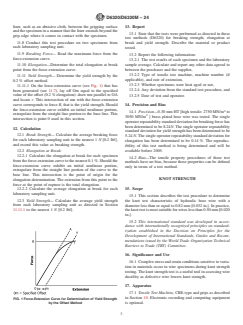
11.11.1 On the force-extension curve (see Fig. 1) that has
13.2.4 Any deviation from the standard test procedure, and
been generated (see 11.7), lay off Om equal to the specified
value of the offset (0.2 % elongation): draw mn parallel to OA
13.2.5 Date of test and operator.
and locate r. This intersection of mn with the force-extension
curve corresponds to force R, that is the yield strength. Should
14. Precision and Bias
the force-extension curve exhibit an initial nonlinear portion,
14.1 Precision—0.30 mm HT [high tensile: 2750 MN/m to
extrapolate from the straight line portion to the base line. This
3050 MN/m ] brass plated hose wire was tested. The single
intersection is point 0 used in this section.
operator repeatability standard deviation for breaking force has
been determined to be 8.24N. The single operator repeatability
12. Calculation
standard deviation for yield strength has been determined to be
12.1 Break Strength— Calculate the average breaking force
5.24 N. The single operator repeatability standard deviation for
for each laboratory sampling unit to the nearest 1 N [0.2 lbf],
elongation has been determined to be 0.14 %. The reproduc-
and record this value as breaking strength.
ibility of this test method is being determined and will be
available before 2005.
12.2 Elongation at Break:
12.2.1 Calculate the elongation at break for each specimen
14.2 Bias—The tensile property procedures of these test
from the force-extension curve to the nearest 0.1 %. Should the
methods have no bias, because these properties can be defined
force-extension curve exhibit an initial nonlinear portion,
only in terms of a test method.
extrapolate from the straight line portion of the curve to the
base line. This intersection is the point of origin for the
KNOT STRENGTH
elongation determination. The extension from this point to the
force at the point of rupture is the total elongation.
15. Scope
12.2.2 Calculate the average elongation at break for each
laboratory sampling unit.
15.1 This section describes the test procedure to determine
12.3 Yield Strength— Calculate the average yield strength
the knot test characteristic of hydraulic hose wire with a
from each laboratory sampling unit as directed in Section diameter less than or equal to 0.82 mm [0.032 in.]. In practice,
11.11.1 to the nearest 1 N [0.2 lbf[.
the knot test is most suitable for wires less than 0.50 mm [0.020
in.].
15.2 This international standard was developed in accor-
dance with internationally recognized principles on standard-
ization established in the Decision on Principles for the
Development of International Standards, Guides and Recom-
mendations issued by the World Trade Organization Technical
Barriers to Trade (TBT) Committee.
16. Significance and Use
16.1 Complex stress and strain conditions sensitive to varia-
tion in materials occur in wire specimens during knot strength
testing. The knot strength test is a useful tool in assessing wire
ductility as defective wire lowers knot strength.
17. Apparatus
17.1 Tensile Test Machine, CRE-type and grips as described
in Section 10. Electronic recording and computing equipment
FIG. 1 Force-Extension Curve for Determination of Yield Strength
by the Offset Method is optional.
D6320/D6320M − 24
18. Procedure Kn 5 100 F /F (1)
kn m
18.1 Select a proper force-scale range on the tensile testing
where:
machine based upon the estimated breaking force of the
Kn = knot strength ratio, %
specimen being tested.
F = knot breaking strength, N [lbf], and
kn
F = breaking strength of the wire, N [lbf].
18.2 If specified, the knot strength test may be carried out m
after aging for 1 h 6 5 min at 150 °C 6 5 °C [300 °F 6 9 °F].
20. Report
18.3 Adjust the distance between the grips of the tensile
20.1 State that the tests were performed as directed in this
testing machine, nip to nip, to a gage length of 250 mm [10 in.]
test methods (D6320). Describe the material or product tested
6 0.5 %.
and report the following:
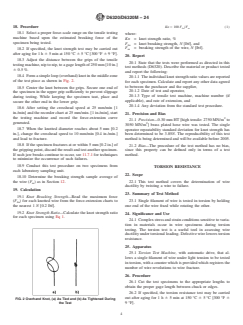
18.4 Form a simple loop (overhand) knot in the middle zone
20.1.1 The individual knot strength ratio values are reported
of the test piece as shown in Fig. 2.
for each specimen. Calculate and report any other data agreed
to between the purchaser and the supplier,
18.5 Center the knot between the grips. Secure one end of
20.1.2 Date of test and operator,
the specimen in the upper grip sufficiently to prevent slippage
20.1.3 Type of tensile test machine, machine number (if
during testing. While keeping the specimen taut, place and
applicable), and rate of extension, and
secure the other end in the lower grip.
20.1.4 Any deviation from the standard test procedure.
18.6 After setting the crosshead speed at 25 mm/min [1
in./min] and the recorder chart at 25 mm/min. [1 in./min], start
21. Precision and Bias
the testing machine and record the force-extension curve
21.1 Precision—0.30 mm HT [high tensile: 2750 MN/m to
generated.
3050 MN/m ] brass plated hose wire was tested. The single
18.7 When the knotted diameter reaches about 5 mm [0.2
operator repeatability standard deviation for knot strength has
in.], change the crosshead speed to 10 mm/min [0.4 in./min.]
been determined to be 3.85N. The reproducibility of this test
and load to fracture.
method is being determined and will be available before 2005.
18.8 If the specimen fractures at or within 5 mm [0.2 in.] of
21.2 Bias—The procedure of the test method has no bias,
the gripping point, discard the result and test another specimen.
since this property can be defined only in terms of a test
If such jaw breaks continue to occur, see 11.7.1 for techniques
method.
to minimize the occurrence of such failures.
18.9 Conduct this test procedure on two specimens from
TORSION RESISTANCE
each laboratory sampling unit.
22. Scope
18.10 Determine the breaking strength sample average of
the wire (F ) as in Section 12. 22.1 This test method covers the determination of wire
m
ductility by twisting a wire to failure.
19. Calculation
23. Summary of Test Method
19.1 Knot Breaking Strength—Read the maximum force
23.1 Single filament of wire is tested in torsion by holding
(F ) for each knotted wire from the force-extension charts to
kn
one end of the wire fixed while rotating the other.
the nearest 1 N [0.2 lbf].
19.2 Knot Strength Ratio—Calculate the knot strength ratio
24. Significance and Use
for each specimen using Eq 1.
24.1 Complex stress and strain conditions sensitive to varia-
tion in materials occur in wire specimens during torsion
testing. The torsion test is a useful tool in assessing wire
ductility under torsional loading. Defective wire lowers torsion
resistance.
25. Apparatus
25.1 Torsion Test Machine, with automatic
...