

ASTM F3611-22e1
(Specification)Standard Specification for P225/60R16 97S Radial Low Tread Depth Standard Reference Test Tire
General Information
- Abstract
SCOPE
1.1 This specification covers the general requirements for the P225/60R16 97S radial low tread depth standard reference test tire. The tire covered by this specification is primarily for use as a reference tire for wet braking traction evaluations for tires in a worn state but may also be used for other evaluations.
1.2 This specification provides a 16 rim diameter code standard tire design and construction, standard dimensions, and specifies the conditions of storage.
1.3 The values stated in inch-pound units are to be regarded as standard. The values given in parentheses are mathematical conversions to SI units that are provided for information only and are not considered standard.
1.4 This standard does not purport to address all of the safety concerns, if any, associated with its use. It is the responsibility of the user of this standard to establish appropriate safety, health, and environmental practices and determine the applicability of regulatory limitations prior to use.
1.5 This international standard was developed in accordance with internationally recognized principles on standardization established in the Decision on Principles for the Development of International Standards, Guides and Recommendations issued by the World Trade Organization Technical Barriers to Trade (TBT) Committee.
- Status
- Published
- Publication Date
- 30-Sep-2022
- Technical Committee
- F09 - Tires
- Drafting Committee
- F09.20 - Vehicular Testing

Overview
ASTM F3611-22e1: Standard Specification for P225/60R16 97S Radial Low Tread Depth Standard Reference Test Tire outlines the requirements for a specialized reference tire designed for evaluating the wet braking traction performance of other tires, particularly in a worn state. Developed by ASTM International, this specification ensures consistency, reliability, and reproducibility in tire testing and comparison processes. The standard addresses tire design, construction, physical properties, storage, and usage to establish uniform testing conditions for industry stakeholders.
Key Topics
Scope of Standard
This standard defines the minimum requirements for the P225/60R16 97S low tread depth radial tire to be used mainly as a reference for wet braking traction evaluations in a worn state. It can also serve in other tire performance evaluations.Design and Construction
- Tire uses steel-belted radial construction with a 16-inch rim diameter code.
- All-season tread design focused on year-round performance.
- Conforms to industry-standard dimensions and tolerances.
- Features proprietary tread compound controlled by physical properties for consistency.
Physical Properties and Dimensions
- Details on tread width, radius, grooves, rib structure, and wear indicators.
- Controlled durometer hardness, tensile strength, and elongation for repeatable performance.
Certification and Storage
- Requirements for manufacturer certification and batch identification.
- Strict guidelines on tire storage conditions to ensure tire preservation and performance integrity.
Test Methods
- Describes preparation, measurements, and evaluation techniques for properties like hardness, tensile strength, and footprint size.
Applications
The P225/60R16 97S Radial Low Tread Depth Standard Reference Test Tire is essential for:
Wet Braking Traction Evaluation
The primary application is serving as a control tire in standardized wet braking traction tests, especially when evaluating the performance degradation of tires as they wear.Industry Benchmarking
Used by tire manufacturers, testing facilities, and regulatory agencies to establish a baseline for comparison against other tires, supporting fair and reproducible performance assessments.Quality Assurance in Manufacturing
Enables manufacturers to benchmark their products against industry-standard reference tires, aiding in research, development, and compliance with regulatory requirements.Research and Development
Supports R&D efforts by providing a consistent, known reference tire for comparative testing of new tread compounds, patterns, and construction methods.
Related Standards
Multiple ASTM standards contribute to or complement ASTM F3611-22e1 by defining test methods, terminology, and additional reference tire specifications:
- ASTM D412 - Test Methods for Vulcanized Rubber and Thermoplastic Elastomers–Tension
- ASTM D2240 - Test Method for Rubber Property–Durometer Hardness
- ASTM D3182 - Practice for Rubber–Materials, Equipment, and Procedures for Mixing Standard Compounds and Preparing Standard Vulcanized Sheets
- ASTM E867 - Terminology Relating to Vehicle-Pavement Systems
- ASTM F538 - Terminology Relating to Characteristics and Performance of Tires
- ASTM F2493, F2870, F2871, F2872 - Specifications for other standard reference test tires
Practical Value
By adhering to ASTM F3611-22e1, industry professionals ensure improved accuracy and comparability of tire testing results. The standard facilitates regulatory compliance, supports consumer safety, and underpins innovation in tire design and testing methodologies. Whether for wet traction testing, tire benchmarking, or conformity assessments, this specification helps unify and streamline key processes in the tire industry.
Relations
- Effective Date
- 01-Oct-2019
- Effective Date
- 01-Oct-2019
- Effective Date
- 01-Jan-2018
- Effective Date
- 01-Oct-2017
- Effective Date
- 01-Nov-2016
- Effective Date
- 01-Nov-2016
- Effective Date
- 15-Aug-2014
- Effective Date
- 01-Jun-2014
- Effective Date
- 01-Jan-2011
- Effective Date
- 01-Jan-2011
- Effective Date
- 01-Jan-2011
- Effective Date
- 15-Jun-2009
- Effective Date
- 01-May-2008
- Effective Date
- 01-Dec-2006
- Effective Date
- 01-Dec-2003
Get Certified
Connect with accredited certification bodies for this standard

DIN CERTCO
DIN Group product certification.

Smithers Quality Assessments
US management systems and product certification.
Sponsored listings
Frequently Asked Questions
ASTM F3611-22e1 is a technical specification published by ASTM International. Its full title is "Standard Specification for P225/60R16 97S Radial Low Tread Depth Standard Reference Test Tire". This standard covers: SCOPE 1.1 This specification covers the general requirements for the P225/60R16 97S radial low tread depth standard reference test tire. The tire covered by this specification is primarily for use as a reference tire for wet braking traction evaluations for tires in a worn state but may also be used for other evaluations. 1.2 This specification provides a 16 rim diameter code standard tire design and construction, standard dimensions, and specifies the conditions of storage. 1.3 The values stated in inch-pound units are to be regarded as standard. The values given in parentheses are mathematical conversions to SI units that are provided for information only and are not considered standard. 1.4 This standard does not purport to address all of the safety concerns, if any, associated with its use. It is the responsibility of the user of this standard to establish appropriate safety, health, and environmental practices and determine the applicability of regulatory limitations prior to use. 1.5 This international standard was developed in accordance with internationally recognized principles on standardization established in the Decision on Principles for the Development of International Standards, Guides and Recommendations issued by the World Trade Organization Technical Barriers to Trade (TBT) Committee.
SCOPE 1.1 This specification covers the general requirements for the P225/60R16 97S radial low tread depth standard reference test tire. The tire covered by this specification is primarily for use as a reference tire for wet braking traction evaluations for tires in a worn state but may also be used for other evaluations. 1.2 This specification provides a 16 rim diameter code standard tire design and construction, standard dimensions, and specifies the conditions of storage. 1.3 The values stated in inch-pound units are to be regarded as standard. The values given in parentheses are mathematical conversions to SI units that are provided for information only and are not considered standard. 1.4 This standard does not purport to address all of the safety concerns, if any, associated with its use. It is the responsibility of the user of this standard to establish appropriate safety, health, and environmental practices and determine the applicability of regulatory limitations prior to use. 1.5 This international standard was developed in accordance with internationally recognized principles on standardization established in the Decision on Principles for the Development of International Standards, Guides and Recommendations issued by the World Trade Organization Technical Barriers to Trade (TBT) Committee.
ASTM F3611-22e1 is classified under the following ICS (International Classification for Standards) categories: 83.160.01 - Tyres in general. The ICS classification helps identify the subject area and facilitates finding related standards.
ASTM F3611-22e1 has the following relationships with other standards: It is inter standard links to ASTM F2872-19, ASTM E1136-19, ASTM F2493-18, ASTM E1136-17, ASTM F2872-16, ASTM F2870-16, ASTM E1136-14, ASTM F2493-14, ASTM F2870-11, ASTM F2871-11, ASTM F2872-11, ASTM F538-09, ASTM F2493-08, ASTM F2493-06, ASTM F538-03. Understanding these relationships helps ensure you are using the most current and applicable version of the standard.
ASTM F3611-22e1 is available in PDF format for immediate download after purchase. The document can be added to your cart and obtained through the secure checkout process. Digital delivery ensures instant access to the complete standard document.
Standards Content (Sample)
This international standard was developed in accordance with internationally recognized principles on standardization established in the Decision on Principles for the
Development of International Standards, Guides and Recommendations issued by the World Trade Organization Technical Barriers to Trade (TBT) Committee.
´1
Designation:F3611 −22
Standard Specification for
P225/60R16 97S Radial Low Tread Depth Standard
Reference Test Tire
This standard is issued under the fixed designation F3611; the number immediately following the designation indicates the year of
original adoption or, in the case of revision, the year of last revision.Anumber in parentheses indicates the year of last reapproval.A
superscript epsilon (´) indicates an editorial change since the last revision or reapproval.
ε NOTE—Corrected 11.1 editorially in January 2023.
1. Scope D3182PracticeforRubber—Materials,Equipment,andPro-
cedures for Mixing Standard Compounds and Preparing
1.1 This specification covers the general requirements for
Standard Vulcanized Sheets
the P225/60R16 97S radial low tread depth standard reference
E867Terminology Relating to Vehicle-Pavement Systems
test tire. The tire covered by this specification is primarily for
E1136Specification for P195/75R14 Radial Standard Refer-
use as a reference tire for wet braking traction evaluations for
ence Test Tire
tiresinawornstatebutmayalsobeusedforotherevaluations.
F538Terminology Relating to Characteristics and Perfor-
1.2 This specification provides a 16 rim diameter code
mance of Tires
standardtiredesignandconstruction,standarddimensions,and
F2493Specification for P225/60R16 97S Radial Standard
specifies the conditions of storage.
Reference Test Tire
1.3 Thevaluesstatedininch-poundunitsaretoberegarded F2870 Specification for 315/70R22.5 154/150L Radial
Truck Standard Reference Test Tire
as standard. The values given in parentheses are mathematical
conversions to SI units that are provided for information only F2871Specification for 245/70R19.5 136/134M Radial
Truck Standard Reference Test Tire
and are not considered standard.
F2872Specification for 225/75R16C 116/114S M+S Radial
1.4 This standard does not purport to address all of the
Light Truck Standard Reference Test Tire
safety concerns, if any, associated with its use. It is the
responsibility of the user of this standard to establish appro-
3. Terminology
priate safety, health, and environmental practices and deter-
3.1 For definitions of terms used in this specification, refer
mine the applicability of regulatory limitations prior to use.
1.5 This international standard was developed in accor- to Terminology F538.
dance with internationally recognized principles on standard-
3.2 Definitions:
ization established in the Decision on Principles for the
3.2.1 all-season tread, n—tread design providing dry, wet,
Development of International Standards, Guides and Recom-
and snow traction performance for an optimized balance for
mendations issued by the World Trade Organization Technical
year-round performance and which may meet the U.S. Tire
Barriers to Trade (TBT) Committee.
Manufacturers Association (USTMA) definition for an M&S,
M+S, M/S, MS, etc. marked tire (see USTMA “Snow Tire
2. Referenced Documents 3
Definitions for Passenger and Light Truck (LT) Tires”). F538
2.1 ASTM Standards:
3.2.2 pavement characteristic, n—physical feature or prop-
D412TestMethodsforVulcanizedRubberandThermoplas-
erty of a pavement surface such as type, roughness, texture,
tic Elastomers—Tension
and skid resistance. E867
D2240TestMethodforRubberProperty—DurometerHard-
3.2.3 pitch, n—unitoftreadpatternelementsusedinvarious
ness
combinations to obtain optimum noise levels. F538
3.2.4 standard reference test tire, SRTT, n—a tire that is
commonly used as a control tire or surface monitoring tire and
This specification is under the jurisdiction of ASTM Committee F09 on Tires
meets the requirements for one of the Standard Specifications
and is the direct responsibility of Subcommittee F09.20 on Vehicular Testing.
Current edition approved Oct. 1, 2022. Published October 2022. DOI: 10.1520/
E1136, F2493, F2870, F2871,or F2872. F538
F3611-22E01.
For referenced ASTM standards, visit the ASTM website, www.astm.org, or
contact ASTM Customer Service at service@astm.org. For Annual Book of ASTM
Standards volume information, refer to the standard’s Document Summary page on Available from the U.S. Tire ManufacturersAssociation, 1400 K Street, N.W.,
the ASTM website. Suite 900 Washington, D.C. 20005.
Copyright © ASTM International, 100 Barr Harbor Drive, PO Box C700, West Conshohocken, PA 19428-2959. United States
´1
F3611−22
FIG. 2Sidewall stamping of the P225/60R16 97S Radial Low
Tread Depth Standard Reference Test Tire
FIG. 1Front View of the P225/60R16 97S Radial Low Tread Depth
Standard Reference Test Tire
4. Design and Construction
4.1 TheP225/60R16lowtreaddepthstandardreferencetest
tire shall feature the steel-belted radial technology, and an
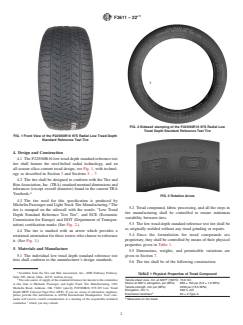
all-season silica content tread design, see Fig. 1, with technol-
ogy as described in Section 3 and Sections5–7.
4.2 The tire shall be designed to conform with the Tire and
RimAssociation,Inc.(TRA)standardnominaldimensionsand
tolerances (except overall diameter) found in the current TRA
Yearbook.
FIG. 3Rotation Arrow
4.3 The tire used for this specification is produced by
Michelin Passenger and LightTruckTire Manufacturing. The
5.2 Tread compound, fabric processing, and all the steps in
tire is stamped on the sidewall with the words: “Low Tread
tire manufacturing shall be controlled to ensure minimum
Depth Standard Reference Test Tire”, and ECE (Economic
variability between tires.
Commission for Europe) and DOT (Department of Transpor-
5.3 The low tread depth standard reference test tire shall be
tation) certification marks (See Fig. 2.).
as originally molded without any tread grinding or repairs.
4.4 The tire is marked with an arrow which provides a
5.4 Since the formulation for tread compounds are
rotational orientation for those testers who choose to reference
proprietary, they shall be controlled by means of their physical
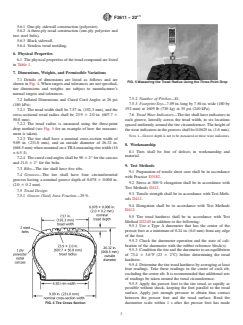
it. (See Fig. 3.)
properties given in Table 1.
5. Materials and Manufacture
5.5 Dimensions, weights, and permissible variations are
5.1 The individual low tread depth standard reference test
given in Section 7.
tires shall conform to the manufacturer’s design standards.
5.6 The tire shall be of the following construction:
Available from the Tire and Rim Association, Inc., 4000 Embassy Parkway,
TABLE 1 Physical Properties of Tread Compound
Suite 390, Akron, Ohio, 44333, tra@us-tra.org.
Tensile sheet cure, min at 320°F (160°C) 15.0 min
Thesolesourceofsupplyofthestandardreferencetireknowntothecommittee
Stress at 300 % elongation, psi (MPa) 850 ± 150 psi (5.9 ± 1.0 MPa)
at this time is Michelin Passenger and Light Truck Tire Manufacturing, 1101
Tensile strength, min psi (MPa) 2250 psi (15.5 MPa)
Michelin Road, Ardmore, OK 73401 (specify P225/60R16 97S DT Low Tread
Elongation, min % 550 % min
Depth SRTT Uniroyal Tiger Paw AWP). If you are aware of alternative suppliers,
A
Durometer hardness 64 ± 2 Type A
please provide this information to ASTM International Headqu
...