

ASTM D7871-23
(Test Method)Standard Test Method for Analysis of Cyclohexane by Gas Chromatography (Effective Carbon Number)
General Information
- Abstract
SIGNIFICANCE AND USE
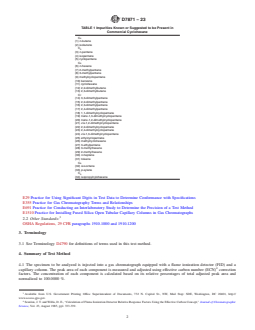
5.1 This test method is suitable for setting specifications on the materials referenced in Table 1 and for use as an internal quality control tool where cyclohexane is produced or is used in a manufacturing process. It may also be used in development or research work involving cyclohexane.
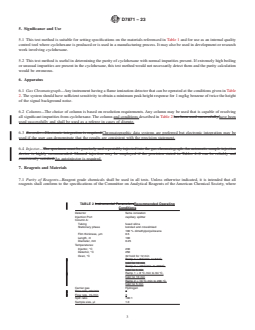
5.2 This test method is useful in determining the purity of cyclohexane with normal impurities present. If extremely high boiling or unusual impurities are present in the cyclohexane, this test method would not necessarily detect them and the purity calculation would be erroneous.
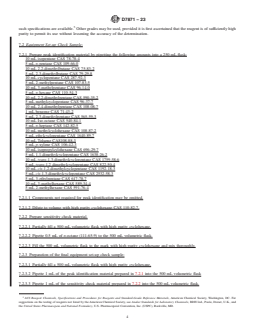
SCOPE
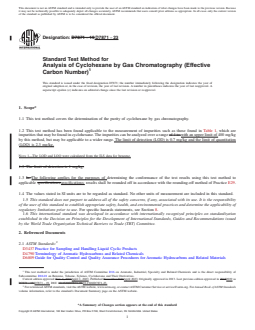
1.1 This test method covers the determination of the purity of cyclohexane by gas chromatography.
1.2 This test method has been found applicable to the measurement of impurities such as those found in Table 1, which are impurities that may be found in cyclohexane. The impurities can be analyzed over a range with an upper limit of 400 mg/kg by this method, but may be applicable to a wider range. The limit of detection (LOD) is 0.7 mg/kg and the limit of quantitation (LOQ) is 2.3 mg/kg.
Note 1: The LOD and LOQ were calculated from the ILS data for benzene.
1.3 The following applies for the purposes of determining the conformance of the test results using this test method to applicable specifications: results shall be rounded off in accordance with the rounding-off method of Practice E29.
1.4 The values stated in SI units are to be regarded as standard. No other units of measurement are included in this standard.
1.5 This standard does not purport to address all of the safety concerns, if any, associated with its use. It is the responsibility of the user of this standard to establish appropriate safety, health, and environmental practices and determine the applicability of regulatory limitations prior to use. For specific hazards statements, see Section 8.
1.6 This international standard was developed in accordance with internationally recognized principles on standardization established in the Decision on Principles for the Development of International Standards, Guides and Recommendations issued by the World Trade Organization Technical Barriers to Trade (TBT) Committee.
- Status
- Published
- Publication Date
- 31-Mar-2023
- Technical Committee
- D16 - Aromatic, Industrial, Specialty and Related Chemicals
- Drafting Committee
- D16.01 - Benzene, Toluene, Xylenes, Cyclohexane and Their Derivatives
Buy Documents
ASTM D7871-23 - Standard Test Method for Analysis of Cyclohexane by Gas Chromatography (Effective Carbon Number)
REDLINE ASTM D7871-23 - Standard Test Method for Analysis of Cyclohexane by Gas Chromatography (Effective Carbon Number)
Overview
ASTM D7871-23: Standard Test Method for Analysis of Cyclohexane by Gas Chromatography (Effective Carbon Number) provides a precise method for determining the purity of cyclohexane and quantifying common impurities using gas chromatography (GC). Developed by ASTM International, this standard ensures reliable quality control, specification setting, and research support for industries handling cyclohexane. The test method leverages an effective carbon number (ECN) approach, making it highly suitable for quality management in manufacturing, petrochemical processing, and laboratory environments.
Key Topics
- Scope of Method: Addresses the determination of cyclohexane purity and the measurement of specific impurities in cyclohexane using gas chromatography with a flame ionization detector (FID) and ECN correction factors.
- Detection Limits: The method detects impurities down to 0.7 mg/kg (limit of detection, LOD) and can quantify them at levels as low as 2.3 mg/kg (limit of quantitation, LOQ).
- Impurity Range: Effective for common cyclohexane impurities (e.g., alkanes, cyclopentane, benzene, toluene, methylcyclohexane) with concentrations up to 400 mg/kg.
- Quality Control: Recommended for internal laboratory quality checks and specification compliance. Procedures include equipment setup verification, calibration, and ongoing instrument sensitivity checks.
- Units: All measurements are reported in SI units, ensuring international compatibility and traceability.
- Safety & Compliance: Users are responsible for following appropriate safety, health, and regulatory procedures when implementing this test method.
Applications
ASTM D7871-23 offers practical benefits across multiple sectors:
- Cyclohexane Production: Supports manufacturers in verifying product purity, ensuring quality assurance, and meeting customer specifications.
- Chemical Manufacturing: Facilitates process control where cyclohexane serves as an intermediate or solvent, preventing contamination from regular impurities.
- Research & Development: Useful for experimental analysis in the development of new cyclohexane-containing formulations or products.
- Regulatory Compliance: Helps organizations demonstrate compliance with industry and international standards for cyclohexane purity.
- Quality Assurance Laboratories: Provides a reliable approach for third-party and internal labs to assess the purity of cyclohexane samples, interpret results, and resolve disputes.
Related Standards
Compliance with ASTM D7871-23 can involve reference to additional ASTM and regulatory standards, including:
- ASTM D3437: Practice for Sampling and Handling Liquid Cyclic Products
- ASTM D4790: Terminology of Aromatic Hydrocarbons and Related Chemicals
- ASTM D6809: Guide for Quality Control and Quality Assurance Procedures for Aromatic Hydrocarbons and Related Materials
- ASTM E29: Practice for Using Significant Digits in Test Data to Determine Conformance with Specifications
- ASTM E355: Practice for Gas Chromatography Terms and Relationships
- ASTM E1510: Practice for Installing Fused Silica Open Tubular Capillary Columns in Gas Chromatographs
- OSHA Regulations 29 CFR 1910.1000, 1910.1200: Referenced for workplace safety and material handling
Summary
Adhering to ASTM D7871-23 ensures rigorous analysis and reporting of cyclohexane purity and its common contaminants through a proven and repeatable gas chromatography method. This standard is essential for quality control in global cyclohexane supply chains, supporting both industrial operations and compliance with international best practices. Key advantages include accurate detection of impurities, robust documentation for regulatory purposes, and greater confidence in cyclohexane product integrity. For optimal implementation, users should ensure laboratory quality systems align with this and related ASTM standards.
Relations
- Effective Date
- 01-Nov-2016
- Effective Date
- 01-Jul-2014
- Effective Date
- 01-May-2013
- Effective Date
- 01-Nov-2011
- Effective Date
- 01-Feb-2011
- Effective Date
- 01-Jan-2011
- Effective Date
- 01-Jun-2010
- Effective Date
- 01-Oct-2008
- Effective Date
- 01-Oct-2008
- Effective Date
- 01-Jun-2008
- Effective Date
- 15-Jul-2007
- Effective Date
- 01-Jun-2007
- Effective Date
- 01-Mar-2007
- Effective Date
- 15-Nov-2006
- Effective Date
- 15-Sep-2006
Buy Documents
ASTM D7871-23 - Standard Test Method for Analysis of Cyclohexane by Gas Chromatography (Effective Carbon Number)
REDLINE ASTM D7871-23 - Standard Test Method for Analysis of Cyclohexane by Gas Chromatography (Effective Carbon Number)
Get Certified
Connect with accredited certification bodies for this standard

ECOCERT
Organic and sustainability certification.

Eurofins Food Testing Global
Global leader in food, environment, and pharmaceutical product testing.

Intertek Bangladesh
Intertek certification and testing services in Bangladesh.
Sponsored listings
Frequently Asked Questions
ASTM D7871-23 is a standard published by ASTM International. Its full title is "Standard Test Method for Analysis of Cyclohexane by Gas Chromatography (Effective Carbon Number)". This standard covers: SIGNIFICANCE AND USE 5.1 This test method is suitable for setting specifications on the materials referenced in Table 1 and for use as an internal quality control tool where cyclohexane is produced or is used in a manufacturing process. It may also be used in development or research work involving cyclohexane. 5.2 This test method is useful in determining the purity of cyclohexane with normal impurities present. If extremely high boiling or unusual impurities are present in the cyclohexane, this test method would not necessarily detect them and the purity calculation would be erroneous. SCOPE 1.1 This test method covers the determination of the purity of cyclohexane by gas chromatography. 1.2 This test method has been found applicable to the measurement of impurities such as those found in Table 1, which are impurities that may be found in cyclohexane. The impurities can be analyzed over a range with an upper limit of 400 mg/kg by this method, but may be applicable to a wider range. The limit of detection (LOD) is 0.7 mg/kg and the limit of quantitation (LOQ) is 2.3 mg/kg. Note 1: The LOD and LOQ were calculated from the ILS data for benzene. 1.3 The following applies for the purposes of determining the conformance of the test results using this test method to applicable specifications: results shall be rounded off in accordance with the rounding-off method of Practice E29. 1.4 The values stated in SI units are to be regarded as standard. No other units of measurement are included in this standard. 1.5 This standard does not purport to address all of the safety concerns, if any, associated with its use. It is the responsibility of the user of this standard to establish appropriate safety, health, and environmental practices and determine the applicability of regulatory limitations prior to use. For specific hazards statements, see Section 8. 1.6 This international standard was developed in accordance with internationally recognized principles on standardization established in the Decision on Principles for the Development of International Standards, Guides and Recommendations issued by the World Trade Organization Technical Barriers to Trade (TBT) Committee.
SIGNIFICANCE AND USE 5.1 This test method is suitable for setting specifications on the materials referenced in Table 1 and for use as an internal quality control tool where cyclohexane is produced or is used in a manufacturing process. It may also be used in development or research work involving cyclohexane. 5.2 This test method is useful in determining the purity of cyclohexane with normal impurities present. If extremely high boiling or unusual impurities are present in the cyclohexane, this test method would not necessarily detect them and the purity calculation would be erroneous. SCOPE 1.1 This test method covers the determination of the purity of cyclohexane by gas chromatography. 1.2 This test method has been found applicable to the measurement of impurities such as those found in Table 1, which are impurities that may be found in cyclohexane. The impurities can be analyzed over a range with an upper limit of 400 mg/kg by this method, but may be applicable to a wider range. The limit of detection (LOD) is 0.7 mg/kg and the limit of quantitation (LOQ) is 2.3 mg/kg. Note 1: The LOD and LOQ were calculated from the ILS data for benzene. 1.3 The following applies for the purposes of determining the conformance of the test results using this test method to applicable specifications: results shall be rounded off in accordance with the rounding-off method of Practice E29. 1.4 The values stated in SI units are to be regarded as standard. No other units of measurement are included in this standard. 1.5 This standard does not purport to address all of the safety concerns, if any, associated with its use. It is the responsibility of the user of this standard to establish appropriate safety, health, and environmental practices and determine the applicability of regulatory limitations prior to use. For specific hazards statements, see Section 8. 1.6 This international standard was developed in accordance with internationally recognized principles on standardization established in the Decision on Principles for the Development of International Standards, Guides and Recommendations issued by the World Trade Organization Technical Barriers to Trade (TBT) Committee.
ASTM D7871-23 is classified under the following ICS (International Classification for Standards) categories: 71.080.10 - Aliphatic hydrocarbons. The ICS classification helps identify the subject area and facilitates finding related standards.
ASTM D7871-23 has the following relationships with other standards: It is inter standard links to ASTM D6809-02(2016), ASTM D4790-14, ASTM E691-13, ASTM E691-11, ASTM D4790-11, ASTM D3437-11, ASTM D3437-10, ASTM E691-08, ASTM E29-08, ASTM D3437-08, ASTM D4790-07, ASTM D6809-02(2007), ASTM E355-96(2007), ASTM E29-06b, ASTM E29-06a. Understanding these relationships helps ensure you are using the most current and applicable version of the standard.
ASTM D7871-23 is available in PDF format for immediate download after purchase. The document can be added to your cart and obtained through the secure checkout process. Digital delivery ensures instant access to the complete standard document.
Standards Content (Sample)
This international standard was developed in accordance with internationally recognized principles on standardization established in the Decision on Principles for the
Development of International Standards, Guides and Recommendations issued by the World Trade Organization Technical Barriers to Trade (TBT) Committee.
Designation: D7871 − 23
Standard Test Method for
Analysis of Cyclohexane by Gas Chromatography (Effective
Carbon Number)
This standard is issued under the fixed designation D7871; the number immediately following the designation indicates the year of
original adoption or, in the case of revision, the year of last revision. A number in parentheses indicates the year of last reapproval. A
superscript epsilon (´) indicates an editorial change since the last revision or reapproval.
1. Scope* 2. Referenced Documents
2.1 ASTM Standards:
1.1 This test method covers the determination of the purity
D3437 Practice for Sampling and Handling Liquid Cyclic
of cyclohexane by gas chromatography.
Products
1.2 This test method has been found applicable to the
D4790 Terminology of Aromatic Hydrocarbons and Related
measurement of impurities such as those found in Table 1,
Chemicals
which are impurities that may be found in cyclohexane. The
D6809 Guide for Quality Control and Quality Assurance
impurities can be analyzed over a range with an upper limit of
Procedures for Aromatic Hydrocarbons and Related Ma-
400 mg/kg by this method, but may be applicable to a wider
terials
range. The limit of detection (LOD) is 0.7 mg/kg and the limit E29 Practice for Using Significant Digits in Test Data to
of quantitation (LOQ) is 2.3 mg/kg.
Determine Conformance with Specifications
E355 Practice for Gas Chromatography Terms and Relation-
NOTE 1—The LOD and LOQ were calculated from the ILS data for
ships
benzene.
E691 Practice for Conducting an Interlaboratory Study to
1.3 The following applies for the purposes of determining
Determine the Precision of a Test Method
the conformance of the test results using this test method to
E1510 Practice for Installing Fused Silica Open Tubular
applicable specifications: results shall be rounded off in accor-
Capillary Columns in Gas Chromatographs
dance with the rounding-off method of Practice E29. 2.2 Other Standards:
OSHA Regulations, 29 CFR paragraphs 1910.1000 and
1.4 The values stated in SI units are to be regarded as
1910.1200
standard. No other units of measurement are included in this
standard.
3. Terminology
1.5 This standard does not purport to address all of the 3.1 See Terminology D4790 for definitions of terms used in
safety concerns, if any, associated with its use. It is the this test method.
responsibility of the user of this standard to establish appro-
4. Summary of Test Method
priate safety, health, and environmental practices and deter-
mine the applicability of regulatory limitations prior to use. 4.1 The specimen to be analyzed is injected into a gas
chromatograph equipped with a flame ionization detector (FID)
For specific hazards statements, see Section 8.
and a capillary column. The peak area of each component is
1.6 This international standard was developed in accor-
measured and adjusted using effective carbon number (ECN)
dance with internationally recognized principles on standard-
correction factors. The concentration of each component is
ization established in the Decision on Principles for the
calculated based on its relative percentages of total adjusted
Development of International Standards, Guides and Recom-
peak area and normalized to 100.0000 %.
mendations issued by the World Trade Organization Technical
Barriers to Trade (TBT) Committee.
For referenced ASTM standards, visit the ASTM website, www.astm.org, or
contact ASTM Customer Service at service@astm.org. For Annual Book of ASTM
Standards volume information, refer to the standard’s Document Summary page on
This test method is under the jurisdiction of ASTM Committee D16 on the ASTM website.
Aromatic, Industrial, Specialty and Related Chemicals and is the direct responsi- Available from U.S. Government Printing Office Superintendent of Documents,
bility of Subcommittee D16.01 on Benzene, Toluene, Xylenes, Cyclohexane and 732 N. Capitol St., NW, Mail Stop: SDE, Washington, DC 20401, http://
Their Derivatives. www.access.gpo.gov.
Current edition approved April 1, 2023. Published April 2023. Originally Scanlon, J. T. and Willis, D. E., “Calculation of Flame Ionization Detector
approved in 2013. Last previous edition approved in 2019 as D7871 – 19. DOI: Relative Response Factors Using the Effective Carbon Concept,” Journal of
10.1520/D7871-23. Chromatographic Science, Vol. 23, August 1985, ppl. 333-339.
*A Summary of Changes section appears at the end of this standard
Copyright © ASTM International, 100 Barr Harbor Drive, PO Box C700, West Conshohocken, PA 19428-2959. United States
D7871 − 23
TABLE 1 Impurities Known or Suggested to be Present in
in a manufacturing process. It may also be used in development
Commercial Cyclohexane
or research work involving cyclohexane.
C
5.2 This test method is useful in determining the purity of
(1) n-butane
(2) isobutene
cyclohexane with normal impurities present. If extremely high
C
boiling or unusual impurities are present in the cyclohexane,
(3) n-pentane
this test method would not necessarily detect them and the
(4) isopentane
(5) cyclopentane purity calculation would be erroneous.
C
(6) n-hexane
6. Apparatus
(7) 2-methylpentane
(8) 3-methylpentane
6.1 Gas Chromatograph—Any instrument having a flame
(9) methylcyclopentane
ionization detector that can be operated at the conditions given
(10) benzene
(11) cyclohexane in Table 2. The system should have sufficient sensitivity to
(12) 2,2-dimethylbutane
obtain a minimum peak height response for 1 mg/kg benzene
(13) 2,3-dimethylbutane
of twice the height of the signal background noise.
C
(14) 3,3-dimethylpentane
6.2 Columns—The choice of column is based on resolution
(15) 2,2-dimethylpentane
requirements. Any column may be used that is capable of
(16) 2,3-dimethylpentane
(17) 2,4-dimethylpentane
resolving all significant impurities from cyclohexane. The
(18) 1,1-dimethylcyclopentane
column and conditions described in Table 2 have been used
(19) trans-1,3-dimethylcyclopentane
successfully and shall be used as a referee in cases of dispute.
(20) trans-1,2-dimethylcyclopentane
(21) cis-1,2-dimethylcyclopentane
6.3 Chromatographic data systems are preferred but elec-
(22) 2,2-dimethylcyclopentane
(23) 2,4-dimethylcyclopentane tronic integration may be used if the user can demonstrate that
(24) cis-1,3-dimethylcyclopentane
the results are consistent with the precision statement.
(25) ethylcyclopentane
(26) methylcyclohexane
6.4 Injector—An autoinjector is required.
(27) 3-ethylpentane
(28) 3-methylhexane
7. Reagents and Materials
(29) 2-methylhexane
(30) n-heptane
7.1 Purity of Reagents—Reagent grade chemicals shall be
(31) toluene
used in all tests. Unless otherwise indicated, it is intended that
C
(32) iso-octane
all reagents shall conform to the specifications of the Commit-
(33) p-xylene
tee on Analytical Reagents of the American Chemical Society,
C
where such specifications are available. Other grades may be
(34) isopropylcylohexane
used, provided it is first ascertained that the reagent is of
sufficiently high purity to permit its use without lessening the
accuracy of the determination.
5. Significance and Use
7.2 Equipment Set-up Check Sample:
5.1 This test method is suitable for setting specifications on 7.2.1 Prepare peak identification material by pipetting the
the materials referenced in Table 1 and for use as an internal following amounts into a 250 mL flask:
quality control tool where cyclohexane is produced or is used 10 mL isopentane CAS 78-78-4
5 mL n-pentane CAS 109-66-0
10 mL 2,2-dimethylbutane CAS 75-83-2
TABLE 2 Recommended Operating Conditions 5 mL 2,3-dimethylbutane CAS 79-29-8
Detector flame ionization 10 mL cyclopentane CAS 287-92-3
Injection Port capillary splitter
5 mL 2-methylpentane CAS 107-83-5
Column A:
10 mL 3-methylpentane CAS 96-14-0
Tubing fused silica
5 mL n-hexane CAS 110-54-3
Stationary phase bonded and crosslinked
100 % dimethylpolysiloxane
10 mL 2,2-dimethylpentane CAS 590-35-2
Film thickness, μm 0.5
5 mL methylcyclopentane CAS 96-37-7
Length, m 100
10 mL 2,4-dimethylpentane CAS 108-08-7
Diameter, mm 0.25
Temperatures:
1 mL benzene CAS 71-43-2
Injector, °C 230
5 mL 2,3-dimethylpentane CAS 565-59-3
Detector, °C 250
Oven, °C 32 hold for 12 min 10 mL Iso-octane CAS 540-84-1
Ramp 1 = 8 °C ⁄min to 64 °C,
hold for 10 min
Ramp 2 = 10 °C ⁄min to 200 °C,
ACS Reagent Chemicals, Specifications and Procedures for Reagents and
hold for 5 min
Standard-Grade Reference Materials, American Chemical Society, Washington,
Carrier gas Hydrogen
DC. For suggestions on the testing of reagents not listed by the American Chemical
Flow rate, mL/min 3
Society, see Analar Standards for Laboratory Chemicals, BDH Ltd., Poole, Dorset,
Split ratio 100:1
Sample size, μl 1.0 U.K., and the United States Pharmacopeia and National Formulary, U.S. Pharma-
copeial Convention, Inc. (USPC), Rockville, MD.
D7871 − 23
5 mL n-heptane CAS 142-82-5 9. Sampling and Handling
10 mL methylcyclohexane CAS 108-87-2
9.1 Sample the material in accordance with Practice D3437.
5 mL ethylcyclopentane CAS 1640-89-7
10. Preparation of Apparatus
10 mL Toluene CAS108-88-3
5 mL p-xylene CAS 106-42-3
10.1 Follow manufacturer’s instructions for mounting and
10 mL isopropylcylohexane CAS 696-29-7
conditioning the column into the chromatograph and adjusting
5 mL 1,1-dimethylcyclopentane CAS 1638-26-2
the instrument to the conditions described in Table 2 allowing
10 mL trans-1,3-dimethylcyclopentane CAS 1759-58-6
sufficient time for the equipment to reach equilibrium. See
5 mL trans-1,2 dimethylcyclopentane CAS 822-50-4
Practices E1510 and E355 for additional information on gas
10 mL cis-1,2-dimethylcyclopentane CAS 1192-18-3
chromatography practices and terminology.
5 mL cis-1,3-dimethylcyclopentane CAS 2532-58-3
11. Identification and Sensitivity Check
5 mL 3-ethylpentane CAS 617-78-7
10 mL 3-methylhexane CAS 589-34-4 11.1 Prior to implementation of the ECN method, the
5 mL 2-methylhexane CAS 591-76-4 laboratory should analyze the Equipment Set Up Check
Sample to confirm retention times of the components and to
7.2.1.1 Components not required for peak identification
may be omitted. deter
...
This document is not an ASTM standard and is intended only to provide the user of an ASTM standard an indication of what changes have been made to the previous version. Because
it may not be technically possible to adequately depict all changes accurately, ASTM recommends that users consult prior editions as appropriate. In all cases only the current version
of the standard as published by ASTM is to be considered the official document.
Designation: D7871 − 19 D7871 − 23
Standard Test Method for
Analysis of Cyclohexane by Gas Chromatography (Effective
Carbon Number)
This standard is issued under the fixed designation D7871; the number immediately following the designation indicates the year of
original adoption or, in the case of revision, the year of last revision. A number in parentheses indicates the year of last reapproval. A
superscript epsilon (´) indicates an editorial change since the last revision or reapproval.
1. Scope*
1.1 This test method covers the determination of the purity of cyclohexane by gas chromatography.
1.2 This test method has been found applicable to the measurement of impurities such as those found in Table 1, which are
impurities that may be found in cyclohexane. The impurities can be analyzed over a range of 1 to with an upper limit of 400 mg/kg
by this method, but may be applicable to a wider range. The limit of detection (LOD) is 0.7 mg/kg and the limit of quantitation
(LOQ) is 2.3 mg/kg.
NOTE 1—The LOD and LOQ were calculated from the ILS data for benzene.
1.3 The limit of detection is 1 mg/kg.
1.3 In The following applies for the purposes of determining the conformance of the test results using this test method to
applicable specifications,specifications: results shall be rounded off in accordance with the rounding-off method of Practice E29.
1.4 The values stated in SI units are to be regarded as standard. No other units of measurement are included in this standard.
1.5 This standard does not purport to address all of the safety concerns, if any, associated with its use. It is the responsibility
of the user of this standard to establish appropriate safety, health, and environmental practices and determine the applicability of
regulatory limitations prior to use. For specific hazards statements, see Section 8.
1.6 This international standard was developed in accordance with internationally recognized principles on standardization
established in the Decision on Principles for the Development of International Standards, Guides and Recommendations issued
by the World Trade Organization Technical Barriers to Trade (TBT) Committee.
2. Referenced Documents
2.1 ASTM Standards:
D3437 Practice for Sampling and Handling Liquid Cyclic Products
D4790 Terminology of Aromatic Hydrocarbons and Related Chemicals
D6809 Guide for Quality Control and Quality Assurance Procedures for Aromatic Hydrocarbons and Related Materials
This test method is under the jurisdiction of ASTM Committee D16 on Aromatic, Industrial, Specialty and Related Chemicals and is the direct responsibility of
Subcommittee D16.01 on Benzene, Toluene, Xylenes, Cyclohexane and Their Derivatives.
Current edition approved Nov. 1, 2019April 1, 2023. Published November 2019April 2023. Originally approved in 2013. Last previous edition approved in 20182019 as
D7871 – 18.D7871 – 19. DOI: 10.1520/D7871-19.10.1520/D7871-23.
For referenced ASTM standards, visit the ASTM website, www.astm.org, or contact ASTM Customer Service at service@astm.org. For Annual Book of ASTM Standards
volume information, refer to the standard’s Document Summary page on the ASTM website.
*A Summary of Changes section appears at the end of this standard
Copyright © ASTM International, 100 Barr Harbor Drive, PO Box C700, West Conshohocken, PA 19428-2959. United States
D7871 − 23
TABLE 1 Impurities Known or Suggested to be Present in
Commercial Cyclohexane
C
(1) n-butane
(2) isobutene
C
(3) n-pentane
(4) isopentane
(5) cyclopentane
C
(6) n-hexane
(7) 2-methylpentane
(8) 3-methylpentane
(9) methylcyclopentane
(10) benzene
(11) cyclohexane
(12) 2,2-dimethylbutane
(13) 2,3-dimethylbutane
C
(14) 3,3-dimethylpentane
(15) 2,2-dimethylpentane
(16) 2,3-dimethylpentane
(17) 2,4-dimethylpentane
(18) 1,1-dimethylcyclopentane
(19) trans-1,3-dimethylcyclopentane
(20) trans-1,2-dimethylcyclopentane
(21) cis-1,2-dimethylcyclopentane
(22) 2,2-dimethylcyclopentane
(23) 2,4-dimethylcyclopentane
(24) cis-1,3-dimethylcyclopentane
(25) ethylcyclopentane
(26) methylcyclohexane
(27) 3-ethylpentane
(28) 3-methylhexane
(29) 2-methylhexane
(30) n-heptane
(31) toluene
C
(32) iso-octane
(33) p-xylene
C
(34) isopropylcylohexane
E29 Practice for Using Significant Digits in Test Data to Determine Conformance with Specifications
E355 Practice for Gas Chromatography Terms and Relationships
E691 Practice for Conducting an Interlaboratory Study to Determine the Precision of a Test Method
E1510 Practice for Installing Fused Silica Open Tubular Capillary Columns in Gas Chromatographs
2.2 Other Standards:
OSHA Regulations, 29 CFR paragraphs 1910.1000 and 1910.1200
3. Terminology
3.1 See Terminology D4790 for definitions of terms used in this test method.
4. Summary of Test Method
4.1 The specimen to be analyzed is injected into a gas chromatograph equipped with a flame ionization detector (FID) and a
capillary column. The peak area of each component is measured and adjusted using effective carbon number (ECN) correction
factors. The concentration of each component is calculated based on its relative percentages of total adjusted peak area and
normalized to 100.0000 %.
Available from U.S. Government Printing Office Superintendent of Documents, 732 N. Capitol St., NW, Mail Stop: SDE, Washington, DC 20401, http://
www.access.gpo.gov.
Scanlon, J. T. and Willis, D. E., “Calculation of Flame Ionization Detector Relative Response Factors Using the Effective Carbon Concept,” Journal of Chromatographic
Science, Vol. 23, August 1985, ppl. 333-339.
D7871 − 23
5. Significance and Use
5.1 This test method is suitable for setting specifications on the materials referenced in Table 1 and for use as an internal quality
control tool where cyclohexane is produced or is used in a manufacturing process. It may also be used in development or research
work involving cyclohexane.
5.2 This test method is useful in determining the purity of cyclohexane with normal impurities present. If extremely high boiling
or unusual impurities are present in the cyclohexane, this test method would not necessarily detect them and the purity calculation
would be erroneous.
6. Apparatus
6.1 Gas Chromatograph—Any instrument having a flame ionization detector that can be operated at the conditions given in Table
2. The system should have sufficient sensitivity to obtain a minimum peak height response for 1 mg/kg benzene of twice the height
of the signal background noise.
6.2 Columns—The choice of column is based on resolution requirements. Any column may be used that is capable of resolving
all significant impurities from cyclohexane. The column and conditions described in Table 2 has been used successfully.have been
used successfully and shall be used as a referee in cases of dispute.
6.3 Recorder—Electronic integration is required.Chromatographic data systems are preferred but electronic integration may be
used if the user can demonstrate that the results are consistent with the precision statement.
6.4 Injector—The specimen must be precisely and repeatably injected into the gas chromatograph. An automatic sample injection
device is highly recommended. Manual injection may be employed if the precision stated in Tables 4–8 can be reliably and
consistently satisfied.An autoinjector is required.
7. Reagents and Materials
7.1 Purity of Reagents—Reagent grade chemicals shall be used in all tests. Unless otherwise indicated, it is intended that all
reagents shall conform to the specifications of the Committee on Analytical Reagents of the American Chemical Society, where
TABLE 2 Instrumental ParametersRecommended Operating
Conditions
Detector flame ionization
Injection Port capillary splitter
Column A:
Tubing fused silica
Stationary phase bonded and crosslinked
100 % dimethylpolysiloxane
Film thickness, μm 0.5
Length, m 100
Diameter, mm 0.25
Temperatures:
Injector, °C 230
Detector, °C 250
Oven, °C 32 hold for 12 min
Ramp 1 = 8°C/min to 64°C,
hold for 10 min
Ramp 2 = 10°C/min to 200°C,
hold for 5 min
Ramp 1 = 8 °C ⁄min to 64 °C,
hold for 10 min
Ramp 2 = 10 °C ⁄min to 200 °C,
hold for 5 min
Carrier gas Hydrogen
Flow rate, mls/min 3
Flow rate, mL/min 3
Split ratio 100:1
Sample size, μl 1.0
D7871 − 23
such specifications are available. Other grades may be used, provided it is first ascertained that the reagent is of sufficiently high
purity to permit its use without lessening the accuracy of the determination.
7.2 Equipment Set-up Check Sample:
7.2.1 Prepare peak identification material by pipetting the following amounts into a 250 mL flask:
10 mL isopentane CAS 78-78-4
5 mL n-pentane CAS 109-66-0
10 mL 2,2-dimethylbutane CAS 75-83-2
5 mL 2,3-dimethylbutane CAS 79-29-8
10 mL cyclopentane CAS 287-92-3
5 mL 2-methylpentane CAS 107-83-5
10 mL 3-methylpentane CAS 96-14-0
5 mL n-hexane CAS 110-54-3
10 mL 2,2-dimethylpentane CAS 590-35-2
5 mL methylcyclopentane CAS 96-37-7
10 mL 2,4-dimethylpentane CAS 108-08-7
1 mL benzene CAS 71-43-2
5 mL 2,3-dimethylpentane CAS 565-59-3
10 mL Iso-octane CAS 540-84-1
5 mL n-heptane CAS 142-82-5
10 mL methylcyclohexane CAS 108-87-2
5 mL ethylcyclopentane CAS 1640-89-7
10 mL Toluene CAS108-88-3
5 mL p-xylene CAS 106-42-3
10 mL isopropylcylohexane CAS 696-29-7
5 mL 1,1-dimethylcyclopentane CAS 1638-26-2
10 mL trans-1,3-dimethylcyclopentane CAS 1759-58-6
5 mL trans-1,2 dimethylcyclopentane CAS 822-50-4
10 mL cis-1,2-dimethylcyclopentane CAS 1192-18-3
5 mL cis-1,3-dimethylcyclopentane CAS 2532-58-3
5 mL 3-ethylpentane CAS 617-78-7
10 mL 3-methylhexane CAS 589-34-4
5 mL 2-methylhexane CAS 591-76-4
7.2.1.1 Components not required for peak identification may be omitted.
7.2.1.2 Dilute to volume with high purity cyclohexane CAS 110-82-7.
7.2.2 Prepare sensitivity check material.
7.2.2.1 Partially fill a 500 mL volumetric flask with high purity cyclohexane.
7.2.2.2 Pipette 0.5 mL of n-octane (111-65-9) to the 500 mL volumetric flask.
7.2.2.3 Fill the 500 mL volumetric flask to the mark with high purity cyclohexane and mix thoroughly.
7.2.3 Preparation of the final equipment set-up check sample:
7.2.3.1 Partially fill a 500 mL volumetric flask with high purity cyclohexane.
7.2.3.2 Pipette 1 mL of the peak identification material prepared in 7.2.1 into the 500 mL volumetric flask
7.2.3.3 Pipette 1 mL of the sensitivity check material prepared in 7.2.2 into the 500 mL volumetric flask.
ACS Reagent Chemicals, Specifications and Procedures for Reagents and Standard-Grade Reference Materials, American Chemical Society, Washington, DC. For
suggestions on the testing of reagents not listed by the American Chemical Society, see Analar Standards for Laboratory Chemic
...