

ASTM D2593-23
(Test Method)Standard Test Method for Butadiene Purity and Hydrocarbon Impurities by Gas Chromatography
General Information
- Abstract
SIGNIFICANCE AND USE
4.1 The trace hydrocarbon compounds listed can have an effect in the commercial use of butadiene. This test method is suitable for use in process quality control and in setting specifications.
SCOPE
1.1 This test method covers the determination of butadiene-1,3 purity and impurities such as propane, propylene, isobutane, n-butane, butene-1, isobutylene, propadiene, trans-butene-2, cis-butene-2, butadiene-1,2, pentadiene-1,4, and, methyl, dimethyl, ethyl, and vinyl acetylene in polymerization grade butadiene by gas chromatography. Impurities including butadiene dimer, carbonyls, inhibitor, and residue are measured by appropriate ASTM procedures and the results used to normalize the component distribution obtained by chromatography.
Note 1: Other impurities present in commercial butadiene must be calibrated and analyzed. Other impurities were not tested in the cooperative work on this test method.
Note 2: This test method can be used to check for pentadiene-1,4 and other C5s instead of Test Method D1088.
1.2 The values stated in SI units are to be regarded as standard. No other units of measurement are included in this standard.
1.3 This standard does not purport to address all of the safety concerns, if any, associated with its use. It is the responsibility of the user of this standard to establish appropriate safety, health, and environmental practices and determine the applicability of regulatory limitations prior to use. For specific warning statements, see 6.1 and 9.3.
1.3.1 The user is advised to obtain LPG safety training for the safe operation of this test method procedure and related activities.
1.4 This international standard was developed in accordance with internationally recognized principles on standardization established in the Decision on Principles for the Development of International Standards, Guides and Recommendations issued by the World Trade Organization Technical Barriers to Trade (TBT) Committee.
- Status
- Published
- Publication Date
- 28-Feb-2023
- Technical Committee
- D02 - Petroleum Products, Liquid Fuels, and Lubricants
- Drafting Committee
- D02.D0.04 - C4 and C5 Hydrocarbons
Buy Documents
ASTM D2593-23 - Standard Test Method for Butadiene Purity and Hydrocarbon Impurities by Gas Chromatography
REDLINE ASTM D2593-23 - Standard Test Method for Butadiene Purity and Hydrocarbon Impurities by Gas Chromatography
Overview
ASTM D2593-23: Standard Test Method for Butadiene Purity and Hydrocarbon Impurities by Gas Chromatography establishes procedures for determining the purity of butadiene-1,3 and quantifying trace hydrocarbon impurities in polymerization-grade butadiene using gas chromatography. This internationally recognized standard, published by ASTM International, is essential for process quality control and setting product specifications within the chemical and petrochemical industries. The method is designed to identify and measure various hydrocarbon constituents and impurities that can significantly impact the commercial use and polymerization performance of butadiene.
Key Topics
- Butadiene Purity: Provides a consistent method for determining the concentration of butadiene-1,3 in polymerization-grade samples.
- Impurity Identification: Enables the detection and quantification of major hydrocarbon impurities including propane, propylene, isobutane, n-butane, butene-1, isobutylene, propadiene, trans-butene-2, cis-butene-2, butadiene-1,2, pentadiene-1,4, and various acetylene derivatives (methyl, ethyl, dimethyl, and vinyl acetylene).
- Normalization and Calibration: Details the use of appropriate ASTM procedures to account for impurities like butadiene dimer, carbonyls, inhibitor, and residue, ensuring accurate component distribution.
- Gas Chromatography Conditions: Specifies equipment setup and chromatographic columns for effective separation and quantitation of the target compounds.
- Precision and Quality Assurance: Establishes guidelines for repeatability and reproducibility in laboratory settings, supporting reliable quality control for butadiene products.
Applications
- Process Quality Control: This test method is used by manufacturers to monitor and maintain the purity of butadiene, ensuring compliance with stringent quality standards essential for the production of synthetic rubbers and related polymers.
- Specification Setting: Supplies reliable data for setting and verifying commercial specifications for polymerization-grade butadiene, addressing regulatory and performance requirements.
- Regulatory Compliance: Supports consistency with international standardization principles, making it suitable for global markets and enabling compliance with the World Trade Organization’s Technical Barriers to Trade (TBT) agreements.
- Alternative to Previous Test Methods: Can be applied as an alternative to withdrawn or superseded test methods such as ASTM D1088 for evaluating certain impurity profiles, especially for C5 hydrocarbons like pentadiene-1,4.
Related Standards
- ASTM D1088: Test method for boiling point range of polymerization-grade butadiene (withdrawn).
- IP 194: Analysis of Butadiene-1,3 Polymerization Grade (Energy Institute Standard).
- Other Relevant ASTM Procedures: Used for measuring dimer, carbonyls, inhibitor, and residue to support normalization in gas chromatographic analysis.
Practical Value
The use of ASTM D2593-23 ensures that polymerization-grade butadiene meets industry and safety requirements by providing laboratories and quality teams with a standardized method for detailed compositional analysis. The focus on trace hydrocarbon impurities, which can critically affect product performance and downstream processing, makes this standard a vital reference for chemical producers, quality control laboratories, and organizations involved in polymer manufacturing and supply chain management. By promoting reliable and internationally recognized test results, ASTM D2593-23 facilitates global trade and high-quality end products within the chemical sector.
Keywords: ASTM D2593-23, butadiene purity, hydrocarbon impurities, gas chromatography, process quality control, polymerization-grade butadiene, chemical analysis, ASTM standards.
Buy Documents
ASTM D2593-23 - Standard Test Method for Butadiene Purity and Hydrocarbon Impurities by Gas Chromatography
REDLINE ASTM D2593-23 - Standard Test Method for Butadiene Purity and Hydrocarbon Impurities by Gas Chromatography
Get Certified
Connect with accredited certification bodies for this standard

ECOCERT
Organic and sustainability certification.

Eurofins Food Testing Global
Global leader in food, environment, and pharmaceutical product testing.

Intertek Bangladesh
Intertek certification and testing services in Bangladesh.
Sponsored listings
Frequently Asked Questions
ASTM D2593-23 is a standard published by ASTM International. Its full title is "Standard Test Method for Butadiene Purity and Hydrocarbon Impurities by Gas Chromatography". This standard covers: SIGNIFICANCE AND USE 4.1 The trace hydrocarbon compounds listed can have an effect in the commercial use of butadiene. This test method is suitable for use in process quality control and in setting specifications. SCOPE 1.1 This test method covers the determination of butadiene-1,3 purity and impurities such as propane, propylene, isobutane, n-butane, butene-1, isobutylene, propadiene, trans-butene-2, cis-butene-2, butadiene-1,2, pentadiene-1,4, and, methyl, dimethyl, ethyl, and vinyl acetylene in polymerization grade butadiene by gas chromatography. Impurities including butadiene dimer, carbonyls, inhibitor, and residue are measured by appropriate ASTM procedures and the results used to normalize the component distribution obtained by chromatography. Note 1: Other impurities present in commercial butadiene must be calibrated and analyzed. Other impurities were not tested in the cooperative work on this test method. Note 2: This test method can be used to check for pentadiene-1,4 and other C5s instead of Test Method D1088. 1.2 The values stated in SI units are to be regarded as standard. No other units of measurement are included in this standard. 1.3 This standard does not purport to address all of the safety concerns, if any, associated with its use. It is the responsibility of the user of this standard to establish appropriate safety, health, and environmental practices and determine the applicability of regulatory limitations prior to use. For specific warning statements, see 6.1 and 9.3. 1.3.1 The user is advised to obtain LPG safety training for the safe operation of this test method procedure and related activities. 1.4 This international standard was developed in accordance with internationally recognized principles on standardization established in the Decision on Principles for the Development of International Standards, Guides and Recommendations issued by the World Trade Organization Technical Barriers to Trade (TBT) Committee.
SIGNIFICANCE AND USE 4.1 The trace hydrocarbon compounds listed can have an effect in the commercial use of butadiene. This test method is suitable for use in process quality control and in setting specifications. SCOPE 1.1 This test method covers the determination of butadiene-1,3 purity and impurities such as propane, propylene, isobutane, n-butane, butene-1, isobutylene, propadiene, trans-butene-2, cis-butene-2, butadiene-1,2, pentadiene-1,4, and, methyl, dimethyl, ethyl, and vinyl acetylene in polymerization grade butadiene by gas chromatography. Impurities including butadiene dimer, carbonyls, inhibitor, and residue are measured by appropriate ASTM procedures and the results used to normalize the component distribution obtained by chromatography. Note 1: Other impurities present in commercial butadiene must be calibrated and analyzed. Other impurities were not tested in the cooperative work on this test method. Note 2: This test method can be used to check for pentadiene-1,4 and other C5s instead of Test Method D1088. 1.2 The values stated in SI units are to be regarded as standard. No other units of measurement are included in this standard. 1.3 This standard does not purport to address all of the safety concerns, if any, associated with its use. It is the responsibility of the user of this standard to establish appropriate safety, health, and environmental practices and determine the applicability of regulatory limitations prior to use. For specific warning statements, see 6.1 and 9.3. 1.3.1 The user is advised to obtain LPG safety training for the safe operation of this test method procedure and related activities. 1.4 This international standard was developed in accordance with internationally recognized principles on standardization established in the Decision on Principles for the Development of International Standards, Guides and Recommendations issued by the World Trade Organization Technical Barriers to Trade (TBT) Committee.
ASTM D2593-23 is classified under the following ICS (International Classification for Standards) categories: 71.080.10 - Aliphatic hydrocarbons. The ICS classification helps identify the subject area and facilitates finding related standards.
ASTM D2593-23 is available in PDF format for immediate download after purchase. The document can be added to your cart and obtained through the secure checkout process. Digital delivery ensures instant access to the complete standard document.
Standards Content (Sample)
This international standard was developed in accordance with internationally recognized principles on standardization established in the Decision on Principles for the
Development of International Standards, Guides and Recommendations issued by the World Trade Organization Technical Barriers to Trade (TBT) Committee.
Designation: D2593 − 23
Standard Test Method for
Butadiene Purity and Hydrocarbon Impurities by Gas
Chromatography
This standard is issued under the fixed designation D2593; the number immediately following the designation indicates the year of
original adoption or, in the case of revision, the year of last revision. A number in parentheses indicates the year of last reapproval. A
superscript epsilon (´) indicates an editorial change since the last revision or reapproval.
1. Scope* 2. Referenced Documents
1.1 This test method covers the determination of butadiene- 2.1 ASTM Standards:
1,3 purity and impurities such as propane, propylene, D1088 Method of Test for Boiling Point Range of
isobutane, n-butane, butene-1, isobutylene, propadiene, trans- Polymerization-Grade Butadiene (Withdrawn 1983)
butene-2, cis-butene-2, butadiene-1,2, pentadiene-1,4, and,
2.2 Energy Institute Standards:
methyl, dimethyl, ethyl, and vinyl acetylene in polymerization
IP 194 Analysis of Butadiene-1,3 Polymerization Grade
grade butadiene by gas chromatography. Impurities including
3. Summary of Test Method
butadiene dimer, carbonyls, inhibitor, and residue are measured
by appropriate ASTM procedures and the results used to
3.1 A representative sample is introduced into a gas-liquid
normalize the component distribution obtained by chromatog-
partition column. The butadiene and other components are
raphy.
separated as they are transported through the column by an
inert carrier gas. Their presence in the effluent is measured by
NOTE 1—Other impurities present in commercial butadiene must be
a detector and recorded as a chromatogram. The chromatogram
calibrated and analyzed. Other impurities were not tested in the coopera-
tive work on this test method.
of the sample is interpreted by applying component attenuation
NOTE 2—This test method can be used to check for pentadiene-1,4 and
and detector response factors to the peak areas or peak heights
other C s instead of Test Method D1088.
and the relative concentration determined by relating indi-
1.2 The values stated in SI units are to be regarded as
vidual peak response to total peak response. Impurities includ-
standard. No other units of measurement are included in this
ing butadiene dimer, carbonyls, inhibitor, and residue are
standard.
measured by appropriate ASTM procedures and the results
used to normalize the distribution obtained by gas chromatog-
1.3 This standard does not purport to address all of the
raphy.
safety concerns, if any, associated with its use. It is the
responsibility of the user of this standard to establish appro-
4. Significance and Use
priate safety, health, and environmental practices and deter-
mine the applicability of regulatory limitations prior to use. 4.1 The trace hydrocarbon compounds listed can have an
For specific warning statements, see 6.1 and 9.3. effect in the commercial use of butadiene. This test method is
1.3.1 The user is advised to obtain LPG safety training for suitable for use in process quality control and in setting
the safe operation of this test method procedure and related specifications.
activities.
5. Apparatus
1.4 This international standard was developed in accor-
5.1 Chromatograph—Any chromatograph having either a
dance with internationally recognized principles on standard-
thermal-conductivity or flame ionization detector can be used
ization established in the Decision on Principles for the
provided the system has sufficient sensitivity and stability to
Development of International Standards, Guides and Recom-
obtain a recorder deflection of at least 2 mm at signal-to-noise
mendations issued by the World Trade Organization Technical
ratio of at least 5:1 for 0.01 % by mass of impurity.
Barriers to Trade (TBT) Committee.
For referenced ASTM standards, visit the ASTM website, www.astm.org, or
This test method is under the jurisdiction of ASTM Committee D02 on contact ASTM Customer Service at service@astm.org. For Annual Book of ASTM
Petroleum Products, Liquid Fuels, and Lubricants and is the direct responsibility of Standards volume information, refer to the standard’s Document Summary page on
Subcommittee D02.D0.04 on C4 and C5 Hydrocarbons. the ASTM website.
This test method was adopted as a joint ASTM-IP Standard, IP 194, in 1972. The last approved version of this historical standard is referenced on
Current edition approved March 1, 2023. Published June 2023. Originally www.astm.org.
approved in 1967. Last previous edition approved in 2019 as D2593 – 19. DOI: Obsolete. Contact Energy Institute, 61 New Cavendish St., London, WIG 7AR,
10.1520/D2593-23. U.K., http://www.energyinst.org.uk.
*A Summary of Changes section appears at the end of this standard
Copyright © ASTM International, 100 Barr Harbor Drive, PO Box C700, West Conshohocken, PA 19428-2959. United States
D2593 − 23
5.2 Column—Any column can be used that is capable of 6.2 Column Materials:
resolving the components listed in 1.1 with the exception of 6.2.1 Liquid Phase—The materials that have been used
butene-1 and isobutylene, which can be eluted together. The successfully in cooperative work as liquid phases are listed in
components should be resolved into distinct peaks such that the Table X1.1.
ratio A/B will not be less than 0.5 where A is the depth of the 6.2.2 Solid Support—The support for use in the packed
valley on either side of peak B and B is the height above the column is usually crushed firebrick or diatomaceous earth.
baseline of the smaller of any two adjacent peaks. In the case Sieve size will depend on the diameter of the column used and
where the small component peak is adjacent to a large one, it liquid-phase loading, and should be such as would give
can be necessary to construct a baseline of the small peak optimum resolution and analysis time. Optimum size ranges
tangent to the curve as shown in Fig. 1. cannot be predicted on purely theoretical grounds. For some
5.2.1 A description of columns that meet the requirements systems it has been found that a ratio of average particle
of this test method is tabulated in the Appendix. Persons using diameter to column inside diameter of 1:25 will result in
other column materials must establish that the column gives minimum retention time and minimum band widths.
results that meet the precision requirements of Section 11. 6.2.3 Tubing Material—Copper, stainless steel, Monel,
aluminum, and various plastic materials have been found to be
5.3 Sample Inlet System—Means shall be provided for
satisfactory for column tubing. The material must be nonreac-
introducing a measured quantity of representative sample into
tive with respect to substrate, sample, and carrier gas and of
the column. Pressure-sampling devices can be used to inject a
uniform internal diameter.
small amount of liquid directly into the carrier gas. Introduc-
tion can also be accomplished by use of a gas valve to charge 6.3 Hydrocarbons for Calibration and Identification—
the vaporized liquid. Hydrocarbon standards for all components present are needed
for identification by retention time and for calibration for
5.4 Recorder—A recording potentiometer with a full-scale
quantitative measurements.
deflection of 10 mV or less is suitable for obtaining the
chromatographic data. Full-scale response time should be 2 s
NOTE 4—Mixtures of hydrocarbons can be used provided there is no
uncertainty as to the identity or concentration of the compounds involved.
or less, and with sufficient sensitivity to meet the requirements
of 5.1.
7. Preparation of Apparatus
NOTE 3—Other methods of recording detector output such as computer-
7.1 Column Preparation—The technique used to prepare the
teletype systems can be used instead of a recorder, provided precision
requirements of Section 11 are met.
column is not critical as long as the finished column produces
the desired separation. Preparation of the packing is not
6. Reagents and Materials
difficult once the support, partitioning liquid, and loading level
have been determined. The following general directions have
6.1 Carrier Gas—A carrier gas appropriate to the type of
detector used should be employed. Helium or hydrogen may be been found to produce columns of acceptable characteristics.
7.1.1 Weigh out the desired quantity of support, usually
used with thermal conductivity detectors. Nitrogen, helium, or
argon may be used with ionization detectors. The minimum twice that required to fill the column.
7.1.2 Calculate and weigh out the required quantity of
purity of any carrier should be 99.95 mol %. (Warning—
Compressed gas. Hazardous pressure.) (Warning—Hydrogen partitioning agent. Dissolve the partitioning agent in a volume
of chemically inert, low-boiling solvent equal to approximately
flammable gas. Hazardous pressure.)
6.1.1 If hydrogen is used, special safety precautions must be twice the volume of support.
7.1.3 Gradually add the support material to the solution with
taken to ensure that the system is free from leaks and that the
effluent is properly vented. gentle stirring.
7.1.4 Slowly evaporate the solvent while gently agitating
the mixture until the packing is nearly dry and no free liquid is
apparent.
7.1.4.1 Some stationary phases such as benzyl cyanide
silver nitrate are susceptible to oxidation and must be protected
from excessive exposure to air during the evaporation and
drying steps.
7.1.5 Spread the packing in thin layers on a nonabsorbent
surface and air- or oven-dry as required to remove all traces of
solvent.
7.1.6 Resieve the packing to remove fines and agglomerates
produced in the impregnation step.
7.1.7 Fill the column tubing with packing by plugging one
end with glass wool and pouring the packing into the other end
through a small funnel. Vibrate the tubing continuously over its
entire length while filling. When the packing ceases to flow, tap
the column gently on the floor or bench-top while vibrating is
FIG. 1 Illustration of A/B Ratio for Small-Component Peak continued. Add packing as necessary until no further settling
D2593 − 23
occurs during a 2-min period. Remove a small amount of
Component Mol wt Thermal Weight Factor Weight
Response Factor,
packing from the open end, plug with glass wool, and shape the
Butadiene-
column to fit the chromatograph.
1,3 = 1.00
cis-Butene-2 56 87 0.64 0.94
7.2 Chromatograph—Mount the column in the chromato-
Propadiene 40 53 0.75 1.10
graph and establish the operating conditions required to give
Methyl acetylene 40 58 0.69 1.01
the desired separation (Appendix X1). Allow sufficient time for
NOTE 5—Response based on data represented by Messner, A. E., Rosie,
the instrument to reach equilibrium as indicated by a stable
D. M., and Argabright, P. A., Analytical Chemistry, Vol 31, 1959, pp.
base line. Control the oven temperature so that it is constant to
230–233, and Dietz, W. A., Journal of Gas Chromatography, Vol 5, No.
within 0.5 °C without thermostat cycling which causes an
2, 1967, pp. 68–71.
uneven base line. Set the carrier-gas flow rate, measured with
8.2.1.1 Although not determined with standards, mass fac-
a soap film meter, so that it is constant to within 1 mL ⁄min of
tors of 1.00 (compared to butadiene 1,3 as 1.00) were used for
the selected value.
pentadiene-1,4 butadiene-1,2, dimethyl acetylene, ethyl and
vinyl acetylene in this study to obtain the precision listed in
8. Calibration
Section 11. It is permissible to use the above established
8.1 Identification—Select the conditions of column tem-
response factors instead of calibration when using thermal-
perature and carrier gas flow that will give the necessary
conductivity detectors with helium-carrier gas. With other
separation. Determine the retention time for each compound by
detectors or carrier gas, or both, it is necessary to calibrate
injecting small amounts of the compound either separately or
(Note 5).
in mixtures. Recommended sample sizes for retention data are
8.2.2 Measurements can be made using peak heights as
1 μL for liquids and 1 cm or less for gases.
criteria for calculations instead of peak areas. If peak heights
8.2 Standardization—The area under the peak of the chro-
are used, care must be taken so that chromatograph-operating
matogram is considered a quantitative measure of the amount
parameters such as column temperature and carrier-gas flow
of the corresponding compound. The relative area is propor-
rate are kept at the same conditions as when the unit was
tional to the concentration if the detector responses of the
calibrated. The chromatograph can be calibrated using known
sample components are equal. The recommended procedure
blends or by establishing relative-response data using peak
for quantitative calibration is as follows: with all equipment at
heights in the same manner as listed above.
equilibrium at operating conditions, inject constant volume
samples of high-purity components. Each compound should be NOTE 6—Use of a hydrogen-flame detector gives essentially equal
relative response to hydrocarbons. On a mass basis, the sensitivity of the
injected at least three times. The areas of the corresponding
flame detector for hydrocarbons is essentially independent of the hydro-
peaks should agree within 1 %. When a recorder is used, adjust
carbons structure. On a molar basis, the sensitivity appears to be a function
the attenuation in all cases to keep the peak on-scale and with
of the carbon content, giving essentially equal relative response to
a height of at least 50 % of full scale. Measure the area of the
hydrocarbons containing the same number of carbon atoms.
peaks by any reliable method (Not
...
This document is not an ASTM standard and is intended only to provide the user of an ASTM standard an indication of what changes have been made to the previous version. Because
it may not be technically possible to adequately depict all changes accurately, ASTM recommends that users consult prior editions as appropriate. In all cases only the current version
of the standard as published by ASTM is to be considered the official document.
Designation: D2593 − 19 D2593 − 23
Standard Test Method for
Butadiene Purity and Hydrocarbon Impurities by Gas
Chromatography
This standard is issued under the fixed designation D2593; the number immediately following the designation indicates the year of
original adoption or, in the case of revision, the year of last revision. A number in parentheses indicates the year of last reapproval. A
superscript epsilon (´) indicates an editorial change since the last revision or reapproval.
1. Scope*
1.1 This test method covers the determination of butadiene-1,3 purity and impurities such as propane, propylene, isobutane,
n-butane, butene-1, isobutylene, propadiene, trans-butene-2, cis-butene-2, butadiene-1,2, pentadiene-1,4, and, methyl, dimethyl,
ethyl, and vinyl acetylene in polymerization grade butadiene by gas chromatography. Impurities including butadiene dimer,
carbonyls, inhibitor, and residue are measured by appropriate ASTM procedures and the results used to normalize the component
distribution obtained by chromatography.
NOTE 1—Other impurities present in commercial butadiene must be calibrated and analyzed. Other impurities were not tested in the cooperative work
on this test method.
NOTE 2—This test method can be used to check for pentadiene-1,4 and other C s instead of Test Method D1088.
1.2 The values stated in SI units are to be regarded as standard. No other units of measurement are included in this standard.
1.3 This standard does not purport to address all of the safety concerns, if any, associated with its use. It is the responsibility
of the user of this standard to establish appropriate safety, health, and environmental practices and determine the applicability of
regulatory limitations prior to use. For specific warning statements, see 6.1 and 9.3.
1.3 This standard does not purport to address all of the safety concerns, if any, associated with its use. It is the responsibility of
the user of this standard to establish appropriate safety, health, and environmental practices and determine the applicability of
regulatory limitations prior to use. For specific warning statements, see 6.1 and 9.3.
1.3.1 The user is advised to obtain LPG safety training for the safe operation of this test method procedure and related activities.
1.4 This international standard was developed in accordance with internationally recognized principles on standardization
established in the Decision on Principles for the Development of International Standards, Guides and Recommendations issued
by the World Trade Organization Technical Barriers to Trade (TBT) Committee.
2. Referenced Documents
2.1 ASTM Standards:
This test method is under the jurisdiction of ASTM Committee D02 on Petroleum Products, Liquid Fuels, and Lubricants and is the direct responsibility of Subcommittee
D02.D0.04 on C4 and C5 Hydrocarbons.
This test method was adopted as a joint ASTM-IP Standard, IP 194, in 1972.
Current edition approved Dec. 1, 2019March 1, 2023. Published January 2020June 2023. Originally approved in 1967. Last previous edition approved in 20142019 as
D2593 – 93 (2014).D2593 – 19. DOI: 10.1520/D2593-19.10.1520/D2593-23.
For referenced ASTM standards, visit the ASTM website, www.astm.org, or contact ASTM Customer Service at service@astm.org. For Annual Book of ASTM Standards
volume information, refer to the standard’s Document Summary page on the ASTM website.
*A Summary of Changes section appears at the end of this standard
Copyright © ASTM International, 100 Barr Harbor Drive, PO Box C700, West Conshohocken, PA 19428-2959. United States
D2593 − 23
D1088 Method of Test for Boiling Point Range of Polymerization-Grade Butadiene (Withdrawn 1983)
2.2 Energy Institute Standards:
IP 194 Analysis of Butadiene-1,3 Polymerization Grade
3. Summary of Test Method
3.1 A representative sample is introduced into a gas-liquid partition column. The butadiene and other components are separated
as they are transported through the column by an inert carrier gas. Their presence in the effluent is measured by a detector and
recorded as a chromatogram. The chromatogram of the sample is interpreted by applying component attenuation and detector
response factors to the peak areas or peak heights and the relative concentration determined by relating individual peak response
to total peak response. Impurities including butadiene dimer, carbonyls, inhibitor, and residue are measured by appropriate ASTM
procedures and the results used to normalize the distribution obtained by gas chromatography.
4. Significance and Use
4.1 The trace hydrocarbon compounds listed can have an effect in the commercial use of butadiene. This test method is suitable
for use in process quality control and in setting specifications.
5. Apparatus
5.1 Chromatograph—Any chromatograph having either a thermal-conductivity or flame ionization detector can be used provided
the system has sufficient sensitivity and stability to obtain a recorder deflection of at least 2 mm at signal-to-noise ratio of at least
5:1 for 0.01 % by mass of impurity.
5.2 Column—Any column can be used that is capable of resolving the components listed in 1.1 with the exception of butene-1
and isobutylene, which can be eluted together. The components should be resolved into distinct peaks such that the ratio A/B will
not be less than 0.5 where A is the depth of the valley on either side of peak B and B is the height above the baseline of the smaller
of any two adjacent peaks. In the case where the small component peak is adjacent to a large one, it can be necessary to construct
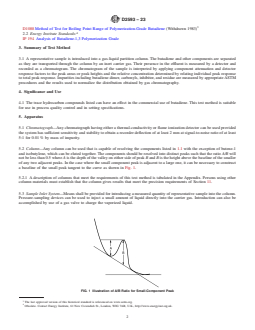
a baseline of the small peak tangent to the curve as shown in Fig. 1.
5.2.1 A description of columns that meet the requirements of this test method is tabulated in the Appendix. Persons using other
column materials must establish that the column gives results that meet the precision requirements of Section 11.
5.3 Sample Inlet System—Means shall be provided for introducing a measured quantity of representative sample into the column.
Pressure-sampling devices can be used to inject a small amount of liquid directly into the carrier gas. Introduction can also be
accomplished by use of a gas valve to charge the vaporized liquid.
FIG. 1 Illustration of A/B Ratio for Small-Component Peak
The last approved version of this historical standard is referenced on www.astm.org.
Obsolete. Contact Energy Institute, 61 New Cavendish St., London, WIG 7AR, U.K., http://www.energyinst.org.uk.
D2593 − 23
5.4 Recorder—A recording potentiometer with a full-scale deflection of 10 mV or less is suitable for obtaining the chromato-
graphic data. Full-scale response time should be 2 s or less, and with sufficient sensitivity to meet the requirements of 5.1.
NOTE 3—Other methods of recording detector output such as computer-teletype systems can be used instead of a recorder, provided precision requirements
of Section 11 are met.
6. Reagents and Materials
6.1 Carrier Gas—A carrier gas appropriate to the type of detector used should be employed. Helium or hydrogen may be used
with thermal conductivity detectors. Nitrogen, helium, or argon may be used with ionization detectors. The minimum purity of any
carrier should be 99.95 mol %. (Warning—Compressed gas. Hazardous pressure.) (Warning—Hydrogen flammable gas.
Hazardous pressure.)
6.1.1 If hydrogen is used, special safety precautions must be taken to ensure that the system is free from leaks and that the effluent
is properly vented.
6.2 Column Materials:
6.2.1 Liquid Phase—The materials that have been used successfully in cooperative work as liquid phases are listed in Table X1.1.
6.2.2 Solid Support—The support for use in the packed column is usually crushed firebrick or diatomaceous earth. Sieve size will
depend on the diameter of the column used and liquid-phase loading, and should be such as would give optimum resolution and
analysis time. Optimum size ranges cannot be predicted on purely theoretical grounds. For some systems it has been found that
a ratio of average particle diameter to column inside diameter of 1:25 will result in minimum retention time and minimum band
widths.
6.2.3 Tubing Material—Copper, stainless steel, Monel, aluminum, and various plastic materials have been found to be satisfactory
for column tubing. The material must be nonreactive with respect to substrate, sample, and carrier gas and of uniform internal
diameter.
6.3 Hydrocarbons for Calibration and Identification—Hydrocarbon standards for all components present are needed for
identification by retention time and for calibration for quantitative measurements.
NOTE 4—Mixtures of hydrocarbons can be used provided there is no uncertainty as to the identity or concentration of the compounds involved.
7. Preparation of Apparatus
7.1 Column Preparation—The technique used to prepare the column is not critical as long as the finished column produces the
desired separation. Preparation of the packing is not difficult once the support, partitioning liquid, and loading level have been
determined. The following general directions have been found to produce columns of acceptable characteristics.
7.1.1 Weigh out the desired quantity of support, usually twice that required to fill the column.
7.1.2 Calculate and weigh out the required quantity of partitioning agent. Dissolve the partitioning agent in a volume of chemically
inert, low-boiling solvent equal to approximately twice the volume of support.
7.1.3 Gradually add the support material to the solution with gentle stirring.
7.1.4 Slowly evaporate the solvent while gently agitating the mixture until the packing is nearly dry and no free liquid is apparent.
7.1.4.1 Some stationary phases such as benzyl cyanide silver nitrate are susceptible to oxidation and must be protected from
excessive exposure to air during the evaporation and drying steps.
7.1.5 Spread the packing in thin layers on a nonabsorbent surface and air- or oven-dry as required to remove all traces of solvent.
7.1.6 Resieve the packing to remove fines and agglomerates produced in the impregnation step.
D2593 − 23
7.1.7 Fill the column tubing with packing by plugging one end with glass wool and pouring the packing into the other end through
a small funnel. Vibrate the tubing continuously over its entire length while filling. When the packing ceases to flow, tap the column
gently on the floor or bench-top while vibrating is continued. Add packing as necessary until no further settling occurs during a
2-min period. Remove a small amount of packing from the open end, plug with glass wool, and shape the column to fit the
chromatograph.
7.2 Chromatograph—Mount the column in the chromatograph and establish the operating conditions required to give the desired
separation (Appendix X1). Allow sufficient time for the instrument to reach equilibrium as indicated by a stable base line. Control
the oven temperature so that it is constant to within 0.5 °C without thermostat cycling which causes an uneven base line. Set the
carrier-gas flow rate, measured with a soap film meter, so that it is constant to within 1 mL ⁄min of the selected value.
8. Calibration
8.1 Identification—Select the conditions of column temperature and carrier gas flow that will give the necessary separation.
Determine the retention time for each compound by injecting small amounts of the compound either separately or in mixtures.
Recommended sample sizes for retention data are 1 μL for liquids and 1 cm or less for gases.
8.2 Standardization—The area under the peak of the chromatogram is considered a quantitative measure of the amount of the
corresponding compound. The relative area is proportional to the concentration if the detector responses of the sample components
are equal. The recommended procedure for quantitative calibration is as follows: with all equipment at equilibrium at operating
conditions, inject constant volume samples of high-purity components. Each compound should be injected at least three times. The
areas of the corresponding peaks should agree within 1 %. When a recorder is used, adjust the attenuation in all cases to keep the
peak on-scale and with a height of at least 50 % of full scale. Measure the area of the peaks by any reliable method (Note 7). To
obtain component weight % response data from the area response of the volume injections, it is necessary to consider the density
and purity of the compounds used for calibration. The average volume area response of each component is divided by the density
multiplied by the weight percent purity of the component as follows:
Mass percent response of component (1)
average component peak area
density ×mass percent purity of component
Component mass% detector correction factors are then obtained by selecting a reference component such as butadiene, and
dividing the individual component mass responses into the reference mass response.
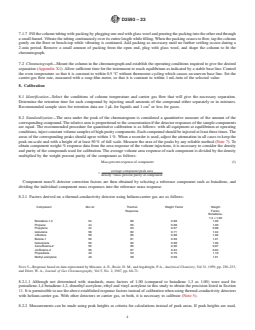
8.2.1 Factors derived on a thermal-conductivity detector using helium-carrier gas are as follows:
Component Mol wt Thermal Weight Factor Weight
Response Factor,
Butadiene-
1,3 = 1.00
Butadiene-1,3 54 80 0.68 1.00
Propane 44 65 0.68 1.00
Propylene 42 63 0.67 0.98
Isobutane 58 82 0.71 1.04
n-Butane 58 85 0.68 1.00
Butene-1 56 81 0.69 1.01
Isobutylene 56 82 0.68 1.00
trans-Butene-2 56 85 0.66 0.97
cis-Butene-2 56 87 0.64 0.94
Propadiene 40 53 0.75 1.10
Methyl acetylene 40 58 0.69 1.01
NOTE 5—Response based on data represented by Messner, A. E., Rosie, D. M., and Argabright, P. A., Analytical Chemistry, Vol 31, 1959, pp. 230–233,
and Dietz, W. A., Journal of Gas Chromatography, Vol 5, No. 2, 1967, pp. 68–71.
8.2.1.1 Although not determined with standards, mass factors of 1.00 (compared to butadiene 1,3 as 1.00) were used for
pentadiene-1,4 butadiene-1,2, dimethyl acety
...