

ASTM D7061-23
(Test Method)Standard Test Method for Measuring n-Heptane Induced Phase Separation of Asphaltene-Containing Heavy Fuel Oils as Separability Number by an Optical Scanning Device
General Information
- Abstract
SIGNIFICANCE AND USE
5.1 This procedure describes a rapid and sensitive method for estimating the stability reserve of an oil. The stability reserve is estimated in terms of a separability number, where a low value of the separability number indicates that there is a stability reserve within the oil. When the separability number is between 0 to 5, the oil can be considered to have a high stability reserve and asphaltenes are not likely to flocculate. If the separability number is between 5 to 10, the stability reserve in the oil will be much lower. However, asphaltenes are, in this case, not likely to flocculate as long as the oil is not exposed to any worse conditions, such as storing, aging, and heating. If the separability number is above 10, the stability reserve of the oil is very low and asphaltenes will easily flocculate, or have already started to flocculate.
5.2 This test method can be used by refiners and users of oils, for which this test method is applicable, to estimate the stability reserves of their oils. Hence, this test method can be used by refineries to control and optimize their refinery processes. Consumers of oils can use this test method to estimate the stability reserve of their oils before, during, and after storage.
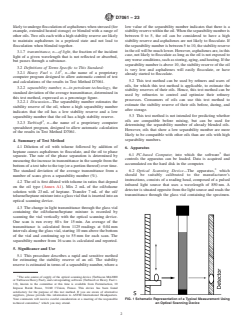
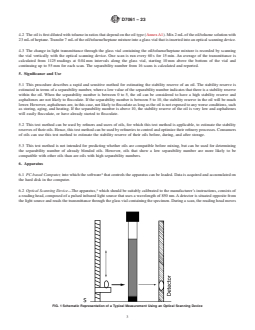
FIG. 1 Schematic Representation of a Typical Measurement Using an Optical Scanning Device
5.3 This test method is not intended for predicting whether oils are compatible before mixing, but can be used for determining the separability number of already blended oils. However, oils that show a low separability number are more likely to be compatible with other oils than are oils with high separability numbers.
SCOPE
1.1 This test method covers the quantitative measurement, either in the laboratory or in the field, of how easily asphaltene-containing heavy fuel oils diluted in toluene phase separate upon addition of heptane. This is measured as a separability number (%) by the use of an optical scanning device.
1.2 The test method is limited to asphaltene-containing heavy fuel oils. ASTM specification fuels that generally fall within the scope of this test method are Specification D396, Grade Nos. 4, 5, and 6, Specification D975, Grade No. 4-D, and Specification D2880, Grade Nos. 3-GT and 4-GT. Refinery fractions from which such blended fuels are made also fall within the scope of this test method.
1.3 The values stated in SI units are to be regarded as standard. No other units of measurement are included in this standard.
1.4 This standard does not purport to address all of the safety concerns, if any, associated with its use. It is the responsibility of the user of this standard to establish appropriate safety, health, and environmental practices and determine the applicability of regulatory limitations prior to use.
1.5 This international standard was developed in accordance with internationally recognized principles on standardization established in the Decision on Principles for the Development of International Standards, Guides and Recommendations issued by the World Trade Organization Technical Barriers to Trade (TBT) Committee.
- Status
- Published
- Publication Date
- 30-Nov-2023
- Technical Committee
- D02 - Petroleum Products, Liquid Fuels, and Lubricants
- Drafting Committee
- D02.14 - Stability, Cleanliness and Compatibility of Liquid Fuels
Buy Documents
ASTM D7061-23 - Standard Test Method for Measuring n-Heptane Induced Phase Separation of Asphaltene-Containing Heavy Fuel Oils as Separability Number by an Optical Scanning Device
REDLINE ASTM D7061-23 - Standard Test Method for Measuring n-Heptane Induced Phase Separation of Asphaltene-Containing Heavy Fuel Oils as Separability Number by an Optical Scanning Device
Overview
ASTM D7061-23: Standard Test Method for Measuring n-Heptane Induced Phase Separation of Asphaltene-Containing Heavy Fuel Oils as Separability Number by an Optical Scanning Device is a key international standard developed by ASTM for evaluating the stability of asphaltene-containing heavy fuel oils. It provides a rapid and quantitative approach for determining the stability reserve of these oils, which is crucial for refiners and end-users to manage phase separation and asphaltene flocculation. The method measures the separability number-a critical indicator of oil stability-using an optical scanning device, helping ensure reliable performance in storage, transport, and use.
Key Topics
Stability Reserve Measurement: The method estimates the stability reserve of heavy fuel oils by determining the separability number. Low separability numbers (0-5) indicate stable oils, with asphaltenes unlikely to flocculate. Higher numbers signify lower stability and increased risk of asphaltene-related issues.
n-Heptane Induced Phase Separation: The procedure involves diluting the oil in toluene, adding n-heptane, and permitting asphaltenes to separate. An optical scanner then measures changes in light transmittance to calculate the separability number.
Applicable Fuel Types: The standard is intended for asphaltene-containing heavy fuel oils, notably:
- ASTM D396, Grades 4, 5, and 6
- ASTM D975, Grade 4-D
- ASTM D2880, Grades 3-GT and 4-GT
- Refinery fractions used for blending such fuels
Interpretation of Results:
- Separability Number 0-5: High stability, low flocculation likelihood
- Separability Number 5-10: Moderate stability-risk increases if oil is stressed (storage, heating, aging)
- Separability Number >10: Low stability, likely or ongoing asphaltene flocculation
Applications
Refinery Process Control: Refineries use this method to monitor and optimize blending processes, ensuring heavy fuel oils possess adequate stability reserves to minimize operational problems.
Quality Assurance for Storage and Transport: Oil consumers (such as power plants and marine operators) can estimate stability before, during, and after storage, helping maintain product integrity and prevent asphaltene precipitation.
Blending Assessment: While not intended for predicting pre-mixing compatibility, oils with a low separability number are more likely to be compatible for blending, aiding operational flexibility.
Laboratory and Field Use: The procedure can be conducted in both laboratory and field settings, supporting immediate decision-making throughout the supply chain.
Related Standards
- ASTM D396: Specification for Fuel Oils
- ASTM D975: Specification for Diesel Fuel
- ASTM D2880: Specification for Gas Turbine Fuel Oils
- ASTM D4057: Practice for Manual Sampling of Petroleum and Petroleum Products
- ASTM D4175: Terminology Relating to Petroleum Products, Liquid Fuels, and Lubricants
- ASTM D4177: Practice for Automatic Sampling of Petroleum and Petroleum Products
Keywords: ASTM D7061-23, heavy fuel oil, asphaltenes, phase separation, separability number, stability reserve, n-heptane, optical scanning device, fuel oil stability, refinery process control, oil compatibility, fuel storage quality.
Relations
- Effective Date
- 01-Dec-2023
- Effective Date
- 01-Dec-2023
Buy Documents
ASTM D7061-23 - Standard Test Method for Measuring n-Heptane Induced Phase Separation of Asphaltene-Containing Heavy Fuel Oils as Separability Number by an Optical Scanning Device
REDLINE ASTM D7061-23 - Standard Test Method for Measuring n-Heptane Induced Phase Separation of Asphaltene-Containing Heavy Fuel Oils as Separability Number by an Optical Scanning Device
Get Certified
Connect with accredited certification bodies for this standard

ECOCERT
Organic and sustainability certification.

Eurofins Food Testing Global
Global leader in food, environment, and pharmaceutical product testing.

Intertek Bangladesh
Intertek certification and testing services in Bangladesh.
Sponsored listings
Frequently Asked Questions
ASTM D7061-23 is a standard published by ASTM International. Its full title is "Standard Test Method for Measuring n-Heptane Induced Phase Separation of Asphaltene-Containing Heavy Fuel Oils as Separability Number by an Optical Scanning Device". This standard covers: SIGNIFICANCE AND USE 5.1 This procedure describes a rapid and sensitive method for estimating the stability reserve of an oil. The stability reserve is estimated in terms of a separability number, where a low value of the separability number indicates that there is a stability reserve within the oil. When the separability number is between 0 to 5, the oil can be considered to have a high stability reserve and asphaltenes are not likely to flocculate. If the separability number is between 5 to 10, the stability reserve in the oil will be much lower. However, asphaltenes are, in this case, not likely to flocculate as long as the oil is not exposed to any worse conditions, such as storing, aging, and heating. If the separability number is above 10, the stability reserve of the oil is very low and asphaltenes will easily flocculate, or have already started to flocculate. 5.2 This test method can be used by refiners and users of oils, for which this test method is applicable, to estimate the stability reserves of their oils. Hence, this test method can be used by refineries to control and optimize their refinery processes. Consumers of oils can use this test method to estimate the stability reserve of their oils before, during, and after storage. FIG. 1 Schematic Representation of a Typical Measurement Using an Optical Scanning Device 5.3 This test method is not intended for predicting whether oils are compatible before mixing, but can be used for determining the separability number of already blended oils. However, oils that show a low separability number are more likely to be compatible with other oils than are oils with high separability numbers. SCOPE 1.1 This test method covers the quantitative measurement, either in the laboratory or in the field, of how easily asphaltene-containing heavy fuel oils diluted in toluene phase separate upon addition of heptane. This is measured as a separability number (%) by the use of an optical scanning device. 1.2 The test method is limited to asphaltene-containing heavy fuel oils. ASTM specification fuels that generally fall within the scope of this test method are Specification D396, Grade Nos. 4, 5, and 6, Specification D975, Grade No. 4-D, and Specification D2880, Grade Nos. 3-GT and 4-GT. Refinery fractions from which such blended fuels are made also fall within the scope of this test method. 1.3 The values stated in SI units are to be regarded as standard. No other units of measurement are included in this standard. 1.4 This standard does not purport to address all of the safety concerns, if any, associated with its use. It is the responsibility of the user of this standard to establish appropriate safety, health, and environmental practices and determine the applicability of regulatory limitations prior to use. 1.5 This international standard was developed in accordance with internationally recognized principles on standardization established in the Decision on Principles for the Development of International Standards, Guides and Recommendations issued by the World Trade Organization Technical Barriers to Trade (TBT) Committee.
SIGNIFICANCE AND USE 5.1 This procedure describes a rapid and sensitive method for estimating the stability reserve of an oil. The stability reserve is estimated in terms of a separability number, where a low value of the separability number indicates that there is a stability reserve within the oil. When the separability number is between 0 to 5, the oil can be considered to have a high stability reserve and asphaltenes are not likely to flocculate. If the separability number is between 5 to 10, the stability reserve in the oil will be much lower. However, asphaltenes are, in this case, not likely to flocculate as long as the oil is not exposed to any worse conditions, such as storing, aging, and heating. If the separability number is above 10, the stability reserve of the oil is very low and asphaltenes will easily flocculate, or have already started to flocculate. 5.2 This test method can be used by refiners and users of oils, for which this test method is applicable, to estimate the stability reserves of their oils. Hence, this test method can be used by refineries to control and optimize their refinery processes. Consumers of oils can use this test method to estimate the stability reserve of their oils before, during, and after storage. FIG. 1 Schematic Representation of a Typical Measurement Using an Optical Scanning Device 5.3 This test method is not intended for predicting whether oils are compatible before mixing, but can be used for determining the separability number of already blended oils. However, oils that show a low separability number are more likely to be compatible with other oils than are oils with high separability numbers. SCOPE 1.1 This test method covers the quantitative measurement, either in the laboratory or in the field, of how easily asphaltene-containing heavy fuel oils diluted in toluene phase separate upon addition of heptane. This is measured as a separability number (%) by the use of an optical scanning device. 1.2 The test method is limited to asphaltene-containing heavy fuel oils. ASTM specification fuels that generally fall within the scope of this test method are Specification D396, Grade Nos. 4, 5, and 6, Specification D975, Grade No. 4-D, and Specification D2880, Grade Nos. 3-GT and 4-GT. Refinery fractions from which such blended fuels are made also fall within the scope of this test method. 1.3 The values stated in SI units are to be regarded as standard. No other units of measurement are included in this standard. 1.4 This standard does not purport to address all of the safety concerns, if any, associated with its use. It is the responsibility of the user of this standard to establish appropriate safety, health, and environmental practices and determine the applicability of regulatory limitations prior to use. 1.5 This international standard was developed in accordance with internationally recognized principles on standardization established in the Decision on Principles for the Development of International Standards, Guides and Recommendations issued by the World Trade Organization Technical Barriers to Trade (TBT) Committee.
ASTM D7061-23 is classified under the following ICS (International Classification for Standards) categories: 71.080.10 - Aliphatic hydrocarbons. The ICS classification helps identify the subject area and facilitates finding related standards.
ASTM D7061-23 has the following relationships with other standards: It is inter standard links to ASTM D7061-19e1, ASTM D7827-19. Understanding these relationships helps ensure you are using the most current and applicable version of the standard.
ASTM D7061-23 is available in PDF format for immediate download after purchase. The document can be added to your cart and obtained through the secure checkout process. Digital delivery ensures instant access to the complete standard document.
Standards Content (Sample)
This international standard was developed in accordance with internationally recognized principles on standardization established in the Decision on Principles for the
Development of International Standards, Guides and Recommendations issued by the World Trade Organization Technical Barriers to Trade (TBT) Committee.
Designation: D7061 − 23
Standard Test Method for
Measuring n-Heptane Induced Phase Separation of
Asphaltene-Containing Heavy Fuel Oils as Separability
Number by an Optical Scanning Device
This standard is issued under the fixed designation D7061; the number immediately following the designation indicates the year of
original adoption or, in the case of revision, the year of last revision. A number in parentheses indicates the year of last reapproval. A
superscript epsilon (´) indicates an editorial change since the last revision or reapproval.
1. Scope* D975 Specification for Diesel Fuel
D2880 Specification for Gas Turbine Fuel Oils
1.1 This test method covers the quantitative measurement,
D4057 Practice for Manual Sampling of Petroleum and
either in the laboratory or in the field, of how easily asphaltene-
Petroleum Products
containing heavy fuel oils diluted in toluene phase separate
D4175 Terminology Relating to Petroleum Products, Liquid
upon addition of heptane. This is measured as a separability
Fuels, and Lubricants
number (%) by the use of an optical scanning device.
D4177 Practice for Automatic Sampling of Petroleum and
1.2 The test method is limited to asphaltene-containing
Petroleum Products
heavy fuel oils. ASTM specification fuels that generally fall
within the scope of this test method are Specification D396,
3. Terminology
Grade Nos. 4, 5, and 6, Specification D975, Grade No. 4-D,
3.1 Definitions:
and Specification D2880, Grade Nos. 3-GT and 4-GT. Refinery
3.1.1 For definitions of terms used in this test method, refer
fractions from which such blended fuels are made also fall
to Terminology D4175.
within the scope of this test method.
3.1.2 asphaltenes, n—(rarely used in the singular), in petro-
1.3 The values stated in SI units are to be regarded as
leum technology, represent an oil fraction that is soluble in a
standard. No other units of measurement are included in this
specified aromatic solvent but separates upon addition of an
standard.
excess of a specified paraffinic solvent.
1.4 This standard does not purport to address all of the
3.1.2.1 Discussion—In this test method, the aromatic sol-
safety concerns, if any, associated with its use. It is the
vent is toluene and the paraffinic solvent is heptane.
responsibility of the user of this standard to establish appro-
3.1.3 compatibility, n—of crude oils or of heavy fuel oils,
priate safety, health, and environmental practices and deter-
the ability of two or more crude oils or fuel oils to blend
mine the applicability of regulatory limitations prior to use.
together within certain concentration ranges without evidence
1.5 This international standard was developed in accor-
of separation, such as the formation of multiple phases.
dance with internationally recognized principles on standard-
3.1.3.1 Discussion—Incompatible heavy fuel oils or crude
ization established in the Decision on Principles for the
oils, when mixed or blended, result in the flocculation or
Development of International Standards, Guides and Recom-
precipitation of asphaltenes. Some oils may be compatible
mendations issued by the World Trade Organization Technical
within certain concentration ranges in specific mixtures, but
Barriers to Trade (TBT) Committee.
incompatible outside those ranges.
2. Referenced Documents 3.1.4 flocculation, n—of asphaltenes from crude oils or
heavy fuel oils, the aggregation of colloidally dispersed as-
2.1 ASTM Standards:
phaltenes into visibly larger masses, which may or may not
D396 Specification for Fuel Oils
settle.
3.1.5 peptization, n—of asphaltenes in crude oils or heavy
This test method is under the jurisdiction of ASTM Committee D02 on
Petroleum Products, Liquid Fuels, and Lubricants and is the direct responsibility of fuel oils, the dispersion of asphaltenes to produce a colloidal
Subcommittee D02.14 on Stability, Cleanliness and Compatibility of Liquid Fuels.
dispersion.
Current edition approved Dec. 1, 2023. Published December 2023. Originally
ɛ1
3.1.6 stability reserve, n—of crude oils, heavy fuel oils, and
approved in 2004. Last previous edition approved in 2019 as D7061 – 19 . DOI:
10.1520/D7061-23.
residual streams containing asphaltenes, the property of an oil
For referenced ASTM standards, visit the ASTM website, www.astm.org, or
to maintain asphaltenes in a peptized (colloidally dispersed)
contact ASTM Customer Service at service@astm.org. For Annual Book of ASTM
state and prevent flocculation of the asphaltenes.
Standards volume information, refer to the standard’s Document Summary page on
the ASTM website. 3.1.6.1 Discussion—An oil with a low stability reserve is
*A Summary of Changes section appears at the end of this standard
Copyright © ASTM International, 100 Barr Harbor Drive, PO Box C700, West Conshohocken, PA 19428-2959. United States
D7061 − 23
likely to undergo flocculation of asphaltenes when stressed (for low value of the separability number indicates that there is a
example, extended heated storage) or blended with a range of stability reserve within the oil. When the separability number is
other oils. Two oils each with a high stability reserve are likely between 0 to 5, the oil can be considered to have a high
to maintain asphaltenes in a peptized state and not lead to stability reserve and asphaltenes are not likely to flocculate. If
flocculation when blended together. the separability number is between 5 to 10, the stability reserve
in the oil will be much lower. However, asphaltenes are, in this
3.1.7 transmittance, n—of light, the fraction of the incident
case, not likely to flocculate as long as the oil is not exposed to
light of a given wavelength that is not reflected or absorbed,
any worse conditions, such as storing, aging, and heating. If the
but passes through a substance.
separability number is above 10, the stability reserve of the oil
3.2 Definitions of Terms Specific to This Standard:
is very low and asphaltenes will easily flocculate, or have
3.2.1 Heavy Fuel v. 1.0 , n—the name of a proprietary
already started to flocculate.
computer program designed to allow automatic control of test
5.2 This test method can be used by refiners and users of
and calculations of the results in Test Method D7061.
oils, for which this test method is applicable, to estimate the
3.2.2 separability number, n—in petroleum technology, the
stability reserves of their oils. Hence, this test method can be
standard deviation of the average transmittance, determined in
used by refineries to control and optimize their refinery
this test method, expressed as a percentage figure.
processes. Consumers of oils can use this test method to
3.2.2.1 Discussion—The separability number estimates the
estimate the stability reserve of their oils before, during, and
stability reserve of the oil, where a high separability number
after storage.
indicates that the oil has a low stability reserve and a low
5.3 This test method is not intended for predicting whether
separability number that the oil has a high stability reserve.
oils are compatible before mixing, but can be used for
3.2.3 Turbisoft , n—the name of a proprietary computer
determining the separability number of already blended oils.
spreadsheet program, designed to allow automatic calculation
However, oils that show a low separability number are more
of the results in Test Method D7061.
likely to be compatible with other oils than are oils with high
separability numbers.
4. Summary of Test Method
4.1 Dilution of oil with toluene followed by addition of
6. Apparatus
heptane causes asphaltenes to flocculate, and the oil to phase
6.1 PC-based Computer, into which the software that
separate. The rate of the phase separation is determined by
controls the apparatus can be loaded. Data is acquired and
measuring the increase in transmittance in the sample from the
accumulated on the hard disk in the computer.
bottom of a test tube to the top (or a portion thereof) over time.
6.2 Optical Scanning Device—The apparatus, which
The standard deviation of the average transmittance from a
number of scans gives a separability number (%). should be suitably calibrated to the manufacturer’s
instructions, consists of a reading head, composed of a pulsed
4.2 The oil is first diluted with toluene in ratios that depend
infrared light source that uses a wavelength of 850 nm. A
on the oil type (Annex A1). Mix 2 mL of the oil/toluene
detector is situated opposite from the light source and reads the
solution with 23 mL of heptane. Transfer 7 mL of the oil/
transmittance through the glass vial containing the specimen.
toluene/heptane mixture into a glass vial that is inserted into an
optical scanning device.
4.3 The change in light transmittance through the glass vial
containing the oil/toluene/heptane mixture is recorded by
scanning the vial vertically with the optical scanning device.
One scan is run every 60 s for 15 min. An average of the
transmittance is calculated from 1125 readings at 0.04 mm
intervals along the glass vial, starting 10 mm above the bottom
of the vial and continuing up to 55 mm for each scan. The
separability number from 16 scans is calculated and reported.
5. Significance and Use
5.1 This procedure describes a rapid and sensitive method
for estimating the stability reserve of an oil. The stability
reserve is estimated in terms of a separability number, where a
The sole source of supply of the optical scanning device (Turbiscan MA2000
or Turbiscan Heavy Fuel), and corresponding software (Turbisoft or Heavy Fuel v.
1.0), known to the committee at this time is available from Formulaction, 10
Impasse Borde Basse, 31240 l’Union, France. This device has been found
satisfactory for the purpose of this test method. If you are aware of alternative
suppliers, please provide this information to ASTM International Headquarters.
Your comments will receive careful consideration at a meeting of the responsible FIG. 1 Schematic Representation of a Typical Measurement Using
technical committee, which you may attend. an Optical Scanning Device
D7061 − 23
During a scan, the reading head moves up and down along the be run automatically every 60 s for 15 min. For more detailed
glass vial and scans the whole vial going up. The transmittance instructions, see Annex A2 and Annex A3.
is automatically measured every 0.04 mm. During one
9.2 Sample to be placed in an oven at 60 °C for 24 h to
measurement, the time interval between each scan shall be 60 s
ensure homogeneity.
and 16 scans shall be run. The measuring principle is sche-
9.3 Remove the sample from the oven and shake for 1 min
matically shown in Fig. 1. The measured transmittance along
to ensure mixing.
the glass vial is reported every 0.04 mm and is automatically
stored on the hard disk in the computer and can be further 9.4 With the aim to increase and achieve a comparable
processed as described in Section 10 and Annex A2 and Annex
transmittance for all types of oils, weigh in 5 g 6 0.01 g of the
A3. oil sample on a balance. Record the weight of oil added to four
decimal places and dilute with toluene, in a weight ratio from
6.3 Cylindrical Clear Glass Vial with Screw Cap, 15 mL,
1:3 to 1:20 to have a baseline under 15 % of transmittance, for
16 mm outside diameter, 12 mm inner diameter, 140 mm high,
guidance see Annex A1, in a bottle with cap (6.6). Carefully
and of high optical purity shall be used as a sample container.
add a magnetic bar to the oil-toluene solution ensuring none of
Use once and then discard.
the oil/toluene mixture is lost, and seal the bottle. Shake the jar
6.4 Pipette, Graduated or Automatic, 5 mL and 10 mL.
well until the oil/toluene mixture no longer adheres to the
6.5 Graduated Cylinder, 25 mL. bottom of the jar. Put the bottle on a magnetic stirrer and stir
the mixture for 90 min 6 5 min.
...
This document is not an ASTM standard and is intended only to provide the user of an ASTM standard an indication of what changes have been made to the previous version. Because
it may not be technically possible to adequately depict all changes accurately, ASTM recommends that users consult prior editions as appropriate. In all cases only the current version
of the standard as published by ASTM is to be considered the official document.
´1
Designation: D7061 − 19 D7061 − 23
Standard Test Method for
Measuring n-Heptane Induced Phase Separation of
Asphaltene-Containing Heavy Fuel Oils as Separability
Number by an Optical Scanning Device
This standard is issued under the fixed designation D7061; the number immediately following the designation indicates the year of
original adoption or, in the case of revision, the year of last revision. A number in parentheses indicates the year of last reapproval. A
superscript epsilon (´) indicates an editorial change since the last revision or reapproval.
ε NOTE—Editorially updated Eq 2 and Eq 3 in April 2020.
1. Scope*
1.1 This test method covers the quantitative measurement, either in the laboratory or in the field, of how easily asphaltene-
containing heavy fuel oils diluted in toluene phase separate upon addition of heptane. This is measured as a separability number
(%) by the use of an optical scanning device.
1.2 The test method is limited to asphaltene-containing heavy fuel oils. ASTM specification fuels that generally fall within the
scope of this test method are Specification D396, Grade Nos. 4, 5, and 6, Specification D975, Grade No. 4-D, and Specification
D2880, Grade Nos. 3-GT and 4-GT. Refinery fractions from which such blended fuels are made also fall within the scope of this
test method.
1.3 The values stated in SI units are to be regarded as standard. No other units of measurement are included in this standard.
1.4 This standard does not purport to address all of the safety concerns, if any, associated with its use. It is the responsibility
of the user of this standard to establish appropriate safety, health, and environmental practices and determine the applicability of
regulatory limitations prior to use.
1.5 This international standard was developed in accordance with internationally recognized principles on standardization
established in the Decision on Principles for the Development of International Standards, Guides and Recommendations issued
by the World Trade Organization Technical Barriers to Trade (TBT) Committee.
2. Referenced Documents
2.1 ASTM Standards:
D396 Specification for Fuel Oils
D975 Specification for Diesel Fuel
D2880 Specification for Gas Turbine Fuel Oils
D4057 Practice for Manual Sampling of Petroleum and Petroleum Products
D4175 Terminology Relating to Petroleum Products, Liquid Fuels, and Lubricants
D4177 Practice for Automatic Sampling of Petroleum and Petroleum Products
This test method is under the jurisdiction of ASTM Committee D02 on Petroleum Products, Liquid Fuels, and Lubricants and is the direct responsibility of Subcommittee
D02.14 on Stability, Cleanliness and Compatibility of Liquid Fuels.
Current edition approved Dec. 1, 2019Dec. 1, 2023. Published January 2020December 2023. Originally approved in 2004. Last previous edition approved in 20172019
ɛ1
as D7061 – 17.D7061 – 19 . DOI: 10.1520/D7061-19E01.10.1520/D7061-23.
For referenced ASTM standards, visit the ASTM website, www.astm.org, or contact ASTM Customer Service at service@astm.org. For Annual Book of ASTM Standards
volume information, refer to the standard’s Document Summary page on the ASTM website.
*A Summary of Changes section appears at the end of this standard
Copyright © ASTM International, 100 Barr Harbor Drive, PO Box C700, West Conshohocken, PA 19428-2959. United States
D7061 − 23
3. Terminology
3.1 Definitions:
3.1.1 For definitions of terms used in this test method, refer to Terminology D4175.
3.1.2 asphaltenes, n—(rarely used in the singular), in petroleum technology, represent an oil fraction that is soluble in a specified
aromatic solvent but separates upon addition of an excess of a specified paraffinic solvent.
3.1.2.1 Discussion—
In this test method, the aromatic solvent is toluene and the paraffinic solvent is heptane.
3.1.3 compatibility, n—of crude oils or of heavy fuel oils, the ability of two or more crude oils or fuel oils to blend together within
certain concentration ranges without evidence of separation, such as the formation of multiple phases.
3.1.3.1 Discussion—
Incompatible heavy fuel oils or crude oils, when mixed or blended, result in the flocculation or precipitation of asphaltenes. Some
oils may be compatible within certain concentration ranges in specific mixtures, but incompatible outside those ranges.
3.1.4 flocculation, n—of asphaltenes from crude oils or heavy fuel oils, the aggregation of colloidally dispersed asphaltenes into
visibly larger masses thatmasses, which may or may not settle.
3.1.5 peptization, n—of asphaltenes in crude oils or heavy fuel oils, the dispersion of asphaltenes to produce a colloidal dispersion.
3.1.6 stability reserve, n—of crude oils, heavy fuel oils, and residual streams containing asphaltenes, the property of an oil to
maintain asphaltenes in a peptized (colloidally dispersed) state and prevent flocculation of the asphaltenes.
3.1.6.1 Discussion—
An oil with a low stability reserve is likely to undergo flocculation of asphaltenes when stressed (for example, extended heated
storage) or blended with a range of other oils. Two oils each with a high stability reserve are likely to maintain asphaltenes in a
peptized state and not lead to flocculation when blended together.
3.1.7 transmittance, n—of light, the fraction of the incident light of a given wavelength that is not reflected or absorbed, but passes
through a substance.
3.2 Definitions of Terms Specific to This Standard:
3.2.1 Heavy Fuel v. 1.0 , n—the name of a proprietary computer program designed to allow automatic control of test and
calculations of the results in Test Method D7061.
3.2.2 separability number, n—in petroleum technology, the standard deviation of the average transmittance, determined in this test
method, expressed as a percentage figure.
3.2.2.1 Discussion—
The separability number estimates the stability reserve of the oil, where a high separability number indicates that the oil has a low
stability reserve and a low separability number that the oil has a high stability reserve.
3.2.3 Turbisoft , n—the name of a proprietary computer spreadsheet program, designed to allow automatic calculation of the
results in Test Method D7061.
4. Summary of Test Method
4.1 Dilution of oil with toluene followed by addition of heptane causes asphaltenes to flocculate, and the oil to phase separate.
The rate of the phase separation is determined by measuring the increase in transmittance in the sample from the bottom of a test
tube to the top (or a portion thereof) over time. The standard deviation of the average transmittance from a number of scans gives
a separability number (%).
The sole source of supply of the optical scanning device (Turbiscan MA2000 or Turbiscan Heavy Fuel), and corresponding software (Turbisoft or Heavy Fuel v. 1.0),
known to the committee at this time is available from Formulaction, 10 Impasse Borde Basse, 31240 l’Union, France. This device has been found satisfactory for the purpose
of this test method. If you are aware of alternative suppliers, please provide this information to ASTM International Headquarters. Your comments will receive careful
consideration at a meeting of the responsible technical committee, which you may attend.
D7061 − 23
4.2 The oil is first diluted with toluene in ratios that depend on the oil type (Annex A1). Mix 2 mL of the oil/toluene solution with
23 mL of heptane. Transfer 7 mL of the oil/toluene/heptane mixture into a glass vial that is inserted into an optical scanning device.
4.3 The change in light transmittance through the glass vial containing the oil/toluene/heptane mixture is recorded by scanning
the vial vertically with the optical scanning device. One scan is run every 60 s for 15 min. An average of the transmittance is
calculated from 1125 readings at 0.04 mm intervals along the glass vial, starting 10 mm above the bottom of the vial and
continuing up to 55 mm for each scan. The separability number from 16 scans is calculated and reported.
5. Significance and Use
5.1 This procedure describes a rapid and sensitive method for estimating the stability reserve of an oil. The stability reserve is
estimated in terms of a separability number, where a low value of the separability number indicates that there is a stability reserve
within the oil. When the separability number is between 0 to 5, the oil can be considered to have a high stability reserve and
asphaltenes are not likely to flocculate. If the separability number is between 5 to 10, the stability reserve in the oil will be much
lower. However, asphaltenes are, in this case, not likely to flocculate as long as the oil is not exposed to any worse conditions, such
as storing, aging, and heating. If the separability number is above 10, the stability reserve of the oil is very low and asphaltenes
will easily flocculate, or have already started to flocculate.
5.2 This test method can be used by refiners and users of oils, for which this test method is applicable, to estimate the stability
reserves of their oils. Hence, this test method can be used by refineries to control and optimize their refinery processes. Consumers
of oils can use this test method to estimate the stability reserve of their oils before, during, and after storage.
5.3 This test method is not intended for predicting whether oils are compatible before mixing, but can be used for determining
the separability number of already blended oils. However, oils that show a low separability number are more likely to be
compatible with other oils than are oils with high separability numbers.
6. Apparatus
6.1 PC-based Computer, into which the software that controls the apparatus can be loaded. Data is acquired and accumulated on
the hard disk in the computer.
6.2 Optical Scanning Device—The apparatus, which should be suitably calibrated to the manufacturer’s instructions, consists of
a reading head, composed of a pulsed infrared light source that uses a wavelength of 850 nm. A detector is situated opposite from
the light source and reads the transmittance through the glass vial containing the specimen. During a scan, the reading head moves
FIG. 1 Schematic Representation of a Typical Measurement Using an Optical Scanning Device
D7061 − 23
up and down along the glass vial and scans the whole vial going up. The transmittance is automatically measured every 0.04 mm.
During one measurement, the time interval between each scan shall be 60 s and 16 scans shall be run. The measuring principle is
schematically shown in Fig. 1. The measured transmittance along the glass vial is reported every 0.04 mm and is automatically
stored on the hard disk in the computer and can be further processed as described in Section 10 and Annex A2 and Annex A3.
6.3 Cylindrical Clear Glass Vial with Screw Cap, 15 mL, 16 mm outside diameter, 12 mm inner diameter, 140 mm high, and of
high optical purity shall be used as a sample container. Use once and then discard.
6.4 Pipette, Graduated or Automatic, 5 mL and 10 mL.
6.5 Graduated Cylinder, 25 mL.
6.6 Clear Glass Bottle with Cap, 250 mL.
6.7 Clear Glass Bottle with Cap, 50 mL.
6.8 Magnetic Bar, TFE-fluorocarbon-coated.
6.9 Magnetic Stirrer.
6.10 Balance, precision 60.01 g.
6.11 Stopwatch, capable of 0.1 s.
6.12 Burette, 25 mL, Grade A.
6.13 Oven, capable of 60 °C at 60.1 °C.
7. Reagents and Materials
7.1 Purity of Reagents—Reagents of technical grade (99 % purity) and higher are adequate for this test.
7.2 Heptane. (Warning—Flammable. Vapor harmful. Vapor may cause flash fire.)
7.3 Toluene. (Warning—Flammable. Vapor harmful. Vapor may cause flash fire.)
8. Sampling and Test Specimens
8.1 The oil sample drawn for the purpose of this test method shall be representative of the lot of oil. Obtain the sample in
accordance with the procedures of Practice D4057 or D4177, if possible.
8.2 When working with the oil sample in the laboratory, the oil shall be stirred either manually or
...