

ASTM D2426-23
(Test Method)Standard Test Method for Butadiene Dimer and Styrene in Butadiene Concentrates by Gas Chromatography
General Information
- Abstract
SIGNIFICANCE AND USE
4.1 Butadiene dimer and styrene may be present as impurities in commercial butadiene. This test method is suitable for use in internal quality control and in establishing product specifications.
SCOPE
1.1 This test method covers the determination of butadiene dimer (4-vinylcyclohexene-1) and styrene in butadiene concentrates, both recycle and specification grade.
1.2 The values stated in SI units are to be regarded as standard. No other units of measurement are included in this standard.
1.3 This standard does not purport to address all of the safety concerns, if any, associated with its use. It is the responsibility of the user of this standard to establish appropriate safety, health, and environmental practices and determine the applicability of regulatory limitations prior to use. For specific precautionary statements see Sections 6 and 8.
1.3.1 The user is advised to obtain LPG safety training for the safe operation of this test method procedure and related activities.
1.4 This international standard was developed in accordance with internationally recognized principles on standardization established in the Decision on Principles for the Development of International Standards, Guides and Recommendations issued by the World Trade Organization Technical Barriers to Trade (TBT) Committee.
- Status
- Published
- Publication Date
- 28-Feb-2023
- Technical Committee
- D02 - Petroleum Products, Liquid Fuels, and Lubricants
- Drafting Committee
- D02.D0.04 - C4 and C5 Hydrocarbons
Buy Documents


ASTM D2426-23 - Standard Test Method for Butadiene Dimer and Styrene in Butadiene Concentrates by Gas Chromatography

REDLINE ASTM D2426-23 - Standard Test Method for Butadiene Dimer and Styrene in Butadiene Concentrates by Gas Chromatography
Overview
ASTM D2426-23: Standard Test Method for Butadiene Dimer and Styrene in Butadiene Concentrates by Gas Chromatography is a recognized international standard developed by ASTM International. This test method defines a reliable procedure for the quantitative determination of butadiene dimer (specifically, 4-vinylcyclohexene-1) and styrene as impurities in commercial butadiene concentrates. It applies to both recycle and specification grade butadiene, using gas chromatography (GC) as the analytical technique.
The standard supports internal quality control processes and the establishment of product specifications in the butadiene and petrochemical industries. Adherence to this method ensures consistently high product purity and verifies compliance with relevant industry requirements.
Keywords: butadiene dimer, styrene, butadiene concentrate, gas chromatography, ASTM D2426-23, petrochemical analysis, quality control, hydrocarbon impurities
Key Topics
Scope and Applicability:
- Covers determination of butadiene dimer and styrene in butadiene concentrates.
- Valid for both recycle and specification grade materials.
- Specifies results in SI units only.
- Emphasizes the requirement for appropriate safety, health, and environmental practices.
Test Method Summary:
- Samples are analyzed using gas-liquid partition columns in a gas chromatograph.
- Both thermal conductivity and flame ionization detectors are permitted.
- Quantification is based on chromatogram peak area or height, compared with known synthetic standards.
Required Apparatus and Materials:
- Gas chromatograph (with sufficient sensitivity for trace impurity detection)
- Recorder and suitable data acquisition devices
- Columns with proven performance for separating dimer and styrene
- High-purity calibration standards
- Suitable carrier gases (hydrogen, helium, nitrogen, or argon)
Safety Considerations:
- Operators must follow safety procedures, particularly regarding compressed, flammable gases.
- Recommends LPG safety training for personnel.
Precision and Reliability:
- Includes detailed precision data for repeatability and reproducibility.
- Notes that bias has not been established due to a lack of accepted reference materials.
Applications
ASTM D2426-23 is vital for:
- Internal Quality Control:
- Enables manufacturers of butadiene and derivatives to monitor impurity levels and maintain production standards.
- Product Specification:
- Assists suppliers and customers in verifying material quality and regulatory compliance.
- Process Optimization:
- Provides actionable data for process improvement by flagging when impurity levels exceed acceptable limits.
- Regulatory Conformance:
- Supports adherence to international trade and environmental standards by documenting purity levels and impurity content.
Industries making use of this standard include:
- Petrochemical producers and refiners
- Synthetic rubber and plastics manufacturers
- Analytical laboratories specializing in hydrocarbons
- Quality assurance teams managing raw material certification
Related Standards
The following ASTM standards are referenced or complement ASTM D2426-23 and may be used for broader hydrocarbon or petrochemical testing needs:
- ASTM D1657: Test Method for Density or Relative Density of Light Hydrocarbons by Pressure Hydrometer
- ASTM D1945: Test Method for Analysis of Natural Gas by Gas Chromatography
- ASTM D2593: Test Method for Butadiene Purity and Hydrocarbon Impurities by Gas Chromatography
Using these related standards alongside ASTM D2426-23 can provide comprehensive analytical coverage for quality assurance and specification of hydrocarbon products.
By following ASTM D2426-23, organizations ensure precise, reproducible analysis of butadiene dimer and styrene impurities, enhancing product quality, supporting regulatory compliance, and increasing confidence in supply chain integrity.
Relations
- Effective Date
- 01-Jun-2012
- Effective Date
- 01-Jun-2012
- Effective Date
- 01-Jan-2010
- Effective Date
- 01-Jul-2009
- Effective Date
- 01-May-2007
- Effective Date
- 01-Nov-2004
- Effective Date
- 10-May-2003
- Effective Date
- 10-Nov-2002
- Effective Date
- 01-Jan-2001
- Effective Date
- 10-Jul-1998
Buy Documents
ASTM D2426-23 - Standard Test Method for Butadiene Dimer and Styrene in Butadiene Concentrates by Gas Chromatography
REDLINE ASTM D2426-23 - Standard Test Method for Butadiene Dimer and Styrene in Butadiene Concentrates by Gas Chromatography
Get Certified
Connect with accredited certification bodies for this standard

ECOCERT
Organic and sustainability certification.

Eurofins Food Testing Global
Global leader in food, environment, and pharmaceutical product testing.

Intertek Bangladesh
Intertek certification and testing services in Bangladesh.
Sponsored listings
Frequently Asked Questions
ASTM D2426-23 is a standard published by ASTM International. Its full title is "Standard Test Method for Butadiene Dimer and Styrene in Butadiene Concentrates by Gas Chromatography". This standard covers: SIGNIFICANCE AND USE 4.1 Butadiene dimer and styrene may be present as impurities in commercial butadiene. This test method is suitable for use in internal quality control and in establishing product specifications. SCOPE 1.1 This test method covers the determination of butadiene dimer (4-vinylcyclohexene-1) and styrene in butadiene concentrates, both recycle and specification grade. 1.2 The values stated in SI units are to be regarded as standard. No other units of measurement are included in this standard. 1.3 This standard does not purport to address all of the safety concerns, if any, associated with its use. It is the responsibility of the user of this standard to establish appropriate safety, health, and environmental practices and determine the applicability of regulatory limitations prior to use. For specific precautionary statements see Sections 6 and 8. 1.3.1 The user is advised to obtain LPG safety training for the safe operation of this test method procedure and related activities. 1.4 This international standard was developed in accordance with internationally recognized principles on standardization established in the Decision on Principles for the Development of International Standards, Guides and Recommendations issued by the World Trade Organization Technical Barriers to Trade (TBT) Committee.
SIGNIFICANCE AND USE 4.1 Butadiene dimer and styrene may be present as impurities in commercial butadiene. This test method is suitable for use in internal quality control and in establishing product specifications. SCOPE 1.1 This test method covers the determination of butadiene dimer (4-vinylcyclohexene-1) and styrene in butadiene concentrates, both recycle and specification grade. 1.2 The values stated in SI units are to be regarded as standard. No other units of measurement are included in this standard. 1.3 This standard does not purport to address all of the safety concerns, if any, associated with its use. It is the responsibility of the user of this standard to establish appropriate safety, health, and environmental practices and determine the applicability of regulatory limitations prior to use. For specific precautionary statements see Sections 6 and 8. 1.3.1 The user is advised to obtain LPG safety training for the safe operation of this test method procedure and related activities. 1.4 This international standard was developed in accordance with internationally recognized principles on standardization established in the Decision on Principles for the Development of International Standards, Guides and Recommendations issued by the World Trade Organization Technical Barriers to Trade (TBT) Committee.
ASTM D2426-23 is classified under the following ICS (International Classification for Standards) categories: 71.080.10 - Aliphatic hydrocarbons. The ICS classification helps identify the subject area and facilitates finding related standards.
ASTM D2426-23 has the following relationships with other standards: It is inter standard links to ASTM D1657-12e1, ASTM D1657-12, ASTM D1945-03(2010), ASTM D2593-93(2009), ASTM D1657-02(2007), ASTM D2593-93(2004)e1, ASTM D1945-03, ASTM D1657-02, ASTM D1945-96(2001), ASTM D2593-93(1998). Understanding these relationships helps ensure you are using the most current and applicable version of the standard.
ASTM D2426-23 is available in PDF format for immediate download after purchase. The document can be added to your cart and obtained through the secure checkout process. Digital delivery ensures instant access to the complete standard document.
Standards Content (Sample)
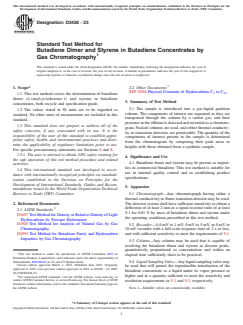
This international standard was developed in accordance with internationally recognized principles on standardization established in the Decision on Principles for the
Development of International Standards, Guides and Recommendations issued by the World Trade Organization Technical Barriers to Trade (TBT) Committee.
Designation: D2426 − 23
Standard Test Method for
Butadiene Dimer and Styrene in Butadiene Concentrates by
Gas Chromatography
This standard is issued under the fixed designation D2426; the number immediately following the designation indicates the year of
original adoption or, in the case of revision, the year of last revision. A number in parentheses indicates the year of last reapproval. A
superscript epsilon (´) indicates an editorial change since the last revision or reapproval.
1. Scope* 2.2 Other Documents:
STP 109A Physical Constants of Hydrocarbons C to C
1 10
1.1 This test method covers the determination of butadiene
dimer (4-vinylcyclohexene-1) and styrene in butadiene
3. Summary of Test Method
concentrates, both recycle and specification grade.
3.1 The sample is introduced into a gas-liquid partition
1.2 The values stated in SI units are to be regarded as
column. The components of interest are separated as they are
standard. No other units of measurement are included in this
transported through the column by a carrier gas, and their
standard.
presence in the effluent is detected and recorded as a chromato-
1.3 This standard does not purport to address all of the
gram. Packed columns are used, and either thermal conductiv-
safety concerns, if any, associated with its use. It is the
ity or ionization detectors are permissible. The quantity of the
responsibility of the user of this standard to establish appro-
components of interest present in the sample is determined
priate safety, health, and environmental practices and deter-
from the chromatogram by comparing their peak areas or
mine the applicability of regulatory limitations prior to use.
heights with those obtained from a synthetic sample.
For specific precautionary statements see Sections 6 and 8.
1.3.1 The user is advised to obtain LPG safety training for
4. Significance and Use
the safe operation of this test method procedure and related
4.1 Butadiene dimer and styrene may be present as impuri-
activities.
ties in commercial butadiene. This test method is suitable for
1.4 This international standard was developed in accor-
use in internal quality control and in establishing product
dance with internationally recognized principles on standard-
specifications.
ization established in the Decision on Principles for the
Development of International Standards, Guides and Recom-
5. Apparatus
mendations issued by the World Trade Organization Technical
Barriers to Trade (TBT) Committee. 5.1 Chromatograph—Any chromatograph having either a
thermal conductivity or flame ionization detector may be used.
2. Referenced Documents The detector system shall have sufficient sensitivity to obtain a
2 deflection of at least 2 mm at a signal-to-noise ratio of at least
2.1 ASTM Standards:
5:1 for 0.01 % by mass of butadiene dimer and styrene under
D1657 Test Method for Density or Relative Density of Light
the operating conditions prescribed in this test method.
Hydrocarbons by Pressure Hydrometer
D1945 Test Method for Analysis of Natural Gas by Gas 5.2 Recorder—A 0 mV to 1 mV, 0 mV to 5 mV, or 0 mV to
Chromatography 10 mV recorder with a full-scale response time of 2 s or less,
D2593 Test Method for Butadiene Purity and Hydrocarbon and with sufficient sensitivity to meet the requirements of 5.1.
Impurities by Gas Chromatography
5.3 Column—Any column may be used that is capable of
resolving the butadiene dimer and styrene as discrete peaks,
quantitatively proportional to concentration and within an
This test method is under the jurisdiction of ASTM Committee D02 on
elapsed time sufficiently short to be practical.
Petroleum Products, Liquid Fuels, and Lubricants and is the direct responsibility of
Subcommittee D02.D0.04 on C4 and C5 Hydrocarbons. 5.4 Liquid Sampling Valve—Any liquid sampling valve may
Current edition approved March 1, 2023. Published June 2023. Originally
be used that will permit the reproducible introduction of the
approved in 1965. Last previous edition approved in 2019 as D2426 – 19. DOI:
butadiene concentrate as a liquid under its vapor pressure or
10.1520/D2426-23.
higher and in a quantity sufficient to meet the sensitivity and
For referenced ASTM standards, visit the ASTM website, www.astm.org, or
contact ASTM Customer Service at service@astm.org. For Annual Book of ASTM
resolution requirements in 5.1 and 5.3, respectively.
Standards volume information, refer to the standard’s Document Summary page on
the ASTM website. NOTE 1—Suitable valves are commercially available.
*A Summary of Changes section appears at the end of this standard
Copyright © ASTM International, 100 Barr Harbor Drive, PO Box C700, West Conshohocken, PA 19428-2959. United States
D2426 − 23
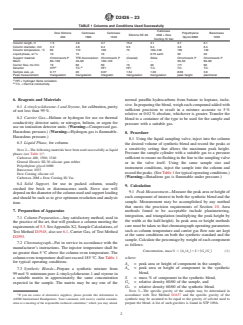
TABLE 1 Columns and Conditions Used Successfully
Carbowax
Dow Silicone Carbowax Carbowax Polyethylene Barecowax
Silicone SE-30 20M + Dow
200 1500 1540 Glycol-6000 1035
Corning Hi Vac
Column length, m 1.5 4.6 3.7 15.2 3.1 3.7 6.1
Column diameter, mm 3.2 4.8 6.4 0.5 6.4 4.8 6.4
Column temperature, °C 85 110 100 75 100–128 155 140
Liquid phase, wt % 10 15 16 . 0.75 each 30 20
Support material Chromosorb P TFE-fluorocarbon Chromosorb P (Coated) Silica Chromosorb P Chromosorb P
Mesh 80–100 40–60 100–120 . . 30–50 60–80
Carrier flow, mL/min 19 60 60 15 30 171 60
A B
Detector HFI T.C. HFI HFI T.C. T.C. T.C.
Sample size, μL 0.77 20 0.07 1.54 1.03 8.69 3.0
Peak measurement triangulation triangulation integrator triangulation triangulation peak height planimeter
A
HFI = hydrogen flame ionization.
B
T.C. = thermal conductivity.
6. Reagents and Materials normal paraffin hydrocarbons from butane to heptane, inclu-
sive. In preparing the blend, weigh each compound added with
6.1 4-vinylcyclohexene-1 and Styrene, for calibration, purity
sufficient precision to result in a mixture accurate to 5 %
of not less than 99 %.
relative or 0.02 % absolute, whichever is greater. Transfer the
6.2 Carrier Gas—Helium or hydrogen for use on thermal
blend to a container of the type to be used for the sample and
conductivity detector units; or nitrogen, helium, or argon for
pressure with a suitable gas.
use on ionization detector units. (Warning—Compressed gas.
Hazardous pres
...
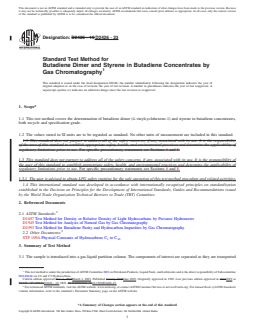
This document is not an ASTM standard and is intended only to provide the user of an ASTM standard an indication of what changes have been made to the previous version. Because
it may not be technically possible to adequately depict all changes accurately, ASTM recommends that users consult prior editions as appropriate. In all cases only the current version
of the standard as published by ASTM is to be considered the official document.
Designation: D2426 − 19 D2426 − 23
Standard Test Method for
Butadiene Dimer and Styrene in Butadiene Concentrates by
Gas Chromatography
This standard is issued under the fixed designation D2426; the number immediately following the designation indicates the year of
original adoption or, in the case of revision, the year of last revision. A number in parentheses indicates the year of last reapproval. A
superscript epsilon (´) indicates an editorial change since the last revision or reapproval.
1. Scope*
1.1 This test method covers the determination of butadiene dimer (4-vinylcyclohexene-1) and styrene in butadiene concentrates,
both recycle and specification grade.
1.2 The values stated in SI units are to be regarded as standard. No other units of measurement are included in this standard.
1.3 This standard does not purport to address all of the safety concerns, if any, associated with its use. It is the responsibility
of the user of this standard to establish appropriate safety, health, and environmental practices and determine the applicability of
regulatory limitations prior to use. For specific precautionary statements see Sections 6 and 8.
1.3 This standard does not purport to address all of the safety concerns, if any, associated with its use. It is the responsibility of
the user of this standard to establish appropriate safety, health, and environmental practices and determine the applicability of
regulatory limitations prior to use. For specific precautionary statements see Sections 6 and 8.
1.3.1 The user is advised to obtain LPG safety training for the safe operation of this test method procedure and related activities.
1.4 This international standard was developed in accordance with internationally recognized principles on standardization
established in the Decision on Principles for the Development of International Standards, Guides and Recommendations issued
by the World Trade Organization Technical Barriers to Trade (TBT) Committee.
2. Referenced Documents
2.1 ASTM Standards:
D1657 Test Method for Density or Relative Density of Light Hydrocarbons by Pressure Hydrometer
D1945 Test Method for Analysis of Natural Gas by Gas Chromatography
D2593 Test Method for Butadiene Purity and Hydrocarbon Impurities by Gas Chromatography
2.2 Other Documents:
STP 109A Physical Constants of Hydrocarbons C to C
1 10
3. Summary of Test Method
3.1 The sample is introduced into a gas-liquid partition column. The components of interest are separated as they are transported
This test method is under the jurisdiction of ASTM Committee D02 on Petroleum Products, Liquid Fuels, and Lubricants and is the direct responsibility of Subcommittee
D02.D0.04 on C4 and C5 Hydrocarbons.
Current edition approved Dec. 1, 2019March 1, 2023. Published January 2020June 2023. Originally approved in 1965. Last previous edition approved in 20142019 as
D2426 – 93 (2014).D2426 – 19. DOI: 10.1520/D2426-19.10.1520/D2426-23.
For referenced ASTM standards, visit the ASTM website, www.astm.org, or contact ASTM Customer Service at service@astm.org. For Annual Book of ASTM Standards
volume information, refer to the standard’s Document Summary page on the ASTM website.
*A Summary of Changes section appears at the end of this standard
Copyright © ASTM International, 100 Barr Harbor Drive, PO Box C700, West Conshohocken, PA 19428-2959. United States
D2426 − 23
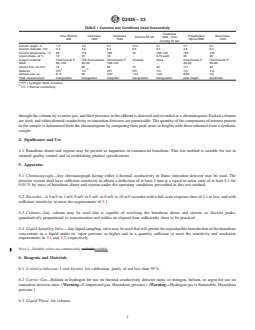
TABLE 1 Columns and Conditions Used Successfully
Carbowax
Dow Silicone Carbowax Carbowax Polyethylene Barecowax
Silicone SE-30 20M + Dow
200 1500 1540 Glycol-6000 1035
Corning Hi Vac
Column length, m 1.5 4.6 3.7 15.2 3.1 3.7 6.1
Column diameter, mm 3.2 4.8 6.4 0.5 6.4 4.8 6.4
Column temperature, °C 85 110 100 75 100–128 155 140
Liquid phase, wt % 10 15 16 . 0.75 each 30 20
Support material Chromosorb P TFE-fluorocarbon Chromosorb P (Coated) Silica Chromosorb P Chromosorb P
Mesh 80–100 40–60 100–120 . . 30–50 60–80
Carrier flow, mL/min 19 60 60 15 30 171 60
A B
Detector HFI T.C. HFI HFI T.C. T.C. T.C.
Sample size, μL 0.77 20 0.07 1.54 1.03 8.69 3.0
Peak measurement triangulation triangulation integrator triangulation triangulation peak height planimeter
A
HFI = hydrogen flame ionization.
B
T.C. = thermal conductivity.
through the column by a carrier gas, and their presence in the effluent is detected and recorded as a chromatogram. Packed columns
are used, and either thermal conductivity or ionization detectors are permissible. The quantity of the components of interest present
in the sample is determined from the chromatogram by comparing their peak areas or heights with those obtained from a synthetic
sample.
4. Significance and Use
4.1 Butadiene dimer and styrene may be present as impurities in commercial butadiene. This test method is suitable for use in
internal quality control and in establishing product specifications.
5. Apparatus
5.1 Chromatograph—Any chromatograph having either a thermal conductivity or flame ionization detector may be used. The
detector system shall have sufficient sensitivity to obtain a deflection of at least 2 mm at a signal-to-noise ratio of at least 5:1 for
0.01 % by mass of butadiene dimer and styrene under the operating conditions prescribed in this test method.
5.2 Recorder—A 0 mV to 1 mV, 0 mV to 5 mV, or 0 mV to 10 mV recorder with a full-scale response time of 2 s or less, and with
sufficient sensitivity to meet the requirements of 5.1.
5.3 Column—Any column may be used that is capable of resolving the butadiene dimer and styrene as discrete peaks,
quantitatively proportional to concentration and within an elapsed time sufficiently short to be practical.
5.4 Liquid Sampling Valve—Any liquid sampling valve may be used that will permit the reproducible introduction of the butadiene
concentrate as a liquid under its vapor pressure or higher and in a quantity sufficient to meet the sensitivity and resolution
requirements in 5.1 and 5.3, respectively.
NOTE 1—Suitable valves are commercially availableavailable.
6. Reagents and Materials
6.1 4-vinylcyclohexene-1 and Styrene, for calibration, purity of not less than 99 %.
6.2 Carrier Gas—Helium or hydrogen for use on thermal conductivity detector units; or nitrogen, helium, or argon for use on
ionization detector units. (Warning—Compressed gas. Hazardous pressure.) (Warning—Hydrogen gas is flammable. Hazardous
pressure.)
6.3 Liquid Phase, for column.
...