

oSIST prEN 17984-5:2026
(Main)Assistance dogs - Creating and sustaining assistance dog teams
General Information
- Abstract
This document provides expectations for assistance dog service providers and assistance dog handlers to protect the interests of all stakeholders. It focuses on the creation of successful assistance dog teams by ensuring transparent and fair eligibility for service, matching applicant beneficiaries with available dogs, thoroughly training the teams to become a partnership and sustaining the team by offering lifetime aftercare support as required.
The purpose of this document is to help create competent and well-functioning teams, maintaining team quality over the years provided that transparency and responsibilities of all stakeholders to one another are met.
Related elements include the following:
— application;
— applicant - dog matching;
— team instruction;
— assessing competency of assistance dog teams;
— aftercare;
— taking a dog out of service (including retirement);
— complaints, appeals and disputes;
— general rights.
- Status
- Not Published
- Public Enquiry End Date
- 03-May-2026
- Technical Committee
- IPV - Assistance Dog & Guide Dog Teams Standards and Instructors Competences
- Current Stage
- 4020 - Public enquire (PE) (Adopted Project)
- Start Date
- 04-Mar-2026
- Due Date
- 22-Jul-2026
- Completion Date
- 06-May-2026

Overview
oSIST prEN 17984-5:2026: Assistance dogs - Part 5: Creating and sustaining assistance dog teams is a draft European Standard developed by CEN that establishes expectations and guidance for assistance dog service providers, handlers, and related stakeholders. The standard focuses on creating, training, and maintaining competent assistance dog teams through transparent eligibility criteria, rigorous matching processes, thorough instruction, ongoing assessment, and lifelong aftercare. Its aim is to protect the interests of all stakeholders, ensuring quality, fairness, and sustainability in the provision of assistance dog services.
Key Topics
This standard addresses the following core elements of forming and supporting assistance dog teams:
Application Process
- Outlines steps for sending initial information and assessing applicants’ suitability.
- Ensures fair and non-discriminatory eligibility for services.
Matching Applicants and Dogs
- Guides on pairing clients with suitable dogs based on needs, capabilities, and compatibility.
- Emphasizes contractual clarity and collaborative decision-making.
Team Instruction
- Specifies best practices for training assistance dog teams.
- Covers essential areas such as dog welfare, human-dog communication, public access rights, and legal regulations.
Competency Assessment
- Describes methods for evaluating the effectiveness of teams.
- Encourages documented, multidisciplinary assessment and feedback loops.
Lifetime Aftercare Support
- Mandates regular, accessible aftercare for active teams, including monitoring, advice, and emergency support.
Retirement and Removal from Service
- Details procedures and welfare considerations for retiring dogs or ending their service.
- Ensures transparent reporting and owner guidance.
Complaints, Appeals, and Disputes
- Requires published processes for addressing client concerns.
- Protects the client’s rights throughout all procedures.
General Rights
- Stipulates the rights to information, privacy, dignity, and equal treatment for all clients and stakeholders.
Applications
The practical value of oSIST prEN 17984-5:2026 lies in its comprehensive framework for all parties involved in the assistance dog sector:
Assistance Dog Service Providers
- Guidance for consistent, transparent, and accountable processes in team creation and ongoing support.
- Tools to ensure quality assurance, continuous improvement, and client satisfaction.
- Framework for outsourcing elements while retaining full organizational responsibility.
Applicants and Assistance Dog Handlers
- Clear path and requirements for obtaining an assistance dog.
- Empowerment through accessible information and defined rights.
- Processes for addressing grievances and safeguarding welfare.
Stakeholders and Third Parties
- Assurance of fair, professional, and ethical standards for organizations working directly or indirectly with assistance dog teams.
- Clarity for external partners such as funders, transport operators, healthcare providers, and regulators.
By aligning services with oSIST prEN 17984-5:2026, organizations can build trust, improve outcomes, and ensure the long-term success and welfare of both handlers and dogs.
Related Standards
oSIST prEN 17984-5:2026 is part of a broader suite of European standards on assistance dogs. Related standards include:
- EN 17984-1: Vocabulary - Foundations for terminology used across the series.
- EN 17984-2: Dog lifetime welfare - Standards for health and wellbeing.
- EN 17984-3: Competencies for assistance dog professionals.
- EN 17984-4: Pre-training, training and tasks.
- EN 17984-6: Accessibility and universal access.
Organizations applying these standards together establish robust, harmonized processes and deliver high-quality assistance dog services aligned with European best practices.
Keywords: assistance dogs standard, assistance dog teams, assistance dog service providers, competency, team instruction, aftercare, matching, retirement, client rights, European Standards, oSIST prEN 17984-5:2026, CEN.
Relations
- Effective Date
- 28-Jan-2026
Get Certified
Connect with accredited certification bodies for this standard

BSI Group
BSI (British Standards Institution) is the business standards company that helps organizations make excellence a habit.

TÜV Rheinland
TÜV Rheinland is a leading international provider of technical services.

TÜV SÜD
TÜV SÜD is a trusted partner of choice for safety, security and sustainability solutions.
Sponsored listings
Frequently Asked Questions
oSIST prEN 17984-5:2026 is a draft published by the Slovenian Institute for Standardization (SIST). Its full title is "Assistance dogs - Creating and sustaining assistance dog teams". This standard covers: This document provides expectations for assistance dog service providers and assistance dog handlers to protect the interests of all stakeholders. It focuses on the creation of successful assistance dog teams by ensuring transparent and fair eligibility for service, matching applicant beneficiaries with available dogs, thoroughly training the teams to become a partnership and sustaining the team by offering lifetime aftercare support as required. The purpose of this document is to help create competent and well-functioning teams, maintaining team quality over the years provided that transparency and responsibilities of all stakeholders to one another are met. Related elements include the following: — application; — applicant - dog matching; — team instruction; — assessing competency of assistance dog teams; — aftercare; — taking a dog out of service (including retirement); — complaints, appeals and disputes; — general rights.
This document provides expectations for assistance dog service providers and assistance dog handlers to protect the interests of all stakeholders. It focuses on the creation of successful assistance dog teams by ensuring transparent and fair eligibility for service, matching applicant beneficiaries with available dogs, thoroughly training the teams to become a partnership and sustaining the team by offering lifetime aftercare support as required. The purpose of this document is to help create competent and well-functioning teams, maintaining team quality over the years provided that transparency and responsibilities of all stakeholders to one another are met. Related elements include the following: — application; — applicant - dog matching; — team instruction; — assessing competency of assistance dog teams; — aftercare; — taking a dog out of service (including retirement); — complaints, appeals and disputes; — general rights.
oSIST prEN 17984-5:2026 is classified under the following ICS (International Classification for Standards) categories: 11.180.99 - Other standards related to aids for disabled and handicapped people; 65.020.30 - Animal husbandry and breeding. The ICS classification helps identify the subject area and facilitates finding related standards.
oSIST prEN 17984-5:2026 has the following relationships with other standards: It is inter standard links to SIST EN ISO 21207:2025. Understanding these relationships helps ensure you are using the most current and applicable version of the standard.
oSIST prEN 17984-5:2026 is available in PDF format for immediate download after purchase. The document can be added to your cart and obtained through the secure checkout process. Digital delivery ensures instant access to the complete standard document.
Standards Content (Sample)
SLOVENSKI STANDARD
01-april-2026
Psi pomočniki - Vzpostavljanje in ohranjanje podpore uporabnikom in psom
pomočnikom
Assistance dogs - Creating and sustaining assistance dog teams
Assistenzhunde - Assistenzhunde-Teams aufbauen und nachhaltig begleiten
Ta slovenski standard je istoveten z: prEN 17984-5
ICS:
11.180.99 Drugi standardi v zvezi s Other standards related to
pripomočki za invalide aids for disabled and
handicapped people
65.020.30 Živinoreja Animal husbandry and
breeding
2003-01.Slovenski inštitut za standardizacijo. Razmnoževanje celote ali delov tega standarda ni dovoljeno.
DRAFT
EUROPEAN STANDARD
NORME EUROPÉENNE
EUROPÄISCHE NORM
April 2026
ICS 11.180.99; 65.020.30
English Version
Assistance dogs - Part 5: Creating and sustaining
assistance dog teams
Assistenzhunde - Assistenzhunde-Teams aufbauen und
nachhaltig begleiten
This draft European Standard is submitted to CEN members for enquiry. It has been drawn up by the Technical Committee
CEN/TC 452.
If this draft becomes a European Standard, CEN members are bound to comply with the CEN/CENELEC Internal Regulations
which stipulate the conditions for giving this European Standard the status of a national standard without any alteration.
This draft European Standard was established by CEN in three official versions (English, French, German). A version in any other
language made by translation under the responsibility of a CEN member into its own language and notified to the CEN-CENELEC
Management Centre has the same status as the official versions.
CEN members are the national standards bodies of Austria, Belgium, Bulgaria, Croatia, Cyprus, Czech Republic, Denmark, Estonia,
Finland, France, Germany, Greece, Hungary, Iceland, Ireland, Italy, Latvia, Lithuania, Luxembourg, Malta, Netherlands, Norway,
Poland, Portugal, Republic of North Macedonia, Romania, Serbia, Slovakia, Slovenia, Spain, Sweden, Switzerland, Türkiye and
United Kingdom.
Recipients of this draft are invited to submit, with their comments, notification of any relevant patent rights of which they are
aware and to provide supporting documentation.
Warning : This document is not a European Standard. It is distributed for review and comments. It is subject to change without
notice and shall not be referred to as a European Standard.
EUROPEAN COMMITTEE FOR STANDARDIZATION
COMITÉ EUROPÉEN DE NORMALISATION
EUROPÄISCHES KOMITEE FÜR NORMUNG
CEN-CENELEC Management Centre: Rue de la Science 23, B-1040 Brussels
© 2026 CEN All rights of exploitation in any form and by any means reserved Ref. No. prEN 17984-5:2026 E
worldwide for CEN national Members.
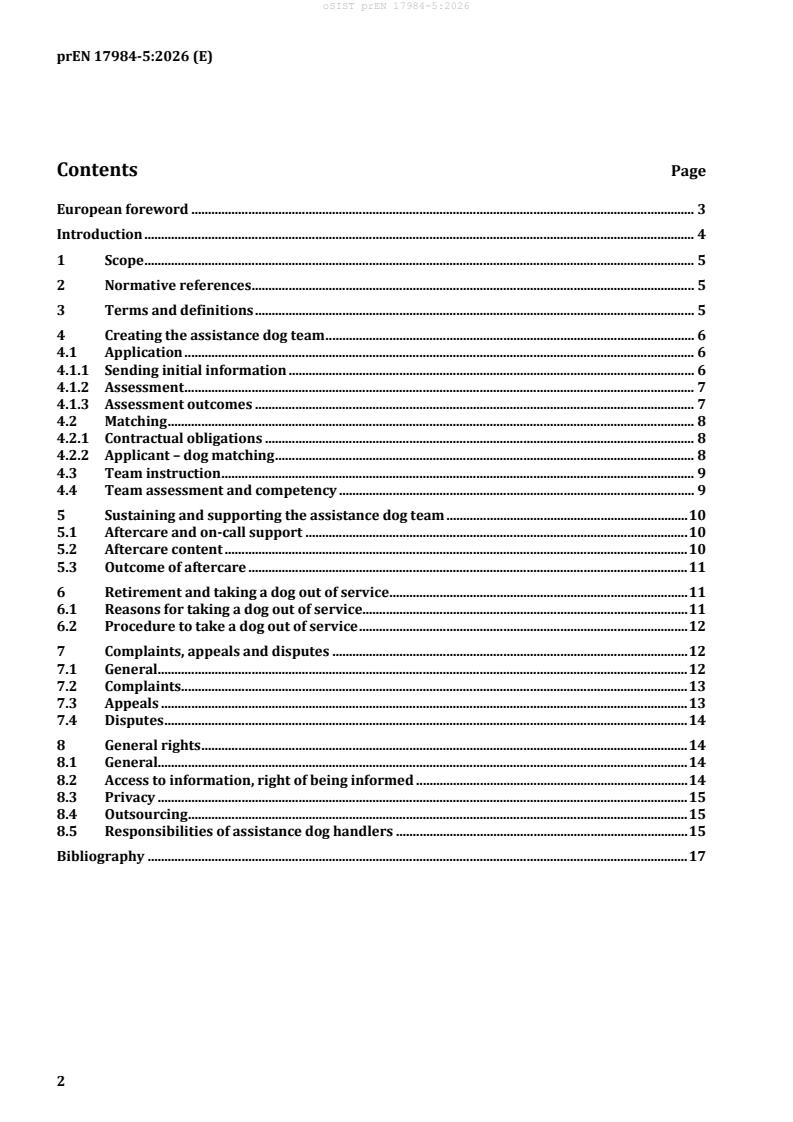
Contents Page
European foreword . 3
Introduction . 4
1 Scope . 5
2 Normative references . 5
3 Terms and definitions . 5
4 Creating the assistance dog team . 6
4.1 Application . 6
4.1.1 Sending initial information . 6
4.1.2 Assessment . 7
4.1.3 Assessment outcomes . 7
4.2 Matching . 8
4.2.1 Contractual obligations . 8
4.2.2 Applicant – dog matching . 8
4.3 Team instruction . 9
4.4 Team assessment and competency . 9
5 Sustaining and supporting the assistance dog team . 10
5.1 Aftercare and on-call support . 10
5.2 Aftercare content . 10
5.3 Outcome of aftercare . 11
6 Retirement and taking a dog out of service . 11
6.1 Reasons for taking a dog out of service. 11
6.2 Procedure to take a dog out of service . 12
7 Complaints, appeals and disputes . 12
7.1 General. 12
7.2 Complaints . 13
7.3 Appeals . 13
7.4 Disputes . 14
8 General rights . 14
8.1 General. 14
8.2 Access to information, right of being informed . 14
8.3 Privacy . 15
8.4 Outsourcing . 15
8.5 Responsibilities of assistance dog handlers . 15
Bibliography . 17
European foreword
This document (prEN 17984-5:2026) has been prepared by Technical Committee CEN/TC 452
“Assistance dogs”, the secretariat of which is held by UNMZ.
This document is currently submitted to the CEN Enquiry.
This document is part of a series of European Standards under the general title Assistance dogs, which
will comprise the following parts:
— Part 1: Vocabulary;
— Part 2: Dog lifetime welfare;
— Part 3: Competencies for assistance dogs professionals;
— Part 4: Pre-training, training and tasks;
— Part 5: Creating and sustaining assistance dog teams;
— Part 6: Accessibility and universal access.
This document will be read in conjunction with EN 17984-1, EN 17984-2, EN 17984-3, EN 17984-4 and
EN 17984-6 as the series is technically linked and to be read conjointly.
Introduction
All stakeholders are entitled to consistent and measurable criteria regarding services related to the
provision of assistance dogs to ensure the quality of assistance dog team guidance and support. The
assistance dog sector is constantly evolving and new types of service models, including owner- trained
assistance dogs, exist side by side with traditional service providers. However, most assistance dog
handlers today receive their assistance dogs, and associated services, in full collaboration with an
assistance dog service provider. Accordingly, this document describes the different stages of service
provision between the providing organization and the client, irrespective of whether the service is
provided on a philanthropic basis or in exchange for payment.
This standard explicitly respects the right of a person willing and able to train their own assistance dog.
As this standard defines the foundations of a competent assistance dog team and the role of the assistance
dog handler in making it happen; the concepts can be applied to all assistance dog teams based on
individual circumstances and adaptations.
Independent assistance dog handlers can choose to work in collaboration with an assistance dog service
provider at certain points during the assistance dog team life cycle.
This document provides expectations of assistance dog service provision which protects the interests of
consumers of these services (i.e. disabled people / beneficiaries), providers of these services, and other
stakeholders such as transport operators, retailers and funders of services e.g. health insurance
providers.
NOTE For the purposes of this document, organizations providing services related to assistance dogs are
termed assistance dog service providers, persons asking for these services are termed clients, persons partnered
with an assistance dog are termed assistance dog handlers and an assistance dog team is the working combination
of an assistance dog handler, an assistance dog and possibly a supervising handler (see EN 17984-1).
1 Scope
This document provides expectations for assistance dog service providers and assistance dog handlers
to protect the interests of all stakeholders. It focuses on the creation of successful assistance dog teams
by ensuring transparent and fair eligibility for service, matching applicant beneficiaries with available
dogs, thoroughly training the teams to become a partnership and sustaining the team by offering lifetime
aftercare support as required.
The purpose of this document is to help create competent and well-functioning teams, maintaining team
quality over the years provided that transparency and responsibilities of all stakeholders to one another
are met.
Related elements include the following:
— application;
— applicant - dog matching;
— team instruction;
— assessing competency of assistance dog teams;
— aftercare;
— taking a dog out of service (including retirement);
— complaints, appeals and disputes;
— general rights.
2 Normative references
The following documents are referred to in the text in such a way that some or all of their content
constitutes requirements of this document. For dated references, only the edition cited applies. For
undated references, the latest edition of the referenced document (including any amendments)
applies.
EN 17984-1:2024, Assistance dogs — Part 1: Vocabulary
EN 17984-2:2025, Assistance dogs — Part 2: Dog lifetime welfare
EN 17984-4, Assistance dogs — Part 4: Pre-training, training and tasks
EN 17984-6, Assistance dogs — Part 6: Accessibility and universal access
3 Terms and definitions
For the purpose of this document, the terms and definitions given in EN 17984-1:2024 and the
following apply.
ISO and IEC maintain terminological databases for use in standardization at the following addresses:
— IEC Electropedia: available at https://www.electropedia.org/
— ISO Online browsing platform: available at https://www.iso.org/obp
3.1
outsourcing
any service or activity in the assistance dog team life cycle subcontracted to an external service provider
4 Creating the assistance dog team
4.1 Application
4.1.1 General
The application process consists of the following steps:
— sending initial information;
— applicant assessment;
— outcomes of assessment.
First and subsequent applications for assistance dog services:
— clients can apply to more than one assistance dog service provider without discrimination or
disadvantage provided they meet the criteria of each provider;
— successor client should receive priority over new applicants with their original service provider.
Prioritised status does not transfer to other service providers;
— this does not apply to service providers who have a criterion that specifies restrictions for acceptance
and where the client no longer meets the criteria.
NOTE 1 Assistance dog service providers can set their own eligibility criteria for other elements such as
applications to multiple organisations or the application of minimum or maximum age of applicants.
NOTE 2 Documented information is provided in a format which is best suited to that individuals’ communication
needs and abilities based on, for example, the frequency and method of communication (see EN 17984-1:2024,
3.4.16.1 accessible documented information).
4.1.2 Sending initial information
Upon receipt of an enquiry, the provider shall respond within 15 business days.
Initial information shall cover the following subjects:
a) information explaining the role of an assistance dog and the rights and responsibilities of an
assistance dog handler;
b) description of the assistance dog service provider and the services it provides;
c) eligibility requirements including:
— the type and/or level of impairment/disability qualifying for the support of an assistance dog;
— the required capacity and capability to learn and consistently implement the skills to work with
an assistance dog;
— the requirements for a safe and supportive environment to ensure the welfare of the dog and the
success of the assistance dog team;
d) comprehensive explanation of the application, matching and training process.
4.1.3 Assessment
a) Where the provider chooses to progress an application through to assessment, this can consist of:
— a combination of interviews and practical exercises;
— interviews in person (face to face meetings);
— video conferencing or conference calls;
— recorded statements;
— questionnaires;
— letters of reference;
b) a suitability assessment shall be carried out which should include:
— evaluation of the client’s motivation and their expectations of an assistance dog;
— medical information about the disability/disabilities/health of the applicant;
— verification of the type and/or level of impairment qualifying for the support of an assistance
dog, diagnosed and documented by at least one qualified professional specialising in the specific
impairment;
— ensuring the applicant meets requirements for a safe and supportive home environment and
other locations and situations, which will have an impact on the dog’s welfare;
c) confirming that the applicant has the financial means and capability to maintain ongoing health and
welfare of the assistance dog; this can be with the support of another person in the household.
NOTE 1 In all cases it is an expectation that the assessment will ensure the applicant has the competence and
capability to conform with the expectations of EN 17984-2.
NOTE 2 In cases where a person does not have the ability to understand and meet all lifetime welfare standards
of a dog, independent assessment or consultation with a qualified professional can be sought by the provider.
NOTE 3 Assistance dog service providers can set their own eligibility criteria for other elements such as the
application of minimum or maximum age of applicants. The eligibility criteria and assessment process should be
transparent and made available.
4.1.4 Assessment outcomes
a) Decisions for acceptance for service shall be made under the advice and agreement of an assistance
dog professional who can be part of a multidisciplinary panel which includes other relevant
professionals.
b) The outcome of the assessment shall be documented in a report containing recommendations for
acceptance or non-acceptance.
c) The applicant shall be notified of acceptance/non-acceptance within 20 business days after
completion of the assessment process. Unsuccessful applicants shall be informed of the reasons for
non-acceptance. In the case of non-acceptance, the applicant has 20 business days to contest
according to the modalities specified in 7.3.
d) If there is any concern regarding the capacity of the applicant, an independent assessment can be
requested, with the applicants' consent, to make additional enquiries to support the application.
e) Where further clarification is required, the assistance dog service provider shall inform the applicant
as soon as possible and provide a copy of the assessment report to the applicant. The applicant shall
have an opportunity to give further input or opinion upon which the report can be updated. If the
applicant does not respond within 15 business days of receiving the information from the report, the
assessor can proceed with a decision without the applicant’s input.
f) Where further professional training or experience could bring an applicant to a level of readiness for
working with an assistance dog, appropriate referrals should be provided.
g) Upon acceptance, the applicant shall be informed about next steps of training with an assistance dog.
h) The provider shall keep the applicant informed on a regular basis regarding progress in the process
of assigning and training a dog for them, as well as regarding subsequent steps in preparation for
training with the new assistance dog.
i) All material (such as documents, references, video) gathered during the assessment process shall be
managed according to principles of privacy and data protection.
NOTE Where an applicant has previously been matched with an assistance dog, the above procedures can be
modified in the light of knowledge previously shared and recorded.
4.2 Matching
4.2.1 Contractual obligations
After acceptance of the application, the applicant and the assistance dog service provider enter a
contractual relationship. Three stages are recognised in this relationship:
Stage 1 - Team instruction. Agreements made about the team training conditions.
Stage 2 - Operational life of the assistance dog team. Upon successful completion of training and
placement of the dog, the contract enters a new stage outlining rights and responsibilities of the
assistance dog client and the provider during the working life of the team.
Stage 3 – Retirement. Agreements made after the working life of the assistance dog Team. In this last
stage topics such as ownership and support shall be considered.
4.2.2 Applicant – dog matching
a) App
...