

SIST EN 303 364-3 V1.1.1:2019
(Main)Primary Surveillance Radar (PSR) - Harmonised Standard for access to radio spectrum - Part 3: Air Traffic Control (ATC) PSR sensors operating in 8 500 MHz to 10 000 MHz frequency band (X band)
General Information
- Abstract
The present document specifies technical characteristics and methods of measurements for monostatic X-band radar
sensors intended for the surveillance of airspace traffic with the following characteristics:
• Operating in the frequency range 8 500 MHz to 10 000 MHz utilizing modulated pulses.
• The transceiver-antenna connection is using a hollow metallic rectangular waveguide.
• The antenna is rotating, waveguide-based and passive.
• At the transceiver output an RF-circulator is used.
NOTE 1: Since transceiver and antenna are hollow metallic rectangular waveguide based the frequency range for
measurements that needs to be addressed covers 6,56 GHz to 26 GHz. The lower limit of this frequency
range is obtained as cut-off frequency of the combination of WR112/R84 taper section and a WR90/R100
Waveguide IEC 60153-2 [i.3]. The upper limit corresponds to the upper limit stated in Table 1 of ERC
Recommendation 74-01 [2].
NOTE 2: Since at the transceiver output an RF circulator is used, it is assumed that the transceiver characteristics
remain independent from the antenna.
NOTE 3: Multi-static radars are not covered by the present document.
NOTE 4: The relationship between the present document and essential requirements of article 3.2 of Directive
2014/53/EU [i.1] is given in annex A.
- Status
- Published
- Public Enquiry End Date
- 31-May-2019
- Publication Date
- 11-Aug-2019
- Technical Committee
- MOC - Mobile Communications
- Current Stage
- 6060 - National Implementation/Publication (Adopted Project)
- Start Date
- 24-Jul-2019
- Due Date
- 28-Sep-2019
- Completion Date
- 12-Aug-2019
- Directive
- 2014/53/EU - Directive 2014/53/EU of The European Parliament and of the Council of 16 April 2014 on the harmonisation of the laws of the Member States relating to the making available on the market of radio equipment and repealing Directive 1999/5/ECOJ Ref: L 289 (GLEJ OPOMBO) OJ Date: 10-Nov-2022
Buy Documents
ETSI EN 303 364-3 V1.1.0 (2019-03) - Primary Surveillance Radar (PSR); Harmonised Standard for access to radio spectrum; Part 3: Air Traffic Control (ATC) PSR sensors operating in 8 500 MHz to 10 000 MHz frequency band (X band)
ETSI EN 303 364-3 V1.1.1 (2019-07) - Primary Surveillance Radar (PSR); Harmonised Standard for access to radio spectrum; Part 3: Air Traffic Control (ATC) PSR sensors operating in the frequency band 8 500 MHz to 10 000 MHz (X band)

Overview
SIST EN 303 364-3 V1.1.1:2019 is a harmonised European standard that outlines the technical requirements and test methods for monostatic Primary Surveillance Radar (PSR) sensors used for Air Traffic Control (ATC) applications in the X band frequency range of 8 500 MHz to 10 000 MHz. Developed by SIST in alignment with ETSI specifications, this standard is essential for manufacturers, operators, and regulatory bodies to ensure radar system compliance with European Union requirements for radio equipment, particularly pursuant to Directive 2014/53/EU.
This document focuses on the technical parameters and radio spectrum access for ATC radar sensors, providing a framework for conformity assessment and supporting safe, reliable, and interference-free radar operation in civil aviation environments.
Key Topics
- Frequency Range and Equipment: The standard covers PSR systems operating with modulated pulses in the 8 500 MHz to 10 000 MHz X band. Implementations must use a hollow metallic rectangular waveguide for the transceiver-antenna connection, incorporate a passive rotating antenna, and utilize an RF circulator at the transceiver output.
- Technical Requirements:
- Frequency tolerance and bandwidth constraints
- Limits for out-of-band (OoB) and spurious emissions based on international recommendations
- Maximum power levels for emissions in standby modes
- System noise figure and receiver selectivity/linearity requirements
- Testing and Conformance: Defines standardized testing procedures under prescribed environmental conditions to demonstrate compliance. These include measurement setups for frequency, power, unwanted emissions, and receiver characteristics according to the declared operational parameters.
- Regulatory Compliance: Provides a voluntary basis for presumption of conformity with the essential requirements of the Radio Equipment Directive (2014/53/EU), streamlining market approval and harmonization across EU member states.
Applications
SIST EN 303 364-3 V1.1.1:2019 is primarily applicable in the following areas:
- Air Traffic Control (ATC): Enables the deployment and operation of reliable X band PSR sensors for the surveillance and separation of aircraft, contributing to the safety and efficiency of national and international airspaces.
- Radar System Manufacturing: Serves as a comprehensive reference for equipment designers and manufacturers developing monostatic X band radar systems, ensuring their products meet critical regulatory and performance criteria for European markets.
- Spectrum Management: Assists regulatory authorities by setting clear emission and testing guidelines, thus minimizing harmful interference, facilitating cross-border cooperation, and ensuring spectrum efficiency in aviation bands.
- Compliance Assessment: Supports laboratories, test houses, and system integrators in conducting standardized conformity assessments, necessary for CE marking and lawful placement of radar products on the EU market.
- System Upgrades and Procurement: Provides guidelines for radar procurement and modernization projects, ensuring that investments meet current technical and legal requirements.
Related Standards
- SIST EN 303 364-1: ATC PSR sensors operating in 1 215 MHz to 1 400 MHz (L band)
- SIST EN 303 364-2: ATC PSR sensors operating in 2 700 MHz to 3 100 MHz (S band)
- ERC Recommendation 74-01: Unwanted emissions in the spurious domain
- ECC Recommendation (02)05: Unwanted emissions
- IEC 60153-2: Hollow metallic waveguides specification
- ITU Radio Regulations: International rules on spectrum usage and emissions
By adhering to SIST EN 303 364-3, stakeholders in the airspace surveillance sector can ensure robust, interference-free operations while maintaining full compliance with European harmonised standards for radio spectrum access.
Buy Documents
ETSI EN 303 364-3 V1.1.0 (2019-03) - Primary Surveillance Radar (PSR); Harmonised Standard for access to radio spectrum; Part 3: Air Traffic Control (ATC) PSR sensors operating in 8 500 MHz to 10 000 MHz frequency band (X band)
ETSI EN 303 364-3 V1.1.1 (2019-07) - Primary Surveillance Radar (PSR); Harmonised Standard for access to radio spectrum; Part 3: Air Traffic Control (ATC) PSR sensors operating in the frequency band 8 500 MHz to 10 000 MHz (X band)
Get Certified
Connect with accredited certification bodies for this standard

ANCE
Mexican certification and testing association.

Great Wall Tianjin Quality Assurance Center
Established 1993, first batch to receive national accreditation with IAF recognition.
Hong Kong Quality Assurance Agency (HKQAA)
Hong Kong's leading certification body.
Sponsored listings
Frequently Asked Questions
SIST EN 303 364-3 V1.1.1:2019 is a standard published by the Slovenian Institute for Standardization (SIST). Its full title is "Primary Surveillance Radar (PSR) - Harmonised Standard for access to radio spectrum - Part 3: Air Traffic Control (ATC) PSR sensors operating in 8 500 MHz to 10 000 MHz frequency band (X band)". This standard covers: The present document specifies technical characteristics and methods of measurements for monostatic X-band radar sensors intended for the surveillance of airspace traffic with the following characteristics: • Operating in the frequency range 8 500 MHz to 10 000 MHz utilizing modulated pulses. • The transceiver-antenna connection is using a hollow metallic rectangular waveguide. • The antenna is rotating, waveguide-based and passive. • At the transceiver output an RF-circulator is used. NOTE 1: Since transceiver and antenna are hollow metallic rectangular waveguide based the frequency range for measurements that needs to be addressed covers 6,56 GHz to 26 GHz. The lower limit of this frequency range is obtained as cut-off frequency of the combination of WR112/R84 taper section and a WR90/R100 Waveguide IEC 60153-2 [i.3]. The upper limit corresponds to the upper limit stated in Table 1 of ERC Recommendation 74-01 [2]. NOTE 2: Since at the transceiver output an RF circulator is used, it is assumed that the transceiver characteristics remain independent from the antenna. NOTE 3: Multi-static radars are not covered by the present document. NOTE 4: The relationship between the present document and essential requirements of article 3.2 of Directive 2014/53/EU [i.1] is given in annex A.
The present document specifies technical characteristics and methods of measurements for monostatic X-band radar sensors intended for the surveillance of airspace traffic with the following characteristics: • Operating in the frequency range 8 500 MHz to 10 000 MHz utilizing modulated pulses. • The transceiver-antenna connection is using a hollow metallic rectangular waveguide. • The antenna is rotating, waveguide-based and passive. • At the transceiver output an RF-circulator is used. NOTE 1: Since transceiver and antenna are hollow metallic rectangular waveguide based the frequency range for measurements that needs to be addressed covers 6,56 GHz to 26 GHz. The lower limit of this frequency range is obtained as cut-off frequency of the combination of WR112/R84 taper section and a WR90/R100 Waveguide IEC 60153-2 [i.3]. The upper limit corresponds to the upper limit stated in Table 1 of ERC Recommendation 74-01 [2]. NOTE 2: Since at the transceiver output an RF circulator is used, it is assumed that the transceiver characteristics remain independent from the antenna. NOTE 3: Multi-static radars are not covered by the present document. NOTE 4: The relationship between the present document and essential requirements of article 3.2 of Directive 2014/53/EU [i.1] is given in annex A.
SIST EN 303 364-3 V1.1.1:2019 is classified under the following ICS (International Classification for Standards) categories: 03.220.50 - Air transport; 33.060.99 - Other equipment for radiocommunications. The ICS classification helps identify the subject area and facilitates finding related standards.
SIST EN 303 364-3 V1.1.1:2019 is associated with the following European legislation: EU Directives/Regulations: 2014/53/EU. When a standard is cited in the Official Journal of the European Union, products manufactured in conformity with it benefit from a presumption of conformity with the essential requirements of the corresponding EU directive or regulation.
SIST EN 303 364-3 V1.1.1:2019 is available in PDF format for immediate download after purchase. The document can be added to your cart and obtained through the secure checkout process. Digital delivery ensures instant access to the complete standard document.
Standards Content (Sample)
Draft ETSI EN 303 364-3 V1.1.0 (2019-03)
HARMONISED EUROPEAN STANDARD
Primary Surveillance Radar (PSR);
Harmonised Standard for access to radio spectrum;
Part 3: Air Traffic Control (ATC) PSR sensors operating
in 8 500 MHz to 10 000 MHz frequency band (X band)
2 Draft ETSI EN 303 364-3 V1.1.0 (2019-03)
Reference
DEN/ERM-TGAERO-31-3
Keywords
aeronautical, harmonised standard, radar, radio
ETSI
650 Route des Lucioles
F-06921 Sophia Antipolis Cedex - FRANCE
Tel.: +33 4 92 94 42 00 Fax: +33 4 93 65 47 16
Siret N° 348 623 562 00017 - NAF 742 C
Association à but non lucratif enregistrée à la
Sous-Préfecture de Grasse (06) N° 7803/88
Important notice
The present document can be downloaded from:
http://www.etsi.org/standards-search
The present document may be made available in electronic versions and/or in print. The content of any electronic and/or
print versions of the present document shall not be modified without the prior written authorization of ETSI. In case of any
existing or perceived difference in contents between such versions and/or in print, the prevailing version of an ETSI
deliverable is the one made publicly available in PDF format at www.etsi.org/deliver.
Users of the present document should be aware that the document may be subject to revision or change of status.
Information on the current status of this and other ETSI documents is available at
https://portal.etsi.org/TB/ETSIDeliverableStatus.aspx
If you find errors in the present document, please send your comment to one of the following services:
https://portal.etsi.org/People/CommiteeSupportStaff.aspx
Copyright Notification
No part may be reproduced or utilized in any form or by any means, electronic or mechanical, including photocopying
and microfilm except as authorized by written permission of ETSI.
The content of the PDF version shall not be modified without the written authorization of ETSI.
The copyright and the foregoing restriction extend to reproduction in all media.
© ETSI 2019.
All rights reserved.
TM TM TM
DECT , PLUGTESTS , UMTS and the ETSI logo are trademarks of ETSI registered for the benefit of its Members.
TM TM
3GPP and LTE are trademarks of ETSI registered for the benefit of its Members and
of the 3GPP Organizational Partners.
oneM2M™ logo is a trademark of ETSI registered for the benefit of its Members and
of the oneM2M Partners. ®
GSM and the GSM logo are trademarks registered and owned by the GSM Association.
ETSI
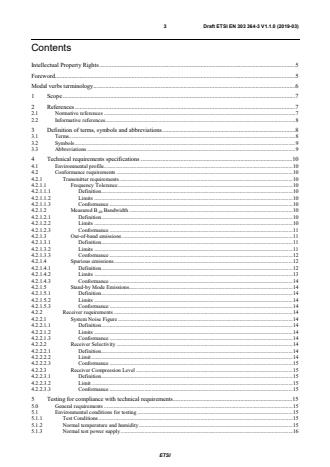
3 Draft ETSI EN 303 364-3 V1.1.0 (2019-03)
Contents
Intellectual Property Rights . 5
Foreword . 5
Modal verbs terminology . 6
1 Scope . 7
2 References . 7
2.1 Normative references . 7
2.2 Informative references . 8
3 Definition of terms, symbols and abbreviations . 8
3.1 Terms . 8
3.2 Symbols . 9
3.3 Abbreviations . 9
4 Technical requirements specifications . 10
4.1 Environmental profile . 10
4.2 Conformance requirements . 10
4.2.1 Transmitter requirements . 10
4.2.1.1 Frequency Tolerance . 10
4.2.1.1.1 Definition. 10
4.2.1.1.2 Limits . 10
4.2.1.1.3 Conformance . 10
4.2.1.2 Measured B Bandwidth . 10
-40
4.2.1.2.1 Definition. 10
4.2.1.2.2 Limits . 10
4.2.1.2.3 Conformance . 11
4.2.1.3 Out-of-band emissions . 11
4.2.1.3.1 Definition. 11
4.2.1.3.2 Limits . 11
4.2.1.3.3 Conformance . 12
4.2.1.4 Spurious emissions . 12
4.2.1.4.1 Definition. 12
4.2.1.4.2 Limits . 13
4.2.1.4.3 Conformance . 14
4.2.1.5 Stand-by Mode Emissions . 14
4.2.1.5.1 Definition. 14
4.2.1.5.2 Limits . 14
4.2.1.5.3 Conformance . 14
4.2.2 Receiver requirements . 14
4.2.2.1 System Noise Figure . 14
4.2.2.1.1 Definition. 14
4.2.2.1.2 Limits . 14
4.2.2.1.3 Conformance . 14
4.2.2.2 Receiver Selectivity . 14
4.2.2.2.1 Definition. 14
4.2.2.2.2 Limit . 14
4.2.2.2.3 Conformance . 15
4.2.2.3 Receiver Compression Level . 15
4.2.2.3.1 Definition. 15
4.2.2.3.2 Limit . 15
4.2.2.3.3 Conformance . 15
5 Testing for compliance with technical requirements . 15
5.0 General requirements . 15
5.1 Environmental conditions for testing . 15
5.1.1 Test Conditions . 15
5.1.2 Normal temperature and humidity . 15
5.1.3 Normal test power supply . 16
ETSI
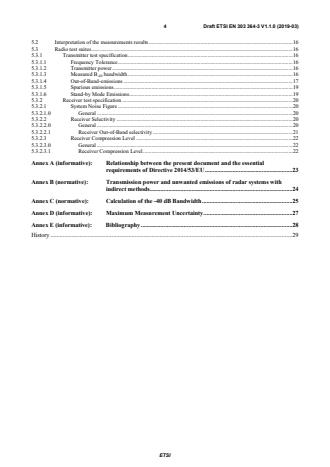
4 Draft ETSI EN 303 364-3 V1.1.0 (2019-03)
5.2 Interpretation of the measurements results . 16
5.3 Radio test suites . 16
5.3.1 Transmitter test specification . 16
5.3.1.1 Frequency Tolerance . 16
5.3.1.2 Transmitter power . 16
5.3.1.3 Measured B bandwidth . 16
-40
5.3.1.4 Out-of-Band-emissions . 17
5.3.1.5 Spurious emissions . 19
5.3.1.6 Stand-by Mode Emissions . 19
5.3.2 Receiver test specification . 20
5.3.2.1 System Noise Figure . 20
5.3.2.1.0 General . 20
5.3.2.2 Receiver Selectivity . 20
5.3.2.2.0 General . 20
5.3.2.2.1 Receiver Out-of-Band selectivity . 21
5.3.2.3 Receiver Compression Level . 22
5.3.2.3.0 General . 22
5.3.2.3.1 Receiver Compression Level . 22
Annex A (informative): Relationship between the present document and the essential
requirements of Directive 2014/53/EU . 23
Annex B (normative): Transmission power and unwanted emissions of radar systems with
indirect methods . 24
Annex C (normative): Calculation of the -40 dB Bandwidth . 25
Annex D (informative): Maximum Measurement Uncertainty . 27
Annex E (informative): Bibliography . 28
History . 29
ETSI
5 Draft ETSI EN 303 364-3 V1.1.0 (2019-03)
Intellectual Property Rights
Essential patents
IPRs essential or potentially essential to normative deliverables may have been declared to ETSI. The information
pertaining to these essential IPRs, if any, is publicly available for ETSI members and non-members, and can be found
in ETSI SR 000 314: "Intellectual Property Rights (IPRs); Essential, or potentially Essential, IPRs notified to ETSI in
respect of ETSI standards", which is available from the ETSI Secretariat. Latest updates are available on the ETSI Web
server (https://ipr.etsi.org/).
Pursuant to the ETSI IPR Policy, no investigation, including IPR searches, has been carried out by ETSI. No guarantee
can be given as to the existence of other IPRs not referenced in ETSI SR 000 314 (or the updates on the ETSI Web
server) which are, or may be, or may become, essential to the present document.
Trademarks
The present document may include trademarks and/or tradenames which are asserted and/or registered by their owners.
ETSI claims no ownership of these except for any which are indicated as being the property of ETSI, and conveys no
right to use or reproduce any trademark and/or tradename. Mention of those trademarks in the present document does
not constitute an endorsement by ETSI of products, services or organizations associated with those trademarks.
Foreword
This draft Harmonised European Standard (EN) has been produced by ETSI Technical Committee Electromagnetic
compatibility and Radio spectrum Matters (ERM), and is now submitted for the combined Public Enquiry and Vote
phase of the ETSI standards EN Approval Procedure.
The present document has been prepared under the Commission's standardisation request C(2015) 5376 final [i.5] to
provide one voluntary means of conforming to the essential requirements of Directive 2014/53/EU on the harmonisation
of the laws of the Member States relating to the making available on the market of radio equipment and repealing
Directive 1999/5/EC [i.1].
Once the present document is cited in the Official Journal of the European Union under that Directive, compliance with
the normative clauses of the present document given in table A.1 confers, within the limits of the scope of the present
document, a presumption of conformity with the corresponding essential requirements of that Directive, and associated
EFTA regulations.
The present document is part 3 of a multi-part deliverable covering Primary Surveillance Radars, as identified below:
Part 1: "Air Traffic Control (ATC) Primary Surveillance Radar sensors operating in 1 215 MHz to 1 400 MHz
frequency band (L band)";
Part 2: "Air Traffic Control (ATC) Primary Surveillance Radar sensors operating in 2 700 MHz to 3 100 MHz
frequency band (S band)";
Part 3: "Air Traffic Control (ATC) Primary Surveillance Radar sensors operating in 8 500 MHz to
10 000 MHz frequency band (X band)".
National transposition dates
Date of latest announcement of this EN (doa): 3 months after ETSI publication
Date of latest publication of new National Standard
or endorsement of this EN (dop/e): 6 months after doa
Date of withdrawal of any conflicting National Standard (dow): 6 months after doa
ETSI
6 Draft ETSI EN 303 364-3 V1.1.0 (2019-03)
Modal verbs terminology
In the present document "shall", "shall not", "should", "should not", "may", "need not", "will", "will not", "can" and
"cannot" are to be interpreted as described in clause 3.2 of the ETSI Drafting Rules (Verbal forms for the expression of
provisions).
"must" and "must not" are NOT allowed in ETSI deliverables except when used in direct citation.
ETSI
7 Draft ETSI EN 303 364-3 V1.1.0 (2019-03)
1 Scope
The present document specifies technical characteristics and methods of measurements for monostatic X-band radar
sensors intended for the surveillance of airspace traffic with the following characteristics:
• Operating in the frequency range 8 500 MHz to 10 000 MHz utilizing modulated pulses.
• The transceiver-antenna connection is using a hollow metallic rectangular waveguide.
• The antenna is rotating, waveguide-based and passive.
• At the transceiver output an RF-circulator is used.
NOTE 1: Since transceiver and antenna are hollow metallic rectangular waveguide based the frequency range for
measurements that needs to be addressed covers 6,56 GHz to 26 GHz. The lower limit of this frequency
range is obtained as cut-off frequency of the combination of WR112/R84 taper section and a WR90/R100
Waveguide IEC 60153-2 [i.3]. The upper limit corresponds to the upper limit stated in Table 1 of ERC
Recommendation 74-01 [2].
NOTE 2: Since at the transceiver output an RF circulator is used, it is assumed that the transceiver characteristics
remain independent from the antenna.
NOTE 3: Multi-static radars are not covered by the present document.
NOTE 4: The relationship between the present document and essential requirements of article 3.2 of Directive
2014/53/EU [i.1] is given in annex A.
2 References
2.1 Normative references
References are specific, identified by date of publication and/or edition number or version number. Only the cited
version applies.
Referenced documents which are not found to be publicly available in the expected location might be found at
https://docbox.etsi.org/Reference/.
NOTE: While any hyperlinks included in this clause were valid at the time of publication, ETSI cannot guarantee
their long term validity.
The following referenced documents are necessary for the application of the present document.
[1] ECC Recommendation (02)05 (2012): "Unwanted emissions".
[2] ERC Recommendation 74-01 (2011): "Unwanted emissions in the spurious domain".
[3] ITU Radio Regulations (2016).
[4] Recommendation ITU-R M.1177-4 (04-2011): "Techniques for measurement of unwanted
emissions of radar systems".
ETSI
8 Draft ETSI EN 303 364-3 V1.1.0 (2019-03)
2.2 Informative references
References are either specific (identified by date of publication and/or edition number or version number) or
non-specific. For specific references, only the cited version applies. For non-specific references, the latest version of the
referenced document (including any amendments) applies.
NOTE: While any hyperlinks included in this clause were valid at the time of publication, ETSI cannot guarantee
their long term validity.
The following referenced documents are not necessary for the application of the present document but they assist the
user with regard to a particular subject area.
[i.1] Directive 2014/53/EU of the European Parliament and of the Council of 16 April 2014 on the
harmonisation of the laws of the Member States relating to the making available on the market of
radio equipment and repealing Directive 1999/5/EC.
[i.2] Merrill I. Skolnik: "Radar Handbook", 2nd Edition, McGraw Hill publications.
[i.3] IEC 60153-2 (Edition 2.0, 1974): "Hollow metallic waveguides. Part 2: Relevant specifications for
ordinary rectangular waveguides".
[i.4] Recommendation ITU-R SM.1541-6 (08/2015): "Unwanted emissions in the out-of-band domain".
[i.5] Commission Implementing Decision C(2015) 5376 final of 4.8.2015 on a standardisation request
to the European Committee for Electrotechnical Standardisation and to the European
Telecommunications Standards Institute as regards radio equipment in support of Directive
2014/53/EU of the European Parliament and of the Council.
3 Definition of terms, symbols and abbreviations
3.1 Terms
For the purposes of the present document, the following terms apply:
active state: produces the authorized emission
allocated band: frequency span that regionally or nationally is allocated to one or more radio services on a primary or
secondary basis
NOTE: A table of national frequency allocations are normally available from the radio authority for each national
state. Also a generic frequency allocation table is available in the ITU Radio Regulations [3].
declared band: band or bands within which the product under test is declared to operate in the applicable operating
modes
NOTE 1: Will often correspond to an allocated band nationally.
NOTE 2: The declared band for a given region or country is always contained within the allocated band.
idle/standby state: where the transmitter is available for traffic, but is not in the active state
Minimum Detectable Signal (MDS): measure of the lowest detectable signal amplitude for a given signal type for a
given radar
NOTE: For solid state radars a processing gain can be associated with a received signal. This processing gain has
the effect of lowering the MDS level in comparison to a MDS which is based only on noise temperature.
MDS in the present document is defined as including the processing gain for the chosen test signal.
necessary bandwidth: width of the frequency band which is just sufficient to ensure the transmission of information at
the rate and with the quality required under specified conditions for a given class of emission
NOTE: This definition is taken from ITU Radio Regulations [3].
ETSI
9 Draft ETSI EN 303 364-3 V1.1.0 (2019-03)
occupied bandwidth: width of a frequency band such that, below the lower and above the upper frequency limits, the
mean powers emitted are each equal to a specified percentage β/2 of the total mean power of a given emission
NOTE 1: This definition is taken from ITU Radio Regulations [3].
NOTE 2: Unless otherwise specified in an Recommendation ITU-R for the appropriate class of emission, the value
of β/2 should be taken as 0,5 %.
operating mode: predefined configuration for a given service accessible to the operator of the radar system
NOTE 1: Several operating modes may be available.
NOTE 2: Changing operating mode might affect the radio characteristics of the radar system.
peak envelope power: average power supplied to the antenna transmission line by a transmitter during one radio
frequency cycle at the crest of the modulation envelope taken under normal operating conditions
NOTE: This definition is taken from ITU Radio Regulations [3].
product configuration: hardware variant of the same typology of system under test (e.g. different power outputs,
magnetrons)
pulse duration: time between the 50 % amplitude (voltage) points
pulse rise time: time taken for the leading edge of the pulse to increase from 10 % to 90 % of the maximum amplitude
(voltage)
3.2 Symbols
For the purposes of the present document, the following symbols apply:
B -40 dB bandwidth
-40
B Chirp bandwidth
C
B Necessary bandwidth
N
B 3 dB resolution bandwidth of transceiver
res
dB/dec dB per decade
dBpp dB with respect to peak power
D Detectability Factor (function of PD & Pfa)
no spur
k Boltzmann's constant
NF Noise Factor of the system
sys
P Probability of detection
D
P Probability of false alarm
FA
P Pulse power of transmission
t
t Time
t Pulse duration
p
t Pulse rise time
r
T Temperature in Kelvin
T Pulse length (of individual chirp) in seconds
C
λ Wavelength
3.3 Abbreviations
For the purposes of the present document, the following abbreviations apply:
AC Alternating Current
EFTA European Free Trade Association
EN European Standard
FM Frequency Modulation
LNA Low Noise Amplifier
ETSI
10 Draft ETSI EN 303 364-3 V1.1.0 (2019-03)
MDS Minimum Detectable Signal
OoB Out-of-Band
PEP Peak Envelope Power
PSR Primary Surveillance Radar
RF Radio Frequency
WG WaveGuide
4 Technical requirements specifications
4.1 Environmental profile
The technical requirements of the present document apply under the environmental profile for operation of the
equipment, which shall be declared by the manufacturer, but as a minimum, shall be that specified in the test conditions
contained in the present document. The equipment shall comply with all the technical requirements of the present
document which are identified as applicable in annex A at all times when operating within the boundary limits of the
declared operational environmental profile.
4.2 Conformance requirements
4.2.1 Transmitter requirements
4.2.1.1 Frequency Tolerance
4.2.1.1.1 Definition
The transmitter of a pulsed radar produces microwave pulses, which cause a broad frequency spectrum, depending on
the pulse duration.
The frequency tolerance is the maximum permissible departure by the centre frequency of the frequency band occupied
by an emission from the assigned frequency or, by the characteristic frequency of an emission from the reference
frequency.
4.2.1.1.2 Limits
The frequency tolerance for radars shall not exceed 1 250 ppm as per appendix 2 of the ITU Radio Regulations [3].
4.2.1.1.3 Conformance
The conformance tests are specified in clause 5.3.1.1.
4.2.1.2 Measured B Bandwidth
-40
4.2.1.2.1 Definition
The measured -40 dB bandwidth (B ) is the measured bandwidth of the emission 40 dB below the measured PEP.
-40
4.2.1.2.2 Limits
The measured -40 dB bandwidth of the signal shall be contained completely within the declared band in all operating
modes.
In case of multiple carrier-frequencies, all measured -40 dB emissions shall be contained within the declared band.
NOTE: The declared band is always contained in the 8 500 MHz to 10 000 MHz frequency range.
ETSI
11 Draft ETSI EN 303 364-3 V1.1.0 (2019-03)
4.2.1.2.3 Conformance
The conformance tests are specified in clause 5.3.1.3.
4.2.1.3 Out-of-band emissions
4.2.1.3.1 Definition
Out-of-Band emissions refer to emissions in the region between the calculated -40 dB bandwidth and the spurious
region (see definition of spu
...
HARMONISED EUROPEAN STANDARD
Primary Surveillance Radar (PSR);
Harmonised Standard for access to radio spectrum;
Part 3: Air Traffic Control (ATC) PSR sensors operating
in the frequency band 8 500 MHz to 10 000 MHz (X band)
2 ETSI EN 303 364-3 V1.1.1 (2019-07)
Reference
DEN/ERM-TGAERO-31-3
Keywords
aeronautical, harmonised standard, radar, radio
ETSI
650 Route des Lucioles
F-06921 Sophia Antipolis Cedex - FRANCE
Tel.: +33 4 92 94 42 00 Fax: +33 4 93 65 47 16
Siret N° 348 623 562 00017 - NAF 742 C
Association à but non lucratif enregistrée à la
Sous-Préfecture de Grasse (06) N° 7803/88
Important notice
The present document can be downloaded from:
http://www.etsi.org/standards-search
The present document may be made available in electronic versions and/or in print. The content of any electronic and/or
print versions of the present document shall not be modified without the prior written authorization of ETSI. In case of any
existing or perceived difference in contents between such versions and/or in print, the prevailing version of an ETSI
deliverable is the one made publicly available in PDF format at www.etsi.org/deliver.
Users of the present document should be aware that the document may be subject to revision or change of status.
Information on the current status of this and other ETSI documents is available at
https://portal.etsi.org/TB/ETSIDeliverableStatus.aspx
If you find errors in the present document, please send your comment to one of the following services:
https://portal.etsi.org/People/CommiteeSupportStaff.aspx
Copyright Notification
No part may be reproduced or utilized in any form or by any means, electronic or mechanical, including photocopying
and microfilm except as authorized by written permission of ETSI.
The content of the PDF version shall not be modified without the written authorization of ETSI.
The copyright and the foregoing restriction extend to reproduction in all media.
© ETSI 2019.
All rights reserved.
DECT™, PLUGTESTS™, UMTS™ and the ETSI logo are trademarks of ETSI registered for the benefit of its Members.
3GPP™ and LTE™ are trademarks of ETSI registered for the benefit of its Members and
of the 3GPP Organizational Partners.
oneM2M™ logo is a trademark of ETSI registered for the benefit of its Members and
of the oneM2M Partners. ®
GSM and the GSM logo are trademarks registered and owned by the GSM Association.
ETSI
3 ETSI EN 303 364-3 V1.1.1 (2019-07)
Contents
Intellectual Property Rights . 5
Foreword . 5
Modal verbs terminology . 6
1 Scope . 7
2 References . 7
2.1 Normative references . 7
2.2 Informative references . 8
3 Definition of terms, symbols and abbreviations . 8
3.1 Terms . 8
3.2 Symbols . 9
3.3 Abbreviations . 9
4 Technical requirements specifications . 10
4.1 Environmental profile . 10
4.2 Conformance requirements . 10
4.2.1 Transmitter requirements . 10
4.2.1.1 Frequency Tolerance . 10
4.2.1.1.1 Definition. 10
4.2.1.1.2 Limits . 10
4.2.1.1.3 Conformance . 10
4.2.1.2 Measured B Bandwidth . 10
-40
4.2.1.2.1 Definition. 10
4.2.1.2.2 Limits . 10
4.2.1.2.3 Conformance . 11
4.2.1.3 Out-of-band emissions . 11
4.2.1.3.1 Definition. 11
4.2.1.3.2 Limits . 11
4.2.1.3.3 Conformance . 12
4.2.1.4 Spurious emissions . 12
4.2.1.4.1 Definition. 12
4.2.1.4.2 Limits . 13
4.2.1.4.3 Conformance . 13
4.2.1.5 Stand-by Mode Emissions . 14
4.2.1.5.1 Definition. 14
4.2.1.5.2 Limits . 14
4.2.1.5.3 Conformance . 14
4.2.2 Receiver requirements . 14
4.2.2.1 System Noise Figure . 14
4.2.2.1.1 Definition. 14
4.2.2.1.2 Limits . 14
4.2.2.1.3 Conformance . 14
4.2.2.2 Receiver Selectivity . 14
4.2.2.2.1 Definition. 14
4.2.2.2.2 Limit . 14
4.2.2.2.3 Conformance . 14
4.2.2.3 Receiver Compression Level . 15
4.2.2.3.1 Definition. 15
4.2.2.3.2 Limit . 15
4.2.2.3.3 Conformance . 15
5 Testing for compliance with technical requirements . 15
5.0 General requirements . 15
5.1 Environmental conditions for testing . 15
5.1.1 Test Conditions . 15
5.1.2 Normal temperature and humidity . 15
5.1.3 Normal test power supply . 16
ETSI
4 ETSI EN 303 364-3 V1.1.1 (2019-07)
5.2 Interpretation of the measurements results . 16
5.3 Radio test suites . 16
5.3.1 Transmitter test specification . 16
5.3.1.1 Frequency Tolerance . 16
5.3.1.2 Transmitter power . 16
5.3.1.3 Measured B bandwidth . 16
-40
5.3.1.4 Out-of-Band-emissions . 17
5.3.1.5 Spurious emissions . 19
5.3.1.6 Stand-by Mode Emissions . 19
5.3.2 Receiver test specification . 20
5.3.2.1 System Noise Figure . 20
5.3.2.1.0 General . 20
5.3.2.2 Receiver Selectivity . 20
5.3.2.2.0 General . 20
5.3.2.2.1 Receiver Out-of-Band selectivity . 21
5.3.2.3 Receiver Compression Level . 22
5.3.2.3.0 General . 22
5.3.2.3.1 Receiver Compression Level . 22
Annex A (informative): Relationship between the present document and the essential
requirements of Directive 2014/53/EU . 23
Annex B (normative): Transmission power and unwanted emissions of radar systems with
indirect methods . 24
Annex C (normative): Calculation of the -40 dB Bandwidth . 25
Annex D (informative): Maximum Measurement Uncertainty . 27
Annex E (informative): Bibliography . 28
History . 29
ETSI
5 ETSI EN 303 364-3 V1.1.1 (2019-07)
Intellectual Property Rights
Essential patents
IPRs essential or potentially essential to normative deliverables may have been declared to ETSI. The information
pertaining to these essential IPRs, if any, is publicly available for ETSI members and non-members, and can be found
in ETSI SR 000 314: "Intellectual Property Rights (IPRs); Essential, or potentially Essential, IPRs notified to ETSI in
respect of ETSI standards", which is available from the ETSI Secretariat. Latest updates are available on the ETSI Web
server (https://ipr.etsi.org/).
Pursuant to the ETSI IPR Policy, no investigation, including IPR searches, has been carried out by ETSI. No guarantee
can be given as to the existence of other IPRs not referenced in ETSI SR 000 314 (or the updates on the ETSI Web
server) which are, or may be, or may become, essential to the present document.
Trademarks
The present document may include trademarks and/or tradenames which are asserted and/or registered by their owners.
ETSI claims no ownership of these except for any which are indicated as being the property of ETSI, and conveys no
right to use or reproduce any trademark and/or tradename. Mention of those trademarks in the present document does
not constitute an endorsement by ETSI of products, services or organizations associated with those trademarks.
Foreword
This Harmonised European Standard (EN) has been produced by ETSI Technical Committee Electromagnetic
compatibility and Radio spectrum Matters (ERM).
The present document has been prepared under the Commission's standardisation request C(2015) 5376 final [i.5] to
provide one voluntary means of conforming to the essential requirements of Directive 2014/53/EU on the harmonisation
of the laws of the Member States relating to the making available on the market of radio equipment and repealing
Directive 1999/5/EC [i.1].
Once the present document is cited in the Official Journal of the European Union under that Directive, compliance with
the normative clauses of the present document given in table A.1 confers, within the limits of the scope of the present
document, a presumption of conformity with the corresponding essential requirements of that Directive, and associated
EFTA regulations.
The present document is part 3 of a multi-part deliverable covering Primary Surveillance Radars, as identified below:
Part 1: "Air Traffic Control (ATC) Primary Surveillance Radar sensors operating in 1 215 MHz to 1 400 MHz
frequency band (L band)";
Part 2: "Air Traffic Control (ATC) Primary Surveillance Radar sensors operating in 2 700 MHz to 3 100 MHz
frequency band (S band)";
Part 3: "Air Traffic Control (ATC) Primary Surveillance Radar sensors operating in 8 500 MHz to
10 000 MHz frequency band (X band)".
National transposition dates
Date of adoption of this EN: 17 June 2019
Date of latest announcement of this EN (doa): 30 September 2019
Date of latest publication of new National Standard
or endorsement of this EN (dop/e): 31 March 2020
Date of withdrawal of any conflicting National Standard (dow): 31 March 2020
ETSI
6 ETSI EN 303 364-3 V1.1.1 (2019-07)
Modal verbs terminology
In the present document "shall", "shall not", "should", "should not", "may", "need not", "will", "will not", "can" and
"cannot" are to be interpreted as described in clause 3.2 of the ETSI Drafting Rules (Verbal forms for the expression of
provisions).
"must" and "must not" are NOT allowed in ETSI deliverables except when used in direct citation.
ETSI
7 ETSI EN 303 364-3 V1.1.1 (2019-07)
1 Scope
The present document specifies technical characteristics and methods of measurements for monostatic X-band radar
sensors intended for the surveillance of airspace traffic with the following characteristics:
• Operating in the frequency range 8 500 MHz to 10 000 MHz utilizing modulated pulses.
• The transceiver-antenna connection is using a hollow metallic rectangular waveguide.
• The antenna is rotating, waveguide-based and passive.
• At the transceiver output an RF-circulator is used.
NOTE 1: Since transceiver and antenna are hollow metallic rectangular waveguide based the frequency range for
measurements that needs to be addressed covers 6,56 GHz to 26 GHz. The lower limit of this frequency
range is obtained as cut-off frequency of the combination of WR112/R84 taper section and a WR90/R100
Waveguide IEC 60153-2 [i.3]. The upper limit corresponds to the upper limit stated in Table 1 of ERC
Recommendation 74-01 [2].
NOTE 2: Since at the transceiver output an RF circulator is used, it is assumed that the transceiver characteristics
remain independent from the antenna.
NOTE 3: Multi-static radars are not covered by the present document.
NOTE 4: The relationship between the present document and essential requirements of article 3.2 of Directive
2014/53/EU [i.1] is given in annex A.
2 References
2.1 Normative references
References are specific, identified by date of publication and/or edition number or version number. Only the cited
version applies.
Referenced documents which are not found to be publicly available in the expected location might be found at
https://docbox.etsi.org/Reference/.
NOTE: While any hyperlinks included in this clause were valid at the time of publication, ETSI cannot guarantee
their long term validity.
The following referenced documents are necessary for the application of the present document.
[1] ECC Recommendation (02)05 (2012): "Unwanted emissions".
[2] ERC Recommendation 74-01 (2019): "Unwanted emissions in the spurious domain".
[3] ITU Radio Regulations (2016).
[4] Recommendation ITU-R M.1177-4 (04-2011): "Techniques for measurement of unwanted
emissions of radar systems".
ETSI
8 ETSI EN 303 364-3 V1.1.1 (2019-07)
2.2 Informative references
References are either specific (identified by date of publication and/or edition number or version number) or
non-specific. For specific references, only the cited version applies. For non-specific references, the latest version of the
referenced document (including any amendments) applies.
NOTE: While any hyperlinks included in this clause were valid at the time of publication, ETSI cannot guarantee
their long term validity.
The following referenced documents are not necessary for the application of the present document but they assist the
user with regard to a particular subject area.
[i.1] Directive 2014/53/EU of the European Parliament and of the Council of 16 April 2014 on the
harmonisation of the laws of the Member States relating to the making available on the market of
radio equipment and repealing Directive 1999/5/EC.
[i.2] Merrill I. Skolnik: "Radar Handbook", 2nd Edition, McGraw Hill publications.
[i.3] IEC 60153-2 (Edition 2.0, 1974): "Hollow metallic waveguides. Part 2: Relevant specifications for
ordinary rectangular waveguides".
[i.4] Recommendation ITU-R SM.1541-6 (08/2015): "Unwanted emissions in the out-of-band domain".
[i.5] Commission Implementing Decision C(2015) 5376 final of 4.8.2015 on a standardisation request
to the European Committee for Electrotechnical Standardisation and to the European
Telecommunications Standards Institute as regards radio equipment in support of Directive
2014/53/EU of the European Parliament and of the Council.
3 Definition of terms, symbols and abbreviations
3.1 Terms
For the purposes of the present document, the following terms apply:
active state: produces the authorized emission
allocated band: frequency span that regionally or nationally is allocated to one or more radio services on a primary or
secondary basis
NOTE: A table of national frequency allocations are normally available from the radio authority for each national
state. Also a generic frequency allocation table is available in the ITU Radio Regulations [3].
declared band: band or bands within which the product under test is declared to operate in the applicable operating
modes
NOTE 1: Will often correspond to an allocated band nationally.
NOTE 2: The declared band for a given region or country is always contained within the allocated band.
idle/standby state: where the transmitter is available for traffic, but is not in the active state
Minimum Detectable Signal (MDS): measure of the lowest detectable signal amplitude for a given signal type for a
given radar
NOTE: For solid state radars a processing gain can be associated with a received signal. This processing gain has
the effect of lowering the MDS level in comparison to a MDS which is based only on noise temperature.
MDS in the present document is defined as including the processing gain for the chosen test signal.
necessary bandwidth: width of the frequency band which is just sufficient to ensure the transmission of information at
the rate and with the quality required under specified conditions for a given class of emission
NOTE: This definition is taken from ITU Radio Regulations [3].
ETSI
9 ETSI EN 303 364-3 V1.1.1 (2019-07)
occupied bandwidth: width of a frequency band such that, below the lower and above the upper frequency limits, the
mean powers emitted are each equal to a specified percentage β/2 of the total mean power of a given emission
NOTE 1: This definition is taken from ITU Radio Regulations [3].
NOTE 2: Unless otherwise specified in an Recommendation ITU-R for the appropriate class of emission, the value
of β/2 should be taken as 0,5 %.
operating mode: predefined configuration for a given service accessible to the operator of the radar system
NOTE 1: Several operating modes may be available.
NOTE 2: Changing operating mode might affect the radio characteristics of the radar system.
peak envelope power: average power supplied to the antenna transmission line by a transmitter during one radio
frequency cycle at the crest of the modulation envelope taken under normal operating conditions
NOTE: This definition is taken from ITU Radio Regulations [3].
product configuration: hardware variant of the same typology of system under test (e.g. different power outputs,
magnetrons)
pulse duration: time between the 50 % amplitude (voltage) points
pulse rise time: time taken for the leading edge of the pulse to increase from 10 % to 90 % of the maximum amplitude
(voltage)
3.2 Symbols
For the purposes of the present document, the following symbols apply:
B -40 dB bandwidth
-40
B Chirp bandwidth
C
B Necessary bandwidth
N
B 3 dB resolution bandwidth of transceiver
res
dB/dec dB per decade
dBpp dB with respect to peak power
D Detectability Factor (function of PD & Pfa)
no spur
k Boltzmann's constant
NF Noise Factor of the system
sys
P Probability of detection
D
P Probability of false alarm
FA
P Pulse power of transmission
t
t Time
t Pulse duration
p
t Pulse rise time
r
T Temperature in Kelvin
T Pulse length (of individual chirp) in seconds
C
λ Wavelength
3.3 Abbreviations
For the purposes of the present document, the following abbreviations apply:
AC Alternating Current
EFTA European Free Trade Association
EN European Standard
FM Frequency Modulation
LNA Low Noise Amplifier
ETSI
10 ETSI EN 303 364-3 V1.1.1 (2019-07)
MDS Minimum Detectable Signal
OoB Out-of-Band
PEP Peak Envelope Power
ppm part(s) per million
PSR Primary Surveillance Radar
RF Radio Frequency
WG WaveGuide
4 Technical requirements specifications
4.1 Environmental profile
The technical requirements of the present document apply under the environmental profile for operation of the
equipment, which shall be declared by the manufacturer, but as a minimum, shall be that specified in the test conditions
contained in the present document. The equipment shall comply with all the technical requirements of the present
document which are identified as applicable in annex A at all times when operating within the boundary limits of the
declared operational environmental profile.
4.2 Conformance requirements
4.2.1 Transmitter requirements
4.2.1.1 Frequency Tolerance
4.2.1.1.1 Definition
The transmitter of a pulsed radar produces microwave pulses, which cause a broad frequency spectrum, depending on
the pulse duration.
The frequency tolerance is the maximum permissible departure by the centre frequency of the frequency band occupied
by an emission from the assigned frequency or, by the characteristic frequency of an emission from the reference
frequency.
4.2.1.1.2 Limits
The frequency tolerance for radars shall not exceed 1 250 ppm as per appendix 2 of the ITU Radio Regulations [3].
4.2.1.1.3 Conformance
The conformance tests are specified in clause 5.3.1.1.
4.2.1.2 Measured B-40 Bandwidth
4.2.1.2.1 Definition
The measured -40 dB bandwidth (B ) is the measured bandwidth of the emission 40 dB below the measured PEP.
-40
4.2.1.2.2 Limits
The measured -40 dB bandwidth of the signal shall be contained completely within the declared band in all operating
modes.
In case of multiple carrier-frequencies, all measured -40 dB emissions shall be contained within the declared band.
NOTE: The declared band is always contained in the 8 500 MHz to 10 000 MHz frequency range.
ETSI
11 ETSI EN 303 364-3 V1.1.1 (2019-07)
4.2.1.2.3 Conformance
The conformance tests are specified in clause 5.3.1.3.
4.2.1.3 Out-of-band emissions
4.2.1.3.1 Definition
Out-of-Band emissions refer to emissions in the region between the calculated -40 dB bandwidth and the spurious
region (see definition of spurious region in clause 4.2.1.4.1).
The Out-of-Band emission limits and the spurious emission limits are defined based on the effective -40 dB bandwidth.
Annex C con
...
SLOVENSKI STANDARD
01-september-2019
Primarni nadzorni radar (PSR) - Harmonizirani standard za dostop do radijskega
spektra - 3. del: Senzorji PSR za nadzor zračnega prometa (ATC), ki delujejo v
frekvenčnem pasu od 8500 MHz do 10.000 MHz (pas X)
Primary Surveillance Radar (PSR) - Harmonised Standard for access to radio spectrum -
Part 3: Air Traffic Control (ATC) PSR sensors operating in 8 500 MHz to 10 000 MHz
frequency band (X band)
Ta slovenski standard je istoveten z: ETSI EN 303 364-3 V1.1.1 (2019-07)
ICS:
03.220.50 Zračni transport Air transport
33.060.99 Druga oprema za radijske Other equipment for
komunikacije radiocommunications
2003-01.Slovenski inštitut za standardizacijo. Razmnoževanje celote ali delov tega standarda ni dovoljeno.
HARMONISED EUROPEAN STANDARD
Primary Surveillance Radar (PSR);
Harmonised Standard for access to radio spectrum;
Part 3: Air Traffic Control (ATC) PSR sensors operating
in the frequency band 8 500 MHz to 10 000 MHz (X band)
2 ETSI EN 303 364-3 V1.1.1 (2019-07)
Reference
DEN/ERM-TGAERO-31-3
Keywords
aeronautical, harmonised standard, radar, radio
ETSI
650 Route des Lucioles
F-06921 Sophia Antipolis Cedex - FRANCE
Tel.: +33 4 92 94 42 00 Fax: +33 4 93 65 47 16
Siret N° 348 623 562 00017 - NAF 742 C
Association à but non lucratif enregistrée à la
Sous-Préfecture de Grasse (06) N° 7803/88
Important notice
The present document can be downloaded from:
http://www.etsi.org/standards-search
The present document may be made available in electronic versions and/or in print. The content of any electronic and/or
print versions of the present document shall not be modified without the prior written authorization of ETSI. In case of any
existing or perceived difference in contents between such versions and/or in print, the prevailing version of an ETSI
deliverable is the one made publicly available in PDF format at www.etsi.org/deliver.
Users of the present document should be aware that the document may be subject to revision or change of status.
Information on the current status of this and other ETSI documents is available at
https://portal.etsi.org/TB/ETSIDeliverableStatus.aspx
If you find errors in the present document, please send your comment to one of the following services:
https://portal.etsi.org/People/CommiteeSupportStaff.aspx
Copyright Notification
No part may be reproduced or utilized in any form or by any means, electronic or mechanical, including photocopying
and microfilm except as authorized by written permission of ETSI.
The content of the PDF version shall not be modified without the written authorization of ETSI.
The copyright and the foregoing restriction extend to reproduction in all media.
© ETSI 2019.
All rights reserved.
DECT™, PLUGTESTS™, UMTS™ and the ETSI logo are trademarks of ETSI registered for the benefit of its Members.
3GPP™ and LTE™ are trademarks of ETSI registered for the benefit of its Members and
of the 3GPP Organizational Partners.
oneM2M™ logo is a trademark of ETSI registered for the benefit of its Members and
of the oneM2M Partners. ®
GSM and the GSM logo are trademarks registered and owned by the GSM Association.
ETSI
3 ETSI EN 303 364-3 V1.1.1 (2019-07)
Contents
Intellectual Property Rights . 5
Foreword . 5
Modal verbs terminology . 6
1 Scope . 7
2 References . 7
2.1 Normative references . 7
2.2 Informative references . 8
3 Definition of terms, symbols and abbreviations . 8
3.1 Terms . 8
3.2 Symbols . 9
3.3 Abbreviations . 9
4 Technical requirements specifications . 10
4.1 Environmental profile . 10
4.2 Conformance requirements . 10
4.2.1 Transmitter requirements . 10
4.2.1.1 Frequency Tolerance . 10
4.2.1.1.1 Definition. 10
4.2.1.1.2 Limits . 10
4.2.1.1.3 Conformance . 10
4.2.1.2 Measured B Bandwidth . 10
-40
4.2.1.2.1 Definition. 10
4.2.1.2.2 Limits . 10
4.2.1.2.3 Conformance . 11
4.2.1.3 Out-of-band emissions . 11
4.2.1.3.1 Definition. 11
4.2.1.3.2 Limits . 11
4.2.1.3.3 Conformance . 12
4.2.1.4 Spurious emissions . 12
4.2.1.4.1 Definition. 12
4.2.1.4.2 Limits . 13
4.2.1.4.3 Conformance . 13
4.2.1.5 Stand-by Mode Emissions . 14
4.2.1.5.1 Definition. 14
4.2.1.5.2 Limits . 14
4.2.1.5.3 Conformance . 14
4.2.2 Receiver requirements . 14
4.2.2.1 System Noise Figure . 14
4.2.2.1.1 Definition. 14
4.2.2.1.2 Limits . 14
4.2.2.1.3 Conformance . 14
4.2.2.2 Receiver Selectivity . 14
4.2.2.2.1 Definition. 14
4.2.2.2.2 Limit . 14
4.2.2.2.3 Conformance . 14
4.2.2.3 Receiver Compression Level . 15
4.2.2.3.1 Definition. 15
4.2.2.3.2 Limit . 15
4.2.2.3.3 Conformance . 15
5 Testing for compliance with technical requirements . 15
5.0 General requirements . 15
5.1 Environmental conditions for testing . 15
5.1.1 Test Conditions . 15
5.1.2 Normal temperature and humidity . 15
5.1.3 Normal test power supply . 16
ETSI
4 ETSI EN 303 364-3 V1.1.1 (2019-07)
5.2 Interpretation of the measurements results . 16
5.3 Radio test suites . 16
5.3.1 Transmitter test specification . 16
5.3.1.1 Frequency Tolerance . 16
5.3.1.2 Transmitter power . 16
5.3.1.3 Measured B bandwidth . 16
-40
5.3.1.4 Out-of-Band-emissions . 17
5.3.1.5 Spurious emissions . 19
5.3.1.6 Stand-by Mode Emissions . 19
5.3.2 Receiver test specification . 20
5.3.2.1 System Noise Figure . 20
5.3.2.1.0 General . 20
5.3.2.2 Receiver Selectivity . 20
5.3.2.2.0 General . 20
5.3.2.2.1 Receiver Out-of-Band selectivity . 21
5.3.2.3 Receiver Compression Level . 22
5.3.2.3.0 General . 22
5.3.2.3.1 Receiver Compression Level . 22
Annex A (informative): Relationship between the present document and the essential
requirements of Directive 2014/53/EU . 23
Annex B (normative): Transmission power and unwanted emissions of radar systems with
indirect methods . 24
Annex C (normative): Calculation of the -40 dB Bandwidth . 25
Annex D (informative): Maximum Measurement Uncertainty . 27
Annex E (informative): Bibliography . 28
History . 29
ETSI
5 ETSI EN 303 364-3 V1.1.1 (2019-07)
Intellectual Property Rights
Essential patents
IPRs essential or potentially essential to normative deliverables may have been declared to ETSI. The information
pertaining to these essential IPRs, if any, is publicly available for ETSI members and non-members, and can be found
in ETSI SR 000 314: "Intellectual Property Rights (IPRs); Essential, or potentially Essential, IPRs notified to ETSI in
respect of ETSI standards", which is available from the ETSI Secretariat. Latest updates are available on the ETSI Web
server (https://ipr.etsi.org/).
Pursuant to the ETSI IPR Policy, no investigation, including IPR searches, has been carried out by ETSI. No guarantee
can be given as to the existence of other IPRs not referenced in ETSI SR 000 314 (or the updates on the ETSI Web
server) which are, or may be, or may become, essential to the present document.
Trademarks
The present document may include trademarks and/or tradenames which are asserted and/or registered by their owners.
ETSI claims no ownership of these except for any which are indicated as being the property of ETSI, and conveys no
right to use or reproduce any trademark and/or tradename. Mention of those trademarks in the present document does
not constitute an endorsement by ETSI of products, services or organizations associated with those trademarks.
Foreword
This Harmonised European Standard (EN) has been produced by ETSI Technical Committee Electromagnetic
compatibility and Radio spectrum Matters (ERM).
The present document has been prepared under the Commission's standardisation request C(2015) 5376 final [i.5] to
provide one voluntary means of conforming to the essential requirements of Directive 2014/53/EU on the harmonisation
of the laws of the Member States relating to the making available on the market of radio equipment and repealing
Directive 1999/5/EC [i.1].
Once the present document is cited in the Official Journal of the European Union under that Directive, compliance with
the normative clauses of the present document given in table A.1 confers, within the limits of the scope of the present
document, a presumption of conformity with the corresponding essential requirements of that Directive, and associated
EFTA regulations.
The present document is part 3 of a multi-part deliverable covering Primary Surveillance Radars, as identified below:
Part 1: "Air Traffic Control (ATC) Primary Surveillance Radar sensors operating in 1 215 MHz to 1 400 MHz
frequency band (L band)";
Part 2: "Air Traffic Control (ATC) Primary Surveillance Radar sensors operating in 2 700 MHz to 3 100 MHz
frequency band (S band)";
Part 3: "Air Traffic Control (ATC) Primary Surveillance Radar sensors operating in 8 500 MHz to
10 000 MHz frequency band (X band)".
National transposition dates
Date of adoption of this EN: 17 June 2019
Date of latest announcement of this EN (doa): 30 September 2019
Date of latest publication of new National Standard
or endorsement of this EN (dop/e): 31 March 2020
Date of withdrawal of any conflicting National Standard (dow): 31 March 2020
ETSI
6 ETSI EN 303 364-3 V1.1.1 (2019-07)
Modal verbs terminology
In the present document "shall", "shall not", "should", "should not", "may", "need not", "will", "will not", "can" and
"cannot" are to be interpreted as described in clause 3.2 of the ETSI Drafting Rules (Verbal forms for the expression of
provisions).
"must" and "must not" are NOT allowed in ETSI deliverables except when used in direct citation.
ETSI
7 ETSI EN 303 364-3 V1.1.1 (2019-07)
1 Scope
The present document specifies technical characteristics and methods of measurements for monostatic X-band radar
sensors intended for the surveillance of airspace traffic with the following characteristics:
• Operating in the frequency range 8 500 MHz to 10 000 MHz utilizing modulated pulses.
• The transceiver-antenna connection is using a hollow metallic rectangular waveguide.
• The antenna is rotating, waveguide-based and passive.
• At the transceiver output an RF-circulator is used.
NOTE 1: Since transceiver and antenna are hollow metallic rectangular waveguide based the frequency range for
measurements that needs to be addressed covers 6,56 GHz to 26 GHz. The lower limit of this frequency
range is obtained as cut-off frequency of the combination of WR112/R84 taper section and a WR90/R100
Waveguide IEC 60153-2 [i.3]. The upper limit corresponds to the upper limit stated in Table 1 of ERC
Recommendation 74-01 [2].
NOTE 2: Since at the transceiver output an RF circulator is used, it is assumed that the transceiver characteristics
remain independent from the antenna.
NOTE 3: Multi-static radars are not covered by the present document.
NOTE 4: The relationship between the present document and essential requirements of article 3.2 of Directive
2014/53/EU [i.1] is given in annex A.
2 References
2.1 Normative references
References are specific, identified by date of publication and/or edition number or version number. Only the cited
version applies.
Referenced documents which are not found to be publicly available in the expected location might be found at
https://docbox.etsi.org/Reference/.
NOTE: While any hyperlinks included in this clause were valid at the time of publication, ETSI cannot guarantee
their long term validity.
The following referenced documents are necessary for the application of the present document.
[1] ECC Recommendation (02)05 (2012): "Unwanted emissions".
[2] ERC Recommendation 74-01 (2019): "Unwanted emissions in the spurious domain".
[3] ITU Radio Regulations (2016).
[4] Recommendation ITU-R M.1177-4 (04-2011): "Techniques for measurement of unwanted
emissions of radar systems".
ETSI
8 ETSI EN 303 364-3 V1.1.1 (2019-07)
2.2 Informative references
References are either specific (identified by date of publication and/or edition number or version number) or
non-specific. For specific references, only the cited version applies. For non-specific references, the latest version of the
referenced document (including any amendments) applies.
NOTE: While any hyperlinks included in this clause were valid at the time of publication, ETSI cannot guarantee
their long term validity.
The following referenced documents are not necessary for the application of the present document but they assist the
user with regard to a particular subject area.
[i.1] Directive 2014/53/EU of the European Parliament and of the Council of 16 April 2014 on the
harmonisation of the laws of the Member States relating to the making available on the market of
radio equipment and repealing Directive 1999/5/EC.
[i.2] Merrill I. Skolnik: "Radar Handbook", 2nd Edition, McGraw Hill publications.
[i.3] IEC 60153-2 (Edition 2.0, 1974): "Hollow metallic waveguides. Part 2: Relevant specifications for
ordinary rectangular waveguides".
[i.4] Recommendation ITU-R SM.1541-6 (08/2015): "Unwanted emissions in the out-of-band domain".
[i.5] Commission Implementing Decision C(2015) 5376 final of 4.8.2015 on a standardisation request
to the European Committee for Electrotechnical Standardisation and to the European
Telecommunications Standards Institute as regards radio equipment in support of Directive
2014/53/EU of the European Parliament and of the Council.
3 Definition of terms, symbols and abbreviations
3.1 Terms
For the purposes of the present document, the following terms apply:
active state: produces the authorized emission
allocated band: frequency span that regionally or nationally is allocated to one or more radio services on a primary or
secondary basis
NOTE: A table of national frequency allocations are normally available from the radio authority for each national
state. Also a generic frequency allocation table is available in the ITU Radio Regulations [3].
declared band: band or bands within which the product under test is declared to operate in the applicable operating
modes
NOTE 1: Will often correspond to an allocated band nationally.
NOTE 2: The declared band for a given region or country is always contained within the allocated band.
idle/standby state: where the transmitter is available for traffic, but is not in the active state
Minimum Detectable Signal (MDS): measure of the lowest detectable signal amplitude for a given signal type for a
given radar
NOTE: For solid state radars a processing gain can be associated with a received signal. This processing gain has
the effect of lowering the MDS level in comparison to a MDS which is based only on noise temperature.
MDS in the present document is defined as including the processing gain for the chosen test signal.
necessary bandwidth: width of the frequency band which is just sufficient to ensure the transmission of information at
the rate and with the quality required under specified conditions for a given class of emission
NOTE: This definition is taken from ITU Radio Regulations [3].
ETSI
9 ETSI EN 303 364-3 V1.1.1 (2019-07)
occupied bandwidth: width of a frequency band such that, below the lower and above the upper frequency limits, the
mean powers emitted are each equal to a specified percentage β/2 of the total mean power of a given emission
NOTE 1: This definition is taken from ITU Radio Regulations [3].
NOTE 2: Unless otherwise specified in an Recommendation ITU-R for the appropriate class of emission, the value
of β/2 should be taken as 0,5 %.
operating mode: predefined configuration for a given service accessible to the operator of the radar system
NOTE 1: Several operating modes may be available.
NOTE 2: Changing operating mode might affect the radio characteristics of the radar system.
peak envelope power: average power supplied to the antenna transmission line by a transmitter during one radio
frequency cycle at the crest of the modulation envelope taken under normal operating conditions
NOTE: This definition is taken from ITU Radio Regulations [3].
product configuration: hardware variant of the same typology of system under test (e.g. different power outputs,
magnetrons)
pulse duration: time between the 50 % amplitude (voltage) points
pulse rise time: time taken for the leading edge of the pulse to increase from 10 % to 90 % of the maximum amplitude
(voltage)
3.2 Symbols
For the purposes of the present document, the following symbols apply:
B -40 dB bandwidth
-40
B Chirp bandwidth
C
B Necessary bandwidth
N
B 3 dB resolution bandwidth of transceiver
res
dB/dec dB per decade
dBpp dB with respect to peak power
D Detectability Factor (function of PD & Pfa)
no spur
k Boltzmann's constant
NF Noise Factor of the system
sys
P Probability of detection
D
P Probability of false alarm
FA
P Pulse power of transmission
t
t Time
t Pulse duration
p
t Pulse rise time
r
T Temperature in Kelvin
T Pulse length (of individual chirp) in seconds
C
λ Wavelength
3.3 Abbreviations
For the purposes of the present document, the following abbreviations apply:
AC Alternating Current
EFTA European Free Trade Association
EN European Standard
FM Frequency Modulation
LNA Low Noise Amplifier
ETSI
10 ETSI EN 303 364-3 V1.1.1 (2019-07)
MDS Minimum Detectable Signal
OoB Out-of-Band
PEP Peak Envelope Power
ppm part(s) per million
PSR Primary Surveillance Radar
RF Radio Frequency
WG WaveGuide
4 Technical requirements specifications
4.1 Environmental profile
The technical requirements of the present document apply under the environmental profile for operation of the
equipment, which shall be declared by the manufacturer, but as a minimum, shall be that specified in the test conditions
contained in the present document. The equipment shall comply with all the technical requirements of the present
document which are identified as applicable in annex A at all times when operating within the boundary limits of the
declared operational environmental profile.
4.2 Conformance requirements
4.2.1 Transmitter requirements
4.2.1.1 Frequency Tolerance
4.2.1.1.1 Definition
The transmitter of a pulsed radar produces microwave pulses, which cause a broad frequency spectrum, depending on
the pulse duration.
The frequency tolerance is the maximum permissible departure by the centre frequency of the frequency band occupied
by an emission from the assigned frequency or, by the characteristic frequency of an emission from the reference
frequency.
4.2.1.1.2 Limits
The frequency tolerance for radars shall not exceed 1 250 ppm as per appendix 2 of the ITU Radio Regulations [3].
4.2.1.1.3 Conformance
The conformance tests are specified in clause 5.3.1.1.
4.2.1.2 Measured B-40 Bandwidth
4.2.1.2.1 Definition
The measured -40 dB bandwidth (B ) is the measured bandwidth of the emission 40 dB below the measured PEP.
-40
4.2.1.2.2 Limits
The measured -40 dB bandwidth of the signal shall be contained completely within the declared band in all operating
modes.
In case of multiple carrier-frequencies, all measured -40 dB emissions shall be contained within the declared band.
NOTE: The declared band is always contained in the 8 500 MHz to 10 000 MHz frequency range.
ETSI
11 ETSI EN 303 364-3 V1.1.1 (2019-07)
4.2.1.2.3 Conformance
The conformance tests are specified in clause 5.3.1.3.
...