

ISO 24478:2023/FDAmd 1
(Amendment)Railway applications — Braking — General vocabulary — Amendment 1
- Status
- Not Published
- Technical Committee
- ISO/TC 269/SC 2 - Rolling stock
- Drafting Committee
- ISO/TC 269/SC 2/WG 1 - Railway braking
- Current Stage
- 5020 - FDIS ballot initiated: 2 months. Proof sent to secretariat
- Start Date
- 20-Oct-2026
- Completion Date
- 20-Oct-2026
Buy Documents

ISO 24478:2023/FDAmd 1 - Railway applications — Braking — General vocabulary — Amendment 1
REDLINE ISO 24478:2023/FDAmd 1 - Railway applications — Braking — General vocabulary — Amendment 1
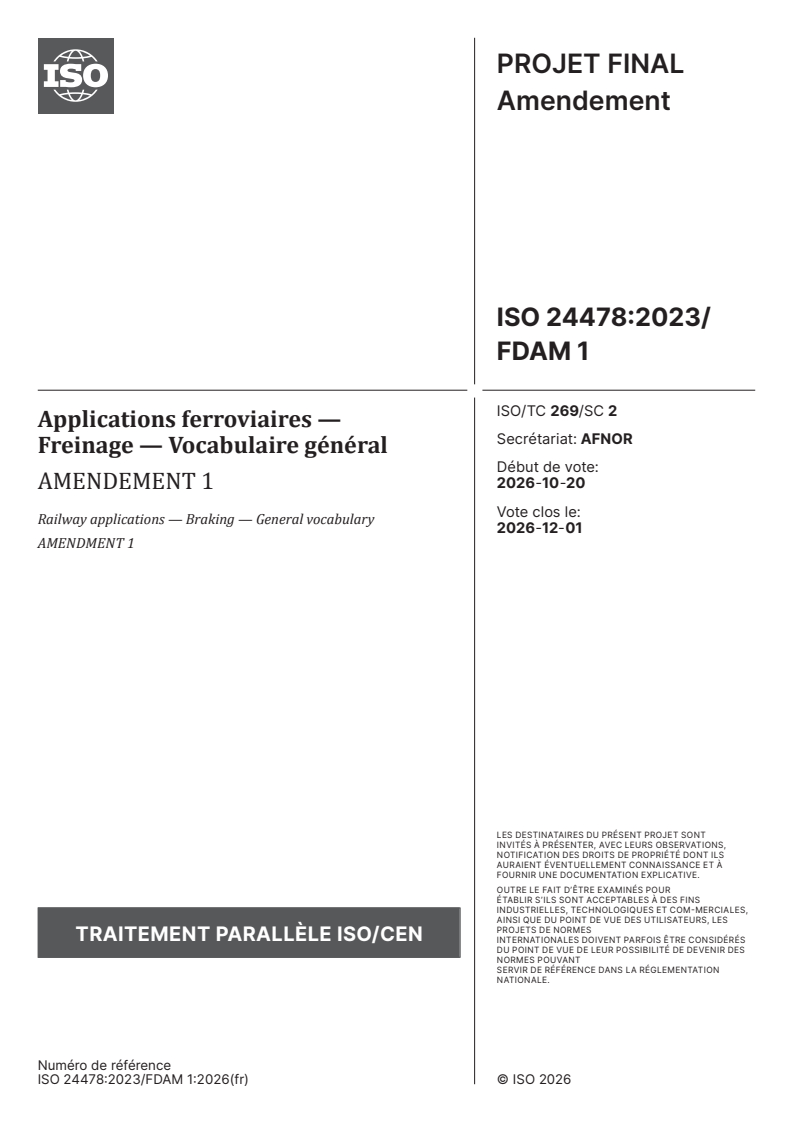

ISO 24478:2023/FDAmd 1 - Applications ferroviaires — Freinage — Vocabulaire général — Amendement 1
ISO 24478:2023/FDAmd 1 is an ISO amendment to Railway applications - Braking - General vocabulary. It updates the vocabulary used for railway braking, including selected definitions, preferred and admitted terms, symbols and annex figures. The amendment is written for people who need consistent braking terminology in rolling stock specifications, design documents and technical reviews.
What does ISO 24478:2023/FDAmd 1 specify?
ISO 24478:2023/FDAmd 1 specifies amendments to the general vocabulary for railway braking rather than a separate braking method or product standard. It revises how key braking terms are named and defined, and it updates the related figures and annex diagrams so the terminology matches current usage.
The amendment is organized as a set of changes to the front matter, the terminology entries in Clause 3, Annex C, Annex D, Annex E and the bibliography. In practice, that means it affects both the words used in the standard and the diagrams that explain how braking concepts relate to each other.
| Annex | What it covers |
|---|---|
| Annex C | Figures and symbols for increasing, decreasing and equivalent braking deceleration, plus response-time notation |
| Annex D | Relationship among brake system, brake subsystem(s), brake devices and signals |
| Annex E | Disc and tread brake unit layouts, stationary braking, and braking force relationships |
What are the key requirements of ISO 24478:2023/FDAmd 1?
ISO 24478:2023/FDAmd 1 mainly updates terminology, not performance limits. The most important practical effect is that engineers, suppliers and assessors should use the revised names, definitions and symbols consistently across drawings, calculations and specifications.
Brake system structure and roles
- Clause 3.1 changes the vocabulary around brake system, brake unit, main brake system and brake subsystem.
- The amendment states that one brake demand is managed by only one brake system, which matters when allocating responsibility in a train braking architecture.
- The new main brake system is a trainwide continuous brake system that enables emergency brake application, service brake application and parking, and can also provide holding and immobilizing functions.
- The new brake subsystem is a combination of brake units and local control devices, usually by brake type. This helps separate train-level functions from local equipment.
Braking performance, payload and mass terms
- Clause 3.3 revises braking performance to mean the parameters and values used to quantify braking by brake system(s) in applicable braking standards.
- Clause 3.5 adds maximum braking payload and design mass under maximum braking payload (MXB).
- These terms matter when a brake design must be checked against payload conditions, because the design mass used for braking calculations is tied to the maximum braking payload.
Timing, deceleration and response terms
- Clause 3.6 updates symbols and definitions for delay time, release delay time, build-up time, release time, increasing braking deceleration, decreasing braking deceleration and equivalent braking deceleration.
- The amendment also updates equivalent free running acceleration and points to the ISO 20138 series for determining equivalent braking deceleration.
- In practice, this standardizes the time and deceleration language used in test reports and braking calculations, which reduces ambiguity in performance comparisons.
Brake blending and force distribution
- Clause 3.9 revises brake blending as the process of distributing expected or demanded train braking force among different brake units or brake subsystems.
- It adds substitution blending, fixed blending, programmed blending and continuous blending.
- This matters for hybrid braking arrangements, especially where dynamic braking and friction braking share the workload.
Updated component and control terminology
- Clause 3.10 updates terms for brake actuators, pressure gauge terminology, parking brake control, brake rigging, scotch block and brake slipper.
- The amendment also revises tread brake and disc brake unit definitions, brake application force, brake pad force and the mean swept radius.
- For users, this helps keep component names aligned across procurement documents, maintenance instructions and engineering drawings.
What terms does ISO 24478:2023/FDAmd 1 define?
| Term | Meaning |
|---|---|
| brake system | The preferred term for the system managing a brake demand; the amendment notes that one brake demand is handled by one brake system. |
| brake subsystem | A combination of brake units and their local control devices, usually grouped by brake type. |
| braking performance | The parameters and values used to quantify braking by brake system(s) in applicable braking standards. |
| maximum braking payload | The maximum payload considered in brake design, which is not greater than exceptional payload. |
| design mass under maximum braking payload (MXB) | The design mass in working order plus the maximum braking payload. |
| brake blending | The process of redistributing braking force among brake units or brake subsystems. |
| scotch block | A device placed between a wheel and the rail to prevent movement for an indefinite time; also called a wheel chock. |
Who uses ISO 24478:2023/FDAmd 1?
ISO 24478:2023/FDAmd 1 is used by railway rolling stock engineers, brake system designers, component suppliers, test laboratories, certification bodies, maintenance teams and technical writers. They use it to name brake parts correctly, describe braking functions, prepare test and design documents, and avoid mixed terminology across train, subsystem and component levels.
What changed in ISO 24478:2023/FDAmd 1 from the previous edition?
ISO 24478:2023/FDAmd 1 amends ISO 24478:2023 by updating vocabulary, notes, symbols, figures and bibliography numbering. The main changes are revised brake-system terminology, new entries for brake subsystem and brake blending, updated timing and deceleration definitions, and replaced figures in Annexes C, D and E.
Which standards are used with ISO 24478:2023/FDAmd 1?
- ISO 10516 - used for the definition of design mass in working order in the MXB term.
- ISO 20138 series - referenced for the method of determining equivalent braking deceleration.
What does the ISO 24478:2023/FDAmd 1 document contain?
ISO 24478:2023/FDAmd 1 changes many terminological entries in Clause 3, including preferred terms, admitted terms, definitions and notes. It also updates symbols and graph labels in Annex C, replaces the relationship diagram in Annex D, and replaces the disc and tread brake figures in Annex E. The bibliography is renumbered to match the updated references.
Relations
- Effective Date
- 12-Feb-2026
- Effective Date
- 14-Sep-2024
- Effective Date
- 07-Sep-2024
Buy Documents
ISO 24478:2023/FDAmd 1 - Railway applications — Braking — General vocabulary — Amendment 1
REDLINE ISO 24478:2023/FDAmd 1 - Railway applications — Braking — General vocabulary — Amendment 1
ISO 24478:2023/FDAmd 1 - Applications ferroviaires — Freinage — Vocabulaire général — Amendement 1
Get Certified
Connect with accredited certification bodies for this standard

IRIS Certification (UNIFE)
International Railway Industry Standard certification.

TÜV SÜD Rail GmbH
TÜV SÜD railway certification services.

Bureau Veritas Railway Certification
Railway and transportation certification.
Sponsored listings
Frequently Asked Questions
ISO 24478:2023/FDAmd 1 is a draft published by the International Organization for Standardization (ISO). Its full title is "Railway applications — Braking — General vocabulary — Amendment 1". This standard covers: Railway applications — Braking — General vocabulary — Amendment 1
Railway applications — Braking — General vocabulary — Amendment 1
ISO 24478:2023/FDAmd 1 is classified under the following ICS (International Classification for Standards) categories: 01.040.45 - Railway engineering (Vocabularies); 45.020 - Railway engineering in general. The ICS classification helps identify the subject area and facilitates finding related standards.
ISO 24478:2023/FDAmd 1 has the following relationships with other standards: It is inter standard links to EN ISO 24478:2024/FprA1:2026, ISO/PAS 13473-6:2021, ISO 24478:2023. Understanding these relationships helps ensure you are using the most current and applicable version of the standard.
ISO 24478:2023/FDAmd 1 is available in PDF format for immediate download after purchase. The document can be added to your cart and obtained through the secure checkout process. Digital delivery ensures instant access to the complete standard document.
Standards Content (Sample)
FINAL DRAFT
Amendment
ISO 24478:2023/
FDAM 1
ISO/TC 269/SC 2
Railway applications — Braking —
Secretariat: AFNOR
General vocabulary
Voting begins on:
2026-10-20
AMENDMENT 1
Voting terminates on:
Applications ferroviaires — Freinage — Vocabulaire général
2026-12-01
AMENDEMENT 1
RECIPIENTS OF THIS DRAFT ARE INVITED TO SUBMIT,
WITH THEIR COMMENTS, NOTIFICATION OF ANY
RELEVANT PATENT RIGHTS OF WHICH THEY ARE AWARE
AND TO PROVIDE SUPPOR TING DOCUMENTATION.
IN ADDITION TO THEIR EVALUATION AS
BEING ACCEPTABLE FOR INDUSTRIAL, TECHNO
ISO/CEN PARALLEL PROCESSING LOGICAL, COMMERCIAL AND USER PURPOSES, DRAFT
INTERNATIONAL STANDARDS MAY ON OCCASION HAVE
TO BE CONSIDERED IN THE LIGHT OF THEIR POTENTIAL
TO BECOME STAN DARDS TO WHICH REFERENCE MAY BE
MADE IN NATIONAL REGULATIONS.
Reference number
ISO 24478:2023/FDAM 1:2026(en) © ISO 2026
FINAL DRAFT
ISO 24478:2023/FDAM 1:2026(en)
Amendment
ISO 24478:2023/
FDAM 1
ISO/TC 269/SC 2
Railway applications — Braking —
Secretariat: AFNOR
General vocabulary
Voting begins on:
AMENDMENT 1
Voting terminates on:
Applications ferroviaires — Freinage — Vocabulaire général
AMENDEMENT 1
© ISO 2026
All rights reserved.
RECIPIENTS OF THIS DRAFT ARE INVITED TO SUBMIT,
WITH THEIR COMMENTS, NOTIFICATION OF ANY
This ISO publication is protected by copyright and is owned by ISO and/or its licensors.
RELEVANT PATENT RIGHTS OF WHICH THEY ARE AWARE
The content of this ISO publication is provided under licence, not sold. Use is subject to the applicable licence terms issued by ISO,
AND TO PROVIDE SUPPOR TING DOCUMENTATION.
an ISO member body, or an authorized third-party distributor.
IN ADDITION TO THEIR EVALUATION AS
BEING ACCEPTABLE FOR INDUSTRIAL, TECHNO
Except as required for implementation or expressly permitted by a separate licence, no part of this ISO publication may be
ISO/CEN PARALLEL PROCESSING
LOGICAL, COMMERCIAL AND USER PURPOSES, DRAFT
reproduced, distributed, modified, used, or made available in any form or by any means – electronic or mechanical, including
INTERNATIONAL STANDARDS MAY ON OCCASION HAVE
photocopying, scanning, recording, or posting on internal or external digital platforms. TO BE CONSIDERED IN THE LIGHT OF THEIR POTENTIAL
TO BECOME STAN DARDS TO WHICH REFERENCE MAY BE
Any use beyond the scope of the granted rights is prohibited and may result in legal action.
MADE IN NATIONAL REGULATIONS.
ISO copyright office
CP 401 • CH-1214 Vernier, Geneva
Phone: +41 22 749 01 11
Email: copyright@iso.org
Website: www.iso.org
Published in Switzerland
Reference number
ISO 24478:2023/FDAM 1:2026(en) © ISO 2026
ii
ISO 24478:2023/FDAM 1:2026(en)
Foreword
ISO (the International Organization for Standardization) is a worldwide federation of national standards
bodies (ISO member bodies). The work of preparing International Standards is normally carried out through
ISO technical committees. Each member body interested in a subject for which a technical committee
has been established has the right to be represented on that committee. International organizations,
governmental and non-governmental, in liaison with ISO, also take part in the work. ISO collaborates closely
with the International Electrotechnical Commission (IEC) on all matters of electrotechnical standardization.
The procedures used to develop this document and those intended for its further maintenance are described
in the ISO/IEC Directives, Part 1. In particular, the different approval criteria needed for the different types
of ISO documents should be noted. This document was drafted in accordance with the editorial rules of the
ISO/IEC Directives, Part 2 (see www.iso.org/directives).
ISO draws attention to the possibility that the implementation of this document may involve the use of (a)
patent(s). ISO takes no position concerning the evidence, validity or applicability of any claimed patent
rights in respect thereof. As of the date of publication of this document, ISO had not received notice of (a)
patent(s) which may be required to implement this document. However, implementers are cautioned that
this may not represent the latest information, which may be obtained from the patent database available at
www.iso.org/patents. ISO shall not be held responsible for identifying any or all such patent rights.
Any trade name used in this document is information given for the convenience of users and does not
constitute an endorsement.
For an explanation of the voluntary nature of standards, the meaning of ISO specific terms and expressions
related to conformity assessment, as well as information about ISO's adherence to the World Trade
Organization (WTO) principles in the Technical Barriers to Trade (TBT), see www.iso.org/iso/foreword.html.
This document was prepared by Technical Committee ISO/TC 269, Railway applications, Subcommittee SC 2,
Rolling stock, in collaboration with the European Committee for Standardization (CEN) Technical Committee
CEN/TC 256, Railway applications, in accordance with the Agreement on technical cooperation between ISO
and CEN (Vienna Agreement).
Any feedback or questions on this document should be directed to the user’s national standards body. A
complete listing of these bodies can be found at www.iso.org/members.html.
iii
ISO 24478:2023/FDAM 1:2026(en)
Railway applications — Braking — General vocabulary
AMENDMENT 1
Introduction, second paragraph
Replace “may” with “can” as shown in the following sentence:
“The braking includes all factors that have a bearing on the stopping, slowing or immobilization performance
of the train (e.g. train resistance, gradient) and can involve the conversion and dissipation of braking energy.”
3.1.1
Add “brake application” as an admitted term.
3.1.2
Change “brake system” to the preferred term and “brake” to the admitted term.
Add Note 2 to entry as follows:
“Note 2 to entry: One brake demand (3.9.1.1) is managed by only one brake system.”
3.1.3
Change the definition as follows:
“device or assembly of components, that is the origin of the braking force or torque”
Change Note 2 to entry as follows:
“Note 2 to entry: For tread brake and disc brake, the brake unit consists of the brake actuator, the friction
material (pads or block) and the surface on which the friction material applies, but the disc or wheel tread is
part of the brake system.”
3.1.3
Add the following new terminological entries after 3.1.3:
3.1.4
main brake system
trainwide continuous brake system which enables emergency brake application (3.8.1), service brake
application (3.8.2) and parking (3.4.7)
Note 1 to entry: The main brake system can also ensure holding function and immobilizing function.
ISO 24478:2023/FDAM 1:2026(en)
3.1.5
brake subsystem
combination of brake units and their local control devices, usually per type of brake units (e.g. disc brake
subsystem or electrodynamic brake subsystem)
3.3.1
Add “brake performance” as an admitted term and change the definition as follows:
“parameters and their values used to quantify braking by brake system(s) as described in applicable braking
standards”
3.5.4
Replace “hold” with “keep” in the definition.
3.5.7
Add the following new terminological entries after 3.5.7, and renumber the former 3.5.8 and 3.5.9 to 3.5.10
and 3.5.11, respectively:
3.5.8
maximum braking payload
maximum payload considered for the design of a brake system, which is lower than or equal to exceptional
payload
3.5.9
design mass under maximum braking payload
MXB
sum of the design mass in working order (as defined by ISO 10516) and maximum braking payload (3.5.8)
Note 1 to entry: In some already published documents the “design mass under maximum braking payload” was also
known as “maximum braking load” [e.g. in Commission Regulation (EU) No 1302/2014].
3.6.7
Change the symbol to "s ".
slw
3.6.8
Change the symbol to "s ".
stp
3.6.14
Add "(3.6.12)" after "delay time" in the definition as follows:
“period of time commencing at the end of the delay time (3.6.12) and ending when achieving an increase
from a % to b % of the established braking parameter”
3.6.15
ISO 24478:2023/FDAM 1:2026(en)
Replace "delay time" with "release delay time (3.6.13)" in the definition as follows:
“period of time commencing at the end of the release delay time (3.6.13) and ending when achieving a
decrease from c % to d % of the established braking parameter”
3.6.16
Change the definition to:
“sum of the delay time (3.6.12) and the build-up time (3.6.14)”
3.6.17
Change the definition to:
“sum of the release delay time (3.6.13) and the release time (3.6.15)”
3.6.20
Change the symbol to "t ".
slw
3.6.21
Change the symbol to "t ".
stp
3.6.28
Change the term to “increasing braking deceleration”.
Delete “variation in” in the definition.
3.6.31
Change the definition and Note 1 to entry to:
“assumed acceleration throughout the equivalent response time (3.6.22), when it is assumed that there is no
braking force applied.
Note 1 to entry: Equivalent free running acceleration can be different from zero due, for example, to gradient,
rolling resistance.”
3.6.32
Change the term to “equivalent braking deceleration”.
Change the definition and Note 1 to entry to:
“assumed constant deceleration throughout the equivalent braking distance (3.6.10)
ISO 24478:2023/FDAM 1:2026(en)
Note 1 to entry: Equivalent braking deceleration can consider external forces, e.g. forces due to gradient,
rolling resistance. The way to determine the equivalent braking deceleration is described in the ISO 20138
series.”
3.6.33
Change the term to “decreasing braking deceleration”.
Delete “variation in” in the definition.
3.6.34
Change the symbol to “a ” and add the symbol“a ”.
stp slw
3.6.40
Replace "brake performance" by "braking performance (3.3.1)".
3.6.41
Replace "brake performance" by "braking performance (3.3.1)".
3.7.1
Replace “brake system” with “brake subsystem”.
3.7.2
Replace “brake system” with “brake subsystem”.
3.7.3
Replace “brake system” with “brake subsystem”.
3.7.3.1
Replace “brake system” with “brake subsystem”.
3.7.3.1.1
Change the definition to:
“force applied by the brake block(s) to the running surface of a wheel (tread)”
Add Note 2 to entry as follows:
ISO 24478:2023/FDAM 1:2026(en)
“Note 2 to entry: For the tread brake, the term “single brake block force” is also used to re
...
ISO 24478:2023/FDAMFDAmd 1:2026(en)
ISO/TC 269/SC 2/WG 1
Secretariat: AFNOR
Date: 2026-08-1110-06
Railway applications — Braking — General vocabulary
AMENDMENT 1
Applications ferroviaires — Freinage — Vocabulaire général
AMENDEMENT 1
TTTThhhhiiiissss dr dr dr draaaafffftttt i i i issss s s s suuuubbbbmmmmiiiitttttttteeeed td td td toooo a a a a p p ppaaaarrrraaaalllllllleeeellll v v v vooootttteeee i i i innnn I I I ISSSSO,O,O,O, C C C CEEEENN.N.N.
© FDIS stage
ISO 24478:2023/FDAMFDAmd 1:2026(en)
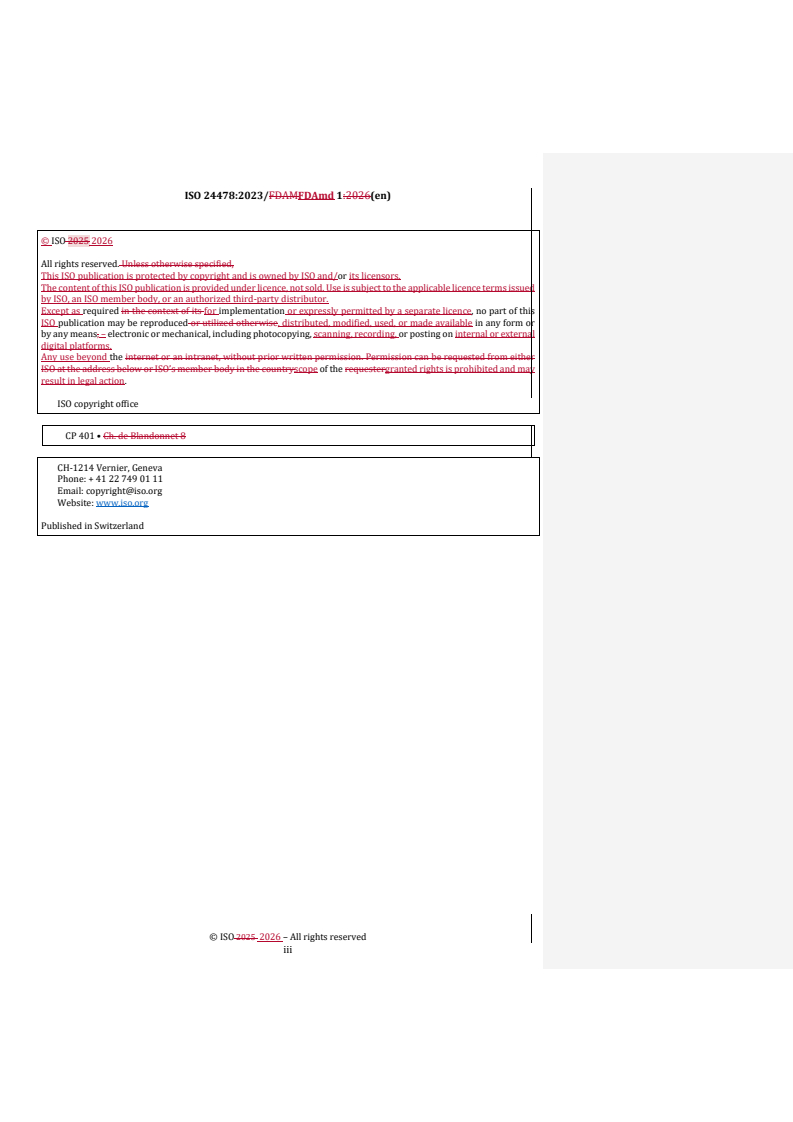
All rights reserved. Unless otherwise specified,
This ISO publication is protected by copyright and is owned by ISO and/or its licensors.
The content of this ISO publication is provided under licence, not sold. Use is subject to the applicable licence terms issued
by ISO, an ISO member body, or an authorized third-party distributor.
Except as required in the context of its for implementation or expressly permitted by a separate licence, no part of this
ISO publication may be reproduced or utilized otherwise, distributed, modified, used, or made available in any form or
by any means, – electronic or mechanical, including photocopying, scanning, recording, or posting on internal or external
digital platforms.
Any use beyond the internet or an intranet, without prior written permission. Permission can be requested from either
ISO at the address below or ISO’s member body in the countryscope of the requestergranted rights is prohibited and may
result in legal action.
ISO copyright office
CP 401 • Ch. de Blandonnet 8
CH-1214 Vernier, Geneva
Phone: + 41 22 749 01 11
Email: copyright@iso.org
Website: www.iso.org
Published in Switzerland
iii
ISO #####-#:####(X 24478:2023/FDAmd 1(en)
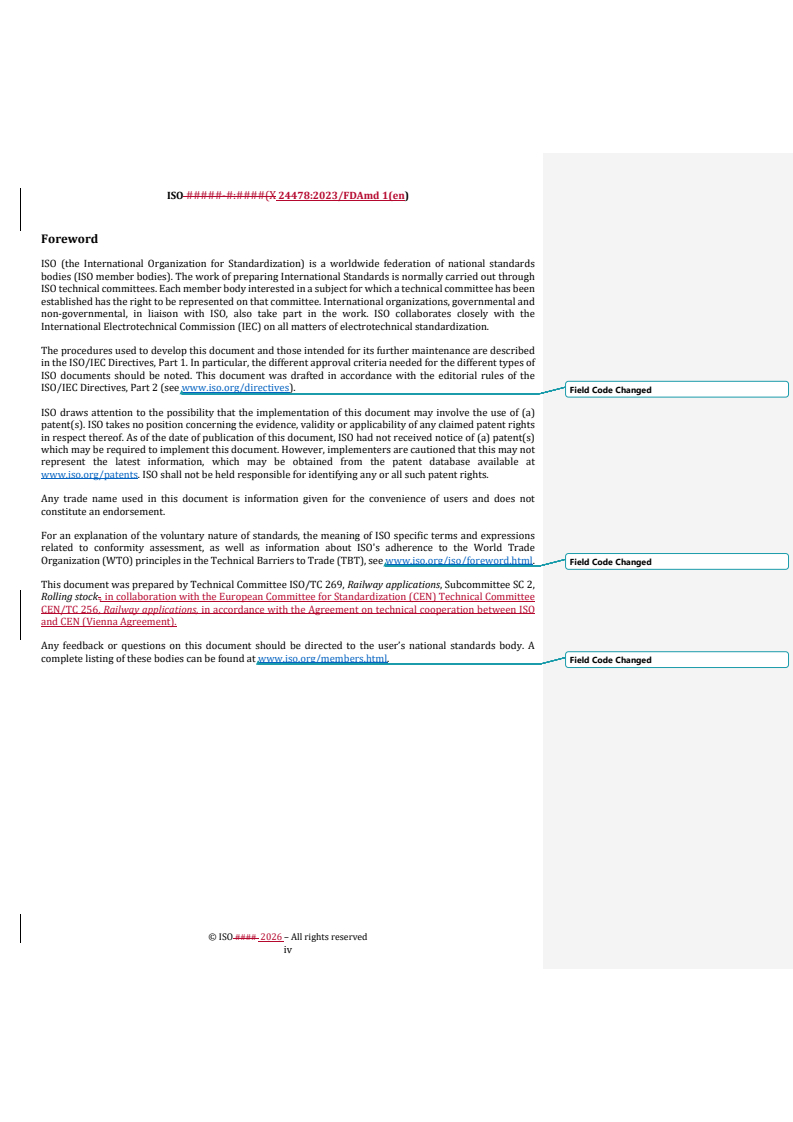
Foreword
ISO (the International Organization for Standardization) is a worldwide federation of national standards
bodies (ISO member bodies). The work of preparing International Standards is normally carried out through
ISO technical committees. Each member body interested in a subject for which a technical committee has been
established has the right to be represented on that committee. International organizations, governmental and
non-governmental, in liaison with ISO, also take part in the work. ISO collaborates closely with the
International Electrotechnical Commission (IEC) on all matters of electrotechnical standardization.
The procedures used to develop this document and those intended for its further maintenance are described
in the ISO/IEC Directives, Part 1. In particular, the different approval criteria needed for the different types of
ISO documents should be noted. This document was drafted in accordance with the editorial rules of the
ISO/IEC Directives, Part 2 (see www.iso.org/directives).
Field Code Changed
ISO draws attention to the possibility that the implementation of this document may involve the use of (a)
patent(s). ISO takes no position concerning the evidence, validity or applicability of any claimed patent rights
in respect thereof. As of the date of publication of this document, ISO had not received notice of (a) patent(s)
which may be required to implement this document. However, implementers are cautioned that this may not
represent the latest information, which may be obtained from the patent database available at
www.iso.org/patents. ISO shall not be held responsible for identifying any or all such patent rights.
Any trade name used in this document is information given for the convenience of users and does not
constitute an endorsement.
For an explanation of the voluntary nature of standards, the meaning of ISO specific terms and expressions
related to conformity assessment, as well as information about ISO's adherence to the World Trade
Organization (WTO) principles in the Technical Barriers to Trade (TBT), see www.iso.org/iso/foreword.html.
Field Code Changed
This document was prepared by Technical Committee ISO/TC 269, Railway applications, Subcommittee SC 2,
Rolling stock., in collaboration with the European Committee for Standardization (CEN) Technical Committee
CEN/TC 256, Railway applications, in accordance with the Agreement on technical cooperation between ISO
and CEN (Vienna Agreement).
Any feedback or questions on this document should be directed to the user’s national standards body. A
complete listing of these bodies can be found at www.iso.org/members.html.
Field Code Changed
© ISO #### 2026 – All rights reserved
iv
ISO 24478:2023/FDAM 1:2026(en)
Railway applications — Braking — General vocabulary
AMENDMENT 1
Introduction, second paragraph
Replace “may” with “can”:” as shown in the following sentence:
“The braking includes all factors that have a bearing on the stopping, slowing or immobilization performance
of the train (e.g. train resistance, gradient) and can involve the conversion and dissipation of braking energy.”
3.1.1
Add “brake application” as an admitted term.
3.1.2
Change “brake system” to the preferred term and “brake” to the admitted term.
Add noteNote 2 to entry as follows:
“Note 2 to entry: One brake demand (3.9.1.1) is managed by only one brake system.”
3.1.3
Change the definition as follows:
“device or assembly of components, that is the origin of the braking force or torque”
Change noteNote 2 to entry as follows:
“Note 2 to entry: For tread brake and disc brake, the brake unit consists of the brake actuator, the friction
material (pads or block) and the surface on which the friction material applies, but the disc or wheel tread is
part of the brake system.”
3.1.43
Add the following new terminological entries after 3.1.4 as follows:
“3.1.4:
main brake system
trainwide continuous brake system which enables emergency brake application (3.8.1), service brake
application (3.8.2) and parking (3.4.7)
Note 1 to entry: The main brake system can also ensure holding function and immobilizing function.”.
3.1.5
Add new 3.1.5 as follows:
“3.1.5
brake subsystem
combination of brake units and their local control devices, usually per type of brake units (e.g. disc brake
subsystem or electrodynamic brake subsystem)”)
3.3.1
Add admitted term “brake performance” as an admitted term and modifychange the definition as follows:
“braking performance
brake performance
“parameters and their values used to quantify braking by brake system(s) as described in applicable braking
standards”
3.5.4
In the definition, replaceReplace “hold” with “keep” in the definition.
3.5.8, 3.5.97
Add the following new terms and definitionsterminological entries after 3.5.7, and renumber the former 3.5.8
and 3.5.9 to 3.5.10 and former 3.5.9 to 3.5.11, respectively:
“3.5.8
maximum braking payload
maximum payload considered for the design of a brake system, which is lower than or equal to exceptional
payload
3.5.9
design mass under maximum braking payload
MXB
sum of the design mass in working order (as defined by ISO 10516) and maximum braking payload (0(3.5.8))
© ISO #### 2026 – All rights reserved
ISO 24478:2023/FDAMFDAmd 1:2026(en)
Note 1 to entry: In some already published documents the “design mass under maximum braking payload” was also
known as “maximum braking load” ([e.g. in Commission Regulation (EU) No 1302/2014).”].
3.6.7
Change the symbol to "s ".
slw
3.6.8
Change the symbol to "s ".
stp
3.6.14
Add "(3.6.12)" after "delay time":" in the definition as follows:
“period of time commencing at the end of the delay time (3.6.12) and ending when achieving an increase from
a % to b % of the established braking parameter”
3.6.15
Replace "delay time" with "release delay time (3.6.13)":)" in the definition as follows:
“period of time commencing at the end of the release delay time (3.6.13) and ending when achieving a decrease
from c % to d % of the established braking parameter”
3.6.16
Change the definition to:
“sum of the delay time (3.6.12) and the build-up time (3.6.14)”
3.6.17
Change the definition to:
“sum of the release delay time (3.6.13) and the release time (3.6.15)”
3.6.20
Change the symbol to "tslw".
3.6.21
Change the symbol to "tstp".
3.6.28
Change the term to “increasing braking deceleration””.
InDelete “variation in” in the definition, delete “variation in”.
3.6.31
Change the definition and Note 1 to entry to:
“assumed acceleration throughout the equivalent response time (3.6.22), when it is assumed that there is no
braking force applied.
Note 1 to entry: equivalentEquivalent free running acceleration can be different from zero due e.g., for
example, to gradient, rolling resistance, etc.”
3.6.32
Change the term to “equivalent braking deceleration””.
Change the definition and Note 1 to entry to:
“assumed constant deceleration throughout the equivalent braking distance (3.6.10)")
Note 1 to entry: equivalentEquivalent braking deceleration can consider external forces, e.g. forces due to
gradient, rolling resistance, etc. The way how to determine the equivalent braking deceleration is described
in the ISO 20138 series.”
3.6.33
Change the term to “decreasing braking deceleration””.
InDelete “variation in” in the definition delete “variation in”.
3.6.34
Change the symbol to “a or ” and add the symbol“a ””.
stp slw
© ISO #### 2026 – All rights reserved
ISO 24478:2023/FDAMFDAmd 1:2026(en)
3.6.40
Replace "brake performance" by "braking performance (3.3.1)")".
3.6.41
Replace "brake performance" by "braking performance (3.3.1)")".
3.7.1
Replace “brake system” with “brake subsystem””.
3.7.2
Replace “brake system” with “brake subsystem””.
3.7.3
Replace “brake system” with “brake subsystem””.
3.7.3.1
Replace “brake system” with “brake subsystem””.
3.7.3.1.1
Change the definition to:
“force applied by the brake block(s) to the running surface of a wheel (tread)”
Add noteNote 2 to entry as follows:
“Note 2 to entry: For the tread brake, the term “single brake block force” is also used to refer to the brake
application force.”
3.7.3.2
Replace “friction brake system” with “friction brake subsystem””.
3.7.3.2.1
ModifyChange Note 1 to entry to:
“"Note 1 to entry: The sum of all brake pad forces for a brake unit is the brake application force (3.7.6).”)."
3.7.3.2.43
Add a new terminological entry after 3.7.3.2.43 as follows:
“3.7.3.2.4
mean swept radius
distance from the centre of the brake disc to the point where the brake pad force can be considered to be
acting
Note 1 to entry: In some published documents, the mean swept radius of the brake pad on the friction face wasis also
known as brake radius.”.
3.7.3.3
Replace “friction brake system” with “friction brake subsystem””.
3.7.4
Change the term “dynamic brake” to “dynamic brake subsys
...
PROJET FINAL
Amendement
ISO 24478:2023/
FDAM 1
ISO/TC 269/SC 2
Applications ferroviaires —
Secrétariat: AFNOR
Freinage — Vocabulaire général
Début de vote:
2026-10-20
AMENDEMENT 1
Vote clos le:
Railway applications — Braking — General vocabulary
2026-12-01
AMENDMENT 1
LES DESTINATAIRES DU PRÉSENT PROJET SONT
INVITÉS À PRÉSENTER, AVEC LEURS OBSERVATIONS,
NOTIFICATION DES DROITS DE PROPRIÉTÉ DONT ILS
AURAIENT ÉVENTUELLEMENT CONNAISSANCE ET À
FOURNIR UNE DOCUMENTATION EXPLICATIVE.
OUTRE LE FAIT D’ÊTRE EXAMINÉS POUR
ÉTABLIR S’ILS SONT ACCEPTABLES À DES FINS
INDUSTRIELLES, TECHNOLOGIQUES ET COM-MERCIALES,
AINSI QUE DU POINT DE VUE DES UTILISATEURS, LES
PROJETS DE NORMES
TRAITEMENT PARALLÈLE ISO/CEN
INTERNATIONALES DOIVENT PARFOIS ÊTRE CONSIDÉRÉS
DU POINT DE VUE DE LEUR POSSI BILITÉ DE DEVENIR DES
NORMES POUVANT
SERVIR DE RÉFÉRENCE DANS LA RÉGLEMENTATION
NATIONALE.
Numéro de référence
ISO 24478:2023/FDAM 1:2026(fr) © ISO 2026
PROJET FINAL
ISO 24478:2023/FDAM 1:2026(fr)
Amendement
ISO 24478:2023/
FDAM 1
ISO/TC 269/SC 2
Applications ferroviaires —
Secrétariat: AFNOR
Freinage — Vocabulaire général
Début de vote:
AMENDEMENT 1 2026-10-20
Vote clos le:
Railway applications — Braking — General vocabulary
2026-12-01
AMENDMENT 1
LES DESTINATAIRES DU PRÉSENT PROJET SONT
INVITÉS À PRÉSENTER, AVEC LEURS OBSERVATIONS,
NOTIFICATION DES DROITS DE PROPRIÉTÉ DONT ILS
AURAIENT ÉVENTUELLEMENT CONNAISSANCE ET À
FOURNIR UNE DOCUMENTATION EXPLICATIVE.
DOCUMENT PROTÉGÉ PAR COPYRIGHT
OUTRE LE FAIT D’ÊTRE EXAMINÉS POUR
ÉTABLIR S’ILS SONT ACCEPTABLES À DES FINS
© ISO 2026 INDUSTRIELLES, TECHNOLOGIQUES ET COM-MERCIALES,
AINSI QUE DU POINT DE VUE DES UTILISATEURS, LES
Tous droits réservés. Sauf prescription différente ou nécessité dans le contexte de sa mise en œuvre, aucune partie de cette
PROJETS DE NORMES
TRAITEMENT PARALLÈLE ISO/CEN
INTERNATIONALES DOIVENT PARFOIS ÊTRE CONSIDÉRÉS
publication ne peut être reproduite ni utilisée sous quelque forme que ce soit et par aucun procédé, électronique ou mécanique,
DU POINT DE VUE DE LEUR POSSI BILITÉ DE DEVENIR DES
y compris la photocopie, ou la diffusion sur l’internet ou sur un intranet, sans autorisation écrite préalable. Une autorisation peut
NORMES POUVANT
être demandée à l’ISO à l’adresse ci-après ou au comité membre de l’ISO dans le pays du demandeur.
SERVIR DE RÉFÉRENCE DANS LA RÉGLEMENTATION
NATIONALE.
ISO copyright office
Case postale 401 • Ch. de Blandonnet 8
CH-1214 Vernier, Genève
Tél.: +41 22 749 01 11
E-mail: copyright@iso.org
Web: www.iso.org
Publié en Suisse Numéro de référence
ISO 24478:2023/FDAM 1:2026(fr) © ISO 2026
ii
ISO 24478:2023/FDAM 1:2026(fr)
Avant-propos
L’ISO (Organisation internationale de normalisation) est une fédération mondiale d’organismes nationaux
de normalisation (comités membres de l’ISO). L’élaboration des Normes internationales est en général
confiée aux comités techniques de l’ISO. Chaque comité membre intéressé par une étude a le droit de faire
partie du comité technique créé à cet effet. Les organisations internationales, gouvernementales et non
gouvernementales, en liaison avec l’ISO participent également aux travaux. L’ISO collabore étroitement avec
la Commission électrotechnique internationale (IEC) en ce qui concerne la normalisation électrotechnique.
Les procédures utilisées pour élaborer le présent document et celles destinées à sa mise à jour sont
décrites dans les Directives ISO/IEC, Partie 1. Il convient en particulier de prendre note des différents
critères d’approbation requis pour les différents types de documents ISO. Le présent document
a été rédigé conformément aux règles de rédaction données dans les Directives ISO/IEC, Partie 2
(voir www.iso.org/directives).
L’ISO attire l’attention sur le fait que la mise en application du présent document peut entraîner l’utilisation
d’un ou de plusieurs brevets. L’ISO ne prend pas position quant à la preuve, à la validité et à l’applicabilité
de tout droit de brevet revendiqué à cet égard. À la date de publication du présent document, l’ISO n’avait
pas reçu notification qu’un ou plusieurs brevets pouvaient être nécessaires à sa mise en application.
Toutefois, il y a lieu d’avertir les responsables de la mise en application du présent document que des
informations plus récentes sont susceptibles de figurer dans la base de données de brevets, disponible à
l’adresse www.iso.org/patents. L’ISO ne saurait être tenue pour responsable de ne pas avoir identifié tout ou
partie de tels droits de propriété.
Les appellations commerciales éventuellement mentionnées dans le présent document sont données pour
information, par souci de commodité, à l’intention des utilisateurs et ne sauraient constituer un engagement.
Pour une explication de la nature volontaire des normes, la signification des termes et expressions
spécifiques de l’ISO liés à l’évaluation de la conformité, ou pour toute information au sujet de l’adhésion de
l’ISO aux principes de l’Organisation mondiale du commerce (OMC) concernant les obstacles techniques au
commerce (OTC), voir le lien suivant: www.iso.org/iso/foreword.html.
Le présent document a été élaboré par le Comité Technique ISO/TC 269, Applications ferroviaires, sous-
comité SC 2, Matériel roulant, en collaboration avec le Comité technique CEN/TC 256 Applications ferroviaires
du Comité européen de normalisation (CEN), conformément à l’Accord de coopération technique entre l’ISO
et le CEN (Accord de Vienne).
Il convient que l’utilisateur adresse tout retour d’information ou toute question concernant le présent
document à l’organisme national de normalisation de son pays. Une liste exhaustive desdits organismes se
trouve à l’adresse www.iso.org/fr/members.html.
iii
ISO 24478:2023/FDAM 1:2026(fr)
Applications ferroviaires — Freinage — Vocabulaire général
AMENDEMENT 1
Introduction, deuxième alinéa
Remplacer “may” par “can” (valable uniquement pour la version anglaise).
3.1.1
Ajouter «serrage de frein» en tant que terme admis.
3.1.2
Indiquer «système de freinage» comme terme préférentiel et «frein» comme terme admis.
Ajouter la Note 2 à l’article suivante:
«Note 2 à l’article: Une consigne de freinage (3.9.1.1) est gérée par un seul système de freinage.»
3.1.3
Modifier la définition comme suit:
«dispositif ou assemblage de composants qui est à l’origine d’un effort ou couple de freinage»
Modifier la Note 2 à l’article comme suit:
«Note 2 à l’article: Pour les freins à semelle et les freins à disque, l’unité de frein se compose de l’actionneur
de frein, du matériau de friction (garnitures de frein ou semelle) et de la surface sur laquelle le matériau de
friction s’applique, alors que le disque ou la table de roulement de la roue font partie du système de freinage.»
3.1.3
Ajouter les nouvelles entrées terminologiques suivantes après 3.1.3:
3.1.4
système de freinage principal
système de freinage continu au niveau train, qui permet le freinage d’urgence (3.8.1), le freinage de service
(3.8.2) et le stationnement (3.4.7)
Note 1 à l'article: Le système de freinage principal peut également assurer la fonction de maintien et la fonction
d’immobilisation.
ISO 24478:2023/FDAM 1:2026(fr)
3.1.5
sous-système de freinage
combinaison d’unités de freinage et de leurs dispositifs de commande locaux, généralement par type d’unités
de freinage (par exemple, sous-système de freinage à disque ou sous-système de freinage électrodynamique)
3.3.1
Ajouter “brake performance” comme terme admis (valable uniquement pour la version anglaise) et modifier
la définition comme suit:
«paramètres et leurs valeurs utilisés pour quantifier le freinage par le(s) système(s) de freinage tel que
décrit dans les normes applicables relatives au freinage»
3.5.4
Dans la définition, remplacer “hold” par “keep” (valable uniquement pour la version anglaise).
3.5.7
Ajouter les nouvelles entrées terminologiques suivantes après 3.5.7 et renuméroter les anciennes 3.5.8 et
3.5.9 en 3.5.10 et 3.5.11 respectivement:
3.5.8
charge maximale de freinage
charge utile maximale prise en compte pour la conception d’un système de freinage, inférieure ou égale à la
charge utile exceptionnelle
3.5.9
masse de conception en charge maximale de freinage
MXB
somme de la masse de conception en ordre de marche (telle que définie par l’ISO 10516) et de la charge
maximale de freinage (3.5.8)
Note 1 à l'article: Dans certaines publications, la «masse de conception en charge maximale de freinage» était
également connue sous le nom de «puissance maximale de freinage» [par exemple, dans le règlement de la Commission
(UE) n° 1302/2014].
3.6.7
Remplacer le symbole par «s ».
slw
3.6.8
Remplacer le symbole par «s ».
stp
3.6.14
Dans la définition, ajouter «(3.6.12)» après «temps mort», comme suit:
«période commençant à la fin du temps mort (3.6.12) et se terminant lorsque l’augmentation de a % à b % du
paramètre de freinage établi est atteinte»
ISO 24478:2023/FDAM 1:2026(fr)
3.6.15
Dans la définition, remplacer «temps mort» avec «temps mort au desserrage (3.6.13)», comme suit:
«période commençant à la fin du temps mort au desserrage (3.6.13) et se terminant lorsque la diminution de
c % à d % du paramètre de freinage établi est atteinte»
3.6.16
Remplacer la définition par:
«somme du temps mort (3.6.12) et du temps de serrage (3.6.14)»
3.6.17
Remplacer la définition par:
«somme du temps mort au desserrage (3.6.13) et du temps de desserrage (3.6.15)»
3.6.20
Remplacer le symbole par «t ».
slw
3.6.21
Remplacer le symbole par «t ».
stp
3.6.28
Remplacer le terme par “increasing braking deceleration” (valable uniquement pour la version anglaise).
Dans la définition, supprimer «variation de la».
3.6.31
Modifier la définition et la Note 1 à l’article comme suit:
«accélération présupposée tout au long du temps de réponse équivalent (3.6.22), lorsqu’on présuppose
qu’aucun effort de freinage n’est appliqué.
Note 1 à l’article L’accélération équivalente en marche sur l’erre peut être différente de zéro en raison de déclivité ou
de résistance au roulement, par exemple.»
3.6.32
Remplacer le terme par “equivalent braking deceleration” (valable uniquement pour la version anglaise).
Modifier la définition et la Note 1 à l’article comme suit:
ISO 24478:2023/FDAM 1:2026(fr)
«décélération constante présupposée tout au long de la distance équivalente de freinage (3.6.10)
Note 1 à l’article La décélération équivalente de freinage peut tenir compte des efforts externes, par exemple, les efforts
dus à la déclivité, à la résistance au roulement. La manière de déterminer la décélération équivalente de freinage est
décrite dans la série ISO 20138.»
3.6.33
Remplacer le terme par “decreasing braking deceleration” (valable uniquement pour la version anglaise).
Dans la définition, supprimer «variation de la».
3.6.34
Remplacer le symbole par «a » et ajouter le symbole «a ».
stp slw
3.6.40
Remplacer «performance de freinage» par «performance de freinage (3.3.1)».
3.6.41
Remplacer «performance de freinage» par «performance de freinage (3.3.1)».
3.7.1
Remplacer «système de freinage» par «sous-système de freinage».
3.7.2
Remplacer «système de freinage» par «sous-système de freinage».
3.7.3
Remplacer «système de freinage» par «sous-système de freinage».
3.7.3.1
Remplacer «système de freinage» par «sous-système de freinage».
3.7.3.1.1
Remplacer la définition par:
«effort appliqué par la (les) semelle(s) de frein sur la table de roulement de la roue»
ISO 24478:2023/FDAM 1:2026(fr)
Ajouter la Note 2 à l’article suivante:
«Note 2 à l’article: Pour les freins à semelle, le terme «effort d’application à la semelle» est également utilisé
pour se référer à l’effort d’application du frein.»
3.7.3.2
Remplacer «système de freinage à friction» par «sous-système de freinage à friction».
3.7.3.2.1
Remplacer la Note 1 à l’article par la suivante:
«Note 1 à l’article: La somme de tous les efforts à la garniture de frein pour une unité de frein est l’effort
d’application du frein (3.7.6).»
3.7.3.2.3
Ajouter la nouvelle entrée terminologique suivante après 3.7.3.2.3:
3.7.3.2.4
rayon de freinage moyen
distance entre le centre du disque de frein et le point où l’effort d’application de la garniture de frein peut
être considérée comme actif
Note 1 à l'article: Dans certaines publications, le rayon de freinage moyen de la garniture de f
...