

ISO/TR 13329:2012
(Main)Nanomaterials — Preparation of material safety data sheet (MSDS)
General Information
- Abstract
ISO/TR 13329:2012 provides guidance on the development of content for, and consistency in, the communication of information on safety, health and environmental matters in safety data sheets (SDS) for substances classified as manufactured nanomaterials and for chemical products containing manufactured nanomaterials. It provides supplemental guidance to ISO 11014:2009 on the preparation of SDSs generally, addressing the preparation of an SDS for both manufactured nanomaterials with materials and mixtures containing manufactured nanomaterials.
- Status
- Withdrawn
- Publication Date
- 09-Dec-2012
- Technical Committee
- ISO/TC 229 - Nanotechnologies
- Drafting Committee
- ISO/TC 229 - Nanotechnologies
- Current Stage
- 9599 - Withdrawal of International Standard
- Start Date
- 25-Sep-2024
- Completion Date
- 29-Aug-2026
Buy Documents

ISO/TR 13329:2012 - Nanomaterials — Preparation of material safety data sheet (MSDS) Released:12/10/2012

ISO/TR 13329:2012 - Nanomatériaux — Préparation des feuilles de données de sécurité des matériaux (MSDS) Released:12/10/2012

ISO/TR 13329:2012 - Nanomaterials — Preparation of material safety data sheet (MSDS) Released:1/12/2015
Overview
ISO/TR 13329:2012 - Nanomaterials: Preparation of Material Safety Data Sheet (MSDS/SDS) is an ISO Technical Report that gives practical guidance for preparing consistent, usable safety data sheets (SDS) for manufactured nanomaterials and products that contain them. It is supplemental to ISO 11014:2009 and aligned with the UN Globally Harmonized System (GHS) for hazard communication. The report is informative (technical report), not a regulatory requirement, and emphasizes a precautionary approach when hazard data are limited.
Key topics and technical requirements
- Scope and purpose: Guidance on SDS content and consistent communication of safety, health and environmental information for nanomaterials and nanomaterial-containing mixtures.
- Alignment with existing systems: Supplements ISO 11014:2009 and considers GHS (2011) hazard communication requirements.
- Terms and definitions: Standardized nano terminology (nanomaterial, nanoparticle, agglomerate, aggregate, nanofibre, nanoscale, etc.) based on ISO/TS 27687 and ISO/TS 80004-1.
- SDS content & layout: Recommendations on how SDS sections should reflect properties and hazards specific to nanomaterials (clarity, conciseness, competent authorship).
- Precautionary recommendations: Advises preparing an SDS for manufactured nanomaterials even when bulk material is non‑hazardous, unless testing demonstrates non‑hazard or release of nano‑objects/agglomerates/aggregates is not expected.
- Cut-off values / concentration limits: Addresses when nanomaterial concentrations may be considered below reporting or hazard cut-off thresholds (document provides guidance; specific numeric cut-offs are determined in context or by competent authorities).
- Measurement and characterization: Informative Annex A points to example measurement methods and standards (see ISO/TR 13014) to support hazard assessment and SDS entries.
Practical applications - who uses this standard
- Manufacturers and formulators preparing SDSs for nanoscale substances or products.
- SDS writers and EHS professionals ensuring hazard communication is consistent and nano‑specific.
- Regulatory affairs teams and compliance officers integrating GHS and national SDS requirements with nano considerations.
- Occupational health/safety managers and downstream users who rely on SDSs to assess workplace controls, exposure prevention, and emergency response.
- Laboratories and test houses using referenced measurement methods to generate characterization data for SDS content.
Related standards and references
- ISO 11014:2009 - Safety data sheet (general SDS preparation)
- ISO/TS 27687:2008 - Nano terminology (nanoparticle, nanofibre, nanoplate)
- ISO/TS 80004-1:2010 - Nanotechnologies vocabulary
- GHS (UN) - Globally Harmonized System for classification and labelling of chemicals
- ISO/TR 13014 - Example measurement methods and standards for nanomaterials
Using ISO/TR 13329:2012 helps organizations provide clearer, more consistent SDSs for nanomaterials, improving hazard communication, workplace safety, and regulatory alignment in the evolving field of nanotechnology.
Relations
- Effective Date
- 06-Jun-2022
Buy Documents
ISO/TR 13329:2012 - Nanomaterials — Preparation of material safety data sheet (MSDS) Released:12/10/2012
ISO/TR 13329:2012 - Nanomatériaux — Préparation des feuilles de données de sécurité des matériaux (MSDS) Released:12/10/2012
ISO/TR 13329:2012 - Nanomaterials — Preparation of material safety data sheet (MSDS) Released:1/12/2015
Get Certified
Connect with accredited certification bodies for this standard

BSI Group
BSI (British Standards Institution) is the business standards company that helps organizations make excellence a habit.

Bureau Veritas
Bureau Veritas is a world leader in laboratory testing, inspection and certification services.

DNV
DNV is an independent assurance and risk management provider.
Sponsored listings
Frequently Asked Questions
ISO/TR 13329:2012 is a technical report published by the International Organization for Standardization (ISO). Its full title is "Nanomaterials — Preparation of material safety data sheet (MSDS)". This standard covers: ISO/TR 13329:2012 provides guidance on the development of content for, and consistency in, the communication of information on safety, health and environmental matters in safety data sheets (SDS) for substances classified as manufactured nanomaterials and for chemical products containing manufactured nanomaterials. It provides supplemental guidance to ISO 11014:2009 on the preparation of SDSs generally, addressing the preparation of an SDS for both manufactured nanomaterials with materials and mixtures containing manufactured nanomaterials.
ISO/TR 13329:2012 provides guidance on the development of content for, and consistency in, the communication of information on safety, health and environmental matters in safety data sheets (SDS) for substances classified as manufactured nanomaterials and for chemical products containing manufactured nanomaterials. It provides supplemental guidance to ISO 11014:2009 on the preparation of SDSs generally, addressing the preparation of an SDS for both manufactured nanomaterials with materials and mixtures containing manufactured nanomaterials.
ISO/TR 13329:2012 is classified under the following ICS (International Classification for Standards) categories: 07.030 - Physics. Chemistry; 07.120 - Nanotechnologies; 13.100 - Occupational safety. Industrial hygiene. The ICS classification helps identify the subject area and facilitates finding related standards.
ISO/TR 13329:2012 has the following relationships with other standards: It is inter standard links to ISO/TS 13329:2024. Understanding these relationships helps ensure you are using the most current and applicable version of the standard.
ISO/TR 13329:2012 is available in PDF format for immediate download after purchase. The document can be added to your cart and obtained through the secure checkout process. Digital delivery ensures instant access to the complete standard document.
Standards Content (Sample)
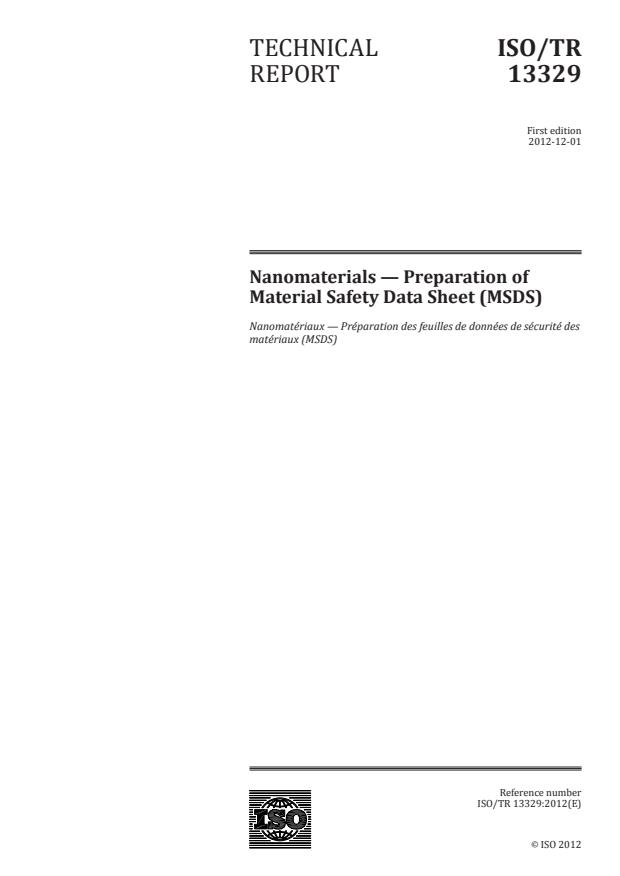
TECHNICAL ISO/TR
REPORT 13329
First edition
2012-12-01
Nanomaterials — Preparation of
Material Safety Data Sheet (MSDS)
Nanomatériaux — Préparation des feuilles de données de sécurité des
matériaux (MSDS)
Reference number
©
ISO 2012
© ISO 2012
All rights reserved. Unless otherwise specified, no part of this publication may be reproduced or utilized in any form or by any
means, electronic or mechanical, including photocopying and microfilm, without permission in writing from either ISO at the
address below or ISO’s member body in the country of the requester.
ISO copyright office
Case postale 56 • CH-1211 Geneva 20
Tel. + 41 22 749 01 11
Fax + 41 22 749 09 47
E-mail copyright@iso.org
Web www.iso.org
Published in Switzerland
ii © ISO 2012 – All rights reserved
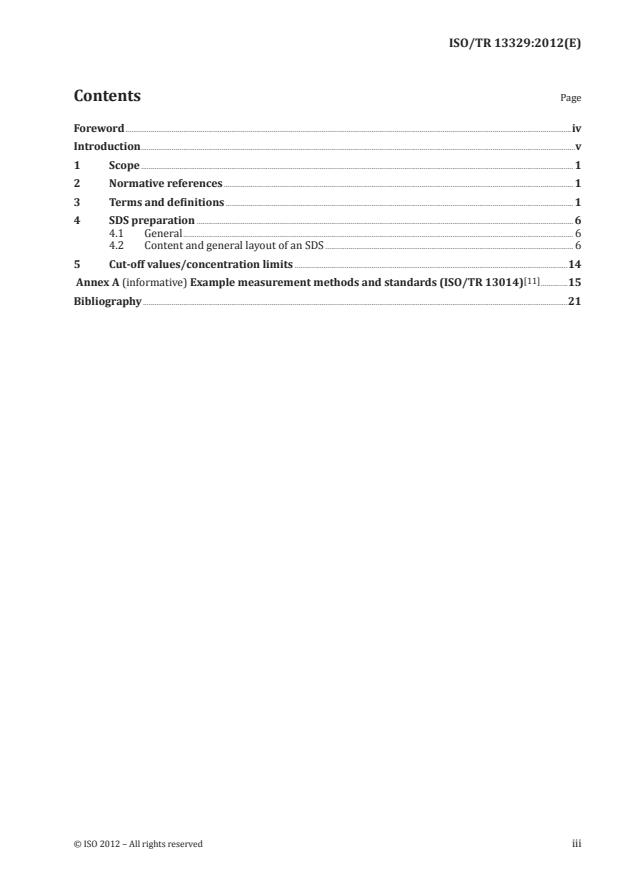
Contents Page
Foreword .iv
Introduction .v
1 Scope . 1
2 Normative references . 1
3 Terms and definitions . 1
4 SDS preparation . 6
4.1 General . 6
4.2 Content and general layout of an SDS . 6
5 Cut-off values/concentration limits .14
[11]
Annex A (informative) Example measurement methods and standards (ISO/TR 13014) .15
Bibliography .21
Foreword
ISO (the International Organization for Standardization) is a worldwide federation of national standards
bodies (ISO member bodies). The work of preparing International Standards is normally carried out
through ISO technical committees. Each member body interested in a subject for which a technical
committee has been established has the right to be represented on that committee. International
organizations, governmental and non-governmental, in liaison with ISO, also take part in the work.
ISO collaborates closely with the International Electrotechnical Commission (IEC) on all matters of
electrotechnical standardization.
International Standards are drafted in accordance with the rules given in the ISO/IEC Directives, Part 2.
The main task of technical committees is to prepare International Standards. Draft International
Standards adopted by the technical committees are circulated to the member bodies for voting.
Publication as an International Standard requires approval by at least 75 % of the member bodies
casting a vote.
In exceptional circumstances, when a technical committee has collected data of a different kind from
that which is normally published as an International Standard (“state of the art”, for example), it may
decide by a simple majority vote of its participating members to publish a Technical Report. A Technical
Report is entirely informative in nature and does not have to be reviewed until the data it provides are
considered to be no longer valid or useful.
Attention is drawn to the possibility that some of the elements of this document may be the subject of
patent rights. ISO shall not be held responsible for identifying any or all such patent rights.
ISO/TR 13329 was prepared by Technical Committee ISO/TC 229, Nanotechnologies.
iv © ISO 2012 – All rights reserved
Introduction
This Technical Report provides guidance on the development of safety data sheets (SDSs) for manufactured
nanomaterials (and materials or products that contain manufactured nanomaterials), and provides
additional information on safety issues associated with manufactured nanomaterials. It is not a stand-
[1]
alone document and should be used in conjunction with ISO 11014:2009 . This Technical Report takes
into account the Globally harmonized system of classification and labelling of chemicals (GHS) document on
hazard communication: safety data sheets. The GHS was developed by the United Nations and is being
incorporated into the laws of various regions and nations, many of which already have laws that govern
the preparation of SDSs. However, implementing the guidance provided in this Technical Report is not a
substitute for complying with the law. Organizations should consult with relevant national authorities
to address questions about interpreting or complying with national law.
Currently, there is limited information on the hazards of most nanomaterials. In many cases the
degree of risk to workers or others who might be exposed to nanomaterials is partly unknown as the
toxicological effects of nanomaterials are not yet well known and exposure is difficult to measure.
Most hazard information and communication systems require preparation of an SDS for hazardous
chemicals, including those containing nanomaterials, for use in manufacture, storage, transport or other
occupational handling activities. Yet, only a few SDSs contain specific information about nanomaterials
or are specific to nanomaterials. Those that exist generally provide insufficient hazard information
(see Reference [2]). There is evidence that some nanomaterials might be more hazardous, e.g. more
bio-reactive or active, leading to higher toxicity, than the same material in bulk (non-nanoscale) form.
Characteristics predictive of potential safety or toxicity for manufactured nanomaterials need to be
determined and included in the preparation of an SDS. Although, currently, no competent authority has
a legal requirement to demand an SDS for a nanomaterial that is not already classified as a hazardous
chemical, it is good practice to do so since an SDS is a well-accepted and effective method for the provision
of workplace health and safety information.
This Technical Report considers the precautionary approach in terms of toxicity and other risks
associated with nanomaterials and thus recommends providing an SDS for nanomaterials and
nanomaterial-containing products regardless of whether or not the material is classified as hazardous,
unless there is existing data for the nanomaterial which demonstrates that it is non-hazardous, or if it is
not envisaged that they can be released as nano-objects, or their agglomerates and aggregates greater
than 100 nm (NOAA), during handling or use.
TECHNICAL REPORT ISO/TR 13329:2012(E)
Nanomaterials — Preparation of Material Safety Data
Sheet (MSDS)
1 Scope
This Technical Report provides guidance on the development of content for, and consistency in, the
communication of information on safety, health and environmental matters in safety data sheets
(SDS) for substances classified as manufactured nanomaterials and for chemical products containing
[1]
manufactured nanomaterials. It provides supplemental guidance to ISO 11014:2009 on the preparation
of SDSs generally, addressing the preparation of an SDS for both manufactured nanomaterials with
materials and mixtures containing manufactured nanomaterials.
2 Normative references
The following referenced documents are indispensable for the application of this document. For dated
references, only the edition cited applies. For undated references, the latest edition of the referenced
document (including any amendments) applies.
ISO/TS 27687:2008, Nanotechnologies — Terminology and definitions for nano-objects: Nanoparticle,
nanofibre and nanoplate
ISO/TS 80004-1:2010, Nanotechnologies — Vocabulary — Part 1: Core terms
Globally harmonized system of classification and labelling of chemicals (GHS). United Nations Economic
Commission for Europe, Fourth Edition, 2011
3 Terms and definitions
For the purposes of this document, the terms and definitions given in ISO/TS 27687:2008,
ISO 80004-1:2010, GHS:2011 and the following apply.
3.1
agglomerate
collection of weakly bound particles or aggregates or mixtures of the two where the resulting external
surface area is similar to the sum of the surface areas of the individual components
[ISO/TS 27687:2008, definition 3.2]
Note 1 to entry: The forces holding an agglomerate together are weak forces, for example van der Waals forces, or
simple physical entanglement.
Note 2 to entry: Agglomerates are also termed secondary particles and the original source particles are termed
primary particles.
3.2
aggregate
particle comprising strongly bonded or fused particles where the resulting external surface area may be
significantly smaller than the sum of calculated surface areas of the individual components
[ISO/TS 27687:2008, definition 3.3]
Note 1 to entry: The forces holding an aggregate together are strong forces, for example covalent bonds, or those
resulting from sintering or complex physical entanglement.
Note 2 to entry: Aggregates are also termed secondary particles and the original source particles are termed
primary particles.
3.3
bioaccumulation
process of accumulation of a substance in organisms or parts thereof
[ISO 6107-6:2004, definition 10]
3.4
biodegradation
degradation due to the biological environment
[ISO 10993-9:2009, definition 3.2]
Note 1 to entry: Biodegradation might be modelled by in vitro tests.
3.5
biodurability
physicochemical property which depends on dissolution and leaching as well as mechanical breaking
and splitting of a material in a physiological solution such as a Gamble solution
Note 1 to entry: The biodurability test is usually performed in vitro.
3.6
biopersistence
ability of a material to persist in a tissue in spite of the tissue’s physiological clearance mechanisms and
environmental conditions
[EU R 18748:1999]
3.7
chemical product
substance or mixture
[ISO 11014:2009, definition 3.1]
3.8
crystallinity
presence of three-dimensional order at the level of molecular dimensions
[ISO 472:1999]
3.9
dispersibility
level of dispersion when it has become constant under the defined conditions
Note 1 to entry: Dispersion is defined as a suspension of discrete particles.
Note 2 to entry: Adapted from ISO 8780-1 and ISO 1213-1.
3.10
dustiness
propensity of a material to generate airborne dust during their handling
[EN 15051:2006]
3.11
engineered nanomaterial
nanomaterial designed for a specific purpose or function
[ISO/TS 80004-1:2010, definition 2.8]
2 © ISO 2012 – All rights reserved
3.12
hazard category
division of criteria within each hazard class as used in GHS
[GHS:2011]
3.13
hazard class
nature of the physical, health or environmental hazard as used in GHS
[GHS:2011]
3.14
hazard statement
statement assigned to a hazard class and category as used in GHS that describes the nature of the hazards
of a hazardous substance or mixture, including, where appropriate, the degree of hazard
[ISO 11014:2009, definition 3.6]
3.15
incidental nanomaterial
nanomaterial generated as an unintentional by-product of a process
[ISO/TS 80004-1:2010, definition 2.10]
Note 1 to entry: The process includes manufacturing, bio-technological or other processes.
[10]
Note 2 to entry: See ISO/TR 27628:2007 , definition 2.21, for definition of “ultrafine particle”.
3.16
manufactured nanomaterial
nanomaterial intentionally produced for commercial purposes to have specific properties or specific
composition
[ISO/TS 80004-1, definition 2.9]
3.17
mixture
mixture or solution composed of two or more substances in which they do not react
[GHS:2011]
3.18
nanoaerosol
aerosol comprised of, or consisting of, nanoparticles and nanostructured particles
[ISO/TR 27628:2007, definition 2.11]
Note 1 to entry: Nanostructured particles mean particles having a composition of inter-related parts, in which
one or more of those parts is a nanoscale region.
3.19
nanofibre
nano-object with two similar external dimensions in the nanoscale and the third dimension
significantly larger
[ISO/TS 27687:2008, definition 4.3]
Note 1 to entry: A nanofibre can be flexible or rigid.
Note 2 to entry: The two similar external dimensions are considered to differ in size by less than three times and
the significantly larger external dimension is considered to differ from the other two by more than three times.
Note 3 to entry: The largest external dimension is not necessarily in the nanoscale.
3.20
nanomaterial
material with any external dimension in the nanoscale or having internal structure or surface structure
in the nanoscale
[ISO/TS 80004-1:2010, definition 2.4]
Note 1 to entry: This generic term is inclusive of nano-object and nanostructured material.
Note 2 to entry: See also engineered nanomaterial, manufactured nanomaterial and incidental nanomaterial.
3.21
nano-object
material with one, two or three external dimensions in the nanoscale
[ISO/TS 27687:2008, definition 2.2; ISO/TS 80004-1:2010, definition 2.5]
Note 1 to entry: Generic term for all discrete nanoscale objects.
3.22
nanoparticle
nano-object with all three external dimensions in the nanoscale
[ISO/TS 27687:2008, definition 4.1]
Note 1 to entry: If the lengths of the longest to the shortest axes of the nano-object differ significantly (typically by
more than three times), the terms nanofibre or nanoplate are intended to be used instead of the term nanoparticle.
3.23
nanoplate
nano-object with one external dimension in the nanoscale and the two other external dimensions
significantly larger
[ISO/TS 27687:2008, definition 4.2]
Note 1 to entry: The smallest external dimension is the thickness of the nanoplate.
Note 2 to entry: The two significantly larger dimensions are considered to differ from the nanoscale dimension
by more than three times.
Note 3 to entry: The larger external dimensions are not necessarily in the nanoscale.
3.24
nanoscale
size range from approximately 1 nm to 100 nm
[ISO/TS 80004-1:2010, definition 2.1; ISO/TS 27687: 2008, definition 2.1]
Note 1 to entry: Properties that are not extrapolations from a larger size will typically, but not exclusively, be
exhibited in this size range. For such properties the size limits are considered approximate.
Note 2 to entry: The lower limit in this definition (approximately 1 nm) is introduced to avoid single and small
groups of atoms from being designated as nano-objects or elements of nanostructures, which might be implied by
the absence of a lower limit.
3.25
nanostructure
composition of inter-related constituent parts, in which one or more of those parts is a nanoscale region
[ISO/TS 80004-1, definition 2.6]
Note 1 to entry: A region is defined by a boundary representing a discontinuity in properties.
4 © ISO 2012 – All rights reserved
3.26
nanostructured material
material having internal nanostructure or surface nanostructure
[ISO/TS 80004-1:2010, definition 2.7]
Note 1 to entry: This definition does not exclude the possibility for a nano-object to have internal structure or
surface structure. If external dimension(s) are in the nanoscale, the term nano-object is recommended.
3.27
nanostructured particle
particle with structural features smaller than 100 nm, which may influence its physical, chemical and/or
biological properties
[ISO/TR 27628:2007, definition 2.13]
Note 1 to entry: A nanostructured particle may have a maximum dimension substantially larger than 100 nm.
EXAMPLE A 500 nm diameter agglomerate of nanoparticles would be considered a nanostructured particle.
3.28
particle
minute piece of matter with defined physical boundaries
[ISO/TS 27687:2008, definition 3.1, ISO/TR 27628:2007, definition 2.13]
Note 1 to entry: A physical boundary can also be described as an interface.
Note 2 to entry: A particle can move as a unit.
Note 3 to entry: This general particle definition applies to nano-objects.
3.29
safety data sheet
SDS
document that provides information on the properties of hazardous chemicals, how they affect health
and safety in the workplace and how to manage the hazardous chemicals in the workplace
[Safe Work Australia]
3.30
substance
chemical elements and their compounds in the natural state or obtained by any production process,
including any additive necessary to preserve the stability of the product and any impurities deriving
from the process used, but excluding any solvent which may be separated without affecting the stability
of the substance or changing its composition
[GHS:2011]
3.31
surface area
area of external surface plus the internal surface of its accessible macro- and mesopore
[ISO/TR 13014:2012, definition 2.28]
Note 1 to entry: Includes mass-specific surface area or volume-specific surface area.
4 SDS preparation
4.1 General
4.1.1 It is advised to prepare an SDS for all manufactured nanomaterials, regardless of whether or not
the bulk (non-nanoscale) material is classified as hazardous, except when
— testing or assessment results that meet requirements of competent authorities, or are based upon
national or international standards, or generally accepted scientific practices, have indicated they
are non-hazardous, or when
— it is not envisaged that manufactured nanomaterials can be released as nano-objects or
agglomerates/aggregates (NOAAs) under reasonably anticipated conditions of use to be exposed to
humans, and the matrix (including the manufactured nanomaterial) does not exhibit a hazard, or when
— the hazard class of manufactured nanomaterials is known and the manufactured nanomaterials are
present in concentrations lower than the cut-off levels identified in 5.1.
4.1.2 The information in the SDS should be written in a clear and concise manner. The SDS should
be prepared by one or more competent persons who should take into account the specific needs of the
intended audience, as far as they are known. The SDS should provide comprehensive information and/or
conclusions about the data that are evaluated, making it easy for any reader to identify all of the hazards,
including those associated with the material’s nanostructure. In addition to the minimum information
requirements, the SDS should contain available information relevant to the safe use of the material.
[1]
4.1.3 The format of the SDS should conform to ISO 11014 .
NOTE The format of the SDS may also be subject to applicable legal requirements.
4.1.4 If relevant information for any of the required 16 SDS sections cannot be found, this fact should
be indicated on the SDS in the appropriate section using phrases such as “not available”. The SDS should
have no blanks under any of the headings.
4.1.5 Separate SDSs should be provided for different forms of the same chemical if they pose
different hazards.
4.1.6 The preparation of an SDS may involve confidential business information about the ingredients or
characteristics of the manufactured nanomaterials (or preparations containing them) that are the subject
of the SDS. The legal requirements regarding confidential business information established by competent
authorities in the markets in which the SDS will be used must be followed. When information that might
be relevant to the SDS is not disclosed for reasons of confidentiality, alternative methods should be
considered to provide users with relevant information (for example providing information using generic
terminology, providing ranges for concentrations, or providing points of contact with which users can
communicate to obtain more detailed information).
4.2 Content and general layout of an SDS
4.2.1 Chemical product and company identification
Due to the rapidly changing state of knowledge in the area of nanomaterial safety, the date the SDS was
prepared and the identity of the organization that prepared the SDS should be included. The SDS should
include a revision number and the superseding date or other indications of what version has been replaced.
6 © ISO 2012 – All rights reserved
4.2.2 Hazard identification
The SDS should describe all of the hazards associated with the manufactured nanomaterial or mixture
for which the SDS is being prepared. It is recommended that GHS hazard statements be used to describe
hazards. Vague and potentially misleading descriptions such as “may be dangerous”, “no health effects”,
“safe under most conditions of use” or “harmless” should not be used. If the manufactured nanomaterial
or mixture is classified according to GHS, the specific hazard and category should be identified. Also,
hazards which do not result in classification or are not currently covered by GHS should be included
in the “hazard identification” section of the SDS. For example, possible dust formation should be
mentioned among the potential hazards as well as other hazards with no relevance to classification
such as suffocation, skidding or specific hazards to the environment. Further guidance on evaluating
exposure scenarios is provided in 4.2.8. When no (or only limited) data on potential hazards are known,
general information will be recommended (see Reference [12]) (see formulation of the Swiss guide for
SDS, section 5.1.2).
4.2.3 Composition of ingredients and related information
4.2.3.1 If a nanomaterial has the same Chemical Abstracts Service (CAS) number as the bulk (non-
nanoscale) material, use that CAS number, but also state that the material is a manufactured nanomaterial
according to ISO’s definition or other applicable definitions, e.g. Anatase TiO , CAS Number 1317-70-0,
(manufactured nanoform).
4.2.3.2 Identify the composition of manufactured nanomaterials, including stabilizing additives and,
where applicable, impurities, to the extent necessary for classification and identification of occupational
health and safety measures. If the manufactured nanomaterial is surface-coated, the hazardous properties
of the surface coating should also be evaluated. The information on the chemical composition of the
nanomaterial should include all ingredients.
NOTE 1 General information on the status of the surface, such as surface charge and surface chemistry of the
manufactured nanomaterial, should be given where necessary for classification, risk assessment and development
of occupational health and safety measures.
NOTE 2 Solubility information should be included for determining relevant hazard profiles, if applicable.
NOTE 3 A listing of all substances having an associated occupational exposure limit is required. This should
include substances where the exposure limit is for bulk (non-nanoscale) materials or manufactured nanomaterials.
These limits are listed in 4.2.8.
4.2.3.3 The SDS should describe whether the manufactured nanomaterial is pure or a component
of another material or product. For mixtures, identify the manufactured nanomaterial(s) and
concentration(s), or concentration ranges, or proportion ranges of all ingredients which are hazardous
within the context of GHS and present above the cut-off levels given in 5.1. For materials or products that
contain manufactured nanomaterials, identify the manufactured nanomaterial(s) of all ingredients which
are hazardous within the context of GHS. If the mixed material or product has not been tested as a whole,
the manufactured nanomaterial and common name(s) of all ingredients which have been determined to
be hazardous should be listed.
NOTE When using a proportion range, refer to the concentration or percentage range of the manufactured
nanomaterial in the mixture.
4.2.3.4 If the mixture has been tested as a whole to determine its hazards, then the manufactured
nanomaterial and common name(s) of the ingredients which contribute to these known hazards, and the
common name(s) of the mixture itself should be included. If the mixture has not been tested as a whole,
the manufactured nanomaterial and common name(s) of all ingredients which have been determined to
be hazardous, and where concentrations are equal to or greater than the cut-off levels as described in 5.2,
should be listed. The manufactured nanomaterial and common name(s) of all ingredients which have been
identified as posing a physical hazard when present in the mixture as described in 5.2 should also be listed.
4.2.4 First-aid measures
[1]
Information provided in this section of the SDS should be based on ISO 11014 . There is no further
guidance specific to manufactured nanomaterials at this time.
4.2.5 Fire-fighting measures
Manufactured nanomaterial forms, particularly powders, of some materials, might show unusually
high reactivity, especially for fire, explosion and catalytic reactions, when compared with equivalent
materials with larger particle sizes. Nanomaterials have been known to exhibit characteristics of
reactivity that would not be anticipated from their chemical composition alone (see Reference [13]).
Decreasing the particle size of combustible materials has the potential to reduce minimum ignition
energy and increase combustion potential and rate. Some normally stable powders become pyrophoric
if deposited on a filter and subject to high airflow, such as the conditions inside a vacuum cleaner. This
means that they can release energy at a much faster rate, tending towards to the explosion scenario.
This suggests that some manufactured nanomaterials should be handled as sources of ignition that have
the potential to result in fire or explosion.
Generally, the maximum explosion pressure, rates of pressure rise and equivalent K (dust deflagration
St
index) of powders containing manufactured nanomaterials have been found to be broadly similar to
conventional micron-scale powders probably due to the agglomeration of particles. However, if particles
are dispersed more efficiently, then the K and P (peak maximum explosion pressure) might be
St max
increased beyond those of micron-scale powders. Therefore, the minimum ignition energies of some
powders containing manufactured nanomaterials have been found to be lower than those for the
equivalent micron-scale material (see Reference [14]).
All recommended agents have to be checked for ingredient compatibility with the nanomaterials,
with a focus on their potential content of water. Some metallic dusts react with water to form, among
other things, hydrogen gas which ignites very easily. The conductive nanopowders, such as the carbon
nanopowders, are not likely to be an electrostatic hazard but, should these powders penetrate into
electric and electronic equipment, they could give rise to short circuits and constitute sources of ignition.
The possibility of nanopowders penetrating into electrical and electronic equipment might be greater as
a result of their reduced particle size (see Reference [14]). Use of dry sand can also quench and exclude
oxygen from the burning material without disturbing the burning mass of the material. Additional
[15] 16]
information on fire-fighting measures can be obtained from ISO/TR 12885 and ISO/TS 12901-1[ .
4.2.6 Accidental release measures
4.2.6.1 The description of measures that should be taken in response to accidents (especially worst-
case scenarios), such as spills or releases involving manufactured nanomaterials, should be based on
the hazardous properties of the nanomaterial and take into account hazard statements and toxicological
and ecological information created pursuant to 4.2.3, 4.2.11 and 4.2.12. Methods for cleaning up spills
and leaks of manufactured nanomaterial should describe, as appropriate, measures to avoid dispersion,
e.g. atmospheric re-suspension, runoff or tracking through the premises, uncontrolled accumulation or
explosion. Cleanup methods should be described in sufficient detail to prevent or minimize adverse effects
due to spills or leakages on persons or the environment. Before selecting a cleaning method, consider the
potential for complications due to the physical and chemical properties of the manufactured nanomaterial,
particularly in the case of larger spills. Complications could include reactions with cleaning materials and
other materials in the locations where wastes generated by cleanup activities will be stored, e.g. vacuum
cleaner filters and canisters. Such waste storage locations include vacuum cleaner filters and canisters.
4.2.6.2 Possible cleanup methods for dry manufactured nanomaterials include
a) using a dedicated high-efficiency particulate air (HEPA) vacuum cleaner intended for use in
industrial or laboratory settings,
b) wet wiping, and
8 © ISO 2012 – All rights reserved
c) other facility-approved methods that do not involve dry sweeping or use of compressed air.
Using a dedicated HEPA-filtered vacuum cleaner such as type H industrial vacuum cleaners for dusts
[17]
hazardous to health (see BS 5415-2.2:Supplement No. 1 ) can avoid mixing waste nanomaterials with
other wastes, thereby decreasing the amount of waste nanomaterials, avoiding potential contamination
of the waste nanomaterials with other wastes, and decreasing the likelihood of unintentional releases of
nanomaterials by making it known that the vacuum cleaner is dedicated to that use (see ISO/TS 12901-
[16]
1:2012, Clause 13 ).
Consider possible pyrophoric hazards associated with the vacuuming of manufactured nanomaterials,
such as spontaneous combustion or ignition.
4.2.6.3 For spills of liquids containing manufactured nanomaterials, the wet-wiping method is
recommended for cleanup. In order to prevent the spread of liquids containing suspended manufactured
nanomaterials during cleanup, it is recommended that the access to the spill area be controlled and
absorbent walk-off mats placed where cleanup personnel will exit the spill area, and/or that barriers
be installed to minimize air currents across the surface affected by the spill. A HEPA-filtered vacuum
cleaner dedicated to the cleanup of manufactured nanomaterials can also be used to cleanup residual
manufactured nanomaterials left behind after the spill area has dried. Additional information can be
[16]
obtained from ISO/TS 12901-1 .
NOTE There are non-resolved problems with using vacuum cleaners for nanomaterials: a) the motor
produces tiny nanoparticles (potential contamination of product and/or trigger of alarm system when measuring
nanoparticle concentration), and b) HEPA filters that are used in commercially available vacuum cleaners have
been shown to not always fulfil industry standards on HEPA.
4.2.6.4 The SDS should outline ways of managing cleanup materials, including the collected
spilled materials and the materials used to clean up the spill according to the hazard classification of
manufactured nanomaterials. If the waste nanomaterials are not classified, it is recommended that they
be managed as if they were hazardous, unless testing or assessment results that meet the requirements
of the competent authorities, or are based upon national or international standards, or generally accepted
scientific practices, have indicated they are non-hazardous. If the waste nanomaterials are not classified,
a competent person should be consulted to determine how they should be managed.
4.2.7 Handling and storage
Scenarios that might result in exposure to manufactured nanomaterials (e.g. formation of aerosols),
for which risk management measures are necessary, should be identified. A statement identifying the
method for measuring and assessing exposure for the substance should be given, if available. Preventive
occupational health and safety measures should be recommended as necessary in accordance with the
hierarchy of controls (see Reference [16]). Manufactured nanomaterial exposure can be mitigated by
implementing engineering control (see Reference [18]). Therefore the SDS should contain details on
storage, e.g. temperature or humidity.
Measures described should adequately protect all people that might enter the workplace. Where
applicable, it should be stated that the provided safety information does not apply to all uses. The same
principles that apply to bulk (non-nanoscale) materials which generate dust and fine powders might
need to be applied to manufactured nanomaterials, with additional consideration given to account for
the typically long settling times for nanoparticles. As an example, attention should be given to oxidizable
metallic manufactured nanomaterials.
If the manufactured nanomaterials are classified as hazardous or regarded as potentially hazardous,
recommended work practices include the following:
— Appropriate engineering controls, such as HEPA filtered ventilation in the work space, etc., should
be described if required by the specific characteristics of the manufactured nanomaterials and the
involved processes.
— Some manufactured nanomaterials might warrant the use of controlled-atmosphere production
and storage processes using carbon dioxide, nitrogen or another inert gas to reduce the risk of fire
and deflagration. Equipment which will be exposed to certain manufactured nanomaterials may be
required to be explosion-proof.
— Transfer manufactured nanomaterial samples between workstations such as exhaust hoods, glove
boxes and furnaces, inside a sealed, labelled container such as a marked, self-sealing bag. The
container or bag should be placed in a second clean container or bag.
— Take reasonable precautions to minimize the likelihood of skin contact with manufactured
nanomaterials or nanomaterial-containing materials which are likely to release manufactured
nanomaterials.
— When small amounts of powders containing manufactured nanomaterials are handled without the
use of exhaust ventilation such as a laboratory exhaust hood or without an enclosure such as a glove-
box, alternative work practice controls to reduce the potential for contamination and exposure
events should be implemented.
— Handle manufactured nanomaterial-bearing waste according to the local guidelines on hazardous
chemical waste, unless testing or assessment results that meet the requirements of competent
authorities have indicated they are non-hazardous.
— Use only a dedicated HEPA-filtered vacuum cleaner, such as Type H vacuum cleaner intended for use
in industrial or laboratory settings, to clean dry nanomaterials.
— Organizational protective measures should be considered. Examples of such measures include
decreasing exposure time, decreasing the number of persons exposed, implementing access
restrictions, and training personnel on the risks associated with working with manufactured
nanomaterials. Alternative work practice controls to reduce the potential for contamination and
exposure events should be implemented.
— Personal protective equipment (PPE) should be identified as a last step after all other measures to limit
exposure have been implemented. Examples include face shields, anti-static shoes, jumpsuits, hair
bonnets, respiratory protection (stating respirator type and use procedures) and hand protection
(stating penetration time and glove material). The suitability of PPE, for example respirator and
gloves, should be sufficiently substantiated. If necessary, differentiations of protective measures
should be made according to different uses of the manufactured nanomaterial.
NOTE Although current methods for certification of respirator filters do not routinely require test at particle
sizes below 100 nm, recent research indicates that a number of respirators can offer levels of protection against
nanomaterials (see Reference [19]), assuming the respirator is well fitted.
More detailed information and references about occupational safety measures for manufactured
[15] [16] [20]
nanomaterials can be found in ISO/TR 12885 , ISO/TS 12901-1 and ISO/TS 12901-2 .
4.2.8 Exposure controls and personal protection
4.2.8.1 People undertaking a wide range of different roles and tasks, including factory workers,
researchers in laboratories, cleaning and maintenance staff, and worksite visitors, can potentially be
exposed to manufactured nanomaterials in locations where they are used. Conditions that should be taken
into account in evaluating the potential for occupational exposure (and thus identifying recommended
protective measures) include those given in References [18], [21] and [22]:
— working with nanomaterials in liquid media, presenting a risk of skin and eye exposure. If pouring,
mixing or agitation is involved, there is an increase in the likelihood of inhalable and respirable
droplets forming.
— generating gas-phase nanoparticles in non-enclosed systems and handling nanostructured powders,
increasing the chance of aerosol release into the workplace.
10 © ISO 2012 – All rights reserved
— cleaning and maintaining manufacturing equipment, PPE and dust collection systems used to
capture aerosol nanomaterials that pose a risk to skin and eyes and could lead to potential inhalation.
— dust formation, or the possibility of nano-objects such as nanoparticles or nanofibres (including
persistent nanofibres or fibrous structures) being released into the air during expected conditions
of use (including release of agglomerates or aggregates of nano-objects), leading to potential
inhalation and skin and eye exposure.
— working with manufactured nanomaterials in powdered form that carry a risk of oxidation, auto-
ignition, fire or explosion (e.g. oxidizable metallic powders).
This evaluation should assess the most important routes of exposure.
4.2.8.2 Existing occupational exposure limit values for all ingredients listed under 4.2.3 should be given.
This should include, if available, a statement identifying occupational exposure limit values for specific
decomposition products, if any, which can be formed during intended use of the material.
The information should state whether the workplace limit is for the bulk (non-nanoscale) or nanomaterial
form of the material. Occupational exposure limits for bulk (non-nanoscale) materials are not necessarily
protective for the nanomaterial form of the material. Therefore, if occupational exposure limits are not
available for the manufactured nanomaterial form of the material, protective measures, such as those
described in 4.2.7, should be recommended to minimize exposure.
NOTE In cases where primary nanoparticles are likely to aggregate and/or agglomerate in the workplace
atmosphere to form inhalable non-nanoscale particles (see Reference [22]), the occupational exposure limits
for the primary nanoparticles (where available) should be documented in the SDS and constitute the basis for
engineering control requirements.
4.2.9 Physical and chemical properties
4.2.9.1 In addition to the physical and chemical properties listed in A.10 of ISO 11014:2009, it is
recommended that the following information and measurement methods also be included:
a) primary particle size (average and range);
b) size distribution;
c) aggregation and/or agglomeration state;
NOTE 1 The relationship between aggregation, agglomeration and hazard is variable and dependent on
the dispersant and the composition of the aggregate and/or agglomerate.
NOTE 2 Aggregation and/or agglomeration states are described qualitatively.
d) shape and aspect ratio;
NOTE Aspect ratio is frequently used to describe nanofibres.
e) crystallinity;
2 3 2
f) specific surface area (m /cm or m /g);
g) dispersibility;
NOTE It is important to consider dispersants such as air, water, media or other materials when evaluating
the risk from manufactured nanomaterials. The degree to which the manufactured nanomaterial is dispersed
and interacts with the media in which it will be used is important for understanding potential hazards.
h) dustiness.
4.2.9.2 Descriptors of manufactured nanomaterial physical and chemical properties and methods
[11]
for measuring these properties are available in the ISO/TR 13014 (See Annex A). Information on
[9]
measuring dustiness from nanomaterials is available in EN 15051:2006 .
4.2.10 Stability and reactivity
4.2.10.1 External conditions influencing the stability of the product should be specified. Any stabilizers
required or recommended to avoid decomposition should be documented and bear a statement of
whether their effect is limited in time (the potential for some manufactured nanomaterials to ignite is
discussed in more detail in 4.2.5). If available, upper and lower explosion limits should be identified.
4.2.10.2 The following risks should be documented as appropriate:
a) conditions promoting exothermic reaction;
b) decomposition reactions resulting from contact with other substances;
c) formation of hazardous decomposition products.
4.2.11 Toxicological information
Any available toxicological information on the manufactured nanomaterial should be evaluated and the
scientifically valid conclusions from such information summarized in the SDS. Where possible, potential
adverse effects should be identified, together with the probable dose required to cause those effects.
If toxicological hazards have been identified for the bulk (non-nanoscale) material, this information
should also be included. If no effects are known, it should be clearly stated whether this is due to a lack
of testing data or if the studies reviewed showed no effect for particular end-points. If there are any
data gaps due to missing toxicological test work, reference should be made to appropriate scientific
studies and ongoing research projects. This includes toxicological information that is available to the
manufacturer with respect to the product or, if appropriate, a product, material or substance that has
similar properties, including any evidence based on established scientific principles.
[1]
In addition to the items listed in A.12 of ISO 11014:2009 , the following information should be provided
as applicable:
a) biodurability;
b) biopersistence.
Further toxicological and ecotoxicological information can be obtained from the OECD WPMN
[23]
sponsorship programme website in which physical, health and environmental hazards of
representative manufactured nanomaterials are reported.
If information on the toxicological properties of manufactured nanomaterial is no
...
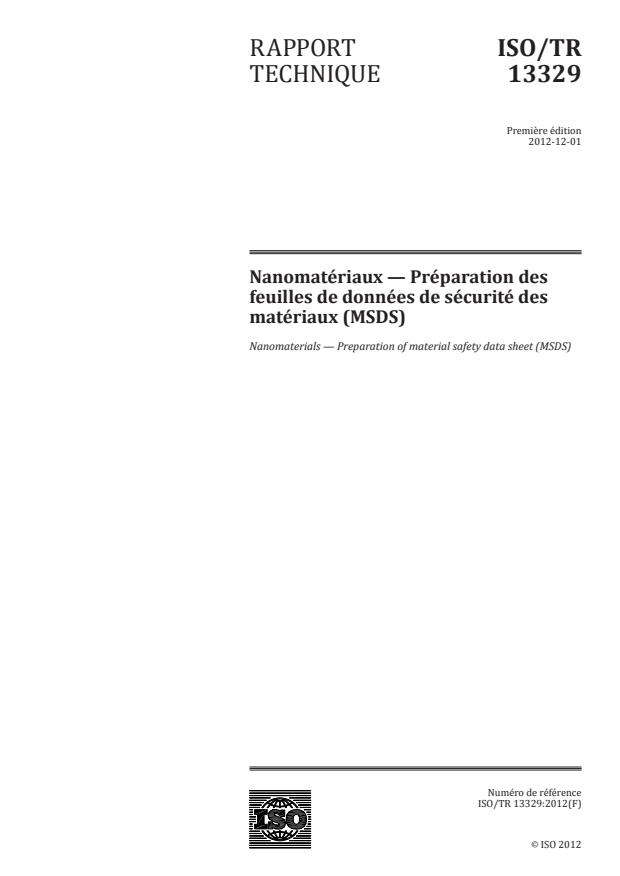
RAPPORT ISO/TR
TECHNIQUE 13329
Première édition
2012-12-01
Nanomatériaux — Préparation des
feuilles de données de sécurité des
matériaux (MSDS)
Nanomaterials — Preparation of material safety data sheet (MSDS)
Numéro de référence
©
ISO 2012
DOCUMENT PROTÉGÉ PAR COPYRIGHT
© ISO 2012
Droits de reproduction réservés. Sauf prescription différente, aucune partie de cette publication ne peut être reproduite ni utilisée
sous quelque forme que ce soit et par aucun procédé, électronique ou mécanique, y compris la photocopie et les microfilms, sans
l’accord écrit de l’ISO à l’adresse ci-après ou du comité membre de l’ISO dans le pays du demandeur.
ISO copyright office
Case postale 56 • CH-1211 Geneva 20
Tel. + 41 22 749 01 11
Fax + 41 22 749 09 47
E-mail copyright@iso.org
Web www.iso.org
Publié en Suisse
ii © ISO 2012 – Tous droits réservés
Sommaire Page
Avant-propos .iv
Introduction .v
1 Domaine d’application . 1
2 Références normatives . 1
3 Termes et définitions . 1
4 Préparation d’une FDS . 6
4.1 Généralités . 6
4.2 Contenu et présentation générale d’une FDS . 7
5 Valeurs seuil/limites de concentration .15
Annexe A (informative) Exemple de méthodes et normes de mesure (ISO/TR 13014) .17
Bibliographie .22
Avant-propos
L’ISO (Organisation internationale de normalisation) est une fédération mondiale d’organismes
nationaux de normalisation (comités membres de l’ISO). L’élaboration des Normes internationales est
en général confiée aux comités techniques de l’ISO. Chaque comité membre intéressé par une étude
a le droit de faire partie du comité technique créé à cet effet. Les organisations internationales,
gouvernementales et non gouvernementales, en liaison avec l’ISO participent également aux travaux.
L’ISO collabore étroitement avec la Commission électrotechnique internationale (CEI) en ce qui concerne
la normalisation électrotechnique.
Les Normes internationales sont rédigées conformément aux règles données dans les Directives
ISO/CEI, Partie 2.
La tâche principale des comités techniques est d’élaborer les Normes internationales. Les projets de
Normes internationales adoptés par les comités techniques sont soumis aux comités membres pour vote.
Leur publication comme Normes internationales requiert l’approbation de 75 % au moins des comités
membres votants.
Exceptionnellement, lorsqu’un comité technique a réuni des données de nature différente de celles qui
sont normalement publiées comme Normes internationales (par exemple des informations sur l’état
de la technique), il peut décider, à la majorité simple de ses membres, de publier un Rapport technique.
Les Rapports techniques sont de nature purement informative et ne doivent pas nécessairement être
révisés avant que les données fournies ne soient plus jugées valables ou utiles.
L’attention est appelée sur le fait que certains des éléments du présent document peuvent faire l’objet de
droits de propriété intellectuelle ou de droits analogues. L’ISO ne saurait être tenue pour responsable de
ne pas avoir identifié de tels droits de propriété et averti de leur existence.
L’ISO/TR 13329 a été élaboré par le Comité technique ISO/TC 229, Nanotechnologies.
iv © ISO 2012 – Tous droits réservés
Introduction
Le présent Rapport technique fournit des lignes directrices pour l’élaboration de fiches de données
de sécurité (FDS) pour les nanomatériaux manufacturés (et les matériaux ou produits contenant des
nanomatériaux manufacturés) et fournit des informations supplémentaires sur les questions de sécurité
associées aux nanomatériaux manufacturés. Le présent Rapport technique n’est pas un document
[1]
autonome et il convient de l’utiliser conjointement à l’ISO 11014:2009 . Le présent Rapport technique
prend en compte le document intitulé «Système Général Harmonisé de Classification et d’Étiquetage
des Produits Chimiques (SGH)» sur la communication des dangers. Le système SGH a été mis en œuvre
sous l’égide des Nations Unies et est en train d’être incorporé dans les législations de divers pays,
dont plusieurs disposent déjà de lois régissant la préparation de fiches de données de sécurité (FDS).
Cependant, la mise en œuvre des lignes directrices fournies dans le présent Rapport technique ne
dispense pas de l’obligation de se conformer à la législation. Il convient que les organismes consultent les
autorités nationales compétentes pour traiter des questions concernant l’interprétation ou le respect de
la législation nationale.
Actuellement, on ne dispose que d’une quantité limitée d’informations sur les dangers liés à la plupart des
nanomatériaux. Dans de nombreux cas, le niveau de risque pour les travailleurs ou autres qui seraient
susceptibles d’être exposés à des nanomatériaux est en partie non connu car les effets toxicologiques
des nanomatériaux ne sont pas encore bien connus et l’exposition est difficile à mesurer. La plupart des
systèmes d’information et de communication exigent la préparation d’une fiche de données de sécurité
(FDS) pour les produits chimiques dangereux, y compris ceux contenant des nanomatériaux, destinés à
être utilisés pour la fabrication, le stockage, le transport ou autres activités professionnelles. Toutefois,
seulement quelques fiches de données de sécurité (FDS) contiennent des informations spécifiques
concernant des nanomatériaux ou sont spécifiques à des nanomatériaux. Celles qui existent fournissent
en général des informations insuffisantes sur les dangers (voir Référence [2]). Il existe des preuves
indiquant que certains nanomatériaux pourraient être plus dangereux (par exemple plus bioréactifs ou
actifs, conduisant à une toxicité plus élevée) que les mêmes matériaux massifs (pas à la nano-échelle).
Des caractéristiques permettant de prévoir l’innocuité ou la toxicité potentielle de nanomatériaux
manufacturés doivent être déterminées et incluses dans la préparation d’une fiche de données de
sécurité (FDS). Bien qu’aucune autorité compétente ne soit actuellement habilitée par la loi à exiger
une fiche de données de sécurité (FDS) pour un nanomatériau qui n’a pas été déjà classé comme un
produit chimique dangereux, il est de bonne pratique de préparer des FDS car une fiche de données de
sécurité constitue un moyen efficace et bien accepté de fournir des informations relatives à la santé et à
la sécurité sur le lieu de travail.
Dans la mesure où le présent Rapport technique prend en compte le principe de précaution en termes
de toxicité et autres risques associés aux nanomatériaux, il recommande donc de fournir une fiche
de données de sécurité (FDS) pour les nanomatériaux et les produits contenant des nanomatériaux,
indépendamment du fait que le matériau soit ou non classé comme dangereux, sauf s’il existe des
données relatives au nanomatériau démontrant qu’il n’est pas dangereux, ou s’il n’a pas été envisagé de
les disséminer sous forme de nano-objets ou d’agglomérats et agrégats supérieurs à 100 nm (NOAA) lors
de leur manipulation ou de leur utilisation.
RAPPORT TECHNIQUE ISO/TR 13329:2012(F)
Nanomatériaux — Préparation des feuilles de données de
sécurité des matériaux (MSDS)
1 Domaine d’application
Le présent Rapport technique donne des lignes directrices pour fournir des informations cohérentes
sur la sécurité, la santé et l’environnement dans des fiches de données de sécurité (FDS) concernant des
substances classées en tant que nanomatériaux manufacturés et des produits chimiques contenant des
[1]
nanomatériaux manufacturés. Il fournit des lignes directrices complémentaires de l’ISO 11014:2009
sur la préparation des FDS en général, en traitant la préparation d’une fiche de données de sécurité (FDS)
à la fois pour un (des) nanomatériau(x) manufacturé(s) avec des matériaux et des mélanges contenant
des nanomatériaux manufacturés.
2 Références normatives
Les documents de référence suivants sont indispensables pour l’application du présent document. Pour
les références datées, seule l’édition citée s’applique. Pour les références non datées, la dernière édition
du document de référence s’applique (y compris les éventuels amendements).
ISO/TS 27687, Nanotechnologies — Terminologie et définitions relatives aux nano-objets — Nanoparticule,
nanofibre et nanofeuillet
ISO/TS 80004-1, Nanotechnologies — Vocabulaire — Partie 1: Termes «coeur»
Globally harmonized system of classification and labelling of chemicals (GHS). United Nations Economic
Commission for Europe, Fourth Edition, 2011
3 Termes et définitions
Pour les besoins du présent document, les termes et définitions donnés dans l’ISO/TS 27687, l’ISO 80004-1,
le SGH ainsi que les suivants s’appliquent.
3.1
agglomérat
ensemble de particules faiblement liées, d’agrégats ou mélange des deux dont l’aire de la surface externe
résultante est similaire à la somme des aires de surface de chacun des composants
Note 1 à l’article: Les forces assurant la cohésion d’un agglomérat sont des forces faibles, par exemple forces de
Van der Waals ou un simple enchevêtrement physique.
Note 2 à l’article: Les agglomérats sont également appelés particules secondaires et les particules sources initiales
sont appelées particules primaires.
[ISO/TS 27687:2008, définition 3.2]
3.2
agrégat
ensemble de particules comprenant des particules fortement liées ou fusionnées dont l’aire de la surface
externe résultante peut être significativement plus petite que la somme des aires de surface calculées
de chacun des composants
Note 1 à l’article: Les forces assurant la cohésion d’un agrégat sont des forces intenses, par exemple liaisons
covalentes ou forces résultant d’un frittage ou d’un enchevêtrement physique complexe.
Note 2 à l’article: Les agrégats sont également appelés particules secondaires et les particules sources initiales
sont appelées particules primaires.
[ISO/TS 27687:2008, définition 3.3]
3.3
bioaccumulation
processus d’accumulation d’une substance dans tout ou partie d’un organisme
[ISO 6107-6:2004, définition 10]
3.4
biodégradation
dégradation due à l’environnement biologique
[ISO 10993-9:2009, définition 3.2]
Note 1 à l’article: La biodégradation est modélisable par des essais in vitro.
3.5
biodurabilité
propriété physico-chimique qui dépend de la dissolution et de la lixiviation aussi bien que de la rupture
et de la division mécaniques dans une solution physiologique telle que la solution de Gamble
Note 1 à l’article: L’essai de biodurabilité est habituellement réalisé in vitro.
3.6
biopersistance
capacité d’un matériau à persister dans un tissu malgré les mécanismes d’élimination physiologique du
tissu et les conditions environnementales
[EU R 18748:1999]
3.7
produit chimique
substance ou mélange
[ISO 11014:2009, définition 3.1]
3.8
structure cristalline
structure caractérisée par une organisation tridimensionnelle des molécules
[ISO 472:1999]
3.9
dispersibilité
état de dispersion lorsqu’il est devenu constant dans des conditions définies
Note 1 à l’article: La dispersion est définie comme une suspension de particules discrètes.
Note 2 à l’article: Adapté de l’ISO 8780-1:1990 et de l’ISO 1213-1:1993.
3.10
pouvoir de resuspension
propension des matériaux à produire des poussières en suspension dans l’air lorsqu’ils sont manipulés
[EN 15051:2006]
2 © ISO 2012 – Tous droits réservés
3.11
nanomatériau d’ingénierie
nanomatériau conçu pour un but ou une fonction spécifique
[ISO/TS 80004-1:2010, définition 2.8]
3.12
catégorie de danger
division des critères dans chaque classe de danger, telle qu’utilisée dans le SGH
[SGH:2011]
3.13
classe de danger
nature du danger physique, du danger pour la santé ou du danger pour l’environnement, telle
qu’utilisée dans le SGH
[SGH:2011]
3.14
mention de danger
mention attribuée à une classe de danger ou à une catégorie de dangers, telle qu’utilisée dans le SGH,
qui décrit la nature du danger que constitue une substance dangereuse ou un mélange dangereux et,
lorsqu’il y a lieu, le degré de ce danger
[ISO 11014:2009, définition 3.6]
3.15
nanomatériau-incident
nanomatériau généré en tant que sous-produit non intentionnel d’un processus
Note 1 à l’article: Le processus peut comprendre la fabrication, les processus biotechnologiques ou autres.
Note 2 à l’article: Voir l’ISO/TS 27628:2007, définition 2.21, pour une définition de «particule ultra-fine».
[ISO/TS 80004-1:2010, définition 2.10]
3.16
nanomatériau manufacturé
nanomatériau produit intentionnellement avec des propriétés ou une composition spécifiques à des
fins commerciales
[ISO/TS 80004-1:2010, définition 2.9]
3.17
mélange
mélange ou solution constitué d’au moins deux substances qui ne réagissent pas entre elles
[SGH:2011]
3.18
nanoaérosol
aérosol constitué ou composé de nanoparticules et de particules nanostructurées
[ISO/TR 27628:2007, définition 2.11]
Note 1 à l’article: Les nanoparticules structurées signifient des particules composées de parties liées entre elles,
dans lesquelles une ou plusieurs de ces parties est une région à la nano-échelle.
3.19
nanofibre
nano-objet dont deux dimensions externes similaires sont à la nano-échelle et dont la troisième
dimension est significativement plus grande
Note 1 à l’article: Une nanofibre peut être flexible ou rigide.
Note 2 à l’article: On considère que les deux dimensions externes similaires ont une différence de taille plus petite
qu’un facteur trois et on considère que la dimension externe significativement plus grande diffère des deux autres
d’un facteur supérieur à trois.
Note 3 à l’article: La dimension externe la plus grande n’est pas nécessairement à la nano-échelle.
[ISO/TS 27687:2008, définition 4.3]
3.20
nanomatériau
matériau ayant une dimension extérieure à la nano-échelle ou ayant une structure interne ou une
structure de surface à la nano-échelle
Note 1 à l’article: Ce terme générique englobe les nano-objets et les matériaux nanostructurés.
Note 2 à l’article: Voir également nanomatériau d’ingénierie, nanomatériau manufacturé et nanomatériau
«incidentel».
[ISO/TS 80004-1:2010, définition 2.4]
3.21
nano-objet
matériau dont une, deux ou les trois dimensions externes sont à la nano-échelle
Note 1 à l’article: Terme générique pour tous les objets discrets à la nano-échelle.
[ISO/TS 27687:2008, définition 2.2]
3.22
nanoparticule
nano-objet dont les trois dimensions externes sont à la nano-échelle
Note 1 à l’article: Si les valeurs de la plus longue dimension et de la plus courte dimension du nano-objet diffèrent
de façon significative (généralement d’un facteur plus grand que trois), on utilise les termes nanofibre ou
nanofeuillet à la place du terme nanoparticule.
[ISO/TS 27687:2008, définition 4.1]
3.23
nanofeuillet
nano-objet dont une dimension externe est à la nano-échelle et dont les deux autres sont
significativement plus grandes
Note 1 à l’article: La dimension externe la plus petite est l’épaisseur du nanofeuillet.
Note 2 à l’article: On considère que les deux dimensions significativement les plus grandes diffèrent de la dimension
à la nano-échelle d’un facteur supérieur à trois.
Note 3 à l’article: Les dimensions externes les plus grandes ne sont pas nécessairement à la nano-échelle.
[ISO/TS 27687:2008, définition 4.2]
4 © ISO 2012 – Tous droits réservés
3.24
nano-échelle
gamme de dimensions s’étendant approximativement de 1 nm à 100 nm
Note 1 à l’article: Les propriétés qui ne constituent pas des extrapolations par rapport à des dimensions plus
grandes seront présentées de façon générale, mais pas exclusivement, dans cette gamme de dimensions. Pour ces
propriétés, on considère que les limites dimensionnelles sont approximatives.
Note 2 à l’article: Dans cette définition, on indique une limite inférieure (approximativement 1 nm) pour éviter
à des atomes isolés et à de petits groupes d’atomes d’être désignés en tant que nano-objets ou éléments de
nanostructures, ce qui pourrait être le cas en l’absence de limite inférieure.
[ISO/TS 27687:2008, définition 2.1]
3.25
nanostructure
composition constituée d’éléments interdépendants dans laquelle un ou plusieurs de ces éléments est un
domaine de la nano-échelle
Note 1 à l’article: Une région est définie par une limite représentant une discontinuité des propriétés.
[ISO/TS 80004-1:2010, définition 2.6]
3.26
matériau nanostructuré
matériau ayant une nanostructure interne ou une nanostructure de surface
Note 1 à l’article: La présente définition n’exclut pas la possibilité qu’un nano-objet ait une structure interne
ou une structure de surface. Si la (les) dimension(s) externe(s) est (sont) à la nano-échelle, il est recommandé
d’utiliser le terme nano-objet.
[ISO/TS 80004-1:2010, définition 2.7]
3.27
particule nanostructurée
particule ayant des caractéristiques structurelles inférieures à 100 nm, qui peuvent influencer ses
propriétés physiques, chimiques et/ou biologiques
Note 1 à l’article: Une particule nanostructurée peut être de dimension sensiblement supérieure à 100 nm.
EXEMPLE Un agglomérat de nanoparticules d’un diamètre de 500 nm pourrait être considéré comme une
particule nanostructurée.
[ISO/TR 27628:2007, définition 2.13]
3.28
particule
élément minuscule de matière avec un périmètre physique défini
Note 1 à l’article: Une limite physique peut également être décrite sous la forme d’une interface.
Note 2 à l’article: Une particule peut se déplacer sous la forme d’une unité.
Note 3 à l’article: Cette définition générale de «particule» s’applique aux nano-objets.
[ISO/TR 27687:2008, définition 3.1]
3.29
fiche de données de sécurité
FDS
document fournissant des informations sur les propriétés des produits chimiques dangereux, sur la
manière dont ils affectent la santé et la sécurité sur le lieu de travail et sur la manière de gérer les
produits chimiques dangereux sur le lieu de travail
[Safe Work Australia]
3.30
substance
élément chimique et ses composés, présents à l’état naturel et obtenus grâce à un procédé de production.
Ce terme inclut tout additif nécessaire pour préserver la stabilité du produit ainsi que toute impureté
produite par le procédé utilisé, mais exclut tout solvant pouvant en être extrait sans diminuer la stabilité
ni modifier la composition de la substance
[SGH:2011]
3.31
aire de surface
superficie de la surface extérieure plus des surfaces internes de ses macrospores et mésopores accessibles
Note 1 à l’article: Désigne aussi l’aire de surface massique ou l’aire de surface volumique.
[ISO/TR 13014:2012, définition 2.28]
4 Préparation d’une FDS
4.1 Généralités
4.1.1 Il est conseillé de préparer une FDS pour tous les nanomatériaux manufacturés, que le matériau
massif (pas à la nano-échelle) soit ou non classé comme dangereux, sauf dans les cas suivants:
— les résultats d’essai ou d’évaluation qui satisfont aux spécifications des autorités compétentes, qui
sont fondés sur des normes nationales ou internationales, ou qui sont considérés comme des pratiques
scientifiques généralement reconnues, indiquent que les nanomatériaux ne sont pas dangereux;
— il n’est pas envisagé qu’un ou plusieurs nanomatériaux manufacturés puissent être libérés en tant
que nano-objets ou agglomérats/agrégats (NOAA) dans des conditions d’utilisation raisonnablement
prévues auxquelles l’être humain est susceptible d’être exposé et que la matrice (comprenant le
nanomatériau manufacturé) ne présente pas de danger;
— la classe de danger des nanomatériaux manufacturés est connue et ces nanomatériaux manufacturés
sont présents à des concentrations inférieures aux valeurs seuil définies en 4.1.
4.1.2 Il convient que les informations contenues dans la FDS soient rédigées de manière claire et
concise. Il convient que la FDS soit préparée par une ou plusieurs personnes compétentes qui tiendront
compte des besoins spécifiques du public visé pour autant qu’elles le connaissent. Il convient que la
FDS fournisse des informations et/ou des conclusions complètes concernant les données évaluées, afin
de permettre à tout lecteur d’identifier facilement tous les dangers, y compris tout danger associé à la
nanostructure du matériau. En plus des spécifications relatives aux informations minimales, il convient
que la FDS contienne les informations disponibles concernant l’utilisation sans danger du matériau.
[1]
4.1.3 Le format de la FDS doit être conforme à l’ISO 11014 .
NOTE Le format de la FDS peut être également soumis à des exigences légales applicables.
6 © ISO 2012 – Tous droits réservés
4.1.4 Si des informations pertinentes concernant l’un des 16 paragraphes spécifiés de la FDS ne sont
pas disponibles, il convient de mentionner cela dans la FDS, dans le paragraphe approprié en utilisant des
mentions telles que «non disponibles». Il convient qu’aucune case ne soit laissée en blanc sous l’une des
rubriques de la FDS.
4.1.5 Il convient de fournir des FDS distinctes pour des formes différentes du même produit chimique,
si elles présentent des dangers différents.
4.1.6 Informations commerciales confidentielles. La préparation d’une FDS peut nécessiter des
informations commerciales confidentielles concernant les composants ou les caractéristiques des
nanomatériaux manufacturés (ou les préparations qui les contiennent) faisant l’objet de la FDS. Les
exigences légales, concernant les informations commerciales confidentielles établies par des autorités
compétentes dans les marchés dans lesquels la FDS sera utilisée, doivent être respectées. Dans la mesure
où des informations pouvant être pertinentes pour la FDS ne sont pas divulguées pour des raisons de
confidentialité, il convient d’envisager d’autres moyens pour fournir aux utilisateurs des informations
pertinentes (par exemple fournir des informations en utilisant une terminologie générique, indiquer des
plages de concentrations, ou fournir des contacts avec lesquels les utilisateurs peuvent communiquer
pour obtenir des informations plus détaillées).
4.2 Contenu et présentation générale d’une FDS
4.2.1 Identification de la substance/du mélange et de la société/l’entreprise
En raison de l’évolution rapide des connaissances dans le domaine de l’impact des nanomatériaux sur la
santé, il convient d’inclure la date à laquelle la FDS a été préparée ainsi que l’identité de l’organisme qui
l’a préparée. Il convient que la FDS comprenne le numéro de révision et la date de la version remplacée
ou d’autres indications sur la version qui est remplacée.
4.2.2 Identification des dangers
Il convient que la FDS décrive tous les dangers associés au nanomatériau manufacturé ou au mélange
pour lequel la FDS a été préparée. Il est recommandé que les mentions de dangers du SGH soient utilisées
pour décrire les dangers. Il convient d’éviter les descriptions vagues ou pouvant prêter à confusion
telles que «peut être dangereux», «pas d’effets sur la santé», «sans danger dans la plupart des conditions
d’emploi» ou «non nocif». Si le nanomatériau manufacturé ou le mélange est classé conformément aux
critères du SGH, il convient d’identifier le danger spécifique ainsi que la catégorie. Par ailleurs, il convient
d’inclure dans le paragraphe «Identification des dangers» du SGH, les dangers qui ne font pas l’objet
d’une classification ou qui ne sont pas actuellement couverts par le SGH. Par exemple, il convient de
mentionner, parmi les dangers potentiels, la formation possible de poussière, ainsi que d’autres dangers
ne faisant pas l’objet d’une classification tels que suffocation, glissade ou dangers spécifiques pour
l’environnement. Des conseils supplémentaires sur l’évaluation des scénarios d’exposition sont fournis
en 4.2.8. Si l’on ne dispose que d’un nombre limité de données (voire d’aucune donnée), concernant
les dangers potentiels, des informations générales seront recommandées (voir Référence [12]) (voir
formulation du guide suisse pour les FDS, paragraphe 5.1.2).
4.2.3 Composition/informations sur les composants
4.2.3.1 Si un nanomatériau a le même numéro CAS (Chemical Abstracts Service) que le matériau
massif (pas à la nano-échelle), utiliser le numéro CAS, mais mentionner également que le matériau est un
nanomatériau manufacturé selon la définition de l’ISO ou d’autres définitions applicables; par exemple
Anatase TiO , numéro CAS 1317-70-0, (nanoforme manufacturée).
4.2.3.2 Identifier la composition du ou des nanomatériaux manufacturés, y compris les adjuvants de
stabilisation et, le cas échéant, des impuretés si cela est nécessaire pour la classification et l’identification
des procédures d’hygiène et de sécurité du travail. Si le nanomatériau manufacturé possède un revêtement
de surface, il convient d’évaluer les propriétés dangereuses de cette couche de surface. Il convient que les
informations sur la composition chimique du nanomatériau comprennent tous les composants.
NOTE 1 Il convient de fournir des informations générales sur l’état de la surface, telles que la charge de surface
et la composition chimique de surface du nanomatériau manufacturé, lorsque celles-ci sont nécessaires pour la
classification, l’évaluation des risques et l’élaboration de procédures d’hygiène et de sécurité du travail.
NOTE 2 Il convient d’inclure des informations sur la solubilité afin de déterminer, le cas échéant des profils de
dangers pertinents.
NOTE 3 Une liste de toutes les substances ayant une limite d’exposition professionnelle associée est exigée. Il
convient que cette liste comprenne des substances pour lesquelles la limite d’exposition concerne des matériaux
massifs (pas à la nano-échelle) ou des nanomatériaux manufacturés. Ces limites sont indiquées en 4.2.8 «Contrôles
de l’exposition/protection individuelle».
4.2.3.3 Il convient que la FDS indique si le nanomatériau manufacturé est pur ou s’il s’agit d’un composant
d’un autre matériau ou produit. Pour les mélanges, identifier le(s) nanomatériau(x) manufacturé(s) et la
(les) concentration(s), ou les plages de concentrations, ou les plages de proportions de tous les composants
considérés comme dangereux selon les critères du SGH et présents à des niveaux supérieurs aux valeurs
seuils indiquées en 5.1. Pour les matériaux ou produits contenant des nanomatériaux manufacturés,
identifier le(s) nanomatériau(x) manufacturé(s) de tous les composants considérés comme dangereux
selon les critères du SGH. Si le matériau mélangé ou le produit n’a pas été soumis à essai, il convient
d’énumérer le nanomatériau manufacturé ainsi que la (les) dénomination(s) courante(s) de tous les
composants identifiés comme dangereux.
NOTE Lorsqu’une plage de proportion est utilisée, il convient de faire référence à la concentration ou à la
plage de pourcentage du nanomatériau manufacturé dans le mélange.
4.2.3.4 Si le mélange a été soumis à essai pour déterminer les dangers qu’il présente, il convient alors
d’inclure le nanomatériau manufacturé, ainsi que la (les) dénomination(s) courante(s) des composants
qui contribuent à ces dangers connus et la (les) dénomination(s) courante(s) du mélange proprement dit.
Si le mélange n’a pas été soumis à essai, il convient d’énumérer le nanomatériau manufacturé et la (les)
dénomination(s) courante(s) de tous les composants définis comme dangereux; il en est de même lorsque
les concentrations sont égales ou supérieures aux valeurs seuil décrites en 5.2. Il convient d’énumérer
également le nanomatériau manufacturé et la (les) dénomination(s) courante(s) de tous les composants
définis comme présentant un danger physique lorsqu’ils sont présents dans le mélange comme décrit en 5.2.
4.2.4 Premiers soins
[1]
Il convient que les informations fournies dans ce paragraphe de la FDS soient fondées sur l’ISO 11014 .
À l’heure actuelle, il n’existe aucune indication supplémentaire spécifique aux nanomatériaux
manufacturés.
4.2.5 Mesures de lutte contre l’incendie
Les formes des nanomatériaux manufacturés, en particulier les poudres, de certains matériaux, peuvent
présenter une réactivité anormalement élevée, notamment pour les feux, les explosions et les réactions
catalytiques, par rapport à des matériaux équivalents présentant de plus grandes tailles de particules.
On a identifié des nanomatériaux qui présentaient des caractéristiques de réactivité impossibles à
prévoir sur la base de leur seule composition chimique (voir Référence [13]). La réduction de la taille
des particules des matériaux combustibles a pour effet de diminuer l’énergie minimale d’inflammation
et d’augmenter le potentiel et le taux de combustion. Certaines poudres d’ordinaire stables deviennent
pyrophoriques lorsqu’elles sont déposées sur un filtre et soumises à un flux d’air important, comme
les conditions à l’intérieur d’un aspirateur. Cela signifie qu’elles peuvent libérer de l’énergie beaucoup
plus rapidement, ayant pour effet de favoriser le scénario d’une explosion. Cela suggère qu’il convient
de manipuler certains nanomatériaux manufacturés comme des sources potentielles d’inflammation
susceptibles de provoquer un incendie ou une explosion.
8 © ISO 2012 – Tous droits réservés
En règle générale, on a constaté que la pression maximale d’explosion, les vitesses de montée en pression
et la constante d’explosivité équivalente, K , des poudres contenant des nanomatériaux manufacturés
St
étaient très similaires à celles des poudres classiques à l’échelle du micron, probablement en raison de
l’agglomération des particules. Cependant, si les particules sont dispersées plus efficacement, alors la
constante d’explosivité, K , et la pression maximale d’explosion, P , peuvent être augmentées au-delà
St max
de celles des poudres à l’échelle du micron. Par conséquent, il s’est avéré que les énergies minimales
d’inflammation de certaines poudres contenant des nanomatériaux manufacturés étaient plus faibles
que celles du matériau équivalent à l’échelle du micron (voir Référence [14]).
Toutes les substances concernées doivent faire l’objet d’un contrôle visant à vérifier la compatibilité
de leurs composants avec les nanomatériaux, en insistant sur leur teneur en eau potentielle. Certaines
poussières métalliques réagissent avec l’eau pour former, entre autres, de l’hydrogène gazeux qui
s’enflamme très facilement. Les nanopoudres conductrices, telles que les nanopoudres de carbone,
ne sont pas susceptibles de présenter un danger électrostatique mais si ces poudres pénètrent dans
des équipements électriques et électroniques, elles peuvent provoquer des problèmes de courts-
circuits et conduire à l’apparition de sources d’inflammation. La capacité des nanopoudres à pénétrer
dans des équipements électriques et électroniques peut être accrue en raison de la taille réduite de
leurs particules (voir Référence [14]). L’utilisation de sable sec peut également éteindre le feu et
exclure l’oxygène du matériau en combustion sans affecter la masse en combustion du matériau. Des
informations complémentaires concernant les mesures à prendre en cas d’incendie sont fournies dans
[15] [16]
l’ISO/TR 12885 et dans l’ISO/TS 12901-1 .
4.2.6 Mesures à prendre en cas de dispersion accidentelle
4.2.6.1 Il convient que la description des mesures à prendre en cas d’accidents (notamment pour
les scénarios les plus défavorables), de dispersions ou d’émissions impliquant des nanomatériaux
manufacturés, soit fondée sur les propriétés dangereuses du nanomatériau et qu’elle tienne compte
des mentions de danger, des informations toxicologiques et des informations écologiques produites en
vertu de 4.2.3, 4.2.11 et 4.2.12. Il convient que les méthodes de nettoyage suite à des dispersions et à
des fuites de nanomatériaux manufacturés décrivent, le cas échéant, les mesures à prendre pour éviter
la dissémination, par exemple une resuspension dans l’air, un écoulement ou un ruissellement dans les
locaux, une accumulation incontrôlée ou une explosion. Il convient que les méthodes de nettoyage soient
décrites de manière assez détaillée pour prévenir ou minimiser les effets nocifs pour les personnes et pour
l’environnement, suite à des déversements ou à des fuites. Avant de choisir une méthode de nettoyage, il
convient de prendre en compte le potentiel de complications dues aux propriétés physiques et chimiques
du nanomatériau manufacturé, notamment en cas de déversements importants. Les complications
peuvent comprendre les réactions avec les matériaux de nettoyage et avec d’autres matériaux dans les
endroits où seront stockés les déchets produits par les activités de nettoyage, par exemple, des filtres
d’aspirateurs et des cartouches filtrantes. De tels lieux de stockage des déchets comprennent les filtres
d’aspirateurs et les cartouches filtrantes.
4.2.6.2 Pour les nanomatériaux manufacturés secs, les méthodes possibles de nettoyage comprennent
a) une méthode faisant usage d’un aspirateur muni d’un filtre HEPA (filtre à particules à haute
efficacité) destiné à l’utilisation dans des environnements industriels ou de laboratoire,
b) une méthode d’essuyage par voie humide, et
c) d’autres méthodes approuvées n’impliquant pas l’essuyage par voie sèche ni l’utilisation d’air comprimé.
L’utilisation d’un aspirateur dédié muni d’un filtre HEPA, tel qu’un aspirateur industriel de type H destiné
[17]
à aspirer les poussières toxiques (BS 5415-2.2:Supplément N°1 ) permet d’éviter de mélanger les
déchets de nanomatériaux avec d’autres déchets, ce qui a pour effet de réduire la quantité de déchets de
nanomatériaux, d’éviter de contaminer les déchets de nanomatériaux par d’autres déchets et de réduire
le risque de déversements involontaires de nanomatériaux en signalant que cet aspirateur est dédié à
[16]
cette fin (voir l’ISO/TS 12901-1:2012, Article 13 ).
Il convient de prendre en compte les éventuels dangers pyrophoriques associés à l’aspiration de
nanomatériaux manufacturés, par exemple une combustion ou une inflammation spontanée.
4.2.6.3 Pour les déversements de liquides contenant des nanomatériaux manufacturés, la méthode
d’essuyage par voie humide est recommandée pour le nettoyage. Afin d’empêcher les liquides contenant
des nanomatériaux manufacturés en suspension de se répandre pendant le nettoyage, il est recommandé
de contrôler l’accès à la zone souillée et de placer des paillassons absorbants à l’endroit où le personnel de
nettoyage est censé quitter la zone souillée et/ou d’installer des barrières destinées à réduire les courants
d’air à travers la surface souillée. Il est également possible d’utiliser un aspirateur muni d’un filtre HEPA
dédié au nettoyage des nanomatériaux manufacturés pour éliminer les résidus de nanomatériaux
manufacturés encore présents après séchage de la zone souillée par le déversement. Des informations
[16]
supplémentaires sont fournies dans l’ISO/TS 12901-1 .
NOTE L’utilisation d’aspirateurs pour nanomatériaux pose toutefois quelques problèmes: a) le moteur de
l’aspirateur produit des nanoparticules très fines (contamination potentielle du produit et/ou déclenchement du
système d’alarme lors du mesurage de la concentration en nanoparticules), b) les filtres HEPA utilisés dans les
aspirateurs disponibles dans le commerce ne répondent pas toujours aux exigences industrielles relatives aux
filtres HEPA.
4.2.6.4 Il convient que la FDS spécifie des méthodes pour traiter les matériaux après le nettoyage,
y compris les matériaux déversés récupérés et les matériaux utilisés pour nettoyer le liquide déversé,
conformément à la classification des dangers présentés par les nanomatériaux manufacturés. Si les déchets
de nanomatériaux ne sont pas classés, il est recommandé de les traiter comme s’il s’agissait de matériaux
dangereux, sauf si des résultats d’essai ou d’évaluation conformes à des spécifications d’autorités
compétentes, ou fondés sur des normes nationales ou internationales, ou sur des pratiques scientifiques
généralement reconnues, indiquent que ces déchets de nanomatériaux ne sont pas dangereux. Si les
déchets de nanomatériaux ne sont pas classés, il est recommandé de consulter une personne compétente
afin de déterminer la manière dont il convient de les traiter.
4.2.7 Manipulation et stockage
Il convient d’identifier les scénarios pouvant donner lieu à une exposition à des nanomatériaux
manufacturés (par exemple formation d’aérosols) pour lesquels des procédures de gestion des risques
sont nécessaires. Il convient de fournir une mention indiquant la méthode pour mesurer et évaluer
l’exposition à la substance, si une telle méthode est disponible. Il convient de recommander les mesures
préventives nécessaires pour la santé et la sécurité du travail, selon l’ordre hiérarchique des contrôles
(voir Référence [16]). L’exposition aux nanomatériaux manufacturés peut être atténuée par la mise en
œuvre d’un contrôle d’ingénierie (voir Référence [18]). En conséquence, il convient que la FDS contienne
des détails concernant les conditions de stockage, par exemple température ou humidité.
Il convient que des procédures décrites assurent de manière adéquate la protection de toutes les
personnes susceptibles d’accéder au lieu de travail. Le cas échéant, il convient de mentionner que les
informations de sécurité fournies ne s’appliquent pas à toutes les utilisations. Il est possible que l’on
soit amené à appliquer aux nanomatériaux manufacturés les mêmes principes que ceux appliqués aux
matériaux massifs (pas à la nano-échelle) qui produisent de la poussière et des poudres fines, en tenant
compte du fait que les nanoparticules mettent en général plus de temps pour se déposer. Par exemple, il
convient de prêter une attention particulière aux nanomatériaux manufacturés métalliques oxydables.
Si les nanomatériaux manufacturés sont classés comme dangereux ou sont considérés comme
potentiellement dangereux, les pratiques au travail suivantes sont recommandées:
— Il convient que des contrôles d’ingénierie appropriés, telle qu’une ventilation utilisant des filtres
HEPA dans l’espace de travail, soient décrits, s’ils sont requis par les caractéristiques spécifiques
des nanomatériaux manufacturés et par les processus concernés.
— Il est possible que certains nanomatériaux manufacturés justifient l’utilisation d’une production
en atmosphère contrôlée et de processus de stockage utilisant du dioxyde de carbone, de l’azote
ou un autre gaz inerte pour réduire le risque d’incendie et de déflagration. Il est possible qu’il soit
exigé que les équipements destinés à être exposés à certains nanomatériaux manufacturés soient
antidéflagrants.
10 © ISO 2012 – Tous droits réservés
— Il convient de transférer les échantillons de nanomatériaux manufacturés entre les postes de travail
(hottes d’évacuation, boîtes à gants et fours) à l’intérieur d’un récipient étanche et étiqueté, tel qu’un
sachet étanche portant un marquage d’identification. Il convient de placer le récipient ou le sachet
dans un second récipient ou sachet propre.
— Il convient de prendre les précautions nécessaires pour éviter tout contact entre la peau et des
nanomatériaux manufacturés ou des matériaux contenant des nanomatériaux susceptibles de
libérer des nanomatériaux manufacturés.
— Lorsque de petites quantités de poudres contenant des nanomatériaux manufacturés sont
manipulées sans système d’évacuation (par exemple hotte d’évacuation de laboratoire) ou sans
enceinte (par exemple boîte à gants), il convient de mettre en œuvre des contrôles pratiques pour
réduire les possibilités de contamination et d’exposition.
— Il convient de manipuler les déchets comportant des nanomatériaux conformément aux directives
locales concernant la manipulation de déchets de produits chimiques dangereux, sauf si des résultats
d’essai ou d’évaluation conformes aux spécifications d’autorités compétentes indiquent qu’ils ne
sont pas dangereux.
— Il convient d’utiliser uniquement un aspirateur dédié à filtre, tel qu’un aspirateur de type H destiné
à être utilisé dans des environnements industriels ou de laboratoires pour assurer le nettoyage par
voie sèche des nanomatériaux.
— Il convient d’envisager des mesures de protection au niveau organisationnel. Les exemples de
mesures de ce type comprennent la réduction du temps d’exposition, la réduction du nombre de
personnes exposées, la mise en œuvre de restrictions d’accès et la formation du personnel aux risques
associés au travail en présence de nanomatériaux manufacturés. Il convient de mettre en œuvre
d’autres contrôles de pratiques professionnelles visant à réduire le potentiel de contamination et
d’exposition.
— Il convient de définir des équipements de protection individuelle (EPI) comme l’ultime étape
après la mise en œuvre de toutes les autres mesures destinées à limiter l’exposition. Les exemples
d’équipement s de protec t ion indiv iduelle comprennent les écrans faciau x, les chaussures ant ist at iques,
les combinaisons, les charlottes, les appareils de protection respiratoire (en mentionnant le type
d’appareil respiratoire et les instructions d’utilisation) et les gants de protection (en mentionnant
le temps de pénétration et le matériau des gants). Il convient de justifier l’adéquation des EPI, par
exemple le respirateur et les gants. Si nécessaire, il convient de définir des mesures de protection
différentes en fonction des différentes utilisations du nanomatériau manufacturé.
NOTE Bien que les méthodes actuelles pour la certification de filtres d’appareils respiratoires ne nécessitent
pas systématiquement des essais avec des tailles de particules inférieures à 100 nm, des études récentes indiquent
que plusieurs types d’appareils respiratoires sont en mesure de garantir des niveaux de protection contre les
nanomatériaux (voir Référence [19]), sous réserve que l’appareil respiratoire soit bien adapté.
Des informati
...
ТЕХНИЧЕСКИЙ ISO/TR
ОТЧЁТ 13329
Первое издание
2012-12-01
Наноматериалы. Подготовка формы
для записи данных (MSDS)
Nanomaterials — Preparation of Material Safety Data Sheet (MSDS)
Ответственность за подготовку русской версии несѐт GOST R
(Российская Федерация) в соответствии со статьѐй 18.1 Устава ISO
Ссылочный номер
©
ISO 2012
ДОКУМЕНТ ЗАЩИЩЕН АВТОРСКИМ ПРАВОМ
© ISO 2012
Все права сохраняются. Если не указано иное, никакую часть настоящей публикации нельзя копировать или использовать в
какой-либо форме или каким-либо электронным или механическим способом, включая фотокопии и микрофильмы, без
предварительного письменного согласия ISO по адресу, указанному ниже, или членов ISO в стране регистрации пребывания.
ISO copyright office
Case postale 56 CH-1211 Geneva 20
Tel. + 41 22 749 01 11
Fax + 41 22 749 09 47
E-mail copyright@iso.org
Web www.iso.org
Опубликовано в Швейцарии
ii © ISO 2012 — Все права сохраняются
Содержание Страница
Предисловие .iv
Введение .v
1 Область применения .1
2 Нормативные ссылки .1
3 Термины и определения .1
4 Подготовка SDS .7
4.1 Общие положения .7
4.2 Содержание и общая схема SDS .7
5 Предельные величины/пределы концентрации. 15
Приложение A Пример методов измерения и стандартов (ISO/TR 13014). 17
Библиография . 23
iii
Предисловие
Международная организация по стандартизации (ISO) является всемирной федерацией национальных
организаций по стандартизации (комитетов-членов ISO). Разработка международных стандартов
обычно осуществляется техническими комитетами ISO. Каждый комитет-член, заинтересованный в
деятельности, для которой был создан технический комитет, имеет право быть представленным в этом
комитете. Международные правительственные и неправительственные организации, имеющие связи с
ISO, также принимают участие в работах. ISO работает в тесном сотрудничестве с Международной
электротехнической комиссией (IEC) по всем вопросам стандартизации в области электротехники.
Международные стандарты разрабатываются в соответствии с правилами, установленными в
Директивах ISO/IEC, Часть 2.
Основная задача технических комитетов состоит в подготовке международных стандартов. Проекты
международных стандартов, одобренные техническими комитетами, рассылаются комитетам-членам
на голосование. Их опубликование в качестве международных стандартов требует одобрения, по
меньшей мере, 75 % комитетов-членов, принимающих участие в голосовании.
В исключительных случаях, когда технический комитет собрал данные, отличающиеся по характеру от
обычно публикуемых в виде международного стандарта (например характеризующие ―современный
технический уровень‖), он может принять решение простым большинством голосов участвующих в
голосовании членов комитета о публикации технического отчета. Технический отчет является
информативным документом и не должен пересматриваться до установленной даты, после которой он
считается недействительным или потерявшим значение.
Следует иметь в виду, что некоторые элементы этого документа могут быть объектом патентных прав.
ISO не должен нести ответственность за идентификацию какого-либо одного или всех патентных прав.
ISO/TR 13329 был подготовлен Техническим комитетом ISO/TC 229, Нанотехнологии.
iv © ISO 2012 — Все права сохраняются
Введение
Данный Технический отчѐт содержит руководство по разработке перечней данных по обеспечению
безопасности (SDS), относящихся к изготавливаемым наноматериалам (и материалам или продуктам,
содержащим изготавливаемые наноматериалы), и предоставляет дополнительную информацию по
вопросам безопасности, ассоциированным с изготавливаемыми наноматериалами. Этот документ не
[1]
является отдельным документом и должен использоваться совместно с ISO 11014:2009 .
Настоящий Технический отчѐт принимает во внимание документ Согласованная на глобальном уровне
система классификации опасности и маркировки химической продукции (GHS) в сообщаемых данных
относительно рисков: перечни данных по безопасности. GHS был разработан ООН и включѐн в
законодательство различных регионов и наций, многие из которых уже имеют законы, регулирующие
подготовку SDS. Однако применение руководства, предоставленного в данном Техническом отчѐте, не
может быть использовано в качестве замены выполнения законов. При рассмотрении вопросов,
связанных с интерпретацией или применением национальных законов, организации должны
консультироваться с соответствующими национальными органами власти.
В настоящее время имеется только ограниченная информация относительно рисков, связанных с
большей частью наноматериалов. Во многих случаях степень рисков для работников или другого
персонала, который может подвергнуться воздействию наноматериалов, лишь частично известна,
поскольку токсикологические характеристики наноматериалов в недостаточной степени известны, в
связи с чем затруднительно получить оценку их влияния. Большая часть информации относительно
рисков и систем оповещения о них требует подготовки SDS, относящихся к опасным химическим
веществам, включая содержащие наноматериалы вешества, предназначенных для использования в
производственных процессах, для хранения, транспортировки, или других видов профессиональной
деятельности. Однако только небольшая часть SDS содержит специальную информацию
относительно наноматериалов или предназначена специально для них. Имеющиеся данные обычно
предоставляют недостаточную информацию о рисках (см. ссылку [2]). Существуют данные, что
некоторые наноматериалы могут быть более опасны, например биореактивны или активны, что
приводит к более высокой токсичности, чем характерная для тех же материалов в объѐмной (не
наномасштабной) форме. Характеристики, позволяющие прогнозировать потенциально возможную
степень безопасности или токсичности изготавливаемых наноматериалов, необходимо определить и
включить в подготовку SDS. Однако хотя в настоящее время отсутствуют компетентные органы,
имеющие основанные на законах полномочия требовать SDS на наноматериалы, которые не
классифицированы уже как опасные химические вещества, было бы целесообразно выполнять эти
требования, поскольку SDS являются общепринятым и эффективным методом предоставления
информации о безопасности и условиях поддержания здоровья на рабочем месте.
В данном Техническом отчѐте рассматривается превентивный подход с точки зрения токсичности и
других рисков, связанных с использованием наноматериалов, и, таким образом, он содержит
рекомендации по предоставлению SDS для наноматериалов и содержащих наноматериалы продуктов,
независимо от того, классифицированы или нет эти материалы как опасные, если только не имеются
относящиеся к наноматериалам данные, показывающие их безопасность, или если отсутствует
прогноз, что они могут быть выпущены в виде нанообъектов, или они имеют форму аггломератов и
агрегатов с размерами больше 100 нм (NOAA), существующими во время их обработки или
применения.
v
ТЕХНИЧЕСКИЙ ОТЧЁТ ISO/TR 13329:2012(R)
Наноматериалы. Подготовка формы для записи данных
(MSDS)
1 Область применения
Настоящий Технический отчѐт содержит руководство по разработке содержания и согласованности
сообщаемой информации по вопросам безопасности, здоровья и условий окружающей среды в
перечнях данных по обеспечению безопасности (SDS) для веществ, классифицированных как
произведѐнные наноматериалы и химические продукты, содержащие произведѐнные наноматериалы.
[1]
Он предоставляет дополнительное руководство для применения ISO 11014:2009 при подготовке SDS
в целом, предназначенное для подготовки SDS как для произведѐнных наноматериалов с
материалами, так и смесей, содержащих произведѐнные наноматериалы.
2 Нормативные ссылки
Следующие ссылочные документы обязательны для применения в настоящем документе. В случае
датированных ссылок применяются только цитированные издания. При недатированных ссылках
используется последнее издание ссылочного документа (включая все изменения).
ISO/TS 27687:2008, Нанотехнологии. Терминология и определения для нанообъектов.
Наночастицы, нановолокна и нанопластинки
ISO/TS 80004-1:2010, Нанотехнологии. Словарь. Часть 1. Основные термины
Согласованная на глобальном уровне система классификации опасности и маркировки химической
продукции (GHS). Организация Объединѐнных Наций Экономическая комиссия для Европы, четвѐртое
издание, 2011
3 Термины и определения
Для целей настоящего документа применяются термины и определения ISO/TS 27687:2008,
ISO 80004-1:2010, GHS:2011 и приведѐнные ниже.
3.1
агломерат
agglomerate
собрание слабо связанных частиц или агрегатов, или их смесь, в котором площадь образующейся в
результате поверхности аналогична сумме площадей поверхности отдельных компонент
[ISO/TS 27687:2008, определение 3.2]
Примечание 1 для входа: Силы, удерживающие элементы агломерата совместно, являются слабыми силами,
например силами ван дер Ваальса, или возникающими при физическом зацеплении.
Примечание 2 для входа: Агломераты называются также вторичными частицами, а образующие их частицы –
первичными частицами.
ISO/TR 13014:2012(R)
3.2
агрегат
aggregate
частицы, включающие сильно связанные или объединѐнные частицы, в которых возникающая в
результате площадь внешней поверхности может быть значительно меньше суммы рассчитанных
значений площади поверхности отдельных компонент
[ISO/TS 27687:2008, определение 3.3]
Примечание 1 для входа: Силы, связывающие агрегат в одно целое, являются сильными силами, например
ковалентными связями, или возникающими в результате спекания или сложного физического переплетения.
Примечание 2 для входа: Агрегаты также называются вторичными частицами, а образующие их частицы –
первичными частицами.
3.3
биоаккумуляция
bioaccumulation
процесс аккумуляции вещества в организмах или их частях
[ISO 6107-6:2004, определение 10]
3.4
биодеградация
biodegradation
деградация вследствие влияния биологического окружения
[ISO 10993-9:2009, определение 3.2]
Примечание 1 для входа: Биодеградация может быть моделирована в испытаниях in vitro.
3.5
биологическая стабильность
biodurability
физикохимическая характеристика, зависящая от разложения и выщелачивания, а также от
механического разрушения и расщепления материала в физиологическом растворе, например в
растворе Gamble
Примечание 1 для входа: Испытания биологической устойчивости обычно проводятся in vitro.
3.6
биологическая устойчивость
biopersistence
способность материала сохраняться в тканях несмотря на механизмы физиологической очистки и
условия окружающей среды
[EU R 18748:1999]
3.7
химический продукт
chemical product
субстанция или смесь
[ISO 11014:2009, определение 3.1]
3.8
кристаллическое состояние
crystallinity
существование трѐхмерного порядка на уровне молекулярных размеров
2 © ISO 2012 – Все права сохраняются
ISO/TR 13014:2012(R)
[ISO 472:1999]
3.9
дисперсность
dispersibility
уровень дисперсности, когда он становится постоянным при определѐнных условиях
Примечание 1 для входа: Дисперсная система определяется как взвесь отдельных частиц.
Примечание 2 для входа: Адаптировано из ISO 8780-1 и ISO 1213-1.
3.10
способность образования пыли
dustiness
способность материала к образованию воздушной пыли при работе с ним
[EN 15051:2006]
3.11
разработанный наноматериал
engineered nanomaterial
наноматериал, разработанный для специальных целей или функций
[ISO/TS 80004-1:2010, определение 2.8]
3.12
категория рисков
hazard category
разделение по критериям внутри каждого класса опасности, согласно применению в GHS
[GHS:2011]
3.13
класс опасности
hazard class
характер физических, угрожающих здоровью или окружающей среде рисков согласно указаниям в GHS
[GHS:2011]
3.14
заявление о рисках
hazard statement
заявление, относящееся к классу и категории опасностей согласно указаниям в GHS, описывающее
характер опасности при использовании опасных веществ или их смесей, включающее, когда это
целесообразно, уровень риска
[ISO 11014:2009, определение 3.6]
3.15
побочный наноматериал
incidental nanomaterial
наноматериал, полученный в качестве непредусматриваемого промежуточного продукта процесса
[ISO/TS 80004-1:2010, определение 2.10]
Примечание 1 для входа: Процесс включает изготовление, биотехнологические или другие процессы.
[10]
Примечание 2 для входа: См. ISO/TR 27628:2007 , определение 2.21, для определения ―сверхтонких частиц‖.
ISO/TR 13014:2012(R)
3.16
изготовленный наноматериал
manufactured nanomaterial
наноматериал, специально изготовленный для коммерческих целей, имеющий определѐнные
характеристики или определѐнный состав
[ISO/TS 80004-1, определение 2.9]
3.17
смесь
mixture
смесь или раствор, образованные из двух или более веществ, в которых они не реагируют
[GHS:2011]
3.18
наноаэрозоль
nanoaerosol
аэрозоль, образованный, или состоящий из наночастиц и имеющих наноструктуру частиц
[ISO/TR 27628:2007, определение 2.11]
Примечание 1 для входа: Имеющие наноструктуру частицы являются частицами, имеющими состав,
образованный взаимодействующими частями, из которых одна или более части соответствуют области
наношкалы.
3.19
нановолокно
nanofibre
нанообъект, имеющий два аналогичных внешних размера в масштабе наношкалы, и третий размер
значительно больший
[ISO/TS 27687:2008, определение 4.3]
Примечание 1 для входа: Нановолокно может быть гибким или жѐстким.
Примечание 2 для входа: Два внешних размера рассматриваются как аналогичные, если они различаются менее
чем в три раза, а значительно больший внешний размер рассматривается как отличающийся от других внешних
размеров, если он превышает их более чем в три раза.
Примечание 3 для входа: Наибольший внешний размер не обязательно должен иметь наномасштаб.
3.20
наноматериал
nanomaterial
материал, имеющий какой-либо внешний размер в диапазоне наномасштаба, или имеющий
внутреннюю структуру или структуру поверхности в диапазоне наномасштаба
[ISO/TS 80004-1:2010, определение 2.4]
Примечание 1 для входа: Это общее определение включает нанообъекты и имеющий наноструктуру материал.
Примечание 2 для входа: См. также технические наноматериалы, изготовляемые наноматериалы и побочные
наноматериалы.
3.21
нанообъект
nano-object
материал, имеющий один, два, или три внешних размера, соответствующие наномасштабу
4 © ISO 2012 – Все права сохраняются
ISO/TR 13014:2012(R)
[ISO/TS 27687:2008, определение 2.2; ISO/TS 80004-1:2010, определение 2.5]
Примечание 1 для входа: Общее обозначение для всех отдельных объектов в наномасштабе.
3.22
нанчастица
nanoparticle
нанообъект, имеющий все три внешних размера в наномасштабе
[ISO/TS 27687:2008, определение 4.1]
Примечание 1 для входа: Если значения длины наиболее длинной и наиболее короткой оси нанообъекта
отличаются значительно (обычно более чем в три раза), вместо терминов наночастица следует использовать
термины нановолокно или нанопластина
3.23
нанопластина
nanoplate
нанообъект, имеющий один внешний размер в наномасштабе и два другие внешние размеры
значительно большей величины
[ISO/TS 27687:2008, определение 4.2]
Примечание 1 для входа: Наименьший внешний размер соответствует толщине нанопластины.
Примечание 2 для входа: Другие два внешние размеры рассматриваются как значительно превышающие
наномасштабный размер, если они отличаются от него более чем в три раза.
Примечание 3 для входа: Внешние размеры большей величины не обязательно соответствуют наномасштабу.
3.24
наношкала
nanoscale
диапазон размеров от приблизительно 1 нм до 100 нм
[ISO/TS 80004-1:2010, определение 2.1; ISO/TS 27687: 2008, определение 2.1]
Примечание 1 для входа: Характеристики, которые не являются экстраполированными от объектов большего
размера, будут обычно, но не исключительно, представлены в этом диапазоне размеров. Для таких характеристик
предельные размеры рассматриваются как приближѐнные.
Примечание 2 для входа: Нижний предел в данном определении (приблизительно 1 нм) введѐн для исключения
рассмотрения отдельных атомов или групп атомов как нанообъектов или элементов наноструктур, что может
подразумеваться в случае отсутствия нижнего предела.
3.25
наноструктура
nanostructure
композиция из взаимосвязанных составляющих частей, в которой одна или более части имеют
наномасштабный размер
[ISO/TS 80004-1, определение 2.6]
Примечание 1 для входа: Область, определѐнная границами, соответствующими разрыву характеристик.
3.26
наноструктурный материал
nanostructured material
материал, имеющий внутреннюю наноструктуру или поверхностную наноструктуру
ISO/TR 13014:2012(R)
[ISO/TS 80004-1:2010, определение 2.7]
Примечание 1 для входа: Это определение не исключает возможность, что нанообъекты имеют внутреннюю
наноструктуру или поверхностную наноструктуру. Если наружный размер(ы) соответствует наномасштабу,
рекомендуется применять термин нанообъект.
3.27
имеющая наноструктуру частица
nanostructured particle
частица, имеющая структурные характеристики с размерами менее 100 нм, которые могут оказывать
влияние на еѐ физические, химические и/или биологические характеристики
[ISO/TR 27628:2007, определение 2.13]
Примечание 1 для входа: имеющая наноструктуру частица может иметь максимальный размер значительно
превышающий 100 нм.
ПРИМЕР Агломерат наночастиц диаметром 500 нм может рассматриваться как имеющая наноструктуру
частица.
3.28
частица
particle
небольшая часть материала, имеющая определѐнные физические границы
[ISO/TS 27687:2008, определение 3.1, ISO/TR 27628:2007, определение 2.13]
Примечание 1 для входа: Физические границы могут быть также описаны как поверхности раздела.
Примечание 2 для входа: Частица может перемещаться как единое целое.
Примечание 3 для входа: Данное общее определение частицы применяется к нанообъектам.
3.29
перечень характеристик по безопасности
safety data sheet
SDS
документ, предоставляющий информацию о характеристиках опасных химических веществ, характере
их влияния на здоровье человека и безопасность на рабочем месте, и способах обращения с
опасными химическими веществами на рабочем месте
[Техника безопасности работы в Австралии]
3.30
вещество
substance
химические элементы и их соединения в естественном состоянии или полученные в производственном
процессе, включая любые необходимые дополнительные меры по поддержанию стабильности
продукта, и с учѐтом каких-либо загрязнений в течение использованного производственного процесса,
но исключая любые растворители, которые могут быть отделены без влияния на стабильность
вещества или без изменения его состава
[GHS:2011]
3.31
площадь поверхности
surface area
площадь наружной поверхности плюс внутренняя поверхность достижимых макро и мезопор
[ISO/TR 13014:2012, определение 2.28]
6 © ISO 2012 – Все права сохраняются
ISO/TR 13014:2012(R)
Примечание 1 для входа: Включает зависящую от массы или зависящую от объѐма площадь поверхности.
4 Подготовка SDS
4.1 Общие положения
4.1.1 Рекомендуется подготовить SDS для всех производимых наноматериалов, независимо от того,
классифицирован или нет этот материал в виде сплошной массы (не наномасштабный) как опасный, за
исключением следующих случаев
— результаты испытаний или оценок, соответствующих требованиям компетентных органов, или
основанных на национальных или международных стандартах, или общепринятой научной
практике, показывают, что эти материалы не опасны, или если
— отсутствуют прогнозы, что изготовленные наноматериалы могут быть выпущены в виде
нанобъектов или агломератов/агрегатов (NOAA) при достоверно прогнозируемых условиях
применения и могут оказывать влияние на человека, а основной материал (включающий
изготовленные наноматериалы) не представляет опасности для человека, или если
— классы опасности, относящиеся к произведѐнным наноматериалам, известны, и эти материалы
присутствуют в концентрациях, более низких, чем указанные в 5.1 предельные
представляющие опасность уровни концентрации.
4.1.2 Информация в SDS должна быть представлена в ясном и лаконичном виде. SDS должны быть
подготовлены одним или более компетентными лицами, учитывающими специальные потребности
предполагаемых потребителей, насколько они известны. SDS должны предоставлять исчерпывающую
информацию и/или заключения относительно оцениваемых данных, облегчая всем читателям
определение всех возможных рисков, включая те из них, которые связаны с наноструктурой
материалов. Дополнительно к минимальным требованиям к информации SDS должны включать
имеющуюся информацию по безопасному использованию материалов.
[1]
4.1.3 Формат SDS должен соответствовать ISO 11014 .
ПРИМЕЧАНИЕ Формат SDS может также быть объектом применения юридических требований.
4.1.4 Если необходимая информация для любых требуемых 16 разделов SDS не может быть
найдена, это должно быть указано в SDS в соответствующем разделе, используя такое выражение
как ―не имеется‖. SDS не должны иметь пропуски под каким либо заголовком.
4.1.5 Отдельные SDS должны быть предоставлены для различных форм одного химического
вещества, если они представляют опасность различного типа.
4.1.6 Подготовка SDS может включать использование конфиденциальной деловой информации
относительно ингредиентов или характеристик изготавливаемых наноматериалов (или препаратов
включающих их), которые являются предметом SDS. Должны выполняться юридические требования,
относящиеся к конфиденциальной деловой информации, установленные компетентными органами на
рынках, на которых используются SDS. Если информация, которая может быть необходима для SDS,
не раскрывается в связи с еѐ конфиденциальностью, следует рассмотреть альтернативные способы
предоставления потребителям этой информации (например предоставление сведений с
использованием общеизвестной терминологии, указание диапазонов концентрации при применении,
или организация контактов с теми потребителями, которые могут сообщить более подробную
информацию).
4.2 Содержание и общая схема SDS
4.2.1 Обозначение химического продукта и компании производителя
Ввиду быстрого изменения уровня знаний в области безопасности наноматериалов, должна быть
указана дата подготовки SDS с указанием организации, подготовившей документ. SDS должен
ISO/TR 13014:2012(R)
включать номер пересмотра и дату замены с указанием заменяемой версии.
4.2.2 Идентификация риска
SDS должен содержать описание всех видов рисков, связанных с изготавливаемым наноматериалом
или смесью, для которых был подготовлен SDS. Рекомендуется для описания рисков использовать
заявление GHS о рисках. Неясные и потенциально вводящие в заблуждение описания типа ―может
быть опасным‖, ―не влияет на состояние здоровья‖, ―безопасно при большей части условий
применения‖ или ―безвредно‖ использовать нельзя. Если изготавливаемый наноматериал или смесь
классифицированы в соответствии с GHS, должны быть указаны конкретные виды рисков и категории.
Кроме того, опасности, не учтѐнные в классификации или не входящие в настоящее время в GHS,
должны быть включены в раздел ―идентификация рисков‖ SDS. Например, возможное образование
пыли должно быть упомянуто среди потенциальных рисков, также, как и другие риски, без ссылок на
классификацию таких опасностей, как удушье, потеря контроля или специальные риски, связанные с
окружающей средой. Дополнительное руководство по оценке путей возникновения рисков приведено в
4.2.8. Если данные о потенциальных рисках отсутствуют (или ограничены) рекомендуется
использовать общую информацию (см. ссылку [12]) (см. Рекомендации руководства по SDS
Швейцарии, cекция 5.1.2).
4.2.3 Смешивание ингредиентов и соответствующая информация
4.2.3.1 Если наноматериал имеет такой же номер Chemical Abstracts Service (CAS), как сплошной
(ненаномасштабный) материал, используют такой же номер CAS, но также указывают, что материал
является изготовленным наноматериалом в соответствии с определением ISO или другими
применяемыми определениеями, например анатаз TiO , номер CAS 1317-70-0, (изготовленная
наноформа).
4.2.3.2 Идентифицируют состав изготовленных наноматериалов, включая стабилизирующие
добавки и, когда это применимо, загрязнения, в той степени, которая необходима для классификации и
определения мер по профессиональной безопасности и сохранению здоровья. Если изготавливаемые
наноматериалы имеют покрытие поверхности, характеристики опасности, создаваемые
поверхностным покрытием, также должны быть оценены. Информация о химическом составе
наноматериалов должна включать все ингредиенты.
ПРИМЕЧАНИЕ 1 Общая информация о состоянии поверхности, например о поверхностном заряде и химических
свойствах поверхности, также должна быть предоставлена, если это необходимо для классификации, оценки
рисков и обеспечению мер по охране здоровья и безопасности.
ПРИМЕЧАНИЕ 2 Информация о растворимости должна быть включена для определения соответствующих
профилей рисков, если это применимо.
ПРИМЕЧАНИЕ 3 Необходим перечень всех веществ, для которых установлены пределы профессиональных
уровней воздействия. Это должно включать вещества, для которых пределы воздействия установлены для
сплошных (ненаномасштабных) материалов или изготавливаемых наноматериалов. Такие пределы перечислены
в 4.2.8.
4.2.3.3 SDS должен содержать описание с указанием является или нет изготовленный
наноматериал чистым или компонентой другого материала или продукта. В случае смесей указывают
изготовленные наноматериалы и их концентрации, или диапазоны концентраций, или диапазоны
пропорций всех ингредиентов, которые представляют опасность в контексте GHS и присутствуют при
уровнях концентрации, превышающих указанные в 5.1 предельные уровни. В случае материалов или
продуктов, содержащих изготовленные наноматериалы, указывают изготовленные наноматериалы во
всех ингредиентах, представляющих опасность в контексте GHS. Если смесевые материалы или
продукты не подвергались испытаниям как целое, изготовленные наноматериалы и общие названия
всех ингредиентов, которые были определены как опасные, должны быть перечислены.
ПРИМЕЧАНИЕ При использовании диапазона пропорции должна быть ссылка на концентрацию или
процентный диапазон изготовленных наноматериалов в смеси.
4.2.3.4 Если проводились испытания смеси как целого для определения еѐ опасности, должны
быть включены названия изготовленных наноматериалов и общие названия ингредиентов, вносящих
8 © ISO 2012 – Все права сохраняются
ISO/TR 13014:2012(R)
вклад в возникновение этих известных опасностей, и общие названия самой смеси. Если испытания
смеси как целого не проводились, должны быть указаны изготовленный наноматериал и общие
названия всех ингредиентов, которые были определены как опасные, и где концентрации равны или
превышают предельные уровни согласно описанию в 5.2. Должны быть также перечислены
изготовленные наноматериалы и общие названия всех ингредиентов, которые были определены как
представляющие опасность для здоровья, когда они присутствуют в смеси, согласно описанию в 5.2.
4.2.4 Меры первой помощи
[1]
Информация, предоставленная в данном разделе SDS, должна быть основана на ISO 11014 .
Дополнительное руководство для конкретных изготовленных наноматериалов в настоящее время
отсутствует.
4.2.5 Противопожарные меры
Изготовливаемые формы наноматериалов, в частности порошки некоторых материалов, могут
показывать необычно высокую реакционную способность, особенно при воздействии огня, при взрыве
и каталитических реакциях, по сравнению с эквивалентными материалами в виде частиц большего
размера. Известно, что наноматериалы показывают характеристики реакционной способности,
которые нельзя прогнозировать исходя только из их химического состава (см. ссылку [13]).
Уменьшение размера частиц горючих материалов приводит к потенциальной возможности
уменьшения минимальной энергии зажигания и повышению потенциала и скорости горения.
Некоторые обычно стабильные порошки становятся пирофорными, если они наложены на фильтр и
помещены в сильный поток воздуха, например в условиях внутри пылесоса. Это означает, что они
могут выделять энергию с намного более высокой скоростью, по типу взрыва. Отсюда следует, что с
некоторыми изготовливаемыми наноматериалами следует обращаться как с источником зажигания,
который может привести к пожару или взрыву.
Было получено, что обычно максимальное давление взрыва, скорости повышения давления и
эквивалентное K (показатель горючести пыли) порошков, содержащих изготавливаемые
St
наноматериалы, должны быть в целом аналогичны показателям обычных порошков микронного
масштаба, вследствие аггломерации частиц. Однако, если частицы диспергированы более
эффективно, показатели K и P (пиковое максимальное давление взрыва) могут повыситься за
St max
пределы для порошков микронного масштаба. Следовательно, минимальные значения энергии
зажигания некоторых порошков, содержащих изготавливаемые наноматериалы, должны быть
согласно имеющимся данным ниже, чем эта величина эквивалентного материала микронного
масштаба (см. ссылку [14]).
Все рекомендуемые агенты должны быть проверены на совместимость ингредиентов с
наноматериалами, обращая особое внимание на потенциально возможное содержание воды.
Некоторые виды металлической пыли вступают в реакцию с водой, образуя, среди прочего,
газообразный водород, загорающийся очень легко. Электропроводящие нанопорошки, например
углеродные нанопорошки, не будут, вероятно, создавать электростатические риски, но если эти
порошки проникают в электрическое и электронное оборудование, они могут привести к
возникновению коротких замыканий и стать источником загорания. Возможность проникания
нанопорошков в электрическое и электронное оборудование может увеличиваться в результате
уменьшения размера частиц (см. ссылку [14]). Использование сухого песка также может уменьшить и
исключить взаимодействие кислорода с горючим материалом, не оказывая влияние на горящую
массу. Дополнительная информация по мерам пожарной безопасности может быть получена в
[15] [16]
ISO/TR 12885 и ISO/TS 12901-1 .
4.2.6 Меры при случайном выбросе
4.2.6.1 Описание мер, которые должны быть предприняты при аварийных ситуациях (особенно при
сценариях наихудшего варианта), например проливе, или выбросе используемых изготовливаемых
наноматериалов, должно быть основано на данных опасных характеристик наноматериалов и с
учѐтом заявления относительно рисков и токсикологической и экологической информации,
разработанных в соответствии с разделами 4.2.3, 4.2.11 и 4.2.12. Методы очистки после проливов и
утечек должны описывать, насколько это возможно, меры по исключению рассеивания, например
образования повторной атмосферной взвеси, стоков или распространения через помещения,
ISO/TR 13014:2012(R)
неконтролируемого накопления или взрывов. Методы очистки должны быть описаны достаточно
подробно с точки зрения минимизации отрицательного влияния проливов или утечек на персонал или
окружающую среду. Перед выбором метода очистки необходимо рассмотреть потенциально
возможные сложности, связанные с физическими и химическими характеристиками изготавливаемого
наноматериала, особенно в случае больших проливов. Сложности в процессе очистки могут
возникнуть вследствие реакций между очищаемым материалом и другими материалами в тех местах,
где происходит накопление загрязнений, например в фильтрах и канистрах пылесосов. Такие места
накопления отходов включают фильтры и канистры пылесосов.
4.2.6.2 Возможные методы очистки сухих изготавливаемых наноматериалов включают следующее
a) использование специально предназначенного для содержащего частицы воздуха
высокоэффективного пылесоса (HEPA), применяемого в промышленных или лабораторных
установках,
b) влажная протирка, и
c) другие утверждѐнные для оборудования методы, не включающие сухую протирку или
применение сжатого воздуха.
Использование специальных пылесосов с фильтром HEPA, например промышленных пылесосов
[17]
типа H для сбора пыли, представляющей угрозу для здоровья (см. BS 5415-2.2: Приложение № 1 ),
может исключить смешивание отходов наноматериалов с другими отходами, снижая, таким образом,
количество наноматериалов в отходах, уменьшая потенциальную возможность загрязнения отходов
наноматериалов другими отходами и вероятность непреднамеренного выброса наноматериалов, с
учѐтом наличия специального пылесоса, предназначенного для этой цели (см. ISO/TS 12901- 1:2012,
[16]
Раздел 13 ).
Необходимо учитывать риски пирофорного эффекта, связанного с вакуумированием
изготавливаемых наноматериалов, например самовозгорание или зажигание.
4.2.6.3 При проливании жидкостей, содержащих изготавливаемые наноматериалы, рекомендуется
при очистке использовать метод влажной протирки. В целях предотвращения распространения
жидкостей, содержащих изготавливаемые наноматериалы во взвешенном состоянии, при очистке
рекомендуется контролировать проход в область пролития и разместить поглощающие жидкость
коврики в местах прохода выполняющего очистку персонала в область пролития и выхода из неѐ,
и/или установить барьеры, минимизирующие потоки воздуха через область, в которой произошло
пролитие. Для очистки остатков наноматериалов после просушивания области пролития может быть
также использован пылесос с фильтром HEPA, предназначенный для очистки от изготавливаемых
наноматериалов. Дополнительная информация может быть получена из стандарта
[16]
ISO/TS 12901-1 .
ПРИМЕЧАНИЕ Существуют неразрешѐнные проблемы при использовании пылесосов для наноматериалов: a)
двигатель создаѐт мелкие наночастицы (потенциально возможное загрязнение продукта и/или переключателя системы
тревожной сигнализации при измерении концентрации наночастиц), и b) было установлено, что фильтры HEPA,
используемые в коммерчески доступных пылесосах, не всегда соответствуют промышленным стандартам HEPA.
4.2.6.4 SDS должны содержать описание способов обращения с материалами, используемыми для
очистки, включая собранные пролитые материалы и материалы, применяемые для очистки пролития,
в соответствии с классификацией опасности изготавливаемых наноматериалов. Если наноматериалы
в отходах не классифицированы, рекомендуется обращаться с ними также, как с опасными
материалами, если только испытания или результаты оценки, соответствующие требованиям
компетентных органов, или основанные на национальных или международных стандартах, или
общепринятой научной практике, не показали, что эти материалы не являются опасными. Если
наноматериалы в отходах не классифицированы, необходимо проконсультироваться с
компетентными лицами для определения, каким образом следует с ними обращаться.
4.2.7 Обращение и хранение
Должны быть определены ситуации, возникающие в результате воздействия изготавливаемых
наноматериалов (например формирование аэрозолей), при которых необходимы меры по
10 © ISO 2012 – Все права сохраняются
ISO/TR 13014:2012(R)
управлению рисками. Должны быть разработаны информационные материалы, определяющие
методы измерения и оценки воздействия различных субстанций, если это возможно. Должны быть
даны рекомендации по превентивным методам поддержания здоровья и безопасности в соответствии
с иерархией мер контроля (см. ссылку [16]). Воздействие изготавливаемых наноматериалов может
быть смягчено с помощью внедрения технического контроля (см. ссылку [18]). В связи с этим SDS
должны содержать подробные сведения о хранении, например рекомендации по температуре и
влажности.
Описываемые меры должны в достаточной степени защищать все людей, которые могут войти на
рабочее место. Если это целесообразно, должно быть указано, что предоставляемая информация по
обеспечению безопасности не применима во всех случаях. В отношении изготавливаемых
наноматериалов может быть необходимым применение тех же принципов, которые используются для
сплошных (ненаномасштабных) материалов, создающих пыль и мелкие порошки, учитывая
дополнительно обычно длительное время осаждения наночастиц. В качестве примера можно
рассмотреть окисляемые металлические изготавливаемые наноматериалы.
Если изготавливаемые наноматериалы классифицированы как опасные, или рассматриваются как
потенциально опасные, рекомендуемая практика работы включает следующее:
— Должны быть описаны, если это требуется в соответствии с конкретными характеристиками
изготавливаемых наноматериалов и применяемых процессов, достаточные меры технического
контроля, например вентиляция на рабочем месте с фильтрами HEPA, и т.п.
— Для некоторых изготавливаемых наноматериалов может потребоваться использование
процессов производства в контролируемой атмосфере и методов хранения с применением
углекислого газа, азота или других инертных газов, в целях уменьшения рисков возникновения
пожара и загорания. Может потребоваться, чтобы оборудование, подвергающееся воздействию
некоторых изготавливаемых наноматериалов, было взрывозащищѐнным.
— Передача образцов изготавливаемых наноматериалов между производственным оборудованием,
например вытяжными шкафами, защитными камерами с перчатками, и печами, внутри
герметизированных, надписанных контейнеров типа маркированных, самогерметизирующихся
мешков. Контейнер или мешок должны быть помещены во вторичный чистый контейнер или
мешок.
— Необходимо принять приемлемые меры предосторожности для минимизации вероятности
контакта кожи с изготавливаемыми наноматериалами или содержащими наноматериалы
материалами, которые вероятно могут выделять изготавливаемые наноматериалы.
— Если производится ручная работа с небольшими количествами порошков, содержащих
изготавливаемые наноматериалы, без использования вытяжной вентиляции, например
лабораторного вытяжного шкафа или замкнутого устройства типа перчаточной камеры, должны
быть использованы альтернативные способы контроля методов работы, позволяющие
уменьшить потенциальную возможность загрязнения и воздействия.
— Работа с отходами, содержащими изготавливаемые наноматериалы, должна производиться в
соответствии с локальными руководствами по обращению с опасными химическими отходами,
если только результаты испытаний или оценок, соответствующих требованиями компетентных
организаций, не показали безопасность этих отходов.
— Для очистки сухих наноматериалов следует использовать только специально предназначенные
для работ на промышленных или лабораторных установках пылесосы типа H с фильтром HEPA.
— Должны быть рассмотрены организационные меры по защите. Примеры таких мер включают
уменьшение времени вредных воздействий, уменьшение количества персонала, находящегося
под вредным воздействием, использование мер по ограничению доступа, обучение персонала по
вопросам рисков, связанных с работой с изготавливаемыми наноматериалами. Должны
применяться также альтернативные методы контроля работ, уменьшающие потенциальную
возможность загрязнений и вредных воздействий.
ISO/TR 13014:2012(R)
— В качестве последнего этапа защитных мер после выполнения всех других мероприятий следует
использовать персональное защитное оборудование (PPE). Примерами такого оборудования
могут служить защитные маски, антистатическая обувь, комбинезоны, накидки на волосы,
защитные респираторы (с указанием типа респиратора и методов его использования) и защита
рук (с установленным временем проникания и указанием материала перчатки). Пригодность PPE,
например респиратора и перчаток, для использования должна быть в достаточной степени
подтверждена. Если это необходимо, следует применять различные методы защиты, в
зависимости от различных способов использования изготавливаемых наноматериалов.
ПРИМЕЧАНИЕ Хотя применяемые в настоящее время методы сертификации фильтров респираторов не
требуют обычно проведения испытаний при частицах с размерами меньше 100 нм, недавние исследования
показали, что некоторые респираторы могут обеспечить определѐнные уровни защиты от наноматериалов (см.
ссылку [19]), предполагая что респиратор хорошо подогнан.
Более подробную информацию и ссылки относительно профессиональных мер безопасности при
[15] [16]
работе с изготавливаемыми наноматериалами можно найти в ISO/TR 12885 , ISO/TS 12901-1 и
[20]
ISO/TS 12901-2 .
4.2.8 Средства контроля воздействия и персональная защита
4.2.8.1 Люди, выполняющие широкий диапазон различных работ и задач, включая фабричных
рабочих, исследователей в лабораториях, персонал, выполняющий очистку и обслуживание,
посетители мест работы, подвергаются потенциально возможному риску воздействия
изготавливаемых наноматериалов в тех местах, где они используются. Условия, которые необходимо
учитывать при оценке потенциальной возможности связанных с профессиональной деятельностью
воздействий (и, соответственно, определяющие рекомендуемые защитные меры) включают указанные
в ссылках [18], [21] и [22]:
— работа с наноматериалами в жидкой среде, создающей риск воздействия на кожу и глаза. Если
в процессе работы выполняется разлив, перемешивание или взбалтывание, это приводит к
повышению вероятности образования вдыхаемых пыли и капель.
— образование наночастиц в газовой фазе в незамкнутых системах и работа с наноструктурными
порошками приводят к повышению вероятности возникновения аэрозолей на рабочем месте.
— очистка и техническое обслуживание производственного оборудования, использование PPE и
систем сбора пыли, применяемых для улавливания аэрозольных наноматериалов,
представляющих опасность для кожи и глаз, а также попадающих в организм при дыхании.
— образование пыли, или возможность выпуска нанообъектов, например наночастиц или
нановолокон (включая стабильные нановолокна или волоконные структуры) в воздух при
ожидаемых условиях работы (включая выпуск агломератов или агрегатов нанообъектов),
приводящая к потенциальной возможности вдыхания и воздействия на кожу и глаза.
— работа с изготавливаемыми наноматериалами в форме порошка, что создаѐт риск окисления,
самовозгорания, зажигания или взрыва (например в случае окисляющихся металлических
порошков).
Данная оценка должна предоставлять данные о наиболее важных путях воздействия.
4.2.8.2 Должны быть указаны существующие профессиональные предельные значения воздействия
всех ингредиентов, перечисленных в разделе 4.2.3. Эти данные должны включать, если они имеются,
заявление, определяющее предельные величины соответствующего определѐнному виду работ
воздействия для конкретных продуктов разложения, какие бы они ни были, которые могут
образоваться во время предусматриваемого использования материала.
Эта информация должна устанавливать, к какой форме материала относятся предельные величины на
рабочем месте - к сплошному (ненаномасштабному) материалу или к этому материалу в виде
наноматериала. Профессиональные
...