

IEC 62305-1:2010
(Main)Protection against lightning - Part 1: General principles
General Information
- Abstract
IEC 62305-1:2010 provides general principles to be followed for protection of structures against lightning, including their installations and contents, as well as persons. This second edition cancels and replaces the first edition, published in 2006, and constitutes a technical revision. This edition includes the following significant technical changes with respect to the previous edition:
1) It no longer covers protection of services connected to structures.
2) Isolated interfaces are introduced as protection measures to reduce failure of electric and electronic systems.
3) First negative impulse current is introduced as a new lightning parameter for calculation purposes.
4) Expected surge overcurrents due to lightning flashes have been more accurately specified for low voltage power systems and for telecommunication systems.
This bilingual version (2013-01) corresponds to the monolingual English version, published in 2010-12.
- Status
- Published
- Publication Date
- 08-Dec-2010
- Technical Committee
- TC 81 - Lightning protection
- Current Stage
- DELPUB - Deleted Publication
- Start Date
- 12-Sep-2024
- Completion Date
- 28-Aug-2026
Buy Documents
IEC 62305-1:2010 - Protection against lightning - Part 1: General principles Released:12/9/2010
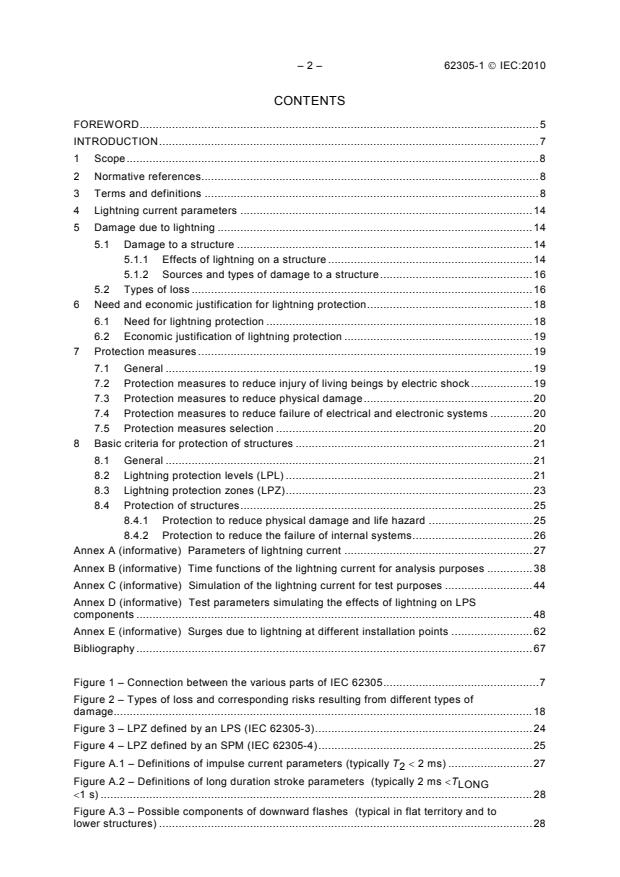
IEC 62305-1:2010 - Protection against lightning - Part 1: General principles Released:12/9/2010
Overview
IEC 62305-1:2010 - Protection against lightning, Part 1: General principles defines the general principles for protecting structures, their installations and contents, and people from lightning. This second edition (2010) is a technical revision of the 2006 edition and introduces several important updates: it no longer covers protection of services connected to structures, it adds isolated interfaces as protection measures for electrical/electronic systems, it introduces the first negative impulse current as a lightning parameter for calculations, and it refines expected surge overcurrents for low-voltage power and telecommunication systems.
Keywords: IEC 62305-1, protection against lightning, lightning protection standards, lightning protection systems.
Key topics and technical requirements
- Scope & principles: Establishes foundational concepts and terminology used across the IEC 62305 series (threat, risk, protection measures).
- Lightning current parameters: Defines parameters used for design and testing (including the newly introduced first negative impulse current) and supplies statistical values and probability tables.
- Damage and types of loss: Categorizes effects of lightning on structures, installations and people; links effects to appropriate protection responses.
- Risk and economic justification: Points to risk assessment methodology (see IEC 62305-2) to determine need and cost-effectiveness of protection measures.
- Protection measures overview: Describes classes of measures to reduce:
- physical damage and life hazard (further detailed in IEC 62305-3),
- failures of electrical and electronic systems (further detailed in IEC 62305-4), including isolated interfaces and surge protection.
- Basic design criteria: Introduces Lightning Protection Levels (LPL), Lightning Protection Zones (LPZ) and criteria for selecting measures.
- Informative annexes: Provide reference data and methods for lightning parameters, time functions, simulation and test parameters, and expected surge overcurrents for different installation points.
Keywords: lightning current parameters, LPL, LPZ, surge overcurrents, isolated interfaces.
Practical applications - who uses this standard
- Design and electrical engineers developing lightning protection systems (LPS) and surge protective measures (SPM).
- Architects and safety managers assessing building resilience to lightning.
- Telecommunications and power distribution engineers designing low-voltage and telecom protection.
- Test laboratories and manufacturers of LPS/SPM components for compliance and test planning.
- Regulators and certification bodies referencing harmonized international requirements.
Keywords: lightning protection systems, surge protection, low-voltage protection, telecommunication protection.
Related standards
- IEC 62305-2 - Risk management for lightning protection.
- IEC 62305-3 - Physical damage to structures and life hazard protection (LPS).
- IEC 62305-4 - Protection of electrical and electronic systems within structures (SPM).
Using IEC 62305-1 ensures consistent terminology, selection criteria and reference data across the IEC 62305 series for effective, economically justified lightning protection design and implementation.
Relations
- Effective Date
- 25-Aug-2026
- Effective Date
- 25-Aug-2026
- Effective Date
- 25-Aug-2026
- Effective Date
- 05-Sep-2023
- Effective Date
- 05-Sep-2023
Buy Documents
IEC 62305-1:2010 - Protection against lightning - Part 1: General principles Released:12/9/2010
IEC 62305-1:2010 - Protection against lightning - Part 1: General principles Released:12/9/2010
Get Certified
Connect with accredited certification bodies for this standard

DIBt (Deutsches Institut für Bautechnik)
German Institute for Building Technology.
DIN CERTCO
DIN Group product certification.

IMQ S.p.A. (Certification)
Italian electrical product certification.
Sponsored listings
Frequently Asked Questions
IEC 62305-1:2010 is a standard published by the International Electrotechnical Commission (IEC). Its full title is "Protection against lightning - Part 1: General principles". This standard covers: IEC 62305-1:2010 provides general principles to be followed for protection of structures against lightning, including their installations and contents, as well as persons. This second edition cancels and replaces the first edition, published in 2006, and constitutes a technical revision. This edition includes the following significant technical changes with respect to the previous edition: 1) It no longer covers protection of services connected to structures. 2) Isolated interfaces are introduced as protection measures to reduce failure of electric and electronic systems. 3) First negative impulse current is introduced as a new lightning parameter for calculation purposes. 4) Expected surge overcurrents due to lightning flashes have been more accurately specified for low voltage power systems and for telecommunication systems. This bilingual version (2013-01) corresponds to the monolingual English version, published in 2010-12.
IEC 62305-1:2010 provides general principles to be followed for protection of structures against lightning, including their installations and contents, as well as persons. This second edition cancels and replaces the first edition, published in 2006, and constitutes a technical revision. This edition includes the following significant technical changes with respect to the previous edition: 1) It no longer covers protection of services connected to structures. 2) Isolated interfaces are introduced as protection measures to reduce failure of electric and electronic systems. 3) First negative impulse current is introduced as a new lightning parameter for calculation purposes. 4) Expected surge overcurrents due to lightning flashes have been more accurately specified for low voltage power systems and for telecommunication systems. This bilingual version (2013-01) corresponds to the monolingual English version, published in 2010-12.
IEC 62305-1:2010 is classified under the following ICS (International Classification for Standards) categories: 29.020 - Electrical engineering in general; 91.120.40 - Lightning protection. The ICS classification helps identify the subject area and facilitates finding related standards.
IEC 62305-1:2010 has the following relationships with other standards: It is inter standard links to EN ISO 21789:2022, EN 13084-6:2004, EN ISO 20257-1:2020, IEC 62305-1:2024, IEC 62305-1:2006. Understanding these relationships helps ensure you are using the most current and applicable version of the standard.
IEC 62305-1:2010 is available in PDF format for immediate download after purchase. The document can be added to your cart and obtained through the secure checkout process. Digital delivery ensures instant access to the complete standard document.
Standards Content (Sample)
IEC 62305-1 ®
Edition 2.0 2010-12
INTERNATIONAL
STANDARD
Protection against lightning –
Part 1: General principles
All rights reserved. Unless otherwise specified, no part of this publication may be reproduced or utilized in any form
or by any means, electronic or mechanical, including photocopying and microfilm, without permission in writing from
either IEC or IEC's member National Committee in the country of the requester.
If you have any questions about IEC copyright or have an enquiry about obtaining additional rights to this publication,
please contact the address below or your local IEC member National Committee for further information.
IEC Central Office
3, rue de Varembé
CH-1211 Geneva 20
Switzerland
Email: inmail@iec.ch
Web: www.iec.ch
About the IEC
The International Electrotechnical Commission (IEC) is the leading global organization that prepares and publishes
International Standards for all electrical, electronic and related technologies.
About IEC publications
The technical content of IEC publications is kept under constant review by the IEC. Please make sure that you have the
latest edition, a corrigenda or an amendment might have been published.
§ Catalogue of IEC publications: www.iec.ch/searchpub
The IEC on-line Catalogue enables you to search by a variety of criteria (reference number, text, technical committee,…).
It also gives information on projects, withdrawn and replaced publications.
§ IEC Just Published: www.iec.ch/online_news/justpub
Stay up to date on all new IEC publications. Just Published details twice a month all new publications released. Available
on-line and also by email.
§ Electropedia: www.electropedia.org
The world's leading online dictionary of electronic and electrical terms containing more than 20 000 terms and definitions
in English and French, with equivalent terms in additional languages. Also known as the International Electrotechnical
Vocabulary online.
§ Customer Service Centre: www.iec.ch/webstore/custserv
If you wish to give us your feedback on this publication or need further assistance, please visit the Customer Service
Centre FAQ or contact us:
Email: csc@iec.ch
Tel.: +41 22 919 02 11
Fax: +41 22 919 03 00
IEC 62305-1 ®
Edition 2.0 2010-12
INTERNATIONAL
STANDARD
Protection against lightning –
Part 1: General principles
INTERNATIONAL
ELECTROTECHNICAL
COMMISSION
PRICE CODE
XB
ICS 29.020; 91.120.40 ISBN 978-2-88912-280-6
– 2 – 62305-1 Ó IEC:2010(E)
CONTENTS
FOREW ORD . 5
INTRODUCTION . 7
1 Scope . 8
2 Normativ e references . 8
3 Terms and definitions . 8
4 Lightning current parameters . 14
5 Damage due to lightning . 14
5.1 Damage to a structure. 14
5.1.1 Effects of lightning on a structure . 14
5.1.2 Sources and types of damage to a structure . 16
5.2 Types of loss . 16
6 Need and economic justification for lightning protection . 18
6.1 Need for lightning protection . 18
6.2 Economic justification of lightning protection . 19
7 Protection measures. 19
7.1 General . 19
7.2 Protection measures to reduce injury of living beings by electric shock . 19
7.3 Protection measures to reduce physical damage . 20
7.4 Protection measures to reduce failure of electrical and electronic systems . 20
7.5 Protection measures selection . 20
8 Basic criteria for protection of structures. 21
8.1 General . 21
8.2 Lightning protection levels (LPL) . 21
8.3 Lightning protection zones (LPZ) . 23
8.4 Protection of structures . 25
8.4.1 Protection to reduce physical damage and life hazard . 25
8.4.2 Protection to reduce the failure of internal systems . 26
Annex A (informative) Parameters of lightning current . 27
Annex B (informative) Time functions of the lightning current for analysis purposes . 38
Annex C (informative) Simulation of the lightning current for test purposes . 44
Annex D (informative) Test parameters simulating the effects of lightning on LPS
com ponents . 48
Annex E (informative) Surges due to lightning at different installation points . 62
Bibliography . 67
Figure 1 – Connection between the various parts of IEC 62305 . 7
Figure 2 – Types of loss and corresponding risks resulting from different types of
dam age . 18
Figure 3 – LPZ defined by an LPS (IEC 62305-3) . 24
Figure 4 – LPZ defined by an SPM (IEC 62305-4) . 25
Figure A.1 – Definitions of impulse current parameters (typically T � 2 ms) . 27
Figure A.2 – Definitions of long duration stroke parameters (typically 2 ms �T
LONG
�1 s) . 28
62305-1 Ó IEC:2010(E) – 3 –
Figure A.3 – Possible components of downward flashes (typical in flat territory and
to lower structures) . 28
Figure A.4 – Possible components of upward flashes (typical to exposed and/or
higher structures) . 29
Figure A.5 – Cumulative frequency distribution of lightning current parameters (lines
through 95 % and 5 % value) . 34
Figure B.1 – Shape of the current rise of the first positive impulse . 39
Figure B.2 – Shape of the current tail of the first positive impulse . 40
Figure B.3 – Shape of the current rise of the first negative impulse . 40
Figure B.4 – Shape of the current tail of the first negative impulse . 41
Figure B.5 – Shape of the current rise of the subsequent negative impulses . 42
Figure B.6 – Shape of the current tail of the subsequent negative impulses . 42
Figure B.7 – Amplitude density of the lightning current according to LPL I . 43
Figure C.1 – Example test generator for the simulation of the specific energy of the
first positive impulse and the charge of the long stroke . 45
Figure C.2 – Definition of the current steepness in accordance with Table C.3 . 46
Figure C.3 – Example test generator for the simulation of the front steepness of the
first positive impulse for large test items . 47
Figure C.4 – Example test generator for the simulation of the front steepness of the
subsequent negative impulses for large test items . 47
Figure D.1 – General arrangement of two conductors for the calculation of
electrodynamic force . 54
Figure D.2 – Typical conductor arrangement in an LPS. 55
Figure D.3 – Diagram of the stresses F for the configuration of Figure D.2. 55
Figure D.4 – Force per unit length F’ along the horizontal conductor of Figure D.2 . 56
Table 1 – Effects of lightning on typical structures . 15
Table 2 – Damage and loss relevant to a structure according to different points of
strike of lightning . 17
Table 3 – Maximum values of lightning parameters according to LPL . 22
Table 4 – Minimum values of lightning parameters and related rolling sphere radius
corresponding to LPL . 22
Table 5 – Probabilities for the limits of the lightning current parameters . 23
Table A.1 – Tabulated values of lightning current parameters taken from CIGRE
[3], [4]
(Electra No. 41 or No. 69) . 31
Table A.2 – Logarithmic normal distribution of lightning current parameters – Mean
m and dispersion σ calculated from 95 % and 5 % values from CIGRE (Electra No.
log
[3], [4]
41 or No. 69) . 32
Table A.3 – Values of probability P as function of the lightning current I . 33
Table B.1 – Parameters for Equation (B.1). 38
Table C.1 – Test parameters of the first positive impulse . 45
Table C.2 – Test parameters of the long stroke . 45
Table C.3 – Test parameters of the impulses . 46
Table D.1 – Summary of the lightning threat parameters to be considered in the
calculation of the test values for the different LPS components and for the different
LPL 49
Table D.2 – Physical characteristics of typical materials used in LPS components . 52
– 4 – 62305-1 Ó IEC:2010(E)
Table D.3 – Temperature rise for conductors of different sections as a function of
W/R . 52
Table E.1 – Conventional earthing impedance values Z and Z according to the
resistivity of the soil . 63
Table E.2 – Expected surge overcurrents due to lightning flashes on low-voltage
system s . 64
Table E.3 – Expected surge overcurrents due to lightning flashes on
telecommunication systems . 65
62305-1 Ó IEC:2010(E) – 5 –
INTERNATIONAL ELECTROTECHNICAL COMMISSION
____________
PROTECTION AGAINST LIGHTNING –
Part 1: General principles
FOREWORD
1) The International Electrotechnical Commission (IEC) is a worldwide organization for standardization comprising
all national electrotechnical committees (IEC National Committees). The object of IEC is to promote international
co-operation on all questions concerning standardization in the electrical and electronic fields. To this end and in
addition to other activities, IEC publishes International Standards, Technical Specifications, Technical Reports,
Publicly Available Specifications (PAS) and Guides (hereafter referred to as “IEC Publication(s)”). Their
preparation is entrusted to technical committees; any IEC National Committee interested in the subject dealt with
may participate in this preparatory work. International, governmental and non-governmental organizations liaising
with the IEC also participate in this preparation. IEC collaborates closely with the International Organization for
Standardization (ISO) in accordance with conditions determined by agreement between the two organizations.
2) The formal decisions or agreements of IEC on technical matters express, as nearly as possible, an international
consensus of opinion on the relevant subjects since each technical committee has representation from all
interested IEC National Committees.
3) IEC Publications have the form of recommendations for international use and are accepted by IEC National
Committees in that sense. While all reasonable efforts are made to ensure that the technical content of IEC
Publications is accurate, IEC cannot be held responsible for the way in which they are used or for any
misinterpretation by any end user.
4) In order to promote international uniformity, IEC National Committees undertake to apply IEC Publications
transparently to the maximum extent possible in their national and regional publications. Any divergence between
any IEC Publication and the corresponding national or regional publication shall be clearly indicated in the latter.
5) IEC itself does not provide any attestation of conformity. Independent certification bodies provide conformity
assessment services and, in some areas, access to IEC marks of conformity. IEC is not responsible for any
services carried out by independent certification bodies.
6) All users should ensure that they have the latest edition of this publication.
7) No liability shall attach to IEC or its directors, employees, servants or agents including individual experts and
members of its technical committees and IEC National Committees for any personal injury, property damage or
other damage of any nature whatsoever, whether direct or indirect, or for costs (including legal fees) and
expenses arising out of the publication, use of, or reliance upon, this IEC Publication or any other IEC
Publications.
8) Attention is drawn to the Normative references cited in this publication. Use of the referenced publications is
indispensable for the correct application of this publication.
9) Attention is drawn to the possibility that some of the elements of this IEC Publication may be the subject of
patent rights. IEC shall not be held responsible for identifying any or all such patent rights.
International Standard IEC 62305-1 has been prepared by IEC technical committee 81:
Lightning protection.
This second edition cancels and replaces the first edition, published in 2006, and
constitutes a technical revision.
This edition includes the following significant technical changes with respect to the previous
edition:
1) It no longer covers protection of services connected to structures.
2) Isolated interfaces are introduced as protection measures to reduce failure of electric
and electronic systems.
3) First negative impulse current is introduced as a new lightning parameter for calculation
purposes.
4) Expected surge overcurrents due to lightning flashes have been more accurately
specified for low voltage power systems and for telecommunication systems.
– 6 – 62305-1 Ó IEC:2010(E)
The text of this standard is based on the following documents:
FDIS Report on voting
81/370/FDIS 81/380/RVD
Full information on the voting for the approval of this standard can be found in the report on
voting indicated in the above table.
This publication has been drafted in accordance with the ISO/IEC Directives, Part 2.
A list of all the parts in the IEC 62305 series, under the general title Protection against
lightning, can be found on the IEC website.
The committee has decided that the contents of this publication will remain unchanged until
the stability date indicated on the IEC web site under "http://webstore.iec.ch" in the data
related to the specific publication. At this date, the publication will be
reconfirmed,
withdrawn,
replaced by a revised edition, or
amended.
A bilingual version of this standard may be issued at a later date.
62305-1 Ó IEC:2010(E) – 7 –
INTRODUCTION
There are no devices or methods capable of modifying the natural weather phenomena to
the extent that they can prevent lightning discharges. Lightning flashes to, or nearby,
structures (or lines connected to the structures) are hazardous to people, to the structures
themselves, their contents and installations as well as to lines. This is why the application
of lightning protection measures is essential.
The need for protection, the economic benefits of installing protection measures and the
selection of adequate protection measures should be determined in terms of risk
management. Risk management is the subject of IEC 62305-2.
Protection measures considered in IEC 62305 are proved to be effective in risk reduction.
All measures for protection against lightning form the overall lightning protection. For
practical reasons the criteria for design, installation and maintenance of lightning protection
measures are considered in two separate groups:
– the first group concerning protection measures to reduce physical damage and life
hazard in a structure is given in IEC 62305-3;
– the second group concerning protection measures to reduce failures of electrical and
electronic systems in a structure is given in IEC 62305-4.
The connection between the parts of IEC 62305 is illustrated in Figure 1.
The lightning threat IEC 62305-1
IEC 62305-2
Lightning risk
L
Lightning protection
SPM
LPS
Protection measures IEC 62305-4
IEC 62305-3
IEC 2612/10
Figure 1 – Connection between the various parts of IEC 62305
– 8 – 62305-1 Ó IEC:2010(E)
PROTECTION AGAINST LIGHTNING –
Part 1: General principles
1 Scope
This part of IEC 62305 provides general principles to be followed for protection of structures
against lightning, including their installations and contents, as well as persons.
The following cases are outside the scope of this standard:
– railway systems;
– vehicles, ships, aircraft, offshore installations;
– underground high pressure pipelines;
- pipe, power and telecommunication lines placed outside the structure.
NOTE These systems usually fall under special regulations produced by various specialized authorities.
2 Normative references
The following referenced documents are indispensable for the application of this document.
For dated references, only the edition cited applies. For undated references, the latest
edition of the referenced document (including any amendments) applies.
IEC 62305-2:2010, Protection against lightning – Part 2: Risk management
IEC 62305-3:2010, Protection against lightning – Part 3: Physical damage to structures and
life hazard
IEC 62305-4:2010, Protection against lightning – Part 4: Electrical and electronic systems
within structures
3 Terms and definitions
For the purposes of this document, the following terms and definitions apply.
3.1
lightning flash to earth
electrical discharge of atmospheric origin between cloud and earth consisting of one or
more strokes
3.2
downward flash
lightning flash initiated by a downward leader from cloud to earth
NOTE A downward flash consists of a first impulse, which can be followed by subsequent impulses. One or more
impulses may be followed by a long stroke.
3.3
upward flash
lightning flash initiated by an upward leader from an earthed structure to cloud
62305-1 Ó IEC:2010(E) – 9 –
NOTE An upward flash consists of a first long stroke with or without multiple superimposed impulses. One or more
impulses may be followed by a long stroke.
3.4
lightning stroke
single electrical discharge in a lightning flash to earth
3.5
short stroke
part of the lightning flash which corresponds to an impulse current
NOTE This current has a time T to the half peak value on the tail typically less than 2 ms (see Figure A.1).
3.6
long stroke
part of the lightning flash which corresponds to a continuing current
NOTE The duration time T (time from the 10 % value on the front to the 10 % value on the tail) of this
LONG
continuing current is typically more than 2 ms and less than 1 s (see Figure A.2).
3.7
multiple strokes
lightning flash consisting on average of 3-4 strokes, with typical time interval between them
of about 50 ms
NOTE Events having up to a few dozen strokes with intervals between them ranging from 10 ms to 250 ms have
been reported.
3.8
point of strike
point where a lightning flash strikes the earth, or protruding structure (e.g. structure, LPS,
line, tree, etc.)
NOTE A lightning flash may have more than one point of strike.
3.9
lightning current
i
current flowing at the point of strike
3.10
current peak value
I
maximum value of the lightning current
3.11
average steepness of the front of impulse current
average rate of change of current within a time interval Δt = t – t
2 1
NOTE It is expressed by the difference Δi = i(t ) – i(t ) of the values of the current at the start and at the end of this
2 1
interval, divided by the time interval Δt = t – t (see Figure A.1).
2 1
3.12
front time of impulse current
T
virtual parameter defined as 1,25 times the time interval between the instants when the
10 % and 90 % of the peak value are reached (see Figure A.1)
– 10 – 62305-1 Ó IEC:2010(E)
3.13
virtual origin of impulse current
O
point of intersection with time axis of a straight line drawn through the 10 % and the 90 %
reference points on the stroke current front (see Figure A.1); it precedes by 0,1 T that
instant at which the current attains 10 % of its peak value
3.14
time to half value on the tail of impulse current
T
virtual parameter defined as the time interval between the virtual origin O and the instant
at which the current has decreased to half the peak value on the tail (see Figure A.1)
3.15
flash duration
T
time for which the lightning current flows at the point of strike
3.16
duration of long stroke current
T
LONG
time duration during which the current in a long stroke is between 10 % of the peak value
during the increase of the continuing current and 10 % of the peak value during the
decrease of the continuing current (see Figure A.2)
3.17
flash charge
Q
FLASH
value resulting from the time integral of the lightning current for the entire lightning flash
duration
3.18
impulse charge
Q
SHORT
value resulting from the time integral of the lightning current in an impulse
3.19
long stroke charge
Q
LONG
value resulting from the time integral of the lightning current in a long stroke
3.20
specific energy
W/R
value resulting from the time integral of the square of the lightning current for the entire
flash duration
NOTE It represents the energy dissipated by the lightning current in a unit resistance.
3.21
specific energy of impulse current
value resulting from the time integral of the square of the lightning current for the duration
of the impulse
NOTE The specific energy in a long stroke current is negligible.
62305-1 Ó IEC:2010(E) – 11 –
3.22
structure to be protected
structure for which protection is required against the effects of lightning in accordance with
this standard
NOTE A structure to be protected may be part of a larger structure.
3.23
line
power line or telecommunication line connected to the structure to be protected
3.24
telecommunication lines
lines intended for communication between equipment that may be located in separate
structures, such as a phone line and a data line
3.25
power lines
distribution lines feeding electrical energy into a structure to power electrical and electronic
equipment located there, such as low voltage (LV) or high voltage (HV) electric mains
3.26
lightning flash to a structure
lightning flash striking a structure to be protected
3.27
lightning flash near a structure
lightning flash striking close enough to a structure to be protected that it may cause
dangerous overvoltages
3.28
electrical system
system incorporating low voltage power supply components
3.29
electronic system
system incorporating sensitive electronic components such as telecommunication
equipment, computer, control and instrumentation systems, radio systems, power electronic
installations
3.30
internal systems
electrical and electronic systems within a structure
3.31
physical damage
damage to a structure (or to its contents) due to mechanical, thermal, chemical and
explosive effects of lightning
3.32
injury of living beings
permanent injuries, including loss of life, to people or to animals by electric shock due to
touch and step voltages caused by lightning
NOTE Although living beings may be injured in other ways, in this standard the term ‘injury to living beings’ is
limited to the threat due to electrical shock (type of damage D1).
– 12 – 62305-1 Ó IEC:2010(E)
3.33
failure of electrical and electronic systems
permanent damage of electrical and electronic systems due to LEMP
3.34
lightning electromagnetic impulse
LEMP
all electromagnetic effects of lightning current via resistive, inductive and capacitive
coupling that create surges and radiated electromagnetic fields
3.35
surge
transient created by LEMP that appears as an overvoltage and/or an overcurrent
3.36
lightning protection zone
LPZ
zone where the lightning electromagnetic environment is defined
NOTE The zone boundaries of an LPZ are not necessarily physical boundaries (e.g. walls, floor and ceiling).
3.37
risk
R
value of probable average annual loss (humans or goods) due to lightning, relative to the
total value (humans or goods) of the structure to be protected
3.38
tolerable risk
R
T
maximum value of the risk which can be tolerated for the structure to be protected
3.39
lightning protection level
LPL
number related to a set of lightning current parameters values relevant to the probability
that the associated maximum and minimum design values will not be exceeded in naturally
occurring lightning
NOTE Lightning protection level is used to design protection measures according to the relevant set of lightning
current parameters.
3.40
protection measures
measures to be adopted for the structure to be protected in order to reduce the risk
3.41
lightning protection
LP
complete system for protection of structures against lightning, including their internal
systems and contents, as well as persons, in general consisting of an LPS and SPM
3.42
lightning protection system
LPS
complete system used to reduce physical damage due to lightning flashes to a structure
NOTE It consists of both external and internal lightning protection systems.
62305-1 Ó IEC:2010(E) – 13 –
3.43
external lightning protection system
part of the LPS consisting of an air-termination system, a down-conductor system and an
earth-termination system
3.44
internal lightning protection system
part of the LPS consisting of lightning equipotential bonding and/or electrical insulation of
external LPS
3.45
air-termination system
part of an external LPS using metallic elements such as rods, mesh conductors or catenary
wires intended to intercept lightning flashes
3.46
down-conductor system
part of an external LPS intended to conduct lightning current from the air-termination
system to the earth-termination system
3.47
earth-termination system
part of an external LPS which is intended to conduct and disperse lightning current into the
earth
3.48
external conductive parts
extended metal items entering or leaving the structure to be protected such as pipe works,
cable metallic elements, metal ducts, etc. which may carry a part of the lightning current
3.49
lightning equipotential bonding
EB
bonding to LPS of separated metallic parts, by direct conductive connections or via surge
protective devices, to reduce potential differences caused by lightning current
3.50
conventional earthing impedance
ratio of the peak values of the earth-termination voltage and the earth-termination current
which, in general, do not occur simultaneously
3.51
LEMP protection measures
SPM
measures taken to protect internal systems against the effects of LEMP
NOTE This is part of overall lightning protection.
3.52
magnetic shield
closed, metallic, grid-like or continuous screen enveloping the structure to be protected, or
part of it, used to reduce failures of electrical and electronic systems
3.53
surge protective device
SPD
device intended to limit transient overvoltages and divert surge currents; contains at least
one non linear component
– 14 – 62305-1 Ó IEC:2010(E)
3.54
coordinated SPD system
SPDs properly selected, coordinated and installed to form a system intended to reduce
failures of electrical and electronic systems
3.55
rated impulse withstand voltage
U
W
impulse withstand voltage assigned by the manufacturer to the equipment or to a part of it,
characterizing the specified withstand capability of its insulation against overvoltages
NOTE For the purposes of this standard, only withstand voltage between live conductors and earth is considered.
[1]
[IEC 60664-1:2007, definition 3.9.2]
3.56
isolating interfaces
devices which are capable of reducing conducted surges on lines entering the LPZ
NOTE 1 These include isolation transformers with earthed screen between windings, metal free fibre optic
cables and opto-isolators.
NOTE 2 Insulation withstand characteristics of these devices are suitable for this application intrinsically or via
SPD.
4 Lightning current parameters
The lightning current parameters used in the IEC 62305 series are given in Annex A.
The time function of the lightning current to be used for analysis purposes is given in
Annex B.
Information for simulation of lightning current for test purposes is given in Annex C.
The basic parameters to be used in laboratories to simulate the effects of lightning on LPS
components are given in Annex D.
Information on surges due to lightning at different installation points is given in Annex E.
5 Damage due to lightning
5.1 Damage to a structure
Lightning affecting a structure can cause damage to the structure itself and to its occupants
and contents, including failure of internal systems. The damages and failures may also
extend to the surroundings of the structure and even involve the local environment.
The scale of this extension depends on the characteristics of the structure and on the
characteristics of the lightning flash.
5.1.1 Effects of lightning on a structure
The main characteristics of structures relevant to lightning effects include:
- construction (e.g. wood, brick, concrete, reinforced concrete, steel frame construction);
___________
References in square brackets refer to the bibliography.
62305-1 Ó IEC:2010(E) – 15 –
- function (dwelling house, office, farm, theatre, hotel, school, hospital, museum, church,
prison, department store, bank, factory, industry plant, sports area);
- occupants and contents (persons and animals, presence of combustible or non-
combustible materials, explosive or non-explosive materials, electrical and electronic
systems with low or high withstand voltage);
- connected lines (power lines, telecommunication lines, pipelines);
- existing or provided protection measures (protection measures to reduce physical
damage and life hazard, protection measures to reduce failure of internal systems);
- scale of the extension of danger (structure with difficulty of evacuation or structure where
panic may be created, structure dangerous to the surroundings, structure dangerous to
the environment).
Table 1 reports the effects of lightning on various types of structures.
Table 1 – Effects of lightning on typical structures
Type of structure according to
Effects of lightning
function and/or contents
Dwelling-house Puncture of electrical installations, fire and material damage
Damage normally limited to structures exposed to the point of strike or to the
lightning current path
Failure of electrical and electronic equipment and systems installed (e.g. TV
sets, computers, modems, telephones, etc.)
Farm building Primary risk of fire and hazardous step voltages as well as material damage
Secondary risk due to loss of electric power, and life hazard to livestock due to
failure of electronic control of ventilation and food supply systems, etc.
Theatre Damage to the electrical installations (e.g. electric lighting) likely to cause
panic
Hotel
Failure of fire alarms resulting in delayed fire fighting measures
School
Department store
Sports area
Bank As above, plus problems resulting from loss of communication, failure of
computers and loss of data
Insurance company
Commercial company, etc.
Hospital As above, plus problems of people in intensive care, and the difficulties of
rescuing immobile people
Nursing home
Prison
Industry Additional effects depending on the contents of factories, ranging from minor
to unacceptable damage and loss of production
Museums and archaeological site Loss of irreplaceable cultural heritage
Church
Telecommunication Unacceptable loss of services to the public
Power plants
Firework factory Consequences of fire and explosion to the plant and its surroundings
Munitions works
Chemical plant Fire and malfunction of the plant with detrimental consequences to the local
and global environment
Refinery
Nuclear plant
Biochemical laboratories and plants
– 16 – 62305-1 Ó IEC:2010(E)
5.1.2 Sources and types of damage to a structure
The lightning current is the source of damage. The following situations shall be taken into
account, depending on the position of the point of strike relative to the structure considered:
a) S1: flashes to the structure;
b) S2: flashes near the structure;
c) S3: flashes to the lines connected to the structure;
d) S4: flashes near the lines connected to the structure.
a) Flashes to the structure can cause:
– immediate mechanical damage, fire and/or explosion due to the hot lightning plasma arc
itself, due to the current resulting in ohmic heating of conductors (over-heated
conductors), or due to the charge resulting in arc erosion (melted metal);
– fire and/or explosion triggered by sparks caused by overvoltages resulting from resistive
and inductive coupling and to passage of part of the lightning currents;
– injury to living beings by electric shock due to step and touch voltages resulting from
resistive and inductive coupling;
– failure or malfunction of internal systems due to LEMP.
b) Flashes near the structure can cause:
– failure or malfunction of internal systems due to LEMP.
c) Flashes to a line connected to the structure can cause:
– fire and/or explosion triggered by sparks due to overvoltages and lightning currents
transmitted through the connected line;
– injury to living beings by electric shock due to touch voltages inside the structure
caused by lightning currents transmitted through the connected line;
– failure or malfunction of internal systems due to overvoltages appearing on connected
lines and transmitted to the structure.
d) Flashes near a line connected to the structure can cause:
– failure or malfunction of internal systems due to overvoltages induced on connected
lines and transmitted to the structure.
NOTE 1 Malfunctioning of internal systems is not covered by the IEC 62305 series. Reference should be made to
[2]
IEC 61000-4-5 .
NOTE 2 Only the sparks carrying lightning current (total or partial) are regarded as able to trigger fire.
NOTE 3 Lightning flashes, direct to or near the incoming pipelines, do not cause damages to the structure,
provided that they are bonded to the equipotential bar of the structure (see IEC 62305-3).
As a result, the lightning can cause three basic type of damage:
- D1: injury to living beings by electric shock;
- D2: physical damage (fire, explosion, mechanical destruction, chemical release) due to
lightning current effects, including sparking;
- D3: failure of internal systems due to LEMP.
5.2 Types of loss
Each type of damage relevant to structure to be protected, alone or in combination with
others, may produce different consequential loss. The type of loss that may appear depends
on the characteristics of the structure itself.
62305-1 Ó IEC:2010(E) – 17 –
For the purposes of IEC 62305, the following types of loss, which may appear as
consequence of damages relevant to structure, are considered:
- L1: loss of human life (including permanent injury);
- L2: loss of service to the public;
- L3: loss of cultural heritage;
- L4: loss of economic value (structure, its content, and loss of activity).
NOTE For the purposes of IEC 62305, only utilities such as gas,water,TV, TLC and power supply are considered
service to the public.
Losses of type L1, L2 and L3 may be considered as loss of social values, whereas a loss of
type L4 may be considered as purely an economic loss.
The relationship between source of damage, type of damage and loss is reported in Table
2.
Table 2 – Damage and loss relevant to a structure according to
different points of strike of lightning
Point of strike Source of damage Type of damage Type of loss
a
D1 L1 L4
,
Structure S1 D2 L1, L2, L3, L4
b
D3 L1 , L2, L4
b
Near a structure S2 D3 L1 , L2, L4
a
D1 L1, L4
Line connected to the
L1, L2, L3, L4
S3 D2
structure
b
D3 L1 , L2, L4
b
Near a line S4 D3 L1 , L2, L4
a Only for properties where animals may be lost.
b Only for structures with risk of explosion and for hospitals or other structures where failure of internal systems
immediately endangers human life.
– 18 – 62305-1 Ó IEC:2010(E)
Types of loss resulting from types of damage and the corresponding risks are reported in
Figure 2.
Risk
Risk Risk
Risk
R
R R 4
2 3
R
Loss of
Loss of Loss of
Loss of
Type of cultural
service to economic
human life
the public heritage values
loss
2)
Injury Injury
1)
Failure Failure Failure
to living
Type of to living
Physical Physical Physical Physical
of internal of internal
of internal
beings beings
damage damage damage damage
damage
systems systems
systems
by electric
by electric
shock
shock
IEC 2613/10
a
Only for hospitals or other structures where failure of internal systems immediately endanger human life.
b
Only for properties where animals may be lost.
Figure 2 – Types of loss and corresponding risks resulting
from different types of damage
6 Need and economic justification for lightning protection
6.1 Need for lightning protection
The need for the lightning protection of a structure to be protected in order to reduce the
loss of social values L1, L2 and L3 shall be evaluated.
In order to evaluate whether or not lightning protection of a structure is needed, a risk
assessment in accordance with the procedures contained in IEC 62305-2 shall be made.
The following risks shall be taken into account, corresponding to the types of loss reported
in 5.2:
- R : risk of loss or permanent injury of human life;
- R : risk of loss of services to the public;
- R : risk of loss of cultural heritage.
NOTE 1 Risk R : risk of loss of economic values, should be assessed whenever the economic justification of
lightning protection is considered (see 6.2).
Protection against lightning is needed if the risk R (R to R ) is higher than the tolerable
1 3
level R
T
R � R
T
In this case, protection measures shall be adopted in order reduce the risk R (R to R ) to
1 3
the tolerable level R
T
R £ R
T
62305-1 Ó IEC:2010(E) – 19 –
If more than one type of loss could appear, the condition R £ R shall be satisfied for each
T
type of loss (L1, L2 and L3).
The values of tolerable risk R where lightning could result in the loss of items of social
T
value should be under the responsibility of a competent national body.
NOTE 2 An authority having jurisdiction may specify the need for lightning protection for specific applications
without requiring a risk assessment. In these cases, the required lightning protection level will be specified by the
authority having jurisdiction. In some cases, a risk assessment may be performed as a technique by which to justify
a waiver to these requirements.
NOTE 3 Detailed information on risk assessment and on the procedure for selection of protection measures is
reported in IEC 62305-2.
6.2 Economic justification of lightning protection
Besides the need for lightning protection for the structure to be protected, it may be useful
to evaluate the economic benefits of providing protection measures in order to reduce the
economic loss L4.
In this case, the risk R of loss of economic values should be assessed. The assessment of
risk R allows for the evaluation of the cost of the economic loss with and without the
adopted protection measures.
Lightning protection is cost effective if the sum of the cost C of residual loss in the
RL
presence of protection measures and the cost C of protection measures is lower than the
PM
cost C of total loss without protection measures:
L
C + C � C
RL PM L
NOTE Detailed information on the evaluation of economic justification of lightning protection is reported in
IEC 62305-2.
7 Protection measures
7.1 General
Protection measures may be adopted in order to reduce the risk according to the type of
damage.
7.2 Protection measures to reduce injury of living beings by electric shock
Possible protection measures include:
– adequate insulation of exposed conductive parts;
– equipotentialization by means of a meshed earthing system;
- physical restrictions and warning notices;
- lightning equipote
...
IEC 62305-1 ®
Edition 2.0 2010-12
INTERNATIONAL
STANDARD
NORME
INTERNATIONALE
Protection against lightning –
Part 1: General principles
Protection contre la foudre –
Partie 1: Principes généraux
All rights reserved. Unless otherwise specified, no part of this publication may be reproduced or utilized in any form
or by any means, electronic or mechanical, including photocopying and microfilm, without permission in writing from
either IEC or IEC's member National Committee in the country of the requester.
If you have any questions about IEC copyright or have an enquiry about obtaining additional rights to this publication,
please contact the address below or your local IEC member National Committee for further information.
Droits de reproduction réservés. Sauf indication contraire, aucune partie de cette publication ne peut être reproduite ni
utilisée sous quelque forme que ce soit et par aucun procédé, électronique ou mécanique, y compris la photocopie et les
microfilms, sans l'accord écrit de la CEI ou du Comité national de la CEI du pays du demandeur.
Si vous avez des questions sur le copyright de la CEI ou si vous désirez obtenir des droits supplémentaires sur cette
publication, utilisez les coordonnées ci-après ou contactez le Comité national de la CEI de votre pays de résidence.
IEC Central Office Tel.: +41 22 919 02 11
3, rue de Varembé Fax: +41 22 919 03 00
CH-1211 Geneva 20 info@iec.ch
Switzerland www.iec.ch
About the IEC
The International Electrotechnical Commission (IEC) is the leading global organization that prepares and publishes
International Standards for all electrical, electronic and related technologies.
About IEC publications
The technical content of IEC publications is kept under constant review by the IEC. Please make sure that you have the
latest edition, a corrigenda or an amendment might have been published.
Useful links:
IEC publications search - www.iec.ch/searchpub Electropedia - www.electropedia.org
The advanced search enables you to find IEC publications The world's leading online dictionary of electronic and
by a variety of criteria (reference number, text, technical electrical terms containing more than 30 000 terms and
committee,…). definitions in English and French, with equivalent terms in
It also gives information on projects, replaced and additional languages. Also known as the International
withdrawn publications. Electrotechnical Vocabulary (IEV) on-line.
IEC Just Published - webstore.iec.ch/justpublished Customer Service Centre - webstore.iec.ch/csc
Stay up to date on all new IEC publications. Just Published If you wish to give us your feedback on this publication
details all new publications released. Available on-line and or need further assistance, please contact the
also once a month by email. Customer Service Centre: csc@iec.ch.
A propos de la CEI
La Commission Electrotechnique Internationale (CEI) est la première organisation mondiale qui élabore et publie des
Normes internationales pour tout ce qui a trait à l'électricité, à l'électronique et aux technologies apparentées.
A propos des publications CEI
Le contenu technique des publications de la CEI est constamment revu. Veuillez vous assurer que vous possédez
l’édition la plus récente, un corrigendum ou amendement peut avoir été publié.
Liens utiles:
Recherche de publications CEI - www.iec.ch/searchpub Electropedia - www.electropedia.org
La recherche avancée vous permet de trouver des Le premier dictionnaire en ligne au monde de termes
publications CEI en utilisant différents critères (numéro de électroniques et électriques. Il contient plus de 30 000
référence, texte, comité d’études,…). termes et définitions en anglais et en français, ainsi que
Elle donne aussi des informations sur les projets et les les termes équivalents dans les langues additionnelles.
publications remplacées ou retirées. Egalement appelé Vocabulaire Electrotechnique
International (VEI) en ligne.
Just Published CEI - webstore.iec.ch/justpublished
Service Clients - webstore.iec.ch/csc
Restez informé sur les nouvelles publications de la CEI.
Just Published détaille les nouvelles publications parues. Si vous désirez nous donner des commentaires sur
Disponible en ligne et aussi une fois par mois par email. cette publication ou si vous avez des questions
contactez-nous: csc@iec.ch.
IEC 62305-1 ®
Edition 2.0 2010-12
INTERNATIONAL
STANDARD
NORME
INTERNATIONALE
Protection against lightning –
Part 1: General principles
Protection contre la foudre –
Partie 1: Principes généraux
INTERNATIONAL
ELECTROTECHNICAL
COMMISSION
COMMISSION
ELECTROTECHNIQUE
PRICE CODE
INTERNATIONALE
CODE PRIX XB
ICS 29.020; 91.120.40 ISBN 978-2-83220-604-1
– 2 – 62305-1 IEC:2010
CONTENTS
FOREWORD . 5
INTRODUCTION . 7
1 Scope . 8
2 Normative references. 8
3 Terms and definitions . 8
4 Lightning current parameters . 14
5 Damage due to lightning . 14
5.1 Damage to a structure . 14
5.1.1 Effects of lightning on a structure . 14
5.1.2 Sources and types of damage to a structure . 16
5.2 Types of loss . 16
6 Need and economic justification for lightning protection . 18
6.1 Need for lightning protection . 18
6.2 Economic justification of lightning protection . 19
7 Protection measures . 19
7.1 General . 19
7.2 Protection measures to reduce injury of living beings by electric shock . 19
7.3 Protection measures to reduce physical damage . 20
7.4 Protection measures to reduce failure of electrical and electronic systems . 20
7.5 Protection measures selection . 20
8 Basic criteria for protection of structures . 21
8.1 General . 21
8.2 Lightning protection levels (LPL) . 21
8.3 Lightning protection zones (LPZ) . 23
8.4 Protection of structures . 25
8.4.1 Protection to reduce physical damage and life hazard . 25
8.4.2 Protection to reduce the failure of internal systems . 26
Annex A (informative) Parameters of lightning current . 27
Annex B (informative) Time functions of the lightning current for analysis purposes . 38
Annex C (informative) Simulation of the lightning current for test purposes . 44
Annex D (informative) Test parameters simulating the effects of lightning on LPS
components . 48
Annex E (informative) Surges due to lightning at different installation points . 62
Bibliography . 67
Figure 1 – Connection between the various parts of IEC 62305 . 7
Figure 2 – Types of loss and corresponding risks resulting from different types of
damage. 18
Figure 3 – LPZ defined by an LPS (IEC 62305-3) . 24
Figure 4 – LPZ defined by an SPM (IEC 62305-4) . 25
Figure A.1 – Definitions of impulse current parameters (typically T < 2 ms) . 27
Figure A.2 – Definitions of long duration stroke parameters (typically 2 ms
LONG
<1 s) . 28
Figure A.3 – Possible components of downward flashes (typical in flat territory and to
lower structures) . 28
62305-1 IEC:2010 – 3 –
Figure A.4 – Possible components of upward flashes (typical to exposed and/or higher
structures) . 29
Figure A.5 – Cumulative frequency distribution of lightning current parameters (lines
through 95 % and 5 % value) . 34
Figure B.1 – Shape of the current rise of the first positive impulse . 39
Figure B.2 – Shape of the current tail of the first positive impulse . 40
Figure B.3 – Shape of the current rise of the first negative impulse . 40
Figure B.4 – Shape of the current tail of the first negative impulse . 41
Figure B.5 – Shape of the current rise of the subsequent negative impulses . 42
Figure B.6 – Shape of the current tail of the subsequent negative impulses . 42
Figure B.7 – Amplitude density of the lightning current according to LPL I . 43
Figure C.1 – Example test generator for the simulation of the specific energy of the first
positive impulse and the charge of the long stroke . 45
Figure C.2 – Definition of the current steepness in accordance with Table C.3 . 46
Figure C.3 – Example test generator for the simulation of the front steepness of the
first positive impulse for large test items . 47
Figure C.4 – Example test generator for the simulation of the front steepness of the
subsequent negative impulses for large test items . 47
Figure D.1 – General arrangement of two conductors for the calculation of
electrodynamic force . 54
Figure D.2 – Typical conductor arrangement in an LPS . 55
Figure D.3 – Diagram of the stresses F for the configuration of Figure D.2 . 55
Figure D.4 – Force per unit length F’ along the horizontal conductor of Figure D.2 . 55
Table 1 – Effects of lightning on typical structures . 15
Table 2 – Damage and loss relevant to a structure according to different points of strike
of lightning . 17
Table 3 – Maximum values of lightning parameters according to LPL . 22
Table 4 – Minimum values of lightning parameters and related rolling sphere radius
corresponding to LPL . 22
Table 5 – Probabilities for the limits of the lightning current parameters . 23
Table A.1 – Tabulated values of lightning current parameters taken from CIGRE
[3], [4]
(Electra No. 41 or No. 69) . 31
Table A.2 – Logarithmic normal distribution of lightning current parameters – Mean µ
and dispersion σ calculated from 95 % and 5 % values from CIGRE (Electra No. 41
log
[3], [4]
or No. 69) . 32
Table A.3 – Values of probability P as function of the lightning current I . 33
Table B.1 – Parameters for Equation (B.1) . 38
Table C.1 – Test parameters of the first positive impulse . 45
Table C.2 – Test parameters of the long stroke . 45
Table C.3 – Test parameters of the impulses . 46
Table D.1 – Summary of the lightning threat parameters to be considered in the
calculation of the test values for the different LPS components and for the different LPL . 49
Table D.2 – Physical characteristics of typical materials used in LPS components . 52
Table D.3 – Temperature rise for conductors of different sections as a function of W/R . 52
Table E.1 – Conventional earthing impedance values Z and Z according to the
resistivity of the soil . 63
– 4 – 62305-1 IEC:2010
Table E.2 – Expected surge overcurrents due to lightning flashes on low-voltage
systems . 64
Table E.3 – Expected surge overcurrents due to lightning flashes on telecommunication
systems . 65
62305-1 IEC:2010 – 5 –
INTERNATIONAL ELECTROTECHNICAL COMMISSION
____________
PROTECTION AGAINST LIGHTNING –
Part 1: General principles
FOREWORD
1) The International Electrotechnical Commission (IEC) is a worldwide organization for standardization comprising
all national electrotechnical committees (IEC National Committees). The object of IEC is to promote
international co-operation on all questions concerning standardization in the electrical and electronic fields. To
this end and in addition to other activities, IEC publishes International Standards, Technical Specifications,
Technical Reports, Publicly Available Specifications (PAS) and Guides (hereafter referred to as “IEC
Publication(s)”). Their preparation is entrusted to technical committees; any IEC National Committee interested
in the subject dealt with may participate in this preparatory work. International, governmental and non-
governmental organizations liaising with the IEC also participate in this preparation. IEC collaborates closely
with the International Organization for Standardization (ISO) in accordance with conditions determined by
agreement between the two organizations.
2) The formal decisions or agreements of IEC on technical matters express, as nearly as possible, an international
consensus of opinion on the relevant subjects since each technical committee has representation from all
interested IEC National Committees.
3) IEC Publications have the form of recommendations for international use and are accepted by IEC National
Committees in that sense. While all reasonable efforts are made to ensure that the technical content of IEC
Publications is accurate, IEC cannot be held responsible for the way in which they are used or for any
misinterpretation by any end user.
4) In order to promote international uniformity, IEC National Committees undertake to apply IEC Publications
transparently to the maximum extent possible in their national and regional publications. Any divergence
between any IEC Publication and the corresponding national or regional publication shall be clearly indicated in
the latter.
5) IEC itself does not provide any attestation of conformity. Independent certification bodies provide conformity
assessment services and, in some areas, access to IEC marks of conformity. IEC is not responsible for any
services carried out by independent certification bodies.
6) All users should ensure that they have the latest edition of this publication.
7) No liability shall attach to IEC or its directors, employees, servants or agents including individual experts and
members of its technical committees and IEC National Committees for any personal injury, property damage or
other damage of any nature whatsoever, whether direct or indirect, or for costs (including legal fees) and
expenses arising out of the publication, use of, or reliance upon, this IEC Publication or any other IEC
Publications.
8) Attention is drawn to the Normative references cited in this publication. Use of the referenced publications is
indispensable for the correct application of this publication.
9) Attention is drawn to the possibility that some of the elements of this IEC Publication may be the subject of
patent rights. IEC shall not be held responsible for identifying any or all such patent rights.
International Standard IEC 62305-1 has been prepared by IEC technical committee 81:
Lightning protection.
This second edition cancels and replaces the first edition, published in 2006, and constitutes a
technical revision.
This edition includes the following significant technical changes with respect to the previous
edition:
1) It no longer covers protection of services connected to structures.
2) Isolated interfaces are introduced as protection measures to reduce failure of electric and
electronic systems.
3) First negative impulse current is introduced as a new lightning parameter for calculation
purposes.
4) Expected surge overcurrents due to lightning flashes have been more accurately specified
for low voltage power systems and for telecommunication systems.
– 6 – 62305-1 IEC:2010
This bilingual version (2013-01) corresponds to the monolingual English version, published in
2010-12.
The text of this standard is based on the following documents:
FDIS Report on voting
81/370/FDIS 81/380/RVD
Full information on the voting for the approval of this standard can be found in the report on
voting indicated in the above table.
The French version of this standard has not been voted upon.
This publication has been drafted in accordance with the ISO/IEC Directives, Part 2.
A list of all the parts in the IEC 62305 series, under the general title Protection against
lightning, can be found on the IEC website.
The committee has decided that the contents of this publication will remain unchanged until the
stability date indicated on the IEC web site under "http://webstore.iec.ch" in the data related to
the specific publication. At this date, the publication will be
• reconfirmed,
• withdrawn,
• replaced by a revised edition, or
• amended.
62305-1 IEC:2010 – 7 –
INTRODUCTION
There are no devices or methods capable of modifying the natural weather phenomena to the
extent that they can prevent lightning discharges. Lightning flashes to, or nearby, structures (or
lines connected to the structures) are hazardous to people, to the structures themselves, their
contents and installations as well as to lines. This is why the application of lightning protection
measures is essential.
The need for protection, the economic benefits of installing protection measures and the
selection of adequate protection measures should be determined in terms of risk management.
Risk management is the subject of IEC 62305-2.
Protection measures considered in IEC 62305 are proved to be effective in risk reduction.
All measures for protection against lightning form the overall lightning protection. For practical
reasons the criteria for design, installation and maintenance of lightning protection measures
are considered in two separate groups:
– the first group concerning protection measures to reduce physical damage and life hazard
in a structure is given in IEC 62305-3;
– the second group concerning protection measures to reduce failures of electrical and
electronic systems in a structure is given in IEC 62305-4.
The connection between the parts of IEC 62305 is illustrated in Figure 1.
The lightning threat IEC 62305-1
IEC 62305-2
Lightning risk
LP
Lightning protection
SPM
LPS
Protection measures
IEC 62305-4
IEC 62305-3
IEC 2612/10
Figure 1 – Connection between the various parts of IEC 62305
– 8 – 62305-1 IEC:2010
PROTECTION AGAINST LIGHTNING –
Part 1: General principles
1 Scope
This part of IEC 62305 provides general principles to be followed for protection of structures
against lightning, including their installations and contents, as well as persons.
The following cases are outside the scope of this standard:
– railway systems;
– vehicles, ships, aircraft, offshore installations;
– underground high pressure pipelines;
− pipe, power and telecommunication lines placed outside the structure.
NOTE These systems usually fall under special regulations produced by various specialized authorities.
2 Normative references
The following referenced documents are indispensable for the application of this document. For
dated references, only the edition cited applies. For undated references, the latest edition of
the referenced document (including any amendments) applies.
IEC 62305-2:2010, Protection against lightning – Part 2: Risk management
IEC 62305-3:2010, Protection against lightning – Part 3: Physical damage to structures and life
hazard
IEC 62305-4:2010, Protection against lightning – Part 4: Electrical and electronic systems
within structures
3 Terms and definitions
For the purposes of this document, the following terms and definitions apply.
3.1
lightning flash to earth
electrical discharge of atmospheric origin between cloud and earth consisting of one or more
strokes
3.2
downward flash
lightning flash initiated by a downward leader from cloud to earth
NOTE A downward flash consists of a first impulse, which can be followed by subsequent impulses. One or more
impulses may be followed by a long stroke.
3.3
upward flash
lightning flash initiated by an upward leader from an earthed structure to cloud
62305-1 IEC:2010 – 9 –
NOTE An upward flash consists of a first long stroke with or without multiple superimposed impulses. One or more
impulses may be followed by a long stroke.
3.4
lightning stroke
single electrical discharge in a lightning flash to earth
3.5
short stroke
part of the lightning flash which corresponds to an impulse current
NOTE This current has a time T to the half peak value on the tail typically less than 2 ms (see Figure A.1).
3.6
long stroke
part of the lightning flash which corresponds to a continuing current
NOTE The duration time T (time from the 10 % value on the front to the 10 % value on the tail) of this
LONG
continuing current is typically more than 2 ms and less than 1 s (see Figure A.2).
3.7
multiple strokes
lightning flash consisting on average of 3-4 strokes, with typical time interval between them of
about 50 ms
NOTE Events having up to a few dozen strokes with intervals between them ranging from 10 ms to 250 ms have
been reported.
3.8
point of strike
point where a lightning flash strikes the earth, or protruding structure (e.g. structure, LPS, line,
tree, etc.)
NOTE A lightning flash may have more than one point of strike.
3.9
lightning current
i
current flowing at the point of strike
3.10
current peak value
I
maximum value of the lightning current
3.11
average steepness of the front of impulse current
average rate of change of current within a time interval Δt = t – t
2 1
NOTE It is expressed by the difference Δi = i(t ) – i(t ) of the values of the current at the start and at the end of
2 1
this interval, divided by the time interval Δt = t – t (see Figure A.1).
2 1
3.12
front time of impulse current
T
virtual parameter defined as 1,25 times the time interval between the instants when the 10 %
and 90 % of the peak value are reached (see Figure A.1)
– 10 – 62305-1 IEC:2010
3.13
virtual origin of impulse current
O
point of intersection with time axis of a straight line drawn through the 10 % and the 90 %
reference points on the stroke current front (see Figure A.1); it precedes by 0,1 T that instant
at which the current attains 10 % of its peak value
3.14
time to half value on the tail of impulse current
T
virtual parameter defined as the time interval between the virtual origin O and the instant at
which the current has decreased to half the peak value on the tail (see Figure A.1)
3.15
flash duration
T
time for which the lightning current flows at the point of strike
3.16
duration of long stroke current
T
LONG
time duration during which the current in a long stroke is between 10 % of the peak value
during the increase of the continuing current and 10 % of the peak value during the decrease of
the continuing current (see Figure A.2)
3.17
flash charge
Q
FLASH
value resulting from the time integral of the lightning current for the entire lightning flash
duration
3.18
impulse charge
Q
SHORT
value resulting from the time integral of the lightning current in an impulse
3.19
long stroke charge
Q
LONG
value resulting from the time integral of the lightning current in a long stroke
3.20
specific energy
W/R
value resulting from the time integral of the square of the lightning current for the entire flash
duration
NOTE It represents the energy dissipated by the lightning current in a unit resistance.
3.21
specific energy of impulse current
value resulting from the time integral of the square of the lightning current for the duration of
the impulse
NOTE The specific energy in a long stroke current is negligible.
62305-1 IEC:2010 – 11 –
3.22
structure to be protected
structure for which protection is required against the effects of lightning in accordance with this
standard
NOTE A structure to be protected may be part of a larger structure.
3.23
line
power line or telecommunication line connected to the structure to be protected
3.24
telecommunication lines
lines intended for communication between equipment that may be located in separate
structures, such as a phone line and a data line
3.25
power lines
distribution lines feeding electrical energy into a structure to power electrical and electronic
equipment located there, such as low voltage (LV) or high voltage (HV) electric mains
3.26
lightning flash to a structure
lightning flash striking a structure to be protected
3.27
lightning flash near a structure
lightning flash striking close enough to a structure to be protected that it may cause dangerous
overvoltages
3.28
electrical system
system incorporating low voltage power supply components
3.29
electronic system
system incorporating sensitive electronic components such as telecommunication equipment,
computer, control and instrumentation systems, radio systems, power electronic installations
3.30
internal systems
electrical and electronic systems within a structure
3.31
physical damage
damage to a structure (or to its contents) due to mechanical, thermal, chemical and explosive
effects of lightning
3.32
injury of living beings
permanent injuries, including loss of life, to people or to animals by electric shock due to touch
and step voltages caused by lightning
NOTE Although living beings may be injured in other ways, in this standard the term ‘injury to living beings’ is
limited to the threat due to electrical shock (type of damage D1).
– 12 – 62305-1 IEC:2010
3.33
failure of electrical and electronic systems
permanent damage of electrical and electronic systems due to LEMP
3.34
lightning electromagnetic impulse
LEMP
all electromagnetic effects of lightning current via resistive, inductive and capacitive coupling
that create surges and radiated electromagnetic fields
3.35
surge
transient created by LEMP that appears as an overvoltage and/or an overcurrent
3.36
lightning protection zone
LPZ
zone where the lightning electromagnetic environment is defined
NOTE The zone boundaries of an LPZ are not necessarily physical boundaries (e.g. walls, floor and ceiling).
3.37
risk
R
value of probable average annual loss (humans or goods) due to lightning, relative to the total
value (humans or goods) of the structure to be protected
3.38
tolerable risk
R
T
maximum value of the risk which can be tolerated for the structure to be protected
3.39
lightning protection level
LPL
number related to a set of lightning current parameters values relevant to the probability that
the associated maximum and minimum design values will not be exceeded in naturally
occurring lightning
NOTE Lightning protection level is used to design protection measures according to the relevant set of lightning
current parameters.
3.40
protection measures
measures to be adopted for the structure to be protected in order to reduce the risk
3.41
lightning protection
LP
complete system for protection of structures against lightning, including their internal systems
and contents, as well as persons, in general consisting of an LPS and SPM
3.42
lightning protection system
LPS
complete system used to reduce physical damage due to lightning flashes to a structure
NOTE It consists of both external and internal lightning protection systems.
62305-1 IEC:2010 – 13 –
3.43
external lightning protection system
part of the LPS consisting of an air-termination system, a down-conductor system and an
earth-termination system
3.44
internal lightning protection system
part of the LPS consisting of lightning equipotential bonding and/or electrical insulation of
external LPS
3.45
air-termination system
part of an external LPS using metallic elements such as rods, mesh conductors or catenary
wires intended to intercept lightning flashes
3.46
down-conductor system
part of an external LPS intended to conduct lightning current from the air-termination system to
the earth-termination system
3.47
earth-termination system
part of an external LPS which is intended to conduct and disperse lightning current into the
earth
3.48
external conductive parts
extended metal items entering or leaving the structure to be protected such as pipe works,
cable metallic elements, metal ducts, etc. which may carry a part of the lightning current
3.49
lightning equipotential bonding
EB
bonding to LPS of separated metallic parts, by direct conductive connections or via surge
protective devices, to reduce potential differences caused by lightning current
3.50
conventional earthing impedance
ratio of the peak values of the earth-termination voltage and the earth-termination current
which, in general, do not occur simultaneously
3.51
LEMP protection measures
SPM
measures taken to protect internal systems against the effects of LEMP
NOTE This is part of overall lightning protection.
3.52
magnetic shield
closed, metallic, grid-like or continuous screen enveloping the structure to be protected, or part
of it, used to reduce failures of electrical and electronic systems
3.53
surge protective device
SPD
device intended to limit transient overvoltages and divert surge currents; contains at least one
non linear component
– 14 – 62305-1 IEC:2010
3.54
coordinated SPD system
SPDs properly selected, coordinated and installed to form a system intended to reduce failures
of electrical and electronic systems
3.55
rated impulse withstand voltage
U
W
impulse withstand voltage assigned by the manufacturer to the equipment or to a part of it,
characterizing the specified withstand capability of its insulation against overvoltages
NOTE For the purposes of this standard, only withstand voltage between live conductors and earth is considered.
[1]
[IEC 60664-1:2007, definition 3.9.2]
3.56
isolating interfaces
devices which are capable of reducing conducted surges on lines entering the LPZ
NOTE 1 These include isolation transformers with earthed screen between windings, metal free fibre optic
cables and opto-isolators.
NOTE 2 Insulation withstand characteristics of these devices are suitable for this application intrinsically or via
SPD.
4 Lightning current parameters
The lightning current parameters used in the IEC 62305 series are given in Annex A.
The time function of the lightning current to be used for analysis purposes is given in Annex B.
Information for simulation of lightning current for test purposes is given in Annex C.
The basic parameters to be used in laboratories to simulate the effects of lightning on LPS
components are given in Annex D.
Information on surges due to lightning at different installation points is given in Annex E.
5 Damage due to lightning
5.1 Damage to a structure
Lightning affecting a structure can cause damage to the structure itself and to its occupants
and contents, including failure of internal systems. The damages and failures may also extend
to the surroundings of the structure and even involve the local environment. The scale of this
extension depends on the characteristics of the structure and on the characteristics of the
lightning flash.
5.1.1 Effects of lightning on a structure
The main characteristics of structures relevant to lightning effects include:
− construction (e.g. wood, brick, concrete, reinforced concrete, steel frame construction);
− function (dwelling house, office, farm, theatre, hotel, school, hospital, museum, church,
prison, department store, bank, factory, industry plant, sports area);
___________
References in square brackets refer to the bibliography.
62305-1 IEC:2010 – 15 –
− occupants and contents (persons and animals, presence of combustible or non-combustible
materials, explosive or non-explosive materials, electrical and electronic systems with low or
high withstand voltage);
− connected lines (power lines, telecommunication lines, pipelines);
− existing or provided protection measures (protection measures to reduce physical damage
and life hazard, protection measures to reduce failure of internal systems);
− scale of the extension of danger (structure with difficulty of evacuation or structure where
panic may be created, structure dangerous to the surroundings, structure dangerous to the
environment).
Table 1 reports the effects of lightning on various types of structures.
Table 1 – Effects of lightning on typical structures
Type of structure according to
Effects of lightning
function and/or contents
Dwelling-house Puncture of electrical installations, fire and material damage
Damage normally limited to structures exposed to the point of strike or to the
lightning current path
Failure of electrical and electronic equipment and systems installed (e.g. TV
sets, computers, modems, telephones, etc.)
Farm building Primary risk of fire and hazardous step voltages as well as material damage
Secondary risk due to loss of electric power, and life hazard to livestock due
to failure of electronic control of ventilation and food supply systems, etc.
Theatre Damage to the electrical installations (e.g. electric lighting) likely to cause
panic
Hotel
Failure of fire alarms resulting in delayed fire fighting measures
School
Department store
Sports area
Bank As above, plus problems resulting from loss of communication, failure of
computers and loss of data
Insurance company
Commercial company, etc.
Hospital As above, plus problems of people in intensive care, and the difficulties of
rescuing immobile people
Nursing home
Prison
Industry Additional effects depending on the contents of factories, ranging from minor
to unacceptable damage and loss of production
Museums and archaeological site Loss of irreplaceable cultural heritage
Church
Telecommunication Unacceptable loss of services to the public
Power plants
Firework factory Consequences of fire and explosion to the plant and its surroundings
Munitions works
Chemical plant Fire and malfunction of the plant with detrimental consequences to the local
and global environment
Refinery
Nuclear plant
Biochemical laboratories and plants
– 16 – 62305-1 IEC:2010
5.1.2 Sources and types of damage to a structure
The lightning current is the source of damage. The following situations shall be taken into
account, depending on the position of the point of strike relative to the structure considered:
a) S1: flashes to the structure;
b) S2: flashes near the structure;
c) S3: flashes to the lines connected to the structure;
d) S4: flashes near the lines connected to the structure.
a) Flashes to the structure can cause:
– immediate mechanical damage, fire and/or explosion due to the hot lightning plasma arc
itself, due to the current resulting in ohmic heating of conductors (over-heated conductors),
or due to the charge resulting in arc erosion (melted metal);
– fire and/or explosion triggered by sparks caused by overvoltages resulting from resistive
and inductive coupling and to passage of part of the lightning currents;
– injury to living beings by electric shock due to step and touch voltages resulting from
resistive and inductive coupling;
– failure or malfunction of internal systems due to LEMP.
b) Flashes near the structure can cause:
– failure or malfunction of internal systems due to LEMP.
c) Flashes to a line connected to the structure can cause:
– fire and/or explosion triggered by sparks due to overvoltages and lightning currents
transmitted through the connected line;
– injury to living beings by electric shock due to touch voltages inside the structure caused
by lightning currents transmitted through the connected line;
– failure or malfunction of internal systems due to overvoltages appearing on connected lines
and transmitted to the structure.
d) Flashes near a line connected to the structure can cause:
– failure or malfunction of internal systems due to overvoltages induced on connected lines
and transmitted to the structure.
NOTE 1 Malfunctioning of internal systems is not covered by the IEC 62305 series. Reference should be made to
[2]
IEC 61000-4-5 .
NOTE 2 Only the sparks carrying lightning current (total or partial) are regarded as able to trigger fire.
NOTE 3 Lightning flashes, direct to or near the incoming pipelines, do not cause damages to the structure,
provided that they are bonded to the equipotential bar of the structure (see IEC 62305-3).
As a result, the lightning can cause three basic type of damage:
− D1: injury to living beings by electric shock;
− D2: physical damage (fire, explosion, mechanical destruction, chemical release) due to
lightning current effects, including sparking;
− D3: failure of internal systems due to LEMP.
5.2 Types of loss
Each type of damage relevant to structure to be protected, alone or in combination with others,
may produce different consequential loss. The type of loss that may appear depends on the
characteristics of the structure itself.
62305-1 IEC:2010 – 17 –
For the purposes of IEC 62305, the following types of loss, which may appear as consequence
of damages relevant to structure, are considered:
− L1: loss of human life (including permanent injury);
− L2: loss of service to the public;
− L3: loss of cultural heritage;
− L4: loss of economic value (structure, its content, and loss of activity).
NOTE For the purposes of IEC 62305, only utilities such as gas,water,TV, TLC and power supply are considered
service to the public.
Losses of type L1, L2 and L3 may be considered as loss of social values, whereas a loss of
type L4 may be considered as purely an economic loss.
The relationship between source of damage, type of damage and loss is reported in Table 2.
Table 2 – Damage and loss relevant to a structure according to
different points of strike of lightning
Point of strike Source of damage Type of damage Type of loss
a
D1 L1 L4
,
Structure S1 D2 L1, L2, L3, L4
b
D3 L1 , L2, L4
b
Near a structure S2 D3 L1 , L2, L4
a
D1 L4
L1,
Line connected to the
S3 D2 L1, L2, L3, L4
structure
b
D3 L1 , L2, L4
b
Near a line S4 D3 L1 , L2, L4
a Only for properties where animals may be lost.
b Only for structures with risk of explosion and for hospitals or other structures where failure of internal systems
immediately endangers human life.
– 18 – 62305-1 IEC:2010
Types of loss resulting from types of damage and the corresponding risks are reported in
Figure 2.
Risk
Risk Risk
Risk
R
R R 4
2 3
R
Loss of
Loss of Loss of
Loss of
Type of service to cultural economic
human life
the public heritage values
loss
2)
Injury Injury
1)
Failure Failure Failure
to living to living
Type of
Physical Physical Physical Physical
of internal of internal
of internal
beings beings
damage damage damage damage
damage
systems systems
systems
by electric by electric
shock
shock
IEC 2613/10
a
Only for hospitals or other structures where failure of internal systems immediately endanger human life.
b
Only for properties where animals may be lost.
Figure 2 – Types of loss and corresponding risks resulting
from different types of damage
6 Need
...