

IEC 62305-2:2024
(Main)Protection against lightning - Part 2: Risk management
General Information
- Abstract
IEC 62305-2:2024 is applicable to the risk management of a structure due to lightning flashes to earth.
Its purpose is to provide a procedure for the evaluation of such a risk. Once an upper tolerable limit for the risk has been selected, this procedure provides a means for the selection of appropriate protection measures to be adopted to reduce the risk to or below the tolerable limit.
This third edition cancels and replaces the second edition, published in 2010. This edition constitutes a technical revision.
This edition includes the following significant technical changes with respect to the previous edition:
a) The concept of a single risk, to combine loss of human life and loss due to fire, has been introduced.
b) The concept of frequency of damage that can impair the availability of the internal systems within the structure has been introduced.
c) The lightning ground strike-point density NSG has been introduced replacing the lightning flash density NG in the evaluation of expected average annual number of dangerous events.
d) Reduction of a few risk components can be achieved by the use of preventive temporary measures activated by means of a thunderstorm warning system (TWS) compliant with IEC 62793. The risk of direct strike to people in open areas has been introduced, considering the reduction of that risk using a TWS.
The content of the corrigendum 1 (2024-10) has been included in this copy.
- Status
- Published
- Publication Date
- 11-Sep-2024
- Technical Committee
- TC 81 - Lightning protection
- Drafting Committee
- MT 9 - TC 81/MT 9
- Current Stage
- PPUB - Publication issued
- Start Date
- 12-Sep-2024
- Completion Date
- 13-Sep-2024
Overview
IEC 62305-2:2024 is the third edition of the international standard published by the International Electrotechnical Commission (IEC) that focuses on protection against lightning through risk management. This part of the IEC 62305 series provides structured procedures to evaluate the risk posed by lightning flashes to earth affecting structures. Its main goal is to assist in selecting appropriate protection measures to reduce the lightning risk to or below a pre-established tolerable limit.
This 2024 edition replaces the 2010 second edition and introduces technical revisions, including new concepts such as combining human life loss and fire damage into a single risk, assessing the frequency of damage impairing internal systems’ availability, and utilizing lightning ground strike-point density for risk evaluation.
Key Topics
Risk Management Procedure: The standard outlines a detailed procedure for risk evaluation, including assessing potential damage sources, types of loss, and risk components relevant to a structure exposed to lightning.
Risk Components and Damage Sources: Four primary sources of damage (S1 to S4) are analyzed in the context of the structure and its environments:
- Direct lightning strikes to the structure
- Strikes to nearby structures or lines
- Strikes near lines impacting internal system availability
- Secondary effects such as fire or explosion caused by lightning
New Concepts in Risk Assessment:
- Single Risk Concept: Combines losses of human life and fire damage for comprehensive risk evaluation.
- Frequency of Damage: Focus on how often lightning damage can impair the structure’s internal systems.
- Ground Strike-Point Density (NSG): Replaces previous lightning flash density (NG) data to improve accuracy in estimating dangerous event occurrences.
- Preventive Temporary Measures: Incorporation of thunderstorm warning systems (TWS) compliant with IEC 62793 to temporarily reduce certain risk components, including risk of direct strikes in open areas.
Partitioning for Detailed Risk Evaluation: Structures can be divided into risk zones and lines into sections to assess risk components with greater precision.
Calculation of Loss and Probability: The standard provides guidance on estimating the probability of damage, expected losses, and frequency of dangerous events using comprehensive models described in informative annexes.
Applications
IEC 62305-2:2024 is critical for professionals engaged in:
- Lightning Protection System Design: Electrical engineers and safety specialists can leverage the risk management procedures to design and specify lightning protection measures optimized for safety and cost-effectiveness.
- Risk Assessment for Structures: Owners and facility managers of buildings, including houses, offices, hospitals, and industrial facilities, can evaluate their lightning risk status and mitigate threats to life, property, and system availability.
- Development of Safety Protocols: Organizations can integrate preventive temporary measures, such as TWS, into their safety policies to further minimize lightning risks during severe weather events.
- Standard Compliance and Certification: Ensures adherence to international standards in lightning protection and risk mitigation, facilitating regulatory approval and insurance requirements.
Related Standards
- IEC 62305-1, 3, and 4: Complementary parts covering general principles, physical damage to structures and life hazard, and electrical and electronic system protection respectively.
- IEC 62793: Specifies requirements for thunderstorm warning systems (TWS) used as preventive temporary lightning risk reduction measures.
- National and Regional Lightning Protection Codes: Local standards often reference IEC 62305 series for harmonized lightning risk management approaches.
Adopting IEC 62305-2:2024 supports comprehensive lightning risk management by delivering a technically updated framework for assessing, quantifying, and reducing risks, thereby enhancing protection of human life, structural integrity, and system functionality from lightning hazards. This makes it an indispensable resource for engineering, safety, and risk professionals worldwide.
Relations
- Effective Date
- 16-Sep-2026
- Effective Date
- 10-Feb-2026
- Effective Date
- 10-Feb-2026
- Effective Date
- 10-Feb-2026
- Corrected By
IEC 62305-2:2024/COR1:2024 - Corrigendum 1 - Protection against lightning - Part 2: Risk management - Effective Date
- 05-Oct-2024
- Effective Date
- 05-Sep-2023
Get Certified
Connect with accredited certification bodies for this standard

DIBt (Deutsches Institut für Bautechnik)
German Institute for Building Technology.
DIN CERTCO
DIN Group product certification.

IMQ S.p.A. (Certification)
Italian electrical product certification.
Sponsored listings
Frequently Asked Questions
IEC 62305-2:2024 is a standard published by the International Electrotechnical Commission (IEC). Its full title is "Protection against lightning - Part 2: Risk management". This standard covers: IEC 62305-2:2024 is applicable to the risk management of a structure due to lightning flashes to earth. Its purpose is to provide a procedure for the evaluation of such a risk. Once an upper tolerable limit for the risk has been selected, this procedure provides a means for the selection of appropriate protection measures to be adopted to reduce the risk to or below the tolerable limit. This third edition cancels and replaces the second edition, published in 2010. This edition constitutes a technical revision. This edition includes the following significant technical changes with respect to the previous edition: a) The concept of a single risk, to combine loss of human life and loss due to fire, has been introduced. b) The concept of frequency of damage that can impair the availability of the internal systems within the structure has been introduced. c) The lightning ground strike-point density NSG has been introduced replacing the lightning flash density NG in the evaluation of expected average annual number of dangerous events. d) Reduction of a few risk components can be achieved by the use of preventive temporary measures activated by means of a thunderstorm warning system (TWS) compliant with IEC 62793. The risk of direct strike to people in open areas has been introduced, considering the reduction of that risk using a TWS. The content of the corrigendum 1 (2024-10) has been included in this copy.
IEC 62305-2:2024 is applicable to the risk management of a structure due to lightning flashes to earth. Its purpose is to provide a procedure for the evaluation of such a risk. Once an upper tolerable limit for the risk has been selected, this procedure provides a means for the selection of appropriate protection measures to be adopted to reduce the risk to or below the tolerable limit. This third edition cancels and replaces the second edition, published in 2010. This edition constitutes a technical revision. This edition includes the following significant technical changes with respect to the previous edition: a) The concept of a single risk, to combine loss of human life and loss due to fire, has been introduced. b) The concept of frequency of damage that can impair the availability of the internal systems within the structure has been introduced. c) The lightning ground strike-point density NSG has been introduced replacing the lightning flash density NG in the evaluation of expected average annual number of dangerous events. d) Reduction of a few risk components can be achieved by the use of preventive temporary measures activated by means of a thunderstorm warning system (TWS) compliant with IEC 62793. The risk of direct strike to people in open areas has been introduced, considering the reduction of that risk using a TWS. The content of the corrigendum 1 (2024-10) has been included in this copy.
IEC 62305-2:2024 is classified under the following ICS (International Classification for Standards) categories: 29.020 - Electrical engineering in general; 29.140.40 - Luminaires; 91.120.40 - Lightning protection. The ICS classification helps identify the subject area and facilitates finding related standards.
IEC 62305-2:2024 has the following relationships with other standards: It is inter standard links to EN ISO 16924:2026, EN IEC 62933-5-2:2020, EN IEC 62305-3:2024, EN IEC 62305-4:2024, IEC 62305-2:2024/COR1:2024, IEC 62305-2:2010. Understanding these relationships helps ensure you are using the most current and applicable version of the standard.
IEC 62305-2:2024 is available in PDF format for immediate download after purchase. The document can be added to your cart and obtained through the secure checkout process. Digital delivery ensures instant access to the complete standard document.
Standards Content (Sample)
IEC 62305-2 ®
Edition 3.0 2024-09
INTERNATIONAL
STANDARD
NORME
INTERNATIONALE
Protection against lightning –
Part 2: Risk management
Protection contre la foudre –
Partie 2: Évaluation des risques
All rights reserved. Unless otherwise specified, no part of this publication may be reproduced or utilized in any form
or by any means, electronic or mechanical, including photocopying and microfilm, without permission in writing from
either IEC or IEC's member National Committee in the country of the requester. If you have any questions about IEC
copyright or have an enquiry about obtaining additional rights to this publication, please contact the address below or
your local IEC member National Committee for further information.
Droits de reproduction réservés. Sauf indication contraire, aucune partie de cette publication ne peut être reproduite ni
utilisée sous quelque forme que ce soit et par aucun procédé, électronique ou mécanique, y compris la photocopie et
les microfilms, sans l'accord écrit de l'IEC ou du Comité national de l'IEC du pays du demandeur. Si vous avez des
questions sur le copyright de l'IEC ou si vous désirez obtenir des droits supplémentaires sur cette publication, utilisez
les coordonnées ci-après ou contactez le Comité national de l'IEC de votre pays de résidence.
IEC Secretariat Tel.: +41 22 919 02 11
3, rue de Varembé info@iec.ch
CH-1211 Geneva 20 www.iec.ch
Switzerland
About the IEC
The International Electrotechnical Commission (IEC) is the leading global organization that prepares and publishes
International Standards for all electrical, electronic and related technologies.
About IEC publications
The technical content of IEC publications is kept under constant review by the IEC. Please make sure that you have the
latest edition, a corrigendum or an amendment might have been published.
IEC publications search - webstore.iec.ch/advsearchform IEC Products & Services Portal - products.iec.ch
The advanced search enables to find IEC publications by a Discover our powerful search engine and read freely all the
variety of criteria (reference number, text, technical publications previews, graphical symbols and the glossary.
committee, …). It also gives information on projects, replaced With a subscription you will always have access to up to date
and withdrawn publications. content tailored to your needs.
IEC Just Published - webstore.iec.ch/justpublished
Electropedia - www.electropedia.org
Stay up to date on all new IEC publications. Just Published
The world's leading online dictionary on electrotechnology,
details all new publications released. Available online and once
containing more than 22 500 terminological entries in English
a month by email.
and French, with equivalent terms in 25 additional languages.
Also known as the International Electrotechnical Vocabulary
IEC Customer Service Centre - webstore.iec.ch/csc
(IEV) online.
If you wish to give us your feedback on this publication or need
further assistance, please contact the Customer Service
Centre: sales@iec.ch.
A propos de l'IEC
La Commission Electrotechnique Internationale (IEC) est la première organisation mondiale qui élabore et publie des
Normes internationales pour tout ce qui a trait à l'électricité, à l'électronique et aux technologies apparentées.
A propos des publications IEC
Le contenu technique des publications IEC est constamment revu. Veuillez vous assurer que vous possédez l’édition la
plus récente, un corrigendum ou amendement peut avoir été publié.
Recherche de publications IEC - IEC Products & Services Portal - products.iec.ch
webstore.iec.ch/advsearchform Découvrez notre puissant moteur de recherche et consultez
La recherche avancée permet de trouver des publications IEC gratuitement tous les aperçus des publications, symboles
en utilisant différents critères (numéro de référence, texte, graphiques et le glossaire. Avec un abonnement, vous aurez
comité d’études, …). Elle donne aussi des informations sur les toujours accès à un contenu à jour adapté à vos besoins.
projets et les publications remplacées ou retirées.
Electropedia - www.electropedia.org
IEC Just Published - webstore.iec.ch/justpublished
Le premier dictionnaire d'électrotechnologie en ligne au monde,
Restez informé sur les nouvelles publications IEC. Just
avec plus de 22 500 articles terminologiques en anglais et en
Published détaille les nouvelles publications parues.
français, ainsi que les termes équivalents dans 25 langues
Disponible en ligne et une fois par mois par email.
additionnelles. Egalement appelé Vocabulaire
Electrotechnique International (IEV) en ligne.
Service Clients - webstore.iec.ch/csc
Si vous désirez nous donner des commentaires sur cette
publication ou si vous avez des questions contactez-nous:
sales@iec.ch.
IEC 62305-2 ®
Edition 3.0 2024-09
INTERNATIONAL
STANDARD
NORME
INTERNATIONALE
Protection against lightning –
Part 2: Risk management
Protection contre la foudre –
Partie 2: Évaluation des risques
INTERNATIONAL
ELECTROTECHNICAL
COMMISSION
COMMISSION
ELECTROTECHNIQUE
INTERNATIONALE
ICS 29.020, 91.120.40 ISBN 978-2-8322-9549-6
– 2 – IEC 62305-2:2024 © IEC 2024
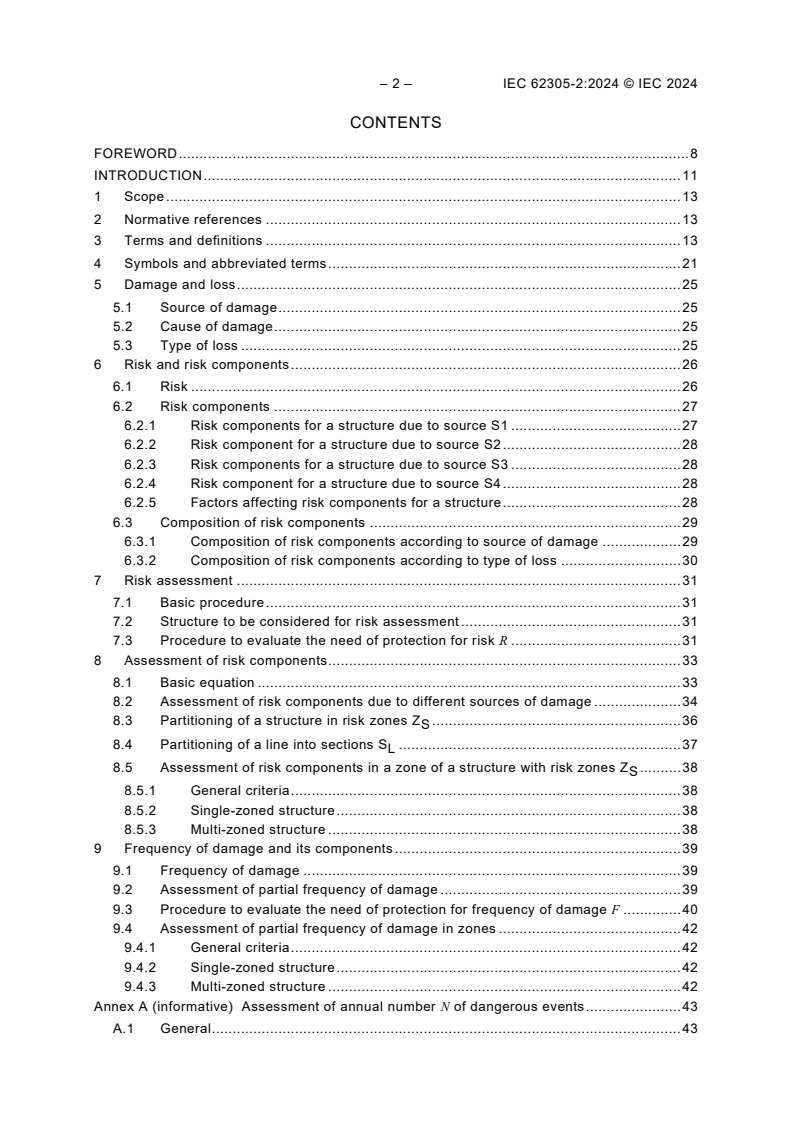
CONTENTS
FOREWORD . 8
INTRODUCTION . 11
1 Scope . 13
2 Normative references . 13
3 Terms and definitions . 13
4 Symbols and abbreviated terms . 21
5 Damage and loss . 25
5.1 Source of damage . 25
5.2 Cause of damage . 25
5.3 Type of loss . 25
6 Risk and risk components . 26
6.1 Risk . 26
6.2 Risk components . 27
6.2.1 Risk components for a structure due to source S1 . 27
6.2.2 Risk component for a structure due to source S2 . 28
6.2.3 Risk components for a structure due to source S3 . 28
6.2.4 Risk component for a structure due to source S4 . 28
6.2.5 Factors affecting risk components for a structure . 28
6.3 Composition of risk components . 29
6.3.1 Composition of risk components according to source of damage . 29
6.3.2 Composition of risk components according to type of loss . 30
7 Risk assessment . 31
7.1 Basic procedure . 31
7.2 Structure to be considered for risk assessment . 31
7.3 Procedure to evaluate the need of protection for risk R . 31
8 Assessment of risk components . 33
8.1 Basic equation . 33
8.2 Assessment of risk components due to different sources of damage . 34
8.3 Partitioning of a structure in risk zones Z . 36
S
8.4 Partitioning of a line into sections S . 37
L
8.5 Assessment of risk components in a zone of a structure with risk zones Z . 38
S
8.5.1 General criteria . 38
8.5.2 Single-zoned structure . 38
8.5.3 Multi-zoned structure . 38
9 Frequency of damage and its components . 39
9.1 Frequency of damage . 39
9.2 Assessment of partial frequency of damage . 39
9.3 Procedure to evaluate the need of protection for frequency of damage F . 40
9.4 Assessment of partial frequency of damage in zones . 42
9.4.1 General criteria . 42
9.4.2 Single-zoned structure . 42
9.4.3 Multi-zoned structure . 42
Annex A (informative) Assessment of annual number N of dangerous events . 43
A.1 General . 43
A.2 Assessment of the average annual number of dangerous events N due to
D
flashes to a structure and N to an adjacent structure . 44
DJ
A.2.1 Determination of the collection area A . 44
D
A.2.2 Structure as a part of a building . 46
A.2.3 Relative location of the structure . 48
A.2.4 Number of dangerous events N for the structure . 48
D
A.2.5 Number of dangerous events N for an adjacent structure . 49
DJ
A.3 Assessment of the average annual number of dangerous events N due to
M
flashes near a structure . 49
A.4 Assessment of the average annual number of dangerous events N due to
L
flashes to a line . 50
A.5 Assessment of average annual number of dangerous events N due to
I
flashes near a line . 51
A.6 Representation of the equivalent collection areas . 52
Annex B (informative) Assessment of probability P of damage . 53
X
B.1 General . 53
B.2 Probability P that a flash to a structure will cause dangerous touch and
AT
step voltages . 54
B.3 Probability P that a flash will cause damage to an exposed person on the
AD
structure . 55
B.4 Probability P that a flash to a structure will cause physical damage by fire
B
or explosion . 57
B.5 Probability P that a flash to a structure will cause failure of internal
C
systems . 59
B.6 Probability P that a flash near a structure will cause failure of internal
M
systems . 63
B.7 Probability P that a flash to a line will cause damage due to touch voltage . 65
U
B.8 Probability P that a flash to a line will cause physical damage by fire or
V
explosion . 67
B.9 Probability P that a flash to a line will cause failure of internal systems . 68
W
B.10 Probability P that a lightning flash near an incoming line will cause failure
Z
of internal systems . 69
B.11 Probability P that a person will be in a dangerous place . 69
P
B.12 Probability P that an equipment will be exposed to a damaging event . 70
e
Annex C (informative) Assessment of loss L . 71
X
C.1 General . 71
C.2 Mean relative loss per dangerous event . 71
Annex D (informative) P evaluation . 74
SPD
D.1 General . 74
D.2 P values . 75
Q
D.2.1 Probability values of both the negative and positive first strokes . 75
D.2.2 Source of damage S1 . 75
D.2.3 Source of damage S3 . 76
D.2.4 Sources of damage S2 and S4. 77
D.3 SPD protection level . 77
D.3.1 General . 77
– 4 – IEC 62305-2:2024 © IEC 2024
D.3.2 Source of damage S1 . 77
D.3.3 Source of damage S3 . 81
D.3.4 Energy coordinated SPDs: One voltage switching SPD and one voltage
limiting SPD downstream . 85
D.4 Source of damage S4 . 88
D.4.1 One voltage limiting SPD . 88
D.4.2 One voltage switching SPD . 88
D.5 Source of damage S2 . 89
Annex E (informative) Detailed investigation of additional losses L related to
E
surroundings . 90
E.1 General . 90
E.2 Calculation of risk components . 90
Annex F (informative) Case studies . 94
F.1 General . 94
F.2 House . 94
F.2.1 Relevant data and characteristics . 94
F.2.2 Calculation of expected annual number of dangerous events . 96
F.2.3 Risk management . 97
F.2.4 Definition of risk zones in the house . 97
F.2.5 Risk assessment . 99
F.2.6 Risk – Selection of protection measures . 99
F.2.7 Conclusions . 100
F.3 Office building . 100
F.3.1 Relevant data and characteristics . 100
F.3.2 Calculation of expected annual number of dangerous events . 101
F.3.3 Risk management . 102
F.3.4 Definition of zones in the office building . 103
F.3.5 Risk assessment . 107
F.3.6 Frequency of damage assessment . 108
F.3.7 Risk – Selection of protection measures . 108
F.3.8 Frequency of damage – Selection of protection measures . 109
F.3.9 Conclusions . 110
F.4 Hospital . 110
F.4.1 Relevant data and characteristics . 110
F.4.2 Calculation of expected annual number of dangerous events . 111
F.4.3 Risk management . 112
F.4.4 Definition of zones in the hospital . 112
F.4.5 Risk assessment . 117
F.4.6 Frequency of damage assessment . 118
F.4.7 Risk – Selection of protection measures . 118
F.4.8 Frequency of damage – Selection of protection measures . 120
F.4.9 Conclusions . 120
Bibliography . 121
Figure 1 – Procedure for deciding the need for protection and for the selection of
protection measures to reduce R ≤ R . 33
T
Figure 2 – Example of zone partitioning . 37
Figure 3 – Procedure for determining the need for protection and for the selection of
protection measures . 41
Figure A.1 – Collection area A of an isolated structure . 44
D
Figure A.2 – Complex-shaped structure . 45
Figure A.3 – Different methods to determine the collection area for a given structure . 46
Figure A.4 – Structure to be considered for evaluation of collection area A . 47
D
Figure A.5 – Equivalent collection areas A , A , A , A and A . 52
D DJ M L l
Figure D.1 – Charge probability of both negative and positive first strokes . 76
Figure D.2 – Probability P as a function of the SPD residual voltage U ’ at 1 kA . 78
Up p
Figure D.3 – Probability P as a function of k . 79
Up 1i
Figure D.4 – Probability P as a function of the SPD2 residual voltage U ’ at 1 kA . 80
Up p
Figure D.5 – Probability P as a function of the SPD2 residual voltage U ’ at 1 kA . 81
Up p
Figure D.6 – Probability P as a function of the residual voltage at 1 kA (U ’) . 82
Up p
Figure D.7 – Probability P as a function of different lengths of the internal circuit . 83
Up
Figure D.8 – Probability P as a function of different lengths of the internal circuit . 83
Up
Figure D.9 – Probability P as a function of the SPD2 residual voltage U ’ at 1 kA . 85
Up p
Figure D.10 – Probability P as a function of the internal loop area for n' = 2 and
Up
w = 0,1 m . 86
Figure D.11 – Probability P as a function of the internal loop area for n' = 2 and
Up
w = 0,5 m . 87
Figure D.12 – Probability P as a function of the internal loop area for n' = 20 and
Up
w = 0,1 m . 87
Figure D.13 – Probability P as a function of the SPD protection level U ’ at 1 kA for
Up p
different internal loop areas . 88
Figure D.14 – Probability P as a function of different internal loop areas for two
Up
typical protection levels of GDTs . 89
Table 1 – Sources of damage, causes of damage, types of loss and risk components
according to the point of strike . 27
Table 2 – Factors influencing the risk components . 29
Table 3 – Risk components for different sources of damage and types of loss . 35
Table 4 – Partial frequency of damage for each source of damage . 40
Table A.1 – Structure location factors C and C . 48
D DJ
Table A.2 – Line installation factor C . 50
I
Table A.3 – Line type factor C . 51
T
Table A.4 – Environmental factor C . 51
E
Table B.1 – Values of probability P that a flash to a structure will cause damage due
am
to touch and step voltages according to different protection measures . 55
Table B.2 – Reduction factor r as a function of the type of surface of soil or floor . 55
t
Table B.3 – Values of probability P depending on the protection measures to
LPS
protect the exposed areas of the structure against the direct flash and to reduce
physical damage . 56
Table B.4 – Values of probability P that a flash to a structure will cause dangerous
S
sparking . 57
– 6 – IEC 62305-2:2024 © IEC 2024
Table B.5 – Reduction factor r as a function of provisions taken to reduce the
p
consequences of fire . 58
Table B.6 – Reduction factor r as a function of risk of fire or explosion of structure. 58
f
Table B.7 – Typical values of P for SPDs on the low-voltage system, used to
SPD
protect against sources of damage S1, S2, S3, S4 . 60
Table B.8 – Typical values of P for SPDs on the telecommunications system used
SPD
to protect against sources of damage S1, S2, S3, S4 . 61
Table B.9 – Values of factors C and C depending on shielding, grounding and
LD LI
isolation conditions . 62
Table B.10 – Value of factor K depending on internal wiring . 65
S3
Table B.11 – Values of the probability P depending on the resistance R of the
LD S
cable screen and the impulse withstand voltage U of the equipment . 66
W
Table B.12 – Values of the probability P depending on the resistance R of the
LD S
cable screen and the higher impulse withstand voltage U of the equipment . 67
W
Table B.13 – Typical values of probability P relevant to protection level LPL for
EB
which the SPD is designed to protect against source of damage S3 . 67
Table C.1 – Loss values for each zone . 72
Table C.2 – Typical mean values of L , L , L , L , L and L . 73
T D F1 F2 O1 O2
Table D.1 – P values of the voltage limiting SPD for combination between a voltage
Up
limiting and a voltage switching SPD . 79
Table D.2 – P values of the voltage limiting SPD . 84
Up
Table E.1 – Risk components for different sources of damage and types of loss, valid
for damage to the surroundings . 91
Table E.2 – Type of loss L1: Proposed typical values for the related time of presence
for people t /8 760 in different environments as limited by Table E.3 . 92
zE
Table E.3 – Type of loss L1: Typical mean values of L and L outside the
F1E O1E
structure . 93
Table E.4 – Type of loss L2: Typical mean values of L and L outside the
F2E O2E
structure . 93
Table F.1 – House: environment and structure characteristics . 95
Table F.2 – House: power line . 95
Table F.3 – House: telecom line . 96
Table F.4 – House: equivalent collection areas of structure and lines . 96
Table F.5 – House: expected annual number of dangerous events . 97
Table F.6 – House: time of presence of persons and risk components into risk zones . 98
Table F.7 – House: values for zone Z (inside the building) . 98
–5
Table F.8 – House: risk for the unprotected structure (values × 10 ) . 99
–5
Table F.9 – House: risk components for protected structure (values × 10 ). 100
Table F.10 – Office building: environment and structure characteristics . 100
Table F.11 – Office building: power line . 101
Table F.12 – Office building: telecom line . 101
Table F.13 – Office building: collection areas of structure and lines . 102
Table F.14 – Office building: expected annual number of dangerous events . 102
Table F.15 – Office building: time of presence of persons and risk components in
zones . 103
Table F.16 – Office building: factors valid for zone Z (entrance area outside) . 104
Table F.17 – Office building: factors valid for zone Z (roof) . 104
Table F.18 – Office building: factors valid for zone Z (archive) . 105
Table F.19 – Office building: factors valid for zone Z (offices) . 106
Table F.20 – Office building: factors valid for zone Z (computer centre) . 107
–5
Table F.21 – Office building: risk for the unprotected structure (values × 10 ) . 108
Table F.22 – Office building: frequency of damage for the unprotected structure . 108
–5
Table F.23 – Risk components for protected structure (values × 10 ) . 109
Table F.24 – Office building: frequency of damage for protected structure . 109
Table F.25 – Hospital: environment and structure characteristics . 110
Table F.26 – Hospital: power line . 111
Table F.27 – Hospital: collection areas of structure and power line . 111
Table F.28 – Hospital: expected annual number of dangerous events . 112
Table F.29 – Hospital: time of presence of persons and risk components in zones . 113
Table F.30 – Hospital: factors valid for zone Z (outside the building) . 113
Table F.31 – Hospital: factors valid for zone Z (roof) . 114
Table F.32 – Hospital: factors valid for zone Z (rooms) . 115
Table F.33 – Hospital: factors valid for zone Z (operating block) . 116
Table F.34 – Hospital: factors valid for zone Z (intensive care unit) . 117
–5
Table F.35 – Hospital: risk for the unprotected structure (values × 10 ) . 118
Table F.36 – Hospital: frequency of damage for the unprotected structure . 118
–5
Table F.37 – Hospital: risk for the protected structure (values × 10 ) . 119
Table F.38 – Hospital: frequency of damage for the protected structure . 120
– 8 – IEC 62305-2:2024 © IEC 2024
INTERNATIONAL ELECTROTECHNICAL COMMISSION
____________
PROTECTION AGAINST LIGHTNING –
Part 2: Risk management
FOREWORD
1) The International Electrotechnical Commission (IEC) is a worldwide organization for standardization comprising
all national electrotechnical committees (IEC National Committees). The object of IEC is to promote international
co-operation on all questions concerning standardization in the electrical and electronic fields. To this end and
in addition to other activities, IEC publishes International Standards, Technical Specifications, Technical Reports,
Publicly Available Specifications (PAS) and Guides (hereafter referred to as “IEC Publication(s)”). Their
preparation is entrusted to technical committees; any IEC National Committee interested in the subject dealt with
may participate in this preparatory work. International, governmental and non-governmental organizations liaising
with the IEC also participate in this preparation. IEC collaborates closely with the International Organization for
Standardization (ISO) in accordance with conditions determined by agreement between the two organizations.
2) The formal decisions or agreements of IEC on technical matters express, as nearly as possible, an international
consensus of opinion on the relevant subjects since each technical committee has representation from all
interested IEC National Committees.
3) IEC Publications have the form of recommendations for international use and are accepted by IEC National
Committees in that sense. While all reasonable efforts are made to ensure that the technical content of IEC
Publications is accurate, IEC cannot be held responsible for the way in which they are used or for any
misinterpretation by any end user.
4) In order to promote international uniformity, IEC National Committees undertake to apply IEC Publications
transparently to the maximum extent possible in their national and regional publications. Any divergence between
any IEC Publication and the corresponding national or regional publication shall be clearly indicated in the latter.
5) IEC itself does not provide any attestation of conformity. Independent certification bodies provide conformity
assessment services and, in some areas, access to IEC marks of conformity. IEC is not responsible for any
services carried out by independent certification bodies.
6) All users should ensure that they have the latest edition of this publication.
7) No liability shall attach to IEC or its directors, employees, servants or agents including individual experts and
members of its technical committees and IEC National Committees for any personal injury, property damage or
other damage of any nature whatsoever, whether direct or indirect, or for costs (including legal fees) and
expenses arising out of the publication, use of, or reliance upon, this IEC Publication or any other IEC
Publications.
8) Attention is drawn to the Normative references cited in this publication. Use of the referenced publications is
indispensable for the correct application of this publication.
9) IEC draws attention to the possibility that the implementation of this document may involve the use of (a)
patent(s). IEC takes no position concerning the evidence, validity or applicability of any claimed patent rights in
respect thereof. As of the date of publication of this document, IEC had not received notice of (a) patent(s), which
may be required to implement this document. However, implementers are cautioned that this may not represent
the latest information, which may be obtained from the patent database available at https://patents.iec.ch. IEC
shall not be held responsible for identifying any or all such patent rights.
IEC 62305-2 has been prepared by IEC technical committee 81: Lightning protection. It is an
International Standard.
This third edition cancels and replaces the second edition, published in 2010. This edition
constitutes a technical revision.
This edition includes the following significant technical changes with respect to the previous
edition:
a) The concept of a single risk, to combine loss of human life and loss due to fire, has been
introduced.
b) The concept of frequency of damage that can impair the availability of the internal systems
within the structure has been introduced.
c) The lightning ground strike-point density N has been introduced replacing the lightning
SG
flash density N in the evaluation of expected average annual number of dangerous events.
G
d) Reduction of a few risk components can be achieved by the use of preventive temporary
measures activated by means of a thunderstorm warning system (TWS) compliant with
IEC 62793. The risk of direct strike to people in open areas has been introduced,
considering the reduction of that risk using a TWS.
The text of this International Standard is based on the following documents:
Draft Report on voting
81/769/FDIS 81/772/RVD
Full information on the voting for its approval can be found in the report on voting indicated in
the above table.
The language used for the development of this International Standard is English.
This document was drafted in accordance with ISO/IEC Directives, Part 2, and developed in
accordance with ISO/IEC Directives, Part 1 and ISO/IEC Directives, IEC Supplement, available
at www.iec.ch/members_experts/refdocs. The main document types developed by IEC are
described in greater detail at www.iec.ch/publications.
A list of all parts in the IEC 62305 series, published under the general title Protection against
lightning, can be found on the IEC website.
The following differing practices of a less permanent nature exist in the countries indicated
below.
In Germany, the value of r = 1 applies for all cases. For the risk components R , R , R , R ,
p B C M V
R and R P = 1 is assumed. For LF1 and LF2 the highest values given in Table C.2 should
W Z TWS
be used.
In Greece, the value of P = 1 for all cases is assumed.
TWS
In Italy, calculating both the risk of loss of human life, RL1 in Equation (7), and the risk of loss
due to physical damages, RL2 in Equation (8), and comparing each risk with the tolerable risk
is required. Protection is achieved when both risks, RL1 and RL2, are less than the tolerable
value.
In the Netherlands and South Africa, Annex D and Annex E should not be applied for usual
studies.
– 10 – IEC 62305-2:2024 © IEC 2024
The committee has decided that the contents of this document will remain unchanged until the
stability date indicated on the IEC website under webstore.iec.ch in the data related to the
specific document. At this date, the document will be
• reconfirmed,
• withdrawn, or
• revised.
IMPORTANT – The "colour inside" logo on the cover page of this document indicates
that it contains colours which are considered to be useful for the correct understanding
of its contents. Users should therefore print this document using a colour printer.
INTRODUCTION
Lightning flashes to earth can be hazardous to structures and to lines supplying the structure.
These hazards can result in:
– damage to the structure and to its contents,
– failure of associated electrical and electronic systems,
– injury to living beings in or close to the structure.
Consequential effects of the damage and failures can be extended to the surroundings of the
structure or can involve its environment. Moreover, regardless of the extent of loss, the
availability of the structure and its internal systems can be unacceptably impaired if the
frequency of damage is high.
To reduce the frequency of damage and the loss due to lightning, protection measures can be
required. Whether they are necessary, and to what extent, should be determined by frequency
of damage and risk assessment.
NOTE 1 The decision to provide lightning protection can be taken regardless of the outcome of frequency of damage
or risk assessment where there is a desire that there be no avoidable damages.
NOTE 2 IEC 60364-4-44 [1] always requires the installation of a surge protective device (SPD) at the power line
entrance in the structure when the consequence caused by overvoltages affects:
– care of human life, e.g. safety services, medical care facilities,
– public services and cultural heritage, e.g. loss of public services, IT centres, museums,
– commercial or industrial activity, e.g. hotels, banks, industries, commercial markets, farms.
The frequency of damage, defined in this document as the annual number of damages in a
structure due to lightning flashes, depends on:
– the annual number of lightning flashes influencing the structure;
– the probability of damaging events by one of the influencing lightning flashes.
The risk, defined in this document as the probable average annual loss in a structure due to
lightning flashes, depends on:
– the frequency of damage;
– the mean extent of consequential loss.
Lightning flashes influencing the structure can be divided into
– flashes terminating on the structure,
– flashes terminating near the structure, directly to connected lines (power, telecom-
munication lines) or near the lines.
Flashes to the structure or a connected line can cause physical damage and life hazards.
Flashes near the structure or line as well as flashes to the structure or line can cause failure of
electrical and electronic systems due to overvoltages resulting from resistive and inductive
coupling of these systems with the lightning current.
Moreover, failures caused by lightning overvoltages in users’ installations and in power supply
lines can also generate voltage switching overvoltages in the installations.
NOTE 3 Malfunctioning of electrical and electronic systems is not covered by the IEC 62305 series. Reference is
made to IEC 61000-4-5 [2].
___________
Numbers in square brackets refer to the Bibliography.
– 12 – IEC 62305-2:2024 © IEC 2024
The number of lightning flashes influencing the structure depends on the dimensions, the
characteristics of the structure and the connected lines, on the environmental characteristics of
the structure and the lines, as well as on lightning ground strike-point density in the region
where the structure and the lines are located. Guidance on the assessment of the number of
lightning flashes influencing the structure is given in Annex A.
The probability of damage depends on the structure, the resistibility of equipment located on
the structure, the connected lines, and the lightning current characteristics, as well as on the
type and efficiency of the protection
...