

IEC 62305-1:2006
(Main)Protection against lightning - Part 1: General principles
General Information
- Abstract
Provides the general principles to be followed in the protection against lightning of - structures including their installations and contents as well as persons, - services connected to a structure. The following cases are outside the scope of this standard: - railway systems; - vehicles, ships, aircraft, offshore installations; - underground high pressure pipelines; - pipe, power and telecommunication lines not connected to a structure.
- Status
- Published
- Publication Date
- 16-Jan-2006
- Technical Committee
- TC 81 - Lightning protection
- Current Stage
- DELPUB - Deleted Publication
- Start Date
- 09-Dec-2010
- Completion Date
- 28-Aug-2026
Buy Documents
IEC 62305-1:2006 - Protection against lightning - Part 1: General principles Released:1/17/2006
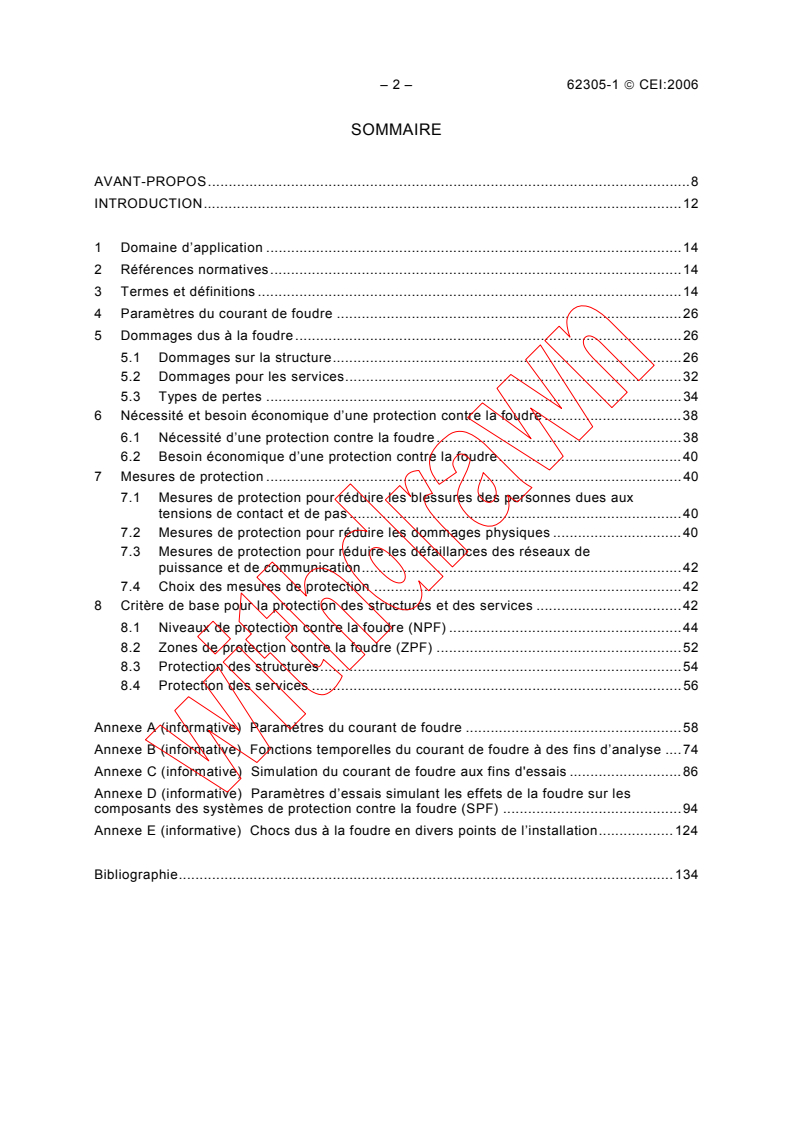
IEC 62305-1:2006 - Protection contre la foudre - Partie 1: Principes généraux Released:1/17/2006
IEC 62305-1:2006 - Protection against lightning - Part 1: General principles Released:1/17/2006
Overview
IEC 62305-1:2006 - "Protection against lightning - Part 1: General principles" sets out the high‑level framework and objectives for protecting structures, their contents and occupants, and services connected to structures from lightning hazards. It defines the scope, key concepts and criteria to be used when planning lightning protection systems (LPS), and it establishes the relationship with the other parts of the IEC 62305 series (risk management, physical damage, electrical/electronic systems, services).
The standard excludes certain domains (railway systems; vehicles, ships, aircraft, offshore installations; underground high‑pressure pipelines; and lines not connected to a structure).
Key topics and requirements
- Scope and exclusions - what structures and services are covered and which cases are out of scope.
- Terms and definitions - consistent vocabulary for lightning protection engineering.
- Lightning current parameters - descriptive parameters for lightning currents used throughout the series (see informative Annexes).
- Damage and loss types - classification of damage to structures, services and people, and corresponding loss scenarios.
- Need and economic convenience - principles for deciding when protection is required and how to assess economic feasibility (risk‑based justification is developed in IEC 62305‑2).
- Protection measures - overview of measures to reduce injury (touch/step voltages), physical damage and failures of electrical/electronic systems.
- Selection criteria - how to choose appropriate protection measures and coordinate them.
- Basic protection criteria - definition of Lightning Protection Levels (LPL) and Lightning Protection Zones (LPZ) used to size and stage protection measures; guidance on protecting structures and services.
- Informative annexes - parameters, time functions, simulation and test guidelines for LPS components and surge effects.
Practical applications
- Designing or specifying a building lightning protection strategy (external LPS, bonding, earthing, surge protection).
- Defining protection requirements for new construction, retrofits and critical facilities (data centres, hospitals, industrial plants).
- Providing normative references and concepts for safety compliance, procurement and contract specifications.
- Guiding coordination between architectural, electrical and telecom installers to mitigate lightning electromagnetic pulse (LEMP) and surge effects.
Who uses this standard
- Lightning protection engineers and consultants
- Electrical and structural engineers
- Architects and building services designers
- Facility managers, safety and risk professionals
- Manufacturers and test labs of LPS components
- Regulators and inspectors
Related standards
- IEC 62305‑2 - Risk management
- IEC 62305‑3 - Physical damage to structures and life hazard
- IEC 62305‑4 - Electrical and electronic systems within structures
- IEC 62305‑5 - Services
For access to the full text, parameters and test annexes consult the IEC Webstore or the IEC publications catalogue.
Relations
- Effective Date
- 05-Sep-2023
- Effective Date
- 05-Sep-2023
Buy Documents
IEC 62305-1:2006 - Protection against lightning - Part 1: General principles Released:1/17/2006
IEC 62305-1:2006 - Protection contre la foudre - Partie 1: Principes généraux Released:1/17/2006
IEC 62305-1:2006 - Protection against lightning - Part 1: General principles Released:1/17/2006
Get Certified
Connect with accredited certification bodies for this standard

DIBt (Deutsches Institut für Bautechnik)
German Institute for Building Technology.
DIN CERTCO
DIN Group product certification.

IMQ S.p.A. (Certification)
Italian electrical product certification.
Sponsored listings
Frequently Asked Questions
IEC 62305-1:2006 is a standard published by the International Electrotechnical Commission (IEC). Its full title is "Protection against lightning - Part 1: General principles". This standard covers: Provides the general principles to be followed in the protection against lightning of - structures including their installations and contents as well as persons, - services connected to a structure. The following cases are outside the scope of this standard: - railway systems; - vehicles, ships, aircraft, offshore installations; - underground high pressure pipelines; - pipe, power and telecommunication lines not connected to a structure.
Provides the general principles to be followed in the protection against lightning of - structures including their installations and contents as well as persons, - services connected to a structure. The following cases are outside the scope of this standard: - railway systems; - vehicles, ships, aircraft, offshore installations; - underground high pressure pipelines; - pipe, power and telecommunication lines not connected to a structure.
IEC 62305-1:2006 is classified under the following ICS (International Classification for Standards) categories: 29.020 - Electrical engineering in general; 91.120.40 - Lightning protection. The ICS classification helps identify the subject area and facilitates finding related standards.
IEC 62305-1:2006 has the following relationships with other standards: It is inter standard links to IEC 61024-1-1:1993, IEC 62305-1:2010. Understanding these relationships helps ensure you are using the most current and applicable version of the standard.
IEC 62305-1:2006 is available in PDF format for immediate download after purchase. The document can be added to your cart and obtained through the secure checkout process. Digital delivery ensures instant access to the complete standard document.
Standards Content (Sample)
INTERNATIONAL IEC
STANDARD 62305-1
First edition
2006-01
Protection against lightning –
Part 1:
General principles
This English-language version is derived from the original
bilingual publication by leaving out all French-language
pages. Missing page numbers correspond to the French-
language pages.
Reference number
Publication numbering
As from 1 January 1997 all IEC publications are issued with a designation in the
60000 series. For example, IEC 34-1 is now referred to as IEC 60034-1.
Consolidated editions
The IEC is now publishing consolidated versions of its publications. For example,
edition numbers 1.0, 1.1 and 1.2 refer, respectively, to the base publication, the
base publication incorporating amendment 1 and the base publication incorporating
amendments 1 and 2.
Further information on IEC publications
The technical content of IEC publications is kept under constant review by the IEC,
thus ensuring that the content reflects current technology. Information relating to
this publication, including its validity, is available in the IEC Catalogue of
publications (see below) in addition to new editions, amendments and corrigenda.
Information on the subjects under consideration and work in progress undertaken
by the technical committee which has prepared this publication, as well as the list
of publications issued, is also available from the following:
• IEC Web Site (www.iec.ch)
• Catalogue of IEC publications
The on-line catalogue on the IEC web site (www.iec.ch/searchpub) enables you to
search by a variety of criteria including text searches, technical committees
and date of publication. On-line information is also available on recently issued
publications, withdrawn and replaced publications, as well as corrigenda.
• IEC Just Published
This summary of recently issued publications (www.iec.ch/online_news/ justpub)
is also available by email. Please contact the Customer Service Centre (see
below) for further information.
• Customer Service Centre
If you have any questions regarding this publication or need further assistance,
please contact the Customer Service Centre:
Email: custserv@iec.ch
Tel: +41 22 919 02 11
Fax: +41 22 919 03 00
INTERNATIONAL IEC
STANDARD 62305-1
First edition
2006-01
Protection against lightning –
Part 1:
General principles
IEC 2006 Copyright - all rights reserved
No part of this publication may be reproduced or utilized in any form or by any means, electronic or mechanical,
including photocopying and microfilm, without permission in writing from the publisher.
International Electrotechnical Commission, 3, rue de Varembé, PO Box 131, CH-1211 Geneva 20, Switzerland
Telephone: +41 22 919 02 11 Telefax: +41 22 919 03 00 E-mail: inmail@iec.ch Web: www.iec.ch
PRICE CODE
XB
Commission Electrotechnique Internationale
International Electrotechnical Commission
МеждународнаяЭлектротехническаяКомиссия
For price, see current catalogue
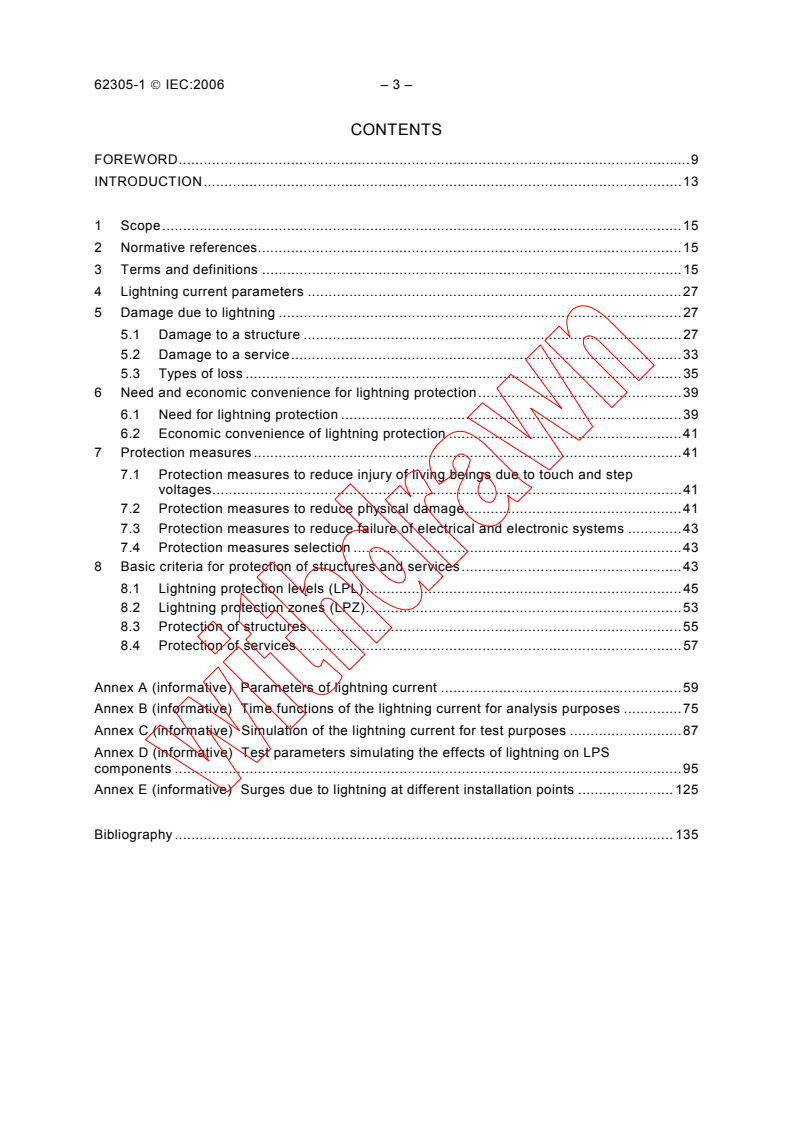
62305-1 IEC:2006 – 3 –
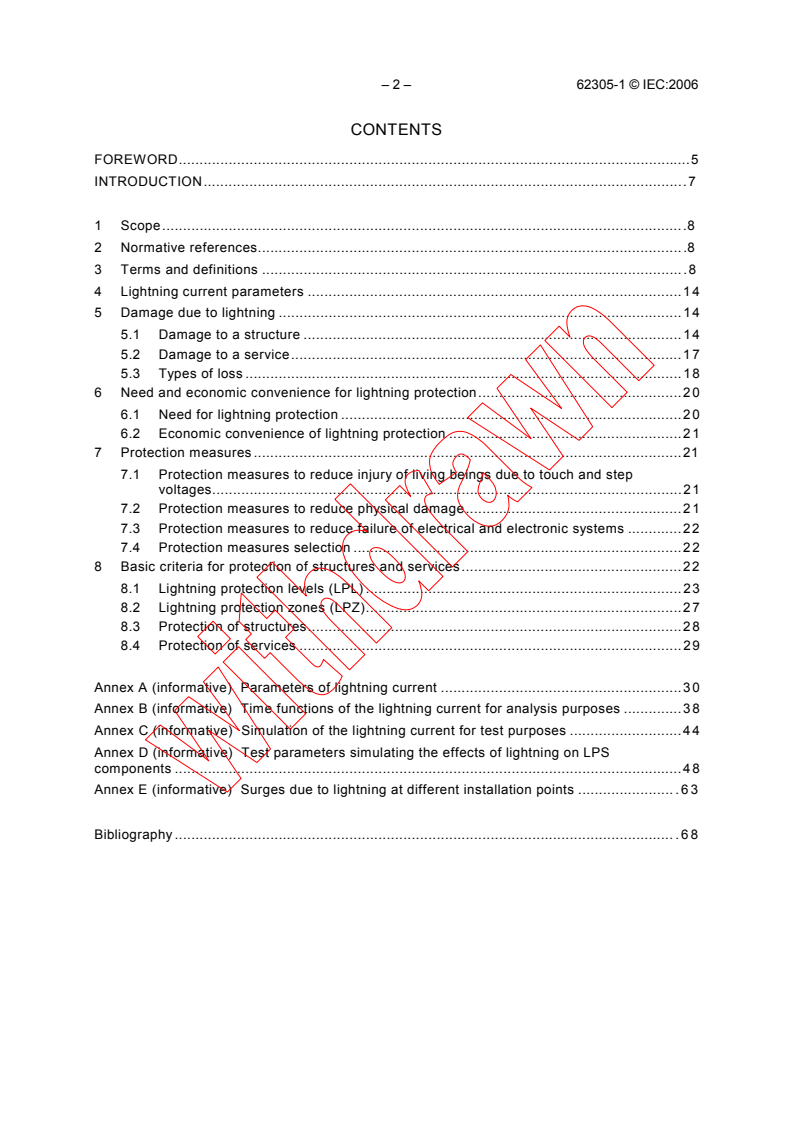
CONTENTS
FOREWORD.9
INTRODUCTION.13
1 Scope.15
2 Normative references.15
3 Terms and definitions .15
4 Lightning current parameters .27
5 Damage due to lightning .27
5.1 Damage to a structure .27
5.2 Damage to a service.33
5.3 Types of loss .35
6 Need and economic convenience for lightning protection.39
6.1 Need for lightning protection .39
6.2 Economic convenience of lightning protection .41
7 Protection measures .41
7.1 Protection measures to reduce injury of living beings due to touch and step
voltages.41
7.2 Protection measures to reduce physical damage.41
7.3 Protection measures to reduce failure of electrical and electronic systems .43
7.4 Protection measures selection .43
8 Basic criteria for protection of structures and services.43
8.1 Lightning protection levels (LPL) .45
8.2 Lightning protection zones (LPZ).53
8.3 Protection of structures.55
8.4 Protection of services .57
Annex A (informative) Parameters of lightning current .59
Annex B (informative) Time functions of the lightning current for analysis purposes .75
Annex C (informative) Simulation of the lightning current for test purposes .87
Annex D (informative) Test parameters simulating the effects of lightning on LPS
components .95
Annex E (informative) Surges due to lightning at different installation points . 125
Bibliography . 135
62305-1 IEC:2006 – 5 –
Figure 1 – Types of loss and corresponding risks resulting from different types of
damage.39
Figure 2 – LPZ defined by an LPS (IEC 62305-3).49
Figure 3 – LPZ defined by protection measures against LEMP (IEC 62305-4) .51
Figure A.1 – Definitions of short stroke parameters (typically T <2 ms).59
Figure A.2 – Definitions of long stroke parameters (typically 2 ms
long
Figure A.3 – Possible components of downward flashes (typical in flat territory and to
lower structures) .61
Figure A.4 – Possible components of upward flashes (typical to exposed and/or higher
structures) .63
Figure A.5 – Cumulative frequency distribution of lightning current parameters (lines
through 95 % and 5 % value).69
Figure B.1 – Waveshape of the current rise of the first short stroke .77
Figure B.2 – Waveshape of the current tail of the first short stroke .79
Figure B.3 – Waveshape of the current rise of the subsequent short strokes.81
Figure B.4 – Waveshape of the current tail of the subsequent short strokes.83
Figure B.5 – Amplitude density of the lightning current according to LPL I .85
Figure C.1 – Example test generator for the simulation of the specific energy of the first
short stroke and the charge of the long stroke .89
Figure C.2 – Definition for the current steepness in accordance with Table C.3.91
Figure C.3 – Example test generator for the simulation of the front steepness of the
first short stroke for large test items .93
Figure C.4 – Example test generator for the simulation of the front steepness of the
subsequent short strokes for large test items.93
Figure D.1 – General arrangement of two conductors for the calculation of
electrodynamic force .109
Figure D.2 – Typical conductor arrangement in an LPS. 109
Figure D.3 – Diagram of the stresses for the configuration of Figure D.2. 111
Figure D.4 – Force per unit length along the horizontal conductor of Figure D.2 . 111
Table 1 – Effects of lightning on typical structures .29
Table 2 – Effects of lightning on typical services.33
Table 3 – Damages and loss in a structure according to different points of strike of
lightning .37
Table 4 – Damages and loss in a service according to different points of strike of
lightning .37
Table 5 – Maximum values of lightning parameters according to LPL.47
Table 6 – Minimum values of lightning parameters and related rolling sphere radius
corresponding to LPL .53
Table 7 – Probabilities for the limits of the lightning current parameters .53
Table A.1 – Tabulated values of lightning current parameters taken from CIGRE
[3], [4]
(Electra No. 41 or No. 69*) .65
Table A.2 – Logarithmic normal distribution of lightning current parameters –
µ
Mean and dispersion σ calculated from 95 % and 5 % values from CIGRE (Electra
log
[3], [4]
No. 41 or No. 69) .67
62305-1 IEC:2006 – 7 –
Table B.1 – Parameters for Equation B.1.75
Table C.1 – Test parameters of the first short stroke .89
Table C.2 – Test parameters of the long stroke .89
Table C.3 – Test parameters of the short strokes .91
Table D.1 – Summary of the lightning threat parameters to be considered in the
calculation of the test values for the different LPS components and for the different LPL.97
Table D.2 – Physical characteristics of typical materials used in LPS components . 103
Table D.3 – Temperature rise for conductors of different sections as a function of W/R . 103
Table E.1 – Conventional earthing impedance values Z and Z according to the
resistivity of the soil. 127
Table E.2 – Expected surge overcurrents due to lightning flashes . 129
62305-1 IEC:2006 – 9 –
INTERNATIONAL ELECTROTECHNICAL COMMISSION
____________
PROTECTION AGAINST LIGHTNING –
Part 1: General principles
FOREWORD
1) The International Electrotechnical Commission (IEC) is a worldwide organization for standardization comprising
all national electrotechnical committees (IEC National Committees). The object of IEC is to promote
international co-operation on all questions concerning standardization in the electrical and electronic fields. To
this end and in addition to other activities, IEC publishes International Standards, Technical Specifications,
Technical Reports, Publicly Available Specifications (PAS) and Guides (hereafter referred to as “IEC
Publication(s)”). Their preparation is entrusted to technical committees; any IEC National Committee interested
in the subject dealt with may participate in this preparatory work. International, governmental and non-
governmental organizations liaising with the IEC also participate in this preparation. IEC collaborates closely
with the International Organization for Standardization (ISO) in accordance with conditions determined by
agreement between the two organizations.
2) The formal decisions or agreements of IEC on technical matters express, as nearly as possible, an international
consensus of opinion on the relevant subjects since each technical committee has representation from all
interested IEC National Committees.
3) IEC Publications have the form of recommendations for international use and are accepted by IEC National
Committees in that sense. While all reasonable efforts are made to ensure that the technical content of IEC
Publications is accurate, IEC cannot be held responsible for the way in which they are used or for any
misinterpretation by any end user.
4) In order to promote international uniformity, IEC National Committees undertake to apply IEC Publications
transparently to the maximum extent possible in their national and regional publications. Any divergence
between any IEC Publication and the corresponding national or regional publication shall be clearly indicated in
the latter.
5) IEC provides no marking procedure to indicate its approval and cannot be rendered responsible for any
equipment declared to be in conformity with an IEC Publication.
6) All users should ensure that they have the latest edition of this publication.
7) No liability shall attach to IEC or its directors, employees, servants or agents including individual experts and
members of its technical committees and IEC National Committees for any personal injury, property damage or
other damage of any nature whatsoever, whether direct or indirect, or for costs (including legal fees) and
expenses arising out of the publication, use of, or reliance upon, this IEC Publication or any other IEC
Publications.
8) Attention is drawn to the Normative references cited in this publication. Use of the referenced publications is
indispensable for the correct application of this publication.
9) Attention is drawn to the possibility that some of the elements of this IEC Publication may be the subject of
patent rights. IEC shall not be held responsible for identifying any or all such patent rights.
International Standard IEC 62305-1 has been prepared by IEC technical committee 81:
Lightning protection.
The IEC 62305 series (Parts 1 to 5), is produced in accordance with the New Publications Plan,
approved by National Committees (81/171/RQ (2001-06-29)), which restructures and updates
in a more simple and rational form the publications of the IEC 61024 series, the IEC 61312
series and the IEC 61663 series.
The text of this first edition of IEC 62305-1 is compiled from and replaces
– IEC 61024-1-1, first edition (1993).
62305-1 IEC:2006 – 11 –
The text of this standard is based on the following documents:
FDIS Report on voting
81/262/FDIS 81/267/RVD
Full information on the voting for the approval of this standard can be found in the report on
voting indicated in the above table.
This publication has been drafted, as close as possible, in accordance with the ISO/IEC
Directives, Part 2.
IEC 62305 consists of the following parts, under the general title Protection against lightning:
Part 1: General principles
Part 2: Risk management
Part 3: Physical damage to structures and life hazard
Part 4: Electrical and electronic systems within structures
Part 5: Services
The committee has decided that the contents of this publication will remain unchanged until the
maintenance result date indicated on the IEC web site under "http://webstore.iec.ch" in the data
related to the specific publication. At this date, the publication will be
• reconfirmed;
• withdrawn;
• replaced by a revised edition, or
• amended.
___________
To be published
62305-1 IEC:2006 – 13 –
INTRODUCTION
There are no devices nor methods capable of modifying the natural weather phenomena to the
extent that they can prevent lightning discharges. Lightning flashes to, or nearby, structures (or
services connected to the structures) are hazardous to people, to the structures themselves,
their contents and installations as well as to services. This is why the application of lightning
protection measures is essential.
The need for protection, the economic benefits of installing protection measures and the
selection of adequate protection measures should be determined in terms of risk management.
Risk management is the subject of IEC 62305-2.
The criteria for design, installation and maintenance of lightning protection measures are
considered in three separate groups:
– the first group concerns protection measures to reduce physical damage and life hazard in
a structure is given in IEC 62305-3,
– the second group concerns protection measures to reduce failures of electrical and
electronic systems in a structure is given in IEC 62305-4,
– the third group concerns protection measures to reduce physical damage and failures of
services connected to a structure (mainly electrical and telecommunication lines) is given in
IEC 62305-5.
62305-1 IEC:2006 – 15 –
PROTECTION AGAINST LIGHTNING –
Part 1: General principles
1 Scope
This part of IEC 62305 provides the general principles to be followed in the protection against
lightning of
– structures including their installations and contents as well as persons,
– services connected to a structure.
The following cases are outside the scope of this standard:
– railway systems;
– vehicles, ships, aircraft, offshore installations;
– underground high pressure pipelines;
− pipe, power and telecommunication lines not connected to a structure.
NOTE Usually these systems are under special regulations made by various specific authorities.
2 Normative references
The following referenced documents are indispensable for the application of this document. For
dated references, only the edition cited applies. For undated references, the latest edition of
the referenced document (including any amendments) applies.
IEC 62305-2, Protection against lightning – Part 2: Risk management
IEC 62305-3, Protection against lightning – Part 3: Physical damage to structures and life
hazard
IEC 62305-4, Protection against lightning – Part 4: Electrical and electronic systems within
structures
IEC 62305-5, Protection against lightning – Part 5: Services
3 Terms and definitions
For the purposes of this document, the following terms and definitions apply.
3.1
lightning flash to earth
electrical discharge of atmospheric origin between cloud and earth consisting of one or more
strokes
___________
To be published.
62305-1 IEC:2006 – 17 –
3.2
downward flash
lightning flash initiated by a downward leader from cloud to earth
NOTE A downward flash consists of a first short stroke, which can be followed by subsequent short strokes. One
or more short strokes may be followed by a long stroke.
3.3
upward flash
lightning flash initiated by an upward leader from an earthed structure to cloud
NOTE An upward flash consists of a first long stroke with or without multiple superimposed short strokes. One or
more short strokes may be followed by a long stroke.
3.4
lightning stroke
single electrical discharge in a lightning flash to earth
3.5
short stroke
part of the lightning flash which corresponds to an impulse current
NOTE This current has a time to the half value T typically less than 2 ms (see Figure A.1).
3.6
long stroke
part of the lightning flash which corresponds to a continuing current
NOTE The duration time T (time from the 10 % value on the front to the 10 % value on the tail) of this
long
continuing current is typically more than 2 ms and less than 1 s (see Figure A.2)
3.7
multiple strokes
lightning flash consisting on average of 3-4 strokes, with typical time interval between them of
about 50 ms
NOTE Events having up to a few dozen strokes with intervals between them ranging from 10 ms to 250 ms have
been reported.
3.8
point of strike
point where a lightning flash strikes the earth, or protruding object (e.g. structure, LPS, service,
tree, etc.)
NOTE A lightning flash may have more than one point of strike.
3.9
lightning current
i
current flowing at the point of strike
3.10
peak value
I
maximum value of the lightning current
3.11
average steepness of the front of short stroke current
average rate of change of current within a time interval t – t
2 1
NOTE It is expressed by the difference i(t ) – i(t ) of the values of the current at the start and at the end of this
2 1
interval, divided by t – t (see Figure A.1).
2 1
62305-1 IEC:2006 – 19 –
3.12
front time of short stroke current
T
virtual parameter defined as 1,25 times the time interval between the instants when the 10 %
and 90 % of the peak value are reached (see Figure A.1)
3.13
virtual origin of short stroke current
O
point of intersection with time axis of a straight line drawn through the 10 % and the 90 %
reference points on the stroke current front (see Figure A.1); it precedes by 0,1 T that instant
at which the current attains 10 % of its peak value
3.14
time to half value of short stroke current
T
virtual parameter defined as the time interval between the virtual origin O and the instant at
which the current has decreased to half the peak value (see Figure A.1)
3.15
flash duration
T
time for which the lightning current flows at the point of strike
3.16
duration of long stroke current
T
long
time duration during which the current in a long stroke is between the 10 % of the peak value
during the increase of the continuing current and 10 % of the peak value during the decrease of
the continuing current (see Figure A.2)
3.17
flash charge
Q
flash
time integral of the lightning current for the entire lightning flash duration
3.18
short stroke charge
Q
short
time integral of the lightning current in a short stroke
3.19
long stroke charge
Q
long
time integral of the lightning current in a long stroke
3.20
specific energy
W/R
time integral of the square of the lightning current for the entire flash duration
NOTE It represents the energy dissipated by the lightning current in a unit resistance.
3.21
specific energy of short stroke current
time integral of the square of the lightning current for the duration of the short stroke
NOTE The specific energy in a long stroke current is negligible.
62305-1 IEC:2006 – 21 –
3.22
object to be protected
structure or service to be protected against the effects of lightning
3.23
structure to be protected
structure for which protection is required against the effects of lightning in accordance with this
standard
NOTE A structure to be protected may be a part of a larger structure.
3.24
service to be protected
service connected to a structure for which protection is required against the effects of lightning
in accordance with this standard
3.25
lightning flash to an object
lightning flash striking an object to be protected
3.26
lightning flash near an object
lightning flash striking close enough to an object to be protected that it may cause dangerous
overvoltages
3.27
electrical system
system incorporating low voltage power supply components
3.28
electronic system
system incorporating sensitive electronic components such as communication equipment,
computer, control and instrumentation systems, radio systems, power electronic installations
3.29
internal systems
electrical and electronic systems within a structure
3.30
physical damage
damage to a structure (or to its contents) or to a service due to mechanical, thermal, chemical
and explosive effects of lightning
3.31
injury of living beings
injuries, including loss of life, to people or to animals due to touch and step voltages caused by
lightning
3.32
failure of electrical and electronic systems
permanent damage of electrical and electronic systems due to LEMP
62305-1 IEC:2006 – 23 –
3.33
lightning electromagnetic impulse
LEMP
electromagnetic effects of lightning current
NOTE It includes conducted surges as well as radiated impulse electromagnetic field effects.
3.34
surge
transient wave appearing as overvoltage and /or overcurrent caused by LEMP
NOTE Surges caused by LEMP can arise from (partial) lightning currents, from induction effects in installation
loops and as remaining threat downstream of SPD.
3.35
lightning protection zone
LPZ
zone where the lightning electromagnetic environment is defined
NOTE The zone boundaries of an LPZ are not necessarily physical boundaries (e.g. walls, floor and ceiling).
3.36
risk
R
value of probable average annual loss (humans and goods) due to lightning, relative to the total
value (humans and goods) of the object to be protected
3.37
tolerable risk
R
T
maximum value of the risk which can be tolerated for the object to be protected
3.38
lightning protection level
LPL
number related to a set of lightning current parameters values relevant to the probability that
the associated maximum and minimum design values will not be exceeded in naturally
occurring lightning
NOTE Lightning protection level is used to design protection measures according to the relevant set of lightning
current parameters.
3.39
protection measures
measures to be adopted in the object to be protected to reduce the risk
3.40
lightning protection system
LPS
complete system used to reduce physical damage due to lightning flashes to a structure
NOTE It consists of both external and internal lightning protection systems.
3.41
external lightning protection system
part of the LPS consisting of an air-termination system, a down-conductor system and an
earth-termination system
62305-1 IEC:2006 – 25 –
3.42
internal lightning protection system
part of the LPS consisting of lightning equipotential bonding and/or electrical insulation of
external LPS
3.43
air-termination system
part of an external LPS using metallic elements such as rods, mesh conductors or catenary
wires intended to intercept lightning flashes
3.44
down-conductor system
part of an external LPS intended to conduct lightning current from the air-termination system to
the earth-termination system
3.45
earth-termination system
part of an external LPS which is intended to conduct and disperse lightning current into the
earth
3.46
external conductive parts
extended metal items entering or leaving the structure to be protected such as pipe works,
cable metallic elements, metal ducts, etc. which may carry a part of the lightning current
3.47
lightning equipotential bonding
bonding to LPS of separated metallic parts, by direct conductive connections or via surge
protective devices, to reduce potential differences caused by lightning current
3.48
shielding wire
metallic wire used to reduce physical damage due to lightning flashes to a service
3.49
LEMP protection measures system
LPMS
complete system of protection measures for internal systems against LEMP
3.50
magnetic shield
closed, metallic, grid-like or continuous screen enveloping the object to be protected, or part of
it, used to reduce failures of electrical and electronic systems
3.51
surge protective device
SPD
device intended to limit transient overvoltages and divert surge currents. It contains at least
one non linear component
3.52
coordinated SPD protection
set of SPD properly selected, coordinated and erected to reduce failures of electrical and
electronic systems
62305-1 IEC:2006 – 27 –
3.53
rated impulse withstand voltage
U
w
impulse withstand voltage assigned by the manufacturer to the equipment or to a part of it,
characterizing the specified withstand capability of its insulation against overvoltages
NOTE For the purposes of this standard, only withstand voltage between live conductors and earth is considered.
[1]
(IEC 60664-1:2002)
3.54
conventional earthing impedance
ratio of the peak values of the earth-termination voltage and the earth-termination current
which, in general, do not occur simultaneously
4 Lightning current parameters
The lightning current parameters used in the IEC 62305 series are given in Annex A.
The time function of the lightning current to be used for analysis purposes is given in Annex B.
Information for simulation of lightning current for test purposes is given in Annex C.
The basic parameters to be used in laboratory to simulate the effects of lightning on LPS
components are given in Annex D.
Information on surges due to lightning at different installation points is given in Annex E.
5 Damage due to lightning
5.1 Damage to a structure
Lightning affecting a structure can cause damage to the structure itself and to its occupants
and contents, including failure of internal systems. The damages and failures may also extend
to the surroundings of the structure and even involve the local environment. The scale of this
extension depends on the characteristics of the structure and on the characteristics of the
lightning flash.
5.1.1 Effects of lightning on a structure
The main characteristics of structures relevant to lightning effects include:
− construction (e.g. wood, brick, concrete, reinforced concrete, steel frame construction);
− function (dwelling house, office, farm, theatre, hotel, school, hospital, museum, church,
prison, department store, bank, factory, industry plant, sports area);
− occupants and contents (persons and animals, presence of combustible or non-combustible
materials, explosive or non-explosive materials, electrical and electronic systems with low or
high withstand voltage);
___________
References in square brackets refer to the bibliography.
62305-1 IEC:2006 – 29 –
− connected services (power lines, telecommunication lines, pipelines);
− existing or provided protection measures (e.g. protection measures to reduce physical
damage and life hazard, protection measures to reduce failure of internal systems);
− scale of the extension of danger (structure with difficulty of evacuation or structure where
panic may be created, structure dangerous to the surroundings, structure dangerous to the
environment).
Table 1 reports the effects of lightning on various types of structures.
Table 1 – Effects of lightning on typical structures
Type of structure
according to
Effects of lightning
function and/or
contents
Dwelling-house Puncture of electrical installations, fire and material damage
Damage normally limited to objects exposed to the point of strike or to the lightning current
path
Failure of electrical and electronic equipment and systems installed (e.g. TV sets,
computers, modems, telephones, etc.)
Farm building Primary risk of fire and hazardous step voltages as well as material damage
Secondary risk due to loss of electric power, and life hazard to livestock due to failure of
electronic control of ventilation and food supply systems, etc.
Theatre, Damage to the electrical installations (e.g. electric lighting) likely to cause panic
Hotel, Failure of fire alarms resulting in delayed fire fighting measures
School
Department store
Sports area
Bank As above, plus problems resulting from loss of communication, failure of computers and loss
of data
Insurance company
Commercial
company, etc.
Hospital As above, plus problems of people in intensive care, and the difficulties of rescuing immobile
people
Nursing home
Prison
Industry Additional effects depending on the contents of factories, ranging from minor to unacceptable
damage and loss of production
Museums and Loss of irreplaceable cultural heritage
archeological sites
Church
Telecommunications Unacceptable loss of services to the public
Power plants
Firework factory Consequences of fire and explosion to the plant and its surroundings
Munition works
Chemical plant Fire and malfunction of the plant with detrimental consequences to the local and global
environment
Refinery
Nuclear plant
Biochemical
laboratories and
plants
62305-1 IEC:2006 – 31 –
5.1.2 Sources and types of damage to a structure
The lightning current is the source of damage. The following situations shall be taken into
account, depending on the position of the point of strike relative to the structure considered:
− S1: flashes to the structure;
− S2: flashes near the structure;
− S3: flashes to the services connected to the structure;
− S4: flashes near the services connected to the structure.
Flashes to the structure can cause:
– immediate mechanical damage, fire and/or explosion due to the hot lightning plasma arc
itself, due to the current resulting in ohmic heating of conductors (over-heated conductors),
or due to the charge resulting in arc erosion (melted metal);
– fire and/or explosion triggered by sparks caused by overvoltages resulting from resistive
and inductive coupling and to passage of part of the lightning currents;
– injury to people by step and touch voltages resulting from resistive and inductive coupling;
– failure or malfunction of internal systems due to LEMP.
Flashes near the structure can cause:
– failure or malfunction of internal systems due to LEMP.
Flashes to a service connected to the structure can cause:
– fire and/or explosion triggered by sparks due to overvoltages and lightning currents
transmitted through the connected service;
– injury to people due to touch voltages inside the structure caused by lightning currents
transmitted through the connected service;
– failure or malfunction of internal systems due to overvoltages appearing on connected lines
and transmitted to the structure.
Flashes near a service connected to the structure can cause:
– failure or malfunction of internal systems due to overvoltages induced on connected lines
and transmitted to the structure.
NOTE 1 Malfunctioning of internal systems is not covered by the IEC 62305 series. Reference should be made to
[2]
IEC 61000-4-5 .
NOTE 2 Only the sparks carrying lightning current (total or partial) are regarded as able to trigger fire.
NOTE 3 Lightning flashes, direct to or near the incoming pipelines, do not cause damages to the structure,
provided that they are bonded to the equipotential bar of the structure (see IEC 62305-3).
As result, the lightning can cause three basic type of damages:
− D1: injury of living beings due to touch and step voltages;
− D2: physical damage (fire, explosion, mechanical destruction, chemical release) due to
lightning current effects including sparking;
− D3: failure of internal systems due to LEMP.
62305-1 IEC:2006 – 33 –
5.2 Damage to a service
Lightning affecting a service can cause damage to the physical means itself (line or pipe) used
to provide the service, as well as to connected electrical and electronic equipment.
NOTE The service to be considered is the physical connection between
– the switch telecommunication building and the user’s building or two switch telecommunication buildings or two
users’ buildings, for the telecommunication (TLC) lines,
– the switch telecommunication building or the user`s building and a distribution node, or two distribution nodes for
the telecommunication (TLC) lines,
– the high voltage (HV) substation and the user’s building, for the power lines,
– the main distribution station and the user’s building, for pipes.
The scale of this extension depends on the characteristics of the service, on the type and
extension of the electrical and electronic systems and on the characteristics of the lightning
flash.
5.2.1 Effects of lightning on a service
The main characteristics of services relevant to lightning effects include:
– construction (line: overhead, underground, screened, unscreened, fibre optic; pipe: above
ground, buried, metallic, plastic);
– function (telecommunication line, power line, pipeline);
– structure supplied (construction, contents, dimensions, location);
– existing or provided protection measures (e.g. shielding wire, SPD, route redundancy, fluid
storage systems, generating sets, uninterruptible power systems).
Table 2 reports the effects of lightning on various types of services.
Table 2 – Effects of lightning on typical services
Type of service Effects of lightning
Telecommunication line Mechanical damage to line, melting of screens and conductors,
breakdown of insulation of cable and equipment leading to a primary
failure with immediate loss of service
Secondary failures on the optical fibre cables with damage of the cable
but without loss of service
Power lines Damages to insulators of low voltage overhead line, puncturing of
insulation of cable line, breakdown of insulation of line equipment and of
transformers, with consequential loss of service
Water pipes Damages to electrical and electronic control equipments likely to cause
loss of service
Gas pipes Puncturing of non-metallic flange gaskets likely to cause fire and/or
explosion.
Fuel pipes
Damage to electrical and electronic control equipments likely to cause
loss of service
5.2.2 Sources and types of damage to a service
The lightning current is the source of damage. The following situations shall be taken into
account, depending on the position of the point of strike relative to the service considered:
− S1: flashes to the supplied structure;
− S3: flashes to the service connected to the structure;
− S4: flashes near the service connected to the structure.
62305-1 IEC:2006 – 35 –
Flashes to the supplied structure can cause:
– melting of metallic wires and of cable screens due to parts of the lightning current flowing
into the services (resulting from resistive heating);
– breakdown of insulation of lines and of the connected equipments (due to the resistive
coupling);
– puncturing of non-metallic gaskets in flanges of pipes, as well as gaskets in insulating
joints.
NOTE 1 Optical fibre cable without metallic conductor are not affected by lightning flashes striking the supplied
structure.
Flashes to a service connected to the structure can cause:
– immediate mechanical damage of metallic wires or piping due to electrodynamic stress or
heating effects caused by lightning current (breaking and/or melting of metallic wires,
screens or piping), and due to the heat of the lightning plasma arc itself (puncturing of
plastic protective cover);
– immediate electrical damage of lines (breakdown of insulation) and of connected
equipment;
– puncturing of thin overhead metallic pipes and of non-metallic gaskets in flanges, where
consequences may extend to fire and explosion depending on the nature of conveyed
fluids.
Flashes near a service connected to the structure can cause:
– breakdown of insulation of lines and of the connected equipments due to inductive coupling
(induced overvoltages).
NOTE 2 Optical fibre cable without metallic conductors are not affected by lightning flashes striking the ground.
As a result, the lightning can cause two basic type of damage:
– D2: physical damage (fire, explosion, mechanical destruction, chemical release) due to
thermal effects of lightning current
– D3: failure of electrical and electronic systems due to overvoltages.
5.3 Types of loss
Each type of damage, alone or in combination with others, may produce different consequential
loss in the object to be protected. The type of loss that may appear depends on the
characteristics of the object itself.
For the purposes of this standard the following types of loss are considered:
− L1: loss of human life;
− L2: loss of service to the public;
− L3: loss of cultural heritage;
− L4: loss of economical value (structure and its content, service and loss of activity).
Loss of type L1, L2 and L3 may be considered as loss of social values, whereas loss of type L4
may be considered as purely economical loss.
Losses which may appear in a structure are as follows:
− L1: loss of human life;
− L2: loss of service to the public;
62305-1 IEC:2006 – 37 –
− L3: loss of cultural heritage
− L4: loss of economic value (structure and its content).
Losses which may appear in a service are as follows:
− L2: loss of service to the public;
− L4: loss of economic value (service and loss of activity).
NOTE In a service, loss of human life is not considered in this standard.
The relationship between source of damage, type of damage and loss is reported in Table 3 for
structures and in Table 4 for services.
Table 3 – Damages and loss in a structure according to
different points of strike of lightning
Source of Type of
Point of strike Type of loss
damage damage
**
L1 L4
D1
,
Structure S1 D2 L1, L2, L3, L4
*
D3 L1 , L2, L4
*
Near a structure S2 D3 L1 , L2, L4
**
L1, L4
D1
Service connected to
S3
D2
the structure
L1, L2, L3, L4
D3
L1*, L2, L4
*
Near a service S4 D3 L1 , L2, L4
* Only for structures with risk of explosion and for hospitals or other structures where failure of internal systems
immediately endangers human life.
** Only for properties where animals may be lost.
Table 4 – Damages and loss in a service according to different points of strike of
lightning
Point of strike Source of damage Type of damage Type of loss
D2
Service S3
D3
Near the service S4 D3 L2, L4
D2
Supplied structure S1
D3
--------
...
NORME CEI
INTERNATIONALE 62305-1
Première édition
2006-01
Protection contre la foudre –
Partie 1:
Principes généraux
Cette version française découle de la publication d’origine
bilingue dont les pages anglaises ont été supprimées.
Les numéros de page manquants sont ceux des pages
supprimées.
Numéro de référence
CEI 62305-1:2006(F)
Numérotation des publications
Depuis le 1er janvier 1997, les publications de la CEI sont numérotées à partir de
60000. Ainsi, la CEI 34-1 devient la CEI 60034-1.
Editions consolidées
Les versions consolidées de certaines publications de la CEI incorporant les
amendements sont disponibles. Par exemple, les numéros d’édition 1.0, 1.1 et 1.2
indiquent respectivement la publication de base, la publication de base incorporant
l’amendement 1, et la publication de base incorporant les amendements 1 et 2
Informations supplémentaires sur les publications de la CEI
Le contenu technique des publications de la CEI est constamment revu par la CEI
afin qu'il reflète l'état actuel de la technique. Des renseignements relatifs à cette
publication, y compris sa validité, sont disponibles dans le Catalogue des
publications de la CEI (voir ci-dessous) en plus des nouvelles éditions, amende-
ments et corrigenda. Des informations sur les sujets à l’étude et l’avancement des
travaux entrepris par le comité d’études qui a élaboré cette publication, ainsi que la
liste des publications parues, sont également disponibles par l’intermédiaire de:
• Site web de la CEI (www.iec.ch)
• Catalogue des publications de la CEI
Le catalogue en ligne sur le site web de la CEI (www.iec.ch/searchpub) vous permet
de faire des recherches en utilisant de nombreux critères, comprenant des
recherches textuelles, par comité d’études ou date de publication. Des informations
en ligne sont également disponibles sur les nouvelles publications, les publications
remplacées ou retirées, ainsi que sur les corrigenda.
• IEC Just Published
Ce résumé des dernières publications parues (www.iec.ch/online_news/justpub)
est aussi disponible par courrier électronique. Veuillez prendre contact avec le
Service client (voir ci-dessous) pour plus d’informations.
• Service clients
Si vous avez des questions au sujet de cette publication ou avez besoin de
renseignements supplémentaires, prenez contact avec le Service clients:
Email: custserv@iec.ch
Tél: +41 22 919 02 11
Fax: +41 22 919 03 00
NORME CEI
INTERNATIONALE 62305-1
Première édition
2006-01
Protection contre la foudre –
Partie 1:
Principes généraux
© IEC 2006 Droits de reproduction réservés
Aucune partie de cette publication ne peut être reproduite ni utilisée sous quelque forme que ce soit et par aucun
procédé, électronique ou mécanique, y compris la photocopie et les microfilms, sans l'accord écrit de l'éditeur.
International Electrotechnical Commission, 3, rue de Varembé, PO Box 131, CH-1211 Geneva 20, Switzerland
Telephone: +41 22 919 02 11 Telefax: +41 22 919 03 00 E-mail: inmail@iec.ch Web: www.iec.ch
CODE PRIX
XB
Commission Electrotechnique Internationale
International Electrotechnical Commission
МеждународнаяЭлектротехническаяКомиссия
Pour prix, voir catalogue en vigueur
– 2 – 62305-1 CEI:2006
SOMMAIRE
AVANT-PROPOS.8
INTRODUCTION.12
1 Domaine d’application .14
2 Références normatives.14
3 Termes et définitions .14
4 Paramètres du courant de foudre .26
5 Dommages dus à la foudre.26
5.1 Dommages sur la structure.26
5.2 Dommages pour les services.32
5.3 Types de pertes .34
6 Nécessité et besoin économique d’une protection contre la foudre .38
6.1 Nécessité d’une protection contre la foudre.38
6.2 Besoin économique d’une protection contre la foudre.40
7 Mesures de protection .40
7.1 Mesures de protection pour réduire les blessures des personnes dues aux
tensions de contact et de pas .40
7.2 Mesures de protection pour réduire les dommages physiques .40
7.3 Mesures de protection pour réduire les défaillances des réseaux de
puissance et de communication.42
7.4 Choix des mesures de protection .42
8 Critère de base pour la protection des structures et des services .42
8.1 Niveaux de protection contre la foudre (NPF) .44
8.2 Zones de protection contre la foudre (ZPF) .52
8.3 Protection des structures.54
8.4 Protection des services .56
Annexe A (informative) Paramètres du courant de foudre .58
Annexe B (informative) Fonctions temporelles du courant de foudre à des fins d’analyse .74
Annexe C (informative) Simulation du courant de foudre aux fins d'essais .86
Annexe D (informative) Paramètres d’essais simulant les effets de la foudre sur les
composants des systèmes de protection contre la foudre (SPF) .94
Annexe E (informative) Chocs dus à la foudre en divers points de l’installation.124
Bibliographie.134
– 4 – 62305-1 CEI:2006
Figure 1 – Types de pertes et risques correspondants dus à différents types de dommages.38
Figure 2 – Zones de protection contre la foudre (ZPF) définies par un SPF (CEI 62305-3).48
Figure 3 – ZPF définies par les mesures de protection contre l’IEMF (CEI 62305-4) .50
Figure A.1 − Définitions des paramètres d’un choc court (typiquement T <2 ms ) .58
Figure A.2 – Définitions des paramètres d’un choc long (typiquement 2 ms
long
Figure A.3 – Composantes possibles d’éclairs descendants (typiques en plaine et sur des
structures peu élevées).60
Figure A.4 – Composantes possibles d’éclairs ascendants (typiques sur des structures
exposées et/ou élevées) .62
Figure A.5 − Fréquence de distribution cumulative des paramètres du courant de foudre
(valeurs de 95 % à 5 %).68
Figure B.1 – Forme d’onde du courant de montée du premier coup court.76
Figure B.2 – Forme d’onde du courant de queue du premier coup court.78
Figure B.3 – Forme d’onde du courant de montée des coups consécutifs .80
Figure B.4 – Forme d’onde du courant de queue des coups consécutifs .82
Figure B.5 – Densité du courant de foudre pour le niveau de protection I.84
Figure C.1 – Exemple de générateur d’essai pour la simulation de l’énergie spécifique du
premier coup de foudre de courte durée et pour la charge du coup de foudre de longue
durée .88
Figure C.2 – Définition de la raideur du courant conformément au Tableau C.3 .90
Figure C.3 – Exemple de générateur d’essai pour la simulation de la raideur du front
du premier coup de foudre court pour des appareils d’essais importants.92
Figure C.4 – Exemple de générateur d’essai pour la simulation de la raideur du front
des coups de foudre consécutifs courts pour des matériels importants .92
Figure D.1 – Disposition générale de deux conducteurs pour le calcul des forces
électrodynamiques.108
Figure D.2 – Disposition typique des conducteurs d'une installation de protection
contre la foudre .108
Figure D.3 – Diagramme des contraintes pour la configuration de la Figure D.2.110
Figure D.4 – Force par unité de longueur le long du conducteur horizontal de la Figure D.2 . 110
Tableau 1 – Effets de la foudre sur des structures habituelles .28
Tableau 2 – Effets de la foudre sur des services typiques.32
Tableau 3 – Dommages et pertes en divers points d’impact de la foudre .36
Tableau 4 – Dommages et pertes dans un service selon les points d’impact de la foudre .36
Tableau 5 – Valeurs maximales des paramètres de foudre correspondant aux niveaux
de protection contre la foudre .46
Tableau 6 – Valeurs minimales des paramètres de foudre et rayon de sphère fictive
associé correspondant aux niveaux de protection .52
Tableau 7 – Probabilités des limites des paramètres du courant de foudre .52
o
Tableau A.1 − Valeurs des paramètres du courant de foudre de la CIGRE (Electra N
o [3], [4]
41 ou N 69*) .64
Tableau A.2 − Distribution logarithmique normale des paramètres de courant de
foudre – Valeurs moyennes µ et de dispersion σ calculées pour 95 % et 5 % à
log
o o [3], [4]
partir de CIGRE (Electra N 41 ou N 69) .66
– 6 – 62305-1 CEI:2006
Tableau B.1 – Paramètres pour l’Equation B.1.74
Tableau C.1 – Paramètres du premier coup de foudre de courte durée .88
Tableau C.2 – Paramètres d’essais d’un coup de foudre de longue durée.88
Tableau C.3 – Paramètres d’essai de coups de foudre de courte durée .90
Tableau D.1 – Synthèse des paramètres de foudre à considérer pour le calcul des
valeurs d’essais pour divers composants des SPF et pour divers niveaux de protection .96
Tableau D.2 – Caractéristiques physiques de matériaux typiques utilisés dans les
composants des SPF .102
Tableau D.3 – Elévation de température de conducteurs de diverses sections en
fonction de W/R .102
Tableau E.1 – Valeurs conventionnelles de résistance de terre Z et Z suivant la
résistivité du sol.126
Tableau E.2 – Surintensités de foudre susceptibles d’apparaître lors des impacts de
foudre .128
– 8 – 62305-1 CEI:2006
COMMISSION ÉLECTROTECHNIQUE INTERNATIONALE
____________
PROTECTION CONTRE LA FOUDRE –
Partie 1: Principes généraux
AVANT-PROPOS
1) La Commission Electrotechnique Internationale (CEI) est une organisation mondiale de normalisation
composée de l'ensemble des comités électrotechniques nationaux (Comités nationaux de la CEI). La CEI a
pour objet de favoriser la coopération internationale pour toutes les questions de normalisation dans les
domaines de l'électricité et de l'électronique. A cet effet, la CEI – entre autres activités – publie des Normes
internationales, des Spécifications techniques, des Rapports techniques, des Spécifications accessibles au
public (PAS) et des Guides (ci-après dénommés "Publication(s) de la CEI"). Leur élaboration est confiée à des
comités d'études, aux travaux desquels tout Comité national intéressé par le sujet traité peut participer. Les
organisations internationales, gouvernementales et non gouvernementales, en liaison avec la CEI, participent
également aux travaux. La CEI collabore étroitement avec l'Organisation Internationale de Normalisation (ISO),
selon des conditions fixées par accord entre les deux organisations.
2) Les décisions ou accords officiels de la CEI concernant les questions techniques représentent, dans la mesure
du possible, un accord international sur les sujets étudiés, étant donné que les Comités nationaux de la CEI
intéressés sont représentés dans chaque comité d’études.
3) Les Publications de la CEI se présentent sous la forme de recommandations internationales et sont agréées
comme telles par les Comités nationaux de la CEI. Tous les efforts raisonnables sont entrepris afin que la CEI
s'assure de l'exactitude du contenu technique de ses publications; la CEI ne peut pas être tenue responsable
de l'éventuelle mauvaise utilisation ou interprétation qui en est faite par un quelconque utilisateur final.
4) Dans le but d'encourager l'uniformité internationale, les Comités nationaux de la CEI s'engagent, dans toute la
mesure possible, à appliquer de façon transparente les Publications de la CEI dans leurs publications
nationales et régionales. Toutes divergences entre toutes Publications de la CEI et toutes publications
nationales ou régionales correspondantes doivent être indiquées en termes clairs dans ces dernières.
5) La CEI n’a prévu aucune procédure de marquage valant indication d’approbation et n'engage pas sa
responsabilité pour les équipements déclarés conformes à une de ses Publications.
6) Tous les utilisateurs doivent s'assurer qu'ils sont en possession de la dernière édition de cette publication.
7) Aucune responsabilité ne doit être imputée à la CEI, à ses administrateurs, employés, auxiliaires ou
mandataires, y compris ses experts particuliers et les membres de ses comités d'études et des Comités
nationaux de la CEI, pour tout préjudice causé en cas de dommages corporels et matériels, ou de tout autre
dommage de quelque nature que ce soit, directe ou indirecte, ou pour supporter les coûts (y compris les frais
de justice) et les dépenses découlant de la publication ou de l'utilisation de cette Publication de la CEI ou de
toute autre Publication de la CEI, ou au crédit qui lui est accordé.
8) L'attention est attirée sur les références normatives citées dans cette publication. L'utilisation de publications
référencées est obligatoire pour une application correcte de la présente publication.
9) L’attention est attirée sur le fait que certains des éléments de la présente Publication de la CEI peuvent faire
l’objet de droits de propriété intellectuelle ou de droits analogues. La CEI ne saurait être tenue pour
responsable de ne pas avoir identifié de tels droits de propriété et de ne pas avoir signalé leur existence.
La Norme internationale CEI 62305-1 a été établie par le comité d'études 81 de la CEI:
Protection contre la foudre.
La série CEI 62305 (Parties 1 à 5), est établie conformément au Nouveau Plan de
Publications, approuvé par les Comités nationaux (81/171/RQ (2001-06-29)). Ce plan
restructure et met à jour, sous une forme simple et rationnelle, les publications de la série
CEI 61024, de la série CEI 61312 et de la série CEI 61663.
Le texte de cette première édition de la CEI 62305-1 est élaboré à partir de la norme suivante
et la remplace:
– la CEI 61024-1-1, première édition (1993).
– 10 – 62305-1 CEI:2006
Le texte de cette norme est issu des documents suivants:
FDIS Rapport de vote
81/262/FDIS 81/267/RVD
Le rapport de vote indiqué dans le tableau ci-dessus donne toute information sur le vote ayant
abouti à l'approbation de cette norme.
Cette publication a été rédigée, aussi fidèlement que possible, selon les Directives ISO/CEI,
Partie 2.
La CEI 62305 comprend les parties suivantes, sous le titre général Protection contre la
foudre:
Partie 1: Principes généraux
Partie 2: Evaluation du risque
Partie 3: Dommages physiques sur les structures et risques humains
Partie 4: Réseaux de puissance et de communication dans les structures
Partie 5: Services
Le comité a décidé que le contenu de cette publication ne sera pas modifié avant la date de
maintenance indiquée sur le site web de la CEI sous "http://webstore.iec.ch" dans les
données relatives à la publication recherchée. A cette date, la publication sera
• reconduite,
• supprimée,
• remplacée par une édition révisée, ou
• amendée.
———————
A publier
– 12 – 62305-1 CEI:2006
INTRODUCTION
Il n’existe pas de dispositifs ou de méthodes susceptibles de modifier les phénomènes
naturels au point d’empêcher les décharges de foudre. Les impacts de foudre sur des
structures ou à leur proximité (ou sur des services pénétrant dans les structures) sont
dangereux pour les personnes, les structures elles-mêmes, leur contenu, les installations et
les services. C’est pourquoi les mesures de protection contre la foudre sont essentielles.
Il convient que le besoin d’une protection, les bénéfices économiques de la mise en œuvre de
mesures de protection appropriées et leur choix soient déterminés en terme d’évaluation du
risque. La méthode d’évaluation du risque fait l’objet de la CEI 62305-2.
Les critères de conception, de mise en œuvre et de maintenance de mesures de protection
contre la foudre sont analysés dans trois parties séparées:
− une première partie qui se réfère aux mesures de protection de réduction des dommages
physiques et des dangers pour les personnes en raison des coups de foudre directs sur la
structure fait l’objet de la CEI 62305-3;
− une deuxième partie qui se réfère aux mesures de protection de réduction les défaillances
des réseaux de puissance et de communication dans la structure fait l’objet de la
CEI 62305-4;
− une troisième partie se référant aux mesures de protection de réduction des dommages
physiques et des pertes des services liés à une structure (plus particulièrement les
réseaux de puissance et de communication) fait l’objet de la CEI 62305-5.
– 14 – 62305-1 CEI:2006
PROTECTION CONTRE LA FOUDRE –
Partie 1: Principes généraux
1 Domaine d’application
La présente partie de la CEI 62305 donne des principes généraux à suivre pour la protection
contre la foudre
− des structures, y compris leurs installations, leur contenu et les personnes;
− des services liés à une structure.
Les cas suivants sont hors du domaine d’application de la présente norme:
− chemins de fer;
− véhicules, navires, avions, installations en mer;
− canalisations enterrées à haute pression;
− canalisations, lignes de puissance et de communication non reliées à la structure.
NOTE Ces cas sont généralement régis par des règlements particuliers émis par des autorités compétentes.
2 Références normatives
Les documents de référence suivants sont indispensables pour l'application du présent
document. Pour les références datées, seule l'édition citée s'applique. Pour les références
non datées, la dernière édition du document de référence s'applique (y compris les éventuels
amendements).
CEI 62305-2, Protection contre la foudre – Partie 2: Evaluation du risque
CEI 62305-3, Protection contre la foudre – Partie 3: Dommages physiques sur les structures
et risques humains
CEI 62305-4, Protection contre la foudre – Partie 4: Réseaux de puissance et de commu-
nication dans les structures
CEI 62305-5, Protection contre la foudre – Partie 5: Services
3 Termes et définitions
Pour les besoins du présent document, les termes et définitions suivants s’appliquent.
3.1
coup de foudre à la terre
décharge électrique d'origine atmosphérique entre un nuage et la terre, consistant en un ou
plusieurs coups de foudre
———————
A publier.
– 16 – 62305-1 CEI:2006
3.2
éclair descendant
éclair initié par un précurseur descendant du nuage vers le sol
NOTE Un éclair descendant comprend un premier coup de foudre de courte durée, pouvant être suivi de coups
consécutifs de courte durée, et pouvant inclure un coup de longue durée.
3.3
éclair ascendant
éclair initié par un précurseur ascendant depuis une structure sur le sol vers un nuage
NOTE Un éclair ascendant comprend un premier coup de foudre de longue durée ou de multiples coups de courte
durée superposés, pouvant être suivi de coups consécutifs de courte durée et pouvant inclure un coup de longue
durée.
3.4
coup de foudre
simple décharge électrique lors d'un coup de foudre à la terre
3.5
coup de foudre de courte durée
partie du coup de foudre correspondant à un courant impulsionnel
NOTE Ce courant présente un temps jusqu’à mi-valeur T de valeur spécifique inférieure à 2 ms (voir Figure A.1).
3.6
coup de foudre de longue durée
partie du coup de foudre correspondant à un courant permanent
NOTE La durée T (durée entre la valeur de 10 % du front et la valeur de 10 % de la queue) du courant est
long
typiquement supérieure à 2 ms et inférieure à 1 s (voir Figure A2).
3.7
coups multiples
coup de foudre dont le nombre moyen de décharges est de 3 à 4, avec un intervalle de temps
typique entre les décharges de 50 ms
NOTE Phénomènes pouvant avoir plus de quelques dizaines de décharges et pour lesquelles des intervalles de
temps, entre les décharges, de 10 ms à 250 ms, ont été observés.
3.8
point d'impact
point où un coup de foudre frappe la terre, ou un objet important (par exemple une structure,
une installation de protection contre la foudre, des services, un arbre, etc.)
NOTE Un coup de foudre peut avoir plus d’un point d’impact.
3.9
courant de foudre
i
courant s’écoulant au point d’impact
3.10
valeur crête
I
valeur maximale du courant de foudre
3.11
raideur moyenne de montée du courant de foudre de courte durée
valeur moyenne de la variation de courant dans un intervalle de temps t – t
2 1
NOTE Elle s’exprime comme la différence entre les valeurs de choc au début et à la fin d'un intervalle de temps
spécifié i(t ) – i(t ) divisée par l'intervalle de temps t – t (voir Figure A.1).
2 1 2 1
– 18 – 62305-1 CEI:2006
3.12
temps de montée du courant de foudre de courte durée
T
paramètre virtuel défini égal à 1,25 fois l'intervalle entre les instants où 10 % et 90 % de la
valeur crête sont atteints (voir Figure A.1)
3.13
origine virtuelle du courant de foudre de courte durée
O
point d'intersection avec l'axe du temps d'une ligne droite tracée entre les points de référence
du temps de montée 10 % et 90 % (voir Figure A.1); elle est précédée par l’instant 0,1 T
correspondant à 10 % de sa valeur crête
3.14
temps jusqu'à mi-valeur
T
paramètre virtuel défini égal à l'intervalle de temps entre l'origine virtuelle O et l'instant où le
courant a décru jusqu'à mi-valeur du courant crête (voir Figure A.1)
3.15
durée de l’éclair
T
durée pendant laquelle le courant de foudre s’écoule au point d’impact
3.16
durée d’un courant de choc de longue durée
T
long
temps durant lequel l’amplitude du courant de foudre de longue durée est compris entre 10 %
de la valeur crête lors de l’accroissement du courant permanent et 10 % de la valeur crête
lors de la diminution du courant permanent (voir Figure A.2)
3.17
charge impulsionnelle
Q
flash
intégrale de temps du courant de foudre pendant la durée totale du coup de foudre
3.18
charge de coup de foudre de courte durée
Q
short
intégrale de temps du courant de foudre pendant la durée du coup de foudre de courte durée
3.19
charge de coup de foudre de longue durée
Q
long
intégrale de temps du courant de foudre pendant la durée du coup de foudre de longue durée
3.20
énergie spécifique
W/R
intégrale de temps du carré du courant de foudre pour la durée du coup de foudre
NOTE Elle représente l’énergie dissipée par le courant de foudre dans une résistance unité.
3.21
énergie spécifique du courant de courte durée
intégrale de temps du carré du courant de foudre pour la durée du coup de foudre de courte
durée
NOTE L’énergie spécifique d’un courant de longue durée est négligeable.
– 20 – 62305-1 CEI:2006
3.22
objet à protéger
structure ou service à protéger contre les effets de la foudre
3.23
structure à protéger
structure pour laquelle une protection contre les effets de la foudre est prescrite conformé-
ment à la présente norme
NOTE Une structure à protéger peut être une partie d’ une structure plus grande.
3.24
service à protéger
service pénétrant dans une structure pour lequel une protection contre les effets de la foudre
est prescrite conformément à la présente norme
3.25
coup de foudre direct sur un objet
coup de foudre frappant directement l’objet à protéger
3.26
coup de foudre proche d’un objet
impact du coup de foudre suffisamment proche de l’objet à protéger et pouvant endommager
les réseaux de puissance ou de communication de cet objet
3.27
réseau de puissance
réseau comprenant des composants de l’alimentation de puissance basse tension
3.28
réseau de communication
réseau comprenant des composants électroniques sensibles tel que matériels de commu-
nication, systèmes d’ordinateurs, de commande et d’instrumentation, systèmes radio et
installations d’électronique de puissance
3.29
réseau interne
réseaux de puissance et de communication à l’intérieur d’une structure
3.30
dommage physique
dommage sur la structure ou dans son contenu en raison d’effets mécaniques, thermiques,
chimiques et explosifs de la foudre
3.31
blessures d’êtres vivants
blessures, y compris la mort, de personnes ou d’animaux en raison des tensions de contact et
de pas dues à la foudre
3.32
défaillance d’un réseau électrique et électronique
dommage permanent d’un réseau électrique et électronique dû aux effets électromagnétiques
de la foudre (IEMF)
– 22 – 62305-1 CEI:2006
3.33
impulsion électromagnétique de foudre
IEMF
effets électromagnétiques dus au courant de foudre
NOTE Elle comprend les chocs conduits ainsi que les effets induits du champ magnétique.
3.34
choc
onde transitoire créant une surtension et/ou une surintensité due à l’IEMF
NOTE Les chocs dus à l’IEMF peuvent être provoqués par des courants (partiels) de foudre, à partir d’effets
inductifs dans les boucles de l’installation et comme menace restante en aval des parafoudres.
3.35
zone de protection contre la foudre
ZPF
zone où l’environnement électromagnétique est défini
NOTE Les limites d’une ZPF ne sont pas forcément des limites physiques (par exemple les parois, le sol ou le
plafond).
3.36
risque
R
mesure des pertes probables annuelles (personnes et biens) en raison de la foudre par
rapport à la valeur relative (personnes et biens) de l’objet à protéger
3.37
risque tolérable
R
T
valeur maximale du risque pouvant être tolérée par la structure ou le service à protéger
3.38
niveau de protection contre la foudre
NPF
chiffre lié à l’ensemble de paramètres du courant de foudre et relatif à la probabilité que les
valeurs minimales et maximales prévues ne seront pas dépassées lors d’apparition naturelle
d’orages
NOTE Un niveau de protection contre la foudre est utilisé pour prévoir des mesures de protection conformément à
l’ensemble des paramètres du courant de foudre.
3.39
mesures de protection
mesures à adopter pour l’objet à protéger afin de réduire le risque
3.40
système de protection contre la foudre
SPF
installation complète utilisée pour réduire les dangers de dommages physiques dus aux coups
de foudre directs sur une structure
NOTE Elle comprend à la fois une installation extérieure et une installation intérieure de protection contre la
foudre.
3.41
installation extérieure du système de protection contre la foudre
partie de système de protection contre la foudre comprenant un dispositif de capture, des
conducteurs de descente et une prise de terre
– 24 – 62305-1 CEI:2006
3.42
installation intérieure du système de protection contre la foudre
partie du SPF comprenant les liaisons équipotentielles de foudre, et/ou l’isolation électrique
d’un SPF extérieur
3.43
dispositif de capture
partie de l'installation extérieure utilisant des éléments métalliques tels que tiges, mailles ou
fils tendus destinés à intercepter la foudre
3.44
conducteur de descente
partie de l'installation extérieure destinée à conduire le courant de foudre du dispositif de
capture à la prise de terre
3.45
prise de terre
partie de l'installation extérieure destinée à conduire et à dissiper le courant de décharge
atmosphérique à la terre
3.46
éléments conducteurs extérieurs
parties métalliques pénétrant dans ou quittant le volume à protéger telles que canalisations,
éléments de câbles métalliques, conduits métalliques, etc. pouvant écouler une partie du
courant de foudre
3.47
liaison équipotentielle de foudre
interconnexion des parties métalliques d’une installation de SPF, par des connexions directes
ou par des parafoudres réduisant les différences de potentiel engendrées par le courant de
foudre
3.48
écran
tresse métallique utilisée pour réduire les dommages physiques dus à l’impact de la foudre
sur un service
3.49
système de protection contre l’IEMF
ensemble complet des mesures de protection contre l’IEMF pour les réseaux intérieurs
3.50
écran magnétique
grillage métallique fermé ou écran continu entourant l’objet à protéger, ou une partie de celui-
ci, afin de réduire les défaillances des réseaux de puissance et de communication
3.51
parafoudre
dispositif conçu pour limiter les surtensions transitoires et évacuer les courants de choc.
Il comporte au moins un composant non linéaire
3.52
protection coordonnée par parafoudres
(parafoudres coordonnés)
ensemble de parafoudres coordonnés choisis de manière appropriée et mis en œuvre afin de
réduire les défaillances des réseaux de puissance et de communication
– 26 – 62305-1 CEI:2006
3.53
tension assignée de choc
U
w
tension donnée par le constructeur de l’équipement ou d’une partie de l’équipement,
caractérisant la tenue spécifiée de son isolation contre les surtensions
NOTE Dans la présente norme, seule la tension assignée de choc entre les parties conductrices et la terre est
considérée.
[1]
(CEI 60664-1:2002)
3.54
résistance de terre conventionnelle
rapport de la valeur crête de la tension et du courant de la borne de terre, qui, en général, ne
se produisent pas en même temps
4 Paramètres du courant de foudre
Les paramètres du courant de foudre utilisés dans la série CEI 62305 sont donnés à l’Annexe A.
L’Annexe B donne la fonction temporelle du courant de foudre à utiliser à des fins d’analyse.
L’Annexe C donne des informations pour la simulation du courant de foudre à des fins
d’essais.
L’Annexe D donne les paramètres essentiels à utiliser dans les laboratoires pour simuler les
effets de la foudre sur les composants des SPF.
L’Annexe E donne des informations sur les chocs dus à la foudre en divers points de
l’installation.
5 Dommages dus à la foudre
5.1 Dommages sur la structure
La foudre qui frappe une structure peut entraîner des dommages sur cette structure, ses
occupants et leurs biens, y compris des défaillances des matériels, particulièrement aux
réseaux internes. Les dommages et les défaillances peuvent aussi s’étendre dans
l’environnement de la structure et peuvent impliquer l’environnement local. Cette extension
est fonction des caractéristiques de la structure et du coup de foudre.
5.1.1 Effets de la foudre sur la structure
Les caractéristiques principales des structures vis-à-vis des effets de la foudre sont les
suivants:
– les matériaux de construction (par exemple, bois, brique, béton, béton armé, armatures
métalliques);
– la fonction (habitat domestique, bureaux, fermes, théâtres, hôtels, écoles, hôpitaux,
musées, églises, prisons, magasins, banques, usines, sites industriels, stades);
− les occupants et les biens (personnes et animaux, matériaux non inflammables, matériaux
inflammables, mélanges explosifs ou non explosifs,dispositifs électriques ou électroniques
à haute ou basse tension);
———————
Les chiffres entre crochets se réfèrent à la bibliographie.
– 28 – 62305-1 CEI:2006
− les services connectés (réseaux de puissance, lignes de communication, canalisations);
− les mesures de limitation des effets consécutifs aux effets des dommages (par exemple
les mesures pour réduire des dommages physiques et pour protéger la vie, les mesures
de protection pour limiter l’échec des réseaux internes);
− l’échelle d’extension du danger (structure avec difficulté d’évacuation où la panique peut
s’installer, structure avec danger pour les alentours, structure avec danger pour l’environ-
nement).
Le Tableau 1 indique les effets de la foudre sur divers types de structures.
Tableau 1 – Effets de la foudre sur des structures habituelles
Type de structure
selon leur fonction Effets de la foudre
et/ou leur contenu
Locaux d’habitation Perforation des installations électriques, incendie et dommages matériels
Dommages normalement limités aux objets exposés au point d’impact ou aux
cheminements du courant de foudre
Défaillances des matériels électriques et électroniques et des réseaux (par exemple
téléviseurs, ordinateurs, modems, téléphones, etc.)
Fermes Risque primaire d’incendie et saut de tension dangereux en plus des dommages matériels
Risque secondaire dû à la perte de l’alimentation et danger de mort pour le bétail en raison
de la défaillance de la commande électronique de la ventilation et de la distribution de
nourriture
Théâtres Dommages dans l’installation électrique (par exemple éclairage) susceptibles de provoquer
la panique
Hôtels
Défaillance des alarmes incendie et retards des mesures anti-incendie
Ecoles
Magasins
Zones sportives
Banques Comme ci-dessus avec en complément des problèmes dus à la perte des communications,
des défaillances des ordinateurs et la perte de données
Compagnies
d’assurance
Compagnies
commerciales, etc.
Hôpitaux Comme ci-dessus avec en complément des problèmes de personnes en soins intensifs et
des difficultés à évacuer des personnes impotentes
Nurseries
Prisons
Industrie Effets complémentaires en fonction des produits fabriqués, allant de la dégradation mineure
aux dégâts inacceptables avec perte de production
Musées et sites Pertes irremplaçables de l’héritage culturel
archéologiques
Eglises
Communications et Pertes inacceptables de services pour le public
production de
puissance
Usines d’artifices Conséquences d’incendie et d’explosion pour le site et son environnement
Munitions
Usine chimique Incendie et dysfonctionnements sur le site avec des conséquences nuisibles pour
l’environnement local et global
Raffinerie
Site nucléaire
Laboratoires
biochimiques et sites
– 30 – 62305-1 CEI:2006
5.1.2 Sources et types de dommages pour une structure
Le courant de foudre est la source de dommage. Les sources de dommages suivantes
doivent être prises en compte selon la situation de l’impact sur la structure:
− S1: éclair frappant directement la structure;
− S2: éclair frappant le sol à proximité de la structure;
− S3: éclair frappant directement les services connectés à la structure;
− S4: éclair frappant le sol à proximité des services connectés à la structure.
Les éclairs frappant directement la structure peuvent provoquer:
− des dommages mécaniques directs, un incendie et/ou une explosion dus au canal de
foudre lui-même dus au courant résultant de la chaleur ohmique des conducteurs ou à
son courant associé (conducteurs surchauffés) et à sa charge (fusion du métal);
− un incendie et/ou une explosion dus à des étincelles en raison des surtensions de
couplage résistif et inductif et à l’écoulement de courants de foudre partiels;
− des blessures pour les personnes par tensions de contact et de pas en raison des
couplages résistif et inductif;
– des défaillances ou des dysfonctionnements des réseaux internes dus à l’IEMF.
Les éclairs frappant à proximité de la structure peuvent provoquer:
– des défaillances ou des dysfonctionnements des réseaux internes dus à l’IEMF.
Les éclairs frappant les services connectés à la structure peuvent provoquer:
− un incendie et/ou une explosion dus à des étincelles en raison des surtensions et des
courants de foudre transmis par les services connectés à la structure;
− des blessures pour les personnes en raison des surintensités et surtensions transmises
par les services connectés à la structure;
– des défaillances ou des dysfonctionnements des réseaux internes en raison des
surtensions transmises par les services connectés à la structure.
Les éclairs frappant à proximité des services connectés à la structure peuvent
provoquer:
− des défaillances ou des dysfonctionnements des réseaux internes en raison des
surtensions transmises par les services connectés à la structure.
NOTE 1 La protection contre les dysfonctionnements des réseaux internes est hors du domaine d’application de
[2]
la série CEI 62305. Il convient de se référer à la CEI 61000-4-5 .
NOTE 2 Seules les étincelles du courant de foudre (partiel ou total) sont considérées comme pouvant être la
cause d’un incendie.
NOTE 3 Les coups de foudre directs ou à proximité des canalisations entrantes ne provoquent pas de dommages
sur la structure si les canalisations sont reliées à la liaison équipotentielle de la structure (voir la CEI 62305-3).
En conclusion, la foudre peut engendrer trois types essentiels de dommages:
− D1: blessures d’êtres vivants dues aux tensions de contact et de pas;
− D2: dommages physiques (incendie, explosion, destruction mécanique, émanation
chimique) dus au courant de foudre, y compris les étincelles dangereuses;
− D3: défaillances des réseaux internes dues à l’IEMF.
– 32 – 62305-1 CEI:2006
5.2 Dommages pour les services
La foudre affectant un service peut entraîner des dommages au service lui-même – ligne ou
canalisation – ainsi qu’aux matériels électriques et électroniques lui étant associés.
NOTE Les services à considérer sont des liaisons physiques entre
− le bâtiment de communication et celui de l’utilisateur ou entre deux bâtiments de communication ou deux
bâtiments d’utilisateurs, pour les lignes de communication,
− le bâtiment de communication ou le bâtiment de l’utilisateur et un nœud de distribution ou entre deux nœuds
de distribution pour les lignes de communication,
− le poste de transformation haute tension et le bâtiment de l’utilisateur pour les lignes de puissance,
− la station principale de distribution et le bâtiment de l’utilisateur pour les canalisations.
L’étendue de cette extension est fonction des caractéristiques de ce service, du type et de
l’extension du réseau électrique ou électronique associé et des caractéristiques de l’éclair.
5.2.1 Effets de la foudre sur un service
Les principales caractéristiques d’un service vis-à-vis des effets de la foudre comprennent:
− la construction (ligne aérienne, souterraine, écrantée ou non, fibre optique; canalisation:
au-dessus du sol, enterrée, métallique ou plastique);
− la fonction (lignes de communication, lignes de puissance, canalisations );
− la structure concernée (construction, contenu, dimensions, situation);
− les mesures de protection existantes ou prévues (par exemple câbles de garde, para-
foudres, redondance des cheminements, stockage des fluides, générateurs, alimentations
sans interruption).
Le Tableau 2 donne les effets de la foudre sur divers types de services.
Tableau 2 – Effets de la foudre sur des services typiques
Classification des structures Effets de la foudre
Ligne de communication Dommages mécaniques de la ligne, fonte des écrans et des conducteurs,
défaillance primaire de l’isolation du câble et des matériels principaux par une
première défaillance avec perte immédiate des services
Défaillances secondaires des câbles à fibre optique avec des dommages sur le
câble, mais sans perte de service
Lignes de puissance Dommages des isolateurs des lignes aériennes de basse tension, percements de
l’isolation des câbles de ligne, défaillance primaire de l’isolation du câble, et du
transformateur avec perte consécutive des services
Canalisations d’eau Dommages des matériels électriques et électroniques de commande susceptibles
d’entraîner une perte des services
Canalisations de gaz Percements des brides non métalliques susceptibles d’entraîner un incendie et/ou
une explosion
Canalisations de fuel Dommages des matériels électriques et électroniques de commande susceptibles
d’entraîner une perte des services
5.2.2 Sources et types de dommages pour un service
Le courant de foudre est la source de dommage. Les sources de dommages suivantes
doivent être prises en compte selon la situation de l’impact sur la structure.
− S1: éclair frappant directement la structure
− S3: éclair frappant directement les services connectés à la structure;
− S4: éclair frappant le sol à proximité des services connectés à la structure.
– 34 – 62305-1 CEI:2006
Les éclairs frappant la structure peuvent provoquer:
– la fusion des conducteurs et des écrans des lignes due à la circulation du courant de
foudre dans les lignes (résultant de l'échauffement résistif);
– la rupture de l’isolement des lignes et de leurs matériels associés( résultant du couplage
résistif)
– perforation des joints non métalliques des bri
...
IEC 62305-1
Edition 1.0 2006-01
INTERNATIONAL
STANDARD
NORME
INTERNATIONALE
Protection against lightning –
Part 1: General principles
Protection contre la foudre –
Partie 1: Principes généraux
All rights reserved. Unless otherwise specified, no part of this publication may be reproduced or utilized in any form or by
any means, electronic or mechanical, including photocopying and microfilm, without permission in writing from either IEC or
IEC's member National Committee in the country of the requester.
If you have any questions about IEC copyright or have an enquiry about obtaining additional rights to this publication,
please contact the address below or your local IEC member National Committee for further information.
Droits de reproduction réservés. Sauf indication contraire, aucune partie de cette publication ne peut être reproduite
ni utilisée sous quelque forme que ce soit et par aucun procédé, électronique ou mécanique, y compris la photocopie
et les microfilms, sans l'accord écrit de la CEI ou du Comité national de la CEI du pays du demandeur.
Si vous avez des questions sur le copyright de la CEI ou si vous désirez obtenir des droits supplémentaires sur cette
publication, utilisez les coordonnées ci-après ou contactez le Comité national de la CEI de votre pays de résidence.
IEC Central Office
3, rue de Varembé
CH-1211 Geneva 20
Switzerland
Email: inmail@iec.ch
Web: www.iec.ch
About the IEC
The International Electrotechnical Commission (IEC) is the leading global organization that prepares and publishes
International Standards for all electrical, electronic and related technologies.
About IEC publications
The technical content of IEC publications is kept under constant review by the IEC. Please make sure that you have the
latest edition, a corrigenda or an amendment might have been published.
ƒ Catalogue of IEC publications: www.iec.ch/searchpub
The IEC on-line Catalogue enables you to search by a variety of criteria (reference number, text, technical committee,…).
It also gives information on projects, withdrawn and replaced publications.
ƒ IEC Just Published: www.iec.ch/online_news/justpub
Stay up to date on all new IEC publications. Just Published details twice a month all new publications released. Available
on-line and also by email.
ƒ Electropedia: www.electropedia.org
The world's leading online dictionary of electronic and electrical terms containing more than 20 000 terms and definitions
in English and French, with equivalent terms in additional languages. Also known as the International Electrotechnical
Vocabulary online.
ƒ Customer Service Centre: www.iec.ch/webstore/custserv
If you wish to give us your feedback on this publication or need further assistance, please visit the Customer Service
Centre FAQ or contact us:
Email: csc@iec.ch
Tel.: +41 22 919 02 11
Fax: +41 22 919 03 00
A propos de la CEI
La Commission Electrotechnique Internationale (CEI) est la première organisation mondiale qui élabore et publie des
normes internationales pour tout ce qui a trait à l'électricité, à l'électronique et aux technologies apparentées.
A propos des publications CEI
Le contenu technique des publications de la CEI est constamment revu. Veuillez vous assurer que vous possédez
l’édition la plus récente, un corrigendum ou amendement peut avoir été publié.
ƒ Catalogue des publications de la CEI: www.iec.ch/searchpub/cur_fut-f.htm
Le Catalogue en-ligne de la CEI vous permet d’effectuer des recherches en utilisant différents critères (numéro de référence,
texte, comité d’études,…). Il donne aussi des informations sur les projets et les publications retirées ou remplacées.
ƒ Just Published CEI: www.iec.ch/online_news/justpub
Restez informé sur les nouvelles publications de la CEI. Just Published détaille deux fois par mois les nouvelles
publications parues. Disponible en-ligne et aussi par email.
ƒ Electropedia: www.electropedia.org
Le premier dictionnaire en ligne au monde de termes électroniques et électriques. Il contient plus de 20 000 termes et
définitions en anglais et en français, ainsi que les termes équivalents dans les langues additionnelles. Egalement appelé
Vocabulaire Electrotechnique International en ligne.
ƒ Service Clients: www.iec.ch/webstore/custserv/custserv_entry-f.htm
Si vous désirez nous donner des commentaires sur cette publication ou si vous avez des questions, visitez le FAQ du
Service clients ou contactez-nous:
Email: csc@iec.ch
Tél.: +41 22 919 02 11
Fax: +41 22 919 03 00
IEC 62305-1
Edition 1.0 2006-01
INTERNATIONAL
STANDARD
NORME
INTERNATIONALE
Protection against lightning –
Part 1: General principles
Protection contre la foudre –
Partie 1: Principes généraux
INTERNATIONAL
ELECTROTECHNICAL
COMMISSION
COMMISSION
ELECTROTECHNIQUE
PRICE CODE
INTERNATIONALE
XB
CODE PRIX
ICS 29.020; 91.120.40 ISBN 2-8318-8358-X
62305-1 IEC:2006 – 3 – – 2 – 62305-1 © IEC:2006
CONTENTS
FOREWORD.5
INTRODUCTION.7
1 Scope.8
2 Normative references.8
3 Terms and definitions .8
4 Lightning current parameters .14
5 Damage due to lightning .14
5.1 Damage to a structure .14
5.2 Damage to a service.17
5.3 Types of loss .18
6 Need and economic convenience for lightning protection.20
6.1 Need for lightning protection .20
6.2 Economic convenience of lightning protection .21
7 Protection measures .21
7.1 Protection measures to reduce injury of living beings due to touch and step
voltages.21
7.2 Protection measures to reduce physical damage.21
7.3 Protection measures to reduce failure of electrical and electronic systems .22
7.4 Protection measures selection .22
8 Basic criteria for protection of structures and services.22
8.1 Lightning protection levels (LPL) .23
8.2 Lightning protection zones (LPZ).27
8.3 Protection of structures.28
8.4 Protection of services .29
Annex A (informative) Parameters of lightning current .30
Annex B (informative) Time functions of the lightning current for analysis purposes .38
Annex C (informative) Simulation of the lightning current for test purposes .44
Annex D (informative) Test parameters simulating the effects of lightning on LPS
components .48
Annex E (informative) Surges due to lightning at different installation points .63
Bibliography .68
62305-1 © IEC:200662305-1 IEC:2006 – 5 – – 3 –
Figure 1 – Types of loss and corresponding risks resulting from different types of
damage.20
Figure 2 – LPZ defined by an LPS (IEC 62305-3).25
Figure 3 – LPZ defined by protection measures against LEMP (IEC 62305-4) .26
Figure A.1 – Definitions of short stroke parameters (typically T <2 ms).30
Figure A.2 – Definitions of long stroke parameters (typically 2 ms
long
Figure A.3 – Possible components of downward flashes (typical in flat territory and to
lower structures) .31
Figure A.4 – Possible components of upward flashes (typical to exposed and/or higher
structures) .32
Figure A.5 – Cumulative frequency distribution of lightning current parameters (lines
through 95 % and 5 % value).35
Figure B.1 – Waveshape of the current rise of the first short stroke .39
Figure B.2 – Waveshape of the current tail of the first short stroke .40
Figure B.3 – Waveshape of the current rise of the subsequent short strokes.41
Figure B.4 – Waveshape of the current tail of the subsequent short strokes.42
Figure B.5 – Amplitude density of the lightning current according to LPL I .43
Figure C.1 – Example test generator for the simulation of the specific energy of the first
short stroke and the charge of the long stroke .45
Figure C.2 – Definition for the current steepness in accordance with Table C.3.46
Figure C.3 – Example test generator for the simulation of the front steepness of the
first short stroke for large test items .47
Figure C.4 – Example test generator for the simulation of the front steepness of the
subsequent short strokes for large test items.47
Figure D.1 – General arrangement of two conductors for the calculation of
electrodynamic force .55
Figure D.2 – Typical conductor arrangement in an LPS.55
Figure D.3 – Diagram of the stresses for the configuration of Figure D.2.56
Figure D.4 – Force per unit length along the horizontal conductor of Figure D.2 .56
Table 1 – Effects of lightning on typical structures .15
Table 2 – Effects of lightning on typical services.17
Table 3 – Damages and loss in a structure according to different points of strike of
lightning .19
Table 4 – Damages and loss in a service according to different points of strike of
lightning .19
Table 5 – Maximum values of lightning parameters according to LPL.24
Table 6 – Minimum values of lightning parameters and related rolling sphere radius
corresponding to LPL .27
Table 7 – Probabilities for the limits of the lightning current parameters .27
Table A.1 – Tabulated values of lightning current parameters taken from CIGRE
[3], [4]
(Electra No. 41 or No. 69*) .33
Table A.2 – Logarithmic normal distribution of lightning current parameters –
µ
Mean and dispersion σ calculated from 95 % and 5 % values from CIGRE (Electra
log
[3], [4]
No. 41 or No. 69) .34
62305-1 IEC:2006 – 7 – – 4 – 62305-1 © IEC:2006
Table B.1 – Parameters for Equation B.1.38
Table C.1 – Test parameters of the first short stroke .45
Table C.2 – Test parameters of the long stroke .45
Table C.3 – Test parameters of the short strokes .46
Table D.1 – Summary of the lightning threat parameters to be considered in the
calculation of the test values for the different LPS components and for the different LPL.49
Table D.2 – Physical characteristics of typical materials used in LPS components .52
Table D.3 – Temperature rise for conductors of different sections as a function of W/R .52
Table E.1 – Conventional earthing impedance values Z and Z according to the
resistivity of the soil.64
Table E.2 – Expected surge overcurrents due to lightning flashes .65
62305-1 © IEC:200662305-1 IEC:2006 – 9 – – 5 –
INTERNATIONAL ELECTROTECHNICAL COMMISSION
____________
PROTECTION AGAINST LIGHTNING –
Part 1: General principles
FOREWORD
1) The International Electrotechnical Commission (IEC) is a worldwide organization for standardization comprising
all national electrotechnical committees (IEC National Committees). The object of IEC is to promote
international co-operation on all questions concerning standardization in the electrical and electronic fields. To
this end and in addition to other activities, IEC publishes International Standards, Technical Specifications,
Technical Reports, Publicly Available Specifications (PAS) and Guides (hereafter referred to as “IEC
Publication(s)”). Their preparation is entrusted to technical committees; any IEC National Committee interested
in the subject dealt with may participate in this preparatory work. International, governmental and non-
governmental organizations liaising with the IEC also participate in this preparation. IEC collaborates closely
with the International Organization for Standardization (ISO) in accordance with conditions determined by
agreement between the two organizations.
2) The formal decisions or agreements of IEC on technical matters express, as nearly as possible, an international
consensus of opinion on the relevant subjects since each technical committee has representation from all
interested IEC National Committees.
3) IEC Publications have the form of recommendations for international use and are accepted by IEC National
Committees in that sense. While all reasonable efforts are made to ensure that the technical content of IEC
Publications is accurate, IEC cannot be held responsible for the way in which they are used or for any
misinterpretation by any end user.
4) In order to promote international uniformity, IEC National Committees undertake to apply IEC Publications
transparently to the maximum extent possible in their national and regional publications. Any divergence
between any IEC Publication and the corresponding national or regional publication shall be clearly indicated in
the latter.
5) IEC provides no marking procedure to indicate its approval and cannot be rendered responsible for any
equipment declared to be in conformity with an IEC Publication.
6) All users should ensure that they have the latest edition of this publication.
7) No liability shall attach to IEC or its directors, employees, servants or agents including individual experts and
members of its technical committees and IEC National Committees for any personal injury, property damage or
other damage of any nature whatsoever, whether direct or indirect, or for costs (including legal fees) and
expenses arising out of the publication, use of, or reliance upon, this IEC Publication or any other IEC
Publications.
8) Attention is drawn to the Normative references cited in this publication. Use of the referenced publications is
indispensable for the correct application of this publication.
9) Attention is drawn to the possibility that some of the elements of this IEC Publication may be the subject of
patent rights. IEC shall not be held responsible for identifying any or all such patent rights.
International Standard IEC 62305-1 has been prepared by IEC technical committee 81:
Lightning protection.
The IEC 62305 series (Parts 1 to 5), is produced in accordance with the New Publications Plan,
approved by National Committees (81/171/RQ (2001-06-29)), which restructures and updates
in a more simple and rational form the publications of the IEC 61024 series, the IEC 61312
series and the IEC 61663 series.
The text of this first edition of IEC 62305-1 is compiled from and replaces
– IEC 61024-1-1, first edition (1993).
62305-1 IEC:2006 – 11 – – 6 – 62305-1 © IEC:2006
The text of this standard is based on the following documents:
FDIS Report on voting
81/262/FDIS 81/267/RVD
Full information on the voting for the approval of this standard can be found in the report on
voting indicated in the above table.
This publication has been drafted, as close as possible, in accordance with the ISO/IEC
Directives, Part 2.
IEC 62305 consists of the following parts, under the general title Protection against lightning:
Part 1: General principles
Part 2: Risk management
Part 3: Physical damage to structures and life hazard
Part 4: Electrical and electronic systems within structures
Part 5: Services
The committee has decided that the contents of this publication will remain unchanged until the
maintenance result date indicated on the IEC web site under "http://webstore.iec.ch" in the data
related to the specific publication. At this date, the publication will be
• reconfirmed;
• withdrawn;
• replaced by a revised edition, or
• amended.
___________
To be published
62305-1 © IEC:200662305-1 IEC:2006 – 13 – – 7 –
INTRODUCTION
There are no devices nor methods capable of modifying the natural weather phenomena to the
extent that they can prevent lightning discharges. Lightning flashes to, or nearby, structures (or
services connected to the structures) are hazardous to people, to the structures themselves,
their contents and installations as well as to services. This is why the application of lightning
protection measures is essential.
The need for protection, the economic benefits of installing protection measures and the
selection of adequate protection measures should be determined in terms of risk management.
Risk management is the subject of IEC 62305-2.
The criteria for design, installation and maintenance of lightning protection measures are
considered in three separate groups:
– the first group concerns protection measures to reduce physical damage and life hazard in
a structure is given in IEC 62305-3,
– the second group concerns protection measures to reduce failures of electrical and
electronic systems in a structure is given in IEC 62305-4,
– the third group concerns protection measures to reduce physical damage and failures of
services connected to a structure (mainly electrical and telecommunication lines) is given in
IEC 62305-5.
62305-1 IEC:2006 – 15 – – 8 – 62305-1 © IEC:2006
PROTECTION AGAINST LIGHTNING –
Part 1: General principles
1 Scope
This part of IEC 62305 provides the general principles to be followed in the protection against
lightning of
– structures including their installations and contents as well as persons,
– services connected to a structure.
The following cases are outside the scope of this standard:
– railway systems;
– vehicles, ships, aircraft, offshore installations;
– underground high pressure pipelines;
− pipe, power and telecommunication lines not connected to a structure.
NOTE Usually these systems are under special regulations made by various specific authorities.
2 Normative references
The following referenced documents are indispensable for the application of this document. For
dated references, only the edition cited applies. For undated references, the latest edition of
the referenced document (including any amendments) applies.
IEC 62305-2, Protection against lightning – Part 2: Risk management
IEC 62305-3, Protection against lightning – Part 3: Physical damage to structures and life
hazard
IEC 62305-4, Protection against lightning – Part 4: Electrical and electronic systems within
structures
IEC 62305-5, Protection against lightning – Part 5: Services
3 Terms and definitions
For the purposes of this document, the following terms and definitions apply.
3.1
lightning flash to earth
electrical discharge of atmospheric origin between cloud and earth consisting of one or more
strokes
___________
To be published.
62305-1 © IEC:200662305-1 IEC:2006 – 17 – – 9 –
3.2
downward flash
lightning flash initiated by a downward leader from cloud to earth
NOTE A downward flash consists of a first short stroke, which can be followed by subsequent short strokes. One
or more short strokes may be followed by a long stroke.
3.3
upward flash
lightning flash initiated by an upward leader from an earthed structure to cloud
NOTE An upward flash consists of a first long stroke with or without multiple superimposed short strokes. One or
more short strokes may be followed by a long stroke.
3.4
lightning stroke
single electrical discharge in a lightning flash to earth
3.5
short stroke
part of the lightning flash which corresponds to an impulse current
NOTE This current has a time to the half value T typically less than 2 ms (see Figure A.1).
3.6
long stroke
part of the lightning flash which corresponds to a continuing current
NOTE The duration time T (time from the 10 % value on the front to the 10 % value on the tail) of this
long
continuing current is typically more than 2 ms and less than 1 s (see Figure A.2)
3.7
multiple strokes
lightning flash consisting on average of 3-4 strokes, with typical time interval between them of
about 50 ms
NOTE Events having up to a few dozen strokes with intervals between them ranging from 10 ms to 250 ms have
been reported.
3.8
point of strike
point where a lightning flash strikes the earth, or protruding object (e.g. structure, LPS, service,
tree, etc.)
NOTE A lightning flash may have more than one point of strike.
3.9
lightning current
i
current flowing at the point of strike
3.10
peak value
I
maximum value of the lightning current
3.11
average steepness of the front of short stroke current
average rate of change of current within a time interval t – t
2 1
NOTE It is expressed by the difference i(t ) – i(t ) of the values of the current at the start and at the end of this
2 1
interval, divided by t – t (see Figure A.1).
2 1
62305-1 IEC:2006 – 19 – – 10 – 62305-1 © IEC:2006
3.12
front time of short stroke current
T
virtual parameter defined as 1,25 times the time interval between the instants when the 10 %
and 90 % of the peak value are reached (see Figure A.1)
3.13
virtual origin of short stroke current
O
point of intersection with time axis of a straight line drawn through the 10 % and the 90 %
reference points on the stroke current front (see Figure A.1); it precedes by 0,1 T that instant
at which the current attains 10 % of its peak value
3.14
time to half value of short stroke current
T
virtual parameter defined as the time interval between the virtual origin O and the instant at
which the current has decreased to half the peak value (see Figure A.1)
3.15
flash duration
T
time for which the lightning current flows at the point of strike
3.16
duration of long stroke current
T
long
time duration during which the current in a long stroke is between the 10 % of the peak value
during the increase of the continuing current and 10 % of the peak value during the decrease of
the continuing current (see Figure A.2)
3.17
flash charge
Q
flash
time integral of the lightning current for the entire lightning flash duration
3.18
short stroke charge
Q
short
time integral of the lightning current in a short stroke
3.19
long stroke charge
Q
long
time integral of the lightning current in a long stroke
3.20
specific energy
W/R
time integral of the square of the lightning current for the entire flash duration
NOTE It represents the energy dissipated by the lightning current in a unit resistance.
3.21
specific energy of short stroke current
time integral of the square of the lightning current for the duration of the short stroke
NOTE The specific energy in a long stroke current is negligible.
62305-1 © IEC:200662305-1 IEC:2006 – 21 – – 11 –
3.22
object to be protected
structure or service to be protected against the effects of lightning
3.23
structure to be protected
structure for which protection is required against the effects of lightning in accordance with this
standard
NOTE A structure to be protected may be a part of a larger structure.
3.24
service to be protected
service connected to a structure for which protection is required against the effects of lightning
in accordance with this standard
3.25
lightning flash to an object
lightning flash striking an object to be protected
3.26
lightning flash near an object
lightning flash striking close enough to an object to be protected that it may cause dangerous
overvoltages
3.27
electrical system
system incorporating low voltage power supply components
3.28
electronic system
system incorporating sensitive electronic components such as communication equipment,
computer, control and instrumentation systems, radio systems, power electronic installations
3.29
internal systems
electrical and electronic systems within a structure
3.30
physical damage
damage to a structure (or to its contents) or to a service due to mechanical, thermal, chemical
and explosive effects of lightning
3.31
injury of living beings
injuries, including loss of life, to people or to animals due to touch and step voltages caused by
lightning
3.32
failure of electrical and electronic systems
permanent damage of electrical and electronic systems due to LEMP
62305-1 IEC:2006 – 23 – – 12 – 62305-1 © IEC:2006
3.33
lightning electromagnetic impulse
LEMP
electromagnetic effects of lightning current
NOTE It includes conducted surges as well as radiated impulse electromagnetic field effects.
3.34
surge
transient wave appearing as overvoltage and /or overcurrent caused by LEMP
NOTE Surges caused by LEMP can arise from (partial) lightning currents, from induction effects in installation
loops and as remaining threat downstream of SPD.
3.35
lightning protection zone
LPZ
zone where the lightning electromagnetic environment is defined
NOTE The zone boundaries of an LPZ are not necessarily physical boundaries (e.g. walls, floor and ceiling).
3.36
risk
R
value of probable average annual loss (humans and goods) due to lightning, relative to the total
value (humans and goods) of the object to be protected
3.37
tolerable risk
R
T
maximum value of the risk which can be tolerated for the object to be protected
3.38
lightning protection level
LPL
number related to a set of lightning current parameters values relevant to the probability that
the associated maximum and minimum design values will not be exceeded in naturally
occurring lightning
NOTE Lightning protection level is used to design protection measures according to the relevant set of lightning
current parameters.
3.39
protection measures
measures to be adopted in the object to be protected to reduce the risk
3.40
lightning protection system
LPS
complete system used to reduce physical damage due to lightning flashes to a structure
NOTE It consists of both external and internal lightning protection systems.
3.41
external lightning protection system
part of the LPS consisting of an air-termination system, a down-conductor system and an
earth-termination system
62305-1 © IEC:200662305-1 IEC:2006 – 25 – – 13 –
3.42
internal lightning protection system
part of the LPS consisting of lightning equipotential bonding and/or electrical insulation of
external LPS
3.43
air-termination system
part of an external LPS using metallic elements such as rods, mesh conductors or catenary
wires intended to intercept lightning flashes
3.44
down-conductor system
part of an external LPS intended to conduct lightning current from the air-termination system to
the earth-termination system
3.45
earth-termination system
part of an external LPS which is intended to conduct and disperse lightning current into the
earth
3.46
external conductive parts
extended metal items entering or leaving the structure to be protected such as pipe works,
cable metallic elements, metal ducts, etc. which may carry a part of the lightning current
3.47
lightning equipotential bonding
bonding to LPS of separated metallic parts, by direct conductive connections or via surge
protective devices, to reduce potential differences caused by lightning current
3.48
shielding wire
metallic wire used to reduce physical damage due to lightning flashes to a service
3.49
LEMP protection measures system
LPMS
complete system of protection measures for internal systems against LEMP
3.50
magnetic shield
closed, metallic, grid-like or continuous screen enveloping the object to be protected, or part of
it, used to reduce failures of electrical and electronic systems
3.51
surge protective device
SPD
device intended to limit transient overvoltages and divert surge currents. It contains at least
one non linear component
3.52
coordinated SPD protection
set of SPD properly selected, coordinated and erected to reduce failures of electrical and
electronic systems
62305-1 IEC:2006 – 27 – – 14 – 62305-1 © IEC:2006
3.53
rated impulse withstand voltage
U
w
impulse withstand voltage assigned by the manufacturer to the equipment or to a part of it,
characterizing the specified withstand capability of its insulation against overvoltages
NOTE For the purposes of this standard, only withstand voltage between live conductors and earth is considered.
[1]
(IEC 60664-1:2002)
3.54
conventional earthing impedance
ratio of the peak values of the earth-termination voltage and the earth-termination current
which, in general, do not occur simultaneously
4 Lightning current parameters
The lightning current parameters used in the IEC 62305 series are given in Annex A.
The time function of the lightning current to be used for analysis purposes is given in Annex B.
Information for simulation of lightning current for test purposes is given in Annex C.
The basic parameters to be used in laboratory to simulate the effects of lightning on LPS
components are given in Annex D.
Information on surges due to lightning at different installation points is given in Annex E.
5 Damage due to lightning
5.1 Damage to a structure
Lightning affecting a structure can cause damage to the structure itself and to its occupants
and contents, including failure of internal systems. The damages and failures may also extend
to the surroundings of the structure and even involve the local environment. The scale of this
extension depends on the characteristics of the structure and on the characteristics of the
lightning flash.
5.1.1 Effects of lightning on a structure
The main characteristics of structures relevant to lightning effects include:
− construction (e.g. wood, brick, concrete, reinforced concrete, steel frame construction);
− function (dwelling house, office, farm, theatre, hotel, school, hospital, museum, church,
prison, department store, bank, factory, industry plant, sports area);
− occupants and contents (persons and animals, presence of combustible or non-combustible
materials, explosive or non-explosive materials, electrical and electronic systems with low or
high withstand voltage);
___________
References in square brackets refer to the bibliography.
62305-1 © IEC:200662305-1 IEC:2006 – 29 – – 15 –
− connected services (power lines, telecommunication lines, pipelines);
− existing or provided protection measures (e.g. protection measures to reduce physical
damage and life hazard, protection measures to reduce failure of internal systems);
− scale of the extension of danger (structure with difficulty of evacuation or structure where
panic may be created, structure dangerous to the surroundings, structure dangerous to the
environment).
Table 1 reports the effects of lightning on various types of structures.
Table 1 – Effects of lightning on typical structures
Type of structure
according to
Effects of lightning
function and/or
contents
Dwelling-house Puncture of electrical installations, fire and material damage
Damage normally limited to objects exposed to the point of strike or to the lightning current
path
Failure of electrical and electronic equipment and systems installed (e.g. TV sets,
computers, modems, telephones, etc.)
Farm building Primary risk of fire and hazardous step voltages as well as material damage
Secondary risk due to loss of electric power, and life hazard to livestock due to failure of
electronic control of ventilation and food supply systems, etc.
Theatre, Damage to the electrical installations (e.g. electric lighting) likely to cause panic
Hotel, Failure of fire alarms resulting in delayed fire fighting measures
School
Department store
Sports area
Bank As above, plus problems resulting from loss of communication, failure of computers and loss
of data
Insurance company
Commercial
company, etc.
Hospital As above, plus problems of people in intensive care, and the difficulties of rescuing immobile
people
Nursing home
Prison
Industry Additional effects depending on the contents of factories, ranging from minor to unacceptable
damage and loss of production
Museums and Loss of irreplaceable cultural heritage
archeological sites
Church
Telecommunications Unacceptable loss of services to the public
Power plants
Firework factory Consequences of fire and explosion to the plant and its surroundings
Munition works
Chemical plant Fire and malfunction of the plant with detrimental consequences to the local and global
environment
Refinery
Nuclear plant
Biochemical
laboratories and
plants
62305-1 IEC:2006 – 31 – – 16 – 62305-1 © IEC:2006
5.1.2 Sources and types of damage to a structure
The lightning current is the source of damage. The following situations shall be taken into
account, depending on the position of the point of strike relative to the structure considered:
− S1: flashes to the structure;
− S2: flashes near the structure;
− S3: flashes to the services connected to the structure;
− S4: flashes near the services connected to the structure.
Flashes to the structure can cause:
– immediate mechanical damage, fire and/or explosion due to the hot lightning plasma arc
itself, due to the current resulting in ohmic heating of conductors (over-heated conductors),
or due to the charge resulting in arc erosion (melted metal);
– fire and/or explosion triggered by sparks caused by overvoltages resulting from resistive
and inductive coupling and to passage of part of the lightning currents;
– injury to people by step and touch voltages resulting from resistive and inductive coupling;
– failure or malfunction of internal systems due to LEMP.
Flashes near the structure can cause:
– failure or malfunction of internal systems due to LEMP.
Flashes to a service connected to the structure can cause:
– fire and/or explosion triggered by sparks due to overvoltages and lightning currents
transmitted through the connected service;
– injury to people due to touch voltages inside the structure caused by lightning currents
transmitted through the connected service;
– failure or malfunction of internal systems due to overvoltages appearing on connected lines
and transmitted to the structure.
Flashes near a service connected to the structure can cause:
– failure or malfunction of internal systems due to overvoltages induced on connected lines
and transmitted to the structure.
NOTE 1 Malfunctioning of internal systems is not covered by the IEC 62305 series. Reference should be made to
[2]
IEC 61000-4-5 .
NOTE 2 Only the sparks carrying lightning current (total or partial) are regarded as able to trigger fire.
NOTE 3 Lightning flashes, direct to or near the incoming pipelines, do not cause damages to the structure,
provided that they are bonded to the equipotential bar of the structure (see IEC 62305-3).
As result, the lightning can cause three basic type of damages:
− D1: injury of living beings due to touch and step voltages;
− D2: physical damage (fire, explosion, mechanical destruction, chemical release) due to
lightning current effects including sparking;
− D3: failure of internal systems due to LEMP.
62305-1 © IEC:200662305-1 IEC:2006 – 33 – – 17 –
5.2 Damage to a service
Lightning affecting a service can cause damage to the physical means itself (line or pipe) used
to provide the service, as well as to connected electrical and electronic equipment.
NOTE The service to be considered is the physical connection between
– the switch telecommunication building and the user’s building or two switch telecommunication buildings or two
users’ buildings, for the telecommunication (TLC) lines,
– the switch telecommunication building or the user`s building and a distribution node, or two distribution nodes for
the telecommunication (TLC) lines,
– the high voltage (HV) substation and the user’s building, for the power lines,
– the main distribution station and the user’s building, for pipes.
The scale of this extension depends on the characteristics of the service, on the type and
extension of the electrical and electronic systems and on the characteristics of the lightning
flash.
5.2.1 Effects of lightning on a service
The main characteristics of services relevant to lightning effects include:
– construction (line: overhead, underground, screened, unscreened, fibre optic; pipe: above
ground, buried, metallic, plastic);
– function (telecommunication line, power line, pipeline);
– structure supplied (construction, contents, dimensions, location);
– existing or provided protection measures (e.g. shielding wire, SPD, route redundancy, fluid
storage systems, generating sets, uninterruptible power systems).
Table 2 reports the effects of lightning on various types of services.
Table 2 – Effects of lightning on typical services
Type of service Effects of lightning
Telecommunication line Mechanical damage to line, melting of screens and conductors,
breakdown of insulation of cable and equipment leading to a primary
failure with immediate loss of service
Secondary failures on the optical fibre cables with damage of the cable
but without loss of service
Power lines Damages to insulators of low voltage overhead line, puncturing of
insulation of cable line, breakdown of insulation of line equipment and of
transformers, with consequential loss of service
Water pipes Damages to electrical and electronic control equipments likely to cause
loss of service
Gas pipes Puncturing of non-metallic flange gaskets likely to cause fire and/or
explosion.
Fuel pipes
Damage to electrical and electronic control equipments likely to cause
loss of service
5.2.2 Sources and types of damage to a service
The lightning current is the source of damage. The following situations shall be taken into
account, depending on the position of the point of strike relative to the service considered:
− S1: flashes to the supplied structure;
− S3: flashes to the service connected to the structure;
− S4: flashes near the service connected to the structure.
62305-1 IEC:2006 – 35 – – 18 – 62305-1 © IEC:2006
Flashes to the supplied structure can cause:
– melting of metallic wires and of cable screens due to parts of the lightning current flowing
into the services (resulting from resistive heating);
– breakdown of insulation of lines and of the connected equipments (due to the resistive
coupling);
– puncturing of non-metallic gaskets in flanges of pipes, as well as gaskets in insulating
joints.
NOTE 1 Optical fibre cable without metallic conductor are not affected by lightning flashes striking the supplied
structure.
Flashes to a service connected to the structure can cause:
– immediate mechanical damage of metallic wires or piping due to electrodynamic stress or
heating effects caused by lightning current (breaking and/or melting of metallic wires,
screens or piping), and due to the heat of the lightning plasma arc itself (puncturing of
plastic protective cover);
– immediate electrical damage of lines (breakdown of insulation) and of connected
equipment;
– puncturing of thin overhead metallic pipes and of non-metallic gaskets in flanges, where
consequences may extend to fire and explosion depending on the nature of conveyed
fluids.
Flashes near a service connected to the structure can cause:
– breakdown of insulation of lines and of the connected equipments due to inductive coupling
(induced overvoltages).
NOTE 2 Optical fibre cable without metallic conductors are not affected by lightning flashes striking the ground.
As a result, the lightning can cause two basic typ
...