

IEC 62305-4:2024
(Main)Protection against lightning - Part 4: Electrical and electronic systems within structures
General Information
- Abstract
IEC 62305-4:2024 provides requirements for the design, installation, inspection, maintenance, and testing of surge protection measures (SPM) for electrical and electronic systems to reduce the risk of permanent failures due to lightning electromagnetic impulse (LEMP) within a structure.
This third edition cancels and replaces the second edition published in 2010. This edition constitutes a technical revision.
This edition includes the following significant technical changes with respect to the previous edition:
a) addition of new informative Annex E and Annex F on the determination of current sharing using modelling and current sharing in PV installations respectively;
b) addition of a new informative Annex G on methods of testing of system level behaviour;
c) addition of a new informative Annex H on induced voltages in SPD-protected installations.
- Status
- Published
- Publication Date
- 11-Sep-2024
- Technical Committee
- TC 81 - Lightning protection
- Drafting Committee
- MT 3 - TC 81/MT 3
- Current Stage
- PPUB - Publication issued
- Start Date
- 12-Sep-2024
- Completion Date
- 29-Dec-2023
Overview
IEC 62305-4:2024, titled Protection against Lightning - Part 4: Electrical and Electronic Systems within Structures, is the latest edition published by the International Electrotechnical Commission (IEC). This third edition replaces the previous 2010 version. It focuses on comprehensive requirements and guidelines for the design, installation, inspection, maintenance, and testing of surge protection measures (SPM) to safeguard electrical and electronic systems against the damaging effects of lightning electromagnetic impulses (LEMP).
The updated standard introduces technical revisions and new informative annexes aimed at enhancing protection strategies, particularly for photovoltaic (PV) installations and system-level testing of surge protective devices (SPDs). With growing reliance on electronic systems and renewable energy, IEC 62305-4:2024 is essential for engineers, designers, and maintenance professionals addressing lightning protection within modern structures.
Key Topics
IEC 62305-4:2024 covers a broad scope of practical topics that support safeguarding electrical and electronic infrastructure inside buildings:
Design and Installation of Surge Protection Measures (SPM)
Guidelines for designing effective surge protection tailored to different lightning protection zones (LPZs) and structural requirements.Lightning Protection Zones (LPZs)
Definition and classification of LPZs to enable targeted electrical protection by controlling lightning-induced overvoltages within specific areas.Earthing and Bonding Networks
Requirements for grounding systems and bonding practices that stabilize electrical potential and enable safe dissipation of lightning currents.Magnetic Shielding and Line Routing
Techniques for minimizing electromagnetic interference (EMI) induced by lightning through spatial shielding, appropriate cable routing, and line shielding.Coordinated Surge Protective Device (SPD) Systems
Criteria for selecting, coordinating, and installing SPDs to provide layered defense against high voltage surges, ensuring system reliability.Isolating Interfaces
Practical solutions for electrically isolating vulnerable circuits and equipment to prevent damage from transient surges.SPM Management and Maintenance
Procedures for ongoing inspection, documentation, and maintenance to maintain the integrity of the surge protection system over its service life.Technical Annexes
- Annex E: Modelling lightning current sharing including applications in PV installations.
- Annex F: Current sharing strategies tailored for photovoltaic systems.
- Annex G: Methods for testing system-level SPD behavior.
- Annex H: Analysis of induced voltages in SPD-protected setups.
Applications
IEC 62305-4:2024 is applicable across various sectors where electrical and electronic systems are exposed to lightning risk. Key applications include:
- Commercial and Residential Buildings: Ensuring protection of power and communication networks to avoid downtime and equipment damage.
- Industrial Facilities: Safeguarding control systems, automation equipment, and sensitive instrumentation critical to production.
- Renewable Energy Installations: Enhanced protocols for PV systems to mitigate lightning-induced surges affecting solar inverters and other components.
- Telecommunication Infrastructure: Maintaining continuity of communication services by protecting lines and switching equipment.
- Data Centers: Preventing data loss and hardware failures due to transient voltage spikes caused by lightning electromagnetic impulses.
- Healthcare and Critical Services: Protecting life-support and monitoring devices that require uninterrupted power and signal integrity.
This standard empowers professionals involved in electrical safety design, facility management, and maintenance planning to implement effective lightning surge protection strategies, minimizing permanent failure risks.
Related Standards
To effectively implement protection against lightning and surges, it is important to consider IEC 62305-4 alongside other parts of the IEC 62305 series and related standards:
- IEC 62305-1: General principles on lightning risk management.
- IEC 62305-2: Risk management for structures and external lightning protection systems (LPS).
- IEC 62305-3: Physical damage to structures and life hazard protection.
- IEC 61643 series: Specifications for surge protective devices used in low-voltage power distribution.
- IEC 61000 series: Electromagnetic compatibility (EMC) standards relevant for immunity testing and mitigation of electromagnetic disturbances.
Adhering to these interconnected standards ensures a holistic approach to lightning protection-addressing risk assessment, structural protection, and the safeguarding of internal electrical and electronic systems effectively.
Keywords: IEC 62305-4:2024, surge protection measures, lightning electromagnetic impulse, LEMP, lightning protection zones, SPD system, earthing and bonding, electrical system protection, photovoltaic installations, lightning surge protection, electromagnetic compatibility, surge protective devices.
Relations
- Effective Date
- 16-Sep-2026
- Effective Date
- 05-Sep-2023
Get Certified
Connect with accredited certification bodies for this standard

DIBt (Deutsches Institut für Bautechnik)
German Institute for Building Technology.
DIN CERTCO
DIN Group product certification.

IMQ S.p.A. (Certification)
Italian electrical product certification.
Sponsored listings
Frequently Asked Questions
IEC 62305-4:2024 is a standard published by the International Electrotechnical Commission (IEC). Its full title is "Protection against lightning - Part 4: Electrical and electronic systems within structures". This standard covers: IEC 62305-4:2024 provides requirements for the design, installation, inspection, maintenance, and testing of surge protection measures (SPM) for electrical and electronic systems to reduce the risk of permanent failures due to lightning electromagnetic impulse (LEMP) within a structure. This third edition cancels and replaces the second edition published in 2010. This edition constitutes a technical revision. This edition includes the following significant technical changes with respect to the previous edition: a) addition of new informative Annex E and Annex F on the determination of current sharing using modelling and current sharing in PV installations respectively; b) addition of a new informative Annex G on methods of testing of system level behaviour; c) addition of a new informative Annex H on induced voltages in SPD-protected installations.
IEC 62305-4:2024 provides requirements for the design, installation, inspection, maintenance, and testing of surge protection measures (SPM) for electrical and electronic systems to reduce the risk of permanent failures due to lightning electromagnetic impulse (LEMP) within a structure. This third edition cancels and replaces the second edition published in 2010. This edition constitutes a technical revision. This edition includes the following significant technical changes with respect to the previous edition: a) addition of new informative Annex E and Annex F on the determination of current sharing using modelling and current sharing in PV installations respectively; b) addition of a new informative Annex G on methods of testing of system level behaviour; c) addition of a new informative Annex H on induced voltages in SPD-protected installations.
IEC 62305-4:2024 is classified under the following ICS (International Classification for Standards) categories: 17.220.99 - Other standards related to electricity and magnetism; 29.020 - Electrical engineering in general; 29.035.01 - Insulating materials in general; 91.120.40 - Lightning protection. The ICS classification helps identify the subject area and facilitates finding related standards.
IEC 62305-4:2024 has the following relationships with other standards: It is inter standard links to EN ISO 16924:2026, IEC 62305-4:2010. Understanding these relationships helps ensure you are using the most current and applicable version of the standard.
IEC 62305-4:2024 is available in PDF format for immediate download after purchase. The document can be added to your cart and obtained through the secure checkout process. Digital delivery ensures instant access to the complete standard document.
Standards Content (Sample)
IEC 62305-4 ®
Edition 3.0 2024-09
INTERNATIONAL
STANDARD
NORME
INTERNATIONALE
Protection against lightning –
Part 4: Electrical and electronic systems within structures
Protection contre la foudre –
Partie 4: Réseaux de puissance et de communication dans les structures
All rights reserved. Unless otherwise specified, no part of this publication may be reproduced or utilized in any form
or by any means, electronic or mechanical, including photocopying and microfilm, without permission in writing from
either IEC or IEC's member National Committee in the country of the requester. If you have any questions about IEC
copyright or have an enquiry about obtaining additional rights to this publication, please contact the address below or
your local IEC member National Committee for further information.
Droits de reproduction réservés. Sauf indication contraire, aucune partie de cette publication ne peut être reproduite ni
utilisée sous quelque forme que ce soit et par aucun procédé, électronique ou mécanique, y compris la photocopie et
les microfilms, sans l'accord écrit de l'IEC ou du Comité national de l'IEC du pays du demandeur. Si vous avez des
questions sur le copyright de l'IEC ou si vous désirez obtenir des droits supplémentaires sur cette publication, utilisez
les coordonnées ci-après ou contactez le Comité national de l'IEC de votre pays de résidence.
IEC Secretariat Tel.: +41 22 919 02 11
3, rue de Varembé info@iec.ch
CH-1211 Geneva 20 www.iec.ch
Switzerland
About the IEC
The International Electrotechnical Commission (IEC) is the leading global organization that prepares and publishes
International Standards for all electrical, electronic and related technologies.
About IEC publications
The technical content of IEC publications is kept under constant review by the IEC. Please make sure that you have the
latest edition, a corrigendum or an amendment might have been published.
IEC publications search - webstore.iec.ch/advsearchform IEC Products & Services Portal - products.iec.ch
The advanced search enables to find IEC publications by a Discover our powerful search engine and read freely all the
variety of criteria (reference number, text, technical publications previews, graphical symbols and the glossary.
committee, …). It also gives information on projects, replaced With a subscription you will always have access to up to date
and withdrawn publications. content tailored to your needs.
IEC Just Published - webstore.iec.ch/justpublished
Electropedia - www.electropedia.org
Stay up to date on all new IEC publications. Just Published
The world's leading online dictionary on electrotechnology,
details all new publications released. Available online and once
containing more than 22 500 terminological entries in English
a month by email.
and French, with equivalent terms in 25 additional languages.
Also known as the International Electrotechnical Vocabulary
IEC Customer Service Centre - webstore.iec.ch/csc
(IEV) online.
If you wish to give us your feedback on this publication or need
further assistance, please contact the Customer Service
Centre: sales@iec.ch.
A propos de l'IEC
La Commission Electrotechnique Internationale (IEC) est la première organisation mondiale qui élabore et publie des
Normes internationales pour tout ce qui a trait à l'électricité, à l'électronique et aux technologies apparentées.
A propos des publications IEC
Le contenu technique des publications IEC est constamment revu. Veuillez vous assurer que vous possédez l’édition la
plus récente, un corrigendum ou amendement peut avoir été publié.
Recherche de publications IEC - IEC Products & Services Portal - products.iec.ch
webstore.iec.ch/advsearchform Découvrez notre puissant moteur de recherche et consultez
La recherche avancée permet de trouver des publications IEC gratuitement tous les aperçus des publications, symboles
en utilisant différents critères (numéro de référence, texte, graphiques et le glossaire. Avec un abonnement, vous aurez
comité d’études, …). Elle donne aussi des informations sur les toujours accès à un contenu à jour adapté à vos besoins.
projets et les publications remplacées ou retirées.
Electropedia - www.electropedia.org
IEC Just Published - webstore.iec.ch/justpublished
Le premier dictionnaire d'électrotechnologie en ligne au monde,
Restez informé sur les nouvelles publications IEC. Just
avec plus de 22 500 articles terminologiques en anglais et en
Published détaille les nouvelles publications parues.
français, ainsi que les termes équivalents dans 25 langues
Disponible en ligne et une fois par mois par email.
additionnelles. Egalement appelé Vocabulaire
Electrotechnique International (IEV) en ligne.
Service Clients - webstore.iec.ch/csc
Si vous désirez nous donner des commentaires sur cette
publication ou si vous avez des questions contactez-nous:
sales@iec.ch.
IEC 62305-4 ®
Edition 3.0 2024-09
INTERNATIONAL
STANDARD
NORME
INTERNATIONALE
Protection against lightning –
Part 4: Electrical and electronic systems within structures
Protection contre la foudre –
Partie 4: Réseaux de puissance et de communication dans les structures
INTERNATIONAL
ELECTROTECHNICAL
COMMISSION
COMMISSION
ELECTROTECHNIQUE
INTERNATIONALE
ICS 29.020, 91.120.40 ISBN 978-2-8322-7933-5
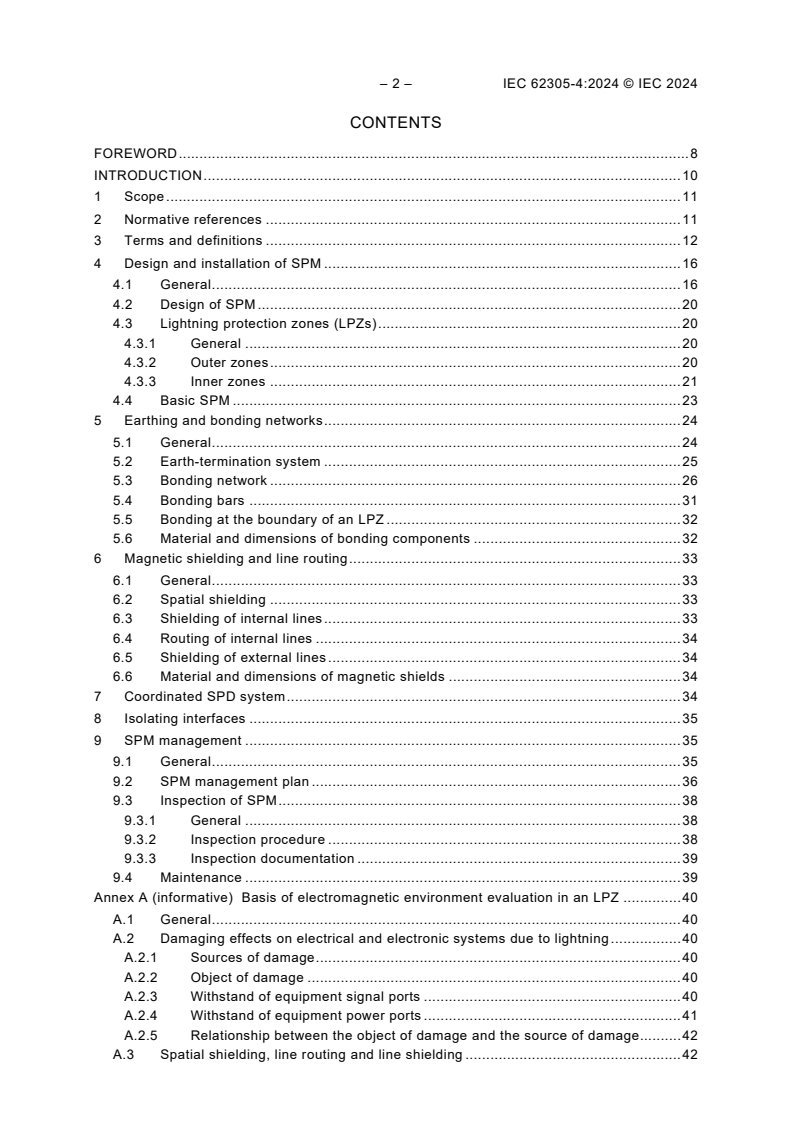
– 2 – IEC 62305-4:2024 © IEC 2024
CONTENTS
FOREWORD . 8
INTRODUCTION . 10
1 Scope . 11
2 Normative references . 11
3 Terms and definitions . 12
4 Design and installation of SPM . 16
4.1 General . 16
4.2 Design of SPM . 20
4.3 Lightning protection zones (LPZs) . 20
4.3.1 General . 20
4.3.2 Outer zones . 20
4.3.3 Inner zones . 21
4.4 Basic SPM . 23
5 Earthing and bonding networks . 24
5.1 General . 24
5.2 Earth-termination system . 25
5.3 Bonding network . 26
5.4 Bonding bars . 31
5.5 Bonding at the boundary of an LPZ . 32
5.6 Material and dimensions of bonding components . 32
6 Magnetic shielding and line routing . 33
6.1 General . 33
6.2 Spatial shielding . 33
6.3 Shielding of internal lines . 33
6.4 Routing of internal lines . 34
6.5 Shielding of external lines . 34
6.6 Material and dimensions of magnetic shields . 34
7 Coordinated SPD system . 34
8 Isolating interfaces . 35
9 SPM management . 35
9.1 General . 35
9.2 SPM management plan . 36
9.3 Inspection of SPM . 38
9.3.1 General . 38
9.3.2 Inspection procedure . 38
9.3.3 Inspection documentation . 39
9.4 Maintenance . 39
Annex A (informative) Basis of electromagnetic environment evaluation in an LPZ . 40
A.1 General . 40
A.2 Damaging effects on electrical and electronic systems due to lightning . 40
A.2.1 Sources of damage . 40
A.2.2 Object of damage . 40
A.2.3 Withstand of equipment signal ports . 40
A.2.4 Withstand of equipment power ports . 41
A.2.5 Relationship between the object of damage and the source of damage . 42
A.3 Spatial shielding, line routing and line shielding . 42
A.3.1 General . 42
A.3.2 Grid-like spatial shields . 45
A.3.3 Line routing and line shielding . 47
A.4 Magnetic field inside LPZ . 51
A.4.1 Approximation for the magnetic field inside LPZ . 51
A.4.2 Numerical magnetic field calculation in case of direct lightning strikes . 57
A.4.3 Experimental evaluation of the magnetic field due to a direct lightning
strike . 61
A.5 Calculation of induced voltages and currents . 62
A.5.1 General . 62
A.5.2 Situation inside LPZ 1 in the case of a direct lightning strike . 62
A.5.3 Situation inside LPZ 1 in the case of a nearby lightning strike . 65
A.5.4 Situation inside LPZ 2 and higher . 66
Annex B (informative) Implementation of SPM for an existing structure . 67
B.1 General . 67
B.2 Checklists . 67
B.3 Design of SPM for an existing structure . 68
B.4 Design of basic protection measures for LPZs . 70
B.4.1 Design of basic protection measures for LPZ 1 . 70
B.4.2 Design of basic protection measures for LPZ 2 . 70
B.4.3 Design of basic protection measures for LPZ 3 . 71
B.5 Improvement of an existing LPS using spatial shielding of LPZ 1 . 71
B.6 Establishment of LPZs for electrical and electronic systems . 71
B.7 Protection using a bonding network . 74
B.8 Protection by surge protective devices . 74
B.9 Protection by isolating interfaces . 75
B.10 Protection measures by line routing and shielding . 75
B.11 Protection measures for externally installed equipment . 77
B.11.1 General . 77
B.11.2 Protection of external equipment . 77
B.11.3 Protection by maintaining electrical insulation to the LPS . 79
B.11.4 Reduction of overvoltages in cables . 80
B.12 Improving interconnections between structures . 81
B.12.1 General . 81
B.12.2 Isolating lines . 81
B.12.3 Metallic lines . 81
B.13 Integration of new internal systems into existing structures . 81
B.14 Overview of possible protection measures . 82
B.14.1 Power supply . 82
B.14.2 Surge protective devices . 83
B.14.3 Isolating interfaces . 83
B.14.4 Line routing and shielding . 83
B.14.5 Spatial shielding . 83
B.14.6 Bonding . 83
B.15 Upgrading a power supply and cable installation inside the structure . 83
Annex C (informative) Selection and installation of a coordinated SPD system . 84
C.1 General . 84
C.2 Selection of SPDs . 85
C.2.1 Location of SPDs according to source of damage . 85
– 4 – IEC 62305-4:2024 © IEC 2024
C.2.2 Selection with regard to lightning current I . 86
C.2.3 Selection with regard to voltage protection level U . 87
p
C.2.4 SPD arrangements . 92
C.2.5 Equipment protection by two SPDs . 92
C.2.6 Equipment connected to two different services . 93
C.2.7 Selection with regard to location and discharge current . 93
C.2.8 Coordination of the SPD with back-up overcurrent protective device
(OCPD) . 96
C.3 Installation of a coordinated SPD system . 97
C.3.1 General . 97
C.3.2 Installation location of SPDs . 97
C.3.3 Connecting conductors . 98
C.3.4 Coordination of SPDs . 98
C.3.5 Procedure for installation of a coordinated SPD system . 98
Annex D (informative) Factors to be considered in the selection of SPDs . 99
D.1 General . 99
D.2 Factors determining the stress experienced by an SPD . 99
D.3 Quantifying the statistical threat level to an SPD . 101
D.3.1 General . 101
D.3.2 Installation factors effecting current distribution . 101
D.3.3 Considerations in the selection of SPD ratings: I , [I ], I , U . 102
imp max n OC
Annex E (informative) Lightning current sharing using simulation modelling . 104
E.1 General . 104
E.1.1 Overview . 104
E.1.2 Methods to determine the lightning current distribution . 104
E.2 Lightning current parameters for SPDs . 105
E.2.1 Lightning current parameters in accordance with IEC 62305-1 . 105
E.2.2 Conclusion on lightning current sharing from numerical modelling . 105
E.3 Distribution of lightning currents in power supply systems . 106
E.3.1 Influencing factors . 106
E.3.2 Considerations in lightning current sharing using numerical modelling . 108
E.4 Current distribution in structures . 111
E.4.1 General . 111
E.4.2 Structures with externally installed equipment and non-isolated LPS . 112
E.4.3 Tall buildings . 113
E.4.4 Transformer located inside a structure . 114
Annex F (informative) Lightning current sharing in photovoltaic installations . 115
F.1 General . 115
F.2 Structures with roof-mounted PV systems . 117
F.2.1 Description and assumptions . 117
F.2.2 Simplified calculation for the lightning current flowing in DC conductors . 117
F.3 Outside free-field power plant with a non-isolated LPS. 119
F.3.1 General . 119
F.3.2 Finding the lightning current flowing through the DC conductor via the
SPD . 120
F.3.3 Results . 120
Annex G (informative) Testing system level behaviour under lightning discharge
conditions . 122
G.1 General . 122
G.2 SPD discharge current test under normal service conditions . 122
G.3 Induction test due to lightning currents . 122
G.4 Recommended test classification of system level immunity (IEC 61000-4-5) . 122
Annex H (informative) Induced voltage in the circuits protected by an SPD . 124
H.1 General . 124
H.2 Direct flashes to the structure (Figure H.1) . 124
H.3 Flashes near the structure (Figure H.2) . 125
H.4 Flashes to the service . 126
Annex I (informative) Isolation interfaces using surge isolation transformers (SITs) . 128
I.1 SIT for low-voltage power distribution system . 128
I.2 SIT for communication systems . 128
I.3 SIT surge mitigation performance (low-voltage power distribution systems) . 128
Bibliography . 130
Figure 1 – General principle for the division into different LPZs . 17
Figure 2 – Examples of possible SPM (LEMP protection measures) . 19
Figure 3 – Examples of interconnected LPZs . 22
Figure 4 – Examples of extended lightning protection zones . 23
Figure 5 – Example of a three-dimensional earthing system consisting of the bonding
network interconnected with the earth-termination system . 25
Figure 6 – Meshed earth-termination system of a plant . 26
Figure 7 – Utilization of reinforcing rods of a structure as a protection measure against
LEMP and for equipotential bonding. 28
Figure 8 – Equipotential bonding in a structure with steel reinforcement . 29
Figure 9 – Integration of conductive parts of internal systems into the bonding network . 30
Figure 10 – Combinations of integration methods of conductive parts of internal
systems into the bonding network . 31
Figure A.1 – LEMP situation due to lightning strike to the structure . 42
Figure A.2 – Simulation of the rise of the field of the subsequent stroke (0,25/100 µs)
by damped 1 MHz oscillations (multiple impulses 0,2/0,5 µs) . 45
Figure A.3 – Large volume shield built by metal reinforcement and metal frames . 46
Figure A.4 – Volume for electrical and electronic systems inside an inner LPZ n . 47
Figure A.5 – Reducing induction effects by line routing and shielding measures . 48
Figure A.6 – Example of SPM for an office building . 50
Figure A.7 – Evaluation of the magnetic field values in case of a direct lightning strike . 51
Figure A.8 – Evaluation of the magnetic field values in case of a nearby lightning strike . 53
Figure A.9 – Distance s depending on rolling sphere radius and structure dimensions. 56
a
Figure A.10 – Types of structure geometries with different volume shields . 58
Figure A.11 – Magnetic field strength H inside a grid-like shield for the cubic
1/MAX
structure shown in Figure A.10 [14] . 59
Figure A.12 – Magnetic field strength H inside a grid-like shield for the cubic
1/MAX
structure according to mesh width . 60
Figure A.13 – Low-level test to evaluate the magnetic field inside a shielded structure . 61
Figure A.14 – Voltages and currents induced into a loop formed by lines . 62
Figure B.1 – SPM design steps for an existing structure . 70
Figure B.2 – Methods of establishing LPZs in existing structures . 73
– 6 – IEC 62305-4:2024 © IEC 2024
Figure B.3 – Reduction of loop area using shielded cables close to a metal plate . 76
Figure B.4 – Example of a metal plate for additional shielding . 76
Figure B.5 – Protection of aerials and other external equipment . 78
Figure B.6 – Separation distance maintained or not maintained . 79
Figure B.7 – Inherent shielding provided by bonded ladders and pipes . 80
Figure B.8 – Ideal positions for lines on a mast (cross-section of steel lattice mast) . 80
Figure B.9 – Upgrading of the SPM in existing structures . 82
Figure C.1 – Selection of SPDs by source of damage . 86
Figure C.2 – Example of installation of an SPD to reduce the effect of SPD lead length . 88
Figure C.3 – Surge voltage between live conductor and bonding bar . 91
Figure C.4 – Equipment with two ports and SPDs on both services bonded to two
different earthing points of a non-equipotential earthing system . 93
Figure D.1 – Installation example of SPD test class I, class II and class III in a TN
system . 100
Figure D.2 – Basic example of different sources of damage to a structure and lightning
current distribution within a system . 101
Figure D.3 – Example of the simplified current distribution in a TN power distribution
system . 102
Figure E.1 – Approach to computer simulation used to analyse lightning current
sharing . 105
Figure E.2 – MEN earthing system . 108
Figure E.3 – Parallel connected structures . 109
Figure E.4 – Influence of lightning current flow in parallel connected structures . 109
Figure E.5 – Influence of lightning current flow in star connected structures . 110
Figure E.6 – Influence of other metallic conductive services on lightning current
sharing . 110
Figure E.7 – Influence of lightning current flow from S3 events . 111
Figure E.8 – Structures with externally installed equipment and non-isolated LPS . 112
Figure E.9 – Protection of internally located sub-station transformers . 114
Figure F.1 – Current sharing between LPS down conductors and the internal cabling of
a PV system in which the separation distance s has not been maintained . 116
Figure F.2 – Protection of a roof-mounted PV system . 117
Figure F.3 – Free-field PV power plant with multiple earthing and meshed earthing
system . 120
Figure G.1 – Example circuit of an SPD discharge current test under service conditions . 123
Figure G.2 – Example circuit of an induction test due to lightning currents . 123
Figure H.1 – Induced loop by a lightning current on the structure . 125
Figure H.2 – Induced loop by a lightning current near the structure . 125
Figure I.1 – Use of SPDs to protect windings of SIT . 129
Table 1 – Minimum cross-sections for bonding components . 33
Table 2 – SPM management plan for new buildings and for extensive changes in
construction or use of existing buildings . 37
Table A.1 – Rated impulse voltage of equipment per IEC 60364-4-44:2007, Clause 443
and IEC 60364-4-44:2007/AMD1:2015, Clause 443 . 41
Table A.2 – Parameters relevant to source of harm and equipment . 43
Table A.3 – Examples for I = 100 kA and w = 2 m . 53
0/MAX m
Table A.4 – Attenuation of the magnetic field of grid-like spatial shields for a plane
wave . 54
Table A.5 – Rolling sphere radius corresponding to maximum lightning current . 56
Table A.6 – Examples for I = 100 kA and w = 2 m corresponding to
0/MAX m
SF = 12,6 dB . 57
Table B.1 – Structural characteristics and surroundings . 67
Table B.2 – Installation characteristics . 68
Table B.3 – Equipment characteristics . 68
Table B.4 – Other questions to be considered for the protection concept . 68
Table B.5 – Type of LPS . 68
Table C.1 – Required rated impulse voltage of equipment. 87
Table C.2 – Connection of the SPD dependent on supply system . 94
Table C.3 – Selection of impulse discharge current (I ) where the building is
imp
protected against direct lightning strike (S1) based on simplified rules . 95
Table C.4 – Nominal discharge current (I ) in kA depending on supply system and
n
connection type . 95
Table C.5 – Selection of impulse discharge current (I ) where the building is
imp
protected from direct strikes to the line (S3) . 96
Table D.1 – Preferred values of I . 99
imp
Table E.1 – General trends associated with protection installations for different power
distribution systems . 107
Table F.1 – Simplified calculated values of I (I ) and I (I ) for voltage-
imp 10/350 n 8/20
limiting SPDs on the DC side of a PV installation mounted on the roof of a building with
an external LPS if the separation distance is not maintained (see Figure F.1) . 118
Table F.2 – Simplified calculated values of I (I ) for voltage switching SPDs
imp 10/350
on the DC side of a PV installation mounted on the roof of a building with an external
LPS if the separation distance is not maintained (see Figure F.1) . 119
Table F.3 – Simplified calculated values of I and I for SPDs intended to be
10/350 8/20
used in free-field PV power plants with multiple earthing and a meshed earthing
system based on Figure F.3 . 121
Table H.1 – Flashes near the structure: induced voltage per square metre q as a
function of LPL. 126
Table H.2 – Values of k . 127
c
Table H.3 – Values of k and k for some copper shields . 127
S1 S2
– 8 – IEC 62305-4:2024 © IEC 2024
INTERNATIONAL ELECTROTECHNICAL COMMISSION
____________
PROTECTION AGAINST LIGHTNING –
Part 4: Electrical and electronic systems within structures
FOREWORD
1) The International Electrotechnical Commission (IEC) is a worldwide organization for standardization comprising
all national electrotechnical committees (IEC National Committees). The object of IEC is to promote
international co-operation on all questions concerning standardization in the electrical and electronic fields. To
this end and in addition to other activities, IEC publishes International Standards, Technical Specifications,
Technical Reports, Publicly Available Specifications (PAS) and Guides (hereafter referred to as “IEC
Publication(s)”). Their preparation is entrusted to technical committees; any IEC National Committee interested
in the subject dealt with may participate in this preparatory work. International, governmental and non-
governmental organizations liaising with the IEC also participate in this preparation. IEC collaborates closely
with the International Organization for Standardization (ISO) in accordance with conditions determined by
agreement between the two organizations.
2) The formal decisions or agreements of IEC on technical matters express, as nearly as possible, an international
consensus of opinion on the relevant subjects since each technical committee has representation from all
interested IEC National Committees.
3) IEC Publications have the form of recommendations for international use and are accepted by IEC National
Committees in that sense. While all reasonable efforts are made to ensure that the technical content of IEC
Publications is accurate, IEC cannot be held responsible for the way in which they are used or for any
misinterpretation by any end user.
4) In order to promote international uniformity, IEC National Committees undertake to apply IEC Publications
transparently to the maximum extent possible in their national and regional publications. Any divergence
between any IEC Publication and the corresponding national or regional publication shall be clearly indicated in
the latter.
5) IEC itself does not provide any attestation of conformity. Independent certification bodies provide conformity
assessment services and, in some areas, access to IEC marks of conformity. IEC is not responsible for any
services carried out by independent certification bodies.
6) All users should ensure that they have the latest edition of this publication.
7) No liability shall attach to IEC or its directors, employees, servants or agents including individual experts and
members of its technical committees and IEC National Committees for any personal injury, property damage or
other damage of any nature whatsoever, whether direct or indirect, or for costs (including legal fees) and
expenses arising out of the publication, use of, or reliance upon, this IEC Publication or any other IEC
Publications.
8) Attention is drawn to the Normative references cited in this publication. Use of the referenced publications is
indispensable for the correct application of this publication.
9) IEC draws attention to the possibility that the implementation of this document may involve the use of (a)
patent(s). IEC takes no position concerning the evidence, validity or applicability of any claimed patent rights in
respect thereof. As of the date of publication of this document, IEC had not received notice of (a) patent(s),
which may be required to implement this document. However, implementers are cautioned that this may not
represent the latest information, which may be obtained from the patent database available at
https://patents.iec.ch. IEC shall not be held responsible for identifying any or all such patent rights.
IEC 62305-4 has been prepared by IEC technical committee 81: Lightning protection. It is an
International Standard.
This third edition cancels and replaces the second edition published in 2010. This edition
constitutes a technical revision.
This edition includes the following significant technical changes with respect to the previous
edition:
a) addition of new informative Annex E and Annex F on the determination of current sharing
using modelling and current sharing in PV installations respectively;
b) addition of a new informative Annex G on methods of testing of system level behaviour;
c) addition of a new informative Annex H on induced voltages in SPD-protected installations.
The text of this International Standard is based on the following documents:
Draft Report on voting
81/733/FDIS 81/752/RVD
Full information on the voting for its approval can be found in the report on voting indicated in
the above table.
The language used for the development of this International Standard is English.
This document was drafted in accordance with ISO/IEC Directives, Part 2, and developed in
accordance with ISO/IEC Directives, Part 1 and ISO/IEC Directives, IEC Supplement,
available at www.iec.ch/members_experts/refdocs. The main document types developed by
IEC are described in greater detail at www.iec.ch/publications.
A list of all parts in the IEC 62305 series, published under the general title Protection against
lightning, can be found on the IEC website.
The following differing practices of a less permanent nature exist in the countries indicated
below.
1) Subclause 5.6: In Japan, the minimum values of the cross-section are reduced from:
2 2 2 2
– 16 mm to 14 mm for copper and 25 mm to 22 mm for aluminium, for bonding
conductors connecting different bonding bars and conductors connecting the bars to
the earth-termination system;
2 2 2 2 2 2
– 6 mm to 5 mm for copper, 10 mm to 8 mm for aluminium and 16 mm to 14 mm
for steel, for bonding conductors connecting internal metal installations to the bonding
bars;
2 2 2 2 2 2
– 16 mm to 14 mm , 6 mm to 5 mm and 2,5 mm to 2 mm for copper, for earthing
conductors to the SPD, conductors connecting SPDs and overcurrent protective
devices to live conductors.
2) Subclause E.3.2.3: In South Africa SANS 10142-1:2020, Clause 6.1.6 [1] states that ‘The
neutral conductor shall not be connected direct to earth or to the earth continuity
conductor on the load side of the point of control’.
The committee has decided that the contents of this document will remain unchanged until the
stability date indicated on the IEC website under webstore.iec.ch in the data related to the
specific document. At this date, the document will be
• reconfirmed,
• withdrawn, or
• revised.
IMPORTANT – The "colour inside" logo on the cover page of this document indicates
that it contains colours which are considered to be useful for the correct
understanding of its contents. Users should therefore print this document using a
colour printer.
___________
Numbers in square brackets refer to the Bibliography.
– 10 – IEC 62305-4:2024 © IEC 2024
INTRODUCTION
Lightning as a source of harm is a very high energy phenomenon. Lightning flashes release
many hundreds of mega-joules of energy. When compared with the milli-joules of energy that
can be enough to cause damage to sensitive electronic equipment in electrical and electronic
systems within a structure, additional protection measures will be necessary to protect some
of this equipment.
The need for this International Standard has arisen due to the increasing cost of failures of
electrical and electronic systems, caused by electromagnetic effects of lightning. Of
importance are electronic systems used in data processing and storage as well as process
control and safety for plants of considerable capital cost, size and complexity (for which plant
outages are very undesirable for cost and safety reasons).
Lightning can cause different types of damage in a structure, as defined in IEC 62305-1.
IEC 62305-3 deals with the protection measures to reduce the risk of physical damage and
life hazard but does not cover the protection of electrical and electronic systems.
This part of IEC 62305 therefore pr
...