

EN 50470-4:2023
(Main)Electricity metering equipment - Part 4: Particular requirements - Static meters for DC active energy (class indexes A, B and C)
General Information
- Abstract
This document applies only to static watt-hour meters of accuracy classes A, B and C for the measurement of direct current electrical active energy in DC systems and it applies to their type tests. NOTE 1 For general requirements, such as construction, EMC, safety, dependability etc., see the relevant EN 62052 series or EN 62059 series. This document applies to electricity metering equipment designed to: - measure and control electrical energy on DC electrical networks with voltages up to 1 500 V; NOTE 2 Meters for unearthed DC supplies and meters for three-wire DC networks are within the scope of this document. - form a complete meter including the legally relevant display of measured values; NOTE 3 Electrical energy meters constructed from separate parts as described in WELMEC Guide 11.7:2017 are included. - operate with integrated or detached legally relevant displays; - optionally, provide additional functions other than those for measurement of electrical energy. They can be used for measuring DC electrical energy, amongst others, in the following application areas: - in EV (electrical vehicle) charging stations or in EV charging infrastructure (also called EVSE, electric vehicle supply equipment), if energy is measured on the DC side; - in solar PV (photovoltaic) systems where DC power generation is measured; - in low voltage DC networks for residential or commercial areas, if energy is measured on the DC side, including similar applications like information technology (IT) server farms or DC supply points for communication equipment; - in DC supply points for public transport networks (e.g. for trolleybuses); - in mobile applications on vehicles for e-road (electric road) systems. Meters designed for operation with external DC instrument transformers, transducers or shunts can be tested for compliance with this document only if such meters and their transformers, transducers or shunts are tested together and meet the requirements for directly connected meters. Requirements in this document and in EN IEC 62052 11:20211 applying to meters designed for operation with DC LPITs also apply to meters designed for operation with external instrument transformers, transducers or shunts. NOTE 4 Modern electricity meters typically contain additional functions such as measurement of voltage magnitude, current magnitude, power, etc.; measurement of power quality parameters; load control functions; delivery, time, test, accounting, recording functions; data communication interfaces and associated data security functions. The relevant standards for these functions could apply in addition to the requirements of this document. However, the requirements for such functions are outside the scope of this document. NOTE 5 Product requirements for power metering and monitoring devices (PMDs) and measurement functions such as voltage magnitude, current magnitude, power, etc., are covered in EN IEC 61557-12:2022. However, devices compliant with EN IEC 61557-12:2022 are not intended to be used as billing meters unless they are also compliant with EN IEC 62052 11:20211 and this document. NOTE 6 Requirements for DC power quality (PQ) instruments, DC PQ measuring techniques, and DC PQ instrument testing are under discussion and will be specified in other standards. This document does not apply to: — portable meters; NOTE 7 Portable meters are meters that are not permanently connected. — meters used in rolling stock (railway applications), ships and airplanes; NOTE 8 DC meters for rolling stock are covered by other standards, e.g. by the EN 50463 series. [...]
- Status
- Published
- Publication Date
- 24-Aug-2023
- Technical Committee
- CLC/TC 13 - Equipment for electrical energy measurement and load control
- Drafting Committee
- CLC/TC 13 - Equipment for electrical energy measurement and load control
- Current Stage
- 6060 - Document made available - Publishing
- Start Date
- 25-Aug-2023
- Due Date
- 28-Aug-2023
- Completion Date
- 25-Aug-2023

Overview
EN 50470-4:2023 (CLC/CENELEC) sets the particular requirements and type-test criteria for static watt‑hour meters measuring DC active energy in accuracy class indexes A, B and C. The standard applies to meters intended for DC networks up to 1 500 V, including unearthed and three‑wire DC systems, and covers complete meters with legally relevant displays (integrated or detached). It focuses on type testing and accuracy for billing-capable DC energy meters while referring to other standards (e.g., EN IEC 62052‑11) for general construction, EMC, safety and dependability.
Key topics and technical requirements
- Scope and applicability: static DC watt‑hour meters for classes A, B and C; excludes portable meters, rolling stock/railway, ships, aircraft, lab reference meters and certain additional functions.
- Type tests and accuracy: procedures for accuracy verification, measurement uncertainty, meter constants, starting‑current, repeatability and no‑load conditions.
- Environmental and durability tests: climatic tests, effects of external influences and durability/reliability requirements.
- Electrical limits: standard electrical values (voltages, currents, limits such as nominal/min/max currents) and power consumption considerations.
- Disturbance and EMC considerations: tests for conducted differential mode current disturbances and voltage conditions relevant to DC systems.
- Software and data protection: identification and protection of metrologically relevant software and parameters, protection of measurement data against corruption and unauthorized influence.
- Integration & interfaces: requirements for meters constructed from separate parts (per WELMEC guidance) and rules for meters using external DC instrument transformers, transducers or shunts (only tested together with those devices).
Applications
EN 50470‑4:2023 is designed for DC energy billing and control applications, including:
- EV charging infrastructure (DC side metering) - EVSE and DC fast charging stations
- Solar PV systems - measurement of DC power generation
- Low-voltage DC networks - residential or commercial DC distribution, IT server farms, telecom DC supply points
- Public transport DC supply - trolleybus substations and similar
- Mobile and e‑road systems - vehicle-mounted DC metering
Who should use this standard
- Meter manufacturers and designers of static DC meters
- Test laboratories and conformity assessment bodies performing type tests
- Utilities, EVSE vendors, PV system integrators and DC network operators specifying billing meters
- Regulators and procurement officers assessing legal metrology compliance
Related standards
- EN IEC 62052‑11 (general meter requirements: construction, EMC, safety)
- EN IEC 62053‑41 (static DC energy meters - other accuracy classes)
- EN IEC 61557‑12 (power metering & monitoring devices - non-billing PMDs)
- WELMEC Guide 11.7 (construction from separate parts)
- Reference to Directive 2014/32/EU (MID) via Annex ZZ for legal metrology alignment
Keywords: EN 50470-4:2023, DC energy metering, static DC meters, accuracy classes A B C, EV charging metering, solar PV DC metering, legal metrology, CENELEC.
Relations
- Effective Date
- 03-Feb-2026
- Effective Date
- 03-Feb-2026
- Effective Date
- 03-Feb-2026
- Effective Date
- 03-Feb-2026
- Effective Date
- 09-Feb-2026
- Effective Date
- 09-Feb-2026
Get Certified
Connect with accredited certification bodies for this standard

DIBt (Deutsches Institut für Bautechnik)
German Institute for Building Technology.
DIN CERTCO
DIN Group product certification.

Aboma Certification B.V.
Specialized in construction, metal, and transport sectors.
Sponsored listings
Frequently Asked Questions
EN 50470-4:2023 is a standard published by CLC. Its full title is "Electricity metering equipment - Part 4: Particular requirements - Static meters for DC active energy (class indexes A, B and C)". This standard covers: This document applies only to static watt-hour meters of accuracy classes A, B and C for the measurement of direct current electrical active energy in DC systems and it applies to their type tests. NOTE 1 For general requirements, such as construction, EMC, safety, dependability etc., see the relevant EN 62052 series or EN 62059 series. This document applies to electricity metering equipment designed to: - measure and control electrical energy on DC electrical networks with voltages up to 1 500 V; NOTE 2 Meters for unearthed DC supplies and meters for three-wire DC networks are within the scope of this document. - form a complete meter including the legally relevant display of measured values; NOTE 3 Electrical energy meters constructed from separate parts as described in WELMEC Guide 11.7:2017 are included. - operate with integrated or detached legally relevant displays; - optionally, provide additional functions other than those for measurement of electrical energy. They can be used for measuring DC electrical energy, amongst others, in the following application areas: - in EV (electrical vehicle) charging stations or in EV charging infrastructure (also called EVSE, electric vehicle supply equipment), if energy is measured on the DC side; - in solar PV (photovoltaic) systems where DC power generation is measured; - in low voltage DC networks for residential or commercial areas, if energy is measured on the DC side, including similar applications like information technology (IT) server farms or DC supply points for communication equipment; - in DC supply points for public transport networks (e.g. for trolleybuses); - in mobile applications on vehicles for e-road (electric road) systems. Meters designed for operation with external DC instrument transformers, transducers or shunts can be tested for compliance with this document only if such meters and their transformers, transducers or shunts are tested together and meet the requirements for directly connected meters. Requirements in this document and in EN IEC 62052 11:20211 applying to meters designed for operation with DC LPITs also apply to meters designed for operation with external instrument transformers, transducers or shunts. NOTE 4 Modern electricity meters typically contain additional functions such as measurement of voltage magnitude, current magnitude, power, etc.; measurement of power quality parameters; load control functions; delivery, time, test, accounting, recording functions; data communication interfaces and associated data security functions. The relevant standards for these functions could apply in addition to the requirements of this document. However, the requirements for such functions are outside the scope of this document. NOTE 5 Product requirements for power metering and monitoring devices (PMDs) and measurement functions such as voltage magnitude, current magnitude, power, etc., are covered in EN IEC 61557-12:2022. However, devices compliant with EN IEC 61557-12:2022 are not intended to be used as billing meters unless they are also compliant with EN IEC 62052 11:20211 and this document. NOTE 6 Requirements for DC power quality (PQ) instruments, DC PQ measuring techniques, and DC PQ instrument testing are under discussion and will be specified in other standards. This document does not apply to: — portable meters; NOTE 7 Portable meters are meters that are not permanently connected. — meters used in rolling stock (railway applications), ships and airplanes; NOTE 8 DC meters for rolling stock are covered by other standards, e.g. by the EN 50463 series. [...]
This document applies only to static watt-hour meters of accuracy classes A, B and C for the measurement of direct current electrical active energy in DC systems and it applies to their type tests. NOTE 1 For general requirements, such as construction, EMC, safety, dependability etc., see the relevant EN 62052 series or EN 62059 series. This document applies to electricity metering equipment designed to: - measure and control electrical energy on DC electrical networks with voltages up to 1 500 V; NOTE 2 Meters for unearthed DC supplies and meters for three-wire DC networks are within the scope of this document. - form a complete meter including the legally relevant display of measured values; NOTE 3 Electrical energy meters constructed from separate parts as described in WELMEC Guide 11.7:2017 are included. - operate with integrated or detached legally relevant displays; - optionally, provide additional functions other than those for measurement of electrical energy. They can be used for measuring DC electrical energy, amongst others, in the following application areas: - in EV (electrical vehicle) charging stations or in EV charging infrastructure (also called EVSE, electric vehicle supply equipment), if energy is measured on the DC side; - in solar PV (photovoltaic) systems where DC power generation is measured; - in low voltage DC networks for residential or commercial areas, if energy is measured on the DC side, including similar applications like information technology (IT) server farms or DC supply points for communication equipment; - in DC supply points for public transport networks (e.g. for trolleybuses); - in mobile applications on vehicles for e-road (electric road) systems. Meters designed for operation with external DC instrument transformers, transducers or shunts can be tested for compliance with this document only if such meters and their transformers, transducers or shunts are tested together and meet the requirements for directly connected meters. Requirements in this document and in EN IEC 62052 11:20211 applying to meters designed for operation with DC LPITs also apply to meters designed for operation with external instrument transformers, transducers or shunts. NOTE 4 Modern electricity meters typically contain additional functions such as measurement of voltage magnitude, current magnitude, power, etc.; measurement of power quality parameters; load control functions; delivery, time, test, accounting, recording functions; data communication interfaces and associated data security functions. The relevant standards for these functions could apply in addition to the requirements of this document. However, the requirements for such functions are outside the scope of this document. NOTE 5 Product requirements for power metering and monitoring devices (PMDs) and measurement functions such as voltage magnitude, current magnitude, power, etc., are covered in EN IEC 61557-12:2022. However, devices compliant with EN IEC 61557-12:2022 are not intended to be used as billing meters unless they are also compliant with EN IEC 62052 11:20211 and this document. NOTE 6 Requirements for DC power quality (PQ) instruments, DC PQ measuring techniques, and DC PQ instrument testing are under discussion and will be specified in other standards. This document does not apply to: — portable meters; NOTE 7 Portable meters are meters that are not permanently connected. — meters used in rolling stock (railway applications), ships and airplanes; NOTE 8 DC meters for rolling stock are covered by other standards, e.g. by the EN 50463 series. [...]
EN 50470-4:2023 is classified under the following ICS (International Classification for Standards) categories: 91.140.50 - Electricity supply systems. The ICS classification helps identify the subject area and facilitates finding related standards.
EN 50470-4:2023 has the following relationships with other standards: It is inter standard links to EN IEC 62052-11:2021, EN 61010-1:2010, EN IEC 61010-2-030:2021, EN 61000-4-19:2014, EN 15193-1:2017+A1:2021, EN 15193-1:2017. Understanding these relationships helps ensure you are using the most current and applicable version of the standard.
EN 50470-4:2023 is associated with the following European legislation: EU Directives/Regulations: 2014/32/EU; Standardization Mandates: M/541. When a standard is cited in the Official Journal of the European Union, products manufactured in conformity with it benefit from a presumption of conformity with the essential requirements of the corresponding EU directive or regulation.
EN 50470-4:2023 is available in PDF format for immediate download after purchase. The document can be added to your cart and obtained through the secure checkout process. Digital delivery ensures instant access to the complete standard document.
Standards Content (Sample)
SLOVENSKI STANDARD
01-november-2023
Oprema za merjenje električne energije - 4. del: Posebne zahteve - Statični števci
za aktivno enosmerno napetost (razred točnosti A, B, C)
Electricity metering equipment - Part 4: Particular requirements - Static meters for DC
active energy (class indexes A, B, C)
Elektrizitätszähler - Teil 4: Besondere Anforderungen - Elektronische
Wirkverbrauchszähler für Gleichstrom der Genauigkeitsklassen A, B und C
Equipement de comptage d'électricité - Partie 4: Exigences particulières - Compteurs
statiques d'énergie active en courant continu (indices de classe A, B et C)
Ta slovenski standard je istoveten z: EN 50470-4:2023
ICS:
17.220.20 Merjenje električnih in Measurement of electrical
magnetnih veličin and magnetic quantities
91.140.50 Sistemi za oskrbo z elektriko Electricity supply systems
2003-01.Slovenski inštitut za standardizacijo. Razmnoževanje celote ali delov tega standarda ni dovoljeno.
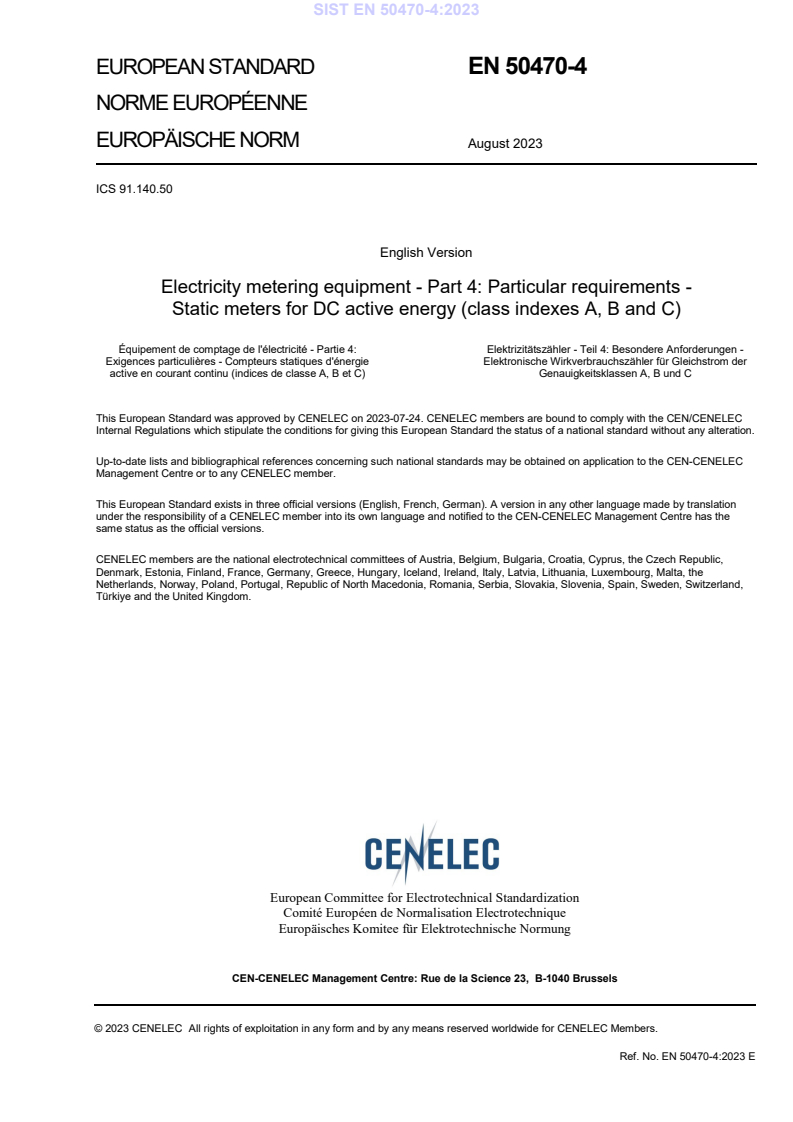
EUROPEAN STANDARD EN 50470-4
NORME EUROPÉENNE
EUROPÄISCHE NORM August 2023
ICS 91.140.50
English Version
Electricity metering equipment - Part 4: Particular requirements -
Static meters for DC active energy (class indexes A, B and C)
Équipement de comptage de l'électricité - Partie 4: Elektrizitätszähler - Teil 4: Besondere Anforderungen -
Exigences particulières - Compteurs statiques d'énergie Elektronische Wirkverbrauchszähler für Gleichstrom der
active en courant continu (indices de classe A, B et C) Genauigkeitsklassen A, B und C
This European Standard was approved by CENELEC on 2023-07-24. CENELEC members are bound to comply with the CEN/CENELEC
Internal Regulations which stipulate the conditions for giving this European Standard the status of a national standard without any alteration.
Up-to-date lists and bibliographical references concerning such national standards may be obtained on application to the CEN-CENELEC
Management Centre or to any CENELEC member.
This European Standard exists in three official versions (English, French, German). A version in any other language made by translation
under the responsibility of a CENELEC member into its own language and notified to the CEN-CENELEC Management Centre has the
same status as the official versions.
CENELEC members are the national electrotechnical committees of Austria, Belgium, Bulgaria, Croatia, Cyprus, the Czech Republic,
Denmark, Estonia, Finland, France, Germany, Greece, Hungary, Iceland, Ireland, Italy, Latvia, Lithuania, Luxembourg, Malta, the
Netherlands, Norway, Poland, Portugal, Republic of North Macedonia, Romania, Serbia, Slovakia, Slovenia, Spain, Sweden, Switzerland,
Türkiye and the United Kingdom.
European Committee for Electrotechnical Standardization
Comité Européen de Normalisation Electrotechnique
Europäisches Komitee für Elektrotechnische Normung
CEN-CENELEC Management Centre: Rue de la Science 23, B-1040 Brussels
© 2023 CENELEC All rights of exploitation in any form and by any means reserved worldwide for CENELEC Members.
Ref. No. EN 50470-4:2023 E
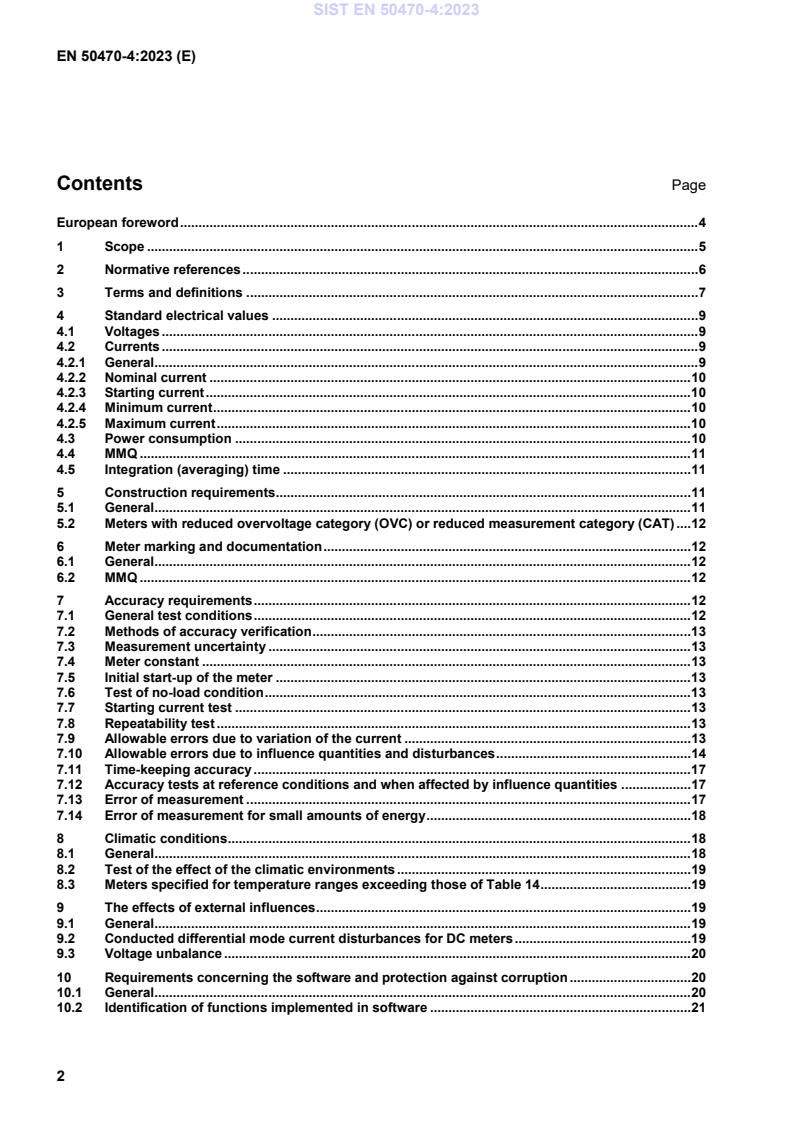
Contents Page
European foreword . 4
1 Scope . 5
2 Normative references . 6
3 Terms and definitions . 7
4 Standard electrical values . 9
4.1 Voltages . 9
4.2 Currents . 9
4.2.1 General . 9
4.2.2 Nominal current . 10
4.2.3 Starting current . 10
4.2.4 Minimum current . 10
4.2.5 Maximum current . 10
4.3 Power consumption . 10
4.4 MMQ . 11
4.5 Integration (averaging) time . 11
5 Construction requirements . 11
5.1 General . 11
5.2 Meters with reduced overvoltage category (OVC) or reduced measurement category (CAT) . 12
6 Meter marking and documentation . 12
6.1 General . 12
6.2 MMQ . 12
7 Accuracy requirements . 12
7.1 General test conditions . 12
7.2 Methods of accuracy verification . 13
7.3 Measurement uncertainty . 13
7.4 Meter constant . 13
7.5 Initial start-up of the meter . 13
7.6 Test of no-load condition . 13
7.7 Starting current test . 13
7.8 Repeatability test . 13
7.9 Allowable errors due to variation of the current . 13
7.10 Allowable errors due to influence quantities and disturbances . 14
7.11 Time-keeping accuracy . 17
7.12 Accuracy tests at reference conditions and when affected by influence quantities . 17
7.13 Error of measurement . 17
7.14 Error of measurement for small amounts of energy . 18
8 Climatic conditions . 18
8.1 General . 18
8.2 Test of the effect of the climatic environments . 19
8.3 Meters specified for temperature ranges exceeding those of Table 14 . 19
9 The effects of external influences . 19
9.1 General . 19
9.2 Conducted differential mode current disturbances for DC meters . 19
9.3 Voltage unbalance . 20
10 Requirements concerning the software and protection against corruption . 20
10.1 General . 20
10.2 Identification of functions implemented in software . 21
10.3 Identification and protection of software . 21
10.4 Identification and protection of metrologically relevant parameters . 21
10.5 Setting of parameters. 21
10.6 Protection of measurement data . 22
10.7 Protection against influence by metrologically non-relevant software . 22
10.8 Protection against influence by connecting another device . 22
10.9 Meters intended for transmission of transaction data . 22
11 Type test . 22
12 Durability . 22
13 Reliability . 23
Annex A (informative) Calculation of the error of measurement . 24
Annex B (informative) Differential mode current disturbance test . 25
Annex C (informative) Differences between IEC and Directive 2014/32/EU . 26
Annex D (informative) Accuracy classes and class indexes . 28
D.1 General . 28
D.2 Class indexes . 28
Annex ZZ (informative) Relationship between this European standard and the essential requirements
of Directive 2014/32/EU aimed to be covered . 29
Bibliography . 32
European foreword
This document (EN 50470-4:2023) has been prepared by CLC/TC 13 “Electrical energy measurement and
control”.
The following dates are fixed:
• latest date by which this document has to be (dop) 2024-07-24
implemented at national level by publication of
an identical national standard or by
endorsement
• latest date by which the national standards (dow) 2026-07-24
conflicting with this document have to be
withdrawn
Attention is drawn to the possibility that some of the elements of this document may be the subject of patent
rights. CENELEC shall not be held responsible for identifying any or all such patent rights.
This document is used in conjunction with EN IEC 62052-11:2021 .
This document is related to EN IEC 62053-41:2021 , Electricity metering equipment - Particular requirements -
Part 41: Static meters for DC energy (classes 0,5 and 1).
NOTE Terms differences for accuracy classes in related standard (EN IEC 62053-41:2021 ) and Directive 2014/32/EU
are listed in Annex D.
The structure of the standards is similar; modifications in this document are provided in the perspective of
compliance with the Essential Requirements of Directive 2014/32/EU on Measuring Instruments (MID).
This document has been prepared under a standardization request addressed to CENELEC by the European
Commission. The Standing Committee of the EFTA States subsequently approves these requests for its
Member States.
For the relationship with EU Legislation, see informative Annex ZZ, which is an integral part of this document.
Any feedback and questions on this document should be directed to the users’ national committee. A complete
listing of these bodies can be found on the CENELEC website.
As impacted by EN IEC 62052-11:2021/A11:2022.
To be published. Stage at the time of publication: FprEN IEC 62053-41:2021.
1 Scope
This document applies only to static watt-hour meters of accuracy classes A, B and C for the measurement of
direct current electrical active energy in DC systems and it applies to their type tests.
NOTE 1 For general requirements, such as construction, EMC, safety, dependability etc., see the relevant
EN 62052 series or EN 62059 series.
This document applies to electricity metering equipment designed to:
— measure and control electrical energy on DC electrical networks with voltages up to 1 500 V;
NOTE 2 Meters for unearthed DC supplies and meters for three-wire DC networks are within the scope of this
document.
— form a complete meter including the legally relevant display of measured values;
NOTE 3 Electrical energy meters constructed from separate parts as described in WELMEC Guide 11.7:2017 are
included.
— operate with integrated or detached legally relevant displays;
— optionally, provide additional functions other than those for measurement of electrical energy.
They can be used for measuring DC electrical energy, amongst others, in the following application areas:
— in EV (electrical vehicle) charging stations or in EV charging infrastructure (also called EVSE, electric
vehicle supply equipment), if energy is measured on the DC side;
— in solar PV (photovoltaic) systems where DC power generation is measured;
— in low voltage DC networks for residential or commercial areas, if energy is measured on the DC side,
including similar applications like information technology (IT) server farms or DC supply points for
communication equipment;
— in DC supply points for public transport networks (e.g. for trolleybuses);
— in mobile applications on vehicles for e-road (electric road) systems.
Meters designed for operation with external DC instrument transformers, transducers or shunts can be tested
for compliance with this document only if such meters and their transformers, transducers or shunts are tested
together and meet the requirements for directly connected meters. Requirements in this document and in
EN IEC 62052-11:2021 applying to meters designed for operation with DC LPITs also apply to meters designed
for operation with external instrument transformers, transducers or shunts.
NOTE 4 Modern electricity meters typically contain additional functions such as measurement of voltage magnitude,
current magnitude, power, etc.; measurement of power quality parameters; load control functions; delivery, time, test,
accounting, recording functions; data communication interfaces and associated data security functions. The relevant
standards for these functions could apply in addition to the requirements of this document. However, the requirements for
such functions are outside the scope of this document.
NOTE 5 Product requirements for power metering and monitoring devices (PMDs) and measurement functions such as
voltage magnitude, current magnitude, power, etc., are covered in EN IEC 61557-12:2022 . However, devices compliant
with EN IEC 61557-12:2022 are not intended to be used as billing meters unless they are also compliant with
EN IEC 62052-11:2021 and this document.
NOTE 6 Requirements for DC power quality (PQ) instruments, DC PQ measuring techniques, and DC PQ instrument
testing are under discussion and will be specified in other standards.
This document does not apply to:
— portable meters;
NOTE 7 Portable meters are meters that are not permanently connected.
— meters used in rolling stock (railway applications), ships and airplanes;
NOTE 8 DC meters for rolling stock are covered by other standards, e.g. by the EN 50463 series.
— laboratory and meter test equipment;
— reference standard meters;
— data interfaces to the register of the meter;
— matching sockets or racks used for installation of electricity metering equipment;
— any additional functions provided in electrical energy meters.
This document does not cover measures for the detection and prevention of fraudulent attempts to compromise
meter’s performance (tampering).
NOTE 9 Nevertheless, specific tampering detection and prevention requirements, and test methods, as relevant for a
particular market are subject to the agreement between the manufacturer and the purchaser.
NOTE 10 Specifying requirements and test methods for fraud detection and prevention would be counterproductive, as
such specifications would provide guidance for potential fraudsters.
NOTE 11 There are many types of meter tampering reported from various markets; therefore, designing meters to detect
and prevent all types of tampering could lead to unjustified increase in costs of meter design, verification, and validation.
NOTE 12 Billing systems, such as smart metering systems, are capable of detecting irregular consumption patterns and
irregular network losses which enable discovery of suspected meter tampering.
NOTE 13 This document does not specify emission requirements. These are specified in EN IEC 62052-11:2021 , 9.3.14.
NOTE 14 Some aspects of meters for EVSE included in this document are expected to be covered by future documents
being worked on in WG 03 of CLC/TC 13 (EN 50732), so they may be removed in future editions of this standard.
2 Normative references
The following documents are referred to in the text in such a way that some of or all their content constitutes
requirements of this document. For dated references, only the edition cited applies. For undated references, the
latest edition of the referenced document (including any amendments) applies.
EN 61000-4-19:2014, Electromagnetic compatibility (EMC) - Part 4-19: Testing and measurement techniques -
Test for immunity to conducted, differential mode disturbances and signalling in the frequency range 2 kHz to
150 kHz at a.c. power ports (IEC 61000-4-19:2014)
EN 61010-1:2010 , Safety requirements for electrical equipment for measurement, control, and laboratory use
- Part 1: General requirements (IEC 61010-1:2010)
As impacted by EN 61010-1:2010/A1:2019 and EN 61010-1:2010/A1:2019/AC:2019-04.
EN IEC 61010-2-030:2021 , Safety requirements for electrical equipment for measurement, control, and
laboratory use - Part 2-030: Particular requirements for equipment having testing or measuring circuits
(IEC 61010-2-030:2017)
EN IEC 62052-11:2021 , Electricity metering equipment - General requirements, tests and test conditions - Part
11: Metering equipment (IEC 62052-11:2020)
3 Terms and definitions
For the purposes of this document, the terms and definitions given in EN IEC 62052-11:2021 and the following
apply.
ISO and IEC maintain terminology databases for use in standardization at the following addresses:
— ISO Online browsing platform: available at https://www.iso.org/obp
— IEC Electropedia: available at https://www.electropedia.org/
NOTE The definitions listed in this document take precedence over those in EN IEC 62052-11:2021 .
3.1
direct current system
DC system
electrical system wherein DC electrical quantities are of primary importance
Note 1 to entry: For the qualifier DC, see IEC 60050-151:2001, 151-15-02.
3.2
direct current
electric current that is time-independent or, by extension, periodic current the direct component of which is of
primary importance
Note 1 to entry: In this context, “time-independent” means stable over periods in the range of tens of milliseconds.
[SOURCE: IEC 60050-131:2002, 131-11-22, modified – Note to entry has been deleted and a new Note 1 to
entry has been added.]
3.3
direct voltage
voltage that is time-independent or, by extension, periodic voltage the direct component of which is of primary
importance
Note 1 to entry: In this context, “time-independent” means stable over periods in the range of tens of milliseconds.
[SOURCE: IEC 60050-131:2002, 131-11-23, modified – Note to entry has been deleted and a new Note 1 to
entry has been added.]
3.4
DC power
DC active power
product of the mean value of direct current flowing through a two-terminal circuit and the mean value of direct
voltage across it
Note 1 to entry: There is no DC reactive power.
As impacted by EN IEC 61010-2-030:2021/A11:2021.
3.5
DC energy
DC active energy
time integral of DC power
Note 1 to entry: The coherent SI unit of active energy is joule, J. Another unit is watt hour. Its multiple, kilowatt hour, kWh,
is commonly used for billing consumers of electrical energy and is therefore indicated on electrical energy meters.
Note 2 to entry: DC energy is a form of active energy as defined in EN IEC 62052-11:2021 .
3.6
DC energy meter
instrument intended to measure DC (active) energy
3.7
transitional current
I
tr
value of the current at, and above which, up to I full accuracy requirements of this document apply
max
3.8
influence quantity
quantity that is not the measurand but that affects the result of measurement
3.9
disturbance
influence quantity having a value within the limits specified in the appropriate requirement but outside the
specified rated operating conditions of the measuring instrument
Note 1 to entry: An influence quantity is a disturbance if for that influence quantity the rated operating conditions are not
specified.
3.10
critical change value
value above which the change in the measurement result is considered unacceptable
Note 1 to entry: The critical change value specifies here the maximum change in the measurement results for all
disturbances. In EN IEC 62052-11:2021 , the critical change value has another definition and meaning and applies only for
tests without any current.
3.11
rated operating condition
value for the measurand and influence quantities making up the normal working conditions of an instrument
3.12
maximum permissible error
MPE
maximum allowable error under rated operating conditions and in the absence of a disturbance
3.13
DC LPIT
LPIT for DC applications like DC current or DC voltage transformers or DC transducers (as defined in
IEC 60688:2021) including combined voltage/current transducers that supply power or energy values to the
meter
Note 1 to entry: Refer to EN IEC 62052-11:2021 for the definition of LPIT.
3.14
legally relevant display
means to communicate legally relevant information like measurement results in a transparent, trustworthy and
non-discriminatory way
Note 1 to entry: Regulations applicable to the billing of energy can require information in addition to measurement values
to be shown. This display may be combined with other displays, e.g. for the unit price.
Note 2 to entry: Depending on the technical implementation, it can be necessary to show information identifying a given
transaction with its associated measurement result.
3.15
minimum measurable quantity
MMQ
minimum amount of energy for which the requirements of this document are met by an energy meter
3.16
pole
designation of a conductor, terminal or any other element of a DC system which is likely to be energized under
normal conditions, e.g. positive pole, negative pole
[SOURCE: IEC 60050-601:1985 , 601-03-12]
3.17
mid-point
pole with a potential in between the positive and the negative pole of a DC three-wire system
4 Standard electrical values
4.1 Voltages
The values in EN IEC 62052-11:2021 , 4.1 apply.
4.2 Currents
4.2.1 General
Table 1 — Preferred values of I and I
tr n
Meters for Current Value of current
A
0,5–1–1,5–2–3–4–5–8–
I
tr
9–12,5–30–50
Direct connection
5–10–15–20–30–40–50–80–
I
n
90–125–300–500
For meters intended for operation with DC LPITs, the values in Table 1 for direct connection apply to the primary
ratings of the DC LPITs used with the meter.
NOTE 1 The values for I are from EN IEC 62052-11:2021 , Table 3.
n
NOTE 2 Meters operating with external DC LPITs are sometimes specified for nominal current values greater than the
values in Table 1, e.g. common values to be considered are 600 A or 630 A.
As impacted by IEC 60050-601:1985/AMD2:2020.
4.2.2 Nominal current
The nominal current I for direct connected meters shall be 10 I .
n tr
4.2.3 Starting current
Starting current I relation to I is shown in Table 2 below.
st tr
Table 2 — Starting current
Starting current I
st
Meters for
Class A Class B Class C
≤ 0,05 I ≤ 0,04 I ≤ 0,04 I
Direct connection
tr tr tr
4.2.4 Minimum current
Minimum current I relation to I is shown in Table 3 below.
min tr
Table 3 — Minimum current
Minimum current I
min
Meters for
Class A Class B Class C
≤ 0,5 I ≤ 0,5 I ≤ 0,3 I
Direct connection
tr tr tr
4.2.5 Maximum current
Maximum current I relation to I is shown in Table 4 below.
max tr
Table 4 — Maximum current
Maximum current I
max
Meters for
Class A Class B Class C
≥ 50 I ≥ 50 I ≥ 50 I
Direct connection
tr tr tr
4.3 Power consumption
The power consumption in the voltage, current and auxiliary power supply circuits shall be determined at
reference conditions given in 7.1 by any suitable method. The maximum uncertainty of the measurement of the
power consumption shall not exceed 5 % of the limits specified in Table 5.
The power consumption for the voltage and current circuits measured at reference temperature should not
exceed the values shown in Table 5.
In case of meters specified for multiple values of voltage or current, the measurements shall be conducted using
the values resulting in the worst case (highest) power consumption of the meter.
Table 5 — Power consumption
Meter circuit Power consumption
Voltage circuit (for non-self-powered meters) 0,5 W
Voltage circuit (for self-powered meters) not specified
Current circuit
120 mW/A · Imax
when measured at maximum current Imax
Auxiliary power supply measured at nominal
not specified
voltage of the auxiliary power supply
NOTE A common value for the power of an auxiliary supply is 2 W or 2 VA.
4.4 MMQ
In transaction-based meter applications such as EVSE, short transactions with very small amounts of energy
might occur. Meters to be used for transaction-based application shall specify a minimum measurable quantity
(MMQ).
NOTE Based on the current practice for petrol pumps, proposed values for the MMQ are in the range between 2 kWh
and 5 kWh.
4.5 Integration (averaging) time
The integration time for determining mean values of current and voltage should be selected to be long enough
so that no AC power is measured.
5 Construction requirements
5.1 General
The requirements given in EN IEC 62052-11:2021 , Clause 5 apply.
In addition to the requirements in EN IEC 62052-11:2021 , 5.6, the following requirements apply:
n n n
a) The scale interval for a measured value shall be in the form 1·10 , 2·10 , or 5·10 , where n is any integer
or zero. The unit of measurement or its symbol shall be shown close to the numerical value.
b) The indication of any result shall be clear and unambiguous and accompanied by such marks and
inscriptions necessary to inform the user of the significance of the result. Easy reading of the presented
result shall be permitted under normal conditions of use. Additional indications may be shown provided
they cannot be confused with the metrologically controlled indications.
c) Legally relevant displays for meters for direct sales, or for use in the absence of one of the trading parties
shall display the energy of the transaction; in such applications, the total energy that has been measured
including previous transactions needs not be displayed to customers. Notwithstanding, it shall be possible
to access the contents of total energy registers. If meters with only a totalizing register are used in such
applications, the meter shall make data available to an external function or device to display the transaction
energy and values of the totalizing register before and after the transaction.
NOTE 1 Pressing buttons to have the values of the total energy registers displayed is an acceptable solution.
NOTE 2 Metrologically relevant information on the legally relevant display requires an unambiguous identification of the
way it is defined. The user manual could provide additional details.
are deemed to provide evidence for compliance with
NOTE 3 The mechanical tests specified in EN IEC 62052-11:2021
the M1 and M2 requirements (see 2014/32/EU, Measuring Instrument Directive), if the meter after the tests shows no
damage or change of the information and operates correctly in accordance with the requirements of
EN IEC 62052-11:2021 . As static meters have no moving parts, it is sufficient to perform metrological tests after the
mechanical tests only.
5.2 Meters with reduced overvoltage category (OVC) or reduced measurement category
(CAT)
Overvoltage category II (OVC II) may be taken as basis for determining insulation requirements of the auxiliary
power supply circuits and other auxiliary circuits of metering equipment, provided that the terminals of the OVC II
circuits are clearly marked on the meter and adequate warnings are provided in the installation manual.
The insulation requirements for OVC II auxiliary circuits shall be implemented according to the applicable
.
requirements in EN 61010-1:2010
NOTE 1 In substations, auxiliary supply circuits of the meter are sometimes energized from a DC supply, from an
Uninterruptable Power Supply (UPS) or from a dedicated AC supply that is independent of the mains to which the current
and voltage circuits of the meter are connected; similarly, auxiliary circuits of the meter – such as control circuits – are
sometimes connected to external circuits classified as having overvoltage category lower than OVC III.
Measurement category II (CAT II) may be taken as a basis for determining insulation requirements for
measuring circuits in DC meters for special applications where transient overvoltages are reduced to OVC II
levels. The terminals of the CAT II circuits shall be clearly marked on the meter and adequate warnings shall
be provided in the installation manual.
The insulation requirements for CAT II measuring circuits shall be implemented according to the applicable
requirements in EN IEC 61010-2-030:2021 .
NOTE 2 It is the responsibility of the installer to make sure that the circuits designated and marked as OVC II resp. CAT II
are not connected to external circuits that require OVC III resp. CAT III or higher, e.g. for meters powered from the AC
distribution network.
NOTE 3 Example for an application with measurement category II: DC meters intended for use in electric vehicle supply
equipment (EVSE) according to EN 61851-23:2014 , where the overvoltages are reduced by using transformers with
protective separation.
NOTE 4 In general, transient overvoltage can be limited using surge protection devices according to EN 61643-11:2012
or using transformers with protective separation.
6 Meter marking and documentation
6.1 General
The requirements of EN IEC 62052-11:2021 , Clause 6 apply, except subclause 6.2, h) and k).
6.2 MMQ
If an MMQ is specified, it shall be marked on the meter housing or shall be shown on the legally relevant display.
7 Accuracy requirements
7.1 General test conditions
Tests and test conditions given in EN IEC 62052-11:2021 , 7.1 apply.
EN IEC 62052-11:2021 , Table 9 is replaced with the following Table 6:
Table 6 — Voltage and current balance
Meters for three-wire connection Permissible tolerances
Each of the voltages between a pole and the mid-
point shall not differ from the average ±1 %
corresponding voltage by more than
Each of the currents in the conductors shall not
±1 %
differ from the average current by more than
In addition to the requirements of EN IEC 62052-11:2021 , Table 10, voltage ripple and current ripple shall be
zero at reference conditions with a permissible tolerance of ±1 %.
7.2 Methods of accuracy verification
Tests and test conditions given in EN IEC 62052-11:2021 , 7.2 apply.
7.3 Measurement uncertainty
The requirements, test conditions and procedures, and acceptance criteria of EN IEC 62052-11:2021 , 7.3
apply.
7.4 Meter constant
The requirements, test conditions and procedures, and acceptance criteria of EN IEC 62052-11:2021 , 7.4
apply.
7.5 Initial start-up of the meter
The requirements, test conditions and procedures, and acceptance criteria of EN IEC 62052-11:2021 , 7.5
apply, disregarding the condition “cos φ = 1”.
7.6 Test of no-load condition
The requirements, test conditions and procedures, and acceptance criteria of EN IEC 62052-11:2021 , 7.6
apply. In addition to the test at 1,1 U , the test shall be executed at 0,8 U . For meters for three-wire connection,
n n
assume m = 2.
7.7 Starting current test
The requirements, test conditions and procedures, and acceptance criteria of EN IEC 62052-11:2021 , 7.7
apply.
7.8 Repeatability test
The requirements, test conditions and procedures, and acceptance criteria of EN IEC 62052-11:2021 , 7.8
apply.
NOTE For static meters the results of the repeatability test are deemed to be sufficient for the reproducibility
requirement as stated in Annex I, Clause 2 of Directive 2014/32/EU.
7.9 Allowable errors due to variation of the current
When the meter is operated under reference conditions as specified in 7.1, and the current is varied, the relative
errors shall not exceed the limits specified for the relevant class indexes in Table 7.
If the meter is designed for the measurement of energy in both directions, the values in Table 7 shall apply for
each direction.
If the meter is rated for multiple connection modes, the accuracy testing results are valid only for the connection
modes tested and cannot be used to claim accuracy for other untested connection modes.
Table 7 — Acceptable relative error limits in per cent at reference conditions
(Meters for two-wire connection, meters for three-wire connection with balanced loads or single-sided loads)
Acceptable relative error limits
in per cent for meters of class index
Value of current
A B C
I ≤ I < I
±2,5 ±1,5 ±1,0
min tr
I ≤ I ≤ I
±2,0 ±1,0 ±0,5
tr max
NOTE 1 The requirements for meters for three-wire connection operating with single-sided loads are exceeding
requirements of Directive 2014/32/EU, and non-compliance with Table 7 requirements does not necessarily imply
non-compliance with Directive 2014/32/EU for this specific test.
Additionally, for currents outside of the controlled current range (i.e. between I and I ), unduly biasing shall
min max
not occur. The relative errors shall not exceed the limits specified for the relevant class indexes in Table 8.
Table 8 — Acceptable relative error limits in per cent at reference conditions
(Meters for two-wire connection, meters for three-wire connection with balanced loads or single-sided loads)
Acceptable relative error limits
in per cent for meters of class index
Value of current
A B C
I I I
min min min
I ≤ I < I
±2,5· ±1,5· ±1,0·
st min
I I I
NOTE 2 The limits between I ≤ I < I are from OIML R 46-1/-2:2012, section 3.3.3.
st min
NOTE 3 Values above I are not expected to occur in installations for longer durations normally (i.e. more than a few
max
hours in a year). However, error limits above I can be specified in an agreement between the manufacturer and the
max
purchaser or according to national regulatory requirements.
NOTE 4 Alternative approaches could be acceptable to demonstrate the requirement of no unduly biasing. The
specifications provided in this document represent the view of CLC/TC 13, WG 01 as the best practice to be followed.
7.10 Allowable errors due to influence quantities and disturbances
Reference conditions as specified in 7.1 apply.
NOTE 1 Differences exist between terminologies in IEC standards and Directive 2014/32/EU. They are detailed in
Annex C, Table C.1.
If the meter is rated for multiple connection modes, the accuracy requirements apply for each of the connection
modes. All tests of effects of influence quantities shall be performed in one connection mode selected to exercise
the complete metrological capability of the meter.
When the current is held constant as specified in 7.1 and any single influence quantity is applied one at a time,
with the meter otherwise operated at reference conditions as specified in 7.1, the variation of relative error with
respect to the intrinsic error shall not exceed the limits specified for the relevant class indexes given in Table 9.
The variation of relative error due to temperature variation shall be determined for each sub-range within the
full temperature range selected by the manufacturer.
For meters with extended temperature ranges, the requirements of 8.3 apply.
NOTE 2 For example, if the manufacturer specifies that the meter is intended for the temperature range −10 °C to 40 °C,
then the requirements for the sub-ranges 5 °C to 30 °C, −10 °C to 5 °C and 30 °C to 40 °C apply.
Table 9 — Acceptable limits of relative error variation in per cent due to influence quantities
(Meters for two-wire connection, meters for three-wire connection with balanced loads or single-sided loads)
Acceptable limits of relative error
variation in per cent
Influence quantity Value of current
for meters of class index
A B C
Temperature variation
I ≤ I ≤ I
5 °C to 30 °C ±1,8 ±0,9 ±0,5
min max
−10 °C to 5 °C
I ≤ I ≤ I
±3,3 ±1,6 ±1,0
min max
30 °C to 40 °C
−25 °C to −10 °C
I ≤ I ≤ I
±4,8 ±2,4 ±1,4
min max
40 °C to 55 °C
−40 °C to −25 °C
I ≤ I ≤ I
±6,3 ±3,1 ±1,9
min max
55 °C to 70 °C
I ≤ I ≤ I
Voltage variation ±10 % ±1,0 ±0,7 ±0,2
min max
NOTE For the relationships I / I and I / I see Tables 3 and 4.
min tr max tr
When the meter is otherwise operated at reference conditions, the error variation in per cent due to disturbances
of long duration, when applied one by one, shall not exceed the critical change values specified in Table 10.
Table 10 — Acceptable limits of relative error variation in per cent due to disturbance of long duration
– Critical change values
(Meters for two-wire connection, meters for three-wire connection with balanced loads or single-sided loads)
Acceptable limits of relative error
Parameter or
Value of current
variation in per cent
Disturbance test subclause in (balanced unless
for meters of class index
1 otherwise stated)
EN IEC 62052-11:2021
C B A
0,8 U ≤ U < 0,9 U
n n
±0,6 ±2,1 ±3,0
1,1 U < U ≤ 1,15 U
a
n n I
Severe voltage variation
n
U < 0,8 U
+10…–100
n
HF (radiated RF)
I
9.3.5 ±1,0 ±2,0 ±3,0
n
electromagnetic field
I
±2,0
Fast transient bursts 9.3.6 ±4,0 ±6,0
n
Conducted disturbances,
I
induced by radio-frequency 9.3.7 ±1,0 ±2,0 ±3,0
n
fields
Conducted differential mode
9.3.8, with modifications in
I
current disturbances ±2,0 ±4,0 ±6,0
n
9.2 of this document
(10 Hz to 150 kHz)
Magnetic fields: External static
I
9.3.12 ±1,0 ±2,0 ±3,0
n
magnetic fields
Magnetic fields: Power
I
frequency magnetic fields of 9.3.13 ±1,0 ±2,0 ±3,0
n
b
external origin
I
Voltage unbalance 9.3 of this document ±1,0 ±2,0 ±4,0
n
I
Auxiliary voltage variation 9.4.8 ±0,1 ±0,2 ±0,4
min
I
Operation of auxiliary devices 9.4.9 ±0,1 ±0,2 ±0,4
min
c
I
Self-heating 9.4.11 ±0,5 ±0,7 ±1,0
max
d
I
Dry heat test 8.3.3 ±0,25 ±0,5 ±1,0
n
d
I
Cold test 8.3.4 ±0,25 ±0,5 ±1,0
n
d
I
Damp heat cyclic test 8.3.5 ±0,25 ±0,5 ±1,0
n
a
This requirement is exceeding requirements of Directive 2014/32/EU, and non-compliance with Table 10 requirements does not
necessarily imply non-compliance with Directive 2014/32/EU for this specific test. The values are chosen to be aligned with the
IEC 62053-41:2021 requirements and considered state-of-the-art for static meters.
b
The frequency is fixed to the AC frequency of the public distribution network of the considered country.
c
The test shall be carried out for at least 1 h, or until the variation of error during 20 min does not exceed 0,2 %.
d
For these tests, the meter accuracy is measured before and after the test. The difference in relative error before and after the test
shall not exceed the error limits specified in this table. These errors limits may be interpreted as allowable meter accuracy drift induced
by the specified test conditions.
When the meter
...