

prEN IEC 62477-2:2025
(Main)Safety requirements for power electronic converter systems and equipment - Part 2: High voltage power electronic converters up to 36 kv a.c. or 54 kv d.c.
General Information
- Abstract
- Status
- Not Published
- Publication Date
- 09-Aug-2027
- Technical Committee
- CLC/TC 22X - Power electronics
- Current Stage
- 4060 - Enquiry results established and sent to TC, SR, BTTF - Enquiry
- Start Date
- 10-Apr-2026
- Completion Date
- 10-Apr-2026

Overview
The standard prEN IEC 62477-2:2025 focuses on the safety requirements for power electronic converter systems (PECS) and equipment, specifically addressing high voltage power electronic converters operating up to 36 kV AC or 54 kV DC. Developed by the CENELEC (CLC) in alignment with the IEC, this standard is a critical document for manufacturers, installers, and operators in the field of high voltage power conversion. It supplements the general provisions of IEC 62477-1 and targets systems that are widely used in industrial, utility, and infrastructure applications, demanding robust electrical and physical safety measures.
Key Topics
The standard comprehensively addresses essential safety aspects and risk mitigations in high voltage PECS by covering:
Protection against Hazards
- Single fault and abnormal operation protection
- Prevention of short-circuits, overloads, and electric shocks (direct and indirect contact)
- Arc fault protection and labelling
Mechanical & Environmental Safety
- Fire and thermal hazard mitigation
- Mechanical safety including rotating parts, sharp edges, and enclosure requirements
- Requirements for liquid-cooled and air-cooled systems
Electrical Design & Connections
- Insulation distances: clearance and creepage
- Wiring methods, conductor identification, and field wiring
- Integration with residual current devices (RCDs) and overcurrent protective devices
Testing & Compliance
- Type testing and routine tests (visual, mechanical, electrical, environmental)
- Evaluation of material durability under stress and exposure
- Environmental tests including vibration, salt mist, and dust resistance
Information and Marking
- Clear instructions for selection, installation, commissioning, operation, and maintenance
- Specific labels and warnings, especially concerning hazardous voltages and internal arc risks
Applications
prEN IEC 62477-2:2025 is vital for industries utilizing or integrating high voltage power electronic converters, such as:
- Electric utilities and substations
- Renewable energy systems (photovoltaic farms, wind energy installations)
- Industrial automation and drive systems
- Railways, marine, and large infrastructure
- DC transmission systems and grids
By following the safety requirements specified in this standard, organizations can ensure:
- Safe equipment design and installation
- Compliance with international regulations and procurement specifications
- Minimized risk of electric shock, fire, or equipment damage
- Improved reliability for end users and maintenance personnel
Related Standards
For comprehensive compliance, the following standards are closely related and should be consulted alongside prEN IEC 62477-2:2025:
- IEC 62477-1:2022: General safety requirements for power electronic converter systems and equipment
- IEC Guide 104: Guide for the drafting of safety publications
- IEC Guide 116: Risk assessment standards in electrical engineering
- IEC 60529: Degrees of protection provided by enclosures (IP code)
Effective implementation of prEN IEC 62477-2:2025 enhances electrical safety, reduces operational risks, and is essential for manufacturers, system integrators, and utility operators dealing with high voltage power electronic converters up to 36 kV AC or 54 kV DC.
Relations
- Effective Date
- 10-Oct-2023
Get Certified
Connect with accredited certification bodies for this standard

IMQ S.p.A. (Certification)
Italian electrical product certification.

SLG Prüf- und Zertifizierungs GmbH
German testing and certification body.

UL Solutions
Global safety science company with testing, inspection and certification.
Sponsored listings
Frequently Asked Questions
prEN IEC 62477-2:2025 is a draft published by CLC. Its full title is "Safety requirements for power electronic converter systems and equipment - Part 2: High voltage power electronic converters up to 36 kv a.c. or 54 kv d.c.". This standard covers: Safety requirements for power electronic converter systems and equipment - Part 2: High voltage power electronic converters up to 36 kv a.c. or 54 kv d.c.
Safety requirements for power electronic converter systems and equipment - Part 2: High voltage power electronic converters up to 36 kv a.c. or 54 kv d.c.
prEN IEC 62477-2:2025 is classified under the following ICS (International Classification for Standards) categories: 29.200 - Rectifiers. Convertors. Stabilized power supply. The ICS classification helps identify the subject area and facilitates finding related standards.
prEN IEC 62477-2:2025 has the following relationships with other standards: It is inter standard links to EN IEC 62477-2:2018. Understanding these relationships helps ensure you are using the most current and applicable version of the standard.
prEN IEC 62477-2:2025 is available in PDF format for immediate download after purchase. The document can be added to your cart and obtained through the secure checkout process. Digital delivery ensures instant access to the complete standard document.
Standards Content (Sample)
SLOVENSKI STANDARD
01-marec-2026
Varnostne zahteve za močnostne elektronske pretvorniške sisteme in opremo - 2.
del: Visokonapetostni elektronski pretvorniki moči do 36 kV izmenično ali 54 kV
enosmerno
Safety requirements for power electronic converter systems and equipment - Part 2:
High voltage power electronic converters up to 36 kv a.c. or 54 kv d.c.
Exigences de sécurité applicables aux systèmes et matériels électroniques de
conversion de puissance - Partie 2: Convertisseurs électroniques de puissance entre 1
000 v en courant alternatif ou 1 500 v en courant continu et 36 kv en courant alternatif ou
54 kv en courant continu
Ta slovenski standard je istoveten z: prEN IEC 62477-2:2025
ICS:
29.200 Usmerniki. Pretvorniki. Rectifiers. Convertors.
Stabilizirano električno Stabilized power supply
napajanje
2003-01.Slovenski inštitut za standardizacijo. Razmnoževanje celote ali delov tega standarda ni dovoljeno.
22/430/CDV
COMMITTEE DRAFT FOR VOTE (CDV)
PROJECT NUMBER:
IEC 62477-2 ED2
DATE OF CIRCULATION: CLOSING DATE FOR VOTING:
2025-12-19 2026-03-13
SUPERSEDES DOCUMENTS:
22/423/CC, 22/424/CD
IEC TC 22 : POWER ELECTRONIC SYSTEMS AND EQUIPMENT
SECRETARIAT: SECRETARY:
Switzerland Ms Chuanhong Zhao
OF INTEREST TO THE FOLLOWING COMMITTEES: HORIZONTAL FUNCTION(S):
TC 8,TC 9,SC 17A,TC 18,TC 31,TC 44,TC 82,TC TC 22 Horizontal Group Safety
88,TC 99,TC 114,TC 120
ASPECTS CONCERNED:
Safety
SUBMITTED FOR CENELEC PARALLEL VOTING NOT SUBMITTED FOR CENELEC PARALLEL VOTING
Attention IEC-CENELEC parallel voting
The attention of IEC National Committees, members of
CENELEC, is drawn to the fact that this Committee Draft for
Vote (CDV) is submitted for parallel voting.
The CENELEC members are invited to vote through the
CENELEC online voting system.
This document is still under study and subject to change. It should not be used for reference purposes.
Recipients of this document are invited to submit, with their comments, notification of any relevant patent rights of which they
are aware and to provide supporting documentation.
Recipients of this document are invited to submit, with their comments, notification of any relevant “In Some Countries”
clauses to be included should this proposal proceed. Recipients are reminded that the CDV stage is the final stage for
submitting ISC clauses. (SEE AC/22/2007 OR NEW GUIDANCE DOC).
TITLE:
Safety requirements for power electronic converter systems and equipment - Part 2: High
Voltage Power electronic converters up to 36 kV a.c. or 54 kV d.c.
PROPOSED STABILITY DATE: 2026
NOTE FROM TC/SC OFFICERS:
electronic file, to make a copy and to print out the content for the sole purpose of preparing National Committee positions.
You may not copy or "mirror" the file or printed version of the document, or any part of it, for any other purpose without
permission in writing from IEC.
IEC CD 62477-2 © IEC 2025
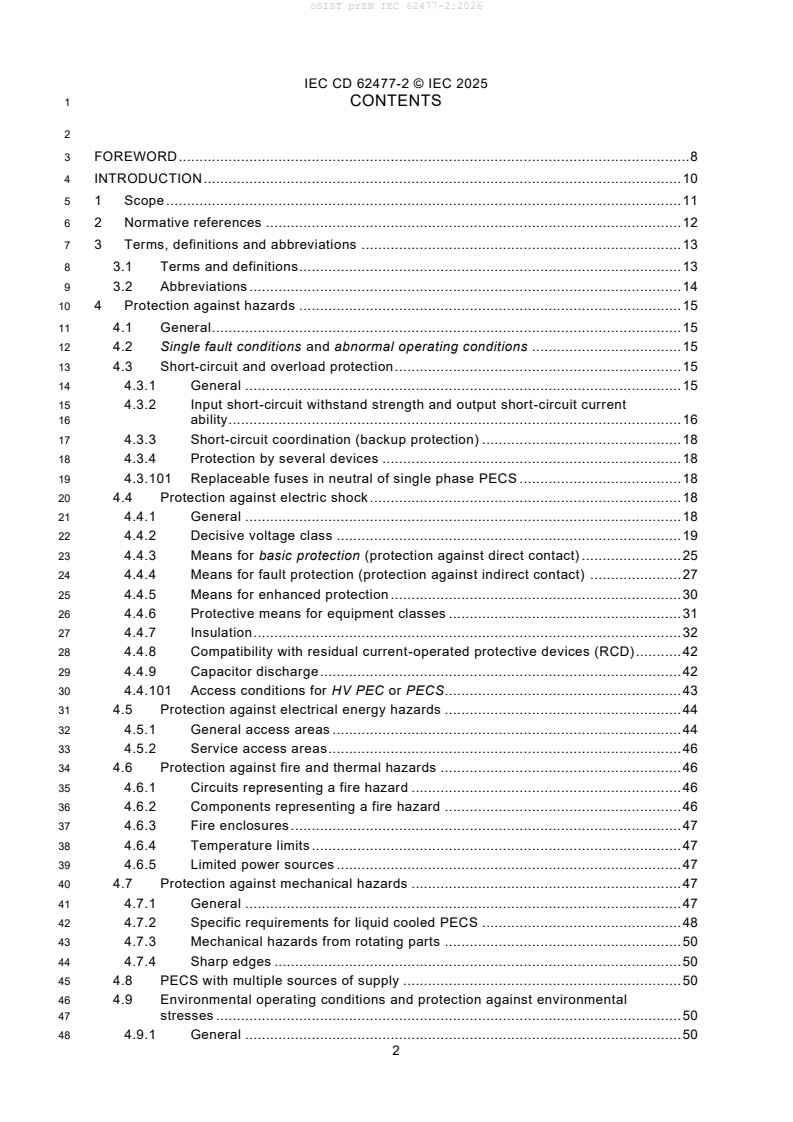
1 CONTENTS
3 FOREWORD . 8
4 INTRODUCTION . 10
5 1 Scope . 11
6 2 Normative references . 12
7 3 Terms, definitions and abbreviations . 13
8 3.1 Terms and definitions . 13
9 3.2 Abbreviations . 14
10 4 Protection against hazards . 15
11 4.1 General . 15
12 4.2 Single fault conditions and abnormal operating conditions . 15
13 4.3 Short-circuit and overload protection . 15
14 4.3.1 General . 15
15 4.3.2 Input short-circuit withstand strength and output short-circuit current
16 ability . 16
17 4.3.3 Short-circuit coordination (backup protection) . 18
18 4.3.4 Protection by several devices . 18
19 4.3.101 Replaceable fuses in neutral of single phase PECS . 18
20 4.4 Protection against electric shock . 18
21 4.4.1 General . 18
22 4.4.2 Decisive voltage class . 19
23 4.4.3 Means for basic protection (protection against direct contact) . 25
24 4.4.4 Means for fault protection (protection against indirect contact) . 27
25 4.4.5 Means for enhanced protection . 30
26 4.4.6 Protective means for equipment classes . 31
27 4.4.7 Insulation . 32
28 4.4.8 Compatibility with residual current-operated protective devices (RCD) . 42
29 4.4.9 Capacitor discharge . 42
30 4.4.101 Access conditions for HV PEC or PECS . 43
31 4.5 Protection against electrical energy hazards . 44
32 4.5.1 General access areas . 44
33 4.5.2 Service access areas . 46
34 4.6 Protection against fire and thermal hazards . 46
35 4.6.1 Circuits representing a fire hazard . 46
36 4.6.2 Components representing a fire hazard . 46
37 4.6.3 Fire enclosures . 47
38 4.6.4 Temperature limits . 47
39 4.6.5 Limited power sources . 47
40 4.7 Protection against mechanical hazards . 47
41 4.7.1 General . 47
42 4.7.2 Specific requirements for liquid cooled PECS . 48
43 4.7.3 Mechanical hazards from rotating parts . 50
44 4.7.4 Sharp edges . 50
45 4.8 PECS with multiple sources of supply . 50
46 4.9 Environmental operating conditions and protection against environmental
47 stresses . 50
48 4.9.1 General . 50
IEC CD 62477-2 © IEC 2025
49 4.9.2.2 Protection against corrosion . 52
50 4.10 Protection against excessive acoustic noise hazards . 52
51 4.10.101 General . 52
52 4.10.102 Sonic pressure and sound level . 53
53 4.11 Wiring and connections . 53
54 4.11.1 General . 53
55 4.11.2 Insulation of conductors . 53
56 4.11.3 Stranded wire . 53
57 4.11.4 Routing and clamping . 53
58 4.11.5 Identification of conductors and terminal . 53
59 4.11.6 Splices and connections . 53
60 4.11.7 Accessible connections . 53
61 4.11.8 Interconnections between parts of the PECS . 54
62 4.11.9 Supply connections. 54
63 4.11.10 Field wiring terminals and internal terminals . 54
64 4.11.11 Means for shield connection of shielded wire or shielded cable . 55
65 4.12 Enclosures . 55
66 4.12.1 General . 55
67 4.12.2 Handles and manual controls . 55
68 4.12.3 Cast metal . 55
69 4.12.4 Sheet metal . 56
70 4.12.5 Stability requirement for enclosure. 56
71 4.12.6 Strain relief . 56
72 4.12.7 Polymeric enclosure stress relief . 56
73 4.12.8 Polymeric enclosure UV resistance . 56
74 4.13 Components . 56
75 4.13.1 General . 56
76 4.13.2 Positive temperature coefficient (PTC) thermistors . 56
77 4.13.3 Mains supply cords . 56
78 4.13.4 Capacitors and RC units bridging insulation . 56
79 4.13.5 Wound components . 56
80 4.13.6 Plug and socket-outlets . 57
81 4.13.7 Components being part of an enclosure . 57
82 4.13.8 Components representing a mechanical hazard . 57
83 4.14 Protection against electromagnetic fields . 57
84 5 Test requirements . 57
85 5.1 General . 57
86 5.1.1 Test objectives and classification . 57
87 5.1.2 Selection of test samples . 57
88 5.1.3 Sequence of tests . 58
89 5.1.4 Earthing conditions . 58
90 5.1.5 General conditions for tests . 58
91 5.1.6 Compliance . 58
92 5.1.7 Test overview . 58
93 5.2 Test specifications . 60
94 5.2.1 Visual inspections (type test and routine test) . 60
95 5.2.2 Mechanical tests . 60
96 5.2.3 Electrical tests . 64
97 5.2.4 Abnormal operation and simulated faults tests . 68
IEC CD 62477-2 © IEC 2025
98 5.2.5 Material tests . 73
99 5.2.6 Environmental tests (type tests) . 74
100 5.2.7 Hydrostatic pressure test (type test and routine test) . 81
101 5.2.8 Electromagnetic fields (EMF) . 82
102 6 Information and marking requirements . 82
103 6.1 General . 82
104 6.2 Information for selection . 83
105 6.2.1 General . 83
106 6.2.2 Instructions and marking pertaining to accessories . 84
107 6.3 Information for installation and commissioning . 84
108 6.3.1 General . 84
109 6.3.2 Mechanical considerations . 84
110 6.3.3 Environment . 84
111 6.3.4 Handling and mounting . 85
112 6.3.5 Enclosure temperature. 85
113 6.3.6 Open type PECS . 85
114 6.3.7 Connections . 86
115 6.3.8 Commissioning . 86
116 6.3.9 Protection requirements . 86
117 6.4 Information for intended use . 88
118 6.4.1 General . 88
119 6.4.2 Adjustment . 88
120 6.4.3 Labels, signs and signals . 88
121 6.4.4 Hot surfaces . 88
122 6.4.5 Control and device marking . 88
123 6.5 Supplementary information . 88
124 6.5.1 Maintenance . 88
125 6.5.2 Capacitor discharge . 89
126 6.5.3 Auto restart/bypass connection . 89
127 6.5.4 Other hazards . 89
128 6.5.5 PECS with multiple sources of supply . 89
129 6.5.6 Replaceable fuses in neutral of single-phase PECS . 89
130 6.5.101 Access conditions for HV PEC or PECS . 89
131 6.5.102 Protection by several devices . 90
132 Annex A (normative) Additional information for protection against electric shock . 91
133 A.1 General . 91
134 A.2 Protection by means of DVC As . 91
135 A.3 Protection by means of protective impedance . 91
136 A.4 Protection by using limited voltages . 91
137 A.5 Evaluation of the working voltage of circuits . 91
138 A.5.1 General . 91
139 A.5.2 Classification of the working voltage . 91
140 A.5.3 AC working voltage . 91
141 A.5.4 DC working voltage. 91
142 A.5.5 Pulsating working voltage . 91
143 A.6 The concept of protective means according to 4.4 . 91
144 A.6.1 General . 91
145 A.6.2 Examples of the use of elements of protective means . 92
146 Annex B (informative) Considerations for the reduction of the pollution degree . 97
IEC CD 62477-2 © IEC 2025
147 Annex C (informative) Symbols referred to in IEC 62477-1 . 98
148 Annex D (normative) Evaluation of clearance and creepage distances . 99
149 Annex E (Normative) Altitude correction for clearances . 100
150 Annex F (normative) Clearance and creepage distance determination for frequencies
151 greater than 30 kHz . 101
152 Annex G (informative) Cross-sections of round conductors . 102
153 Annex H (informative) Guidelines for RCD compatibility . 103
154 Annex I (informative) Examples of overvoltage category reduction . 104
155 Annex J (informative) Burn thresholds for touchable surfaces . 105
156 Annex K (informative) Table of electrochemical potentials . 106
157 Annex L (informative) Measuring instrument for touch current measurements . 107
158 Annex M (Normative) Test probes for determining access . 108
159 Annex N (Informative) Guidance regarding short-circuit current. . 109
160 Annex O (Informative) Guidelines for determination of clearance and creepage
161 distances . 110
162 Annex P (Normative) Protection of persons against electromagnetic fields for
163 frequencies from 0 Hz up to 300 GHz . 111
164 Annex Q (Informative) Maximum disconnection times . 112
165 Q.1 Maximum disconnection times. 112
166 Q.2 Supplementary protective equipotential bonding . 113
167 Annex R (Informative) Risk assessment according to IEC Guide 116 . 114
168 Annex S (Informative) Guidance to product technical committees . 115
169 Annex AA (normative) Arc fault test and labelling requirements . 116
170 AA.1 Overview. 116
171 AA.2 References . 116
172 AA.3 Terms and definitions . 116
173 AA.4 Ratings . 119
174 AA.4.1 General . 119
175 AA.4.2 Internal arc classification . 120
176 AA.5 Testing . 124
177 AA.5.1 General . 124
178 AA.5.2 Test preparation . 125
179 AA.5.3 Test conditions . 132
180 AA.5.4 Assessment . 142
181 AA.6 Arc-prohibiting design . 146
182 AA.6.1 General . 146
183 AA.6.2 Requirements . 146
184 AA.6.3 Testing . 147
185 AA.7 Information and marking requirements . 148
186 AA.7.1 General . 148
187 AA.7.2 IAC rating plate . 149
188 AA.7.3 Information in manuals . 151
189 AA.7.4 Product marking – Internal protection . 153
190 AA.8 Internal arc classification concepts . 153
191 AA.8.1 General . 153
192 AA.8.2 Description of risk and selection of equipment . 155
193 AA.8.3 Causes and preventative measures . 155
IEC CD 62477-2 © IEC 2025
194 AA.8.4 Protection . 156
195 AA.8.5 Considerations for selection and installation . 157
196 AA.8.6 Requirements for concepts 5 and 6. 158
197 AA.8.7 Installation of PECS with general public access . 158
198 Annex BB (new) (informative) Considerations for environmental operating,
199 transportation, storage and handling conditions . 160
200 BB.1 General . 160
201 BB.2 Examples for environmental operating conditions . 160
202 BB.3 Environmental conditions during transportation, storage and handling . 161
203 BB.4 Interdependence of air temperature and relative or absolute air humidity . 162
204 Bibliography . 163
206 Figure 5 – Time-voltage zones for accessible circuits of DVC As and DVC B – DC
207 during single fault conditions . 22
208 Figure 6 – Time-voltage zones for accessible circuits of DVC As and DVC B – AC peak
209 during single fault conditions . 23
210 Figure 7- Protection by using limited voltages . 31
211 Figure 101 – Example of Cold test cycle . 77
212 Figure AA.1 – Mounting frame for vertical indicators . 127
213 Figure AA.2 – Horizontal indicator . 127
214 Figure AA.3 – Arrangement of indicators for different height of PECS . 130
215 Figure AA.4 – Example for two adjacent sides . 131
216 Figure AA.5 – Examples for an accessible side to a non-accessible side . 131
217 Figure AA.6 – General setup for testing – Details . 133
218 Figure AA.7 – General setup for calibration . 133
219 Figure AA.8 – General setup for testing . 133
220 Figure AA.9 – General setup for user installation . 134
221 Figure AA.10 – Power drive system with 12-pulse diode rectifier supplied by an
222 external transformer and a motor at the output . 136
223 Figure AA.11 – Power drive system with integrated transformer and a motor at the
224 output . 137
225 Figure AA.12 – Grid interconnection between 50 Hz and 60 Hz grids . 138
226 Figure AA.13 – Example for test of sub-assemblies of a PECS . 142
227 Figure AA.14 – Installation example of mix of accessibility types including 4a or 4b . 159
228 Figure BB.1 – Climatogram of interdependence among temperature and humidity . 162
230 Table 2 – Voltage limits for the decisive voltage classes DVC . 21
231 Table 3 – Minimum protection requirements for circuit under consideration . 25
232 Table 7 – Impulse withstand voltage and temporary overvoltage versus system voltage
233 up to 36 kV AC or 54 kV DC . 33
234 Table 8 – Clearance distances for functional, basic or supplementary insulation . 37
235 Table 9 – Creepage distances (in millimetres) . 38
236 Table 104 – Limits for sources without an overcurrent protective device . 45
237 Table 105 – Limits for power sources with an overcurrent protective device . 46
238 Table 111 – Minimum tubing wall thickness . 48
239 Table 18 – Environmental service conditions . 50
IEC CD 62477-2 © IEC 2025
240 Table 23 – Test overview . 58
241 Table 106 – Impulse test voltage . 65
242 Table 107 – AC or DC test voltage for circuits connected directly to HV mains and Non-
243 mains supply with comparable level of temporary over voltages . 66
244 Table 32 – Prospective short-circuit current for test vs PECS rated input current . 70
245 Table 33 – Environmental tests . 74
246 Table 108 – Preconditioning or recovery procedure for climatic tests . 76
247 Table 109 – Cold test (type test) . 77
248 Table 110 – Damp heat test (cyclic) (type test) . 79
249 Table 36 – Vibration test (sinusoidal/random) (type test) . 79
250 Table 37 – Salt mist test . 80
251 Table 38 – Blown dust test (type test) . 80
252 Table 40 – Marking location . 82
253 Table 41.1 – Maximum disconnection times . 112
254 Table AA.1 – Definition of accessibility types . 121
255 Table AA.2 – Single phase-to-earth internal arc fault current depending on the network
256 neutral earthing. 123
257 Table AA.3 – Parameters for internal fault test according to compartment construction . 141
258 Table AA.4 – Information requirements . 149
259 Table AA.5 – Example for concepts 2 and 3 (see Clause AA 8). 150
260 Table AA.6 – Example for concept 4 (see Clause AA 8) . 150
261 Table AA.7 – Example for not tested or test failed for concepts 5 and 6 (see Clause AA
262 8) 150
263 Table AA.8 – Example for concept 1 (see Clause AA 8) . 150
264 Table AA.9 – Example for accessibility type 0+ for concepts 5 and 6 (see Clause AA 8) . 150
265 Table AA.10 – Internal arc fault safety concepts . 154
266 Table AA.11 – Locations, causes and examples of measures to decrease the
267 probability of internal arc faults . 156
268 Table BB.1 – Examples of mandatory environmental operating condition . 160
269 Table BB.2 – Examples of additional environmental operating condition . 161
IEC CD 62477-2 © IEC 2025
271 INTERNATIONAL ELECTROTECHNICAL COMMISSION
272 ____________
274 SAFETY REQUIREMENTS FOR POWER ELECTRONIC
275 CONVERTER SYSTEMS AND EQUIPMENT –
277 Part 2: High Voltage Power electronic converters up to 36 kV AC or 54 kV
278 DC
280 FOREWORD
281 1) The International Electrotechnical Commission (IEC) is a worldwide organization for standardization comprising
282 all national electrotechnical committees (IEC National Committees). The object of IEC is to promote international
283 co-operation on all questions concerning standardization in the electrical and electronic fields. To this end and
284 in addition to other activities, IEC publishes International Standards, Technical Specifications, Technical Reports,
285 Publicly Available Specifications (PAS) and Guides (hereafter referred to as “IEC Publication(s)”). Their
286 preparation is entrusted to technical committees; any IEC National Committee interested in the subject dealt with
287 may participate in this preparatory work. International, governmental and non-governmental organizations liaising
288 with the IEC also participate in this preparation. IEC collaborates closely with the International Organization for
289 Standardization (ISO) in accordance with conditions determined by agreement between the two organizations.
290 2) The formal decisions or agreements of IEC on technical matters express, as nearly as possible, an international
291 consensus of opinion on the relevant subjects since each technical committee has representation from all
292 interested IEC National Committees.
293 3) IEC Publications have the form of recommendations for international use and are accepted by IEC National
294 Committees in that sense. While all reasonable efforts are made to ensure that the technical content of IEC
295 Publications is accurate, IEC cannot be held responsible for the way in which they are used or for any
296 misinterpretation by any end user.
297 4) In order to promote international uniformity, IEC National Committees undertake to apply IEC Publications
298 transparently to the maximum extent possible in their national and regional publications. Any divergence between
299 any IEC Publication and the corresponding national or regional publication shall be clearly indicated in the latter.
300 5) IEC itself does not provide any attestation of conformity. Independent certification bodies provide conformity
301 assessment services and, in some areas, access to IEC marks of conformity. IEC is not responsible for any
302 services carried out by independent certification bodies.
303 6) All users should ensure that they have the latest edition of this publication.
304 7) No liability shall attach to IEC or its directors, employees, servants or agents including individual experts and
305 members of its technical committees and IEC National Committees for any personal injury, property damage or
306 other damage of any nature whatsoever, whether direct or indirect, or for costs (including legal fees) and
307 expenses arising out of the publication, use of, or reliance upon, this IEC Publication or any other IEC
308 Publications.
309 8) Attention is drawn to the Normative references cited in this publication. Use of the referenced publications is
310 indispensable for the correct application of this publication.
311 9) Attention is drawn to the possibility that some of the elements of this IEC Publication may be the subject of patent
312 rights. IEC shall not be held responsible for identifying any or all such patent rights.
313 International Standard IEC 62477-2 has been prepared by IEC technical committee 22: Power
314 electronic systems and equipment.
315 The text of this International Standard is based on the following documents:
FDIS Report on voting
22/XXX/FDIS 22/XXX/RVD
317 Full information on the voting for the approval of this International Standard can be found in the
318 report on voting indicated in the above table.
319 This document has been drafted in accordance with the ISO/IEC Directives, Part 2.
320 It has the status of a group safety publication in accordance with IEC Guide 104.
IEC CD 62477-2 © IEC 2025
321 This International Standard is to be used in conjunction with IEC 62477-1:2022.
322 This document replaces IEC 62477-2:2018.
323 This International Standard is to be used in conjunction with IEC 62477-1:2022.
324 The provisions of the general rules dealt within IEC 62477-1:2022 are only applicable to this
325 document insofar as they are specifically cited. Clauses and subclauses of IEC 62477 -1:2022
326 that are applicable in this document are identified by reference to IEC 62477-1:2022, for
327 example, "Clause 4 of IEC 62477- 1:2022 applies, except as follows".
328 The exceptions are then listed. The exceptions can take the form of a deletion, a replacement
329 or an addition of subclauses, tables, figures or annexes.
330 Any Table, Figure, and/or clause reference which is modified by this document takes
331 precedence over the reference in IEC 62477-1:2022.
332 Subclauses, tables and figures that are additional to those in IEC 62477-1:2022 are, in this
333 document, identified by a suffix in the format of X.10x, for example 4. 4.101.
334 Annexes that are additional to those in IEC 62477-1:2022 are, in this document, lettered AA,
335 BB, etc.
336 This second edition cancels and replaces the first edition published in 2018. This edition
337 constitutes a technical revision.
338 This edition includes the following significant technical changes with respect to the previous
339 edition:
340 • harmonization with IEC 62477-1:2022;
341 • harmonization with IEC 61800-5-1:2022 on related HV topics;
342 • revision of Annex AA for Arc Fault topics including rated minimum arc fault current.
343 A list of all the parts in the IEC 62477 series, published under the general title Safety
344 requirements for power electronic converter systems and equipment can be found on the
345 IEC website.
346 The committee has decided that the contents of this document will remain unchanged until the
347 stability date indicated on the IEC website under "http://webstore.iec.ch" in the data related to
348 the specific document. At this date, the document will be
349 • reconfirmed,
350 • withdrawn,
351 • replaced by a revised edition, or
352 • amended.
IEC CD 62477-2 © IEC 2025
355 INTRODUCTION
356 This part of IEC 62477 relates to products that include power electronic converters up to
357 36 kV AC or 54 kV DC. It specifies requirements to reduce risks of fire, electric shock, thermal,
358 energy and mechanical hazards, except functional safety as defined in IEC 61508 series. The
359 objectives of this document are to establish a common terminology and basis for the safety
360 requirements of products that contain power electronic converters across several IEC technical
361 committees.
362 This document has been developed with the intention
363 • is to be used in coordination with IEC 62477-1:2022
364 • to be used as a reference document for product committees inside TC 22 in the development
365 of product standards for power electronic converter systems and equipment
366 • to replace IEC 62103 as a product family standard providing minimum requirements for
367 safety aspects of power electronic converter systems and equipment in apparatus for which
368 no product standard exists, and
369 NOTE The scope of IEC 62103 (now withdrawn) contained reliability aspects, which are not covered by this
370 document.
371 • to be used as a reference document for product committees outside TC 22 in the
372 development of product standards of power electronic converter systems and equipment
373 intended for renewable energy sources. Especially TC 82, TC 88, TC 105 and TC 114 have
374 been identified as relevant technical committees at the time of publication.
375 Technical committees using this document should carefully consider the relevance of each
376 paragraph in this document for the product under consideration and reference, add, replace or
377 modify requirement as relevant. Product specific topics not covered by this document are in the
378 responsibility of the technical committees using this document as reference document.
379 This document will not take precedence on any product specific standard according to IEC
380 Guide 104. IEC Guide 104 provides information about the responsibility of product committees
381 to use group safety standards for the development of their own product standards.
382 The most significant differences compared to IEC 62477-1:2022 are the following:
383 • this document extends the range of rated system voltages for high-voltage (HV) up to
384 36 kV AC or 54 kV DC
385 • this document adds arc fault rating label requirements with testing instructions.
IEC CD 62477-2 © IEC 2025
388 SAFETY REQUIREMENTS FOR POWER ELECTRONIC
389 CONVERTER SYSTEMS AND EQUIPMENT –
391 Part 2: High Voltage Power electronic converters up to 36 kV AC or 54 kV
392 DC
395 1 Scope
396 This part of IEC 62477 applies to power electronic converter systems (PECS) and equipment,
397 their components for electronic power conversion and electronic power switching, including the
398 means for their control, pro
...