

EN 50636-2-107:2015/A3:2021
(Amendment)Safety of household and similar appliances - Part 2-107: Particular requirements for robotic battery powered electrical lawnmowers
General Information
- Abstract
This European Standard specifies safety requirements and their verification for the design and construction of robotic battery powered electrical rotary lawnmowers and their peripherals with the rated voltage of the battery being not more than 75 V d.c. charged by mains electrical and/or alternative energies, e.g. solar power.
- Status
- Published
- Publication Date
- 15-Apr-2021
- Technical Committee
- CLC/TC 116 - Safety of hand-held motor-operated electric tools
- Drafting Committee
- CLC/TC 116/WG 05 - Gardening appliances
- Current Stage
- 6060 - Document made available - Publishing
- Start Date
- 16-Apr-2021
- Due Date
- 05-Aug-2022
- Completion Date
- 16-Apr-2021
- Directive
- 2006/42/EC - Directive 2006/42/EC of the European Parliament and of the Council of 17 May 2006 on machinery, and amending Directive 95/16/EC (recast)OJ Ref: L, L 115 OJ Date: 13-Apr-2022


Overview
EN 50636-2-107:2015/A3:2021 is a European standard developed by CLC (CENELEC) that specifies the safety requirements and verification procedures for the design and construction of robotic battery-powered electrical rotary lawnmowers for household and similar applications. This standard covers mowers with rated battery voltages not exceeding 75 V d.c., charged by mains electricity and/or alternative energy sources such as solar power. The amendment A3 of 2021 brings the document in alignment with updates from related IEC standards and supports compliance with the essential safety requirements of EU Directives, including the Machinery Directive 2006/42/EC.
Key Topics
Scope of Application
- Applies to robotic, battery-powered, rotary lawnmowers intended for domestic and similar outdoor environments.
- Covers both the main unit and peripherals, provided the battery voltage does not exceed 75 V d.c.
- Addresses units charged by mains or alternative energies.
Safety and Verification
- Details mechanical and electrical safety requirements, including hazard prevention, moisture resistance, and mechanical strength.
- Specifies testing methods for stability, operator protection, and sensor functionality (tilt, lift, rollover, and obstruction sensors).
- Emphasizes requirements for manual and wireless controllers, including set-up, operation boundaries, and restart conditions.
- Sets guidelines for resistance to heat and fire, ensuring unattended appliances do not pose safety risks.
Control and Operation
- Defines autonomous operational modes and manual control scenarios.
- Outlines the use and requirements for wired and wireless manual controllers, including safety measures if signal is lost.
- Regulates start-up indication methods (visual or audible alerts) before the cutting mechanism engages after an interruption.
Component and Construction Requirements
- Mandates durability and reliability for switches and control electronics.
- Specifies design features for safety, such as the minimal risk on contact surfaces and edge radius limits.
Applications
Robotic battery-powered lawnmower manufacturers and developers are the primary users of this standard, as it ensures that products entering the European market conform with essential safety requirements. The following practical applications highlight its importance:
- Product Development and Compliance: Ensures new robotic lawnmower models integrate the latest required safety features and pass predefined tests, supporting CE marking and market acceptance across Europe.
- Testing and Certification: Testing laboratories and certification bodies use the standard to assess safety features, such as sensor response, mechanical robustness, safe operation boundaries, and resilience to environmental hazards.
- Consumer and User Protection: By enforcing strict requirements on stability, hazard prevention, and clear operation guidelines, the standard enhances user safety during both automated and manual lawnmower operation.
- Innovation Support: The inclusion of alternative energy sources (e.g., solar charging) and the focus on autonomous technology supports ongoing innovation within smart gardening and home automation products.
Related Standards
- EN 60335-1 and IEC 60335-2-107: General safety standards for household and similar electrical appliances. This robotic lawnmower standard is a particular application of these broader requirements.
- EN 61058-1: Specifies requirements for appliance switches, referenced for switch performance in lawnmowers.
- EN ISO 3744: Methodology for measuring sound pressure levels, referenced for noise emission testing.
- EN 50636-2-91: Pertains to pedestrian controlled lawnmowers, relevant for non-robotic equipment.
- Machinery Directive 2006/42/EC: European legislative framework for machine safety which EN 50636-2-107 helps fulfill.
By providing a clear, unified set of safety requirements for robotic battery-powered lawnmowers, EN 50636-2-107:2015/A3:2021 plays a crucial role in product development, compliance, and market safety within the fast-growing sector of automated horticultural equipment. Implementing this standard not only supports legal compliance and consumer trust but also drives safer innovation in smart garden technology.
Relations
- Effective Date
- 19-Nov-2019
Get Certified
Connect with accredited certification bodies for this standard

Control Union Certifications
Global certification for agriculture and sustainability.

ECOCERT
Organic and sustainability certification.

FSC International
Forest Stewardship Council certification.
Sponsored listings
Frequently Asked Questions
EN 50636-2-107:2015/A3:2021 is a amendment published by CLC. Its full title is "Safety of household and similar appliances - Part 2-107: Particular requirements for robotic battery powered electrical lawnmowers". This standard covers: This European Standard specifies safety requirements and their verification for the design and construction of robotic battery powered electrical rotary lawnmowers and their peripherals with the rated voltage of the battery being not more than 75 V d.c. charged by mains electrical and/or alternative energies, e.g. solar power.
This European Standard specifies safety requirements and their verification for the design and construction of robotic battery powered electrical rotary lawnmowers and their peripherals with the rated voltage of the battery being not more than 75 V d.c. charged by mains electrical and/or alternative energies, e.g. solar power.
EN 50636-2-107:2015/A3:2021 is classified under the following ICS (International Classification for Standards) categories: 65.060.70 - Horticultural equipment. The ICS classification helps identify the subject area and facilitates finding related standards.
EN 50636-2-107:2015/A3:2021 has the following relationships with other standards: It is inter standard links to EN 50636-2-107:2015. Understanding these relationships helps ensure you are using the most current and applicable version of the standard.
EN 50636-2-107:2015/A3:2021 is associated with the following European legislation: EU Directives/Regulations: 2006/42/EC; Standardization Mandates: M/396. When a standard is cited in the Official Journal of the European Union, products manufactured in conformity with it benefit from a presumption of conformity with the essential requirements of the corresponding EU directive or regulation.
EN 50636-2-107:2015/A3:2021 is available in PDF format for immediate download after purchase. The document can be added to your cart and obtained through the secure checkout process. Digital delivery ensures instant access to the complete standard document.
Standards Content (Sample)
SLOVENSKI STANDARD
01-junij-2021
Varnost gospodinjskih in podobnih električnih aparatov - 2-107. del: Posebne
zahteve za baterijske robotsko vodene električne vrtne kosilnice - Dopolnilo A3
Safety of household and similar appliances - Part 2-107: Particular requirements for
robotic battery powered electrical lawnmowers
Sicherheit elektrischer Geräte für den Hausgebrauch und ähnliche Zwecke - Teil 2-107:
Besondere Anforderungen für batteriebetriebene Roboter-Rasenmäher
Appareils électrodomestiques et analogues - Partie 2-107: Exigences particulières
relatives aux tondeuses à gazon électriques robotisées alimentées par batteries
Ta slovenski standard je istoveten z: EN 50636-2-107:2015/A3:2021
ICS:
13.120 Varnost na domu Domestic safety
65.060.70 Vrtnarska oprema Horticultural equipment
2003-01.Slovenski inštitut za standardizacijo. Razmnoževanje celote ali delov tega standarda ni dovoljeno.
EUROPEAN STANDARD EN 50636-2-107:2015/A3
NORME EUROPÉENNE
EUROPÄISCHE NORM
April 2021
ICS 65.060.70
English Version
Safety of household and similar appliances - Part 2-107:
Particular requirements for robotic battery powered electrical
lawnmowers
Appareils électrodomestiques et analogues - Partie 2-107: Sicherheit elektrischer Geräte für den Hausgebrauch und
Exigences particulières relatives aux tondeuses à gazon ähnliche Zwecke - Teil 2-107: Besondere Anforderungen für
électriques robotisées alimentées par batteries batteriebetriebene Roboter-Rasenmäher
This amendment A3 modifies the European Standard EN 50636-2-107:2015; it was approved by CENELEC on 2021-03-22. CENELEC
members are bound to comply with the CEN/CENELEC Internal Regulations which stipulate the conditions for giving this amendment the
status of a national standard without any alteration.
Up-to-date lists and bibliographical references concerning such national standards may be obtained on application to the CEN-CENELEC
Management Centre or to any CENELEC member.
This amendment exists in three official versions (English, French, German). A version in any other language made by translation under the
responsibility of a CENELEC member into its own language and notified to the CEN-CENELEC Management Centre has the same status as
the official versions.
CENELEC members are the national electrotechnical committees of Austria, Belgium, Bulgaria, Croatia, Cyprus, the Czech Republic,
Denmark, Estonia, Finland, France, Germany, Greece, Hungary, Iceland, Ireland, Italy, Latvia, Lithuania, Luxembourg, Malta, the
Netherlands, Norway, Poland, Portugal, Republic of North Macedonia, Romania, Serbia, Slovakia, Slovenia, Spain, Sweden, Switzerland,
Turkey and the United Kingdom.
European Committee for Electrotechnical Standardization
Comité Européen de Normalisation Electrotechnique
Europäisches Komitee für Elektrotechnische Normung
CEN-CENELEC Management Centre: Rue de la Science 23, B-1040 Brussels
© 2021 CENELEC All rights of exploitation in any form and by any means reserved worldwide for CENELEC Members.
Ref. No. EN 50636-2-107:2015/A3:2021 E
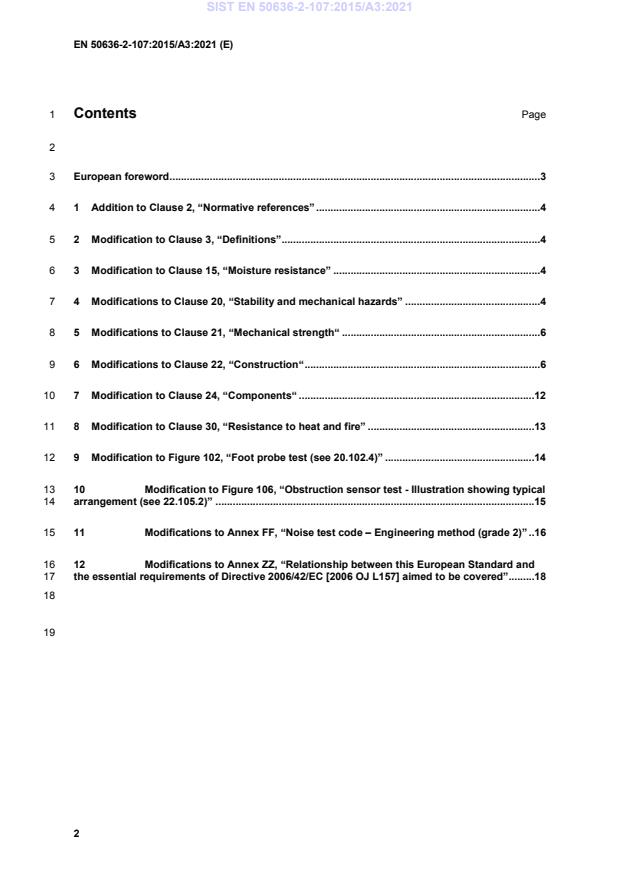
1 Contents Page
3 European foreword . 3
4 1 Addition to Clause 2, “Normative references” . 4
5 2 Modification to Clause 3, “Definitions” . 4
6 3 Modification to Clause 15, “Moisture resistance” . 4
7 4 Modifications to Clause 20, “Stability and mechanical hazards” . 4
8 5 Modifications to Clause 21, “Mechanical strength“ . 6
9 6 Modifications to Clause 22, “Construction“ . 6
10 7 Modification to Clause 24, “Components“ .12
11 8 Modification to Clause 30, “Resistance to heat and fire” .13
12 9 Modification to Figure 102, “Foot probe test (see 20.102.4)” .14
13 10 Modification to Figure 106, “Obstruction sensor test - Illustration showing typical
14 arrangement (see 22.105.2)” .15
15 11 Modifications to Annex FF, “Noise test code – Engineering method (grade 2)” .16
16 12 Modifications to Annex ZZ, “Relationship between this European Standard and
17 the essential requirements of Directive 2006/42/EC [2006 OJ L157] aimed to be covered” .18
20 European foreword
21 This document (EN 50636-2-107:2015/A3:2021) has been prepared by CLC/TC 116 “Safety and
22 environmental aspects of motor-operated electric tools”.
23 The following dates are fixed:
• latest date by which this document has to be (dop) 2022–03–22
implemented at national level by publication of
an identical national standard or by
endorsement
• latest date by which the national standards (dow) 2024–03–22
conflicting with this document have to be
withdrawn
24 This document has been prepared under a mandate given to CENELEC by the European Commission
25 and the European Free Trade Association and supports essential requirements of EU Directive(s).
26 For the relationship with EU Directive(s) see informative Annex ZZ, which is an integral part of
27 EN 50636-2-107:2015/A2:2020.
28 This amendment was developed to align the current standard EN 50636-2-107:2015 with the major
29 changes from IEC 60335-2-107:2017+A1:2020.
———————
As amended by EN 50636-2-107:2015/A1:2018 and EN 50636-2-107:2015/A2:2020.
30 1 Addition to Clause 2, “Normative references”
31 Add the following reference:
32 “EN 61058-1:2002, Switches for appliances - Part 1: General requirements”
33 2 Modification to Clause 3, “Definitions”
34 Replace the existing 3.101 with the following:
35 “3.101
36 automatic mode
37 autonomous operation of the machine without the use of a manual controller”
38 3 Modification to Clause 15, “Moisture resistance”
39 Replace the existing subclause 15.2 with the following:
40 “15.2 Addition:
41 Machines or peripherals fitted with an appliance inlet or cable coupler shall be tested with the
42 appropriate mating connector in place.
43 Air filters are not removed.”
44 4 Modifications to Clause 20, “Stability and mechanical hazards”
45 Replace the existing first paragraph of subclause 20.2 with the following:
46 “To prevent unexpected operation which could result in a hazard, the cutting means shall not start until
47 either,
48 a) a manual reset; or
49 b) the start-up procedure as described in 22.110 is completed; or
50 c) for manual control, as described in 20.101.3.”
51 Replace the existing subclause 20.101.3 with the following:
52 “20.101.3 Manual Controller
53 If a manual controller is supplied by the manufacturer, it shall meet the requirements of 22.107.
54 Compliance is checked by inspection and by the tests of 22.107 and 21.101.5.”
55 Replace the existing subclause 20.101.4 with the following:
56 “20.101.4 Manual stop
57 A single action clearly identifiable manual stop shall be provided on the machine in a prominent position
58 on the top surface. The actuator of the manual stop shall have at least 20 % of its surface raised at
59 least 5 mm above the immediate surrounding area. The minimum width of the immediate surrounding
60 area shall be not less than 15 mm. The geometric minor dimension of the actuator of the manual stop
61 shall be not less than 35 mm.
62 The operating force of the actuator of the manual stop shall not exceed 30 N on any part of its surface
63 that is raised at least 5 mm above the immediate surrounding area.
———————
As amended by EN 61058-1:2002/A2:2008.
64 The manual stop shall override all other controls and cause all moving parts to stop.
65 Restarting of the mower following a manual stop shall only be possible following either:
66 a) two separate actions; or
67 b) the introduction of an alpha-numeric code of at least four characters; or
68 c) multiple key strokes in response to prompts.
69 Compliance is checked by inspection, practical test and by measurement, and if the compliance relies
70 on the operation of an electronic circuit, it is checked under the following conditions applied separately:
71 1) the fault conditions in a) to g) of 19.11.2 applied one at a time to the electronic circuit;
72 2) the electromagnetic phenomena tests of 19.11.4.1 and 19.11.4.2 applied to the machine.
73 If the electronic circuit is programmable, the software shall contain measures to control the fault/error
74 conditions specified in Table R.1 and is evaluated in accordance with the relevant requirements of
75 Annex R.”
76 Replace the existing third paragraph of subclause 20.102.2 with the following:
77 “The total stopping time, as a result of condition 1), shall either
78 — not exceed twice of the value given above. Under this condition, a manual operation shall be
79 required to restart the cutting means, such a restart shall only be allowed for one attempt;
80 — not exceed 0,1 J of rotational energy at the end of an interval of twice of the value given above. In
81 this case, the test is repeated and either the cutting means stopping command shall comply with
82 the stopping time limit value above or the cutting means shall be permanently disabled such that
83 the cutting means cannot be reactivated by the operator and requires repair by qualified service
84 personnel.
85 The calculation of rotational energy shall be made using Annex AA or, as appropriate, the following:
86 E = ½Iω
87 where
E is the rotational energy
I is the moment of inertia around the axis of rotation
ω is the angular velocity
88 ”
nd
89 Replace the existing 2 paragraph of subclause 20.102.4.1.2 with the following:
90 “The foot probe of Figure 102 shall be inserted towards the cutting means around the machine’s
91 external enclosure. The base of the probe is held horizontally at any height and then inclined up to 15°
92 forward or backward from the horizontal. The probe is applied around the entire machine as described
93 in Figure 102 until a horizontal force of 20 N maximum is reached, or until the machine’s enclosure lifts
94 or moves from the original position, or until contact is made with the cutting means path, whichever
95 occurs first.”
nd
96 Replace the existing 2 paragraph of subclause 20.102.4.1.3 with the following:
97 “The foot probe of Figure 107 shall be inserted towards the cutting means around the machine’s
98 external enclosure. The base of the probe is held horizontally at any height and then inclined up to 15°
99 forward or backward from the horizontal. The probe is applied around the entire machine as described
100 in Figure 102 until a horizontal force of 20 N maximum is reached, or until the machine’s enclosure lifts
101 or moves from the original position, or until contact is made with the cutting means path, whichever
102 occurs first.”
103 Replace the existing first paragraph of subclause 20.102.6 with the following:
104 “When a tilt sensor and/or lift sensor is activated, the cutting means shall stop within 2 s. If the
105 machine attempts to recover from the condition that caused the activation of the sensor(s) the machine
106 shall move away in a different direction (with the cutting means static).”
107 5 Modifications to Clause 21, “Mechanical strength“
108 Replace the existing subclause 21.1 with the following:
109 “21.1 Modification:
110 The impact energy applied to all enclosures (including the peripherals) shall be (1,0 ± 0,05) J.
111 This subclause does not apply to
112 — remote setting device(s); and
113 — peripherals that are covered by a separate end product standard, such as power supplies or
114 battery chargers.”
115 Replace the heading “21.101.1.2 Imbalance” with “21.101.2 Imbalance”.
116 6 Modifications to Clause 22, “Construction“
117 Add the following new subclause:
118 “22.40 This subclause is not applicable.
119 NOTE 101 This requirement is covered by 20.101.1 and 20.101.4.”
120 Add the following new subclause:
121 “22.49 This subclause is not applicable.
122 NOTE 101 This requirement is covered in 20.101.2 for remote setting devices.”
123 Add the following new subclause:
124 “22.50 This subclause is not applicable.
125 NOTE This requirement is covered by 20.101.4.”
126 Add the following new subclause:
127 “22.51 This subclause is not applicable.
128 NOTE 101 This requirement is covered in 22.107 for manual controllers.”
129 Replace the existing first paragraph of subclause 22.103.1 with the following:
130 “When the disabling device is removed, it shall not be possible for the machine to be operable. A
131 removable disabling device may be fulfilled by removal of all detachable battery pack(s), provided
132 — any individual battery pack does not have a mass exceeding 5,0 kg; and
133 — the detachable battery pack(s) are removable without the use of tools.
134 The machine is not considered to be operating when displaying, communicating, transmitting or storing
135 data (e.g. error codes) whilst the removable disabling device is removed or operated.”
136 Add the following text after the first paragraph of subclause 22.103.2:
137 “The machine is not considered to be operating when displaying, communicating, transmitting or storing
138 data (e.g. error codes) whilst the machine is disabled by the code protected disabling device.”
139 Replace the existing subclause 22.104 with the following:
140 “22.104 Working area
141 When the machine is operating in automatic mode, the machine shall not be able to leave the working
142 area. It shall not be possible for the machine to cross the boundary of the working area by a distance
143 greater than one full length of the machine when operating in automatic mode.
144 The boundary of the working area may be established by the use of a perimeter delimiter as specified
145 in 22.104.2 or by a pre-programmed area.
146 If the machine is placed outside the working area, it shall not be able to operate at a distance of more
147 than 1 m from the boundary of the working area to the nearest part of the machine, unless under manual
148 control.
149 If the machine fails to receive any signal that is required to recognize the working area, the machine
150 shall travel not more than 1 m or travel such that it is not displaced by more than 1 m and the cutting
151 means shall stop within 5 s from the instant the machine fails to receive any signal that is required to
152 recognize the working area to the time that the cutting means stops in accordance with 20.102.2.
153 If the machine regains recognition of the working area, the machine may operate in automatic mode,
154 providing the cutting means start-up indication procedure in 22.110 is completed.
155 If the working area is changed, it shall not be possible for the machine to operate in automatic mode
156 unless the restart procedure in 20.102.6 is completed. This requirement is not applicable for perimeter
157 delimiters.
158 Compliance is checked by inspection, by measurement and by practical test.
159 If the compliance relies on the operation of an electronic circuit, it is checked under the following
160 condition:
161 1) the fault conditions in a) to g) of 19.11.2 applied one at a time to the electronic circuit.
162 The total travelling distance and/or the total stopping time, as a result of condition 1), shall not exceed
163 twice of the values given above. Under this condition, a manual operation shall be required to restart
164 the cutting means, such a restart shall only be allowed for one attempt.
165 If the electronic circuit is programmable, the software shall contain measures to control the fault/error
166 conditions specified in Table R.1 and is evaluated in accordance with the relevant requirements of
167 Annex R.
168 22.104.1 Void
169 22.104.2 Perimeter delimiter
170 If a perimeter delimiter is provided which uses a boundary wire that emits a signal to indicate the limit
171 of the working area, the maximum voltage shall not exceed safety extra-low voltage.
172 Compliance is checked by measurement.”
173 Replace the existing subclause 22.105.2 with the following:
174 “22.105.2 Obstruction sensors
175 The machine shall be provided with (an) obstruction sensor(s). In automatic mode, the sensor(s)
176 shall be active and capable of performing its intended function in all operating positions and in all
177 directions of travel, except those directions of travel where
178 — the cutting means is not operating and the distance travelled does not exceed 2,0 times the length
179 of the machine; or
180 — the cutting means is operating and the distance travelled does not exceed the distance from the
181 edge of the machine in the direction of travel to the nearest cutting means tip circle.
182 NOTE 1 The machine does not have to incorporate discrete sensing devices for each sensor requirement. The
183 various sensing functions can be achieved by fewer devices that respond to multiple stimuli. Sensing requirements
184 can also be fulfilled by mechanical devices instead of electrical circuits.
185 The maximum kinetic energy of a machine that could be imparted to an obstruction upon impact when
186 travelling in automatic mode shall be 5 J.
187 The maximum force applied by the machine against an obstruction in automatic mode shall not be
188 greater than
189 — 260 N during the first 0,5 s after impact and a minimum of 50 N is exceeded; and
190 — 130 N thereafter.
191 NOTE 2 ISO/TS 15066:2016 provides guidance on relevant values of maximum force.
192 If an obstruction sensor is activated, the traction drive in the direction of travel shall stop within
193 t = D/v, where
ts
t is the traction drive stopping time;
ts
D is the distance from the front edge of the machine to the nearest edge of the nearest
cutting means tip circle; and
v is the velocity of the machine upon approach.
194 The machine shall then restart in a different direction to allow the machine to move away from the object
195 such that the sensor is deactivated within 3 s of initial activation. If the sensor is not deactivated within
196 3 s of initial activation, the cutting means shall stop as required by 20.102.2.
197 An additional non-contact sensor, if relied upon to reduce speed in order to fulfil the requirement for
198 maximum force upon impact, is permitted providing that it responds to a rigid non-metallic target of:
199 — cylindrical shape;
200 — (70 ± 2) mm diameter by (400 ± 5) mm high, standing on end;
201 — of a colour or shade that matches the background; and
202 — normalized to the ambient temperature.
203 Compliance is checked by inspection, by measurement, by the following test and by 20.102.2.
204 The machine is placed on a level test surface as described in CC.3. The machine shall be made to
205 collide with a force measuring means. The force to operate the obstruction sensor at impact shall be
206 measured parallel to the ground plane and vertically aligned with the point of contact with the force
207 measu
...