

EN 13067:2012
(Main)Plastics welding personnel - Qualification testing of welders - Thermoplastics welded assemblies
General Information
- Abstract
This European Standard specifies the method of testing the knowledge and skill of a welder who is required to carry out welds on thermoplastics in new constructions and repair work.
The skill examination of a welder is an essential condition for the assurance of the quality of the welding work.
The application of this standard guarantees that the examination is carried out according to a uniform test procedure.
This European Standard applies when the contractor or the authorities responsible for the application require it.
Gas and water utility network industries with alternative qualification programmes are excluded from this standard.
This European Standard applies to the following welding processes:
- hot gas welding: round nozzle, high speed nozzle, wedge;
- extrusion welding;
- heated tool welding: butt, saddle, socket, wedge;
- electrofusion welding: socket, saddle;
- solvent welding: socket.
This European Standard applies to the welding of the following products:
- sheet;
- pipe;
- fittings;
- lining membrane.
This European Standard covers the welding of the following groups of materials:
a) for sheets, pipes and fittings:
1) group 1: PVC (including all kinds of PVC-U, PVC-C), ABS;
2) group 2: PP (including all kinds of PP);
3) group 3: PE (including all kinds of PE);
4) group 4: PVDF;
5) group 5: ECTFE or PFA or FEP;
b) for lining membranes:
1) group 6: PVC-P;
2) group 7: PE (including all kinds of PE);
3) group 8: ECB;
4) group 9: PP.
- Status
- Withdrawn
- Publication Date
- 06-Nov-2012
- Withdrawal Date
- 29-Sep-2026
- Technical Committee
- CEN/TC 249 - Plastics
- Drafting Committee
- CEN/TC 249/WG 16 - Welding of thermoplastics
- Current Stage
- 9960 - Withdrawal effective - Withdrawal
- Start Date
- 02-Sep-2020
- Completion Date
- 30-Sep-2026


Relations
- Effective Date
- 14-Nov-2012
- Effective Date
- 09-Sep-2020
- Effective Date
- 28-Jan-2026
- Effective Date
- 28-Jan-2026
- Effective Date
- 28-Jan-2026
- Effective Date
- 28-Jan-2026
- Effective Date
- 28-Jan-2026
- Effective Date
- 28-Jan-2026
Get Certified
Connect with accredited certification bodies for this standard

BSI Group
BSI (British Standards Institution) is the business standards company that helps organizations make excellence a habit.

Bureau Veritas
Bureau Veritas is a world leader in laboratory testing, inspection and certification services.

DNV
DNV is an independent assurance and risk management provider.
Sponsored listings
Frequently Asked Questions
EN 13067:2012 is a standard published by the European Committee for Standardization (CEN). Its full title is "Plastics welding personnel - Qualification testing of welders - Thermoplastics welded assemblies". This standard covers: This European Standard specifies the method of testing the knowledge and skill of a welder who is required to carry out welds on thermoplastics in new constructions and repair work. The skill examination of a welder is an essential condition for the assurance of the quality of the welding work. The application of this standard guarantees that the examination is carried out according to a uniform test procedure. This European Standard applies when the contractor or the authorities responsible for the application require it. Gas and water utility network industries with alternative qualification programmes are excluded from this standard. This European Standard applies to the following welding processes: - hot gas welding: round nozzle, high speed nozzle, wedge; - extrusion welding; - heated tool welding: butt, saddle, socket, wedge; - electrofusion welding: socket, saddle; - solvent welding: socket. This European Standard applies to the welding of the following products: - sheet; - pipe; - fittings; - lining membrane. This European Standard covers the welding of the following groups of materials: a) for sheets, pipes and fittings: 1) group 1: PVC (including all kinds of PVC-U, PVC-C), ABS; 2) group 2: PP (including all kinds of PP); 3) group 3: PE (including all kinds of PE); 4) group 4: PVDF; 5) group 5: ECTFE or PFA or FEP; b) for lining membranes: 1) group 6: PVC-P; 2) group 7: PE (including all kinds of PE); 3) group 8: ECB; 4) group 9: PP.
This European Standard specifies the method of testing the knowledge and skill of a welder who is required to carry out welds on thermoplastics in new constructions and repair work. The skill examination of a welder is an essential condition for the assurance of the quality of the welding work. The application of this standard guarantees that the examination is carried out according to a uniform test procedure. This European Standard applies when the contractor or the authorities responsible for the application require it. Gas and water utility network industries with alternative qualification programmes are excluded from this standard. This European Standard applies to the following welding processes: - hot gas welding: round nozzle, high speed nozzle, wedge; - extrusion welding; - heated tool welding: butt, saddle, socket, wedge; - electrofusion welding: socket, saddle; - solvent welding: socket. This European Standard applies to the welding of the following products: - sheet; - pipe; - fittings; - lining membrane. This European Standard covers the welding of the following groups of materials: a) for sheets, pipes and fittings: 1) group 1: PVC (including all kinds of PVC-U, PVC-C), ABS; 2) group 2: PP (including all kinds of PP); 3) group 3: PE (including all kinds of PE); 4) group 4: PVDF; 5) group 5: ECTFE or PFA or FEP; b) for lining membranes: 1) group 6: PVC-P; 2) group 7: PE (including all kinds of PE); 3) group 8: ECB; 4) group 9: PP.
EN 13067:2012 is classified under the following ICS (International Classification for Standards) categories: 03.100.30 - Management of human resources; 25.160.10 - Welding processes. The ICS classification helps identify the subject area and facilitates finding related standards.
EN 13067:2012 has the following relationships with other standards: It is inter standard links to EN 13067:2003, EN 13067:2020, EN 12814-1:2025, EN 13100-1:2017, EN 12814-2:2000, EN 12814-4:2018, EN 12814-8:2024, EN 14728:2019. Understanding these relationships helps ensure you are using the most current and applicable version of the standard.
EN 13067:2012 is available in PDF format for immediate download after purchase. The document can be added to your cart and obtained through the secure checkout process. Digital delivery ensures instant access to the complete standard document.
Standards Content (Sample)
2003-01.Slovenski inštitut za standardizacijo. Razmnoževanje celote ali delov tega standarda ni dovoljeno.Osebje za varjenje polimerov - Preskušanje usposobljenosti varilcev - Varjenje plastomerovKunststoffschweißpersonal - Anerkennungsprüfung von Schweißern - Thermoplastische SchweißverbindungenPersonnel en soudage des plastiques - Épreuve de qualification des soudeurs - Assemblages soudés thermoplastiquesPlastics welding personnel - Qualification testing of welders - Thermoplastics welded assemblies83.080.20PlastomeriThermoplastic materials25.160.01Varjenje, trdo in mehko spajkanje na splošnoWelding, brazing and soldering in general03.100.30Vodenje ljudiManagement of human resourcesICS:Ta slovenski standard je istoveten z:EN 13067:2012SIST EN 13067:2014en,fr,de01-maj-2014SIST EN 13067:2014SLOVENSKI
STANDARDSIST EN 13067:20031DGRPHãþD
EUROPEAN STANDARD NORME EUROPÉENNE EUROPÄISCHE NORM
EN 13067
November 2012 ICS 03.100.30; 25.160.10 Supersedes EN 13067:2003English Version
Plastics welding personnel - Qualification testing of welders - Thermoplastics welded assemblies
Personnel en soudage des plastiques - Épreuve de qualification des soudeurs - Assemblages soudés thermoplastiques
Kunststoffschweißpersonal - Anerkennungsprüfung von Schweißern - Thermoplastische Schweißverbindungen This European Standard was approved by CEN on 22 September 2012.
CEN members are bound to comply with the CEN/CENELEC Internal Regulations which stipulate the conditions for giving this European Standard the status of a national standard without any alteration. Up-to-date lists and bibliographical references concerning such national standards may be obtained on application to the CEN-CENELEC Management Centre or to any CEN member.
This European Standard exists in three official versions (English, French, German). A version in any other language made by translation under the responsibility of a CEN member into its own language and notified to the CEN-CENELEC Management Centre has the same status as the official versions.
CEN members are the national standards bodies of Austria, Belgium, Bulgaria, Croatia, Cyprus, Czech Republic, Denmark, Estonia, Finland, Former Yugoslav Republic of Macedonia, France, Germany, Greece, Hungary, Iceland, Ireland, Italy, Latvia, Lithuania, Luxembourg, Malta, Netherlands, Norway, Poland, Portugal, Romania, Slovakia, Slovenia, Spain, Sweden, Switzerland, Turkey and United Kingdom.
EUROPEAN COMMITTEE FOR STANDARDIZATION
COMITÉ EUROPÉEN DE NORMALISATION EUROPÄISCHES KOMITEE FÜR NORMUNG
Management Centre:
Avenue Marnix 17,
B-1000 Brussels © 2012 CEN All rights of exploitation in any form and by any means reserved worldwide for CEN national Members. Ref. No. EN 13067:2012: ESIST EN 13067:2014
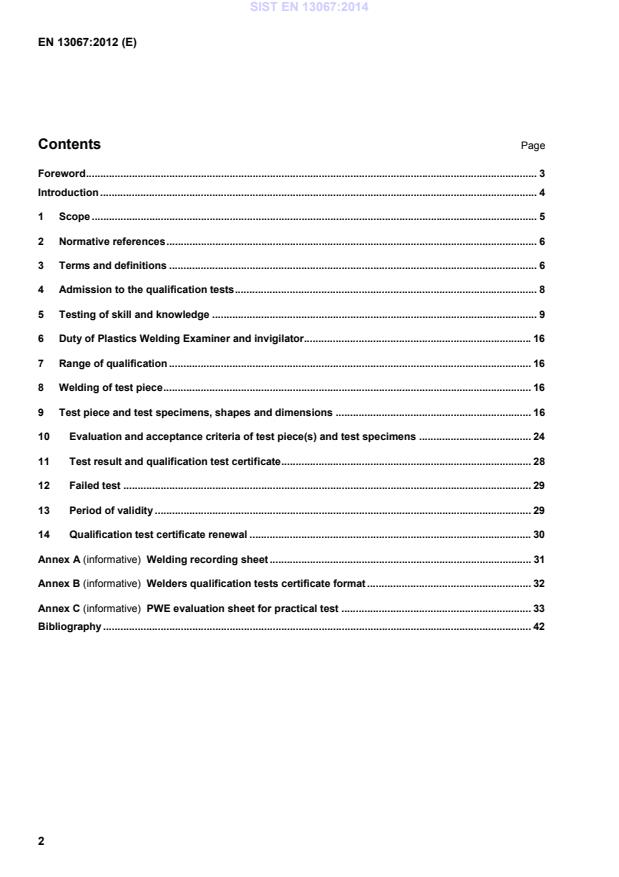
Welding recording sheet . 31Annex B (informative)
Welders qualification tests certificate format . 32Annex C (informative)
PWE evaluation sheet for practical test . 33Bibliography . 42 SIST EN 13067:2014
Gas and water utility network industries with alternative qualification programmes are excluded from this standard. This European Standard applies to the following welding processes: hot gas welding: round nozzle, high speed nozzle, wedge; extrusion welding; heated tool welding: butt, saddle, socket, wedge; electrofusion welding: socket, saddle; solvent welding: socket. This European Standard applies to the welding of the following products: sheet; pipe; fittings; lining membrane. This European Standard covers the welding of the following groups of materials: a) for sheets, pipes and fittings: 1) group 1: PVC (including all kinds of PVC-U, PVC-C), ABS; 2) group 2: PP (including all kinds of PP); 3) group 3: PE (including all kinds of PE); 4) group 4: PVDF; 5) group 5: ECTFE or PFA or FEP; b) for lining membranes: 1) group 6: PVC-P; SIST EN 13067:2014
Note 1 to entry: 3.3 and 3.5 can be the same person. 3.4 manufacturer company, contractor or organisation who is responsible for the welding SIST EN 13067:2014
PWE qualified person approved by Certificate Issuing Authority (CIA) who verifies the compliance with this standard 3.6 qualification test theoretical and practical tests in order to verify the knowledge and the skill of the welder 3.7 range of qualification welding processes, types of joint, materials, thicknesses and diameters for which a welder is qualified 3.8 test piece assembly which is welded during the practical test 3.9 test specimen part or portion cut from the test piece for the test specified 3.10 test house establishment having all relevant test equipment to carry out the required tests and working in compliance with EN ISO/IEC 17025 3.11 training centre educational establishment for training plastics welding personnel and/or Plastics Welding Examiner, approved by CIA 3.12 welding process technique characterized by the method of softening to obtain permanent assembly 3.12.1 electrofusion welding softening of fitting and pipe surfaces to be welded is obtained by means of a heating element embedded in the fitting which remain between welded joints 3.12.2 extrusion welding welding process in which an extruder unit with a melting chamber gives the extruded material required by the thickness and shape of the joint. Hot air or inert gas heats simultaneously the parent material 3.12.3 heated tool welding welding process in which the joint surfaces are adequately heated by exposure, through direct contact with heated elements and are welded under pressure, which includes butt fusion welding (also called hot plate welding, platen welding or mirror welding) and socket fusion welding 3.12.4 heated wedge welding process in which the lining membrane welded is gripped by rollers which guide and propel the welding machine which uses either hot gas to heat the lining membrane and the wedge to effect the weld or electrically heated wedge to heat the lining membrane in the area being welded SIST EN 13067:2014
solvent welding softening of fitting and pipe surfaces, by means of a solvent contained in the cement Note 1 to entry: After suitable cure time, the solvent dries leaving the parent material in the interface between welded joints. 3.13 welding Procedure Specification
WPS document providing in detail the required variables for a specific application to assure repeatability 3.14 welding record sheet document recording
in detail the variables used during the practical test 3.15 welder person making a welded assembly by any process, whose manual skill and knowledge are two of the determining factors influencing the quality of the welded joint, or person performing a welding operation by means of mechanical or automatic equipment 4 Admission to the qualification tests Only welders whose training and/or for whose previous activities show that they are likely to pass the planned test may be admitted. As a rule this is the case if one of the following conditions is met: completed apprenticeship as plastics fabricator; at least two years experience as a plastics welder confirmed by manufacturer’s declaration; completion of both a technical and practical training course in preparation for the plastic welders qualification test. An example of a suitable training course is defined in Entry [1] in the Bibliography or may be identified in national standards. SIST EN 13067:2014
Completion of the theoretical test shall not exceed one hour, be continuous without access to teaching aids. The questions shall cover the following subjects, as appropriate: rules for welding of thermoplastics to which the test is designed to apply, meaning of the welding signs and symbols of the range of work; operation and control of the welding equipment; welding processes; knowledge concerning on-site welding; correct preparation of the work pieces for welding; knowledge concerning the characteristics of thermoplastics within the sub-groups; knowledge concerning the characteristics of solvents / cements within the relevant sub-group; preventing and correcting faults when making welds; knowledge concerning the types of imperfections for the applied welding process(es); knowledge concerning the WPS and welding record sheet; SIST EN 13067:2014
Group of material Sub groupsType of product S = sheet P = pipe en = nominal wall thickness dn = nominal pipe outside diameter SDR=dn/en Welding process Weld formb Examination and testing Type of test a Test pieceaccording to Figure Range of qualification Dimensions Type of joint b
1 PVC 1.1 S en=5 Hot gas round nozzle V V/ B f+r 1 All en V,X,⊥ 1.2 S en=5 Hot gas high speed nozzle V V/ B f+r 1 All en V,X,⊥ 1.3 S en=5 Heated tool ][ V/ B 1 en ≥ 3 ][ 1.4 P dn=40 and dn=110 SDR≤21 Solvent Welding I V/ Vls 4 dn< 160 I 1.5 P dn≥160 SDR≤21 Solvent Welding I V/ Vls 4 dn≥160 I
2 PP 2.1 S en=9 or 10 Hot gas high speed nozzle X V/ B f+r 1 All en V,X,⊥ 2.2 S en=9 or 10 Extrusion continuous V V/ B f+r 1 en ≥ 3 V,X,⊥ 2.3 S en=9 or 10 Heated tool ][ V/ B 1 en ≥ 3 ][ 2.4 P dn=110 SDR≤17,6 Heated tool ][ V/ B
2 en ≥ 3 dn≤ 315 ][ 2.5 P dn≥400 SDR≤17,6 Heated tool ][ V/ B s 2 dn> 315 ][ 2.6 P dn=63 SDR≤17,6 Heated tool c I V/ Pc 4 All dn I 2.7 P dn=63 SDR≤17,6 Electrofusion I V/ Pc 4 All dn I
SDR=dn/en Welding process
Weld formb
Examination and testing Type of test a
Test pieceaccording to Figure
Range of qualification Dimensions Type of joint b
3 PE 3.1 S en=10 Hot gas high speed nozzle X V/ B f+r 1 All en V,X,⊥ 3.2 S en=10 Extrusion continuous V V/ B f+r 1 en ≥ 3 V,X,⊥ 3.3 S en=10 Heated tool ][ V/ B 1 en ≥ 3 ][ 3.4 P 110≤dn ≤180
SDR≤17,6 Heated tool ][ V/ T 2 dn≤ 315 ][ 3.5 P dn≥400 SDR≤17,6 Heated tool ][ V/ T 2 dn >315 ][ 3.6 P 90≤dn ≤125
SDR≤17,6 Electrofusion I V/ Pc 4 dn ≤ 315 I 3.7 P dn≥355 SDR≤17,6 Electrofusion I V/ Pd 4 dn>315 I 3.8 P dn≤63 on 90≤dn ≤125 SDR≤17,6 Electrofusion .†. V/ Pc 5 All dn .†. 3.9 P dn=63 SDR=11 Heated tool c I V/ Pc 4 All dn I 3.10 P dn=32 on dn=90 SDR=11 Heated tool .†. V/ Pc 5 All dn .†.
SDR=dn/en Welding process Weld Form b Examination and testing Type of test a
Test pieceaccording to Figure Range of qualification Dimensions Type of jointb 4 PVDF 4.1 S en=4 Hot gas high speed nozzle V V/ B f+r 1 en ≥ 2 V,X,⊥ 4.2 S en=4 Heated tool V V/ B 1 en ≥ 2 ][ 4.3 P dn=110 en=5,3 Heated tool ][ V/ B
2 All dn en ≥ 1,9 ][ 4.4 P dn=63 en=3 Heated tool c I V/ Pc 4 All dn I 5 ECTFE or FEP
or PFA 5.1 S en=2,3 Hot gas high speed nozzle V V/ T 3 en ≥ 1,6 V,X,⊥ 5.2 P dn=110 en=3 Heated tool ][ V/ T 2 All dn All en ][ a
" / " = and;
B = Bend test (f: face ; r: root ; s: side (for thick materials))
Pc = Peel test (crush test) ;
V = Visual examination;
Pd = Peel test (decohesion test);
T = Tensile test;
Vls = Visual examination of longitudinal sections b
V
= V preparation
X
= double V preparation
⊥
= fillet weld
][
= butt weld
.†.
= saddle
I
= socket
c
Welding by machine only
Examination and testing Type of test a Test pieceaccording to Figure
Range of qualification Dimensions Type of joint 6 PVC-P 6.1 M en=2 Hot gas manual
V/ Pt 6 1≤en≤4 All Lap 6.2 M en=2 Hot gas high by machine
V/ Pt 7 1≤en≤4 All Lap 6.3 M en=2 Heated wedge by hot gas
V/ Pt 7 1≤en≤4 All Lap 6.4 M en=2 Heated wedge electric
V / Pt 7 1≤en≤4 All Lap 7 PE 7.1 M 2≤en ≤2,5 Hot gas manual
V/ Pt 6 1≤en≤5 All Lap 7.2 M 2≤en ≤2,5 Hot gas by machine
V/ Pt 7 1≤en≤5 All Lap 7.3 M 2≤en ≤2,5 Heated wedge by hot gas
V/ Pt 7 1≤en≤5 All Lap 7.4 M 2≤en ≤2,5 Heated wedge electric
V/ Pt 7 1≤en≤5 All Lap 7.5 M 2≤en ≤2,5 Extrusion manual
V/ Pt 8 1≤en≤5 All Lap
8 ECB 8.1 M en=2 Hot gas manual
V/ Pt 6 1≤en≤4 All Lap 8.2 M en=2 Hot gas high by machine
V/ Pt 7 1≤en≤4 All Lap 8.3 M en=2 Heated wedge by hot gas
V/ Pt 7 1≤en≤4 All Lap 8.4 M en=2 Heated wedge electric
V / Pt 7 1≤en≤4 All Lap
9 PP 9.1 M 1≤en ≤2 Hot gas manual
V/ Pt 6 0,7≤en≤3 All Lap 9.2 M 1≤en ≤2 Hot gas by machine
V/ Pt 7 0,7≤en≤3 All Lap 9.3 M 1≤en ≤2 Heated wedge by hot gas
V/ Pt 7 0,7≤en≤3 All Lap 9.4 M 1≤en ≤2 Heated wedge electric
V/ Pt 7 0,7≤en≤3 All Lap 9.5 M 1≤en ≤2 Extrusion manual
V/ Pt 8 0,7≤en≤3 All Lap a " / " = and; Pt= Peel test (T-peel test) ; V = Visual examination
the test pieces to the qualified test house. The PWE shall not examine any candidate trained by himself. The PWE shall reach his professional decisions independently. The PWE shall check the test house qualification and, where applicable, the training centre. 7 Range of qualification The designation of a plastics welder's test shall be formed according to the group and sub-group and the range of qualification (see Table 1 or Table 2). The range of validity of qualification shall be shown on the certificate. 8 Welding of test piece 8.1 Difficulties and corrections whilst welding the test piece If difficulties arise during the practical test
that are not caused by the welder, a test piece on which welding has been started may be replaced after qualification by the PWE or invigilator. Errors made or occurring during the hot gas or extrusion welding may be repaired only after permission has been given by the PWE or invigilator. 8.2 Inspection requirements Before welding, the PWE or invigilator shall check the identity of candidate, the suitability of the materials, WPS, machines and equipment. The test piece shall be identified with the number or mark of the PWE or
invigilator and the welder. The PWE or invigilator shall supervise the welding of the test piece. The welder shall complete the welding record sheet (see proposal given in Annex A) controlled and witnessed by the PWE or invigilator. The PWE or invigilator shall stop the test if the welding conditions a
...