

EN 15316-1:2007
(Main)Heating systems in buildings - Method for calculation of system energy requirements and system efficiencies - Part 1: General
General Information
- Abstract
This European Standard specifies the structure for calculation of energy use for space heating systems and domestic hot water systems in buildings. It standardises the required inputs and outputs for the calculations, in order to achieve a common European calculation method.
The calculation method facilitates the energy analysis of the different sub-systems of the heating system, including control (emission, distribution, storage, generation), through determination of the system energy losses and the system performance factors. This performance analysis permits the comparison between sub-systems and makes it possible to monitor the impact of each sub-system on the energy performance of the building.
Calculations of the system energy losses of each sub-system of the heating system are defined in subsequent standards (prEN 15316, parts 2-x, 3-x and 4-x). The system thermal losses, the recoverable system thermal losses and the auxiliary energy of the sub-systems of the heating system are summed up. The system thermal losses of the heating system contribute to the overall energy use in buildings (prEN 15603).
Ventilation systems are not included in this European Standard (e.g. balanced systems with heat recovery), but if the air is preheated or an air heating system is installed, system energy losses of these systems are covered by this European Standard.
- Status
- Withdrawn
- Publication Date
- 24-Jul-2007
- Withdrawal Date
- 29-Sep-2026
- Technical Committee
- CEN/TC 228 - Heating systems in buildings
- Current Stage
- 9960 - Withdrawal effective - Withdrawal
- Start Date
- 26-Apr-2017
- Completion Date
- 30-Sep-2026

Relations
- Effective Date
- 03-May-2017
- Effective Date
- 28-Jan-2026
- Effective Date
- 28-Jan-2026
- Effective Date
- 28-Jan-2026
- Effective Date
- 28-Jan-2026
- Effective Date
- 28-Jan-2026
- Effective Date
- 28-Jan-2026
- Effective Date
- 28-Jan-2026
- Effective Date
- 28-Jan-2026
- Effective Date
- 28-Jan-2026
- Effective Date
- 28-Jan-2026
Get Certified
Connect with accredited certification bodies for this standard

DIBt (Deutsches Institut für Bautechnik)
German Institute for Building Technology.
DIN CERTCO
DIN Group product certification.

Aboma Certification B.V.
Specialized in construction, metal, and transport sectors.
Sponsored listings
Frequently Asked Questions
EN 15316-1:2007 is a standard published by the European Committee for Standardization (CEN). Its full title is "Heating systems in buildings - Method for calculation of system energy requirements and system efficiencies - Part 1: General". This standard covers: This European Standard specifies the structure for calculation of energy use for space heating systems and domestic hot water systems in buildings. It standardises the required inputs and outputs for the calculations, in order to achieve a common European calculation method. The calculation method facilitates the energy analysis of the different sub-systems of the heating system, including control (emission, distribution, storage, generation), through determination of the system energy losses and the system performance factors. This performance analysis permits the comparison between sub-systems and makes it possible to monitor the impact of each sub-system on the energy performance of the building. Calculations of the system energy losses of each sub-system of the heating system are defined in subsequent standards (prEN 15316, parts 2-x, 3-x and 4-x). The system thermal losses, the recoverable system thermal losses and the auxiliary energy of the sub-systems of the heating system are summed up. The system thermal losses of the heating system contribute to the overall energy use in buildings (prEN 15603). Ventilation systems are not included in this European Standard (e.g. balanced systems with heat recovery), but if the air is preheated or an air heating system is installed, system energy losses of these systems are covered by this European Standard.
This European Standard specifies the structure for calculation of energy use for space heating systems and domestic hot water systems in buildings. It standardises the required inputs and outputs for the calculations, in order to achieve a common European calculation method. The calculation method facilitates the energy analysis of the different sub-systems of the heating system, including control (emission, distribution, storage, generation), through determination of the system energy losses and the system performance factors. This performance analysis permits the comparison between sub-systems and makes it possible to monitor the impact of each sub-system on the energy performance of the building. Calculations of the system energy losses of each sub-system of the heating system are defined in subsequent standards (prEN 15316, parts 2-x, 3-x and 4-x). The system thermal losses, the recoverable system thermal losses and the auxiliary energy of the sub-systems of the heating system are summed up. The system thermal losses of the heating system contribute to the overall energy use in buildings (prEN 15603). Ventilation systems are not included in this European Standard (e.g. balanced systems with heat recovery), but if the air is preheated or an air heating system is installed, system energy losses of these systems are covered by this European Standard.
EN 15316-1:2007 is classified under the following ICS (International Classification for Standards) categories: 91.140.10 - Central heating systems. The ICS classification helps identify the subject area and facilitates finding related standards.
EN 15316-1:2007 has the following relationships with other standards: It is inter standard links to EN 15316-1:2017, EN ISO 52000-1:2017, EN ISO 52016-1:2017, EN 15316-3:2017, EN ISO 7345:1995, EN 15316-2:2017, EN 14161:2011+A1:2015, CEN/TR 15232-2:2016, EN 14161:2011, EN 15232:2012, EN ISO 3977-5:2003. Understanding these relationships helps ensure you are using the most current and applicable version of the standard.
EN 15316-1:2007 is associated with the following European legislation: Standardization Mandates: M/343. When a standard is cited in the Official Journal of the European Union, products manufactured in conformity with it benefit from a presumption of conformity with the essential requirements of the corresponding EU directive or regulation.
EN 15316-1:2007 is available in PDF format for immediate download after purchase. The document can be added to your cart and obtained through the secure checkout process. Digital delivery ensures instant access to the complete standard document.
Standards Content (Sample)
2003-01.Slovenski inštitut za standardizacijo. Razmnoževanje celote ali delov tega standarda ni dovoljeno.Heating systems in buildings - Method for calculation of system energy requirements and system efficiencies - Part 1: GeneralSystemes de chauffage dans les bâtiments - Méthode de calcul des exigences énergétiques et des rendements du systeme - Partie 1: GénéralitésHeizanlagen in Gebäuden - Verfahren zur Berechnung des Energiebedarfs und Nutzungsgrade der Anlagen - Teil 1: AllgemeinesTa slovenski standard je istoveten z:EN 15316-1:2007SIST EN 15316-1:2007en91.140.10Sistemi centralnega ogrevanjaCentral heating systemsICS:SLOVENSKI
STANDARDSIST EN 15316-1:200701-november-2007
EUROPEAN STANDARDNORME EUROPÉENNEEUROPÄISCHE NORMEN 15316-1July 2007ICS 91.140.10 English VersionHeating systems in buildings - Method for calculation of systemenergy requirements and system efficiencies - Part 1: GeneralSystèmes de chauffage dans les bâtiments - Méthode decalcul des besoins
énergétiques et des rendements dessystèmes - Partie 1: GénéralitésHeizsysteme in Gebäuden - Verfahren zur Berechnung derEnergieanforderungen und Wirkungsgrade von Systemen -Teil 1: AllgemeinesThis European Standard was approved by CEN on 21 June 2007.CEN members are bound to comply with the CEN/CENELEC Internal Regulations which stipulate the conditions for giving this EuropeanStandard the status of a national standard without any alteration. Up-to-date lists and bibliographical references concerning such nationalstandards may be obtained on application to the CEN Management Centre or to any CEN member.This European Standard exists in three official versions (English, French, German). A version in any other language made by translationunder the responsibility of a CEN member into its own language and notified to the CEN Management Centre has the same status as theofficial versions.CEN members are the national standards bodies of Austria, Belgium, Bulgaria, Cyprus, Czech Republic, Denmark, Estonia, Finland,France, Germany, Greece, Hungary, Iceland, Ireland, Italy, Latvia, Lithuania, Luxembourg, Malta, Netherlands, Norway, Poland, Portugal,Romania, Slovakia, Slovenia, Spain, Sweden, Switzerland and United Kingdom.EUROPEAN COMMITTEE FOR STANDARDIZATIONCOMITÉ EUROPÉEN DE NORMALISATIONEUROPÄISCHES KOMITEE FÜR NORMUNGManagement Centre: rue de Stassart, 36
B-1050 Brussels© 2007 CENAll rights of exploitation in any form and by any means reservedworldwide for CEN national Members.Ref. No. EN 15316-1:2007: E
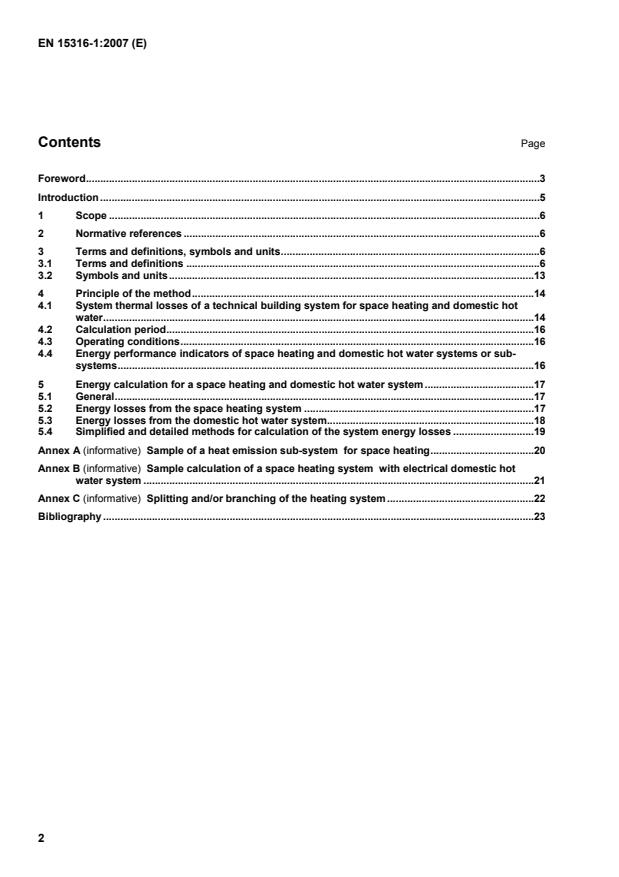
Sample of a heat emission sub-system
for space heating.20 Annex B (informative)
Sample calculation of a space heating system
with electrical domestic hot water system.21 Annex C (informative)
Splitting and/or branching of the heating system.22 Bibliography.23
1) To be published.
For active solar and wind energy systems, the incident solar radiation on solar panels or on solar collectors or the kinetic energy of wind is not part of the energy balance of the building. It is decided on a national level whether or not renewable energy produced on site constitutes part of the delivered energy. NOTE 2 Delivered energy can be calculated for defined energy uses or it can be measured. 3.1.15 domestic hot water heating process of heat supply to raise the temperature of the cold water to the intended delivery temperature
2) Directive 2002/91/EC of the European Parliament and of the Council of 16 December 2002 on the energy performance of buildings
technical building system, including the space heating system and the domestic hot water system 3.1.37 heating system thermal losses, distribution heat losses of the heat distribution system, including recoverable heat loss NOTE See also "system thermal loss" and "recoverable system thermal loss". 3.1.38 heating system thermal losses, emission heat losses through the building envelope due to non-uniform temperature distribution and control inefficiencies in the heated space 3.1.39 heating system thermal losses, generation heat generator heat losses occurring both during operation and stand-by, and heat losses due to non-ideal control of the heat generator, including recoverable heat loss 3.1.40 intermittent heating or cooling heating or cooling pattern where normal heating or cooling periods alternate with periods of reduced or no heating or cooling 3.1.41 non-renewable energy energy taken from a source which is depleted by extraction (e.g. fossil fuels) 3.1.42 non-renewable primary energy factor non-renewable primary ene
...