

EN 16055:2026
(Main)Leather - Raw bovine hides and skins - Description, presentation and preservation
General Information
- Abstract
This document specifies the following for raw bovine hides and skins intended for use throughout the leather manufacturing supply chain:
— Terms and definitions;
— Requirements for the presentation of raw hides and skins.
It is applicable to fresh and salted bovine hides and skins.
It outlines the opening cut and trim of hides and skins and the types of defects typically associated with this raw material.
NOTE 1 Opening cut and trim vary from country to country.
It shows which parts of hides and skins can be used for leather production and which factors influence the quality of hides and skins.
Furthermore, it gives recommendations on precautions to be taken for transport, preservation, loading and unloading.
NOTE 2 For commercial agreements between the buyer and the supplier of hides and skins, operators use the INTERNATIONAL CONTRACT No. 6 – HIDES and SKINS as drawn up by the International Council of Hides, Skins and Leather Traders Associations (ICHSLTA) and the International Council of Tanners (ICT) [1].
- Status
- Published
- Publication Date
- 25-Aug-2026
- Technical Committee
- CEN/TC 289 - Leather
- Current Stage
- 6060 - Definitive text made available (DAV) - Publishing
- Start Date
- 26-Aug-2026
- Due Date
- 11-Dec-2025
- Completion Date
- 26-Aug-2026

Overview
EN 16055:2026 - Leather - Raw Bovine Hides and Skins - Description, Presentation and Preservation is a key European standard developed by CEN, focused on establishing uniform requirements for the leather manufacturing supply chain. The standard outlines essential terminology, detailed requirements for the presentation, and best practices for the preservation of fresh and salted bovine hides and skins. By addressing aspects such as the opening, cutting, trimming, defect classification, and preservation methods, EN 16055 helps ensure consistent leather quality while supporting international trade and supply chain efficiency.
Key Topics
- Terms and Definitions: Provides standardized terminology for various types of bovine hides and skins, their specific weights, forms (calfskin, cowhide, ox hide, etc.), and key processing actions like opening, trimming, and preservation.
- Presentation Requirements: Details best practices for preparing, cutting, and trimming hides and skins to maximize their usability in leather production. Special attention is given to the correct methods for opening and trimming both general cattle hides and cowhides.
- Defect Classification: Identifies and defines common defects arising from flaying, natural conditions, and preservation, including cuts, holes, parasite damage, rot, and stains. This enables more accurate reporting and communication across the supply chain.
- Preservation Methods: Covers practical guidance for transportation, cooling, salting, brining, and storing raw hides and skins to prevent deterioration. Includes recommendations for temperature control and monitoring during transport, as well as salting and brining specifics based on hide type.
- Precautionary Measures: Recommends operational measures during transport, loading/unloading, and storage, outlining immediate actions if preservation issues are detected.
Applications
EN 16055:2026 serves a broad array of stakeholders across the leather manufacturing sector, including:
- Slaughterhouses and Primary Processors: Ensure correct skinning, opening, and trimming procedures to minimize defects and maximize yield.
- Hide and Skin Traders: Align product descriptions and quality standards for smooth commercial transactions, minimizing disputes between buyers and suppliers.
- Tanneries: Enhance the selection, classification, and handling of incoming raw materials, enabling efficient processing and higher end-product quality.
- Logistics Providers: Standardize transport and storage conditions, such as temperature ranges and stacking recommendations, to prevent spoilage and preserve leather value.
- Quality Assurance Professionals: Benefit from clear defect classifications and recommended inspection practices for improved traceability and quality monitoring.
By establishing a common framework, EN 16055 supports international contracts, compliance with legal requirements, and the optimization of resource use within the leather industry.
Related Standards
For comprehensive quality and safety within the leather supply chain, consider these related standards:
- INTERNATIONAL CONTRACT No. 6 – HIDES and SKINS: Utilized internationally for commercial agreements, as referenced for contract terms by ICHSLTA and the International Council of Tanners.
- Commission Regulation (EU) No 142/2011: Addresses animal by-products, including hides and skins, pertaining to health rules and proper treatment.
- ISO Terminology Databases (ISO OBP, IEC Electropedia): For additional technical definitions used in the standardization field.
- Other CEN standards under ICS 59.140.20 related to raw skins, hides, and pelts.
By adopting EN 16055:2026, organizations across the leather industry can achieve more consistent raw material classification, minimize waste from defects, and streamline international sourcing and trade-delivering practical value from slaughterhouse to finished leather product.
Relations
- Replaces
EN 16055:2012 - Leather - Raw bovine hides and skins - Description, presentation and preservation - Effective Date
- 06-Sep-2023
Get Certified
Connect with accredited certification bodies for this standard

Control Union Certifications
Global certification for agriculture and sustainability.

Hohenstein Institut
Textile testing and certification.

Bureau Veritas Bangladesh
Bureau Veritas certification services in Bangladesh.
Sponsored listings
Frequently Asked Questions
EN 16055:2026 is a standard published by the European Committee for Standardization (CEN). Its full title is "Leather - Raw bovine hides and skins - Description, presentation and preservation". This standard covers: This document specifies the following for raw bovine hides and skins intended for use throughout the leather manufacturing supply chain: — Terms and definitions; — Requirements for the presentation of raw hides and skins. It is applicable to fresh and salted bovine hides and skins. It outlines the opening cut and trim of hides and skins and the types of defects typically associated with this raw material. NOTE 1 Opening cut and trim vary from country to country. It shows which parts of hides and skins can be used for leather production and which factors influence the quality of hides and skins. Furthermore, it gives recommendations on precautions to be taken for transport, preservation, loading and unloading. NOTE 2 For commercial agreements between the buyer and the supplier of hides and skins, operators use the INTERNATIONAL CONTRACT No. 6 – HIDES and SKINS as drawn up by the International Council of Hides, Skins and Leather Traders Associations (ICHSLTA) and the International Council of Tanners (ICT) [1].
This document specifies the following for raw bovine hides and skins intended for use throughout the leather manufacturing supply chain: — Terms and definitions; — Requirements for the presentation of raw hides and skins. It is applicable to fresh and salted bovine hides and skins. It outlines the opening cut and trim of hides and skins and the types of defects typically associated with this raw material. NOTE 1 Opening cut and trim vary from country to country. It shows which parts of hides and skins can be used for leather production and which factors influence the quality of hides and skins. Furthermore, it gives recommendations on precautions to be taken for transport, preservation, loading and unloading. NOTE 2 For commercial agreements between the buyer and the supplier of hides and skins, operators use the INTERNATIONAL CONTRACT No. 6 – HIDES and SKINS as drawn up by the International Council of Hides, Skins and Leather Traders Associations (ICHSLTA) and the International Council of Tanners (ICT) [1].
EN 16055:2026 is classified under the following ICS (International Classification for Standards) categories: 59.140.20 - Raw skins, hides and pelts. The ICS classification helps identify the subject area and facilitates finding related standards.
EN 16055:2026 has the following relationships with other standards: It is inter standard links to EN 16055:2012. Understanding these relationships helps ensure you are using the most current and applicable version of the standard.
EN 16055:2026 is available in PDF format for immediate download after purchase. The document can be added to your cart and obtained through the secure checkout process. Digital delivery ensures instant access to the complete standard document.
Standards Content (Sample)
SLOVENSKI STANDARD
01-oktober-2026
Usnje - Surove goveje kože - Opis, predstavitev in ohranjanje
Leather - Raw bovine hides and skins - Description, presentation and preservation
Leder - Rohe Rinderhäute und Kalbfelle - Beschreibung, Darstellung, Konservierung
Cuir - Peaux brutes de bovins - Description, présentation et conservation
Ta slovenski standard je istoveten z: EN 16055:2026
ICS:
59.140.20 Surove kože, kože in kožuhi Raw skins, hides and pelts
2003-01.Slovenski inštitut za standardizacijo. Razmnoževanje celote ali delov tega standarda ni dovoljeno.
EN 16055
EUROPEAN STANDARD
NORME EUROPÉENNE
August 2026
EUROPÄISCHE NORM
ICS 59.140.20 Supersedes EN 16055:2012
English Version
Leather - Raw bovine hides and skins - Description,
presentation and preservation
Cuir - Peaux brutes de bovins - Description, Leder - Rohe Rinderhäute und Kalbfelle -
présentation et conservation Beschreibung, Darstellung, Konservierung
This European Standard was approved by CEN on 22 June 2026.
CEN members are bound to comply with the CEN/CENELEC Internal Regulations which stipulate the conditions for giving this
European Standard the status of a national standard without any alteration. Up-to-date lists and bibliographical references
concerning such national standards may be obtained on application to the CEN-CENELEC Management Centre or to any CEN
member.
This European Standard exists in three official versions (English, French, German). A version in any other language made by
translation under the responsibility of a CEN member into its own language and notified to the CEN-CENELEC Management
Centre has the same status as the official versions.
CEN members are the national standards bodies of Austria, Belgium, Bulgaria, Croatia, Cyprus, Czech Republic, Denmark, Estonia,
Finland, France, Germany, Greece, Hungary, Iceland, Ireland, Italy, Latvia, Lithuania, Luxembourg, Malta, Netherlands, Norway,
Poland, Portugal, Republic of North Macedonia, Romania, Serbia, Slovakia, Slovenia, Spain, Sweden, Switzerland, Türkiye and
United Kingdom.
EUROPEAN COMMITTEE FOR STANDARDIZATION
COMITÉ EUROPÉEN DE NORMALISATION
EUROPÄISCHES KOMITEE FÜR NORMUNG
CEN-CENELEC Management Centre: Rue de la Science 23, B-1040 Brussels
© 2026 CEN All rights of exploitation in any form and by any means reserved Ref. No. EN 16055:2026 E
worldwide for CEN national Members.
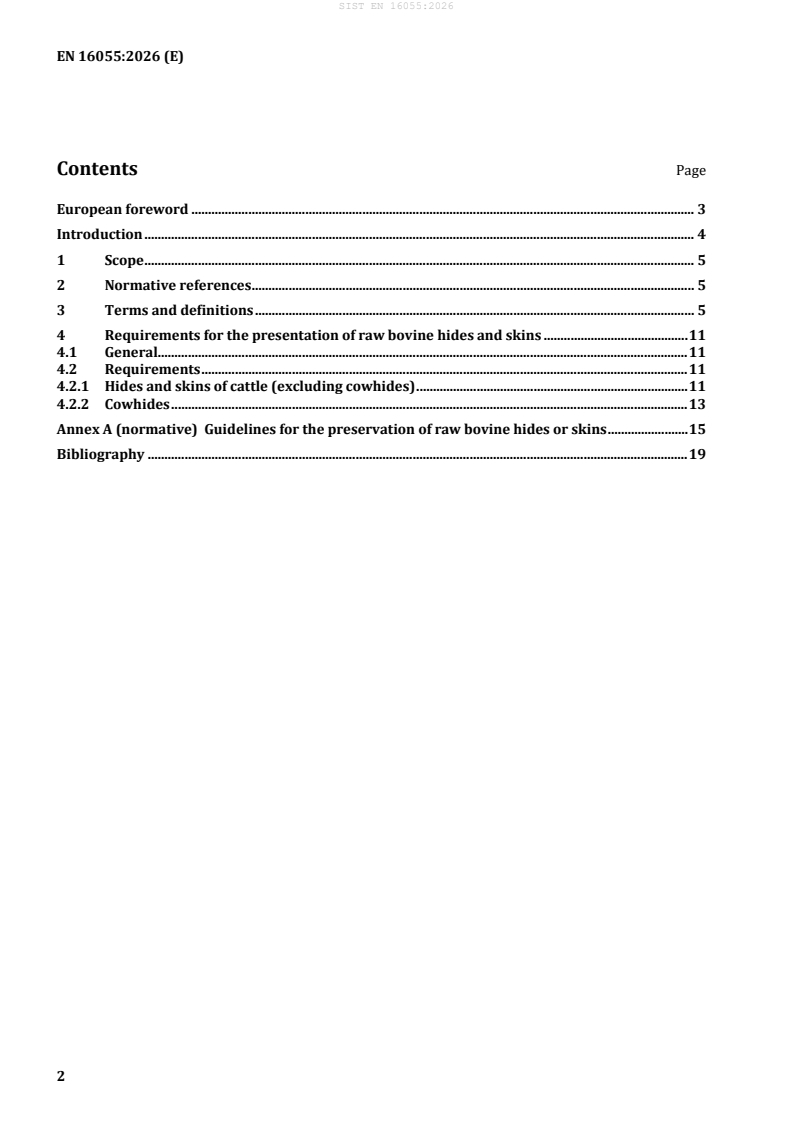
Contents Page
European foreword . 3
Introduction . 4
1 Scope . 5
2 Normative references . 5
3 Terms and definitions . 5
4 Requirements for the presentation of raw bovine hides and skins . 11
4.1 General. 11
4.2 Requirements . 11
4.2.1 Hides and skins of cattle (excluding cowhides) . 11
4.2.2 Cowhides . 13
Annex A (normative) Guidelines for the preservation of raw bovine hides or skins . 15
Bibliography . 19
European foreword
This document (EN 16055:2026) has been prepared by Technical Committee CEN/TC 289 “Leather”,
the secretariat of which is held by UNI.
This European Standard shall be given the status of a national standard, either by publication of an
identical text or by endorsement, at the latest by February 2027, and conflicting national standards
shall be withdrawn at the latest by February 2027.
Attention is drawn to the possibility that some of the elements of this document may be the subject of
patent rights. CEN shall not be held responsible for identifying any or all such patent rights.
This document supersedes EN 16055:2012.
— addition of new terms and modifications of existing terms;
— update of existing figures and addition of new figures.
Any feedback and questions on this document should be directed to the users’ national standards body.
A complete listing of these bodies can be found on the CEN website.
According to the CEN-CENELEC Internal Regulations, the national standards organisations of the
following countries are bound to implement this European Standard: Austria, Belgium, Bulgaria,
Croatia, Cyprus, Czech Republic, Denmark, Estonia, Finland, France, Germany, Greece, Hungary, Iceland,
Ireland, Italy, Latvia, Lithuania, Luxembourg, Malta, Netherlands, Norway, Poland, Portugal, Republic of
North Macedonia, Romania, Serbia, Slovakia, Slovenia, Spain, Sweden, Switzerland, Türkiye and the
United Kingdom.
Introduction
It should be noted that raw hides, bovine hides and calfskins are natural products. As a result,
companies trading in these products do not have control over all their properties. All links in the chain
should ensure that the best possible quality of the natural product skin is maintained. For this purpose,
controls should take place in the respective stages, the results of which are then brought to the
attention of the preceding stage, so that they can work on improving the quality there.
This document is intended to avoid disagreements between parties. It is the result of discussions with
representatives of agriculture, slaughterhouses, hides and skins processors and tanneries.
prEN 18199:2025 addresses essential requirements of traceability of hides and skins.
1 Scope
This document specifies the following for raw bovine hides and skins intended for use throughout the
leather manufacturing supply chain:
— Terms and definitions;
— Requirements for the presentation of raw hides and skins.
It is applicable to fresh and salted bovine hides and skins.
It outlines the opening cut and trim of hides and skins and the types of defects typically associated with
this raw material.
NOTE 1 Opening cut and trim vary from country to country.
It shows which parts of hides and skins can be used for leather production and which factors influence
the quality of hides and skins.
Furthermore, it gives recommendations on precautions to be taken for transport, preservation, loading
and unloading.
NOTE 2 For commercial agreements between the buyer and the supplier of hides and skins, operators use the
INTERNATIONAL CONTRACT No. 6 – HIDES and SKINS as drawn up by the International Council of Hides, Skins
and Leather Traders Associations (ICHSLTA) and the International Council of Tanners (ICT) [1].
2 Normative references
There are no normative references in this document.
3 Terms and definitions
For the purposes of this document, the following terms and definitions apply.
ISO and IEC maintain terminology databases for use in standardization at the following addresses:
— ISO Online browsing platform: available at https://www.iso.org/obp/
— IEC Electropedia: available at https://www.electropedia.org/
3.1 Raw bovine hides and skins
3.1.1
calfskin
skin of very young cattle feeding predominantly on milk
Note 1 to entry: In the international trade calfskins are classified under HS code 4101 20: whole hides and skins,
unsplit, of a weight per skin not exceeding 8 kg when simply dried; 10 kg when dry-salted or 16 kg when fresh,
wet-salted or otherwise preserved.
3.1.2
kip skin
skin of a young bovine already eating grass or other animal feed
3.1.3
casualty calf skin
skin from an animal that died naturally in the stable or during transport
3.2
cattle hide
skin of adult bovine animals
3.2.1
bull hide
skin of a male bovine animal (not castrated)
3.2.2
cowhide
skin of female bovine animals that have given birth to calves
3.2.3
ox hide
skin of a castrated male bovine animal
3.2.4
heifer hide
skin of female bovine animal that has not given birth to calves
3.3
opening the bovine hide or skin
procedure to make initial cuts to facilitate the removal of the hide or skin from the animal carcass
Note 1 to entry: Ideal opening is a symmetrical opening (see Figure 3).
3.4
flaying
process of removing the entire hide or skin from a dead animal
3.5
trimming
process in which parts of the hide or skin, that are not suitable for subsequent leather production, are
removed
Key
1 head
2 forehead
3 Cheek
2 + 3 mask
4 Shoulder
5 foreleg
6 bend or croupon
4 + 6 back
7 belly
8 middle-belly
9 half-croupon
10 hind-leg
10+8+9 half culatta
5 right and left+4 avancorpo/front
8+10 half-belly
Figure 1 — Different parts of the hide or skin after trimming
3.6
preservation
treatment to protect hide and skin from rotting after flaying until further processing in the
tannery, by cooling or by salting
3.6.1
cooling
temperature reduction to significantly reduce bacterial activity and avoid preservation defects
3.6.2
fresh hides and skins
hides and skins, chilled to a temperature of less than 7 °C, but not below 0,3 °C
Note 1 to entry: The temperature of less than 7 °C, but not below 0,3 °C is to avoid salting.
Note 2 to entry: Temperature not below 0,3 °C prevents hides and skins, or parts of them, from freezing during the
chilling process.
3.6.3
salting
process done with NaCl during at least 14 days before palletisation for delivery of hides
3.7
defect
flaw
all damage to raw or preserved hides which may affect the quality of the leather produced
3.7.1 Flaying defects
3.7.1.1
cut
cut on the hide or skin by a knife or flaying tool on the flesh side that has cut into the dermis or skin
substance without completely penetrating the skin
Note 1 to entry: See Figure 2 – key 1.
3.7.1.2
hole
flaying damage caused by a knife or flaying tool on the flesh side, completely severing the skin
Note 1 to entry: See Figure 2 - key 2.
3.7.1.3
gouge
loss of substance of the skin on the flesh side caused by a knife or skinning tool without completely
perforating the skin
Note 1 to entry: See Figure 2 – key 3.
3.7.1.4
poorly cut head
head cut along a line not perpendicular to the longitudinal axis
Note 1 to entry: See Figure 4.
3.7.1.5
poorly shaped flank
poorly-shaped leg
leg cut along a line not perpendicular to the opening cut of the leg and/or too long, i.e. not cut at the
foreshank or knee cap
Note 1 to entry: Poorly shaped legs are unusable (see Figure 4).
3.7.1.6
deformed skin
deformed hide
any deviation from the regular shape of the skin or hide due to unproper carcass opening or unproper
cutting and trimming
Note 1 to entry: See also Figure 4 for a regular shape of a skin.
3.7.1.7
grain break
grain burst
hide/skin puller damage occurring when they are removed from the animals at too high speed by the
hide puller
3.7.1.8
improper bleeding
incomplete and inadequate bleeding of the animal at the time of slaughter
Note 1 to entry: Incomplete and inadequate bleeding results in clotted blood remaining in the blood vessels and
visible on the flesh side of the skin and results in wrong cutting and loss of usable neck/shoulder skin.
Key
1 cut
2 hole
3 gouge
4 wrong opening cut
Figure 2 — Examples of defects
3.7.2 Natural damage - defects to the skin of the living animal
3.7.2.1
mechanical defect
defect caused by brand marks, various scratches, spines, surgical operations, which may be open or
healed (scars)
Note 1 to entry: Scratches can be caused by barbed wire, brambles, transport or drag marks, cattle fight marks,
rope marks, etc.
3.7.2.2
dung or urine damage
manure or urine damage visible on the skin that has affected or corroded the grain side of the hide/skin
3.7.2.3
damage caused by parasites
damage caused
...