

EN 1860-1:2013
(Main)Appliances, solid fuels and firelighters for barbecueing - Part 1: Barbecues burning solid fuels - Requirements and test methods
General Information
- Abstract
This part of this European Standard is applicable to barbecues which burn solid fuels, except single use barbecues. Barbecues which are intended to be converted from other fuels to solid fuels also should conform to this standard.
This European Standard specifies requirements for materials, construction, design, test methods, markings and instructions relating to them.
- Status
- Withdrawn
- Publication Date
- 29-Jan-2013
- Withdrawal Date
- 29-Sep-2026
- Technical Committee
- CEN/TC 281 - Appliances, solid fuels and firestarters for barbecuing
- Drafting Committee
- CEN/TC 281/WG 1 - Barbecues burning solid fuels
- Current Stage
- 9960 - Withdrawal effective - Withdrawal
- Start Date
- 28-Jun-2017
- Completion Date
- 30-Sep-2026
- Directive
- 2001/95/EC - General product safetyOJ Ref: OJ C 256 OJ Date: 15-Oct-2005

Relations
- Effective Date
- 06-Feb-2013
- Effective Date
- 16-Jul-2011
- Effective Date
- 12-Apr-2017
- Effective Date
- 28-Jan-2026
- Effective Date
- 05-Aug-2015
Get Certified
Connect with accredited certification bodies for this standard

Element Materials Technology
Materials testing and product certification.

ABS Group Brazil
ABS Group certification services in Brazil.

ABS Quality Evaluations Inc.
American Bureau of Shipping quality certification.
Sponsored listings
Frequently Asked Questions
EN 1860-1:2013 is a standard published by the European Committee for Standardization (CEN). Its full title is "Appliances, solid fuels and firelighters for barbecueing - Part 1: Barbecues burning solid fuels - Requirements and test methods". This standard covers: This part of this European Standard is applicable to barbecues which burn solid fuels, except single use barbecues. Barbecues which are intended to be converted from other fuels to solid fuels also should conform to this standard. This European Standard specifies requirements for materials, construction, design, test methods, markings and instructions relating to them.
This part of this European Standard is applicable to barbecues which burn solid fuels, except single use barbecues. Barbecues which are intended to be converted from other fuels to solid fuels also should conform to this standard. This European Standard specifies requirements for materials, construction, design, test methods, markings and instructions relating to them.
EN 1860-1:2013 is classified under the following ICS (International Classification for Standards) categories: 75.160.10 - Solid fuels; 97.040.20 - Cooking ranges, working tables, ovens and similar appliances. The ICS classification helps identify the subject area and facilitates finding related standards.
EN 1860-1:2013 has the following relationships with other standards: It is inter standard links to EN 1860-1:2003/A1:2006, EN 1860-1:2003, EN 1860-1:2013+A1:2017, EN 1860-2:2023, EN 1860-1:2013/FprA1. Understanding these relationships helps ensure you are using the most current and applicable version of the standard.
EN 1860-1:2013 is associated with the following European legislation: EU Directives/Regulations: 2001/95/EC. When a standard is cited in the Official Journal of the European Union, products manufactured in conformity with it benefit from a presumption of conformity with the essential requirements of the corresponding EU directive or regulation.
EN 1860-1:2013 is available in PDF format for immediate download after purchase. The document can be added to your cart and obtained through the secure checkout process. Digital delivery ensures instant access to the complete standard document.
Standards Content (Sample)
2003-01.Slovenski inštitut za standardizacijo. Razmnoževanje celote ali delov tega standarda ni dovoljeno.Naprave, trdna goriva in naprave za vžiganje žara - 1. del: Žari na trdna goriva - Zahteve in preskusne metodeGeräte, feste Brennstoffe und Anzündhilfen zum Grillen - Teil 1: Grillgeräte für feste Brennstoffe - Anforderungen und PrüfverfahrenAppareils, combustibles solides et allume-barbecue pour la cuisson au barbecue - Partie 1: Barbecue utilisant les combustibles solides - Exigences et méthodes d’essaiAppliances, solid fuels and firelighters for barbecueing - Part 1: Barbecues burning solid fuels - Requirements and test methods97.040.20Cooking ranges, working tables, ovens and similar appliances75.160.10Trda gorivaSolid fuelsICS:Ta slovenski standard je istoveten z:EN 1860-1:2013SIST EN 1860-1:2013en,fr,de01-junij-2013SIST EN 1860-1:2013SLOVENSKI
STANDARDSIST EN 1860-1:2004/A1:2006SIST EN 1860-1:20041DGRPHãþD
EUROPEAN STANDARD NORME EUROPÉENNE EUROPÄISCHE NORM
EN 1860-1
January 2013 ICS 75.160.10; 97.040.20 Supersedes EN 1860-1:2003English Version
Appliances, solid fuels and firelighters for barbecueing - Part 1: Barbecues burning solid fuels - Requirements and test methods Appareils, combustibles solides et allume-feu pour la cuisson au barbecue - Partie 1: Barbecues utilisant les combustibles solides - Exigences et méthodes d'essai
Geräte, feste Brennstoffe und Anzündhilfen zum Grillen - Teil 1: Grillgeräte für feste Brennstoffe - Anforderungen und Prüfverfahren This European Standard was approved by CEN on 16 September 2012.
CEN members are bound to comply with the CEN/CENELEC Internal Regulations which stipulate the conditions for giving this European Standard the status of a national standard without any alteration. Up-to-date lists and bibliographical references concerning such national standards may be obtained on application to the CEN-CENELEC Management Centre or to any CEN member.
This European Standard exists in three official versions (English, French, German). A version in any other language made by translation under the responsibility of a CEN member into its own language and notified to the CEN-CENELEC Management Centre has the same status as the official versions.
CEN members are the national standards bodies of Austria, Belgium, Bulgaria, Croatia, Cyprus, Czech Republic, Denmark, Estonia, Finland, Former Yugoslav Republic of Macedonia, France, Germany, Greece, Hungary, Iceland, Ireland, Italy, Latvia, Lithuania, Luxembourg, Malta, Netherlands, Norway, Poland, Portugal, Romania, Slovakia, Slovenia, Spain, Sweden, Switzerland, Turkey and United Kingdom.
EUROPEAN COMMITTEE FOR STANDARDIZATION
COMITÉ EUROPÉEN DE NORMALISATION EUROPÄISCHES KOMITEE FÜR NORMUNG
Management Centre:
Avenue Marnix 17,
B-1000 Brussels © 2013 CEN All rights of exploitation in any form and by any means reserved worldwide for CEN national Members. Ref. No. EN 1860-1:2013: ESIST EN 1860-1:2013
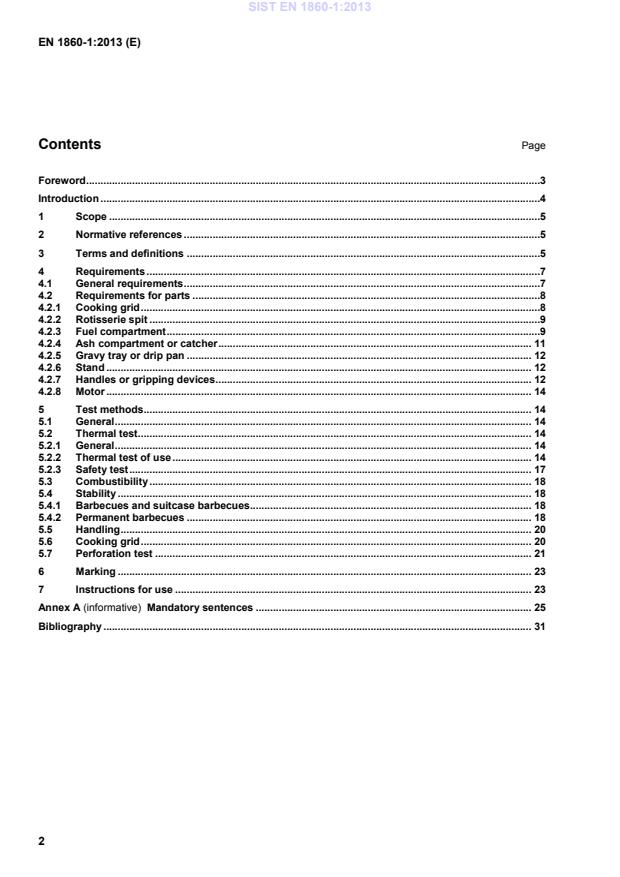
Mandatory sentences . 25 Bibliography . 31
a. Clause 3, Terms and definitions: definition of BBQ modified to introduce Close and Open barbecues; b. 4.2.3.1: measurement of thickness added; c. New 4.2.4, Ash compartment or catcher; d. 4.2.7: Table 3 modified; e. Clause 5, Test Methods: Test methods modified. A thermal test of use and a safety test were added; f. New Annex A.
This European Standard on appliances, solid fuels and firelighters for barbecuing consists of the following parts: Part 1: Barbecues burning solid fuels — Requirements and test methods Part 2: Barbecue charcoal and barbecue charcoal briquettes — Requirements and test methods Part 3: Firelighters for igniting solid fuels for use in barbecue appliances — Requirements and test methods Part 4: Single use barbecues burning solid fuels — Requirements and test methods According to the CEN/CENELEC Internal Regulations, the national standards organisations of the following countries are bound to implement this European Standard: Austria, Belgium, Bulgaria, Croatia, Cyprus, Czech Republic, Denmark, Estonia, Finland, Former Yugoslav Republic of Macedonia, France, Germany, Greece, Hungary, Iceland, Ireland, Italy, Latvia, Lithuania, Luxembourg, Malta, Netherlands, Norway, Poland, Portugal, Romania, Slovakia, Slovenia, Spain, Sweden, Switzerland, Turkey and the United Kingdom.
3.10 silk paper thin, soft, relatively hard to tear paper with a weight between 12 g/m2 and 25 g/m2 usually used to wrap delicate objects
3.11 windshield component of the barbecue used to minimise undesirable effect of the wind during the use of the barbecue 4 Requirements 4.1 General requirements When testing as described in 5.2, the coatings of the barbecue accessories shall not liberate any solid substance nor ignite. Also any solid substance coming from other parts of the barbecue shall not ignite nor fall into the usable area.
NOTE For surfaces of and coatings on parts of the barbecue coming into contact with the food to be barbecued, cooking grid, rotisserie spit, rotisserie meat forks and gravy trays, see Regulation (EC) No 1935/2004 (see Bibliography). Differing legal requirements may exist in non-EU-countries. It shall be possible to assemble and dismantle suitcase or portable barbecues as described in the instructions for use either without the aid of a tool or using the tool that is supplied. Components shall be fixed in such a way that they cannot fall off during transportation. When assembling, operating and manipulating the barbecue, accessible edges and corners shall be free from burr. Rough surfaces, sharp edges and corners, which can cause injury, are not allowed.
In case of doubt to determine whether rough surface, sharp edges or corners can cause an injury a test according to EN 71-1:2009, 8.11 is mandatory. All accessible parts of the barbecue components made of metal sheet or tubes of thickness less than 0,7 mm (– 0,02 mm) coating excluded shall be as shown in Figures 1, 2, 3 and 4.
Figure 1 — Fully edged
Figure 2 — Folded and flattened SIST EN 1860-1:2013
Figure 3 — Rolled and closed
Figure 4 — Rolled and half closed The construction of the barbecue shall be such that when placed horizontally the change of the fuel compartment position, according to the instruction for use and the insertion and removal of barbecue accessories with the cooking grid and/or rotisserie spit loaded as described in 5.5, shall be possible without the barbecue tipping over or components becoming detached or moved in such a way that they are no longer capable of fulfilling their functions. These requirements also apply when testing the barbecue as described in 5.2. After testing in accordance with Clause 5, a barbecue fails if it does not meet the following requirements: a) any deformation of a component that compromises the use and safety of the barbecue; b) any component showing cracks and/or fractures; NOTE A permanent barbecue may show cracks and/or fractures which do not influence the safety. c) any component falls off; d) the temperature and safety requirements mentioned in the test descriptions are not met. 4.2 Requirements for parts 4.2.1 Cooking grid The clear distance between the bars of the cooking grid shall not exceed 20 mm before, during and after testing according to 5.2 and 5.6. This requirement relates to the usable area of the grid, which shall be at least 80 % of the horizontal area of the fuel compartment, vertically projected. If the cooking grid has the function of a grate, the clear distance between the bars of the grate and also, in the case of vertical fuel compartment, of those between the grate and the edges of the fuel container shall not exceed 20 mm before, during and after testing according to 5.2 and 5.6. SIST EN 1860-1:2013
one to be in the centre of the bottom; two on the opposite sides at minimum 150 mm from each other; If one side of the fuel compartment is a grate, only two sides are measured. SIST EN 1860-1:2013
2) Measure at these same points on both sides the thickness of the coating Cext and Cint. 3) Calculate by subtraction the thickness of the uncoated steel sheet in each. T = Tt – (Cext + Cint) 4) Calculate the average from them. Table 1 — Minimum thickness of steel sheet for fuel compartments Grid size diameter or longest side measurement Thickness ≤ 400 mm > 400 mm 0,7 mm 0,8 mm For fuel compartments with a grid size diameter or longest side measurement ≤ 400 mm, a thickness (coating excluded) between 0,5 mm and 0,7 mm is acceptable, provided they are glass or porcelain enamelled on both sides and withstand the tests according to: a) 5.2.2 one time and 5.2.3 two times consecutively; and b) 5.7. Fuel compartments made of cast metal require a minimum thickness coating excluded of 2,5 mm. Fuel compartments made of materials other than steel sheet or cast material (excluding permanent barbecues) shall withstand the tests according to: a) 5.2.2 one time and 5.2.3 two times consecutively; and b) 5.7. 4.2.3.2 Openings If the fuel compartment after assembly has openings, these shall meet the following requirements when tested as described in 5.2 and 5.3. The number of openings in the flat base of the fuel compartment shall not exceed four and shall be dimensioned so that a sphere of 3 mm in diameter will not fall through them, their area shall not exceed 50 mm2. Other openings, other than in the flat base, if circular should have a diameter not exceeding 8 mm, or, if a different shape, their area shall not exceed 50 mm2. With larger openings the barbecue shall be equipped with an ash catcher or the barbecue shall be designed so that it is impossible for any embers or fuel to fall out or roll off when tested as described in 5.2 and 5.3. 4.2.3.3 Depth of the fuel compartment The minimum depth of the fuel compartment shall be as indicated in Table 2. The minimum depth shall be available over 80 % of the usable area of the fuel compartment. SIST EN 1860-1:2013
Keys A fuel compartment B flat protection plane Figure 5 — Top view of flat protection plane for permanent barbecue 4.2.4 Ash compartment or catcher Ash compartments or catcher made of sheet metal require a minimum thickness (coating excluded) of 0,7 mm. For ash compartments or catchers with a diameter or longest side measurement ≤ 400 mm, a thickness (coating excluded) between 0,5 mm and 0,7 mm is acceptable, provided they are glass or porcelain enamelled on both sides. SIST EN 1860-1:2013
Key 1 80 mm usable area Figure 6 — Example of useful parts of gripping area for cooking grid handles
Key 1 80 mm usable area Figure 7 — Example of useful parts of gripping area for cooking grid handles SIST EN 1860-1:2013
E
...