

EN 13524:2003+A2:2014
(Main + Amendment)Highway maintenance machines - Safety requirements
General Information
- Abstract
This European Standard applies to machines used for highway maintenance which are attached to or mounted on carrier vehicles and which are defined in clause 3. Directives and standards for the vehicular truck chassis aspect, termed 'carrier vehicle' in this standard, would be those relevant to that equipment, even where specific modifications have been made to adapt the machines for highway maintenance application. The use in public road traffic is governed by the national regulations.
This European Standard deals with all significant hazards identified through a risk assessment pertinent to highway maintenance machines, when they are used as intended and under the conditions foreseen by the manufacturer (see clause 4). This European Standard does not deal with significant hazards associated with !deleted text" EMC. This European Standard specifies the appropriate technical measures to eliminate or reduce risks arising from the significant hazards associated with machine operation, setting and adjustments, load discharge and routine maintenance.
This European Standard does not include requirements for the carrier vehicles (e.g. trucks, tractors, construction machines, industrial trucks) as well as their demountable bodywork. These are covered in directives related to the construction of vehicles. Demountable bodywork systems are specified in other standards.
This European Standard does not deal with:
- walker-operated an hand-held machines;
- machines for the maintenance of sports grounds;
- machines for agriculture, horticulture and forestry;
- winter-service machines;
- street-cleansing machines, except sweepers #deleted text$;
- earth-moving machinery;
- pit and sewer cleaning vehicles/-machines;
- lifting platforms;
- refuse-collecting vehicles;
- bridge-inspection equipment;
- loading cranes;
- wood-choppers (bush wood choppers).
A machine which is a combination of several parts with different uses should conform to all the standards referring to the corresponding parts of the machine.
This European Standard does not deal with the risks associated with the operation of machines in potentially explosive atmospheres.
This standard applies to machines manufactured after the date of approval of this standard through CEN.
- Status
- Withdrawn
- Publication Date
- 18-Feb-2014
- Withdrawal Date
- 29-Sep-2026
- Technical Committee
- CEN/TC 151 - Construction equipment and building material machines - Safety
- Current Stage
- 9960 - Withdrawal effective - Withdrawal
- Start Date
- 20-Oct-2021
- Completion Date
- 30-Sep-2026
- Directive
- 2006/42/EC - Directive 2006/42/EC of the European Parliament and of the Council of 17 May 2006 on machinery, and amending Directive 95/16/EC (recast)OJ Ref: C, C 220 OJ Date: 11-Jul-2014


Relations
- Effective Date
- 18-Jan-2023
- Effective Date
- 08-Jun-2022
- Effective Date
- 08-Jun-2022
- Effective Date
- 25-Aug-2026
- Effective Date
- 25-Aug-2026
- Effective Date
- 25-Aug-2026
- Effective Date
- 25-Aug-2026
- Refers
ISO 789-1:1990 - Agricultural tractors — Test procedures — Part 1: Power tests for power take-off - Effective Date
- 25-Aug-2026
- Effective Date
- 25-Aug-2026
- Effective Date
- 25-Aug-2026
- Effective Date
- 25-Aug-2026
- Effective Date
- 25-Aug-2026
- Effective Date
- 25-Aug-2026
- Effective Date
- 09-Feb-2026
- Effective Date
- 28-Jan-2026
Get Certified
Connect with accredited certification bodies for this standard

TÜV Rheinland
TÜV Rheinland is a leading international provider of technical services.

TÜV SÜD
TÜV SÜD is a trusted partner of choice for safety, security and sustainability solutions.

DEKRA Certification Inc.
DEKRA US certification services.
Sponsored listings
Frequently Asked Questions
EN 13524:2003+A2:2014 is a standard published by the European Committee for Standardization (CEN). Its full title is "Highway maintenance machines - Safety requirements". This standard covers: This European Standard applies to machines used for highway maintenance which are attached to or mounted on carrier vehicles and which are defined in clause 3. Directives and standards for the vehicular truck chassis aspect, termed 'carrier vehicle' in this standard, would be those relevant to that equipment, even where specific modifications have been made to adapt the machines for highway maintenance application. The use in public road traffic is governed by the national regulations. This European Standard deals with all significant hazards identified through a risk assessment pertinent to highway maintenance machines, when they are used as intended and under the conditions foreseen by the manufacturer (see clause 4). This European Standard does not deal with significant hazards associated with !deleted text" EMC. This European Standard specifies the appropriate technical measures to eliminate or reduce risks arising from the significant hazards associated with machine operation, setting and adjustments, load discharge and routine maintenance. This European Standard does not include requirements for the carrier vehicles (e.g. trucks, tractors, construction machines, industrial trucks) as well as their demountable bodywork. These are covered in directives related to the construction of vehicles. Demountable bodywork systems are specified in other standards. This European Standard does not deal with: - walker-operated an hand-held machines; - machines for the maintenance of sports grounds; - machines for agriculture, horticulture and forestry; - winter-service machines; - street-cleansing machines, except sweepers #deleted text$; - earth-moving machinery; - pit and sewer cleaning vehicles/-machines; - lifting platforms; - refuse-collecting vehicles; - bridge-inspection equipment; - loading cranes; - wood-choppers (bush wood choppers). A machine which is a combination of several parts with different uses should conform to all the standards referring to the corresponding parts of the machine. This European Standard does not deal with the risks associated with the operation of machines in potentially explosive atmospheres. This standard applies to machines manufactured after the date of approval of this standard through CEN.
This European Standard applies to machines used for highway maintenance which are attached to or mounted on carrier vehicles and which are defined in clause 3. Directives and standards for the vehicular truck chassis aspect, termed 'carrier vehicle' in this standard, would be those relevant to that equipment, even where specific modifications have been made to adapt the machines for highway maintenance application. The use in public road traffic is governed by the national regulations. This European Standard deals with all significant hazards identified through a risk assessment pertinent to highway maintenance machines, when they are used as intended and under the conditions foreseen by the manufacturer (see clause 4). This European Standard does not deal with significant hazards associated with !deleted text" EMC. This European Standard specifies the appropriate technical measures to eliminate or reduce risks arising from the significant hazards associated with machine operation, setting and adjustments, load discharge and routine maintenance. This European Standard does not include requirements for the carrier vehicles (e.g. trucks, tractors, construction machines, industrial trucks) as well as their demountable bodywork. These are covered in directives related to the construction of vehicles. Demountable bodywork systems are specified in other standards. This European Standard does not deal with: - walker-operated an hand-held machines; - machines for the maintenance of sports grounds; - machines for agriculture, horticulture and forestry; - winter-service machines; - street-cleansing machines, except sweepers #deleted text$; - earth-moving machinery; - pit and sewer cleaning vehicles/-machines; - lifting platforms; - refuse-collecting vehicles; - bridge-inspection equipment; - loading cranes; - wood-choppers (bush wood choppers). A machine which is a combination of several parts with different uses should conform to all the standards referring to the corresponding parts of the machine. This European Standard does not deal with the risks associated with the operation of machines in potentially explosive atmospheres. This standard applies to machines manufactured after the date of approval of this standard through CEN.
EN 13524:2003+A2:2014 is classified under the following ICS (International Classification for Standards) categories: 43.160 - Special purpose vehicles; 93.080.99 - Other standards related to road engineering. The ICS classification helps identify the subject area and facilitates finding related standards.
EN 13524:2003+A2:2014 has the following relationships with other standards: It is inter standard links to EN 13524:2003+A1:2009, EN 17106-1:2021, EN 17106-4:2021, ISO 11001-3:1993, ISO 2758:2001, ISO 11001-1:1993, ISO 730:2009, ISO 789-1:1990, ISO 11001-2:1993, ISO 6405-1:2004, ISO 536:2012, ISO 6750:2005, ISO 11001-4:1994, ISO 1974:2012, EN ISO 18153:2003. Understanding these relationships helps ensure you are using the most current and applicable version of the standard.
EN 13524:2003+A2:2014 is associated with the following European legislation: EU Directives/Regulations: 2006/42/EC; Standardization Mandates: M/396. When a standard is cited in the Official Journal of the European Union, products manufactured in conformity with it benefit from a presumption of conformity with the essential requirements of the corresponding EU directive or regulation.
EN 13524:2003+A2:2014 is available in PDF format for immediate download after purchase. The document can be added to your cart and obtained through the secure checkout process. Digital delivery ensures instant access to the complete standard document.
Standards Content (Sample)
2003-01.Slovenski inštitut za standardizacijo. Razmnoževanje celote ali delov tega standarda ni dovoljeno.Stroji za vzdrževanje avtocest - Varnostne zahteveMaschinen für den Straßenbetriebsdienst - SicherheitsanforderungenMachines de maintenance des routes - Exigences de sécuritéHighway maintenance machines - Safety requirements93.080.99Drugi standardi v zvezi s cestnim inženiringomOther standards related to road engineering43.160Vozila za posebne nameneSpecial purpose vehiclesICS:Ta slovenski standard je istoveten z:EN 13524:2003+A2:2014SIST EN 13524:2004+A2:2014en,fr,de01-april-2014SIST EN 13524:2004+A2:2014SLOVENSKI
STANDARDSIST EN 13524:2004+A1:20091DGRPHãþD
EUROPEAN STANDARD NORME EUROPÉENNE EUROPÄISCHE NORM
EN 13524:2003+A2
February 2014 ICS 43.160; 93.080.99 Supersedes EN 13524:2003+A1:2009English Version
Highway maintenance machines - Safety requirements
Machines de maintenance des routes - Exigences de sécurité
Maschinen für den Straßenbetriebsdienst - Sicherheitsanforderungen This European Standard was approved by CEN on 6 December 2002 and includes Amendment 1 approved by CEN on 24 November 2008 and Amendment 2 approved by CEN on 24 November 2013.
CEN members are bound to comply with the CEN/CENELEC Internal Regulations which stipulate the conditions for giving this European Standard the status of a national standard without any alteration. Up-to-date lists and bibliographical references concerning such national standards may be obtained on application to the CEN-CENELEC Management Centre or to any CEN member.
This European Standard exists in three official versions (English, French, German). A version in any other language made by translation under the responsibility of a CEN member into its own language and notified to the CEN-CENELEC Management Centre has the same status as the official versions.
CEN members are the national standards bodies of Austria, Belgium, Bulgaria, Croatia, Cyprus, Czech Republic, Denmark, Estonia, Finland, Former Yugoslav Republic of Macedonia, France, Germany, Greece, Hungary, Iceland, Ireland, Italy, Latvia, Lithuania, Luxembourg, Malta, Netherlands, Norway, Poland, Portugal, Romania, Slovakia, Slovenia, Spain, Sweden, Switzerland, Turkey and United Kingdom.
EUROPEAN COMMITTEE FOR STANDARDIZATION
COMITÉ EUROPÉEN DE NORMALISATION EUROPÄISCHES KOMITEE FÜR NORMUNG
CEN-CENELEC Management Centre:
Avenue Marnix 17,
B-1000 Brussels © 2014 CEN All rights of exploitation in any form and by any means reserved worldwide for CEN national Members. Ref. No. EN 13524:2003+A2:2014 ESIST EN 13524:2004+A2:2014
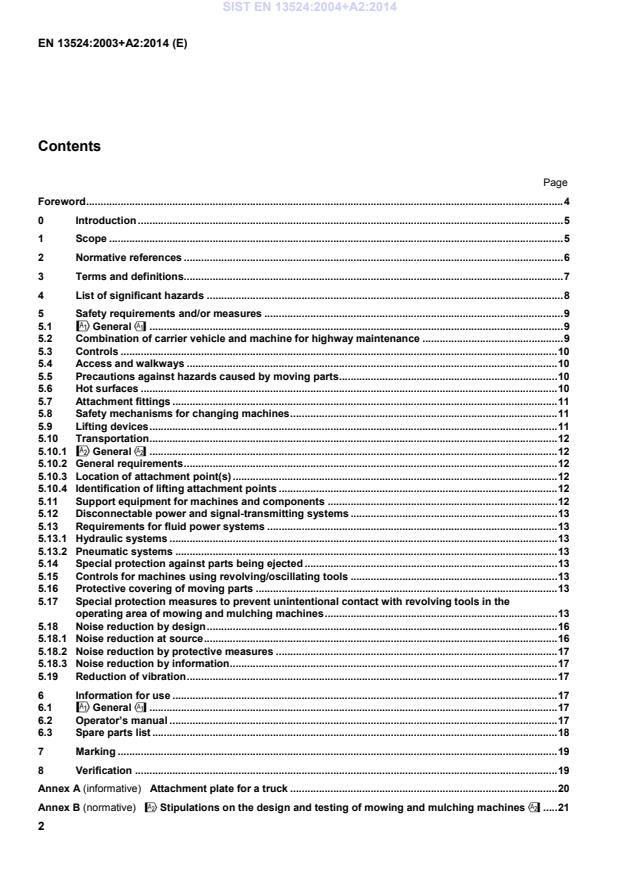
Attachment plate for a truck . 20 Annex B (normative)
#Stipulations on the design and testing of mowing and mulching machines$ . 21 SIST EN 13524:2004+A2:2014
#Thrown-object test reports - Machines . 45 Annex ZA (informative)
!Relationship between this European Standard and the Essential Requirements of EU Directive 2006/42/EC" . 51 Bibliography . 52
Hazards Location of hazard relevant for machine Dealt with in clause 1.1 Crushing hazard Persons in danger zone Coupling area of machines all all !5.5" !5.16" !5.7" 1.2 Shearing hazard Operating area of rotating/oscillating tools; Moving elements; Slewing area of machines and machine parts all !5.16" 1.3 Cutting or severing hazard Operating area of cutting machinery 3.4 3.5 !5.16" 1.4 Entanglement hazard Operating area of rotating machinery; Rotating or oscillating machine parts all !5.16" 1.5 Drawing-in or trapping hazard Operating area of rotating machinery; Rotary or oscillating machine parts all !5.16" !1.6 High pressure fluid ejection or ejection hazard Power transmission lines all 5.13.1 5.13.2" 2 Burns, scalds and other injuries by a possible contact of persons with objects or materials with an extreme high or low temperature, by flames or explosions and also by the radiation of heat sources Engine cooling systems; Exhaust system all !5.6" 3 Hazards from contact with or inhalation of harmful fluids, gases, mists, fumes and dusts Workplace 3.3 3.4 3.6 3.7 #deleted text$ 6 4 Human error, human behaviour Operating area of the machines all 6 5 Inadequate design, location or identification of manual controls Operating area of the machines all !5.3" !5.15" SIST EN 13524:2004+A2:2014
all
8.1 Hearing loss (deafness), other physiological disorders (e.g. loss of balance, loss of awareness)
all 5.18 8.2 Interference with speech communication, acoustic signals etc.
all 5.18 9 Hazards generated by vibration
all
9.1 Whole body vibration, particularly when combined with poor postures
all 5.19" !10" Loss of stability/overturning of machinery Impermissible combinations; Supporting equipment all all !5.2" !5.11" !11" Slip, trip and fall of persons (related to machinery) Access steps #3.8$ !5.4" !12" Movement without all parts in a safe position Movable machine parts all !5.10" !5.11" 5 Safety requirements and/or measures ! 5.1 General" The machines shall comply with the safety requirements and/or measures of this clause. In addition the machines shall be designed to comply with the requirements of #EN ISO 12100$for hazards that are relevant but not significant and therefore are not dealt with in this standard. For the application of the reference standards !deleted text" EN 953, #EN ISO 4413, EN ISO 4414$
!and EN ISO 13732-1"which are used in this standard, the manufacturer shall carry out an adequate risk assessment relating to those requirements for which a special safety measure or category is necessary. NOTE This specific risk assessment should be part of the general risk assessment relating to the hazards not covered by this standard. Where the means of reducing the risk is by a safe system of working the machinery, the manufacturer shall include in the Information for use details of the system and of the elements of training required by the operating personnel. 5.2 Combination of carrier vehicle and machine for highway maintenance SIST EN 13524:2004+A2:2014
!EN ISO 13732-1". This shall be achieved by the use of guards (e.g. perforated plates placed in front of or around the hot surfaces) or be positioned to avoid unintended risk of contact. Where guarding is impractical, e.g. engine radiator caps, adequate warning signs shall be employed advising on the nature of the risk and avoidance measures shall be described in information for use. SIST EN 13524:2004+A2:2014
1) Unintended lowering is when a load runs back or descends because of an interruption or an irregularity in the energy supply. 2) The term “as part of working procedure” does not cover repair work. SIST EN 13524:2004+A2:2014
Key 1 Area within the guard (e.g. deflector bar) 2 Path of rotation of the tool 3 Ground Figure 1 — Mowing machine with a horizontal axis in the operating position –
Protection by means of deflector bar In addition to, or instead of, the described protective means, covering guards are permissible which shall be arranged in the vicinity of the tools in such a way that their bottom edges are at least 3 mm below the path of rotation of the tools (see Figure 2). !Dimensions in millimetres" SIST EN 13524:2004+A2:2014
Key 1 Protection device 2 Path of rotation of the tool 3 Ground Figure 2 — Mowing machine with vertical axis in the operating position – Covering guard b) Lateral protection on mulching and mowing machines with a horizontal axis may be attained by using guards which shall be arranged in the vicinity of the tools in such a way that their bottom edge is at least 3 mm over the path of rotation of the tools. Above the point M the guards shall be at least 150 mm over the path of rotation of the tools. Below the point M the guards shall not be arranged above the line W (see Figure 3). SIST EN 13524:2004+A2:2014
Key 1 Tool path of rotation 2 Ground a Radius of tool path of rotation b Radius of tool path of rotation + min. 3 mm c Distance between M and V (max. 120 mm) d Safety gap of min. 150 mm from tool path of rotation E Point on the circle with radius b in the vertical plane which encloses the rotating axis V Horizontal line through point E W Line which runs straight through point M and tangential to the circle with radius b Figure 3 — Mowing and mulching machines with a horizontal axis – Lateral protection by means of covering guard ! 5.18 Noise reduction by design 5.18.1 Noise reduction at source Machines shall be so designed and constructed that risks resulting from the emission of airborne noise are reduced to the lowest possible level, taking account of technical progress and the availability of means of reducing noise, in particularly, at source. SIST EN 13524:2004+A2:2014
personnel; — information that there may be a negative effect on the driving characteristic of the vehicle, caused by changes in the location of the centre of gravity of the whole machine and by the reduction in stability caused by the addition of demountable machinery; — information on regular checking of the working implements, the protection devices and their fixing; — instructions in case of interruption of power supply; — information on measures to protect the operator against dust and aerosols. 6.3 Spare parts list SIST EN 13524:2004+A2:2014
3) !For machines and their related products intended to be put on the market in the EEA, CE-marking as defined in the applicable European Directive(s), e.g. Machinery." SIST EN 13524:2004+A2:2014
(informative)
Attachment plate for a truck
Figure A.1 – Attachment plate for truck The attachment plate for a truck shown is only an example. It shows in combination systems actually used in Europe. The dimensioning was omitted deliberately. This attachment plate as shown does not exist at present. SIST EN 13524:2004+A2:2014
(normative)
#Stipulations on the design and testing of mowing and mulching machines B.1 Thrown object test of mowing and mulching machines The thrown object test determines the effectiveness of the guard of mowing and mulching machines against objects ejected. The test involves driving the running mowing machine into cone-shape mounds of gravel. The number of ejected stones is then counted. B.2 Testing conditions B.2.1 Machines used for test B.2.1.1 General Tests shall be performed using the same machine, and the same guards. If the machine can be operated in different working positions, the test shall be performed with the cutting head in the outmost working positions in respect of the carrier vehicle as specified by the manufacturer in the operator's manual. This does not apply to articulated arm-type machines. NOTE The thrown objects tests can be done with one suitable single carrier-vehicle (dedicated to these tests). Moreover, for articulated arm-type machinery, the thrown objects tests for each type of cutting head shall be done, if possible, with one long enough articulated arm in order to perform the test as described in B.3.3 (Figure B.7) and the location of the fixing point of the arm on the carrier-vehicle is freely determined by the manufacturer, provided that all the functional parameters (e.g. rotating speed of the tool, control functions) remain unchanged. B.2.1.2 Machinery adjustment Adjustable guards (e.g. multi-positions front deflector) and/or other part(s) of the machinery (e.g. housing) which may influence the efficiency of the guards (e.g. front guard, rear guard, rear lateral guard) or other protective measures to prevent projections, shall be located in the least favourable position. NOTE Fixed guards which are only allowed to be removed for maintenance, repair and cleaning but not for application reasons are not considered as adjustable guards. If the machine can operate in a different rotating direction, the test shall be done in both directions. B.2.1.3 Cutting height Cutting height shall be adjusted at 50 mm. If this is not possible due to the design of the machine, cutting height shall be adjusted as near as possible to 50 mm. B.2.2 Test surface area B.2.2.1 Ground conditions Tests shall be performed on firm and horizontal hard ground. SIST EN 13524:2004+A2:2014
...