

EN 13820:2003
(Main)Thermal insulating materials for building applications - Determination of organic content
General Information
- Abstract
This European Standard specifies the equipment and procedures for determining the organic content of thermal insulating materials.
The method is aimed at determining the organic content for products which are inorganic, i.e. products containing a low percentage of organic compounds, either unfaced products or the insulating material of a faced product.
NOTE 1 It can be used to verify that a thermal insulating product complies with the requirements in prEN 13501-1 Fire classification of construction products and building elements - Part 1: Classification using test data from reaction to fire test to be in Euroclass A1 without testing.
NOTE 2 The standard is not intended for the determination of organic content in the presence of water of hydration and/or combined carbonate, sulphate etc.
NOTE 3 The standard is not intended for the determination of organic content of adhesives, facings and/or coatings.
- Status
- Published
- Publication Date
- 16-Sep-2003
- Technical Committee
- CEN/TC 88 - Thermal insulating materials and products
- Drafting Committee
- CEN/TC 88/WG 1 - Common general test methods
- Current Stage
- 9093 - Decision to confirm - Review Enquiry
- Start Date
- 07-Sep-2026
- Completion Date
- 30-Sep-2026

Overview
EN 13820:2003 is a European Standard developed by CEN that specifies the equipment and procedures for determining the organic content in thermal insulating materials used for building applications. The standard is primarily intended for inorganic insulation products containing low percentages of organic compounds, whether unfaced or as the insulating core of faced products. Knowing the organic content is critical for verifying fire performance and ensuring material compliance with safety regulations such as those outlined in prEN 13501-1 (Fire classification of construction products).
By following EN 13820:2003, manufacturers, testing laboratories, and quality control specialists can accurately determine the organic content in thermal insulation products, supporting quality assurance and regulatory compliance across the European construction industry.
Key Topics
Scope of Application
- Applies to thermal insulating materials used in buildings
- Focuses on inorganic products with low organic content
- Not intended for adhesives, facings, coatings, or materials containing water of hydration and combined carbonate or sulphate
Test Principle
- Organic content is determined as the loss of mass from a previously dried test specimen when heated at a specified temperature for a specified duration
Equipment and Apparatus
- High-precision balance (to 0.001 g)
- Temperature-controlled ventilated oven (typically 105 ± 5 °C)
- Temperature-controlled ventilated furnace (typically 500 ± 20 °C)
- Inert test specimen containers (e.g., pre-heated porcelain crucibles or aluminum trays)
- Desiccator for cooling and maintaining dryness of specimens
Sampling and Conditioning
- Removal of facings/coatings before testing
- Specification of test specimen size, quantity, and preparation
- Drying and conditioning protocols to ensure accurate mass loss measurement
Calculations and Reporting
- Organic content expressed as a mass percentage
- Results calculated as the mean value across multiple test specimens
- Detailed requirements for test reporting and documentation of procedures and results
Quality Control
- Includes a simplified method (Annex A) for factory production control, featuring streamlined sample preparation and weighing procedures
Applications
- Building Product Compliance
- Essential for certifying that thermal insulating materials meet fire safety requirements, particularly Euroclass A1 classification under prEN 13501-1, often without separate fire testing
- Quality Assurance in Manufacturing
- Enables insulation material manufacturers to control production quality, maintain consistency, and verify compliance with specifications
- Testing and Certification Facilities
- Provides accredited laboratories with a harmonized protocol for organic content analysis, supporting product certification and regulatory documentation
- Research and Development
- Useful for R&D teams evaluating the impact of formulation changes or sourcing on the organic content and fire safety of new insulation products
Related Standards
- EN 13501-1 – Fire classification of construction products and building elements - Provides fire performance criteria for insulation products
- EN 13162 to EN 13171 (Series) – Product standards for various types of building insulation materials
- ISO 1716 – Reaction to fire tests for products - Determination of gross heat of combustion (calorific value)
- EN ISO 1182 – Non-combustibility test for building materials
EN 13820:2003 is an essential reference for anyone involved in the production, testing, or certification of thermal insulating materials for building applications. By providing a standardized approach for determining organic content, it ensures quality, enhances safety, and supports regulatory compliance in construction projects across Europe.
Relations
- Effective Date
- 16-Sep-2026
- Effective Date
- 16-Sep-2026
- Effective Date
- 16-Sep-2026
- Effective Date
- 09-Feb-2026
- Effective Date
- 28-Jan-2026
- Effective Date
- 28-Jan-2026
- Effective Date
- 28-Jan-2026
- Effective Date
- 28-Jan-2026
- Effective Date
- 28-Jan-2026
- Effective Date
- 28-Jan-2026
- Referred By
EN 15824:2017 - Specifications for external renders and internal plasters based on organic binders - Effective Date
- 28-Jan-2026
- Effective Date
- 28-Jan-2026
- Effective Date
- 28-Jan-2026
- Effective Date
- 28-Jan-2026
- Effective Date
- 28-Jan-2026
Get Certified
Connect with accredited certification bodies for this standard

DIBt (Deutsches Institut für Bautechnik)
German Institute for Building Technology.
DIN CERTCO
DIN Group product certification.

Aboma Certification B.V.
Specialized in construction, metal, and transport sectors.
Sponsored listings
Frequently Asked Questions
EN 13820:2003 is a standard published by the European Committee for Standardization (CEN). Its full title is "Thermal insulating materials for building applications - Determination of organic content". This standard covers: This European Standard specifies the equipment and procedures for determining the organic content of thermal insulating materials. The method is aimed at determining the organic content for products which are inorganic, i.e. products containing a low percentage of organic compounds, either unfaced products or the insulating material of a faced product. NOTE 1 It can be used to verify that a thermal insulating product complies with the requirements in prEN 13501-1 Fire classification of construction products and building elements - Part 1: Classification using test data from reaction to fire test to be in Euroclass A1 without testing. NOTE 2 The standard is not intended for the determination of organic content in the presence of water of hydration and/or combined carbonate, sulphate etc. NOTE 3 The standard is not intended for the determination of organic content of adhesives, facings and/or coatings.
This European Standard specifies the equipment and procedures for determining the organic content of thermal insulating materials. The method is aimed at determining the organic content for products which are inorganic, i.e. products containing a low percentage of organic compounds, either unfaced products or the insulating material of a faced product. NOTE 1 It can be used to verify that a thermal insulating product complies with the requirements in prEN 13501-1 Fire classification of construction products and building elements - Part 1: Classification using test data from reaction to fire test to be in Euroclass A1 without testing. NOTE 2 The standard is not intended for the determination of organic content in the presence of water of hydration and/or combined carbonate, sulphate etc. NOTE 3 The standard is not intended for the determination of organic content of adhesives, facings and/or coatings.
EN 13820:2003 is classified under the following ICS (International Classification for Standards) categories: 91.100.60 - Thermal and sound insulating materials. The ICS classification helps identify the subject area and facilitates finding related standards.
EN 13820:2003 has the following relationships with other standards: It is inter standard links to EN 13238:2026, EN 15254-7:2026, EN 15254-5:2026, HD 558 S1:1991, EN 13163:2012+A1:2015, EN 14305:2015, EN 14303:2009+A1:2013, EN 13500:2003, EN 13162:2012+A1:2015, EN 13165:2012+A1:2015, EN 15824:2017, EN 15501:2013, EN 14305:2009, EN 14305:2009+A1:2013, EN 15732:2012. Understanding these relationships helps ensure you are using the most current and applicable version of the standard.
EN 13820:2003 is associated with the following European legislation: EU Directives/Regulations: 305/2011, 89/106/EEC. When a standard is cited in the Official Journal of the European Union, products manufactured in conformity with it benefit from a presumption of conformity with the essential requirements of the corresponding EU directive or regulation.
EN 13820:2003 is available in PDF format for immediate download after purchase. The document can be added to your cart and obtained through the secure checkout process. Digital delivery ensures instant access to the complete standard document.
Standards Content (Sample)
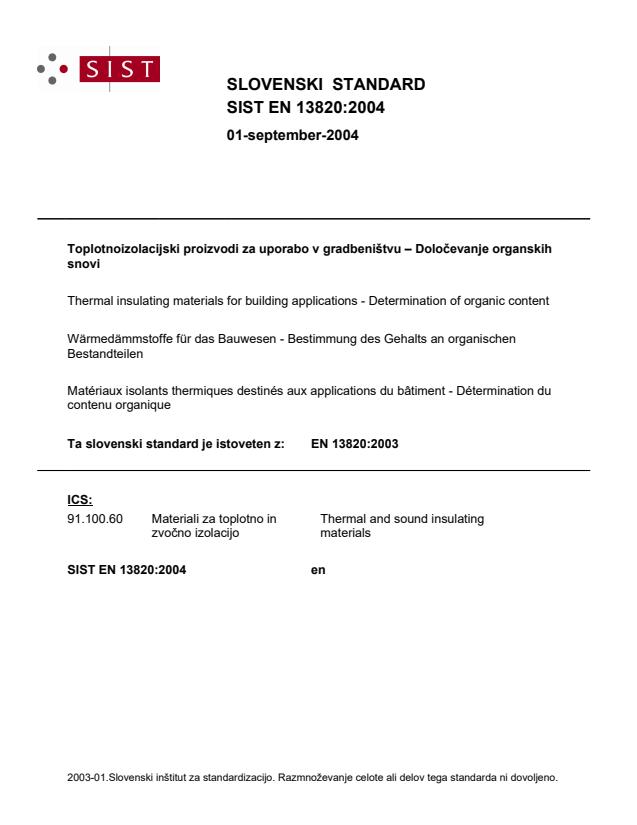
2003-01.Slovenski inštitut za standardizacijo. Razmnoževanje celote ali delov tega standarda ni dovoljeno.VQRYLWärmedämmstoffe für das Bauwesen - Bestimmung des Gehalts an organischen BestandteilenMatériaux isolants thermiques destinés aux applications du bâtiment - Détermination du contenu organiqueThermal insulating materials for building applications - Determination of organic content91.100.60Thermal and sound insulating materialsICS:Ta slovenski standard je istoveten z:EN 13820:2003SIST EN 13820:2004en01-september-2004SIST EN 13820:2004SLOVENSKI
STANDARD
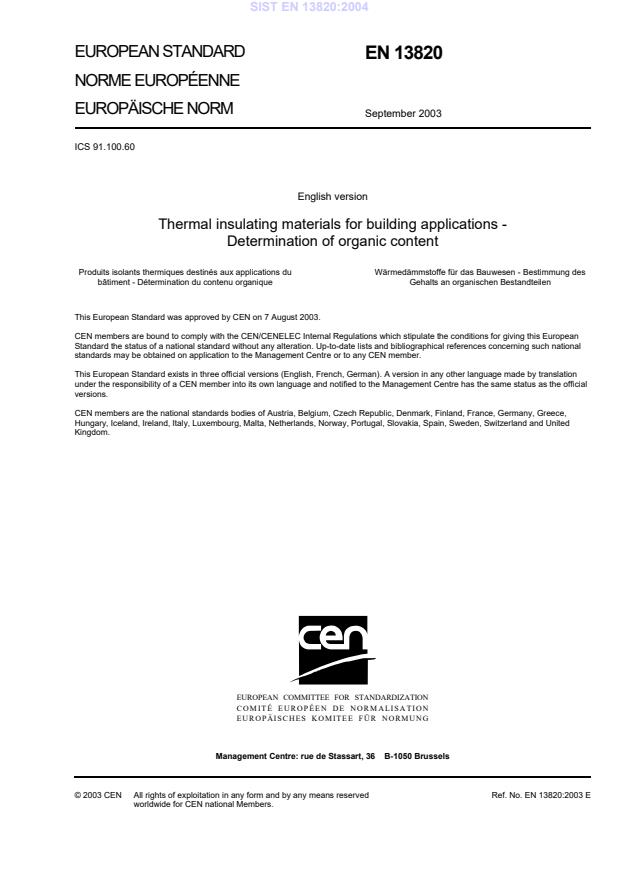
EUROPEAN STANDARDNORME EUROPÉENNEEUROPÄISCHE NORMEN 13820September 2003ICS 91.100.60English versionThermal insulating materials for building applications -Determination of organic contentProduits isolants thermiques destinés aux applications dubâtiment - Détermination du contenu organiqueWärmedämmstoffe für das Bauwesen - Bestimmung desGehalts an organischen BestandteilenThis European Standard was approved by CEN on 7 August 2003.CEN members are bound to comply with the CEN/CENELEC Internal Regulations which stipulate the conditions for giving this EuropeanStandard the status of a national standard without any alteration. Up-to-date lists and bibliographical references concerning such nationalstandards may be obtained on application to the Management Centre or to any CEN member.This European Standard exists in three official versions (English, French, German). A version in any other language made by translationunder the responsibility of a CEN member into its own language and notified to the Management Centre has the same status as the officialversions.CEN members are the national standards bodies of Austria, Belgium, Czech Republic, Denmark, Finland, France, Germany, Greece,Hungary, Iceland, Ireland, Italy, Luxembourg, Malta, Netherlands, Norway, Portugal, Slovakia, Spain, Sweden, Switzerland and UnitedKingdom.EUROPEAN COMMITTEE FOR STANDARDIZATIONCOMITÉ EUROPÉEN DE NORMALISATIONEUROPÄISCHES KOMITEE FÜR NORMUNGManagement Centre: rue de Stassart, 36
B-1050 Brussels© 2003 CENAll rights of exploitation in any form and by any means reservedworldwide for CEN national Members.Ref. No. EN 13820:2003 ESIST EN 13820:2004
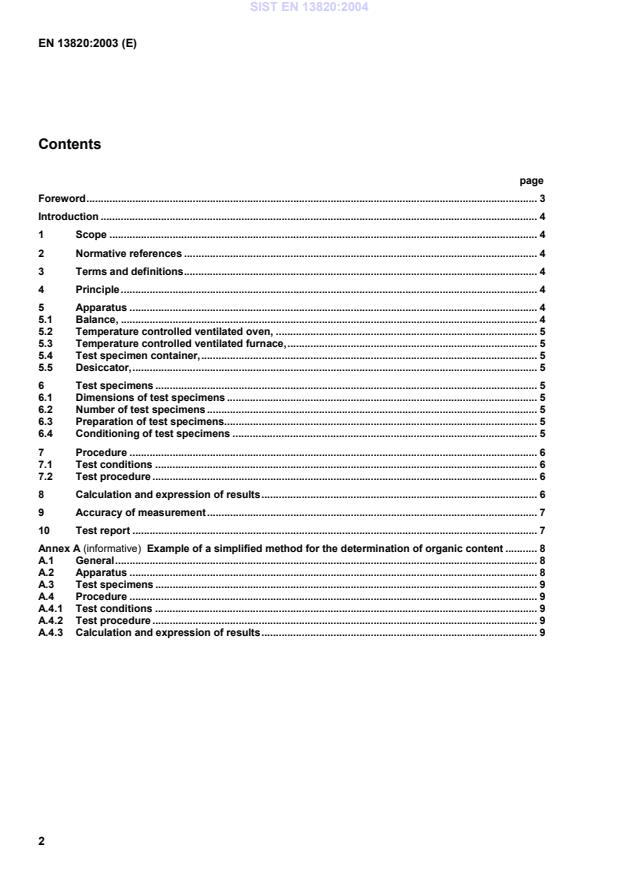
Example of a simplified method for the determination of organic content.8A.1General.8A.2Apparatus.8A.3Test specimens.9A.4Procedure.9A.4.1Test conditions.9A.4.2Test procedure.9A.4.3Calculation and expression of results.9SIST EN 13820:2004
...