

EN 16247-1:2022
(Main)Energy audits - Part 1: General requirements
General Information
- Abstract
This document specifies the requirements, common methodology and deliverables for energy audits. It is applicable to all forms of establishments and organizations, all forms of energy and energy uses.
This document covers the general requirements common to all energy audits. Specific energy audit requirements complete the general requirements in separate parts dedicated to energy audits for buildings, industrial processes and transport.
- Status
- Published
- Publication Date
- 16-Aug-2022
- Technical Committee
- CEN/CLC/TC 14 - Energy management, energy audits, energy savings
- Drafting Committee
- CEN/CLC/TC 14 - Energy management, energy audits, energy savings
- Current Stage
- 6060 - Definitive text made available (DAV) - Publishing
- Start Date
- 17-Aug-2022
- Due Date
- 16-Oct-2021
- Completion Date
- 17-Aug-2022



Overview
EN 16247-1:2022 - Energy audits: Part 1 - General requirements is the CEN European standard that defines the common requirements, methodology and expected deliverables for energy audits. Applicable to all types of establishments (commercial, industrial, residential, public-sector), all forms of energy (electricity, fuels, steam, heat, compressed air, renewables) and all energy uses, it sets the attributes of a high-quality energy audit and harmonizes core elements across sectors. This 2022 edition supersedes EN 16247-1:2012 and complements sector-specific Parts 2–5.
Key topics and requirements
- Scope & purpose: Systematic inspection and analysis of energy use to identify energy flows and opportunities for improvement.
- Quality requirements: Expectations for the energy auditor including competency, confidentiality, objectivity and transparency.
- Energy audit process: Chronological elements required for a compliant audit:
- Preliminary contact and start-up meeting
- Data collection and review
- Measurement planning and sampling methods
- Field work and site visits
- Analysis (energy balance, breakdown, Energy Performance Indicators - EnPIs)
- Identification and evaluation of Energy Performance Improvement Actions (EPIAs)
- Reporting and final meeting/deliverables
- Deliverables: Structured audit report covering findings, EnPIs, energy balance, identified significant energy uses (SEUs) and recommended EPIAs.
- Annexes: Informative guidance added in 2022 - Audit Process Flow Diagram (Annex A), Examples of audit levels (Annex B), and Sampling guidance based on ISO 19011 (Annex C).
- Compatibility: Terminology and concepts aligned with ISO 50001 and other ISO energy management guidance (ISO 50002, ISO 50006, ISO 50015).
Practical applications
- Use this standard to design, perform or review energy audits that are robust, transparent and comparable.
- Typical users:
- Energy auditors and consulting firms conducting audits
- Energy managers and facility managers implementing energy management systems (EnMS)
- Organisations planning energy efficiency investments or compliance with audit schemes
- Procurement teams specifying audit scope and deliverables
- Policy-makers and programme administrators referencing audit quality criteria
- Benefits: Improved clarity of audit outputs, consistent identification of SEUs, better quantified EnPIs and actionable recommendations for energy efficiency investments.
Related standards
- EN 16247 series - Part 2 (Buildings), Part 3 (Processes), Part 4 (Transport), Part 5 (Competence of energy auditors)
- ISO 50001, ISO 50002, ISO 50006, ISO 50015, ISO 19011
EN 16247-1:2022 is essential reading for professionals involved in energy audits, energy efficiency projects and energy management to ensure audits meet recognized European quality and methodological expectations.
Relations
- Effective Date
- 10-Feb-2026
Get Certified
Connect with accredited certification bodies for this standard

DNV
DNV is an independent assurance and risk management provider.

BSI Group
BSI (British Standards Institution) is the business standards company that helps organizations make excellence a habit.

Bureau Veritas
Bureau Veritas is a world leader in laboratory testing, inspection and certification services.
Sponsored listings
Frequently Asked Questions
EN 16247-1:2022 is a standard published by the European Committee for Standardization (CEN). Its full title is "Energy audits - Part 1: General requirements". This standard covers: This document specifies the requirements, common methodology and deliverables for energy audits. It is applicable to all forms of establishments and organizations, all forms of energy and energy uses. This document covers the general requirements common to all energy audits. Specific energy audit requirements complete the general requirements in separate parts dedicated to energy audits for buildings, industrial processes and transport.
This document specifies the requirements, common methodology and deliverables for energy audits. It is applicable to all forms of establishments and organizations, all forms of energy and energy uses. This document covers the general requirements common to all energy audits. Specific energy audit requirements complete the general requirements in separate parts dedicated to energy audits for buildings, industrial processes and transport.
EN 16247-1:2022 is classified under the following ICS (International Classification for Standards) categories: 03.120.10 - Quality management and quality assurance; 27.015 - Energy efficiency. Energy conservation in general. The ICS classification helps identify the subject area and facilitates finding related standards.
EN 16247-1:2022 has the following relationships with other standards: It is inter standard links to EN 16247-1:2012. Understanding these relationships helps ensure you are using the most current and applicable version of the standard.
EN 16247-1:2022 is associated with the following European legislation: Standardization Mandates: M/479. When a standard is cited in the Official Journal of the European Union, products manufactured in conformity with it benefit from a presumption of conformity with the essential requirements of the corresponding EU directive or regulation.
EN 16247-1:2022 is available in PDF format for immediate download after purchase. The document can be added to your cart and obtained through the secure checkout process. Digital delivery ensures instant access to the complete standard document.
Standards Content (Sample)
SLOVENSKI STANDARD
01-oktober-2022
Nadomešča:
SIST EN 16247-1:2012
Energetske presoje - 1. del: Splošne zahteve
Energy audits - Part 1: General requirements
Energieaudits - Teil 1: Allgemeine Anforderungen
Audits énergétiques - Partie 1: Exigences générales
Ta slovenski standard je istoveten z: EN 16247-1:2022
ICS:
03.100.70 Sistemi vodenja Management systems
27.015 Energijska učinkovitost. Energy efficiency. Energy
Ohranjanje energije na conservation in general
splošno
2003-01.Slovenski inštitut za standardizacijo. Razmnoževanje celote ali delov tega standarda ni dovoljeno.
EUROPEAN STANDARD EN 16247-1
NORME EUROPÉENNE
EUROPÄISCHE NORM
August 2022
ICS 03.120.10; 27.015
Supersedes EN 16247-1:2012
English version
Energy audits - Part 1: General requirements
Audits énergétiques - Partie 1 : Exigences générales Energieaudits - Teil 1: Allgemeine Anforderungen
This European Standard was approved by CEN on 3 July 2022.
CEN and CENELEC members are bound to comply with the CEN/CENELEC Internal Regulations which stipulate the conditions for
giving this European Standard the status of a national standard without any alteration. Up-to-date lists and bibliographical
references concerning such national standards may be obtained on application to the CEN-CENELEC Management Centre or to
any CEN and CENELEC member.
This European Standard exists in three official versions (English, French, German). A version in any other language made by
translation under the responsibility of a CEN and CENELEC member into its own language and notified to the CEN-CENELEC
Management Centre has the same status as the official versions.
CEN and CENELEC members are the national standards bodies and national electrotechnical committees of Austria, Belgium,
Bulgaria, Croatia, Cyprus, Czech Republic, Denmark, Estonia, Finland, France, Germany, Greece, Hungary, Iceland, Ireland, Italy,
Latvia, Lithuania, Luxembourg, Malta, Netherlands, Norway, Poland, Portugal, Republic of North Macedonia, Romania, Serbia,
Slovakia, Slovenia, Spain, Sweden, Switzerland, Türkiye and United Kingdom.
CEN-CENELEC Management Centre:
Rue de la Science 23, B-1040 Brussels
© 2022 CEN/CENELEC All rights of exploitation in any form and by any means
Ref. No. EN 16247-1:2022 E
reserved worldwide for CEN national Members and for
CENELEC Members.
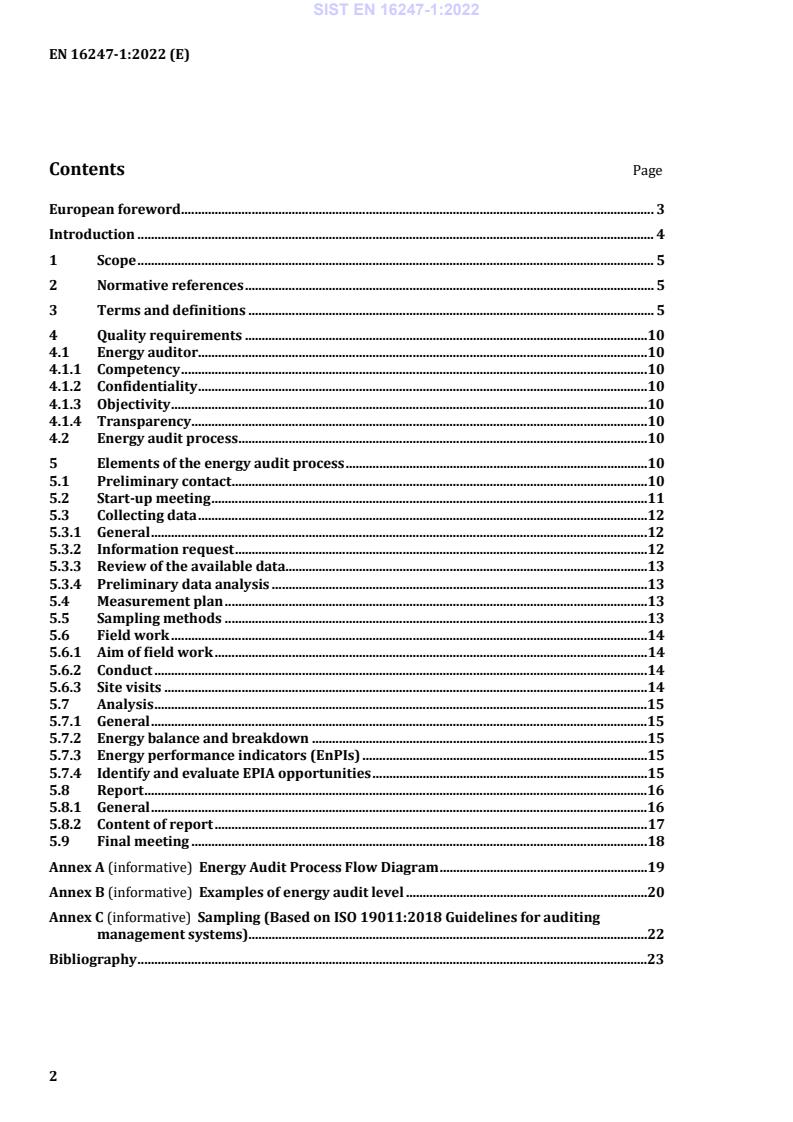
Contents Page
European foreword . 3
Introduction . 4
1 Scope . 5
2 Normative references . 5
3 Terms and definitions . 5
4 Quality requirements .10
4.1 Energy auditor .10
4.1.1 Competency .10
4.1.2 Confidentiality .10
4.1.3 Objectivity .10
4.1.4 Transparency .10
4.2 Energy audit process .10
5 Elements of the energy audit process .10
5.1 Preliminary contact .10
5.2 Start-up meeting .11
5.3 Collecting data .12
5.3.1 General .12
5.3.2 Information request .12
5.3.3 Review of the available data.13
5.3.4 Preliminary data analysis .13
5.4 Measurement plan .13
5.5 Sampling methods .13
5.6 Field work .14
5.6.1 Aim of field work .14
5.6.2 Conduct .14
5.6.3 Site visits .14
5.7 Analysis .15
5.7.1 General .15
5.7.2 Energy balance and breakdown .15
5.7.3 Energy performance indicators (EnPIs) .15
5.7.4 Identify and evaluate EPIA opportunities .15
5.8 Report .16
5.8.1 General .16
5.8.2 Content of report .17
5.9 Final meeting .18
Annex A (informative) Energy Audit Process Flow Diagram .19
Annex B (informative) Examples of energy audit level .20
Annex C (informative) Sampling (Based on ISO 19011:2018 Guidelines for auditing
management systems).22
Bibliography .23
European foreword
This document (EN 16247-1:2022) has been prepared by the Joint Technical Committee CEN-
CENELEC/JTC 14 “Energy management and energy efficiency in the framework of energy transition”, the
secretariat of which is held by UNI.
This European Standard shall be given the status of a national standard, either by publication of an
identical text or by endorsement, at the latest by February 2023, and conflicting national standards shall
be withdrawn at the latest by February 2023.
Attention is drawn to the possibility that some of the elements of this document may be the subject of
patent rights. CEN-CENELEC shall not be held responsible for identifying any or all such patent rights.
This document supersedes EN 16247-1:2012.
Significant changes compared to the previous edition are:
a) Terms and definition updated to be compliant with ISO 50001;
b) New Annex A Energy Audit Process Flow Diagram added;
c) New Annex B Examples of energy Audit level added;
d) New Annex C Sampling (Based on ISO 19011:2018 Guidelines for auditing management systems)
added.
This Part covers the general requirements common to all energy audits. There are four further parts of
the EN 16247 series, which provide additional material to Part 1 for four specific sectors.
The other parts of EN 16247 “Energy audits” are:
— Part 2: Buildings;
— Part 3: Processes;
— Part 4: Transport;
— Part 5: Competence of energy auditors.
This document has been prepared under a mandate given to CEN and CENELEC by the European
Commission and the European Free Trade Association.
Any feedback and questions on this document should be directed to the users’ national standards
body/national committee. A complete listing of these bodies can be found on the CEN and CENELEC
websites.
According to the CEN-CENELEC Internal Regulations, the national standards organisations of the
following countries are bound to implement this European Standard: Austria, Belgium, Bulgaria, Croatia,
Cyprus, Czech Republic, Denmark, Estonia, Finland, France, Germany, Greece, Hungary, Iceland, Ireland,
Italy, Latvia, Lithuania, Luxembourg, Malta, Netherlands, Norway, Poland, Portugal, Republic of North
Macedonia, Romania, Serbia, Slovakia, Slovenia, Spain, Sweden, Switzerland, Türkiye and the United
Kingdom.
Introduction
An energy audit is an important step for an organization, whatever its size or type, wanting to improve
its energy performance, reduce energy consumption and bring related environmental and other benefits.
This document defines the attributes of a high-quality energy audit. It states the requirements for energy
audits and corresponding obligations within the energy auditing process. It recognizes that there are
differences in approach to energy auditing in terms of scope, aims and thoroughness, but seeks to
harmonize common aspects of energy auditing in order to bring more clarity and transparency to the
market for energy auditing services. The energy audit process is presented as a simple chronological
sequence; this does not preclude however repeated iterations of certain steps.
This document applies to commercial, industrial, residential and public-sector organizations. This
document does not deal with the energy audit programme/scheme properties (such as programme
administration, training of energy auditors, quality control issues, energy auditors' tools, etc.).
1 Scope
This document specifies the requirements, common methodology and deliverables for energy audits. It
is applicable to all forms of establishments and organizations, all forms of energy and energy uses.
This document covers the general requirements common to all energy audits. Specific energy audit
requirements complete the general requirements in separate parts dedicated to energy audits for
buildings, industrial processes and transport.
2 Normative references
There are no normative references in this document.
3 Terms and definitions
For the purposes of this document, the following terms and definitions apply.
ISO and IEC maintain terminological databases for use in standardization at the following addresses:
— ISO Online browsing platform: available at https://www.iso.org/obp
— IEC Electropedia: available at https://www.electropedia.org/
3.1
energy audit
systematic inspection and analysis of energy use and energy consumption of a site, building, system or
organization with the objective of identifying energy flows and the potential for energy efficiency
improvements and reporting them
3.2
energy auditor
individual, group of people or body carrying out an energy audit
Note 1 to entry: A group or body can include subcontractors.
3.3
audited object
site, building, equipment, system, process, vehicle, service or organization (3.4) which is the subject of
the energy audit (3.1)
3.4
organization
person or group of people that has its own functions with responsibilities, authorities and relationships
to achieve its objectives
Note 1 to entry: The concept of organization includes, but is not limited to, sole-trader, company, corporation,
firm, enterprise, authority, partnership, charity or institution, or part or combination thereof, whether incorporated
or not, public or private.
[SOURCE: ISO 50001:2018, 3.1.1]
3.5
energy consumption
quantity of energy (3.16) applied
[SOURCE: ISO 50001:2018, 3.5.2]
3.6
energy efficiency
ratio or other quantitative relationship between an output of performance, service, goods, commodities,
or energy (3.16), and an input of energy
EXAMPLE Conversion efficiency; energy required/energy consumed.
Note 1 to entry: Both input and output should be clearly specified in terms of quantity and quality and be
measurable.
[SOURCE: ISO 50001:2018, 3.5.3]
3.7
energy performance
measurable result(s) related to energy efficiency (3.6), energy use (3.10) and energy consumption (3.5)
Note 1 to entry: Energy performance can be measured against the organization’s (3.4) objectives, energy targets
(3.20) and other energy performance requirements.
Note 2 to entry: Energy performance is one component of the performance of the energy management
system (3.18).
[SOURCE: ISO 50001:2018, 3.4.3, modified]
3.8
energy performance indicator
EnPI
measure or unit of energy performance (3.7), as defined by the organization (3.4)
Note 1 to entry: EnPI(s) can be expressed by using a simple metric, ratio, or a model, depending on the nature of
the activities being measured.
Note 2 to entry: See ISO 50006 for additional information on EnPI(s).
[SOURCE: ISO 50001:2018, 3.4.4]
3.9
energy performance improvement action
EPIA
action or measure or group of action or measures implemented or planned within an organization (3.4)
intended to achieve energy performance improvement (3.21) through technological, managerial or
operational, behavioural, economical, or other changes
[SOURCE: ISO 50015:2014, 3.5]
3.10
energy use
application of energy (3.16)
EXAMPLE Ventilation; lighting; heating; cooling; transportation; data storage; production process
Note 1 to entry: Energy use is sometimes referred to as “energy end-use”.
[SOURCE: ISO 50001:2018, 3.5.4]
3.11
sampling method
method of studying from representative selected audited objects, instead of the entire number of objects
Note 1 to entry: The selection is called sample.
Note 2 to entry: The principle of sampling is to analyse the samples selected in order to issue recommendations
that will be valid for all audited object.
3.12
significant energy use
SEU
energy use (3.10) accounting for substantial energy consumption (3.5) and/or offering considerable
potential for energy performance improvement (3.21)
Note 1 to entry: Significance criteria are determined by the organization (3.4).
Note 2 to entry: SEUs can be facilities, systems, processes, or equipment.
[SOURCE: ISO 50001:2018, 3.5.6]
3.13
energy balance
accounting of inputs and/or generation of energy supply versus energy outputs based on energy
consumption (3.5) by energy use (3.10)
Note 1 to entry: Energy storage is considered within energy supply or energy use. If included in the energy audit
scope (3.23), an energy balance needs to include energy storage and feedstock variation, as well as wasted energy,
or energy content in material flows.
Note 2 to entry: An energy balance reconciles all energy, goods and products that enter the system boundary
against the energy, goods and products leaving the system boundary.
[SOURCE: ISO 50002:2014, 3.6]
3.14
static factor
identified factor that significantly impacts energy performance (3.7) and does not routinely change
EXAMPLE Facility size; design of installed equipment; number of weekly shifts; range of products
Note 1 to entry: Significance criteria are determined by the organization (3.4).
[SOURCE: ISO 50015:2014, 3.22, modified — Note 1 to entry added, and EXAMPLE 1 have been modified
and EXAMPLE 2 has been deleted.]
3.15
relevant variable
quantifiable factor that significantly impacts energy performance (3.7) and routinely changes
EXAMPLE Weather conditions, operating conditions (indoor temperature, light level), working hours,
production output.
Note 1 to entry: Significance criteria are determined by the organization (3.4).
[SOURCE: ISO 50015:2014, 3.18, modified — Note 1 to entry has been added and wording of examples
has been modified]
3.16
energy
electricity, fuels, steam, heat, compressed air and other similar media
Note 1 to entry: For the purposes of this document, energy refers to the various types of energy, including
renewable, which can be purchased, stored, treated, used in an equipment or in a process, or recovered.
[SOURCE: ISO 50001:2018, 3.5.1]
3.17
process
set of interrelated or interacting activities which transform inputs into outputs
Note 1 to entry: A process related to an organization’s (3.4) activities can be
— physical (e.g. energy-using processes, such as combustion), or
— business or service (e.g. order fulfilment).
[SOURCE: ISO 50001:2018, 3.3.6]
3.18
energy management system
EnMS
management system (3.19) to establish an energy policy, objectives, energy targets (3.20), action plans
and process(es) (3.17) to achieve the objectives and energy targets
[SOURCE: ISO 50001:2018, 3.2.2]
3.19
management system
set of interrelated or interacting elements of an organization (3.4) to establish policies and objectives and
processes (3.17) to achieve those objectives
Note 1 to entry: A management system can address a single discipline or several disciplines.
Note 2 to entry: The system elements include the organization’s structure, roles and responsibilities, planning
and operation.
Note 3 to entry: In some management systems, the scope of a management system can include the whole of the
organization, specific and identified functions of the organization, specific and identified sections of the
organization, or one or more functions across a group of organizations. The EnMS scope includes all energy types
within its boundaries.
[SOURCE: ISO 50001:2018, 3.2.1]
3.20
energy target
quantifiable objective of energy performance improvement (3.21)
Note 1 to entry: An energy target can be included within an objective.
[SOURCE: ISO 50001:2018, 3.4.15]
3.21
energy performance improvement
improvement in measurable results of energy efficiency (3.6), or energy consumption (3.5) related to
energy use (3.10), compared to the energy baseline (3.22)
[SOURCE: ISO 50001:2018, 3.4.6]
3.22
energy baseline
EnB
quantitative reference(s) providing a basis for comparison of energy performance (3.7)
Note 1 to entry: An energy baseline is based on data from a specified period of time and/or conditions, as defined
by the organization (3.4).
Note 2 to entry: One or more energy baselines are used for determination of energy performance improvement
(3.21), as a reference before and after, or with and without implementation of energy performance improvement
actions.
Note 3 to entry: See ISO 50015 for additional information on measurement and verification of energy
performance.
Note 4 to entry: See ISO 50006 for additional information on EnPIs and EnBs.
[SOURCE: ISO 50001:2018, 3.4.7]
3.23
energy audit scope
extent of energy uses (3.10) and related activities to be included in the energy audit (3.1), as defined by
the organization (3.4) in consultation with the energy auditor (3.2), which can include several boundaries
EXAMPLE Organization, facility/facilities, equipment, system(s) and process(es)
Note 1 to entry: The energy audit scope can include energy related to transport.
[SOURCE: ISO 50002:2014, 3.4]
3.24
site
activities of organization (3.4) within the boundaries of the audited object, service or system
3.25
interested party
person or organization (3.4) that can affect, be affected by, or perceive itself to be affected by a decision
or activity
[SOURCE: ISO 50001:2018, 3.1.5]
3.26
net present value
NPV
sum of discounted cash flows over the whole lifetime of an investment
[SOURCE: EN 17463:2021, 3.13]
4 Quality requirements
4.1 Energy auditor
4.1.1 Competency
The energy auditor shall be suitably qualified (according to local guidelines and recommendations or as
defined in EN 16247-5:2015) and experienced for the type of work being undertaken and for the agreed
scope, aim and thoroughness.
4.1.2 Confidentiality
The energy auditor shall treat as confidential all information provided by the organization or disclosed
during the energy audit.
4.1.3 Objectivity
The energy auditor shall treat the organization’s interests as paramount and act in an objective manner.
The energy auditor shall ensure that the requirements apply to its subcontractors, if any.
4.1.4 Transparency
If the energy auditor has business goals, product and process or marketing involvement that might be in
conflict with the energy audit, the energy auditor shall disclose any conflict of interests in a transparent
way.
4.2 Energy audit process
The energy audit process shall be:
a) appropriate: suitable to the agreed scope, aims and thoroughness;
b) complete: in order to define the audited object and the organization;
c) representative: in order to collect reliable and relevant data;
d) traceable: in order to trace the origin and processing of data;
e) useful: in order to include the energy savings and might be the associated greenhouse gas emissions,
and a cost effectiveness analysis of the Energy Performance Improvement Action (EPIA) identified;
f) verifiable: in order to allow the organization to monitor the achievement of the energy targets of
implemented EPIA opportunities.
NOTE See Informative Annex A: A flow diagram of the energy audit process.
5 Elements of the energy audit process
5.1 Preliminary contact
a) The energy auditor shall agree with the organization on:
1) aims, needs and expectations concerning the energy audit;
2) scope and boundary(ies);
EXAMPLE 1 The whole site and all energy using systems or the boiler plant or the vehicle fl
...